
Key Takeaways
- A membership-based creator platform can combine tiered communities, exclusive content, creator interactions, member benefits, and recurring access around deeper fan relationships.
- A subscription-based platform typically focuses on recurring paid access to premium content, channels, creator feeds, or digital services through monthly or annual plans.
- Founders should compare content discovery, access rules, membership tiers, creator control, fan engagement, payment models, and monetization flexibility before choosing a platform structure.
Discovery & Access Signals
- Membership platforms can use creator discovery, community recommendations, free previews, tier comparisons, exclusive groups, and personalized feeds to move fans toward paid membership.
- Subscription platforms can control access through recurring plans, content gates, premium catalogs, free trials, renewal rules, account permissions, and subscriber-only experiences.
- Search, recommendations, creator profiles, content previews, notifications, membership benefits, and clear upgrade paths influence how easily users discover value and convert to paid access.
Monetization Insights
- Membership models can monetize through multiple tiers, locked content, paid communities, live access, tipping, premium messaging, virtual gifts, and exclusive creator experiences.
- Subscription models emphasize recurring billing, plan upgrades, renewals, bundled access, premium subscriptions, retention, and predictable recurring revenue.
- Miracuves develops customizable creator platforms with memberships, subscriptions, content discovery, access controls, PPV content, messaging, live sessions, payments, payouts, analytics, and admin controls.
Creator platforms are no longer just places where creators upload content and fans pay to view it. The stronger platforms now combine discovery, paid access, community, private engagement, direct monetization, and admin control into one connected business model.
That is why founders often ask the same question before building: should the platform be membership-based or subscription-based?
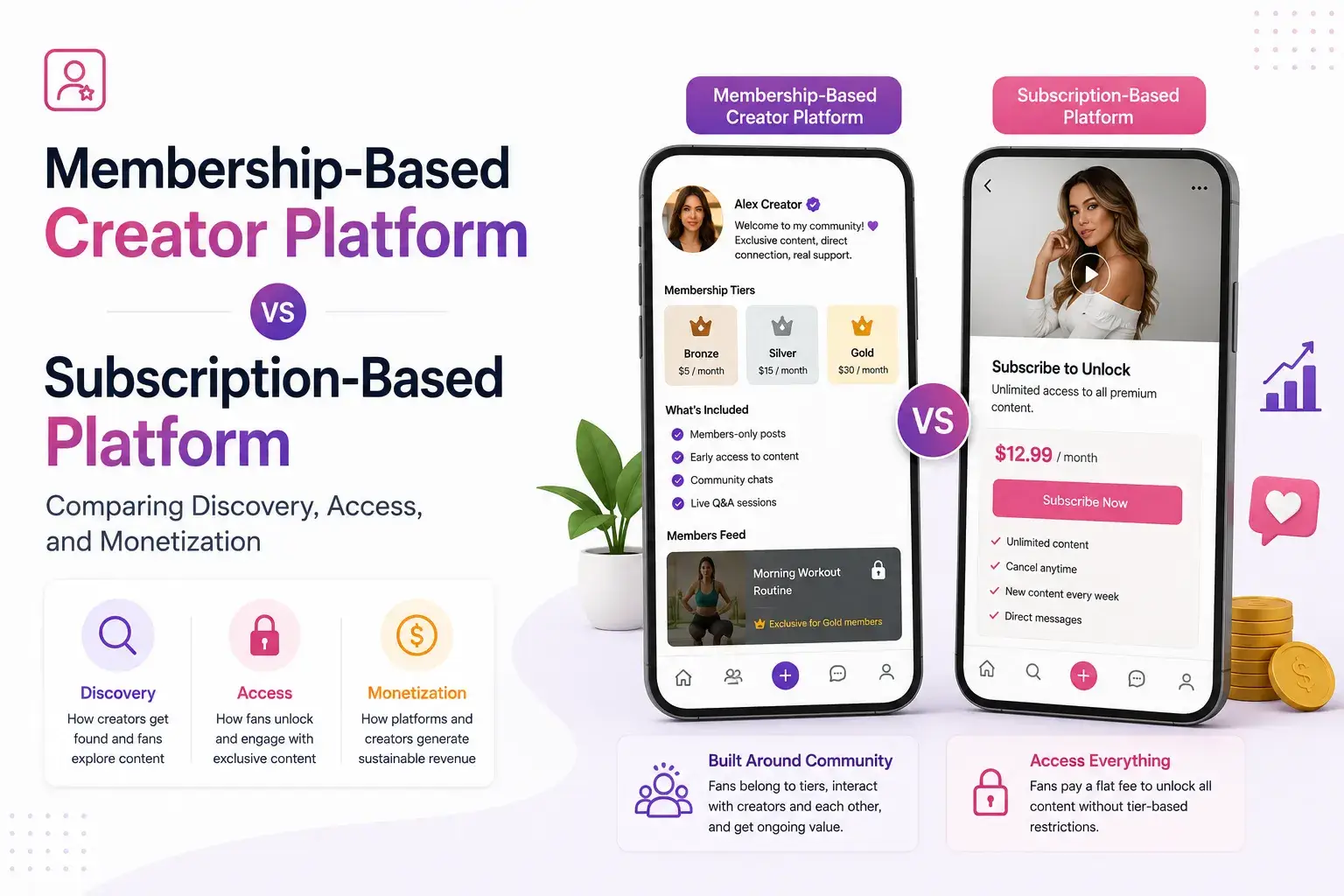
At first, both models look similar because users pay on a recurring basis. But from a product strategy point of view, they are not the same. A subscription-based platform mainly sells access to content or features. A membership-based creator platform sells a deeper relationship between creators and their fans.
For founders, this difference affects almost everything: onboarding, discovery, pricing, creator tools, retention, moderation, analytics, payouts, and platform revenue.
Miracuves helps founders think through this decision before development starts, because the wrong model can lead to unnecessary features, weak retention, or a monetization system that does not match how creators actually earn.
What Is a Subscription-Based Creator Platform?
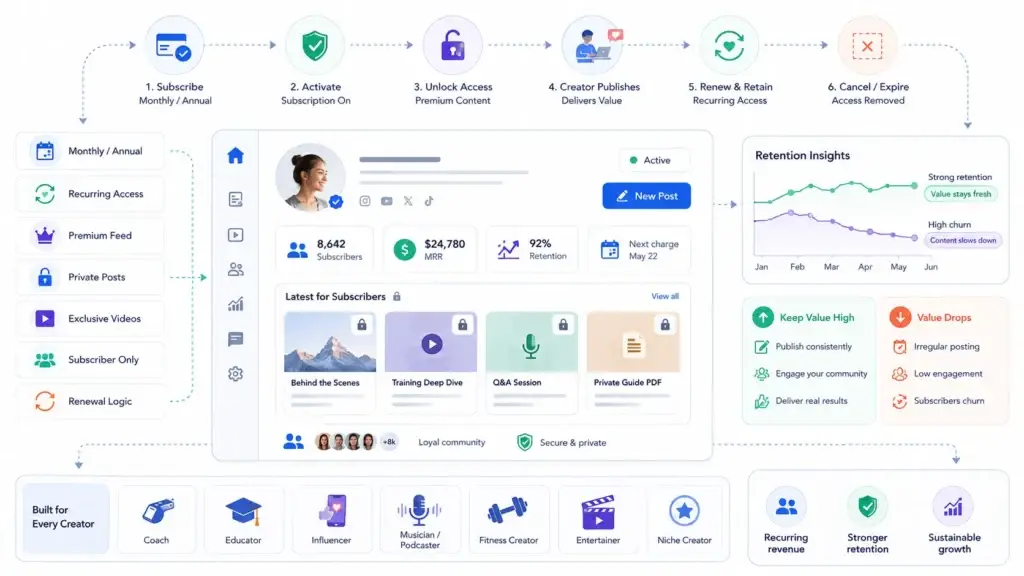
A subscription-based creator platform is built around recurring paid access.
The user pays monthly or annually to unlock content, features, channels, private posts, premium videos, exclusive updates, or gated creator feeds. The product logic is simple: payment creates access, cancellation removes access, and the creator must keep publishing enough value to retain the subscriber.
This model works well when creators already have an audience and need a direct way to monetize that audience. Coaches, educators, influencers, entertainers, podcasters, musicians, adult creators, fitness experts, and niche content creators can all use subscription-based access if their fans are willing to pay repeatedly for premium content.
The subscription model is usually easier to understand and easier to launch than a full membership ecosystem. But it can also become fragile if the platform depends only on content drops. If subscribers do not see fresh value, they cancel.
What Is a Membership-Based Creator Platform?
A membership-based creator platform goes beyond content access.
For founders studying real-world paid community models, a paid creator membership platform can show how creators combine gated access, recurring memberships, creator profiles, private content, and fan engagement inside one monetization ecosystem.
It still may include paid tiers and recurring billing, but the real value is belonging. Members are not only paying to unlock posts. They may be paying to join a private community, receive recognition, access creator interactions, participate in events, join live sessions, receive badges, vote on content, or feel closer to the creator.
In this model, the fan relationship matters as much as the content library.
Membership works especially well for creators who have strong identity-driven audiences. Examples include educators with learning communities, fitness coaches with accountability groups, musicians with fan clubs, creators with private communities, spiritual advisors, niche experts, gaming creators, writers, and local influencer networks.
A membership-based creator platform needs stronger engagement tools because retention depends on participation, not just consumption.
The Core Difference: Content Access vs Relationship Access
The simplest way to separate the two models is this:
- A subscription platform asks, “What content does the user get after paying?”
- A membership platform asks, “What relationship, identity, or community does the user join after paying?”
That difference changes the product from the inside.
A subscription-first platform needs strong content gating, billing, media delivery, previews, plan management, payment retries, creator payouts, and cancellation logic.
A membership-first platform needs all of that plus community layers, member recognition, discussion spaces, engagement tools, exclusive events, tier-based benefits, creator interaction workflows, and loyalty signals.
Both models can succeed. The mistake is treating them as identical during development.
Membership vs Subscription Platform: Simple Comparison
| Factor | Subscription-Based Platform | Membership-Based Creator Platform |
|---|---|---|
| Main value | Paid access to content or features | Paid access to community, identity, and creator relationship |
| User mindset | “I pay to unlock content” | “I pay to belong and participate” |
| Best for | Premium videos, private posts, courses, exclusive feeds | Fan clubs, creator communities, coaching groups, niche networks |
| Retention driver | Fresh content and perceived value | Engagement, connection, recognition, and habit |
| Discovery need | Medium to high depending on platform model | High if community growth is part of the promise |
| Monetization | Recurring plans, PPV, tips, paid messages | Membership tiers, events, community perks, subscriptions, PPV, live access |
| Product complexity | Moderate | Higher |
| Founder risk | Churn if content slows down | Community management and moderation burden |
How Discovery Changes the Platform Model
Discovery is one of the most important differences founders overlook.
A subscription-based creator platform can work even when discovery is limited, especially if creators bring their own audience from Instagram, TikTok, YouTube, X, newsletters, or podcasts. In that case, the platform mainly acts as the monetization layer.
A membership-based creator platform usually needs stronger discovery if it wants to grow as a network. Fans may want to find creators by category, interest, language, content type, community theme, popularity, live status, pricing, or niche.
That means the platform may need:
- Search and filters
- Creator categories
- Featured creator sections
- Trending communities
- Public creator profiles
- Free previews
- Recommendation logic
- Follow-before-pay flows
- Creator onboarding campaigns
- Admin-controlled promotion tools
For founders, this is a product decision, not just a feature decision. If the platform depends only on creators bringing their own fans, discovery can stay lighter. If the platform itself promises creator growth, discovery becomes part of the core product.
How Access Rules Shape User Experience
Access rules decide what the user can see before payment, after payment, after cancellation, and across different tiers.
In a subscription platform, access is usually direct. A fan subscribes to a creator or plan and unlocks premium content. If payment fails or the subscription ends, access is restricted.
In a membership platform, access can be more layered. A member may unlock private groups, member-only comments, exclusive events, badges, digital products, live replays, premium posts, or direct creator interaction.
Founders should define access rules early because they affect the backend structure.
A strong access model should answer:
- Can users follow creators for free before paying?
- Can creators offer free and paid tiers?
- Can one creator offer multiple membership levels?
- Can fans unlock one-time PPV content without subscribing?
- What happens when payment fails?
- Can members keep access until the billing cycle ends?
- Can creators limit the number of members in a tier?
- Can admins override access during disputes or refunds?
These details may look small, but they directly affect trust, billing accuracy, creator satisfaction, and support workload. Founders can also review a detailed creator subscription platform features breakdown to understand how gated content, membership tiers, creator dashboards, paid access, and admin workflows connect inside a paid creator platform.
Monetization: Which Model Makes More Money?
Neither model automatically makes more money. The stronger model is the one that matches creator behavior and fan willingness to pay.
A subscription-based platform can create predictable recurring revenue. This is useful for creators who produce consistent premium content. The platform owner can earn from commission, payment fees, creator upgrades, PPV unlocks, tips, paid messages, and promotional placements.
A membership-based platform can create stronger retention when users feel emotionally connected to the creator or community. Members may stay longer because they are not only consuming content. They are participating in a relationship.
The most practical route for many founders is a hybrid model.
A strong creator platform business model usually combines multiple revenue streams instead of depending on only one. This may include platform commission, subscription revenue share, PPV unlocks, paid messages, tips, live sessions, creator promotions, and digital product sales.
That means the platform supports subscription access, membership tiers, PPV content, paid messaging, live sessions, tips, creator shops, private communities, and admin-controlled promotions. This gives creators more than one way to earn and gives the platform more than one revenue stream.
Monetization Models Founders Should Consider
For creator platform founders, monetization should start with the revenue behavior that fits the creator category, not with every possible earning feature. Platform commission is often the base model, where the platform earns a percentage from creator income across subscriptions, PPV content, tips, paid messages, live sessions, calls, digital products, or creator shops. Subscription revenue works well when fans pay monthly or annually for ongoing content or community access, while pay-per-view unlocks help creators sell high-value individual content without forcing every fan into a recurring plan.
Tips, gifts, paid messaging, and live events add stronger engagement-based earning opportunities, especially when fans want direct interaction with creators. Founders can also study a creator platform business model comparison to understand how paid creator platforms structure subscriptions, commissions, private content, and fan payments. The smarter approach is not to add every monetization model at launch, but to choose the revenue layers that match how creators attract, engage, and convert their audience.
Founder Decision Signals
Speed
Choose a subscription-first model if you need a faster launch with simpler access logic, recurring payments, creator profiles, and premium content gating.
Cost
Choose a membership model only if community, engagement, events, recognition, or member participation are essential to the business model.
Scalability
If discovery, recommendations, moderation, and creator growth are part of the platform promise, plan the backend and admin controls from the start.
Market Fit
If creators already have audiences, subscription access may validate faster. If the platform must build community demand, membership may create stronger retention.
When a Subscription-Based Platform Makes More Sense
A subscription-based creator platform is usually the better starting point when the value is clear, repeatable, and content-led.
This model fits when creators are already publishing premium content regularly and users understand what they are paying for. It also works when the platform needs to launch faster, validate demand, and avoid overbuilding complex community tools too early.
Choose this model when:
- Creators already have an external audience
- Premium content is the main product
- The launch version needs to stay focused
- Billing, content access, and payouts are the core workflows
- Community is useful but not the main value proposition
- The founder wants faster validation before expanding features
A subscription-first model can still evolve later. Once creators prove demand, the platform can add membership benefits, live events, community spaces, creator shops, or engagement tools.
When a Membership-Based Creator Platform Makes More Sense
A membership-based creator platform makes more sense when fans are paying for participation, identity, and connection.
This model is stronger when the community itself creates value. A fan may stay because they enjoy the group, want creator recognition, attend live sessions, access member-only discussions, or feel part of a niche movement.
Choose this model when:
- The creator category is community-driven
- Fans want interaction, not only content
- Retention depends on belonging and habit
- Creators need events, groups, badges, or member roles
- The platform wants to build niche communities
- Discovery and engagement are part of the product promise
Membership platforms can be more powerful, but they are also more operationally demanding. They require moderation, community guidelines, abuse reporting, creator verification, member communication, and stronger admin controls.
Why Hybrid Creator Platforms Are Often Stronger
A hybrid platform combines subscription access with membership depth.
This is often the strongest model because creators do not monetize in only one way. Some fans subscribe monthly. Some buy individual premium content. Some tip during live streams. Some pay for private messages. Some join exclusive groups. Some buy products or services.
A hybrid creator platform gives each creator more flexibility.
For the platform owner, this creates stronger revenue diversity. If subscriptions slow down, PPV, tips, messages, events, or promotions can still generate income. If one creator category performs differently from another, the platform can adapt without rebuilding its entire monetization system.
This is where Miracuves’ ready-made and white-label platform approach can help founders move faster. Instead of building every monetization, access, creator, fan, and admin workflow from zero, founders can start with a launch-ready foundation and customize the model around their niche.
Key Features a Subscription-Based Creator Platform Needs
A subscription-based platform should focus on clean access, billing, and premium content delivery.
Important features include:
- Creator profiles
- Subscription plans
- Recurring billing integration
- Premium content locking
- Free previews
- PPV unlocks
- Fan wallet or payment flow
- Creator earnings dashboard
- Payout management
- Subscriber lists
- Cancellation handling
- Admin commission settings
- Content moderation
- Reports and analytics
The priority is to make paid access simple. If users struggle to subscribe, unlock content, manage payments, or understand billing, the model loses trust quickly.
Founders who want a more detailed feature breakdown can refer to this creator subscription platform features list, which explains the core modules needed for subscriptions, creator profiles, paid content access, messaging, payouts, and admin control.
Key Features a Membership-Based Creator Platform Needs
A membership-based platform needs everything a subscription platform needs, plus deeper engagement tools.
Important features include:
- Membership tiers
- Community spaces
- Member-only posts
- Live events
- Group discussions
- Creator announcements
- Badges or recognition
- Polls and voting
- Private messaging
- Member segmentation
- Limited member spots
- Tier-based benefits
- Moderation queues
- Abuse reporting
- Community rules
- Engagement analytics
The priority is to make members feel that they belong. If the platform only gives locked content, it is not truly membership-led. It is a subscription platform with different wording.
Admin Control Matters More Than Founders Think
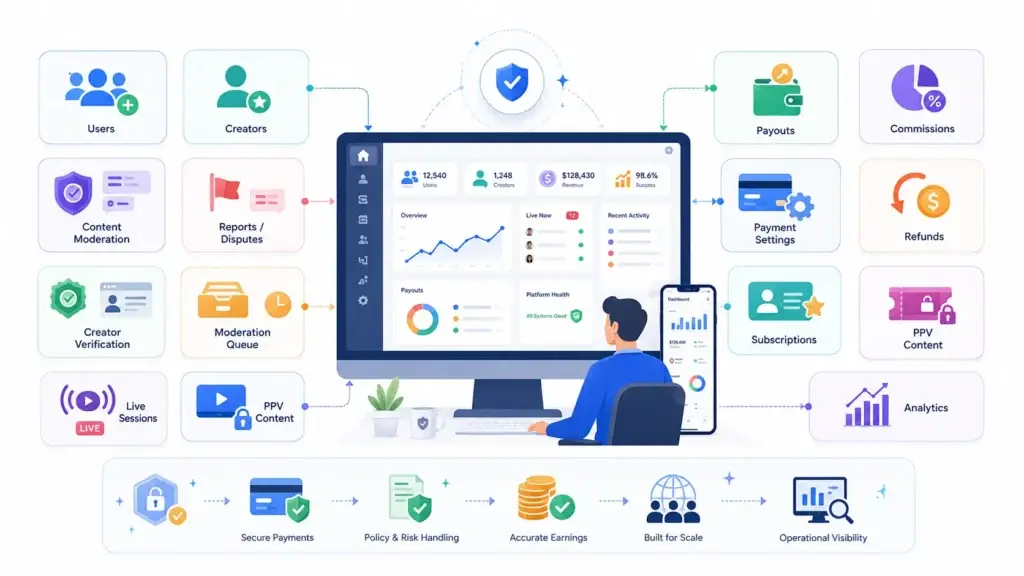
A creator platform can look simple on the frontend, but the admin layer decides whether the business can operate at scale.
The admin dashboard should help the platform operator manage users, creators, content, reports, payouts, commissions, payment settings, moderation queues, creator verification, refunds, subscriptions, PPV content, live sessions, and analytics.
This matters because creator platforms carry trust risk. Users are paying for access. Creators are expecting accurate earnings. The platform owner must handle disputes, content reports, failed payments, and policy issues without depending on developers for every operational action.
For this reason, founders should not treat admin control as a secondary feature. It is the control center of the business.
Security and Trust Considerations
Creator platforms need practical security and trust workflows from the beginning. For a deeper breakdown of safety layers, Miracuves has a dedicated creator platform security guide covering access control, user privacy, payments, moderation, and platform trust.
Important layers include encrypted data transfer, secure payment gateway integration, role-based access control, creator verification, payout monitoring, abuse reporting, content moderation, audit logs, admin access controls, and privacy-conscious data handling.
For platforms with user-generated content, moderation is not optional. The platform should support clear reporting flows, content review queues, creator verification rules, blocked content controls, and dispute handling.
Founders should avoid claiming that a platform is automatically compliant everywhere. Legal and compliance requirements depend on jurisdiction, content category, payment partners, age rules, operating model, and legal review.
Mistakes Founders Should Avoid
Using membership and subscription as the same thing
This leads to poor feature planning. A subscription model needs access and billing strength. A membership model also needs community, engagement, recognition, and retention workflows.
Adding too many monetization features too early
Subscriptions, PPV, tips, calls, shops, and promotions are useful, but not every creator category needs all of them at launch. Start with the revenue paths your target creators will actually use.
Ignoring discovery
If creators depend on the platform for growth, search, categories, featured listings, recommendations, and promotional tools must be planned early.
Underbuilding the admin dashboard
Without strong admin controls, the platform operator struggles with payments, content reports, moderation, commissions, user disputes, and creator support.
Many founder mistakes happen because the platform is planned around visible features instead of operational reality. Before development, founders should understand common creator membership platform launch mistakes that can affect monetization, retention, moderation, and long-term scalability.
Which Model Should You Build First?
Founders should choose the starting model based on how creators already earn and how fans are expected to engage. If creators already have an audience and the main goal is to monetize premium content quickly, a subscription-based creator platform is the better first move. If the platform’s value depends on community, live interaction, member recognition, group identity, and long-term participation, a membership-based creator platform makes more sense.
For founders who want flexibility, a hybrid model is often the strongest path: begin with the clearest revenue flow, then add deeper membership, engagement, and community features once real creator and fan behavior becomes visible. The right platform is not the one with the longest feature list; it is the one where discovery, access, monetization, and retention all support the same business model.
This decision should also consider operational readiness. A subscription-first platform may need stronger billing, access control, and content delivery workflows, while a membership-first platform needs more attention on engagement, moderation, community management, and creator-fan communication. Founders should avoid choosing the model only because it sounds more attractive; the better choice is the one their team can manage consistently after launch.
Cost planning should also match the platform model. A simple subscription-first product may need fewer community layers at launch, while a membership-first or hybrid platform may require deeper engagement tools, moderation workflows, creator analytics, and admin controls. Founders comparing build scope can review this creator subscription platform development cost guide before deciding how much to include in the first launch version.
Miracuves Perspective: Build Around the Business Model, Not Just the Feature List
Many founders begin by asking for subscriptions, PPV, wallets, messages, live streaming, and creator dashboards. Those features matter, but they are not the strategy.
The better question is: what kind of creator relationship are you building?
If the answer is premium access, then the subscription model should lead. If the answer is community and belonging, then the membership model should lead. If the answer is flexible monetization across creator categories, then a hybrid model is usually stronger.
Miracuves helps founders launch creator economy platforms with white-label branding, source-code ownership, admin control, monetization workflows, and faster deployment. For founders who want to validate demand without building every module from zero, this creates a more practical path from idea to launch.
Final Thoughts
The difference between a membership-based creator platform and a subscription-based platform is not just language.
A subscription platform sells recurring access. A membership platform sells belonging, participation, and creator-fan connection. A hybrid platform can combine both, but only when the access rules, monetization logic, discovery system, and admin controls are designed clearly.
For founders, the right choice depends on how creators will attract fans, what fans are paying for, how often they will engage, and how the platform owner will earn.
Build the model first. Then build the features around it.
FAQs
What is the main difference between a membership-based creator platform and a subscription-based platform?
A subscription-based creator platform focuses on recurring paid access to content or features. A membership-based creator platform focuses on community, belonging, creator interaction, recognition, and ongoing participation.
Is a membership platform better than a subscription platform?
Not always. A membership platform is better when community and creator-fan relationships drive retention. A subscription platform is better when premium content access is the main value.
Can a creator platform use both membership and subscription models?
Yes. Many creator platforms work best as hybrid models. They can offer recurring subscriptions, membership tiers, PPV content, tips, paid messaging, live sessions, and promotional tools.
Which model is easier to launch?
A subscription-based platform is usually easier to launch because the core workflow is simpler: users pay, unlock content, and maintain access while billing remains active.
Which model has better retention?
Membership platforms can create stronger retention when users feel connected to a creator or community. Subscription platforms can also retain users well if creators publish consistent premium value.
What features are essential for a creator subscription platform?
Essential features include creator profiles, subscription plans, recurring billing, premium content access, PPV content, payment gateway integration, creator payouts, analytics, moderation, and admin controls.
What features are essential for a membership-based creator platform?
A membership platform needs tiered access, community spaces, member-only posts, live events, badges, polls, discussions, private messaging, moderation tools, creator analytics, and admin controls.
What should founders choose for a new creator platform?
Founders should choose based on audience behavior. If users mainly pay for content, start subscription-first. If users pay for community and connection, start membership-first. If creators need multiple earning paths, plan a hybrid model.
Miracuves is an independent software development company. We are not affiliated with, connected to, sponsored by, or endorsed by any company or product named in this article.
Terms such as “X Clone” are used descriptively. It is how the software industry refers to building a platform with functionality comparable to a known service, and how clients search for it.
The entire design and codebase of our products is built by our own team. Our products contain no code, design, graphics, or content originating from any third-party website or applications.
All third-party names and marks referenced in this article are the property of their respective owners, referenced solely to identify the services discussed.