
Key Takeaways
- Luxury fashion marketplace security must protect payments, seller accounts, customer data, and order workflows.
- High-value products and international transactions create greater fraud, chargeback, and account-takeover risks.
- Seller verification and product approval controls help reduce fake stores, counterfeit listings, and payout fraud.
- Encryption, secure APIs, role-based permissions, and audit logs strengthen marketplace protection.
- Security should cover the complete buyer, seller, payment, order, return, and refund lifecycle.
Security Evaluation Signals
- Review payment tokenization, gateway security, refund permissions, chargebacks, and seller payout controls.
- Require strong authentication, seller verification, session management, and sensitive-action alerts.
- Protect customer profiles, addresses, purchase histories, and support records with encryption and restricted access.
- Track order updates, returns, refunds, delivery events, and administrative decisions through audit logs.
- Test API protection, staff permissions, backups, monitoring, incident response, and security update procedures.
Real Insights
- Secure checkout is not enough when seller dashboards or payout settings remain vulnerable.
- A compromised seller account can affect pricing, inventory, customer communication, orders, and settlements.
- Order fraud often involves connected actions across payments, delivery, returns, and refunds.
- Strong admin permissions help teams investigate incidents without giving every employee unrestricted access.
- Miracuves develops luxury fashion marketplaces with secure payments, seller controls, protected data, audit logs, and order-management workflows.
Luxury Fashion Marketplace Security is no longer just a technical concern; it is a business trust layer that protects buyers, sellers, payments, customer data, and order workflows across a premium ecommerce ecosystem. In a luxury fashion marketplace, customers expect secure checkout, private account handling, reliable delivery updates, and protection for high-value purchases. Sellers also need confidence that their dashboards, inventory, pricing, payouts, and order records are protected from unauthorized access or misuse.
For founders, this matters because one weak security layer can affect more than the app. It can damage brand credibility, increase refund disputes, expose sensitive customer information, and reduce seller confidence. A secure marketplace must protect the full transaction journey, from account login and product browsing to payment confirmation, shipping, returns, refunds, and post-order support.
This guide explains the core security areas every luxury fashion marketplace should consider before launch, including payment protection, seller account security, customer data privacy, fraud prevention, order integrity, admin access control, and compliance-ready workflows. It also helps founders understand what to check when evaluating a ready-made or white-label marketplace foundation, so they can launch with stronger operational control and fewer avoidable risks.
Why Security Matters More in Luxury Fashion Marketplaces
A luxury fashion marketplace handles more than products and payments. It manages trust between buyers, boutique sellers, fashion brands, logistics partners, and the platform operator.
In a regular ecommerce store, the business usually controls inventory, checkout, shipping, and customer service from one place. In a luxury marketplace, multiple sellers may upload products, update pricing, manage stock, process orders, and respond to buyer issues. That creates a larger attack surface.
For founders, this matters because security failure does not only create technical damage. It can damage brand perception, seller relationships, payment reliability, customer confidence, and marketplace liquidity.
A luxury buyer expects privacy. A seller expects payout protection. A platform operator expects control. Security is the layer that keeps all three aligned.
The Four Security Areas Every Luxury Marketplace Founder Should Review
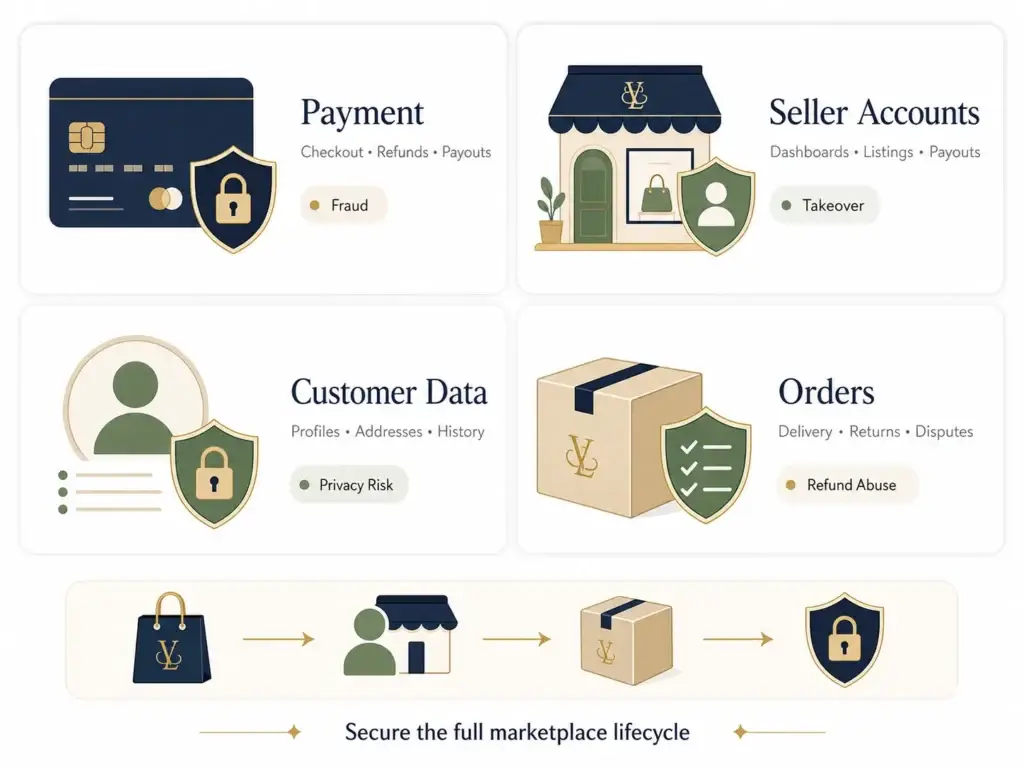
Image Source: AI-generated visual by Miracuves
Luxury marketplace security should be reviewed across four operational layers:
| Security Area | What It Protects | Business Risk If Weak |
|---|---|---|
| Payment security | Checkout, transactions, refunds, payout flows | Fraud, chargebacks, failed trust, payment disputes |
| Seller account security | Boutique dashboards, inventory, pricing, order access | Account takeover, fake listings, payout manipulation |
| Customer data security | Profiles, addresses, purchase history, support records | Privacy risk, reputational damage, regulatory exposure |
| Order security | Order status, delivery updates, returns, refunds, disputes | Refund abuse, delivery fraud, customer support escalation |
A platform that protects only one of these areas is not secure enough for a premium marketplace model. The real goal is to secure the complete buyer-seller-order lifecycle.
1. Payment Security: Protecting High-Value Transactions
Luxury fashion orders usually carry higher transaction value than standard ecommerce purchases. That changes the security expectation.
Payment security should cover:
- Secure payment gateway integration.
- Tokenized payment handling.
- Encrypted transaction communication.
- Webhook verification.
- Refund approval controls.
- Chargeback monitoring.
- Suspicious transaction flags.
- Admin-level transaction audit logs.
Founders should avoid storing sensitive card data directly unless they have the required payment security infrastructure and compliance scope. A better approach is to use trusted payment gateways and tokenization so the marketplace can process payments without exposing raw card data inside the app environment.
PCI DSS is the major payment security framework for protecting account data, and PCI DSS v4.0 was published by the PCI Security Standards Council as the next evolution of the standard. A luxury marketplace that processes online payments should treat PCI alignment as a payment-risk requirement, not a marketing badge.
Payment Risks to Watch
| Risk | What It Looks Like | Safer Platform Control |
| Card testing | Fraudsters attempt small transactions to test stolen cards | Rate limits, fraud scoring, payment gateway rules |
| Fake refund claims | Buyer claims non-delivery or damage after receiving product | Proof-of-delivery, order logs, dispute workflow |
| Webhook tampering | Payment status is manipulated through insecure callbacks | Signed webhook verification and idempotency keys |
| Admin misuse | Excessive internal access to refunds or transaction actions | Role-based permissions and audit logs |
| Payout fraud | Seller payout details are changed by an attacker | Payout change verification and approval workflow |
For a founder, the question is not “Does the app have payments?” The better question is “Can the platform protect payments before, during, and after checkout?”
2. Seller Account Security: Protecting Boutiques, Brands, and Inventory Control
Seller accounts are one of the most sensitive parts of a luxury fashion marketplace. A seller dashboard may control product listings, prices, images, inventory availability, order acceptance, shipping status, return approvals, and payout information.
If a seller account is compromised, the damage can move quickly.
An attacker may:
- Add fake designer products.
- Change prices on premium items.
- Redirect payout details.
- Cancel real orders.
- Access customer order information.
- Manipulate return approvals.
- Damage seller reputation inside the marketplace.
This is why seller account security should be treated as a marketplace trust layer.
Seller Protection Features That Matter
A secure luxury marketplace should include:
- Multi-factor authentication for seller dashboards.
- Strong password and login policies.
- Device and location-based login alerts.
- Role-based access for seller teams.
- Restricted payout setting changes.
- Seller verification workflows.
- Product approval controls.
- Activity logs for inventory, pricing, and order changes.
- Suspicious login detection.
- Admin review for high-risk actions.
Not every seller needs the same access level. A boutique owner, inventory manager, fulfilment staff member, and finance user may need different permissions. Role-based access reduces the chance that one compromised login can expose the entire seller operation.
3. Customer Data Security: Protecting Privacy, Identity, and Purchase History
Luxury fashion customers often share sensitive data beyond basic checkout details. Their accounts may include names, addresses, phone numbers, saved preferences, wishlists, order history, returns, support conversations, and sometimes identity or payment verification information.
This data needs privacy-conscious handling because it can reveal lifestyle patterns, spending behavior, delivery locations, and personal preferences.
Customer data protection should include:
- Encrypted data transfer.
- Encrypted data storage.
- Secure login and password reset flows.
- Limited admin visibility into sensitive information.
- Consent and privacy preference controls.
- Secure API access.
- Data retention rules.
- Audit logs for admin access.
- Breach response workflows.
- Secure support ticket handling.
If a marketplace serves users in regions with strict privacy rules, the platform must also support data access, deletion, consent, and breach notification workflows. Under GDPR, organizations generally must notify the supervisory authority without undue delay and, where feasible, within 72 hours after becoming aware of a personal data breach that is likely to create risk for individuals.
The safest wording for founders is this: a platform can be built with a compliance-ready foundation, but final compliance depends on the target region, legal review, integrations, business model, and operating policies.
4. Order Security: Protecting the Transaction After Checkout
Many founders think the risk ends once the payment succeeds. In a marketplace, risk continues through fulfilment, delivery, returns, refunds, and disputes.
Order security protects the integrity of:
- Order creation.
- Seller acceptance.
- Inventory reservation.
- Shipping updates.
- Delivery confirmation.
- Return requests.
- Refund approvals.
- Customer support records.
- Dispute decisions.
A weak order system can create serious marketplace losses. For example, if order status updates are not verified, a bad actor may attempt to trigger refunds without proper delivery evidence. If return workflows are loose, refund abuse can become expensive. If admin users can manually change order states without audit logs, accountability becomes difficult.
Secure Order Workflow Checklist
| Order Stage | Security Control |
| Checkout | Payment verification, stock validation, fraud scoring |
| Seller confirmation | Seller-side order acceptance and inventory lock |
| Shipping | Verified tracking integration and shipment status logs |
| Delivery | Proof-of-delivery, delivery confirmation, timestamped records |
| Returns | Return reason tracking, seller/admin approval workflow |
| Refunds | Permission-based refund access and audit logs |
| Disputes | Evidence capture, support notes, decision history |
Order security is where technical architecture and operating policy meet. The software must provide controls, but the business also needs clear rules for refunds, seller responsibilities, and customer disputes.
Founder Decision Signals
Payment Risk
If your marketplace will process high-value fashion orders, review payment gateway security, refund controls, webhook protection, and chargeback workflows before launch.
Seller Trust
If multiple boutiques or sellers use the platform, protect seller dashboards with role-based access, login alerts, approval workflows, and activity logs.
Data Privacy
If you collect customer profiles, delivery addresses, purchase history, and support records, privacy-conscious data handling must be part of the platform foundation.
Order Integrity
If returns, refunds, and disputes are core to the marketplace, the platform needs verified order states, documented approvals, and admin audit trails.
Read More:Luxury Fashion Marketplace Business Model: How Boutiques, Brands, and Shoppers Connect
Why APIs Are a Major Security Layer in Fashion Marketplace Apps
Luxury marketplace apps depend heavily on APIs. The mobile app, seller dashboard, admin panel, payment gateway, shipping partner, notification system, inventory engine, and analytics tools often communicate through APIs.
That makes API security one of the most important technical layers.
OWASP lists Broken Object Level Authorization as the top API security risk in its API Security Top 10 for 2023. In simple terms, this means an attacker may try to access data or actions they should not be allowed to access by manipulating object IDs or API requests.
For a fashion marketplace, weak API authorization could expose:
- Another customer’s order details.
- Seller-only inventory data.
- Restricted payout settings.
- Admin-only refund actions.
- Private customer addresses.
- Internal product approval records.
Secure API architecture should include:
- Strong authentication.
- Object-level authorization checks.
- Rate limiting.
- Secure session handling.
- Input validation.
- API logging.
- Token expiration rules.
- Admin action restrictions.
- Environment-based secret management.
- Regular vulnerability testing.
API security is not only a developer concern. It directly affects customer trust, seller confidence, and marketplace reliability.
Admin Dashboard Security: The Control Room of the Marketplace
The admin dashboard is where the platform operator controls users, sellers, listings, orders, payments, disputes, categories, commissions, refunds, and reports. That makes it one of the highest-risk areas in the entire system.
A secure admin dashboard should never be treated as a simple backend screen. It should be a permission-based control center.
Important admin controls include:
- Separate roles for support, finance, operations, seller approval, and super admin access.
- Multi-factor authentication for admin users.
- IP or device-based access controls where needed.
- Audit logs for sensitive actions.
- Approval workflows for refunds and payout changes.
- Restricted access to customer personal data.
- Product moderation tools.
- Seller suspension and review workflows.
- Dispute tracking.
- Security alerts for unusual activity.
For luxury fashion marketplaces, admin control is especially important because the operator needs to protect both sides of the marketplace. Buyers expect trustworthy products and smooth refunds. Sellers expect fair treatment, protected payouts, and clear dispute handling.
A weak admin layer makes the business dependent on manual workarounds. A strong admin layer helps the founder operate with control.
Fraud Prevention for Luxury Fashion Marketplaces
Luxury marketplaces face a different fraud profile from low-ticket ecommerce stores. The incentive for abuse is higher because each order, refund, or seller account may involve expensive products.
Common fraud risks include:
- Stolen payment credentials.
- Fake buyer accounts.
- Fake seller applications.
- Counterfeit product listings.
- Refund abuse.
- Chargeback fraud.
- Account takeover.
- Coupon and promotion misuse.
- Address manipulation.
- Return fraud.
Fraud prevention should combine software controls and operational review.
Useful fraud-control layers include:
- Seller verification before onboarding.
- Product approval workflows.
- Risk scoring for high-value orders.
- Manual review for suspicious transactions.
- Device and IP monitoring.
- Address verification signals.
- Return pattern analysis.
- Payout hold rules for new or high-risk sellers.
- Admin alerts for unusual seller activity.
- Dispute evidence storage.
A founder should not expect software alone to remove every fraud risk. The stronger approach is to build a marketplace platform where risky activity can be detected, reviewed, and controlled before it becomes a financial loss.
Security Features and Their Business Value
| Security Feature | Business Value | Founder Impact |
|---|---|---|
| Role-based access control | Limits what sellers, staff, and admins can access | Reduces damage from compromised or misused accounts |
| Tokenized payments | Reduces direct exposure to sensitive card data | Supports safer checkout and payment processing |
| Seller verification workflow | Protects marketplace quality and product trust | Helps reduce fake sellers and counterfeit listing risk |
| Order audit logs | Creates a record of order, refund, and dispute actions | Improves accountability during support escalations |
| Encrypted data storage | Protects sensitive customer and seller information | Reduces breach impact and strengthens privacy posture |
| Webhook verification | Protects payment and shipping status updates | Prevents false order updates and refund manipulation |
White-Label Marketplace Security: What Founders Should Ask Before Launch
A white-label fashion marketplace can be secure when the foundation is properly built, configured, tested, and maintained. The risk is not the white-label model itself. The risk is choosing a weak provider, skipping security review, or launching without operational controls.
Before selecting a platform, founders should ask:
- How are customer passwords, sessions, and profile data protected?
- Does the platform support encrypted data transfer and secure storage?
- Are payment webhooks verified?
- Does the platform use trusted payment gateway integrations?
- Can seller roles and permissions be configured?
- Are admin actions logged?
- Is there a seller verification workflow?
- Can high-value orders be flagged for review?
- How are refunds and disputes approved?
- Are APIs protected against unauthorized object access?
- Is there a vulnerability testing process before launch?
- Who handles patches, updates, and post-launch monitoring?
- What happens if suspicious activity is detected?
- Does the platform include a clear handoff and access-management process?
Miracuves helps founders evaluate these practical security layers when planning a luxury marketplace product. For businesses that want a launch-ready fashion marketplace foundation, the Miracuves luxury fashion marketplace solution can be explored as the next step after security planning.
Read More: How Should Luxury Fashion Marketplaces Handle Global Pricing, Currencies, and Regional Differences?
Custom Development vs Ready-Made Marketplace Foundation: Security Comparison
Security does not automatically become better because a platform is custom-built. It also does not automatically become weaker because a platform starts from a ready-made foundation.
The stronger question is whether the platform has secure architecture, clean access control, tested payment workflows, protected APIs, privacy-conscious data handling, and ongoing update support.
| Build Approach | Security Advantage | Security Risk | Best For |
| Fully custom build | Maximum flexibility for unique security requirements | Longer build time, higher QA burden, more room for new-code bugs | Large businesses with complex workflows and larger budgets |
| Ready-made marketplace foundation | Faster launch with prebuilt buyer, seller, admin, product, order, and payment flows | Must be configured and reviewed properly before launch | Founders who want faster validation with controlled customization |
| Low-quality script | Lower upfront effort | Weak code, poor patching, limited support, security blind spots | Not recommended for serious luxury marketplace operations |
A ready-made foundation can be a practical route when the provider offers source-code access, security review, admin controls, payment integration support, and post-launch handoff. The founder still needs to define policies for seller approval, refund handling, customer support, fraud review, and compliance.
Marketplace Compliance: What to Treat Carefully
Compliance should be handled carefully because requirements vary by region, payment model, data flows, integrations, and operating structure.
A luxury fashion marketplace may need to consider:
- PCI DSS for payment data environments.
- GDPR or UK GDPR for users in Europe or the UK.
- CCPA/CPRA considerations for California users.
- Local data protection rules in target countries.
- Tax and invoicing rules.
- Consumer protection and refund obligations.
- Seller terms and marketplace policies.
- Brand, trademark, and product authenticity rules.
- Data retention and deletion processes.
A platform can support compliance workflows, but no vendor should claim universal legal compliance for every country by default. Final compliance depends on legal review, jurisdiction, integrations, payment handling, hosting setup, and business operations.
Mistakes Founders Should Avoid
Treating SSL as complete security
SSL protects data in transit, but luxury marketplace security also needs protected APIs, encrypted storage, payment controls, admin restrictions, and monitoring.
Giving broad admin access to every team member
Support, finance, seller management, and operations teams should not all have the same permissions. Role-based access reduces internal and external risk.
Skipping seller verification
Luxury marketplace trust depends heavily on seller quality. Without seller checks, fake listings and payout abuse become easier.
Ignoring refund and return abuse
High-value fashion products require structured return approvals, delivery evidence, support records, and dispute workflows.
Launching without a post-launch security plan
Security is continuous. Updates, dependency checks, monitoring, access reviews, and incident response should continue after launch.
Security Checklist for a Luxury Fashion Marketplace Launch
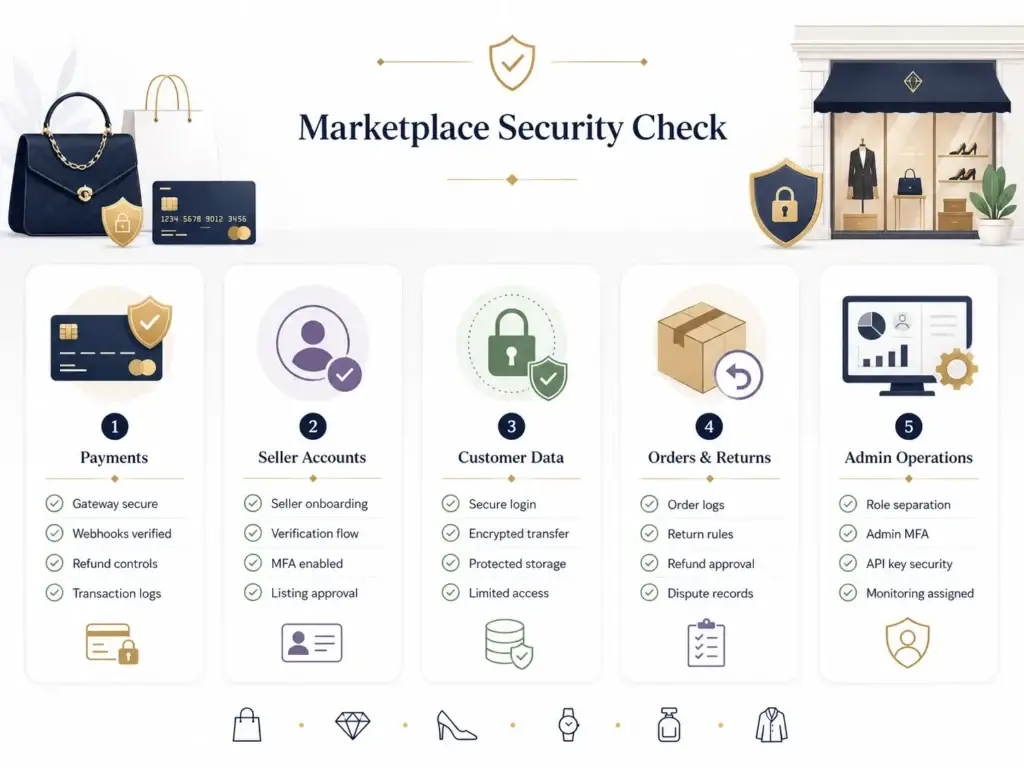
Use this checklist before taking your marketplace live.
Payment and Checkout
- Secure payment gateway configured.
- Payment webhooks verified.
- Refund permissions restricted.
- Suspicious transaction review enabled.
- Transaction logs available.
- Payment error handling tested.
- Payout change workflows protected.
Seller and Brand Accounts
- Seller onboarding workflow created.
- Seller verification process defined.
- Multi-factor authentication enabled for seller dashboards.
- Seller roles configured.
- Listing approval rules created.
- Payout details protected.
- Suspicious seller activity alerts planned.
Customer Data
- Secure login and password reset flow tested.
- Customer personal data access restricted.
- Data transfer encrypted.
- Sensitive data storage protected.
- Privacy policy aligned with operating regions.
- Data deletion and access request process defined.
- Support team access limited.
Orders, Returns, and Disputes
- Order state changes logged.
- Delivery status verified through trusted workflows.
- Return request rules configured.
- Refund approvals permission-based.
- Dispute evidence stored.
- Customer support records traceable.
- High-value order review rules defined.
Admin and Operations
- Admin roles separated.
- Multi-factor authentication enabled.
- Admin actions logged.
- API keys stored securely.
- Secrets removed from source code.
- Security testing completed.
- Post-launch monitoring assigned.
Read More:How Luxury Multi-Brand Fashion Marketplaces Work: Business Model, User Flow, and Founder Lessons
How Miracuves Supports Secure Luxury Marketplace Development
Miracuves helps founders build ready-made and white-label marketplace platforms with source code, custom branding, admin dashboards, and faster deployment. For luxury fashion marketplace founders, the goal is not only to launch a beautiful storefront. The goal is to launch a platform where payments, seller access, customer data, orders, and admin controls work together securely.
A Miracuves-built marketplace foundation can support:
- Buyer app and web storefront workflows.
- Seller dashboard and inventory control.
- Product catalogue and category management.
- Secure checkout integration.
- Order and shipping workflows.
- Admin dashboard control.
- Refund and dispute workflows.
- Role-based permissions.
- Custom branding.
- Source-code ownership.
- Post-launch customization.
If your business is researching a premium fashion marketplace model, you can review the Miracuves fashion marketplace for solution-level details.
Final Thoughts: Security Is a Business Decision, Not Just a Technical Feature
Luxury fashion marketplace security is not only about preventing hacks. It is about protecting the trust that makes a premium marketplace work.
Buyers need confidence that their payments, data, addresses, and orders are safe. Sellers need confidence that their accounts, inventory, and payouts are protected. Platform operators need control over approvals, refunds, disputes, and suspicious activity.
The safest marketplace strategy is to think beyond checkout. Protect the full journey: login, browsing, seller access, payment, order fulfilment, delivery, returns, refunds, and post-launch monitoring.
For founders planning to launch faster, Miracuves offers a practical route through ready-made marketplace foundations that can be customized for branding, workflows, admin control, and business model needs. Security should be part of that decision from day one.
FAQs
What is luxury fashion marketplace security?
Luxury fashion marketplace security refers to the systems, workflows, and controls used to protect buyers, sellers, payments, customer data, orders, refunds, and admin access inside a premium fashion ecommerce marketplace.
Why do luxury marketplaces need stronger payment protection?
Luxury marketplaces often process high-value orders, which increases the risk of fraud, chargebacks, stolen payment attempts, refund abuse, and payout manipulation. Secure gateways, tokenized payments, webhook verification, and transaction monitoring help reduce these risks.
How can seller accounts be protected in a fashion marketplace?
Seller accounts can be protected with multi-factor authentication, role-based access, seller verification, payout change controls, activity logs, product approval workflows, and suspicious login alerts.
What customer data should a marketplace protect?
A luxury marketplace should protect names, contact details, delivery addresses, purchase history, wishlist data, support records, payment-related references, and any identity verification details collected during onboarding or transactions.
What is order security in a marketplace app?
Order security means protecting the accuracy and integrity of order creation, payment confirmation, seller acceptance, shipping updates, delivery proof, return requests, refund approvals, and dispute records.
Can a white-label luxury marketplace platform be secure?
Yes, a white-label marketplace platform can be secure when it is built with strong architecture, secure APIs, encrypted data handling, payment gateway protections, role-based access, admin logs, testing, and ongoing update support.
What should founders check before launching a luxury marketplace app?
Founders should check payment security, seller verification, customer data protection, admin permissions, API security, order workflows, refund rules, compliance requirements, vulnerability testing, and post-launch monitoring.
Does marketplace software guarantee compliance?
No. Marketplace software can support compliance workflows, but final compliance depends on jurisdiction, legal review, payment providers, hosting setup, data practices, integrations, and the operating model.
Miracuves is an independent software development company. We are not affiliated with, connected to, sponsored by, or endorsed by any company or product named in this article.
Terms such as “X Clone” are used descriptively. It is how the software industry refers to building a platform with functionality comparable to a known service, and how clients search for it.
The entire design and codebase of our products is built by our own team. Our products contain no code, design, graphics, or content originating from any third-party website or applications.
All third-party names and marks referenced in this article are the property of their respective owners, referenced solely to identify the services discussed.