
















Key Takeaways
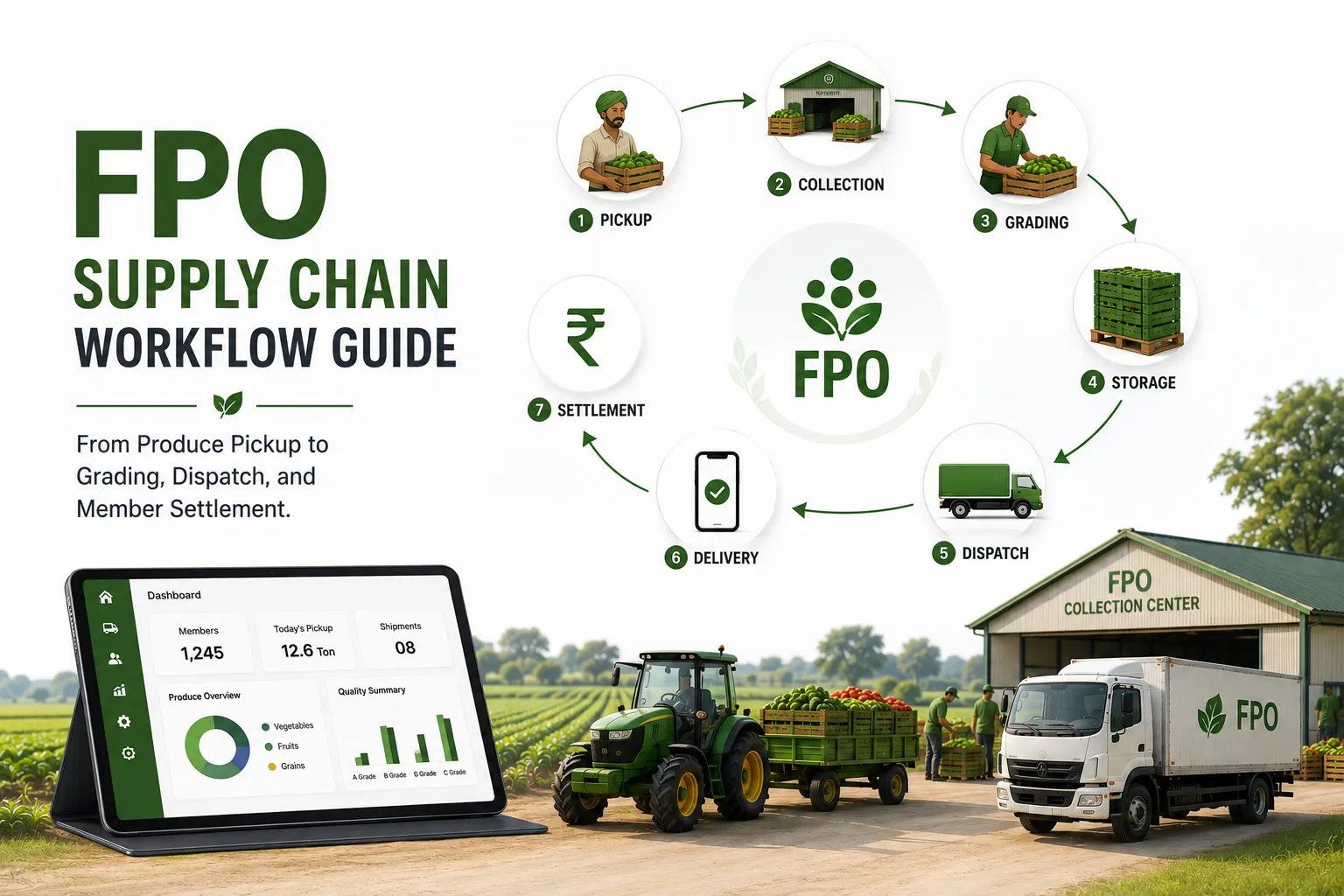
- FPO supply chain workflow connects farmer-member produce from pickup and collection centre receiving through grading, lot creation, dispatch, delivery, and final settlement.
- FPO logistics requires member-level traceability because one buyer shipment may contain produce contributed by many different smallholder farmers.
- Digital grading and quality records help connect produce quality with buyer acceptance, sale price, rejection handling, and farmer payouts.
- Lot creation links individual farmer contributions with aggregated buyer-ready produce while preserving quantity, grade, and ownership records.
- Settlement transparency is critical because farmers need to understand how quantity, grade, buyer price, deductions, transport costs, and rejection status affect final payouts.
Workflow Signals
- Member onboarding should record farmer identity, crop availability, expected harvest, quantity, pickup location, and payout details.
- Collection centre workflows should capture weighment, packaging, arrival time, member association, grading, quality status, and receipt records.
- Produce from multiple members can be grouped into lots based on crop, grade, buyer order, harvest date, storage location, or dispatch plan.
- Buyer dispatch should connect lot allocation, transporter assignment, shipment tracking, delivery proof, quantity received, and quality acceptance.
- Member settlement should connect contributed quantity, grade, sale price, deductions, transport costs, service fees, rejected quantity, and final payout status.
Real Insights
- FPO logistics should not be treated like single-seller delivery because multiple farmers can contribute different quantities and grades to the same commercial lot.
- The collection centre is a critical control point because this is where farmer produce becomes a recorded and traceable supply-chain asset.
- Grading rules should be defined before settlement automation because quality decisions directly influence buyer pricing and member payouts.
- Admin controls should provide visibility across members, lots, quality records, warehouses, buyer orders, transporters, payments, disputes, and settlements.
- The strongest workflow is: member onboarding → pickup → receiving → grading → lot creation → storage → buyer allocation → dispatch → delivery proof → member settlement.
Farmer Producer Organizations play a critical role in bringing smallholder farmers into organized agricultural supply chains. But managing produce movement for multiple members is not simple. An FPO may need to schedule pickups, aggregate crops at collection centres, record grades, coordinate transporters, dispatch produce to buyers, handle quality issues, track delivery proof, and reconcile payments for each member.
When these workflows depend on calls, notebooks, spreadsheets, and disconnected WhatsApp updates, the FPO team loses visibility. Farmers wait for payment updates. Buyers ask for quality records. Transporters need clearer dispatch instructions. Admin teams struggle to match produce records with final settlement.
An agricultural logistics platform can help FPOs digitize this flow from pickup to settlement. The goal is not just to move produce. The goal is to create traceability, accountability, and operational clarity across every handover.
This guide explains how an FPO supply chain workflow works, which modules matter, what business logic founders should plan, and how digital workflows can support smallholder aggregation, grading, dispatch, and member-level settlement.
Why FPO Supply Chain Workflows Need a Dedicated Digital Layer
An FPO does not usually move produce from one seller to one buyer in a straight line. It often manages produce from many members, across multiple villages, pickup points, collection centres, storage areas, transporters, and buyers.
That creates operational complexity.
A single buyer dispatch may include produce from dozens or hundreds of smallholder farmers. Each member may contribute different quantities, grades, harvest times, and packaging conditions. Some produce may be accepted immediately. Some may require regrading. Some may be held in storage. Some may be rejected or sold at a different rate.
This is why a basic transport app is not enough. FPO supply chains need digital workflows for:
- Member registration
- Farm and crop details
- Pickup scheduling
- Collection centre receiving
- Weighment records
- Quality grading
- Lot and batch creation
- Warehouse handover
- Buyer order allocation
- Transporter dispatch
- Delivery confirmation
- Payment deductions
- Member settlement tracking
- Admin reports
Founders planning this type of product should also understand how agriculture and agritech platform development supports farmer networks, rural workflows, produce aggregation, and digital supply-chain coordination.
Read more – Ready-Made vs Custom Agricultural Logistics Platform Development: Which Route Fits AgriTech Startups?
What Is an FPO Supply Chain Workflow?
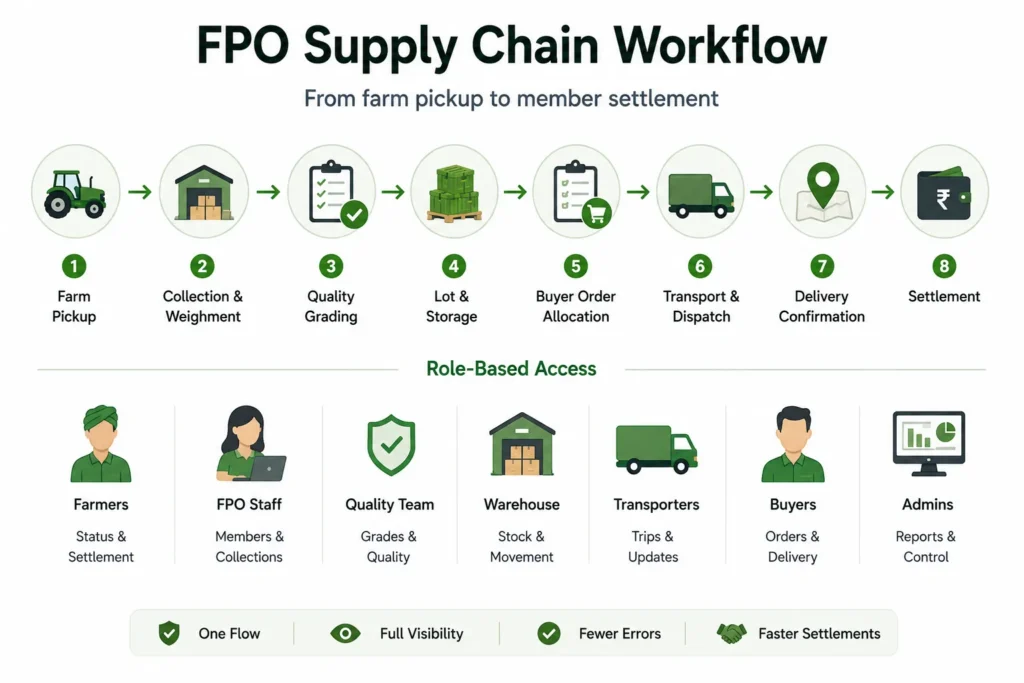
An FPO supply chain workflow is the structured process through which farmer-member produce moves from farm pickup to collection, grading, storage, buyer dispatch, delivery, and final settlement.
The workflow usually begins before pickup. The FPO needs to know which farmers are harvesting, what crop is available, how much quantity is expected, where pickup should happen, and which buyer or market demand the produce may serve.
After produce reaches the collection centre, the FPO must record quantity, grade, quality status, and member ownership. Once produce is grouped into a lot, the FPO may assign it to a buyer order, dispatch it through a transporter, track delivery, and settle payments after deductions, commissions, service charges, or quality-based pricing rules are applied.
A good agricultural logistics platform gives each user the right workflow:
- Farmers see pickup status and settlement visibility.
- FPO staff manage member produce and collection centre records.
- Quality teams capture grades and rejection reasons.
- Warehouse teams manage stock movement.
- Transporters receive dispatch instructions.
- Buyers track delivery and quality records.
- Admins control reports, payments, disputes, and business rules.
The platform becomes useful when it connects these roles into one traceable operating flow.
Core Users in an FPO Logistics Platform
FPO Supply Chain Users and Their Workflow Needs
| User Type | Primary Workflow | Why It Matters |
|---|---|---|
| Farmer Members | Register produce availability, receive pickup updates, view grading status, and track settlement. | Improves trust because members can follow their produce contribution and payment status. |
| FPO Coordinators | Plan pickups, assign collection points, manage member produce, and coordinate dispatch. | Reduces manual coordination and gives the FPO better control over daily operations. |
| Collection Centre Staff | Record receiving, weighment, grading, packaging, and lot creation. | Creates the first reliable record after produce arrives from farmers. |
| Quality Inspectors | Capture grade, images, rejection reasons, quality notes, and approval status. | Supports buyer confidence and reduces disputes after delivery. |
| Warehouse Teams | Manage stock receiving, storage, dispatch readiness, and inventory movement. | Helps FPOs manage produce that is not dispatched immediately. |
| Transporters and Drivers | Receive assigned loads, pickup instructions, route details, tracking updates, and delivery tasks. | Improves dispatch reliability and reduces confusion during produce movement. |
| Buyers | View assigned lots, shipment status, quality records, delivery confirmation, and invoice details. | Builds buyer trust and supports repeat procurement. |
| Platform Admins | Manage users, roles, routes, grading rules, commissions, settlements, disputes, and reports. | Gives the operator control over the complete farm-to-market workflow. |
Step 1: Member Onboarding and Crop Availability
The workflow begins with member data. An FPO needs to know who the farmer is, what crops they grow, where the farm is located, what quantity may be available, and when harvesting is expected.
A practical onboarding workflow may include:
- Farmer profile
- Member ID
- Village or location
- Crop category
- Farm size
- Expected harvest date
- Expected quantity
- Preferred pickup point
- Bank or payout details
- Language preference
- Support contact
This information helps the FPO plan collection, transportation, buyer commitments, and settlement reporting.
For founders, this step matters because poor member data creates problems later. If farmer identity, produce quantity, or pickup location is unclear, the platform cannot reliably connect pickup, grading, lot creation, buyer dispatch, and final payment.
Step 2: Produce Pickup Scheduling
Pickup scheduling decides when and where produce will be collected.
This can happen in several ways. Farmers may request pickup. FPO coordinators may create pickup schedules. Collection centre staff may plan routes by village. Buyers may trigger procurement demand that the FPO converts into pickup tasks.
A useful pickup scheduling module should help teams manage:
- Farmer pickup requests
- Village-level collection plans
- Time-slot allocation
- Vehicle assignment
- Pickup route grouping
- Driver instructions
- Crop quantity estimate
- Packaging instructions
- Pickup confirmation
- Missed pickup records
For smallholder networks, route grouping is especially important. If each farmer pickup is treated as a separate delivery job, transport costs may rise quickly. The FPO often needs to group multiple farmers into one pickup route or collection cycle.
Founders building this workflow can review these agricultural logistics platform features to compare which modules should be included in the first launch version.
Step 3: Collection Centre Receiving and Weighment
The collection centre is where field-level produce becomes a recorded supply-chain asset.
When produce arrives, staff need to capture the actual quantity, condition, packaging, and member association. The system should compare expected quantity with received quantity and record differences clearly.
A collection centre receiving workflow may include:
- Farmer/member selection
- Crop type
- Gross weight
- Net weight
- Packaging count
- Moisture or condition notes
- Arrival time
- Staff name
- Photo record where needed
- Temporary lot assignment
- Receipt generation
This step creates transparency. The farmer knows what was received. The FPO knows what quantity entered the system. The buyer later gets a clearer record of the produce source and quality.
Step 4: Grading and Quality Records
Grading is one of the most important steps in an FPO supply chain workflow. It affects buyer acceptance, selling price, farmer payout, disputes, and reputation.
A grading workflow may capture:
- Grade category
- Size or quality band
- Moisture level where relevant
- Visual inspection notes
- Defect percentage
- Rejection reason
- Accepted quantity
- Rejected quantity
- Quality photos
- Inspector name
- Time of inspection
- Buyer-specific quality requirement
The key is to keep grading transparent and traceable. If a member’s produce is downgraded, the platform should show why. If a buyer rejects part of a lot, the FPO needs enough records to review the reason.
This is where an agricultural logistics platform can create real trust. Instead of disputes being handled through memory or handwritten notes, every quality event becomes part of the produce history.
Step 5: Lot Creation and Produce Aggregation
Once produce is received and graded, the FPO may group member contributions into lots.
A lot may be created based on crop, grade, buyer order, harvest date, warehouse location, packaging type, or dispatch plan.
For example, tomatoes from different farmers may be grouped into Grade A and Grade B lots. A buyer may only accept Grade A produce. Another buyer may accept Grade B at a different price. The FPO needs records that show which members contributed to each lot and how the final sale value should be distributed.
A lot creation workflow should support:
- Lot ID
- Crop type
- Grade
- Total quantity
- Member contribution mapping
- Collection centre location
- Warehouse/bin location
- Buyer assignment
- Dispatch status
- Quality status
- Settlement status
This is the bridge between individual farmer records and commercial buyer dispatch.
Step 6: Warehouse Handover and Inventory Visibility
Not every lot is dispatched immediately. Some produce may move into short-term storage, cold rooms, packhouses, or warehouses.
Warehouse visibility helps the FPO answer basic but important questions:
- What stock is available?
- Which lot is ready for dispatch?
- Which produce is on quality hold?
- Which lot is assigned to a buyer?
- What quantity has been dispatched?
- What quantity remains?
- Which lot needs faster movement because of perishability?
Warehouse workflows may include receiving, storage location, batch movement, bin-level stock, quality hold, release status, dispatch preparation, and inventory reports.
For perishable produce, warehouse visibility can also connect with cold-chain monitoring and expiry-sensitive dispatch planning.
Step 7: Buyer Order Allocation and Dispatch Planning
Once lots are ready, the FPO needs to allocate them to buyers.
A buyer order allocation workflow may include:
- Buyer name
- Crop requirement
- Quantity
- Grade requirement
- Delivery location
- Delivery date
- Price terms
- Packaging requirement
- Quality checklist
- Transport requirement
- Invoice status
After allocation, dispatch planning begins. The FPO may assign a transporter, create a shipment, generate delivery documents, and track movement.
Founders should avoid treating buyer dispatch as only a delivery workflow. In FPO supply chains, dispatch is tied to member contribution, grading, buyer pricing, inventory release, delivery proof, and settlement.
Step 8: Transporter Assignment and Shipment Tracking
Transporter assignment connects the prepared lot with the right vehicle and driver.
Depending on the operating model, the FPO may use its own vehicles, contracted transporters, spot carriers, or a transporter marketplace.
The workflow may include:
- Vehicle type
- Driver details
- Pickup location
- Delivery location
- Expected dispatch time
- Route information
- Live tracking
- Delivery window
- Proof of pickup
- Proof of delivery
- Delay alerts
- Transport cost
- Payment status
Founders building dispatch, route visibility, and movement workflows can also explore Miracuves’ experience in logistics and supply chain software development to understand how tracking, fulfillment, and operational dashboards connect.
Step 9: Delivery Proof and Buyer Acceptance
Delivery proof confirms that produce reached the buyer or receiving location.
A strong delivery confirmation workflow may include:
- Delivery timestamp
- Receiver name
- OTP confirmation
- Digital signature
- Photo proof
- Quantity received
- Shortage record
- Quality acceptance status
- Rejection reason
- Buyer remarks
- Invoice reference
This step matters because settlement depends on completion. If the buyer accepts the shipment, payment can move forward. If the buyer rejects part of the produce, the FPO needs records to adjust member settlement and handle disputes.
Delivery proof also improves trust with transporters because completed delivery records can support payout processing.
Step 10: Member Settlement and Reconciliation
Settlement is where many FPO workflows become difficult.
The FPO must connect farmer contribution, grade, quantity, buyer sale price, deductions, logistics cost, service fee, commission, rejected quantity, and final payout. If this is handled manually, errors and disputes become common.
A member settlement workflow may include:
- Farmer/member ID
- Produce quantity contributed
- Grade assigned
- Lot participation
- Buyer sale price
- Accepted quantity
- Rejected quantity
- Deductions
- Transport cost allocation
- FPO service fee
- Advance adjustment where applicable
- Final payout
- Payment status
- Settlement receipt
- Dispute status
The settlement layer should be transparent enough for members to understand how the final amount was calculated. This is especially important when one buyer dispatch includes produce from many farmers.
To explore monetization and settlement-related revenue paths, founders can review this farm logistics business model breakdown and align platform rules with the operating model.
Full FPO Workflow Map
FPO Supply Chain Workflow From Pickup to Settlement
| Workflow Stage | What Happens | Digital Record Created |
|---|---|---|
| Member Onboarding | Farmer details, crop profile, village, payout details, and expected produce are recorded. | Member profile and crop availability record. |
| Pickup Planning | FPO schedules pickup by farmer, village, crop, route, or collection centre. | Pickup schedule and assigned collection route. |
| Collection Receiving | Produce arrives at the collection point and is weighed, counted, and recorded. | Received quantity, timestamp, and member-linked receipt. |
| Grading | Quality inspection is completed and produce is accepted, downgraded, or rejected. | Grade record, photos, notes, accepted quantity, and rejection reason. |
| Lot Creation | Produce from multiple members is grouped into buyer-ready lots. | Lot ID, grade, member mapping, and dispatch readiness. |
| Warehouse Handover | Lots are stored, moved, held, released, or prepared for dispatch. | Inventory movement and storage record. |
| Buyer Dispatch | Buyer order is matched with available lots and shipment is created. | Buyer order allocation and dispatch record. |
| Transport Tracking | Vehicle movement, route status, delay alerts, and delivery progress are tracked. | Shipment tracking and transporter record. |
| Delivery Confirmation | Buyer confirms receipt, accepted quantity, and quality status. | Proof of delivery and buyer acceptance record. |
| Member Settlement | Final payout is calculated based on quantity, grade, sale price, deductions, and payment rules. | Member settlement statement and payout status. |
Business Logic Founders Should Define Before Building
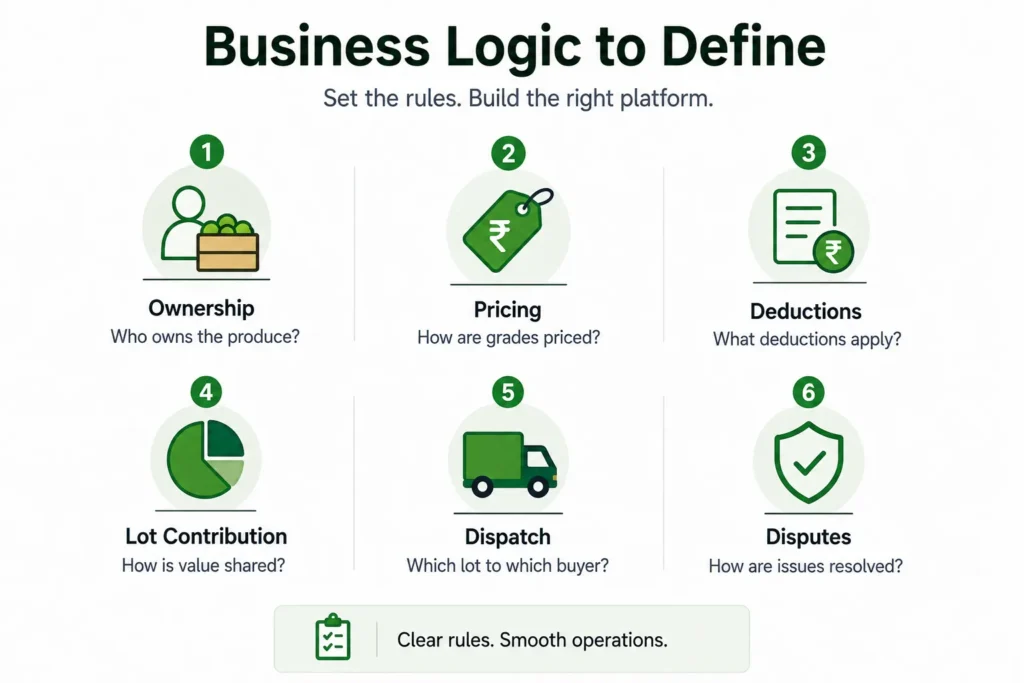
An FPO supply chain platform should not be planned only around screens. Founders must define the rules behind the workflow.
Ownership Logic
Who owns the produce at each stage? The farmer, the FPO, the buyer, or the platform operator? Ownership clarity affects liability, pricing, quality disputes, and settlement.
Grade-Based Pricing Logic
Does each grade have a fixed price? Does the buyer set the price? Does the FPO apply a pricing rule? Can prices change after buyer inspection?
Deduction Logic
Which deductions apply before member payout? Examples may include transport cost, packaging cost, FPO service fee, commission, loan adjustment, advance recovery, or rejected quantity.
Lot Contribution Logic
If multiple farmers contribute to one lot, how is the sale value divided? Is it based only on quantity, or does grade and rejection status also affect payout?
Dispatch Logic
Who decides which lot goes to which buyer? Does the admin assign it manually? Does the system recommend based on grade, buyer demand, location, or expiry sensitivity?
Dispute Logic
What happens when the buyer rejects produce, transport is delayed, quantity differs, or quality records are challenged? The platform should preserve enough activity logs to support resolution.
Cost Factors in FPO Supply Chain Platform Development
The cost of building an FPO logistics workflow depends on how deep the product needs to go.
A basic version may only include member onboarding, pickup scheduling, receiving, grading, dispatch, and settlement status. A more advanced version may include warehouse inventory, live tracking, cold-chain alerts, payment gateway integration, automated payout calculation, ERP integration, and analytics.
Important cost drivers include:
- Number of user roles
- Member profile depth
- Pickup scheduling rules
- Collection centre workflows
- Weighment and grading logic
- Lot and batch tracking
- Warehouse inventory depth
- Transporter assignment model
- Live tracking and delivery proof
- Buyer order management
- Settlement calculation
- Payment gateway integration
- Admin dashboard complexity
- Reporting and analytics
- Language and offline support
- Third-party integrations
For a deeper pricing breakdown, founders can review this farm-to-market logistics app cost guide before requesting a final estimate.
Founder Decision Signals
Speed
Start with the workflow needed to prove member pickup, collection centre intake, grading, dispatch, and settlement visibility before adding advanced automation.
Cost
Cost increases when the platform needs warehouse inventory, live tracking, multi-party settlement, payment automation, offline sync, and custom reports.
Scalability
A scalable agricultural logistics platform should support more members, collection centres, buyers, transporters, lots, grades, and regions over time.
Trust
FPO members need clear records for quantity, grade, buyer dispatch, deductions, and payout status. Settlement transparency directly affects adoption.
Security and Trust Layers for FPO Supply Chains
FPO supply chains handle sensitive member, shipment, quality, and payment data. Security should be built into the platform from the beginning.
Important trust layers include:
- Member verification
- Staff role permissions
- Transporter verification
- Buyer approval controls
- Role-based access control
- Secure payment gateway integration
- Activity logs
- Audit logs
- Quality inspection records
- Proof of pickup
- Proof of delivery
- Dispute management
- Settlement history
- Privacy-conscious data handling
Not every user should see every record. Farmers should see their own contribution and settlement. Buyers should see relevant shipment and quality records. FPO admins should control full operational visibility. This permission structure protects trust across the network.
Ready-Made Foundation vs Custom Development for FPO Workflows
Founders usually compare two build paths: starting with a ready-made foundation or building a custom product from zero.
A ready-made foundation is useful when the founder wants to launch faster with common agricultural logistics workflows already available. The platform can then be customized for FPO member roles, crop categories, collection centres, grading rules, buyer dispatch, settlement logic, language preferences, and branding.
Custom development is useful when the workflow is highly unique. For example, an FPO network may need deep ERP integration, complex procurement logic, advanced finance workflows, IoT-based cold-chain monitoring, or custom analytics.
For founders comparing build options, Miracuves’ ready-made app solutions can provide a faster starting point than building every workflow from zero.
If your operating model requires highly specific workflows, deeper integrations, or custom product architecture, custom mobile app development may be the better route for long-term flexibility.
For founders who want a launch-ready agricultural supply chain app foundation, Miracuves offers a white-label agricultural logistics solution that can support FPO collection workflows, produce movement, transporter coordination, tracking, admin control, and settlement visibility.
Mistakes Founders Should Avoid
Treating FPO Logistics Like Single-Seller Delivery
FPO workflows involve many members contributing to shared lots. The platform must track member contribution, grade, lot mapping, dispatch, and settlement clearly.
Skipping Grading Records
Without grade and quality records, buyer acceptance and member payout can become difficult to explain. Grading should be traceable and linked to settlement.
Building Settlement Before Defining Rules
Member payout depends on quantity, grade, deductions, buyer price, transport cost, and rejection status. These rules should be mapped before automation.
Ignoring Collection Centre Operations
The collection centre is where produce becomes a recorded supply-chain asset. Weak receiving and weighment workflows can break the entire downstream process.
Making Admin Controls Too Shallow
FPO operators need dashboards for members, lots, quality, dispatch, transporters, buyer orders, payments, disputes, and reports. A weak admin layer creates manual dependency.
How Miracuves Helps Founders Plan FPO Supply Chain Platforms
Miracuves helps founders, startups, agencies, FPO networks, and agricultural operators launch ready-made and white-label app platforms with source-code ownership, branded design, admin dashboards, and faster deployment.
For FPO supply chain workflows, the goal is not just to digitize transport. The goal is to create a connected operating layer where members, collection centres, quality teams, buyers, transporters, warehouses, and admins work from the same records.
Businesses that need expert support can work with Miracuves as an agricultural logistics app development company to plan, customize, and launch a platform aligned with their FPO operating model.
Final Thoughts
FPO supply chain digitization is not only about moving produce faster. It is about making every stage visible: member contribution, pickup scheduling, collection centre receiving, grading, lot creation, warehouse handover, buyer dispatch, delivery proof, and final settlement.
The strongest FPO platforms do not treat farmers as anonymous suppliers. They keep member-level records connected to every commercial movement. That is what makes settlement transparent and operations scalable.
For founders, the practical path is to start with the workflow that proves trust: pickup, receiving, grading, dispatch, and member settlement visibility. Once that is working, the platform can expand into deeper inventory, cold-chain, buyer procurement, analytics, payment automation, and regional scaling.
A well-planned agricultural logistics platform can help FPOs move from manual coordination to a more transparent, growth-ready supply chain operating system.
FAQs
What is an FPO supply chain workflow?
An FPO supply chain workflow is the process through which farmer-member produce moves from pickup and collection centre receiving to grading, lot creation, buyer dispatch, delivery proof, and member settlement.
How can an agricultural logistics platform help FPOs?
An agricultural logistics platform helps FPOs manage member onboarding, produce pickup, collection centre records, grading, warehouse handover, transporter assignment, buyer delivery, settlement tracking, and admin reporting from one system.
Why is grading important in FPO logistics management?
Grading affects buyer acceptance, sale price, member payout, rejection handling, and dispute resolution. Digital grading records help FPOs explain quality decisions transparently.
What features should FPO logistics software include?
Important features include member onboarding, crop availability records, pickup scheduling, collection centre receiving, weighment, grading, lot creation, inventory visibility, buyer order allocation, transporter dispatch, proof of delivery, settlement tracking, and admin dashboards.
How does member settlement work in an FPO platform?
Member settlement connects each farmer’s contributed quantity, grade, buyer sale price, accepted quantity, rejected quantity, deductions, transport cost, service fee, and final payout status.
What is lot creation in FPO supply chains?
Lot creation is the process of grouping produce from multiple members into buyer-ready batches based on crop type, grade, quantity, collection centre, buyer order, or dispatch plan.
What affects the cost of FPO supply chain platform development?
Cost depends on user roles, pickup logic, grading workflows, lot tracking, warehouse inventory, live tracking, payment integration, settlement rules, admin dashboard depth, language support, offline sync, and third-party integrations.
How can Miracuves help build an FPO supply chain platform?
Miracuves helps founders build ready-made and white-label app platforms with source-code ownership, branded design, admin dashboards, logistics workflows, tracking modules, and customization support. Final scope depends on user roles, integrations, region, and FPO operating model.
Miracuves is an independent software development company. We are not affiliated with, connected to, sponsored by, or endorsed by any company or product named in this article.
Terms such as “X Clone” are used descriptively. It is how the software industry refers to building a platform with functionality comparable to a known service, and how clients search for it.
The entire design and codebase of our products is built by our own team. Our products contain no code, design, graphics, or content originating from any third-party website or applications.
All third-party names and marks referenced in this article are the property of their respective owners, referenced solely to identify the services discussed.