Written by the Miracuves Editorial Team. Reviewed by Aditya Bhimrajka, Founder & CEO, Miracuves.
Key Takeaways
- Records before screens A shipping paper is rendered from data, so a versioned table of regulated entries, locked product classifications and per-vehicle totals matter more than any form.
- One record, four rulebooks A jurisdiction and mode profile lets the same shipment produce a 49 CFR shipping paper, an ADR transport document or a sea or air declaration.
- Three clocks to automate Training within 90 days and every three years, an emergency number monitored at all times, and shipping paper copies kept two years (three for hazardous waste) from carrier acceptance.
- Electronic is allowed, unavailable is not US rules now accept electronic emergency response information and ADR accepts electronic transport documents, but lost signal or a dead device is no excuse, so build offline first.
- People decide, software checks Classification and the shipper’s certification stay with trained people; the system blocks inconsistencies and records the evidence.
- Own it when compliance is what you sell Low-volume shippers should subscribe; carriers, forwarders and distributors who sell dangerous goods handling gain most from owning the workflow.
A drum of paint thinner, a pallet of lithium batteries or a cylinder of compressed gas is only as legal as the paper that travels with it. Get the UN number, the packing group or the emergency phone number wrong and the load can be held at a roadside check, fined, or misread by a firefighter who trusted the document.
This article is for the operations or product lead at a specialist carrier, chemical distributor or freight forwarder who has to decide what a hazmat compliance system must actually check, whether the team buys one or builds one. By the end you should be able to write that spec: the records it needs, the rules it enforces under the US Hazardous Materials Regulations (49 CFR) and the European ADR agreement, the clocks it watches, and the decisions it must leave to trained people.
It covers software design, not legal advice. Your dangerous goods advisor still owns classification and how your company applies the rules.
Why loads get stopped: small data errors, not dramatic ones
The failures this software has to prevent are mundane. They come from retyping, copying and splitting, when the correct information existed somewhere in the company, in a spreadsheet, an email thread or one person’s memory, instead of in a record that every later step reads from.
- Description drift. Someone copies last month’s shipping paper, but the packaging has changed from a steel drum to a plastic jerrican.
- Split loads. A dispatcher moves two pallets to a second truck, and only the first driver carries paperwork.
- Buried hazmat lines. Hazardous and ordinary lines share one bill of lading with nothing to set them apart.
- A dead emergency number. The phone printed on the paper rings an office that closes at 6 pm.
- Lapsed training. The person preparing shipments is past their retraining date, and nobody notices until an inspection.
- Missing copies. An investigator asks for a paper from last year and nobody can produce it.
Each of these has a rule behind it and a software control that prevents it. The rest of this article follows that mapping instead of listing features.
Start with the records, not the screens
A shipping paper is a view rendered from structured data. If the data is loose, no interface will stop the errors above. Five kinds of record do most of the work.
A versioned table of regulated entries
Each entry holds the identification number (UN or NA), the proper shipping name, the hazard class or division, subsidiary hazards, the packing group, special provisions and quantity limits by mode. In the US the source is the Hazardous Materials Table in 49 CFR 172.101. For road transport in Europe it is Table A in Chapter 3.2 of ADR.
Never let users edit this table. Load it as dated reference data and keep superseded rows, because you must be able to show which version applied on the day a paper was issued. The volume of change is real: Trans.INFO’s summary of the 2027 ADR amendments counts four new UN numbers, one deleted entry and about 185 amended Table A entries, including a split of UN 3536 (lithium batteries installed in cargo transport units) into separate lithium-ion, lithium-metal and sodium-ion entries.
Your products, with locked classifications
The second layer is your own catalog: SKUs, net quantities, packaging types, safety data sheet references and the regulated entry each product is classified under. Classification is a decision made by a trained person, so store who made it, when and on what evidence, then lock the link. A sales rep should not be able to reclassify a product quietly to get a cheaper freight rate.
Safety data sheets as a proposal, not an answer
Classification usually starts from the supplier’s safety data sheet (SDS). Under Appendix D of the OSHA Hazard Communication Standard, section 14 (transport information) is where the UN number, shipping name, hazard class and packing group appear. OSHA lists sections 12 to 15 as not mandatory and does not enforce them, because those areas fall outside its jurisdiction, so section 14 can be blank, generic or out of date. A practical intake pipeline does four things:
- Parse and store. Extract sections 1, 2, 3, 9 and 14, keep the original PDF and record the SDS revision date.
- Propose. Turn section 14 into a suggested regulated entry, linked to the text it came from.
- Cross-check. Compare the proposal with the physical data. For a flammable liquid, 49 CFR 173.121 sets the packing group: an initial boiling point of 35 C or lower means packing group I, and a flash point below 23 C with a boiling point above 35 C means packing group II.
- Route to a person. Send every gap or mismatch to the classifier queue, and reopen the classification whenever the supplier issues a new SDS revision.
Shipments, packages and the vehicle
A shipment holds handling units, units hold packages, and packages hold line items that point back to catalog products. The compliance arithmetic runs per vehicle, not per order. In the US, 49 CFR 172.504 requires placards in any amount for Table 1 materials such as Division 1.1 to 1.3 explosives and poison gas, while Table 2 materials in non-bulk packages moving by highway or rail need placards only once a vehicle carries 454 kg (1,001 pounds) or more aggregate gross weight, with a few exceptions. Under ADR, the small-load exemption in 1.1.3.6 applies to goods in packages and works on a points total: transport categories 1 to 3 each have a multiplier, category 0 never qualifies, and the load escapes several requirements, orange plates among them, only while the total stays at or below 1,000. The UK HSE guide to the main ADR exemptions lists what still applies.
That is why splitting and consolidation are where errors breed. When a planner moves pallets to another truck, the system must recompute both vehicles and reissue both document sets. Give every document a status (draft, issued, superseded, voided) so a driver can never carry a stale one.
The emergency contact
Every issued paper links to an emergency response record: the number, the party that monitors it, the contract dates and the materials it covers. Model the monitoring contract as its own entity so the system can refuse to issue a paper once it has lapsed. Keep the exceptions in data rather than code: 49 CFR 172.604 does not require the number for limited quantity or excepted quantity shipments, or for a short list of named materials such as dry ice.
One record, four rulebooks
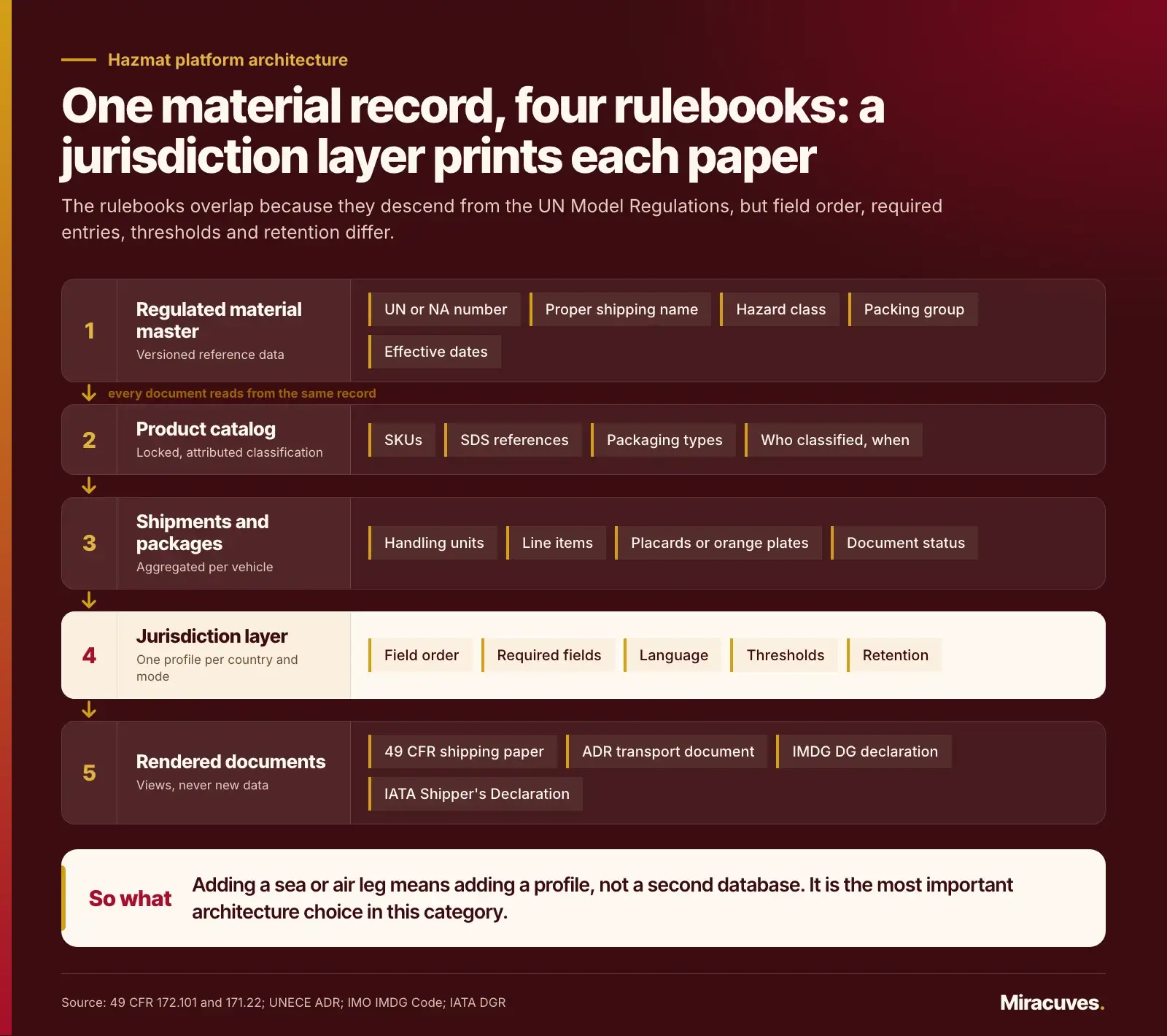
The US regulations and ADR both descend from the UN Model Regulations, so the material data overlaps heavily. What differs is the document: field order, required entries, thresholds, language and retention. The design that holds up is one material record with a jurisdiction and mode profile between it and the printed output. Adding a new leg then means adding a profile, not a second database.
US road and rail: the shipping paper
49 CFR 172.201 sets two rules that a generic freight tool may not enforce. When one paper lists hazmat and non-hazmat items, the hazmat entries must be entered first, printed in a contrasting color, or marked with an X in a column headed HM. And the person who provides the paper keeps a copy, or an electronic image of it, for two years after the initial carrier accepts the material, or three years for hazardous waste.
In code, that means the renderer enforces ordering or an HM column, and the archive keys retention to the carrier acceptance date, not the order date.
European road: ADR
ADR governs international road carriage of dangerous goods among its contracting parties, and Directive 2008/68/EC applies the same rules to domestic road transport inside each EU member state, subject to limited national derogations. As of November 2026 the 2025 edition is in force; the UNECE dates it from 1 January 2025. The 2027 amendments are due to take effect on 1 January 2027, with ADR 2025 still usable until 30 June 2027. A two-year cycle means your reference data needs a release process, not a one-time import.
The ADR transport document has its own content rules in Chapter 5.4, the crew carries instructions in writing, and road tunnels carry restriction codes, so a route that suits one load may be closed to the next. A system that only knows US rules will print a document a European roadside inspector will not accept.
Sea and air legs
Under 49 CFR 171.22, shipments in the US may move under the IMDG Code for sea or the ICAO Technical Instructions for air, but US requirements for emergency response information, training, security plans and incident reporting still apply. Both international rulebooks run on fixed cycles. According to the IMO, the 2024 edition of the IMDG Code (Amendment 42-24) became mandatory on 1 January 2026. IATA reissues its Dangerous Goods Regulations every year; the 67th edition took effect on 1 January 2026, and IATA posted an addendum with corrections the same day. Each release is a data load your platform has to test and date.
| Mode | Rulebook (as of November 2026) | Main document | What changes in the software |
|---|---|---|---|
| US road and rail | 49 CFR Hazardous Materials Regulations | Shipping paper | HM column or ordering, placards per vehicle, monitored emergency number |
| European road | ADR 2025 (ADR 2027 from 1 January 2027) | Transport document plus instructions in writing | Tunnel restriction codes, orange plates, the 1.1.3.6 points exemption |
| Sea | IMDG Code 2024 edition (Amendment 42-24) | Dangerous goods declaration with a container packing certificate | EmS codes, marine pollutant marks, stowage and segregation on board |
| Air | ICAO Technical Instructions and IATA DGR 67th edition (reissued yearly) | Shipper’s Declaration for Dangerous Goods | Passenger versus cargo aircraft limits, forbidden items, lithium battery provisions |
The material record stays the same across all four rows. Only the profile changes, which is why the jurisdiction layer pays for itself the first time a forwarder adds an ocean or air booking.
The checks from order to archive
Rules only help when they fire at the moment someone acts. Here is the usual sequence for a shipper or carrier, with the check the software should run at each step.
- Order intake. Orders arrive from an ERP, a store or a customer portal. Any line without a classification on file is blocked.
- Packaging. The packer picks packaging, and the system checks it against the authorizations for that entry and packing group. A mismatch stops the line.
- Load planning. Packages are assigned to vehicles. The system aggregates per vehicle, checks segregation between incompatible classes and works out placards or orange plates.
- Route check. European road legs are checked against tunnel restriction codes. US legs flag routing restrictions on certain materials for the dispatcher.
- Documents. The system renders the shipping paper or ADR transport document from structured data, attaches emergency response information and confirms the emergency contract is active.
- Sign-off. A trained person reviews and signs the shipper’s certification. Identity, time and the exact document version are captured.
- Handover. The driver app confirms receipt of the documents for that vehicle, and the carrier acceptance time starts the retention clock.
- In transit. Incidents, delays and transfers are logged against the shipment. A transfer to another vehicle triggers reissue.
- Delivery and archive. Proof of delivery closes the shipment, and the final document set is sealed with its retention date.
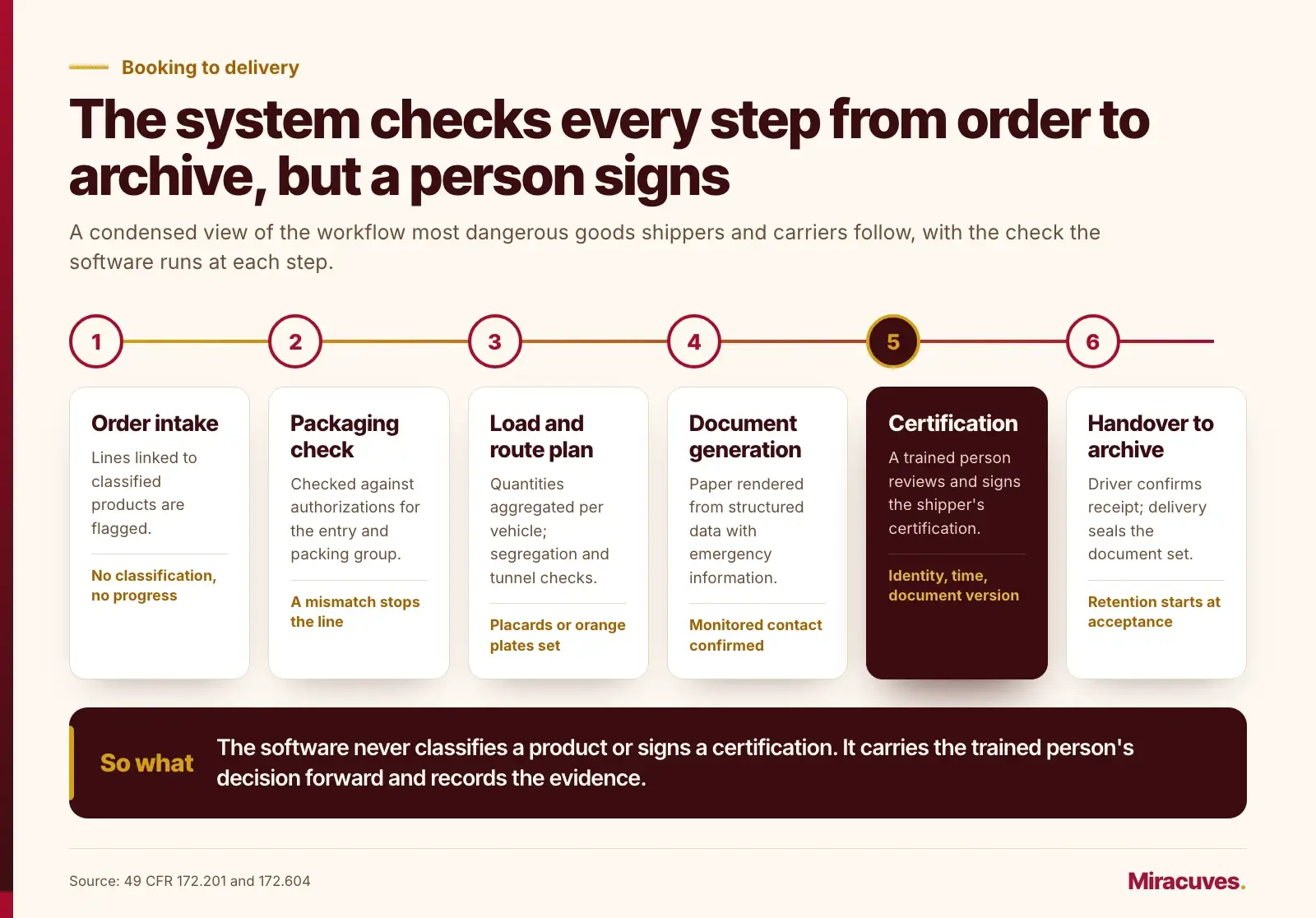
Notice what the software never does: it never classifies a product on its own and never signs the certification. It carries a trained person’s decision forward, checks consistency and records the evidence. Keep that boundary visible in the product, because it is where the regulations place responsibility.
Exceptions need a reason code
Real operations produce edge cases: a returned carton of damaged batteries, a sample shipped under a special permit, a limited quantity consignment a customer wants upgraded to full regulation. Each needs an explicit exception path with a reason code and a named approver, not a free-text override. Unexplained overrides are hard to defend in an investigation.
Who may do what, and the trail it leaves
Permissions here mirror who is allowed to do what, not just who can see which screen. A workable role set:
- Classifier: links products to regulated entries and attaches the evidence.
- Preparer: packs, labels and builds shipments, but cannot change classifications.
- Certifying signatory: reviews the final document and signs the shipper’s certification.
- Dispatcher: assigns vehicles and routes, and sees segregation and placard warnings.
- Driver: sees documents for the assigned vehicle only, confirms receipt and logs incidents.
- Compliance manager: maintains reference data, training records and emergency contracts.
- Customer: books shipments and downloads documents for their own account.
The control that matters most ties roles to training status: when someone’s training lapses, their hazmat permissions switch off without waiting for a manager to notice. Small teams where one person does everything can still get a second look by requiring a different user to approve classifications, or a recorded self-review against a checklist. Make that separation configurable rather than hardcoded. Outside carriers deserve the same scrutiny, as our guide to carrier verification in a digital freight marketplace explains.
The location and contents of hazardous loads are sensitive, and the records are evidence. Build the evidence trail in from the start:
- An append-only audit log of every change to a classification, shipment or document, with user, time, old value and new value.
- Issued documents stored with a content hash, so any later edit is detectable.
- Live location of high-consequence loads visible only to named roles.
- Encryption for archives and APIs, with key management kept apart from application access.
- Restores that are actually tested, because losing the archive means losing records you are required to keep.
Three clocks the system should watch
Training
Under 49 CFR 172.704, a new hazmat employee, or one who changes job function, must be trained within 90 days and may work only under the direct supervision of a trained employee until then. Recurrent training is due at least once every three years. The record covers the preceding three years, with the employee’s name, completion date, a description or location of the materials, the trainer’s name and address, and a certification that the employee was trained and tested.
In the product, each person gets a training record with an expiry date, a supervision flag for the first 90 days and a store for the materials and certification. Reminders fire well before expiry, and permissions switch off when the date passes. Records must be kept while the person works as a hazmat employee and for 90 days after, so offboarding must never delete them.
The emergency line
Under 49 CFR 172.604, the number on a US shipping paper must be monitored at all times while the material is in transportation, including storage incidental to transportation. It must reach a person who knows the material and has emergency response and incident mitigation information, or who has immediate access to such a person. A number that depends on a callback, such as an answering service, answering machine or beeper, does not qualify.
Software cannot answer the phone. It can refuse to print a number that is not covered by an active arrangement for every material on the paper, and it can log periodic test calls as evidence.
Retention and retrieval
Keeping documents is half the job; producing the right one quickly is the other half. Index the archive by shipment, customer, material, vehicle and date, and store the exact rendered file alongside the data that produced it. When reference data changes later, you still need to show what the paper said on the day it was issued.
Paper, phones and dead zones
Drivers lose signal in tunnels, at rural depots and at borders. At the same time the rules are moving toward electronic documents, with a performance standard attached rather than a technology.
- US emergency response information. A PHMSA final rule, HM-268D, lets domestic carriers and facility operators keep emergency response information in electronic form instead of on paper from 3 September 2026. The information must be immediately available to first responders and inspectors at all times, and PHMSA states that lost signal, power loss or device failure does not excuse noncompliance. The rule amends 49 CFR 172.602; it does not by itself make the shipping paper paperless.
- ADR transport documents. ADR 5.4.0.2 permits electronic data processing or interchange in place of paper, provided the data is at least as available and as legally reliable during carriage as a paper document. The joint RID/ADR/ADN guidelines for applying 5.4.0.2, published by OTIF, describe a reference architecture for countries that adopt them.
- EU freight information. The eFTI Regulation applies in full from 9 July 2027, when member state authorities must accept regulatory freight information that operators share electronically through eFTI platforms meeting the regulation’s certification rules.
For the product, this all points the same way: offline first. The driver app caches the current document set and the emergency response information on the device, shows them without a connection and syncs incident logs when signal returns. Printing from the cab or the depot must keep working when the cloud is unreachable, because a paper copy remains the simplest fallback.
Integrations that stop retyping
A compliance tool that sits apart from daily operations becomes a place where people retype data after the fact, which is exactly how description drift starts.
- ERP and order management: products, orders and customer accounts flow in, with classification links kept in one place.
- Warehouse management: pick, pack and pallet data update shipment contents, so quantities on the paper match what was loaded.
- Transport management and telematics: vehicle assignment, routes and position feed the per-vehicle totals and tunnel checks.
- Printers: warehouse and in-cab thermal printers need dependable printing of labels, marks and papers.
- Carrier EDI: hazmat details must survive the trip into the carrier’s systems, which means mapping your fields to their message formats.
- Learning management: course completions update the training record without manual entry.
Build these as versioned APIs with idempotent writes. A retried warehouse message must never double the quantity of flammable liquid on a vehicle.
Buy, build, or extend a freight base
For many shippers, a subscription tool is the right answer. The honest test is whether compliance is a cost for your business or part of what you sell.
| Question | Lean toward renting if | Lean toward owning if |
|---|---|---|
| Volume and variety | You ship a modest number of loads with a stable product list | You handle many materials, mixed loads and constant consolidation |
| Jurisdictions | You work in one country under one rulebook | You cross US and European networks and need one record rendered several ways |
| Customer experience | Customers never see your documents | Customers book, track and download documents in your own branded portal |
| Integrations | Your ERP and warehouse tools already connect to an existing product | Your warehouse, telematics or EDI flows are custom and connectors force retyping |
| Business model | Compliance is overhead you want handled with the least effort | Dangerous goods handling is a service you price and sell |
| Team | Nobody can own the product internally | You can name a product owner and fund reference data updates |
A manufacturer that ships a few hundred regulated parcels a year through established carriers should almost always subscribe. It gets maintained reference data and standard document formats, and someone else absorbs every amendment cycle.
Ownership starts to make sense for specialist carriers, forwarders, chemical distributors and third-party logistics providers whose customers pay them for safe, documented dangerous goods handling. Rented tools can block them in three places: they cannot brand the customer experience, they cannot model their own consolidation logic, and they cannot connect deeply to the warehouse and fleet systems that generate the data. A middle path is to start from an existing freight base, such as white-label load board software with a carrier TMS and GPS tracking, and add a compliance module for your materials, jurisdictions and roles.
Both routes hide costs. Subscriptions hide integration work: connectors, middleware and staff hours spent reconciling two systems. Custom builds hide maintenance: every ADR cycle, IMDG amendment and yearly IATA edition means reference data work and regression testing. Whichever you choose, name an owner for reference data.
A first release, and what it costs
Resist covering every mode and every exception in version one, because it delays launch and spreads testing thin. Start with one jurisdiction profile, your real product catalog and the document you print most often. Add the training and emergency contract clocks next, because they are cheap to build and catch expensive mistakes. Then add per-vehicle aggregation, the driver app and the customer portal. A second jurisdiction comes after the first has run on real loads and been reviewed by your dangerous goods advisor.
The phases below are planning assumptions for a team of four to five engineers plus a dangerous goods advisor who reviews outputs. They are not a quote.
| Phase | Scope | Planning assumption | Relative effort |
|---|---|---|---|
| Discovery | Materials shipped, document types, jurisdictions, roles, current systems | 2-4 weeks | Low |
| First release | Versioned material master, product catalog with SDS intake, one jurisdiction profile, document rendering, archive | 10-14 weeks | High |
| Phase 2 | Training and emergency contract clocks, per-vehicle aggregation and segregation, offline driver app | 8-12 weeks | Medium to high |
| Phase 3 | Second jurisdiction or a sea or air profile, customer portal, ERP, warehouse and EDI integrations | 8-14 weeks | Medium to high |
As an illustration of the arithmetic, not a price: the BLS puts the median US software developer wage at $135,980 a year (May 2025), about $65 an hour. Five engineers for the 28 to 44 weeks in the table come to 5,600 to 8,800 hours, or roughly $364,000 to $572,000 in wages alone, before benefits, overhead, hosting and advisor fees. Use your own team’s real rate.
Measure the right things from the first live load: documents reissued after loading, overrides by reason code, training renewals completed before expiry and time taken to retrieve an archived paper. Those numbers show where the process still leaks.
Where Miracuves fits
Miracuves builds custom logistics software, and can also start from a ready-made freight base and extend it. For a carrier, forwarder or distributor in this position, the first module we would scope is the versioned material master with your product classifications, because every later screen reads from it. Next come shipments with per-vehicle aggregation, the jurisdiction layer that renders a 49 CFR shipping paper or an ADR transport document from the same record, and an archive keyed to carrier acceptance. Delivery covers Android and iOS apps for drivers and customers, a web admin panel for compliance staff and full source code. ERP, warehouse, telematics and EDI integrations are scoped per project, because every operation connects differently.
If your shipper customers ask about information security, we build to the controls they name, such as SOC 2 or ISO 27001, and take you through the audit with a partner; any certificate or report is issued to your company. Share the materials you ship, the jurisdictions you cover and the systems you run today, and the Miracuves team will scope a build around them.
Frequently Asked Questions
What does hazmat compliance software actually do?
It stores the regulated reference data and your classified products, builds shipments, checks packaging, per-vehicle quantities and segregation, and renders shipping papers or ADR transport documents from that data. It also tracks training dates, emergency response contracts and record retention. Classification and the shipper’s certification remain decisions made by trained people; the software checks consistency and keeps the evidence.
How long do you have to keep hazmat shipping papers?
Under 49 CFR 172.201, the person who provides a shipping paper keeps a copy, or an electronic image of it, for two years after the initial carrier accepts the material, or three years for hazardous waste. The copy must be accessible at or through the principal place of business and available to officials on request, so archives should be indexed by carrier acceptance date.
How often is hazmat training required?
Under 49 CFR 172.704, recurrent training is due at least once every three years. New employees, or those who change job function, must be trained within 90 days and work under the direct supervision of a trained employee until then. Training records must be kept for as long as the person works as a hazmat employee and for 90 days afterwards.
Can hazmat shipping documents be electronic?
Partly, and it depends on the rulebook. In the US, a PHMSA final rule effective 3 September 2026 lets domestic carriers keep emergency response information electronically, provided it is immediately available at all times. ADR 5.4.0.2 allows electronic transport documents if they are at least as available and reliable as paper. In both cases, lost signal or a dead device is not an excuse.
Does ADR apply to domestic road transport in the EU?
Yes. Directive 2008/68/EC requires EU member states to apply the ADR rules to national road transport as well as international carriage, with limited national derogations that each state may adopt. A platform serving EU carriers should use the ADR profile for domestic legs too and record any derogation that applies in the member state concerned.
Is a hazardous waste manifest the same as a shipping paper?
Not exactly. Hazardous waste must travel with a hazardous waste manifest under 49 CFR 172.205, prepared by the generator under EPA rules in 40 CFR part 262. The manifest may be used as the shipping paper if it contains everything the shipping paper rules require, and copies are kept for three years rather than two. Software should model it as its own document type that can also satisfy the shipping paper rules.
Should a small shipper build its own hazmat software?
Usually not. If you ship a modest volume of stable products through established carriers, a subscription tool is cheaper and someone else maintains the reference data through every ADR, IMDG and IATA cycle. Building makes sense when dangerous goods handling is part of what you sell, or when your mix of modes, jurisdictions and integrations outgrows generic tools.
Miracuves is an independent software development company. We are not affiliated with, connected to, sponsored by, or endorsed by any company or product named in this article.
Terms such as “X Clone” are used descriptively. It is how the software industry refers to building a platform with functionality comparable to a known service, and how clients search for it.
The entire design and codebase of our products is built by our own team. Our products contain no code, design, graphics, or content originating from any third-party website or applications.
All third-party names and marks referenced in this article are the property of their respective owners, referenced solely to identify the services discussed.