
Key Takeaways
- Carrier Verification should act as a trust layer across onboarding, bidding, tendering, dispatch, documents, payments, and admin review.
- Verification should combine identity, business, insurance, equipment, compliance, and marketplace behavior checks instead of relying on one document.
- Carrier status should directly control whether an account can browse, bid, accept loads, access sensitive freight, or receive payment.
- High-risk loads, expired documents, payout changes, and suspicious account behavior should trigger re-verification.
- Admin teams need configurable approval, restriction, review, expiry, and audit workflows so verification rules remain enforceable as the marketplace grows.
Verification Signals
- A verified business profile is not enough if insurance is expired, equipment is unsuitable, or required documents are incomplete.
- Risk scoring can combine verification completeness, insurance status, lane history, cancellations, disputes, account changes, and suspicious behavior.
- Pending, conditional, verified, high-risk, and suspended statuses should map to different marketplace permissions.
- Insurance and compliance records should include expiry tracking, approval history, renewal reminders, rejection reasons, and load eligibility.
- Identity, banking, contact, login, and profile-change signals can help surface fraud risk before a carrier is allowed to move sensitive freight.
Real Insights
- Document upload is not the same as verification; the platform needs review status, evidence, expiry control, and audit history.
- Verification becomes useful only when trust signals appear beside bidding, tendering, dispatch, and payment decisions.
- The strongest question is not whether a carrier was approved once, but whether that carrier is suitable for this specific load today.
- Carrier risk scores should support human review rather than replace judgment, especially for high-value or sensitive freight.
- The strongest flow is: collect carrier identity and business data → verify insurance and documents → review equipment and compliance → assign verification status → control marketplace access → monitor behavior → trigger re-verification when risk changes.
A Freight Marketplace succeeds when shippers, brokers, and carriers trust the people they are doing business with.
Load posting and carrier discovery are only the visible parts of the platform. Behind every booking decision, the marketplace must answer a harder question:
Is this carrier qualified, verified, insured, compliant, and suitable for this load?
That question matters because freight risk is not theoretical. A weak verification layer can expose the platform to fake carrier profiles, identity misuse, expired insurance, double brokering, cargo theft risk, unqualified capacity, poor service quality, and payment disputes.
For founders building a digital freight product, carrier verification should not be treated as a form upload screen. It should be designed as a trust layer across onboarding, load access, bidding, tendering, dispatch, tracking, documents, and admin review.
A marketplace that verifies carriers properly becomes more than a listing platform. It becomes a safer operating environment for freight movement.
Why Carrier Verification Matters Before Freight Matching
Many founders think of a freight marketplace as a matching system.
A shipper posts freight. A carrier searches. A broker negotiates. A truck gets assigned.
But if the carrier is not properly verified, matching becomes risky.
If you are still mapping the basics of load posting, broker-carrier discovery, bidding, and carrier payment flow, this freight load board guide gives useful context before building a verification layer.
A carrier may appear available but fail basic qualification. A company profile may be incomplete. Insurance may be expired. A contact may be using another carrier’s identity. The equipment may not match the load. A broker may not have enough evidence to defend the carrier selection if something goes wrong.
That is why verification must happen before serious transaction access.
A stronger platform should be able to decide:
- Can this carrier create an account?
- Can this carrier view available loads?
- Can this carrier bid?
- Can this carrier accept freight?
- Can this carrier receive high-value loads?
- Can this carrier access sensitive shipper information?
- Can this carrier receive payment?
- Should this carrier be reviewed before the next tender?
For readers who want to understand how large freight boards are used by truckers, brokers, and fleets, this guide on how large freight boards work can provide helpful background.
Carrier verification protects the marketplace from treating every account as equally trustworthy.
What Carrier Verification Means in a Freight Marketplace
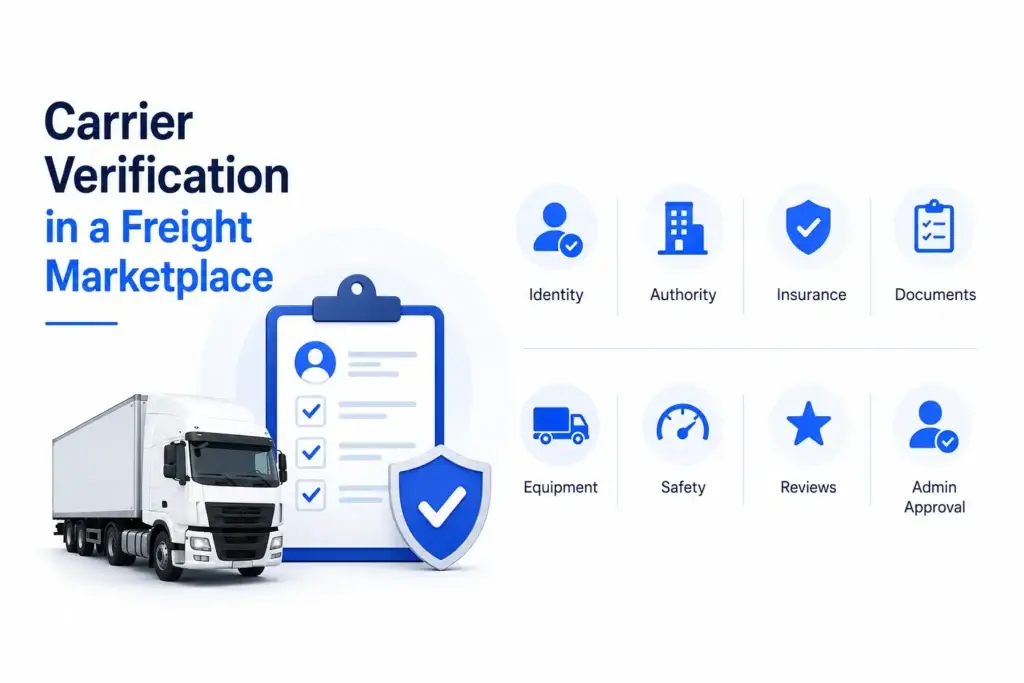
Carrier verification is the process of checking whether a carrier is legitimate, qualified, insured, operationally capable, and acceptable for the type of freight being assigned.
In a digital Freight Marketplace, verification may include:
- Identity verification
- Business registration checks
- DOT or operating authority review where relevant
- Insurance document verification
- Cargo insurance validation
- Equipment and capacity review
- Fleet profile checks
- Driver and vehicle documentation
- Safety and performance signals
- Compliance document expiry tracking
- Broker or shipper reviews
- Past cancellation or claim history
- Payment and bank account validation
- Suspicious behavior monitoring
- Admin approval before full access
The goal is not to create friction for legitimate carriers. The goal is to stop bad actors, incomplete profiles, and unqualified capacity from entering critical workflows.
A good verification system should be strict where risk is high and smooth where trust has already been established.
The Verification Layers Founders Should Build
Carrier verification works best when it is layered. No single check is enough.
Carrier Verification Layers in a Freight Marketplace
| Verification Layer | What It Checks | Why It Matters |
|---|---|---|
| Identity Verification | Whether the user behind the account is connected to a real and authorized business profile. | Reduces impersonation, account misuse, and suspicious onboarding activity. |
| Company Verification | Business name, contact details, operating details, authority status, and marketplace profile consistency. | Helps brokers and shippers know who they are actually working with. |
| Insurance Verification | Liability coverage, cargo insurance, expiry dates, certificate details, and policy relevance. | Protects freight movement from uninsured or underqualified capacity. |
| Equipment Verification | Trailer type, vehicle type, capacity, refrigeration, special handling ability, and fleet availability. | Prevents carriers from accepting loads they cannot safely or properly move. |
| Compliance Records | Required documents, expiry dates, safety signals, operating restrictions, and region-specific rules. | Supports operational due diligence before tendering freight. |
| Marketplace Behavior | Cancellation rate, response time, late pickup history, document quality, disputes, and suspicious actions. | Adds performance context beyond static documents. |
These layers should work together. A carrier may have a verified business profile but still have expired insurance. Another carrier may be compliant but not suitable for refrigerated freight. A carrier with valid documents may still show risky marketplace behavior.
A mature marketplace does not ask, “Is this carrier approved?” only once. It asks, “Is this carrier suitable for this load today?”
Carrier Onboarding Flow: From Signup to Marketplace Access
A clean onboarding workflow helps legitimate carriers join without creating weak verification gaps.
A practical carrier onboarding flow looks like this:
- Carrier creates an account.
- Platform collects company and contact details.
- Carrier submits business documents.
- Carrier uploads insurance certificates and compliance files.
- Carrier adds equipment, fleet, lane, and service region details.
- Platform checks required fields and expiry dates.
- Admin reviews documents or flags exceptions.
- Carrier receives pending, approved, rejected, or conditional status.
- Platform controls what the carrier can access based on verification status.
- Carrier must update documents before expiry.
- Risk status updates based on future behavior and load performance.
This prevents incomplete profiles from receiving the same access as fully reviewed carriers.
For example, a pending carrier may be able to browse general marketplace information but not bid. A conditionally approved carrier may only access low-risk loads. A fully verified carrier may access broader load opportunities. A carrier under review may be temporarily restricted.
That status-based approach keeps the platform flexible without ignoring risk.
Verification Status Should Control Load Access
Verification is only useful if it affects permissions.
If every carrier can view, bid, accept, and move every load regardless of verification quality, then the platform is only collecting documents for appearance.
A Freight Marketplace should connect verification status to access rules.
| Carrier Status | Suggested Platform Access | Use Case |
|---|---|---|
| New / Unverified | Limited account access, no bidding, no tender acceptance | Account created but documents not reviewed |
| Pending Review | Can complete profile and upload documents, limited marketplace visibility | Admin or automated checks still pending |
| Conditionally Approved | Can bid on lower-risk freight under defined limits | Some checks passed, but restrictions still apply |
| Verified | Can bid, accept, and operate within approved lanes, equipment, and rules | Standard operating status |
| High-Risk Review | Restricted from sensitive loads or payout changes | Suspicious activity, expired documents, or behavior flags |
| Suspended | No transaction access | Fraud, serious dispute, or compliance failure |
The admin dashboard should allow the platform operator to define these rules clearly.
This is especially important for high-value freight, temperature-sensitive shipments, regulated goods, multi-stop loads, or loads requiring special handling.
Reducing Fraud With Identity and Business Validation
Freight fraud often starts with identity confusion.
A bad actor may use a legitimate company name, copied documents, a compromised login, a fake email domain, or a phone number that does not match the real carrier. If the platform does not validate identity and business details, it may allow the wrong party to reach freight.
Useful fraud-reduction checks include:
- Identity verification for account owners
- Company email domain checks
- Phone and email validation
- Business registration consistency
- DOT or authority number validation where relevant
- Insurance certificate verification
- Bank account ownership checks before payout
- Device and login risk signals
- IP and location mismatch flags
- Multi-factor authentication
- New user behavior monitoring
- Suspicious profile-change alerts
No single control prevents every risk. The safer approach is layered validation.
For example, if a carrier changes banking details right before a payout, that should trigger additional review. If a new account claims to represent a known carrier but uses mismatched contact data, it should not be treated as fully trusted. If a carrier account shows unusual login behavior, the platform should flag it before the load is tendered.
Insurance and Document Verification: The Practical Risk Layer
Insurance verification is one of the most important parts of carrier onboarding.
A platform should not simply collect an uploaded PDF and mark the carrier verified.
The system should track:
- Insurance type
- Coverage amount
- Expiry date
- Named insured
- Certificate issuer
- Cargo coverage
- Liability coverage
- Policy exclusions where reviewed
- Document authenticity checks
- Renewal reminders
- Admin approval status
- Load eligibility linked to coverage
Documents also need controlled handling. A proof document, certificate, BOL, rate confirmation, or compliance file should be uploaded securely, stored safely, and reviewed by the right role.
Useful document controls include:
- Required document checklist
- File type validation
- Document expiry tracking
- Admin review queue
- Rejection reason
- Renewal notification
- Audit history
- Role-based download access
- Ownership checks
- Virus-scan status fields where implemented
The goal is to make the verification decision defensible.
If a broker later asks why a carrier was approved, the platform should show the review history, not just a green checkmark.
Carrier Risk Scoring: Moving Beyond Approved or Rejected
Binary verification is too limited.
A carrier can be legitimate but still risky for a specific load. Another carrier can be newly approved but not yet proven on the platform. A long-time carrier may become risky if documents expire or suspicious behavior appears.
Carrier verification also improves matching quality. Once the platform understands insurance status, equipment type, lane history, compliance records, and behavior signals, it can support smarter recommendations through AI load matching in a digital freight marketplace.
A better model uses carrier risk scoring.
A carrier risk score may consider:
- Verification completeness
- Document expiry status
- Insurance coverage status
- Equipment match
- Lane history
- Cancellation behavior
- On-time performance
- Dispute history
- Claim history where available
- Broker or shipper ratings
- Profile changes
- Login anomalies
- Banking update behavior
- Response consistency
- Load acceptance and rejection patterns
The score should not replace human judgment. It should help users prioritize review.
For example, a broker may see:
“Medium risk: insurance valid, equipment confirmed, but carrier has no lane history and recently changed payout details.”
That kind of explanation is more useful than a hidden score.
Re-Verification Before High-Risk Loads
Carrier verification should not happen only during account signup.
Some loads deserve an extra check before tender.
Re-verification may be useful when:
- The load is high-value
- The load is time-sensitive
- The load requires special equipment
- The carrier recently changed contact or payment details
- Insurance is close to expiry
- The carrier has limited platform history
- The carrier is accepting freight outside normal lanes
- The pickup location or route has higher risk
- A broker manually flags the carrier
- The system detects unusual behavior
This does not mean every load needs manual review. The platform can use rules.
For example:
- Verified carrier + normal lane + valid insurance = standard tender
- Verified carrier + new payout details + high-value load = review before tender
- Pending carrier + special cargo = blocked from bidding
- Expired insurance = automatic restriction until updated
This helps the marketplace stay operationally efficient without ignoring risk.
How Verification Improves Broker and Shipper Confidence
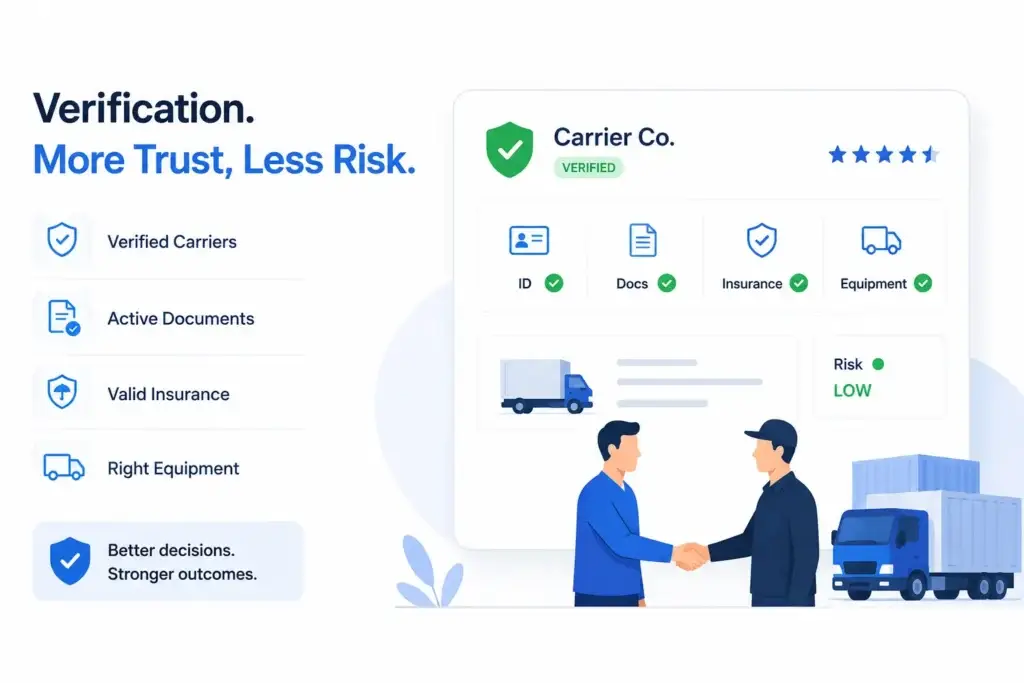
Brokers and shippers do not want more dashboards. They want fewer bad decisions.
Carrier verification helps them answer:
- Is this carrier legitimate?
- Does this carrier have active documents?
- Is the insurance current?
- Does the equipment fit the load?
- Has this carrier moved similar freight before?
- Are there recent risk alerts?
- Has the carrier changed key details recently?
- Is there enough evidence to award this load?
This is where verification becomes a commercial advantage.
A marketplace with stronger trust controls can attract more serious users because it reduces uncertainty. Brokers can act faster when evidence sits next to the load. Shippers can feel more confident when carrier approval is not based on memory or informal relationships alone.
Miracuves’ freight marketplace feature breakdown shows how carrier intelligence, company verification, ratings, broker credit signals, compliance records, and admin workflows can sit beside operational freight activity instead of living in disconnected systems.
Admin Controls Needed for Carrier Verification
The admin console is where the verification policy becomes enforceable.
A strong freight marketplace admin should include:
- Carrier profile review
- Company verification status
- Document upload review
- Insurance expiry tracking
- Compliance record management
- Approval, rejection, and conditional approval
- Rejection reasons
- Carrier notes
- Risk flags
- Manual restrictions
- Preferred and blocked carrier lists
- Broker or shipper-specific rules
- Review history
- Audit logs
- Expiring document reminders
- Suspicious behavior queue
- Role-based staff permissions
- Exportable compliance records where needed
The admin team should not need developers every time a verification rule changes.
For example, the platform operator may decide that carriers with expired insurance cannot bid, while carriers missing optional documents can browse but not accept high-value freight. These rules should be configurable where possible.
Verification and Freight Marketplace Monetization
Carrier verification can also support the platform’s business model.
A safer marketplace can create premium value through:
- Verified carrier badges
- Broker trust tools
- Carrier intelligence dashboards
- Premium compliance checks
- Advanced risk monitoring
- Verified-only load access
- Shipper-facing compliance reports
- Managed carrier onboarding
- Transaction fees on verified loads
- Subscription tiers for broker tools
- Add-on fraud monitoring modules
This does not mean every verification feature should be locked behind a paid plan. Basic trust controls should protect the marketplace as a whole.
Advanced reporting, managed onboarding, deeper carrier intelligence, and enterprise-grade risk workflows can become monetizable layers once the platform has strong marketplace activity.
For a deeper look at monetization options around subscriptions, transaction fees, broker tools, carrier services, and premium modules, read Miracuves’ freight platform business model.
Compliance Language Founders Should Use Carefully
Carrier verification can support compliance workflows, but it should not be marketed as a guarantee of legal compliance.
A safer way to position the platform is:
- Supports carrier verification workflows
- Helps organize compliance records
- Provides audit logs for review decisions
- Can be configured around regional requirements
- Helps operators prepare stronger internal controls
- Final compliance depends on jurisdiction, legal review, business model, integrations, and operating process
Avoid claims such as:
- Fully compliant everywhere
- Guaranteed fraud-free platform
- Regulator-approved carrier onboarding
- Zero-risk freight marketplace
- Complete legal protection
This matters because logistics rules vary by region, freight type, operating model, and customer expectation.
A good product gives the operator tools, records, and workflows. The final compliance decision still depends on the business and its advisors.
Security and Privacy Controls for Carrier Data
Carrier verification requires sensitive information.
The platform may store identity records, company details, insurance documents, bank details, tax information, contact records, and operational history. That data should be handled carefully.
Important security controls include:
- Role-based access control
- Encrypted data transfer
- Secure API integration
- Permission-based dashboards
- Admin access controls
- Activity logs
- Document access restrictions
- Secure file storage
- Audit trails for approval decisions
- Account change alerts
- Multi-factor authentication
- Staff permission levels
- Data retention rules
- Suspicious login monitoring
Trust is not only about verifying carriers. It is also about protecting the information carriers share with the platform.
If carriers do not trust the onboarding process, they may avoid completing profiles or sharing required documents.
Common Mistakes Startups Should Avoid
Treating Document Upload as Verification
An uploaded file is not automatically verified. The platform needs review status, expiry tracking, approval history, rejection reasons, and access controls.
Allowing Unverified Carriers to Bid Freely
If unverified accounts can access high-risk freight, the marketplace weakens its own trust layer. Verification status should control transaction permissions.
Ignoring Re-Verification Triggers
Carrier status can change after onboarding. Expired documents, payout changes, unusual login activity, and high-value loads should trigger additional checks.
Building Verification Outside the Load Workflow
Carrier trust signals should appear near bidding, tendering, dispatch, and payment decisions. If verification lives in another tool, users may ignore it under pressure.
Founder Decision Signals for Carrier Verification
Trust
If brokers and shippers are worried about who is moving freight, carrier verification should be part of the first platform release, not a later add-on.
Risk
If loads include high-value cargo, sensitive delivery windows, or special handling requirements, verification status should control access and tender eligibility.
Scale
If the marketplace grows beyond a small known network, manual memory-based carrier vetting becomes unreliable. Admin queues and risk scoring become necessary.
Revenue
If the platform plans premium broker tools, verified carrier access, managed onboarding, or compliance reporting, the verification layer can support monetization.
Where a Ready-Made Freight Platform Foundation Helps
Building a Freight Marketplace from zero requires more than load posting and bid management.
The platform needs carrier onboarding, user roles, verification status, document review, insurance tracking, load access rules, bidding workflows, dispatch, tracking, POD, invoicing, admin controls, audit logs, and reporting.
If budgeting is the next step, review these freight marketplace development cost factors to understand how modules, integrations, ownership, verification workflows, and launch scope affect planning.
Startups that need implementation support can also evaluate Miracuves as a freight app development partner for carrier onboarding, verification workflows, fraud controls, dispatch logic, and admin operations.
A ready-made foundation can help founders launch faster when the core freight workflow is already understood and the main work is configuration, branding, market adaptation, and workflow refinement.
Miracuves offers a freight marketplace and load board solution for founders who want a launch-ready platform with load posting, carrier workflows, dispatch control, tracking, compliance records, monetization, and admin operations. This blog focuses on the carrier verification layer, while the solution page remains the commercial destination for product evaluation.
If budgeting is the next step, review these freight marketplace development cost factors to understand how modules, integrations, ownership, and launch scope affect planning.
Startups that need implementation support can also evaluate Miracuves as a freight app development partner for carrier onboarding, verification workflows, marketplace operations, dispatch logic, and admin control.
For custom workflows across freight marketplaces, carrier portals, dispatch tools, fleet systems, and supply-chain operations, explore Miracuves’ logistics app development services.
Final Thoughts: Verification Is the Trust Layer of a Freight Marketplace
A Freight Marketplace should not only help users find capacity. It should help them trust the capacity they find.
Carrier verification reduces the risk of fake accounts, incomplete profiles, expired insurance, unqualified equipment, suspicious behavior, and weak tender decisions. It gives brokers and shippers better evidence before assigning freight. It gives platform operators better control over who can access loads, bid, dispatch, and receive payment.
For broader digital transformation across transportation, fulfillment, fleet operations, and supply-chain workflows, explore Miracuves’ logistics and supply chain software solutions.
For founders, this is the bigger lesson: marketplace liquidity without verification can create exposure. Verified liquidity is stronger.
The best freight platforms do not treat trust as a manual side process. They build it into onboarding, bidding, tendering, dispatch, documents, payments, and admin review from the beginning.
For broader digital transformation across transportation, fulfillment, fleet operations, and supply-chain workflows, explore Miracuves’ logistics and supply chain software solutions.
FAQs
What is carrier verification in a Freight Marketplace?
Carrier verification is the process of checking whether a carrier is legitimate, qualified, insured, compliant, and suitable to move freight. It may include identity checks, company verification, insurance review, equipment validation, document tracking, risk scoring, and admin approval.
Why is carrier verification important before assigning a load?
Carrier verification helps reduce fraud, unqualified capacity, expired insurance risk, identity misuse, double brokering risk, and poor carrier selection. It gives brokers and shippers stronger evidence before tendering freight.
What documents should a freight marketplace collect from carriers?
A marketplace may collect company details, operating authority records where relevant, insurance certificates, cargo coverage documents, vehicle and equipment information, driver details, tax or payment details, and compliance documents based on the operating region.
Should verification status control bidding access?
Yes. Verification status should control whether a carrier can browse, bid, accept, or move loads. Unverified or high-risk accounts should not receive the same access as fully reviewed carriers.
What is carrier risk scoring?
Carrier risk scoring combines signals such as verification completeness, document status, insurance expiry, lane history, cancellation behavior, dispute history, account changes, and suspicious activity. It helps users evaluate suitability before awarding freight.
How often should carriers be re-verified?
Carriers should be re-verified when documents expire, insurance changes, payout details change, suspicious activity appears, or high-risk loads are involved. Some platforms may also schedule regular periodic reviews.
Can carrier verification prevent all freight fraud?
No verification system can guarantee zero fraud. However, layered identity checks, document review, insurance tracking, risk scoring, admin queues, audit logs, and access controls can reduce exposure and help operators respond faster.
Can Miracuves help build carrier verification workflows for a freight platform?
Yes. Miracuves helps founders launch ready-made and white-label freight marketplace platforms with carrier onboarding, verification status, document review, dispatch workflows, tracking, admin dashboards, and source-code ownership. Verification workflows can be configured around the selected business model and regional requirements.
Miracuves is an independent software development company. We are not affiliated with, connected to, sponsored by, or endorsed by any company or product named in this article.
Terms such as “X Clone” are used descriptively. It is how the software industry refers to building a platform with functionality comparable to a known service, and how clients search for it.
The entire design and codebase of our products is built by our own team. Our products contain no code, design, graphics, or content originating from any third-party website or applications.
All third-party names and marks referenced in this article are the property of their respective owners, referenced solely to identify the services discussed.