Key Takeaways
- A script is a starting point, not a business. The useful question is what the package includes on day one: apps, coach tools, operator console, billing and food data, not how many features a brochure lists.
- Price shape matters more than price. A ready-made script is a fixed one-time price, custom work is a scoped quote, and SaaS is a subscription that never ends. Compare all three over 12 and 36 months.
- Food data is the cost nobody quotes. A calorie app is only as good as its catalog. Check whether Indian foods, portions and barcodes are in the package and who keeps the catalog current.
- AI usage follows members, not the build. An AI coach costs per use on your own provider key. Per-member daily caps keep that line predictable.
- Android and iOS should arrive together. If a vendor prices the iPhone version apart, the price you were shown is not the price you will pay.
- Run the demo before the call. Try all three roles, member then coach then admin, log a meal six ways, change a price and read an invoice. An hour tells you more than a feature sheet.
- Own the code and the data. Ask for full source code, an export route and a deletion workflow in writing before you pay anything.
- Use the 15-point checklist below. It turns a vague comparison into a yes or no per vendor, so the shortlist makes itself.
A HealthifyMe clone script is a ready-built calorie-tracking and nutrition-coaching product that you license, brand and launch as your own. Buying one looks simple: find a demo, compare a price, sign. In practice the packages differ enormously. One includes native apps, a coach portal and an operator console. Another is a web template with a food diary. A third is a monthly subscription that you will keep paying for as long as you operate.
This guide is written for the founder who is about to compare quotes. It explains what a script in this category must include, how the three pricing routes work, which costs sit outside every price list (food data, AI usage, hosting, payments), a 15-point vendor checklist, and a step-by-step way to test a published demo in about an hour.
We build this category at Miracuves, so the examples lean on our own ready-made nutrition coaching app. Where a claim is about the wider market, it is sourced and linked. If you would rather start with the product itself, our plain-language explainer of how the app works covers the member journey first.
What a HealthifyMe Clone Script Actually Is
Strip the marketing and a script in this category is four things in one package: a member app for logging food and following a plan, a coaching layer where humans and software answer members, an operator console where you run prices and payouts, and the plumbing that connects them (accounts, subscriptions, notifications, a food catalog).
The reference point is a well-known Indian nutrition app. According to its public profile, HealthifyMe was founded in Bengaluru in 2012 and grew from a calorie counter for regional foods into a freemium coaching product with an AI nutritionist, food photo logging and human coaches. That mix, tracking plus coaching plus a business behind it, is what buyers mean when they search for a HealthifyMe clone script, and it is the yardstick for the rest of this guide.
Three honest limits apply to any script, ours included:
- A script gives you the product, not the members. Acquisition, coach hiring and content are your work.
- A script does not make you a medical provider. It supports habit change and general guidance, and it should say so in the app.
- A script is a base. The more of your model that fits its defaults, the faster and cheaper the launch; the more you need unusual workflows, the more you are really buying custom work.
Core Features a Calorie and Coaching Script Must Include
Feature lists are cheap to produce, so judge a script by whether each layer exists as working software. The table below is a buying filter, not a tour; each row names the layer, what should be present and the question that exposes a thin implementation. For a deeper look at how the food side is engineered, see our guide to the engineering behind a calorie counting app.
| Layer | What should be present | Question that exposes a thin version |
|---|---|---|
| Onboarding and targets | A structured assessment that produces a calorie budget, macro split, water and step targets | Are targets stored and editable, or recalculated and lost? |
| Food logging | Six routes: search, barcodes, photos, voice, label scans and free text, plus custom foods | Which of these work without an extra paid service, and which need your AI key? |
| Food catalog | Indian foods, portion sizes, brands, barcodes and a moderation route for member-added foods | Who curates it, and can you edit it from the console? |
| Plans and recipes | Weekly meal plans, recipes with macros, auto-fill and a shopping list | Does the plan respect diet and restriction answers? |
| Coaching | AI coach on your own key, human coaches in the same thread, appointments, notes and follow-ups | Does a coach see the diary before replying? |
| Progress | Weight trend, measurements, streaks, habits, weekly review | Does history stay fixed when a food entry is edited later? |
| Billing | Free, premium and coaching tiers, trials, coupons, rupee checkout and card billing | Can you change a price without a release? |
| Operator console | Members, plans, finance, coach pay, store, AI routing and feature switches | How many separate areas, and is every change audited? |
| Platforms | Android and iOS apps, responsive web app and a coach portal | Are native apps in the base price? |
Two items deserve their own warning. First, the AI coach: it should answer from the member’s own diary and weight trend, show members what it can see, and carry a per-member daily cap on calls and tokens. It gives general guidance and is not medical advice, and a script that implies otherwise is a liability for you, not a feature. Second, coach pay: if you plan to employ or contract coaches, the script needs rate cards (retainer, per member, per session or commission) and monthly settlements with line items. Without them you will run payouts in a spreadsheet.
What Miracuves includes in the base
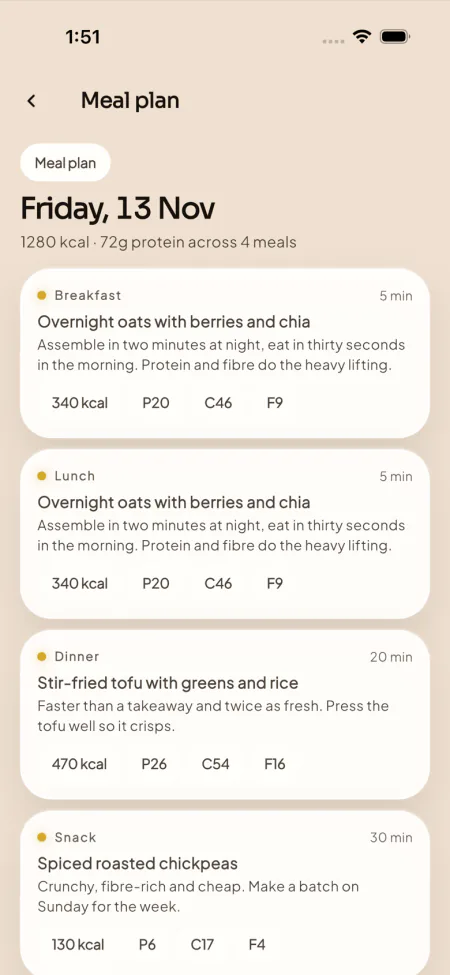
In the Miracuves build, a member sets up through a 12-question assessment, logs meals six ways, plans the week with recipes and a shopping list, asks the AI coach, follows lessons and tracks progress. Coaches work from a caseload view where each client’s food log, goals and messages sit side by side. Operators get a console with 14 areas. Every one of these ships as part of the base product, which is built on MXHealthy and described on our ready-made nutrition coaching app page.
Three Ways Scripts Are Priced
Every quote you receive will fall into one of three shapes. Knowing the shape before you read the number saves weeks.
| What you compare | Ready-made script | Custom development | SaaS or no-code builder |
|---|---|---|---|
| How you pay | One-time fixed price, shown publicly | Scoped project fee after discovery | Monthly or annual subscription |
| Time to first live build | Days. Miracuves ready-made is 6 working days of work | Weeks to months | Days to weeks |
| Native Android and iOS apps | Should be included; verify | Whatever you scope | Often web first; check the plan |
| Source code | Should be included; verify | Yes if the contract says so | Usually not, or partial |
| Fit for unusual workflows | Configuration plus add-on work | Full | Limited to the platform’s model |
| Price risk | Low: the number is the number | Scope creep and delay | Per-seat or per-member fees rise with growth |
| Exit cost | Low: you own the code | Low if you own the code | High: you rebuild elsewhere |
A fixed price is only meaningful if it is public and the inclusions are listed. If a vendor will not show a number until a sales call, assume the number moves with your enthusiasm. If a vendor shows a very low number, check which of the table rows above were quietly excluded.
Ready-made: what the fixed price should cover
A ready-made price should cover the whole delivered product: native apps for both platforms, a browser version, coach screens, an operator console, full source code and a defined support period. Ours is $3,399, paid once. Custom work on top of the base is quoted separately: typically 15 to 30 days, and up to 45 to 60 days for larger scope.
Custom: where the quote comes from
A custom quote is a time estimate multiplied by a team rate, and the market is wide. Clutch’s app development pricing guide reports an average project cost above $90,000, with most reviewed projects between $10,000 and $49,999. A nutrition product with AI, billing and a coach layer sits in the upper part of that spread unless it starts from a proven base. Custom is the right choice when your workflow is the differentiator; it is rarely the right choice when your model is calorie tracking plus coaching, which is a known shape.
SaaS: cheap to start, expensive to stay
A subscription platform can be the cheapest way to test a simple idea. The cost curve is the issue. Compare the total over 36 months, include per-seat or per-member fees at the member count you hope to reach, and ask what happens to your data and your branding if you leave. Subscription tools also rarely include native apps under your own store account, which matters for retention in a habit product.
Hidden Costs Outside the Price List
The build price is one line. Four categories sit beside it, and each one behaves differently as you grow. Budget them separately so no single surprise ends the project.
Food data
A calorie app lives or dies on its catalog. Free public data exists: the USDA’s FoodData Central is published in the public domain with an API. But it is built around American foods, and Indian home cooking (a katori of dal, a roti, a regional sabzi) needs portions and nutrient values that a US catalog does not carry well. Decide early how the catalog will be built and curated: operator-curated entries, an imported commercial database, or both. Our package ships with Indian foods in the catalog and a console to edit, moderate and extend it. Plan staff time for curation either way, because catalog quality is the single biggest driver of whether members keep logging.
AI usage
An AI coach, photo logging and plan generation use your own AI provider key, and you pay the provider per use. That cost follows member activity, not the build. Two controls keep it predictable: per-member daily caps on calls and tokens, and routing each task (chat, vision, plan generation) to a model sized for that job. Ask any vendor whether those controls exist in the operator console, and who owns the key. If the vendor holds the key and resells usage, you have a hidden margin layer.
Hosting and storage
The platform needs a server, a PostgreSQL database, TLS and backups. Usage-based cost appears in three places only: database growth, media, and AI. Images are stored in the database at launch and move to object storage as volume grows, which is a planned scale step, not a rebuild. Ask a vendor for its own scale path in writing: vertical first, then read replicas, then partitioning.
Payments and store accounts
Card processing is a percentage of every transaction. As one example, Stripe’s India pricing page lists 2% for domestic Visa and Mastercard cards and 3% for foreign-issued ones, with currency conversion on top. Rupee checkout through an Indian gateway has its own fee schedule. Store accounts are small but not free: Apple’s developer program costs $99 per year and Google charges a one-time $25 registration fee. Open both as an organization early; verification is the slow step, not the fee.
| Cost line | Who pays | How it scales | What to ask a vendor |
|---|---|---|---|
| Build | You, once (ready-made) or per scope (custom) | Does not scale with members | Is the number public and the inclusions listed? |
| Food data | You, in staff time or a data license | Grows with the catalog | Who curates and can I edit it in the console? |
| AI provider usage | You, to your provider | Grows with active members | Is there a per-member cap and do I own the key? |
| Hosting and database | You, to your host | Grows with data and media | What is the written scale path? |
| Card and rupee fees | You, to your processor | Grows with revenue | Which gateways are connected out of the box? |
| Email and push | You, to your providers | Grows with sends | Are templates and reminders configurable? |
| Store accounts | You, to Apple and Google | Fixed | Do I publish under my own organization account? |
| Support after launch | Included period, then optional | Fixed | What exactly is covered and for how long? |
Check the India Defaults Before You Pay
If your audience is in India or the Indian diaspora, three defaults decide whether the script feels native or imported: rupee payments, Indian foods and an Indian language. They are cheap to include in a base product and expensive to retrofit, so test them first.
- Rupee checkout. Members should be able to pay in rupees at an Indian checkout as well as by card. Our package includes rupee checkout alongside Stripe.
- Indian foods in the catalog. Search for dal, paneer, poha, idli and a regional dish you know well. Check the portion units, not only the name.
- Hindi alongside English. Our app ships in English and Hindi. Further languages such as Tamil, Telugu, Bengali, Marathi, Arabic and Spanish are available as a regional language pack add-on, scoped and priced in writing.
The same test works for any market: swap the dish names and the currency for your own, and treat a miss as an add-on cost to price in before you sign.
The 15-Point Vendor Checklist
Use this list verbatim in an email to every vendor. A good vendor answers each point with a specific yes and a document. A vague answer is a no.
- Public price. Is the fixed price published, with the inclusions listed beside it?
- Native apps. Are Android and iOS apps both in the base price, not one now and one later?
- Full source code. Do you receive the complete code, schema and deployment notes at handover?
- Coach portal. Is there a role-gated coach desk with caseload, member detail, notes and earnings?
- Operator console. Can you change prices, trials, coupons, coach rates and feature switches without a release?
- Food logging paths. Can members log from search, barcodes, photos, voice, labels and free text, and which of those need an AI key?
- Food catalog. Are Indian foods and portions present, and can you curate and moderate entries?
- AI controls. Does it route tasks to your own provider key with per-member daily caps and a view of what the coach can see?
- Billing. Are free, premium and coaching tiers, trials and coupons built in, with both card and rupee checkout?
- Coach pay. Are retainer, per-member, per-session and commission models supported, with monthly settlements?
- Security controls. Are there roles checked on every action, hashed passwords, parameterized SQL, session cookies without browser-storage tokens and an audit trail?
- Privacy workflows. Is there a member data export and an account deletion route with a grace period?
- Delivery date. Is the time to a live build stated in working days, with store review listed separately?
- Support terms. Are guidance, bug resolution and product updates each given a stated period?
- Add-on pricing. Are wearable sync, smart scale and glucose monitor sync, video coaching, a video lesson studio and a corporate portal listed as priced add-ons rather than vague roadmap?
Points 1, 2, 3 and 13 eliminate most of the market on their own. If you only have time to check four things, check those.
How to Test a Published Demo in One Hour
A published demo is the fairest comparison tool you have, because it cannot be rehearsed for you. Ours runs at mxhealthy.mimeld.com, with an Android build on the demo app portal. Use the same routine on every vendor.
- Minutes 0 to 10, member side. Sign in as the demo member (maya@mxhealthy.app, password demo1234), open Today and note whether the calorie ring, macros and water are live.
- Minutes 10 to 20, logging. Log a meal by search, then try the barcode scan, photo and typed description paths. Search for three Indian dishes.
- Minutes 20 to 30, plan and coach. Open the meal plan, auto-fill a day, view the shopping list, then ask the AI coach why you feel hungry at 4pm. The answer should cite your day, and the screen should show what the coach can see.
- Minutes 30 to 40, coach portal. Sign in at the coach page as priya@mxhealthy.app and open the caseload, a member’s diary and the earnings screen.
- Minutes 40 to 55, operator console. Sign in at the admin page as admin@mxhealthy.app. Open members, finance, coach rates, the store and the feature switches. Ask yourself whether a non-technical manager could change a price here.
- Minutes 55 to 60, what is missing. List every screen that was empty, every label that confused you and every feature that needed a key. Those become your questions for the vendor call.
Remember that all figures inside a demo are seeded sample data, never business metrics. Judge whether the product works, not whether the numbers look impressive. A weak demo with a strong sales deck is the most common pattern in this market.
Red Flags in Scripts and Vendors
After the checklist, a short list of patterns that predict regret:
- Screenshots without a live demo. Mockups are free; working software has to be shown.
- A split quote for the iPhone version. It turns a published price into a first instalment.
- The vendor holds your AI key. You lose cost visibility and give away margin.
- No coach pay model. You will end up reconciling payouts by hand within a quarter.
- Certification claims with no document. A badge is not evidence; ask for the control list and what is actually tested.
- Outcome promises in the marketing. A nutrition app supports habit change. Promises of specific weight loss are a legal and reputational risk for you, as the operator.
Contract and Handover Terms to Get in Writing
Once a vendor passes the checklist, the contract decides whether the answers stay true. Five terms are worth reading line by line, because they are the ones that surface only when something goes wrong.
- What is delivered at handover. The contract should list source code for every app, the database schema, deployment configuration and architecture notes, not only a login to a hosted instance.
- Who holds the accounts. The Apple and Google developer accounts, the domain, the hosting and the payment accounts should be in your company’s name from day one.
- What counts as a bug and what counts as a change. A clear line avoids arguments in month three. Bugs belong to the support period; new behavior belongs to a scoped change with a price.
- How add-ons are quoted. Ask for each add-on to be scoped with a price and a delivery window before work starts, so the base price and the final bill stay comparable.
- What happens at the end of the support period. A product keeps changing after launch, so ask what ongoing evolution looks like and whether it is optional.
None of this is exotic. It is the same discipline you would apply to a lease or a franchise agreement, applied to software that will hold your members’ food diaries and payment references. A vendor who is comfortable with these terms is usually a vendor who has delivered before.
Who Should Buy a Script and Who Should Not
A ready-made script is the right route when the model is proven and speed matters: calorie tracking, plans, coaching, subscriptions and a store. It is the wrong route when the core of your business is a clinical workflow, a new medical device integration or a regulated service. In those cases the build is the product, and custom development is the honest answer.
The middle case is common. You want the proven base plus one or two differentiators. That is the sweet spot for a base and a scoped add-on: launch the base quickly, learn from real members, then commission the differentiator with evidence behind it rather than a guess. Our buyer’s guide to a weight-loss coaching script walks through the same decision for a behavior-change product.
Founder Decision Signals: Are You Ready to Buy a Script?
Price Is In Writing
Do you have a fixed price, a list of inclusions and a delivery time in working days, not a rough estimate?
Demo Is Tested
Have you opened a published demo in all three roles and logged a meal, a plan and a coach question?
Running Costs Are Modeled
Have you estimated AI usage, card fees, hosting and food data upkeep for the member count you plan to reach?
Catalog Fits Your Market
Do the foods, portions, currency and language match the people you intend to serve on day one?
Ownership Is Clear
Do you own the source code, the data and the store accounts, with an export and a deletion route?
Growth Budget Exists
Is there cash for coaches, content and acquisition after the build is paid for?
How Miracuves Helps You Launch a Nutrition Coaching Business
Miracuves sells the product this guide describes, built on MXHealthy and priced openly at $3,399, one time, with full source code. The ready-made nutrition coaching app includes phone apps for Android and iOS together, a browser version, a desk for coaches and an operator console organized into 14 areas. It runs on Next.js, TypeScript, PostgreSQL and Flutter, takes payments through Stripe plus rupee checkout, and ships in English and Hindi with Indian foods in the catalog.
The ready-made build goes live in 6 working days of Miracuves work, with store review handled separately and on the stores’ own timelines. Custom changes on top typically take 15 to 30 days, and larger scope up to 45 to 60 days. Support runs in three overlapping periods: 60 days of dedicated platform guidance, 6 months of priority bug resolution and 12 months of continuous product evolution.
Six paid add-ons cover what many founders ask for next: native wearable adapters, smart scale and glucose monitor sync, live video coaching and group classes, a video lesson studio, a corporate wellness portal and regional language packs. Every add-on gets its own written quote and timeline, kept apart from the base price so nothing is buried in it.
Security is described by what the code does. Every page and every action checks the caller’s role, identity always comes from the server session, passwords are hashed, queries are parameterized, and operators get an audit trail for plan, price, payout and order changes. Members can export their data and request deletion with a grace period. Browse the wider healthcare solutions we build or ask for our published product facts if you want every claim traced.
Final Thoughts
Buying a HealthifyMe clone script is a smaller decision than building a nutrition company, and it deserves a smaller process: a public price, a tested demo, a modeled cost sheet and a checklist that every vendor answers in writing. Most of the regret in this market comes from skipping one of those four steps and discovering the gap after payment.
Run the checklist this week, test two demos for an hour each and price the running costs before you compare headline numbers. If a proven model and a firm launch date describe your plan, Miracuves will put the fixed price, the inclusions and the delivery time in front of you in writing, and leave your budget for the coaches and members the business depends on.
Frequently Asked Questions
What should a HealthifyMe clone script include as a minimum?
At minimum it should include native apps for Android and iOS, a browser version for members, coach tools, an operator console, food logging with a food catalog, meal plans, an AI coach on your own provider key, subscription billing and full source code. If any of these is missing from the base package, ask for it to be priced in writing before you compare vendors.
How are nutrition app scripts priced?
They fall into three shapes. A ready-made script is a one-time fixed price, custom development is a scoped project fee after discovery, and SaaS is a recurring subscription. Compare them over 12 and 36 months, and include running costs such as AI usage, card fees and hosting, which sit outside all three.
What hidden costs come with a calorie tracking app?
The main ones are food data upkeep, AI provider usage, hosting and database growth, card and rupee payment fees, email and push providers, store developer accounts, and the staff time for coaches and catalog curation. None of these is part of the build price, so budget them separately.
Does a script include an Indian food database?
It depends on the vendor, so test it. Search for several everyday dishes and check the portion units such as katori and roti, not only the names. Our package includes Indian foods in the catalog and a console to extend and moderate them, and no catalog size is promised.
Who pays for the AI coach usage?
You do, to your own AI provider, per use. The cost follows how many members use the coach and how often. Look for per-member daily caps on calls and tokens and per-task routing so the spend stays predictable. The coach gives general guidance and is not medical advice.
How do I test a script demo properly?
Open the demo as a member, then a coach, then an admin. Log a meal by search, barcode, photo and typed description, build a meal plan, ask the coach a question, then change a price or a coach rate in the console. Note every empty screen and every feature that needs a paid key, and ask the vendor about each.
Can I own the source code of a nutrition app script?
You should. Ask for full source code, the database schema and deployment notes at handover, and confirm in the contract that there is no per-seat or per-member license fee. Without source code you cannot move hosts, change developers or add features freely.
Is a ready-made script better than custom development?
For a proven model such as calorie tracking with coaching and subscriptions, a ready-made script usually launches far sooner and costs less upfront. Custom development makes sense when your core workflow is new or regulated. Many founders launch a base first and commission one differentiator later.
What support should come after launch?
Ask for each period in writing: guidance during launch, a window of priority bug resolution and a longer period of product updates. Miracuves provides 60 days of dedicated platform guidance, 6 months of priority bug resolution and 12 months of continuous product evolution.
Miracuves is an independent software development company. We are not affiliated with, connected to, sponsored by, or endorsed by any company or product named in this article.
Terms such as “X Clone” are used descriptively. It is how the software industry refers to building a platform with functionality comparable to a known service, and how clients search for it.
The entire design and codebase of our products is built by our own team. Our products contain no code, design, graphics, or content originating from any third-party website or applications.
All third-party names and marks referenced in this article are the property of their respective owners, referenced solely to identify the services discussed.