

Key Takeaways
- Four lines carry the money. A rupee-priced nutrition app earns from paid plans, coach-led plans, a product store and partner or corporate plans. Everything else is a cost line or a growth lever.
- The free tier is a cost, not revenue. In the worked example below, each paying Premium member covers the running cost of about 23 free members, so the free-to-paid rate decides the business.
- Coaching is the biggest line and the biggest cost. HealthifyMe’s FY23 filings, as reported by Inc42, show coaching revenue of INR 139.24 Cr against INR 79.23 Cr paid to healthcare professionals.
- Coach commission is money you pay out. A flat retainer, a fee per client, a fee per session or a sales cut each moves risk to a different party, and coaches trust a payout only when they can read its line items.
- Store billing and rupee checkout change the margin. Selling a subscription through an app store can cost 15% of every rupee, while web or UPI-style checkout costs a gateway fee of a few percent.
- Price in rupees, not converted dollars. Indian members compare you with a gym fee or a dietitian visit, so plan prices, coupons and free-shipping thresholds all need to be set in INR.
- A runtime operator console keeps pricing flexible. Plans, trials, coupons and coach pay change without an app release, which lets you test price points the week you think of them.
Ask ten founders how a diet app makes money and nine will say subscriptions. That answer is true and not very useful. The questions that decide whether an India-first nutrition business survives are narrower: how many free members convert, what a coach costs per client, who takes a cut of each rupee, and whether the store earns margin or only adds support tickets.
This post breaks the HealthifyMe revenue model into its working parts and then prices an imaginary rupee-based app line by line. It does not repeat the full company history; for the overall picture of how the company works, read our overall business model explainer first and come back here for the arithmetic.
Two kinds of numbers appear below. Facts about HealthifyMe come from public filings coverage and press releases, each linked at the point of use. Every figure in the worked example is an assumption we chose to make the maths easy to follow, and it is labeled that way. Replace them with your own before you take any decision from them.
If you are weighing a build rather than a study, the ready-made India-ready nutrition and coaching app already contains the plan tiers, coach pay models, store and rupee checkout discussed here, so you can test these revenue lines on a working product instead of a spreadsheet.
What a Rupee-Priced Nutrition App Actually Sells
A diet app sells four different things under one logo, and they have different buyers, margins and sales cycles. Separating them is the first step in any revenue model.
- Access to tools. Food logging, a calorie and macro budget, meal plans, workouts and progress charts. This is the free tier and the entry paid tier.
- Access to people. A human nutrition coach who reads the diary and answers inside the one conversation the automated coach also uses. This is the high-price tier and the one with real labor cost.
- Products. Supplements, kitchen tools, ready meals or measuring devices sold through an in-app store, with margin and shipping economics of their own.
- Programs for groups. Employer or partner plans, where one buyer pays for many members and the sales motion looks more like B2B than app marketing.
Each line answers a different member need, which is why a single price rarely works. A student logging lunch will not pay what a person managing a long-term eating plan will pay, and neither behaves like an employer buying wellness cover for a team.
Why rupee pricing is not a currency conversion
It is tempting to take a Western price list and divide by the exchange rate. That is how apps end up priced out of the market. Indian members compare a plan with the monthly gym fee, a dietitian consultation or a bundle of groceries, not with a US subscription. Payment habits differ too: UPI-style checkout and rupee cards convert better than a foreign-currency card form, which is why MXHealthy supports Indian rupee checkout alongside Stripe, with English and Hindi in the app and Indian foods in the catalog. Price in INR from the first plan page, and treat the card fee and the cost of a coach as rupee costs as well.
What HealthifyMe’s Public Numbers Show
HealthifyMe is one of the few Indian consumer health apps whose accounts have been reported in detail. The most useful public breakdown is for the year to March 2023, covered by Inc42’s report on the FY23 filings. The table restates those reported lines and adds two ratios we calculated from them.
| Line (INR crore) | FY22 | FY23 | What it tells a founder |
|---|---|---|---|
| Revenue from operations | 185.25 | 228.76 | Grew about 23.5% in a year, mostly from coaching. |
| Nutrition and wellbeing coaching | 111.62 | 139.24 | About 61% of FY23 revenue came from the human-coaching line. |
| Support services | 72.10 | 74.11 | A second large line. Inc42 notes it could include revenue from the company’s Pro subscription plan, which the filings do not confirm. |
| Product sales (health devices) | Not reported | 13.90 | First reported in FY23. About 6% of revenue, so devices were a supporting line, not the engine. |
| Payments to healthcare professionals | 80.25 | 79.23 | Roughly 57 paise paid out for every rupee of coaching revenue, if the two lines are read side by side. |
| Advertising and promotion | 133.19 | 115.90 | About half of revenue was spent to acquire members. |
| Employee benefit expenses | 93.85 | 116.09 | Up about 24%, the other big fixed cost. |
Read the table carefully. The ratio between payouts and coaching revenue is our arithmetic on two separate reported lines, so it is a guide, not an official margin. Still, it points to the lesson that matters for anyone planning a similar app: the human-coaching line produces the most revenue and consumes the most direct cost, and a large share of revenue goes to acquiring members.
Earlier price lists show the same logic from the customer’s side. In a 2017 press release on a premium plan sold through an online marketplace, prepaid coach-led plans were listed at INR 2,799 for two months with an activity tracker, INR 3,699 for three months, INR 5,699 for six months and INR 9,499 for twelve months. Those are dated prices and not today’s, but the shape is instructive: the twelve-month plan works out to roughly INR 792 a month, well under the INR 1,400 a month implied by the two-month bundle that included a device. Longer commitments cut the monthly price and, in exchange, lock in revenue and reduce churn.
We deliberately do not quote a current HealthifyMe price list. Its prices change by offer and by market, and we could not find one official, current source. Treat any blog that prints a fixed number as a snapshot at best.
Revenue Line One: From the Free Tier to Paid Plans
The free tier is the largest group of members and the smallest source of income. It exists to make the paid tiers believable: members log food, see their calorie budget and meet the product before they pay. In cost terms it is a marketing expense with a hosting bill attached.
What a free tier should include
Keep the free tier useful enough to build a daily habit and limited enough to leave a reason to upgrade. In MXHealthy the three plan levels are free, premium and coaching, with meal plans limited on the free level and fully open on the paid ones. Food logging, the daily budget and basic progress remain free. The operator sets the line between free and paid in the console, so you can move it as you learn what members value.
Monthly, annual and trial prices
Every tier holds three numbers of its own (what a month costs, what a year costs, and how many free days come first), and the operator edits all three while the app is live. They pull on different levers:
- Trial days decide how many members reach a paid plan. Too short and members have not formed a habit; too long and you pay for service that never converts.
- Annual price decides how much cash you collect up front and how many members you retain past the first month, which is when many diet apps lose them.
- Coupons with spending caps and counted redemptions let you run a festival or new-year offer without giving away unlimited discounts.
A sensible first test is to price the annual plan at roughly eight to ten times the monthly price in rupees. That discount is large enough to persuade a motivated member to commit and small enough to protect the monthly offer. It is a starting hypothesis, not a rule, and the console lets you change it the day the data disagrees.
Where conversion usually leaks
Founders often blame price when the leak is earlier. Members who never complete the 12-question assessment never see a personal budget, and members who do not log a second day rarely pay. Track assessment completion, day-two logging and trial-to-paid as three separate numbers before you touch the price. The acquisition half of that funnel lives in our India growth playbook for a diet app; here we stay with the money once a member has arrived.
Revenue Line Two: Coach-Led Plans
The coaching tier is the top rung of the ladder and the reason a nutrition app can charge several times what a pure tracker charges. The member gets a person who has read the diary, targets and messages before replying, in the same thread as the automated coach. The AI coach gives general guidance and is not medical advice; the human coach adds judgment, accountability and a relationship.
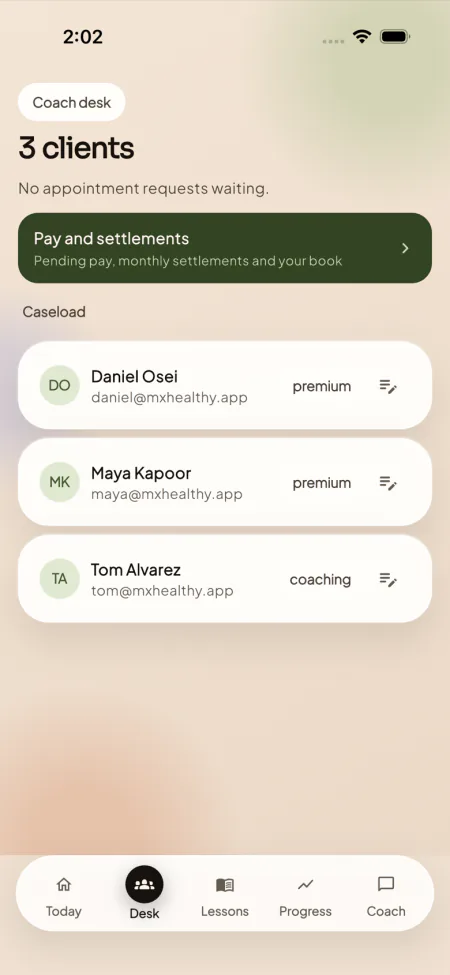
In MXHealthy this tier brings bookable appointments that carry a meeting link, plus notes and dated tasks for each client, so a check-in can be booked, held on your preferred video tool and tracked. Native in-app video sessions and group classes are available as an add-on for operators who want them inside the product.
Why coaching margin is a staffing problem
Coach revenue scales with members, and coach cost scales with caseload. The margin lever is the number of clients a single coach can look after properly. A coach with a small caseload delivers a lovely experience that does not pay for itself; a coach with a huge caseload sends template replies and sees members cancel. The tools that raise caseload safely are the ones that save a coach’s time: a list of clients whose logging has gone quiet, the diary open beside the chat, and dated reminders for each follow-up.
That is also why the AI coach and the human coach share a thread. The automated coach handles the routine questions at any hour, within a per-member daily cap you set, so the human coach spends time where judgment is needed. Done well, that raises the number of members a coach can serve without lowering quality.
How Coach Commission and Payouts Flow
Coach pay is where trust is won or lost. Coaches who cannot see how an amount was calculated assume the worst, and an operator who cannot predict payouts cannot predict margin. The flow has four steps: rate, activity, settlement, payment.
Four ways to pay a coach
| Pay model | How it works | Who carries the risk | Best when |
|---|---|---|---|
| Retainer | A fixed monthly amount per coach | The operator, if the caseload is thin | You need committed coaches and have a steady flow of coaching members. |
| Per member | A set amount per assigned member each month | Shared; cost follows caseload | Caseloads vary and you want cost to track revenue closely. |
| Per session | A set amount for each appointment held | The operator, if members book heavily | Coaches are part-time or paid for check-ins, not for availability. |
| Commission | A percentage of attributed sales | The coach, in slow months | Coaches also recommend store products and you want pay tied to results. |
MXHealthy supports all four, with rates held per coach and the currency stored with the rate. A mixed model is common: a modest per-member fee for the daily work plus commission on store sales the coach recommends. The operator console sets these at runtime, so changing a coach’s terms does not need a developer.
From activity to settlement
Each month the platform builds a settlement for every coach with line items: members served, sessions held and attributed orders, each converted into an amount under that coach’s rate card. Each settlement starts as a draft, the operator approves it in the console, and the money then goes out to the coach through the connected Stripe Connect payout account, with the payment reference stored against that settlement. Build a monthly finance routine around the approval step so payouts land on a predictable date.
Two habits keep this clean. First, approve settlements in a fixed window each month so coaches know when to expect payment. Second, keep the line items visible to the coach on the earnings screen. Disputes shrink when a coach can see which members and which orders produced a number.
Who pays whom in this model
Coach commission is money you pay to coaches, not a fee you charge them. There is no platform take rate on coach-set prices in this model; the coach is paid by the operator and the member pays the operator. If you plan a marketplace where independent coaches set their own prices and you keep a percentage, that is a different build and should be scoped as custom work.
Revenue Line Three: The In-App Store
A nutrition member is already thinking about food and routine, which makes a store a natural extension: supplements, meal-prep containers, spices, kitchen scales or branded merchandise. It earns product margin on top of subscriptions, and it gives coaches something concrete to recommend.
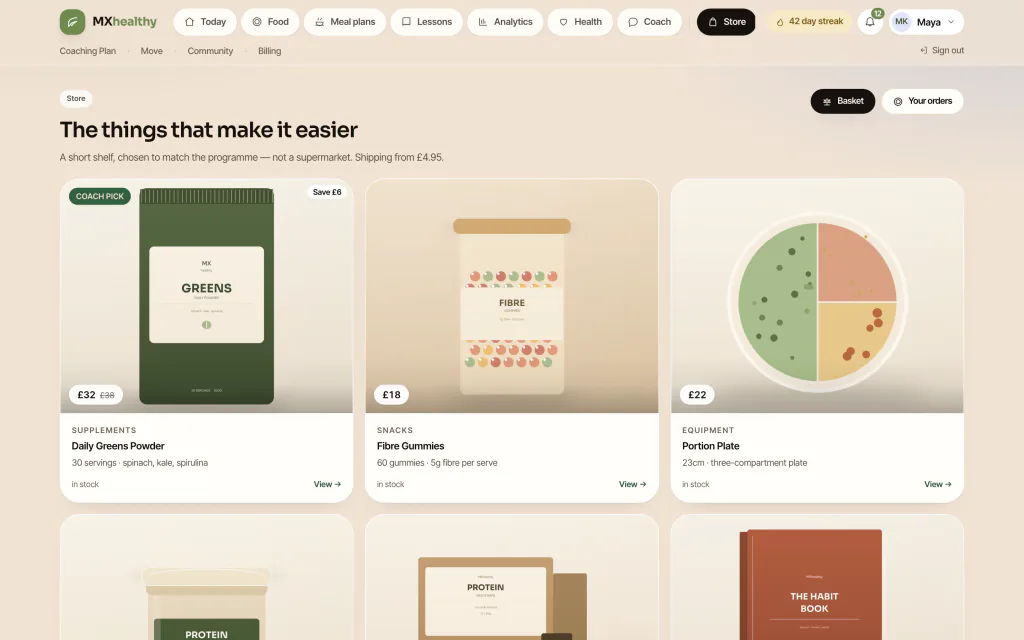
The pieces of store economics
- Price and compare-at price. Show a reference price to make a discount legible, and keep an eye on whether it is real.
- Stock states. Out-of-stock items that remain visible frustrate members, so use stock states and not dead links.
- Shipping zones. A rate per region and a free-shipping threshold, set in rupees, which nudges basket size upward.
- Coupons. Percentage offers with caps, so a festival promotion cannot turn a thin margin negative.
- Coach attribution. The coach’s id travels from basket line to order, so commission is calculated from real orders and not from memory.
The order tracker has five stages (placed, paid, packed, shipped and delivered) and two terminal states, cancelled and refunded. Each order carries a reference, a money breakdown, carrier and tracking details, and the admin side manages fulfilment. Run the store lean at first: ten products you can ship reliably beat a hundred you cannot.
When the store is worth it
The store pays when product margin after shipping, returns and coach commission leaves something meaningful. For a low-ticket product with a high return rate it often does not. Test it with a short list of high-margin, light, non-perishable items, and judge it by contribution per order, not by order count. Physical goods and the store flow stay outside subscription billing, so the store’s economics are your product margin and your gateway fee, which the worked example makes concrete below.
Revenue Line Four: Corporate and Partner Plans
Employers, insurers’ wellness programs, gyms and clinics all buy member access in bulk. One contract can bring hundreds of members without ten thousand app-store installs. The trade-off is a longer sales cycle, reporting demands and a buyer who judges you on engagement, not on features.
MXHealthy places corporate members on a plan like anyone else, served by the same coaches and the same console. When group sales grow up, the Corporate Wellness Portal add-on brings employer-level plans, company challenges, reports for the HR buyer and billing by seat. That sequencing is deliberate. Prove the individual plans first, then add the portal once one buyer is ready to sign, so you build to a real brief.
Price a group plan per active member per month, not per seat purchased, so the buyer pays for the outcome they care about, which is engagement. Keep a floor so a quiet month does not leave you serving members at a loss.
Worked Unit Economics for an India-First App
Now the arithmetic. Everything in this section is an assumption chosen for clarity, not a HealthifyMe figure and not a forecast. Imagine an app with 5,000 active members in a month.
| Assumption | Value | Why we chose it |
|---|---|---|
| Active members | 5,000 | A modest early base, so each number is easy to check. |
| Mix: free, Premium, Coaching | 4,000 / 800 / 200 | 80%, 16% and 4%, a plausible shape for a freemium app. |
| Premium price | INR 299 a month | Entry paid tier, priced to sit below a restaurant meal. |
| Coaching price | INR 1,999 a month | A coach-led tier, below the cost of most private dietitian visits. |
| Coach retainer, caseload | INR 30,000 a month, 50 members | Gives each coach a workable caseload. |
| Store orders | 600 a month at INR 900 | INR 5,40,000 gross; assume 40% product margin. |
| Coach-attributed share of store sales | 30% at 10% commission | INR 1,62,000 attributed; INR 16,200 commission. |
| Gateway fee | 2% of collections | An assumption; use your gateway’s quoted rate. |
| Hosting, AI usage, email, push | INR 60,000 a month | About INR 12 per active member. |
The monthly contribution
| Line | Amount (INR) | Note |
|---|---|---|
| Premium subscriptions | 2,39,200 | 800 x 299 |
| Coaching subscriptions | 3,99,800 | 200 x 1,999 |
| Store gross margin | 2,16,000 | 40% of 5,40,000 |
| Total revenue and margin | 8,55,000 | |
| Coach retainers | -1,20,000 | 4 coaches for 200 coaching members |
| Coach commission on store sales | -16,200 | 10% of 1,62,000 |
| Gateway fees | -23,580 | 2% of 11,79,000 collected |
| Hosting, AI and messaging | -60,000 | Usage-based |
| Contribution before marketing and staff | 6,35,220 | About 74% of the 8,55,000 base |
The result is a healthy-looking contribution, but notice what is missing: marketing, support staff, founders’ pay and taxes. The Inc42 numbers above showed advertising at about half of revenue, and nothing in this example includes it. Contribution is the pool from which you pay for growth, not profit.
Per-member economics
- Free member: costs about INR 12 a month to serve and earns nothing directly.
- Premium member: INR 299 minus about INR 6 in gateway fees and INR 12 in hosting leaves roughly INR 281. One Premium member covers about 23 free ones.
- Coaching member: INR 1,999 minus INR 600 of coach retainer (30,000 divided by 50), INR 40 in gateway fees and INR 12 in hosting leaves roughly INR 1,347.
- Coach break-even: before the retainer, each coaching member leaves about INR 1,947, so a coach pays for themselves at 16 coaching members. Below that, the caseload loses money.
Add a churn assumption and the lifetime value follows. If Premium members leave at 8% a month, they stay about 12.5 months on average and are worth around INR 3,500 each in contribution. If Coaching members leave at 10% a month, they stay about ten months and are worth about INR 13,500. Those churn rates are assumptions; replace them with your real ones after the first two cohorts.
What the example teaches
- Free-to-paid conversion is the first lever. Moving the mix from 16% to 20% Premium adds 200 members and about INR 56,000 a month in contribution.
- Coach caseload is the second. A coach at 25 members costs INR 1,200 a member instead of INR 600, which cuts the coaching contribution from INR 1,347 to INR 747.
- The store is the third, and the smallest in this example. It adds margin but takes shipping effort, so judge it last.
Store Commission and Gateway Fees: Where Rupee Checkout Changes the Maths
The example above assumed members pay through a rupee gateway at 2%. If you instead sell subscriptions through an app store’s billing, the fee is much higher. Google’s published fee table lists 15% on auto-renewing subscriptions in the markets still on its standard schedule, and Apple’s Small Business Program charges a 15% commission on in-app purchases for developers earning up to 1 million dollars a year. Check both pages before you plan, because the terms change and depend on where members live and how you collect payment.
| Scenario | Fee on INR 6,39,000 of subscriptions | Contribution after fee |
|---|---|---|
| A: web or rupee gateway checkout at 2% | INR 12,780 | 6,35,220 (already includes it) |
| B: store billing at 15% in place of the gateway | INR 95,850 | 5,39,370 on the same members |
The difference is INR 95,850 a month, or about 15% of the contribution in this example, on the same members and the same plans. That is why a web checkout and rupee payment option matters in India. It is also why you should read each store’s rules for your model before you decide how members buy. Physical store goods follow different rules and use the gateway.
The practical answer for most operators is to offer the web and rupee checkout prominently, keep card data with the payment provider, and compare the real blended fee after the first quarter. MXHealthy holds provider references, not card numbers, and the operator console shows invoice history so you can reconcile each payout.
Pricing Experiments You Can Run Without a Release
A revenue model is a hypothesis until members test it. Because prices live in the console rather than in the code, most of these tests are an operator task, with no developer involved. Run one change at a time and wait for a full billing cycle before reading results.
| Experiment | What to change | What to watch |
|---|---|---|
| Trial length | Trial days on the Premium tier | Trial-to-paid rate and day-two logging |
| Annual discount | Annual price against monthly | Share of members choosing annual and 90-day retention |
| Coach tier entry price | Coaching monthly price | Coaching mix and coach caseload |
| Festival offer | A capped percentage coupon | Redemptions, margin per order, repeat purchases |
| Free-shipping threshold | Threshold by shipping zone | Average basket size and shipping cost per order |
| Coach pay model | Retainer vs per member | Coach cost per coaching member and coach satisfaction |
Record the expected result before you change a number. A test without a prediction teaches nothing, because any outcome can be explained afterwards.
Founder Decision Signals: Is Your Revenue Model Ready to Price?
Free Tier Has a Job
Can you say which action in the free tier predicts a paid plan, and are you tracking it separately from sign-ups?
Coach Cost Is Known
Do you know what one coach costs per coaching member at your target caseload, in rupees, before you set the price?
Payouts Are Explainable
Could a coach see how every line of their monthly settlement was calculated without asking you?
Checkout Fee Is Chosen
Have you compared the fee on web and rupee checkout with the fee on store billing for your member mix?
How Miracuves Helps You Launch These Revenue Lines
Miracuves hands over the ready-made nutrition and coaching app, built on MXHealthy, at $3,399 paid once. That buys full source code, the Android and iOS apps as one package, a browser app for members, a workspace for your coaches and an operator console spanning 14 areas. The ready-made build goes live in 6 working days of Miracuves work, with store review separate.
Every line in this post maps to something already there. The console holds the plan tiers, each tier’s monthly and annual price, and its trial days. Coach rate cards support retainer, per-member, per-session and commission pay, with monthly settlements and line items. The store has categories, stock states, shipping zones, coupons and an order tracker. Rupee checkout runs alongside Stripe, the app speaks English and Hindi, and the food catalog includes Indian foods.
Under the hood it runs Next.js, TypeScript and PostgreSQL, with Flutter for the phones; every action verifies the caller’s role, sessions sit on the server, queries are parameterized, and members can export their records or ask for removal. If you want to extend the revenue model, six add-ons are available: wearable adapters, smart scale and CGM sync, live video coaching and group classes, a video lesson studio, a corporate wellness portal and regional language packs. Custom work typically takes 15 to 30 days, and up to 45 to 60 for larger scope.
Support is included: 60 days of dedicated platform guidance, 6 months of priority bug resolution and 12 months of continuous product evolution. You can also browse the healthcare solutions category for related products, or compare with the subscription maths in our subscription and coaching tier revenue breakdown.
If you want to see how a plan change, a coach settlement and a store order look in the product, book a short walkthrough on the consultation page and bring your own price points.
Final Thoughts
HealthifyMe’s reported figures point to a simple structure: a large human-coaching line that brings revenue and cost together, supporting lines for services and products, and a heavy spend on finding members. A new operator should take the same shape and scale it to a smaller, sharper base, priced in rupees from day one.
The unit economics in this post are illustrative, but the sequence of decisions is real. Set the free-to-paid line, price the coaching tier against a realistic caseload, pay coaches in a way they can verify, run the store lean, and choose checkout paths with the fee in mind. Then change one number at a time and let your own members tell you where the model bends.
Miracuves gives you the product to run those experiments on, with every revenue line already wired and the operator console ready to change prices without a release.
Frequently Asked Questions
How does a nutrition app like HealthifyMe make money?
It earns from paid subscription plans, coach-led plans, product sales and corporate or partner plans. Reported filings show human coaching as the largest line, with payments to healthcare professionals as the largest direct cost. Advertising to acquire members is the other big expense.
What is a realistic free-to-paid conversion rate for a diet app?
There is no single figure that applies to every market. Many freemium apps see a small minority of active members pay, so plan around a low single-digit to low double-digit share of active members and measure your own after each cohort. Track assessment completion, day-two logging and trial-to-paid separately.
How should I price plans for Indian members?
Price in rupees from the start and compare against local alternatives such as a gym fee or a dietitian visit, not converted dollar prices. Test a monthly and an annual price, set trial days per tier, and use capped coupons for festivals. Offer rupee checkout so members are not forced into a foreign-currency card form.
How are coaches paid in a coaching app?
Common models are a fixed retainer, a monthly amount for each assigned client, a payment for every appointment, or a share of attributed sales. Many operators combine a per-member fee with store commission. Settlements should show line items so a coach can see how each amount was calculated, and payouts should follow a fixed monthly approval window.
Does the platform take a cut of coach earnings?
In this model the operator pays coaches and members pay the operator, so there is no platform take rate on coach-set prices. Coach commission is a cost to you, not income. A marketplace where independent coaches set prices and you keep a percentage is a different build and would be scoped as custom work.
Should an India-first diet app run its own product store?
It can be, if you sell light, high-margin products you can ship reliably. Judge it by contribution per order after shipping, returns and coach commission, not by order count. Start with a short product list, set free-shipping thresholds and capped coupons, and expand only when margins hold.
How much do app store fees reduce subscription margin?
Store billing can take a double-digit percentage of every subscription rupee, while a web or rupee gateway checkout usually costs a few percent. Read the current Google Play and Apple terms for your markets, because rates depend on revenue and region, and compare the blended fee after your first quarter.
Can I change plan prices without releasing a new app version?
Yes. In MXHealthy the operator console changes plan prices, annual prices, trial days, coupons and coach pay at runtime, and the changes are written to an audit trail. That lets you test a pricing change the same day you decide on it.
Does the AI coach replace human coaches?
No. The AI coach answers routine questions from the member’s own day and gives general guidance, not medical advice. Human coaches handle judgment, accountability and relationships. Used together, the AI handles routine questions so each coach can serve more members without lowering quality.
Miracuves is an independent software development company. We are not affiliated with, connected to, sponsored by, or endorsed by any company or product named in this article.
Terms such as “X Clone” are used descriptively. It is how the software industry refers to building a platform with functionality comparable to a known service, and how clients search for it.
The entire design and codebase of our products is built by our own team. Our products contain no code, design, graphics, or content originating from any third-party website or applications.
All third-party names and marks referenced in this article are the property of their respective owners, referenced solely to identify the services discussed.