
Key Takeaways
- The cost to build an AI app in 2026 depends on product scope, engineering requirements, model usage, infrastructure, data preparation, security, and ongoing operations rather than one universal development price.
- Initial development cost and recurring operating cost are different. Engineering, design, integration, testing, and deployment contribute to the initial budget, while AI APIs, hosting, monitoring, maintenance, and support continue after launch.
- AI infrastructure costs extend beyond GPU hosting. Production applications may also require backend servers, databases, storage, networking, background jobs, monitoring, backups, and retrieval infrastructure.
- AI API costs depend heavily on usage. Input tokens, output tokens, conversation history, retrieved context, tool calls, retries, and model selection can all influence the monthly inference bill.
- Hosted APIs and self-hosted models have different cost structures. Hosted APIs can simplify infrastructure management, while self-hosting provides more deployment control but introduces compute, capacity planning, monitoring, and maintenance responsibilities.
- Engineering remains a major part of AI app development cost. Product planning, UX, backend and frontend development, AI integration, QA, DevOps, security, and data engineering may all be required depending on the application’s complexity.
- Retrieval and data preparation can create hidden expenses. Document cleaning, parsing, embeddings, indexing, permission-aware retrieval, evaluation, and ongoing knowledge-base updates can add both development and operating costs.
- The cost of one API request is not the same as the cost of completing a user task. Retrieval, multiple model calls, external tools, retries, validation, and human review can increase the fully loaded cost of delivering a successful outcome.
- Cost optimization should not sacrifice AI quality. Model routing, context reduction, caching, agent limits, usage controls, and budget alerts can reduce unnecessary spending, but every optimization should be evaluated against accuracy, reliability, latency, and user outcomes.
- Security and reliability need to be included in the budget. Access controls, encryption, privacy safeguards, prompt-injection protection, monitoring, retries, incident response, and fallback systems can become important production expenses.
- A first-year AI budget should combine development and operating costs. Founders should model initial engineering expenditure, monthly infrastructure and model usage, maintenance, expected growth, and a reasonable contingency rather than focusing only on the launch cost.
- The best AI app budget is based on cost per successful user outcome. A sustainable product is not necessarily the one with the lowest API price, but the one that delivers reliable value while keeping its fully loaded cost manageable as usage grows.
Building an AI-powered application in 2026 can be surprisingly affordable at the prototype stage and significantly more expensive once real users, production infrastructure, security requirements, and ongoing model usage enter the picture. The biggest budgeting mistake founders make is treating AI development as a one-time software purchase rather than a combination of engineering investment and continuing operational expenditure.
A basic AI assistant might use an existing language model through an API, while a more sophisticated application could require document retrieval, external integrations, automated workflows, specialized evaluations, and dedicated inference infrastructure. These products can look similar to users but have very different cost structures. Founders exploring custom AI engineering and implementation services should first understand which expenses are necessary for their intended product and which can be postponed until demand is validated.
In practice, the real cost of building an AI app includes the people designing and implementing it, the infrastructure serving users, the model or API processing their requests, and the operational systems required to maintain quality and security. A low initial development quote may exclude several of these expenses, making the eventual cost higher than expected.
This guide breaks down AI application costs in 2026, explains how infrastructure and token-based pricing work, provides a transparent engineering-team example, and shows founders how to estimate monthly operating costs and first-year financial commitments without relying on misleading universal price ranges.
What Actually Determines the Cost of Building an AI App in 2026?
There is no single development price that accurately describes every AI application. An assistant that summarizes documents operates differently from a system that reviews thousands of images, retrieves company records, or performs several business actions with human approval.
The cost is shaped by the product’s required capabilities, the number of systems it connects to, the accuracy expected, and the volume of activity after launch. Choosing a more expensive model does not automatically make the overall product more reliable. Similarly, selecting the lowest-cost API does not guarantee an efficient application if prompts, retrieval processes, and workflow design are poorly optimized.
The Difference Between Initial Build Cost and Running Cost
Initial development expenditure covers activities such as product discovery, interface design, backend engineering, model integration, data preparation, testing, and deployment.
Recurring costs begin when infrastructure, model calls, monitoring services, data pipelines, support, and maintenance continue operating. Some expenses arise before the first customer arrives because servers, databases, and development environments may already be active.
This distinction is especially important for products where AI is used frequently. A conventional application might serve many user actions through relatively inexpensive database requests. An AI-heavy application may generate a new model-inference charge for each meaningful interaction.
Five Questions That Drive the Budget
- What problem does the AI solve? A simple text classifier and an autonomous workflow assistant require different engineering effort.
- Where does the model run? Hosted APIs and dedicated inference infrastructure have different financial characteristics.
- How much information is processed? Long documents, conversation history, images, and audio may create substantially different usage charges.
- How reliable must the result be? Higher accuracy requirements often involve more evaluation, data preparation, human review, and monitoring.
- How many users will interact with the system? Request volume determines the scale of recurring infrastructure and inference expenditure.
Before estimating development costs, founders should document these assumptions. Without them, two proposals may appear comparable while describing fundamentally different applications.
AI App Development Cost Breakdown: The Main Budget Categories
Instead of dividing projects into generic low, medium, and high price packages, a more useful approach is to identify the cost components that the application actually requires.
| Cost Category | What It Covers | Budget Behavior |
|---|---|---|
| Product and engineering team | Design, frontend, backend, AI integration, testing | Mostly initial, with ongoing improvements |
| AI models and APIs | Inference, tokens, images, audio, tools | Usage-dependent |
| Application infrastructure | Compute, databases, storage, networking | Recurring, partly usage-dependent |
| Data and retrieval | Document processing, embeddings, search indexes | Initial setup and ongoing updates |
| Security and quality | Authentication, permission controls, evaluations, monitoring | Both initial and recurring |
| Maintenance and operations | Model changes, bug fixes, support, optimization | Recurring |
These categories overlap in practical projects. For example, a retrieval system requires development labor during setup and ongoing infrastructure expenditure for storage and search. Founders should avoid counting the same cost twice when converting component estimates into a consolidated budget.
How Much Does AI Infrastructure Cost?
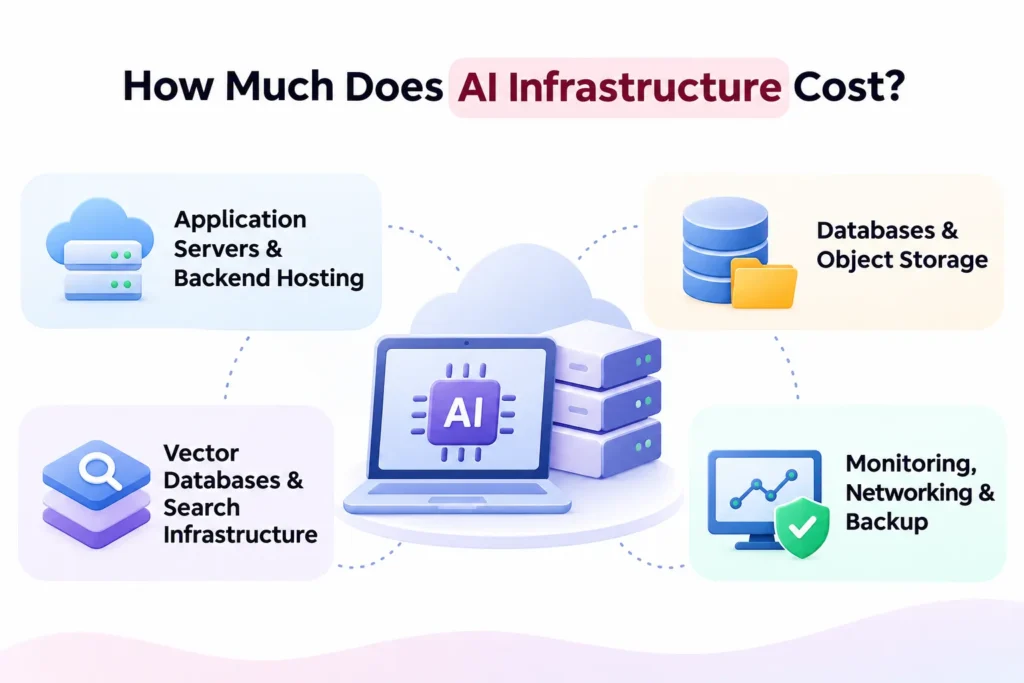
AI infrastructure is often misunderstood as simply purchasing GPU access. In reality, most AI applications require ordinary software infrastructure as well as model inference. The website or mobile application, authentication service, database, background jobs, and analytics systems still need to operate even when the model is hosted by an external provider.
Application Servers and Backend Hosting
The backend handles user sessions, requests, billing logic, file processing, integrations, and communication with the AI provider. These tasks may run on managed containers, virtual machines, or serverless functions depending on the architecture.
A lightly used application may operate with relatively modest server capacity. A product handling continuous traffic, large file uploads, or heavy background processing may require more compute and additional redundancy.
Serverless hosting can be attractive when traffic is irregular, but frequent executions, long-running jobs, memory consumption, and network traffic can change the economics. The appropriate model depends on actual workload rather than a universal preference for one hosting approach.
Databases and Object Storage
AI applications often store user accounts, chat metadata, document references, workflow histories, permissions, and billing records. Uploaded files may require object storage, while structured information belongs in a suitable application database.
Storage expenditure depends on retained data volume, backup frequency, replication, access patterns, and transfer charges. Frequent document processing can also produce temporary files and intermediate outputs that need lifecycle management.
Founders should specify how long data must be retained and when obsolete content can be removed. Keeping every intermediate artifact indefinitely can increase cost and create unnecessary privacy exposure.
Vector Databases and Search Infrastructure
Applications that answer questions using company documents frequently use retrieval-augmented generation, or RAG. The system prepares source material, generates representations suitable for retrieval, and searches relevant content before sending context to a language model.
The cost includes data ingestion, document parsing, embeddings, index storage, query processing, and possibly reranking. The amount depends on document volume, update frequency, search workload, and whether managed or self-operated search infrastructure is used.
For deeper information about production retrieval quality, Miracuves’ guide to common enterprise knowledge retrieval failures examines source preparation, retrieval relevance, permissions, and evaluation. These considerations matter financially because poor retrieval can increase repeated model calls and manual correction work.
Monitoring, Networking, and Backup Costs
Logging, tracing, alerts, backups, network transfer, and operational dashboards are often overlooked during initial budgeting. They help teams investigate slow responses, failed API requests, unexpected spending, and production errors.
Infrastructure costs can often be optimized without reducing application reliability. Oversized servers, underutilized computing capacity, unnecessary storage retention, and continuously running development environments can increase cloud expenditure. Miracuves’ cloud infrastructure cost optimization guide explores practical approaches to resource allocation, autoscaling, and infrastructure monitoring. These practices are particularly relevant to AI applications where model inference and supporting backend services create different patterns of resource consumption.
Log retention needs special attention. Recording entire prompts, files, and responses without clear rules may increase storage expenses and introduce privacy concerns. Monitoring should capture useful operational signals while minimizing unnecessary sensitive information.
AI API Pricing in 2026: How Token Costs Work
Hosted AI models commonly charge according to the amount of input and output processed. Text usage is often measured in tokens, which are units used to represent text and related model input.
Input tokens may include the user’s message, system instructions, conversation history, retrieved documents, and tool results. Output tokens represent the content generated by the model, although billing details can also depend on reasoning tokens, processing modes, and provider-specific rules.
The important point is that one visible user message may trigger much more model activity than the user realizes.
The Basic Token Pricing Formula
AI Inference Cost Formula
Input cost = Input tokens ÷ 1,000,000 × Input price per million tokens
Output cost = Output tokens ÷ 1,000,000 × Output price per million tokens
Total text inference cost = Input cost + Output cost + Applicable additional charges
Additional charges can include tools, special processing modes, multimodal usage, or other provider-specific services. Cached input may qualify for a different rate.
Example: Calculating Monthly API Usage
Consider a hypothetical AI application handling 20,000 requests per month. Assume each request consumes an average of 2,000 input tokens and generates 500 output tokens.
For this example, use a model tariff of $2 per million input tokens and $10 per million output tokens. These figures are illustrative modeling inputs, not a quotation for a specific deployment. Providers publish different rates for different models and service conditions.
| Metric | Illustrative Value |
|---|---|
| Monthly requests | 20,000 |
| Input tokens per request | 2,000 |
| Output tokens per request | 500 |
| Total monthly input tokens | 40 million |
| Total monthly output tokens | 10 million |
| Input cost | $80 |
| Output cost | $100 |
| Total text model cost | $180 per month |
Under these assumptions, the base model expenditure is $0.009 per request. This excludes infrastructure, additional tools, embeddings, storage, failed attempts, retries, and human operational effort.
At 100,000 requests with the same token usage and tariff, the comparable model cost would be $900 per month. However, real applications may not scale linearly because user behavior, context length, model routing, caching, and the number of model calls per task can change over time.
Before calculating a production budget, confirm current rates using the model provider’s official API pricing documentation. The final bill depends on the selected model, processing configuration, usage pattern, and applicable billing rules.
API expenses can rise unexpectedly when applications repeatedly send lengthy instructions, process unnecessary conversation history, or execute multiple model calls for a single task. Founders looking to control these expenses can explore Miracuves’ practical guide to reducing generative AI token consumption, which examines prompt caching, model routing, context optimization, and usage controls. Understanding these factors helps teams estimate not only the cost of individual requests but also how those costs change as application usage increases.
Why Long Conversation History Can Increase Costs
A conversation-based application may send earlier messages back to the model to preserve context. As a conversation grows, later requests may contain more input tokens than earlier ones.
This means a user making ten short requests does not necessarily create the same cost as another user making ten requests that each include extensive conversation history.
Summarizing older interactions, retrieving only relevant context, and using provider-supported caching can reduce unnecessary token consumption. These changes should be tested for answer quality before they are applied broadly.
Why AI Agents Can Cost More Than Simple Chat Interfaces
An AI agent may call a model several times to plan an action, retrieve information, interact with an external system, validate a result, and generate a final response.
A single user request might therefore involve multiple model calls and paid tool operations. If the workflow fails and retries, the additional processing can further increase the effective cost of completing the task.
Miracuves’ AI agent integration guide explores workflow scope, system integrations, permission handling, and evaluation requirements. These factors directly influence how much engineering and inference activity a production agent requires.
Hosted AI APIs vs. Self-Hosted Models: Which Is More Cost-Efficient?
One of the most important architecture decisions is whether to use a hosted model service or operate model inference on dedicated infrastructure.
A hosted API shifts much of the model-serving responsibility to an external provider. The application pays according to the relevant usage tariff. Self-hosting requires the team to deploy and operate model inference, often using GPU instances or specialized hardware.
Neither option is universally less expensive. The correct choice depends on traffic, latency, model capability, concurrency, utilization, governance requirements, and the engineering work needed to maintain the system.
| Evaluation | Hosted AI API | Self-Hosted Inference |
|---|---|---|
| Upfront setup | Usually lower infrastructure complexity | Requires model-serving configuration |
| Primary cost | Usage or token charges | Hardware, compute time, operations |
| Scaling | Provider-managed subject to limits | Capacity planning and autoscaling required |
| Customization | Constrained by provider capabilities | Greater deployment control for suitable models |
| Maintenance | Provider operates model infrastructure | Team manages inference performance and updates |
| Suitable use case | Variable traffic and faster experimentation | Workloads with justified capacity or deployment constraints |
The GPU Utilization Problem
A dedicated GPU instance can create recurring costs even during periods of low user activity. If the infrastructure remains active continuously, the operator pays for capacity that may not always be used.
For example, an illustrative GPU hosting rate of $1.50 per hour would equal approximately $1,080 for a 720-hour month before storage, networking, operational labor, and supporting services. This is a calculation example, not a verified hardware quote.
At low request volumes, pay-per-use APIs may be financially attractive. At sustained high utilization, self-hosting could become competitive if the chosen model meets the required quality and the organization can operate it efficiently.
Founders should calculate cost per completed inference task for both options, including idle capacity, failed requests, monitoring, and engineering effort.
AI App Development Team Costs: Roles, Responsibilities, and Hours
The engineering team is often a major component of initial AI application expenditure. The exact staffing requirement depends on whether the product is a simple API-enabled application, a retrieval system, a workflow agent, or a custom machine-learning solution.
A founder should resist the temptation to estimate cost from the number of developers alone. A smaller team with unclear responsibilities may spend more time on rework than a well-coordinated team with explicit engineering and testing ownership.
Product Planning and UX Design
Product planning identifies what the AI must do, what it must not do, which user roles exist, and how success will be evaluated. UX design defines the user journey, input methods, results presentation, error states, and controls for correcting or rejecting AI output.
These activities reduce the risk of building an impressive demonstration that does not solve the intended business problem.
Backend and Application Engineering
Backend engineers implement authentication, databases, billing, API integrations, authorization checks, background tasks, and reliability controls. Frontend engineers build interfaces that make model responses understandable and usable.
This work remains necessary even when the AI model itself is purchased as an external service.
AI and Data Engineering
AI engineers design model interactions, retrieval workflows, evaluation pipelines, fallback logic, and performance controls. Data engineers may be required when the application depends on large, inconsistent, or frequently changing information sources.
Simple products may combine some of these responsibilities into one role. More complex systems require specialized ownership, especially when information quality or automated decisions have significant business consequences.
QA, Security, and DevOps
Quality assurance must test ordinary application flows and AI-specific behavior, including inconsistent outputs, inaccessible source data, malformed responses, and failed tool calls.
DevOps work includes deployment pipelines, credentials management, monitoring, rollback procedures, and infrastructure configuration. Security review covers access control, data handling, prompt injection exposure, and safe operation of connected tools.
Illustrative Team Budget for One AI Application
The following sample assumes a focused AI application with a web interface, hosted text model, basic user management, one external integration, and production testing. All rates and hours are hypothetical budgeting assumptions. They are not employment market averages, supplier quotations, or Miracuves contract prices.
| Role | Planned Hours | Assumed Rate | Illustrative Cost |
|---|---|---|---|
| Product planning | 60 | $60/hour | $3,600 |
| UX and interface design | 70 | $50/hour | $3,500 |
| Application engineering | 160 | $55/hour | $8,800 |
| AI integration engineering | 100 | $65/hour | $6,500 |
| Quality assurance | 60 | $40/hour | $2,400 |
| Deployment and DevOps | 30 | $65/hour | $1,950 |
| Total | 480 hours | Assumed mix | $26,750 |
This example demonstrates a role-based budget calculation, not what every AI app should cost. A project using an existing interface may need less design effort. A project requiring mobile applications, extensive integrations, custom data pipelines, or complex agent permissions may require substantially more.
The structure of the development team also influences an AI application’s long-term cost. Independent specialists may be appropriate for clearly defined integrations, while coordinated engineering teams can provide continuity across application development, AI workflows, testing, and maintenance. Founders comparing these approaches can read Miracuves’ analysis of freelancers versus dedicated development teams to understand how technical ownership, knowledge transfer, and software maintenance affect the total engineering budget.
Founders should also consider whether additional time is needed for stakeholder reviews, security testing, data preparation, accessibility, and deployment approval. These activities should appear explicitly in project scope rather than becoming unexpected additions.
The Hidden Costs of Retrieval, Data Preparation, and Model Evaluation
Some of the most underestimated AI expenses arise before and after model inference. The system may require clean business data, consistent document formats, permission-aware retrieval, and a repeatable process for checking answer quality.
Document Ingestion and Cleaning
Business documents are rarely ready for immediate AI use. They may contain duplicated information, outdated policies, tables, scanned pages, inconsistent formatting, or sensitive records.
Preparing these sources requires parsing, cleaning, segmentation, metadata handling, and access checks. The resulting engineering effort can be more substantial than connecting the model API itself.
Embeddings and Index Updates
Retrieval systems often transform document sections into searchable representations. Initial indexing creates a setup workload, while changed content generates ongoing processing costs.
Reprocessing an entire knowledge base after every small document update wastes resources. Incremental indexing and deletion tracking can improve both cost efficiency and information freshness.
Applications that depend on frequently changing business documents may need more than basic vector search. Document ingestion, permission-aware retrieval, index updates, and answer evaluation introduce engineering requirements that vary according to the size and complexity of the underlying knowledge base. Founders assessing these requirements can examine Miracuves’ specialized retrieval and knowledge-system engineering capabilities to understand which implementation considerations may affect project scope and long-term maintenance.
Evaluation and Human Review
An AI app needs testing beyond whether the API returns a valid response. Evaluation may include answer correctness, source relevance, refusal behavior, latency, privacy protection, and the accuracy of tool actions.
Teams should prepare representative test cases and run them when prompts, models, retrieval rules, or external integrations change. Some evaluations may require human review, creating an ongoing labor expense.
Removing evaluation from the budget can make an initial project appear less expensive while increasing the risk of poor user outcomes and expensive production corrections.
A Realistic Monthly Operating Cost Example for an AI App
Once the application is launched, founders need a monthly spending model. This should distinguish the costs that remain relatively stable from those that increase with user activity.
The following example uses hypothetical cloud and operating assumptions alongside the previously calculated $180 text-model usage scenario. It illustrates budgeting mechanics only; the figures are not a provider quotation or a published industry benchmark.
| Monthly Expense | Illustrative Budget |
|---|---|
| Application compute | $150 |
| Database | $90 |
| Vector search and retrieval storage | $80 |
| Object storage and backup | $40 |
| Monitoring and logs | $60 |
| Networking and transfer | $35 |
| Queues and supporting services | $25 |
| Infrastructure subtotal | $480 |
| Text-model inference | $180 |
| Embeddings and indexing | $40 |
| Additional APIs and tools | $70 |
| Operational review and maintenance allowance | $300 |
| Illustrative monthly total | $1,070 |
This example assumes limited operational support and modest traffic. It excludes additional cloud environments, significant compliance expenses, payment processing, tax obligations, large-scale human review, and extraordinary incident-response costs.
A production business should replace every line with a provider quote, observed usage measurement, or documented staffing allocation. Costs will also vary with reliability requirements and whether infrastructure runs continuously.
How to Calculate the First-Year Total Cost of Ownership
One-time development expenditure does not capture the full financial commitment of launching an AI application. Founders should combine development cost, operating expenses, expected product improvements, and an allowance for uncertainty.
Using the illustrative development cost of $26,750 and the sample operating budget of $1,070 per month, the calculation becomes straightforward.
First-Year Budget Example
Initial engineering: $26,750
12 months of illustrative operations: $12,840
Subtotal: $39,590
Optional 15% planning contingency on this subtotal: $5,938.50
Illustrative first-year planning envelope: $45,528.50
This is a hypothetical budget exercise, not a development quote, market average, or guaranteed ceiling. It assumes unchanged monthly usage and operating scope. Taxes, financing costs, major upgrades, and other exclusions would need to be added where relevant.
A contingency is useful because actual model consumption, user behavior, and infrastructure requirements are not perfectly predictable before launch. However, adding a percentage without examining project risks is not a substitute for proper financial forecasting.
Founders should also model alternative scenarios. A base case can represent expected usage, a higher-demand case can reflect faster growth, and a stress case can account for longer prompts, repeated model calls, or the need for more expensive inference.
The Difference Between Cost per API Call and Cost per Successful User Task
A common AI budgeting mistake is treating the price of one model request as the total cost of delivering a feature. Real user tasks may require retrieval, repeated model calls, external API requests, validation, storage, or human intervention.
Imagine an AI document assistant answering a question. The platform may first retrieve several source passages, generate a response, verify its structure, and retry if the result fails validation. Each step can consume resources.
Therefore, the more useful financial metric is the fully loaded cost of a successfully completed task.
AI Unit Economics Formula
Cost per successful task = Total attributable task-processing costs / Number of successfully completed tasks
Attributable costs may include model calls, retrieval, paid tools, failed attempts, processing overhead, and human review. Shared infrastructure should be allocated consistently.
A system that uses an inexpensive model but frequently fails may be less cost-efficient than one using a more capable model that completes tasks reliably. Founders should test both cost and outcome quality before choosing a model tier.
Seven Practical Ways to Reduce AI App Costs Without Sacrificing Quality
1. Route Simple Requests to Lower-Cost Models
Not every user request requires the most capable model. Straightforward formatting, classification, or extraction tasks may be handled by lower-cost models if evaluation confirms acceptable quality.
A routing layer can direct complex requests to stronger models while keeping simpler tasks on a more economical path. The added routing logic itself should remain understandable and measurable.
2. Reduce Unnecessary Context
Sending long documents or entire conversations when only a small portion is relevant increases input tokens and may reduce answer focus.
Use appropriate retrieval, concise instructions, and controlled conversation history to reduce unnecessary processing. Always test whether context reduction affects response accuracy.
3. Cache Repeatable Information
Some application instructions and frequently reused context remain stable across requests. Provider-supported prompt caching or carefully designed application-level caching may reduce repeated processing.
However, cached content must respect user permissions and freshness requirements. Information that changes frequently or contains sensitive personal data may require stricter controls.
4. Avoid Unnecessary Agent Loops
Agents that repeatedly reconsider the same task can consume large numbers of model calls. Set reasonable iteration limits, validate tool arguments, and establish clear completion conditions.
Where a deterministic software function can perform a task reliably, it may be more economical than repeatedly asking a model to solve the same problem.
5. Measure Cost by Feature and User Segment
A single total API bill does not explain which product capabilities are expensive. Monitor model usage by feature, request type, and appropriately aggregated customer segment.
These measurements can reveal whether document summarization, long-form generation, or agent workflows are responsible for disproportionate spending.
6. Introduce Usage Limits and Budget Alerts
Per-user rate limits, maximum input sizes, spending thresholds, and anomaly alerts can prevent unexpected bills caused by abuse, bugs, or unusual activity.
Usage limits should be appropriate to the product’s commercial model and communicated clearly. They are most effective when paired with server-side enforcement rather than client-side interface restrictions alone.
7. Evaluate Quality Before Optimizing Price
An inexpensive result is not useful if it frequently creates incorrect answers, unsafe recommendations, or failed business actions. Cost optimization should begin with defining what successful performance means.
Compare alternatives using representative test cases, reliability measurements, latency, and fully loaded task cost. Reducing expenditure while significantly increasing failure rates may produce higher total operating costs.
Security, Compliance, and Reliability Costs Founders Often Miss
AI products can introduce risks that ordinary application budgets may not fully anticipate. Sensitive documents, connected business systems, automated actions, and externally hosted models all affect the level of security and governance required.
Data Privacy and Access Control
Applications handling personal or confidential information should establish appropriate data collection rules, access controls, encryption, retention policies, and deletion processes.
For retrieval systems, permission checks should occur before restricted information is included in model context. Hiding a document from the frontend while making it retrievable by the AI is not sufficient protection.
Prompt Injection and Tool Safety
AI applications that read untrusted documents or interact with external tools need controls against instructions embedded in retrieved content. Tool permissions, input validation, output handling, and approvals for consequential actions may require additional engineering and testing.
These safeguards are especially important when the AI can modify records, send communications, or initiate business transactions.
Reliability and Incident Management
Production services need fallback behavior when a model provider experiences an outage, a request times out, or a tool returns an unexpected result.
Retries, queues, operational alerts, and failover arrangements increase system complexity but can reduce disruption. The appropriate investment depends on the product’s business criticality and service commitments.
Moving an AI model from a working prototype into production introduces additional responsibilities beyond initial deployment. Teams must monitor model behavior, maintain consistent processing pipelines, investigate unexpected outputs, and manage infrastructure or dependency changes. Miracuves’ guide to deploying and monitoring machine learning models provides further context on production monitoring, version control, and operational reliability. These activities should be considered recurring engineering expenses rather than optional improvements after launch.
How to Build an AI App Budget That Investors and Decision-Makers Can Evaluate
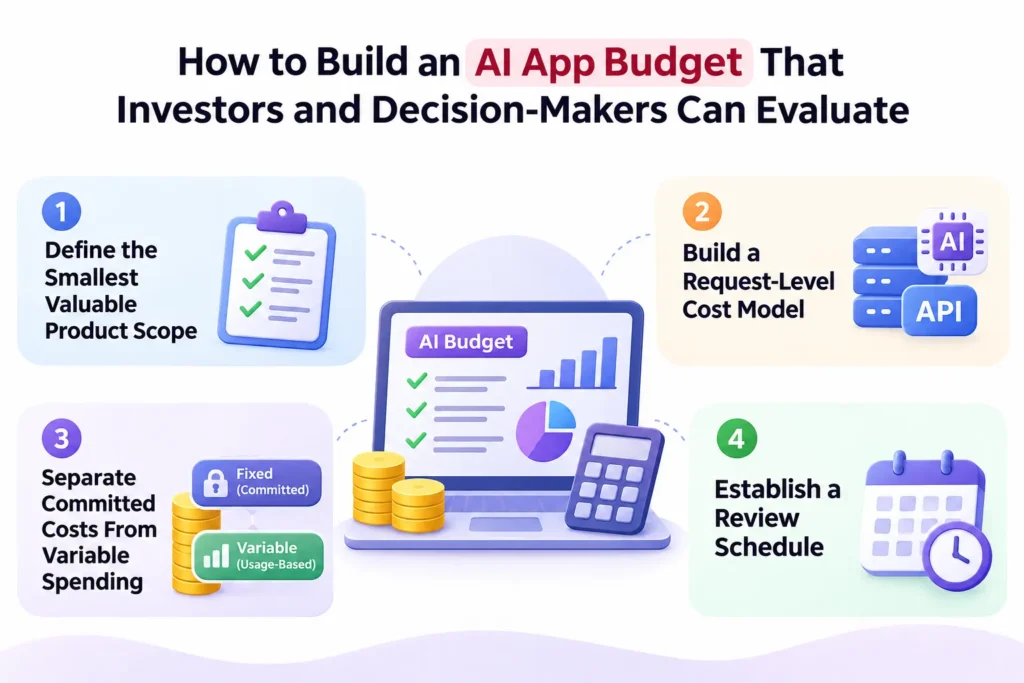
A useful AI budget should show how costs relate to product capabilities and expected demand. It should not depend on a single headline figure with undefined assumptions.
Define the Smallest Valuable Product Scope
Identify the primary user problem and the minimum workflow needed to solve it reliably. Features that do not contribute directly to initial validation can be considered for later development.
This reduces the risk of funding advanced automation before there is evidence that customers value the core experience.
Build a Request-Level Cost Model
Estimate monthly active users, requests per user, average tokens per request, and additional processing steps. Use realistic usage scenarios instead of assuming every user behaves identically.
Include expected failure and retry behavior where appropriate. A cost model based only on ideal successful requests will understate production expense.
Separate Committed Costs From Variable Spending
Some expenses continue even when traffic decreases, such as reserved compute capacity and ongoing maintenance commitments. Others rise with activity, including API calls, file processing, and certain network charges.
Keeping these categories separate makes it easier to estimate how the business behaves under both slow adoption and rapid growth.
Establish a Review Schedule
Before launch, define who reviews the infrastructure and model-spending reports. During early operations, frequent monitoring can identify inefficient prompts, abnormal usage, or unexpected service costs before they become large financial problems.
As the application matures, founders can assess whether changes in user behavior justify a different model route, hosting arrangement, or staffing allocation.
When a Ready-Made AI Foundation Makes Financial Sense
Some founders need a differentiated AI system that must be designed around proprietary data, specialized workflows, and complex integrations. Others need a familiar application experience with branding, user management, standard administrative controls, and an existing model integration.
These situations call for different implementation strategies. Starting from an established product foundation can reduce initial application engineering work when the required workflows already exist. It does not automatically eliminate recurring model costs, infrastructure expenses, or the need for product-specific evaluation.
Similarly, a completely custom system may be justified when the product depends on unusual data, specialized permissions, complex workflow coordination, or performance characteristics that cannot be achieved through standard modules.
The key decision is whether the existing foundation genuinely matches the product’s intended behavior. Founders should compare the total implementation effort and ongoing costs rather than treating faster initial deployment as proof of lower lifetime expenditure.
Miracuves offers ready-made product foundations for selected use cases and separately scoped custom AI engineering. Its ready-made solutions can have a six-working-day delivery process when the requirements match the standard package. Custom model workflows, substantial integrations, and specialized AI behavior require their own implementation scope and timeline.
Final Thoughts: The Real Cost of an AI App Is the Cost of Delivering Value Reliably
AI app development cost in 2026 cannot be understood through a single generic project price. A realistic budget combines engineering effort, model usage, hosting, data preparation, evaluation, security, and ongoing operations.
Hosted APIs can make experimentation easier, but their costs depend on requests and token usage. Self-hosted inference provides different infrastructure control but introduces capacity planning and maintenance responsibilities. Neither approach is universally more economical.
For founders, the strongest financial decisions begin with clear product requirements, transparent cost assumptions, measured usage, and a practical first-year spending model. If the project requires a more specialized implementation, Miracuves’ custom AI engineering and implementation provides a relevant next step for translating the requirements into an appropriately scoped development plan.
The objective is not simply to build the least expensive AI application. It is to build a product whose cost per successful user outcome remains sustainable as adoption increases.
Frequently Asked Questions
How much does it cost to build an AI app in 2026?
The cost depends on the application’s scope, engineering hours, model integration, data requirements, security, and deployment architecture. A reliable estimate should separate one-time development expenses from recurring API, hosting, maintenance, and monitoring costs rather than relying on a universal price range.
What is the biggest cost in AI app development?
The largest expense varies by project. During initial development, engineering and data preparation may dominate the budget. After launch, frequently used applications can accumulate substantial model inference, infrastructure, and maintenance costs.
How are AI API costs calculated?
Many text model APIs charge according to input and output token consumption. Multiply the number of tokens used by the relevant per-token tariff, then include any additional tool, multimodal, processing, or provider-specific charges. Cached input may qualify for a different rate.
Is self-hosting an AI model cheaper than using an API?
Not necessarily. Self-hosting requires compute capacity, deployment engineering, monitoring, and maintenance. Hosted APIs charge according to usage and can be attractive for variable traffic. Compare fully loaded cost per successful task under realistic workloads.
How much does it cost to run an AI app every month?
Monthly costs depend on model requests, token volumes, application compute, databases, retrieval infrastructure, storage, monitoring, and operational support. Founders should calculate these components individually and test scenarios for different traffic levels.
Does a retrieval-augmented generation system increase AI app costs?
Retrieval systems may require document preparation, embeddings, searchable indexes, retrieval processing, data updates, and quality evaluation. They can improve answers grounded in source material but introduce additional implementation and operating costs.
Which specialists are needed to build a production AI application?
Depending on scope, the project may require product planning, UX design, backend and frontend engineering, AI integration, data engineering, quality assurance, DevOps, and security expertise. Smaller projects can combine roles, while complex systems need more specialized responsibilities.
How can founders reduce AI operating costs?
Founders can reduce unnecessary token usage, route simpler tasks to economical models, cache appropriate repeated inputs, limit agent loops, monitor spending by feature, and implement rate limits. Every optimization should be evaluated for its effect on output quality and user outcomes.
Miracuves is an independent software development company. We are not affiliated with, connected to, sponsored by, or endorsed by any company or product named in this article.
Terms such as “X Clone” are used descriptively. It is how the software industry refers to building a platform with functionality comparable to a known service, and how clients search for it.
The entire design and codebase of our products is built by our own team. Our products contain no code, design, graphics, or content originating from any third-party website or applications.
All third-party names and marks referenced in this article are the property of their respective owners, referenced solely to identify the services discussed.