
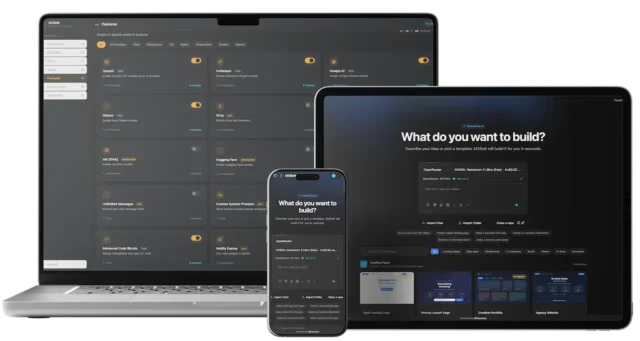
RAG Development Company
pgvectorPineconeQdrantWeaviateHybrid SearchCitations
Miracuves builds RAG systems that answer from your own documents and data, not from what a model remembers. We ingest and clean your sources, index them in a vector database, retrieve with hybrid search and reranking, and return answers that cite the exact passage - filtered by what each user is allowed to open. You own 100% of the source code.
- Cited Answers
- Permission-Aware Search
- 100% Source Ownership
- NDA Day One
- Web · Slack · APIOne retrieval index behind every channel
- Permission-awareUsers only see what they may open
- Faithfulness scoredTested on your real questions
- 6 DaysReady-made platform, brief to live
- Cited answersEach claim linked to its passage
Grounded Answers
From your files, not model memory
NDA Day One
Signed before documents are shared
Full Source Code
Pipeline, index config and eval set
60-Day Support
Re-index and retrieval tuning after launch
100% IP Ownership
Embeddings and index are yours
Reviewed on Clutch
Third-party client reviews
Miracuves is a RAG development company. We build retrieval augmented generation systems that search a company's own documents and data, pass the relevant passages to an LLM and return answers with citations, filtered by each user's permissions and kept fresh as files change. Custom RAG builds take 2-8 weeks, a ready-made AI chat platform ships in 6 working days, and you own 100% of the source code.
Our RAG Approach
How Miracuves builds retrieval augmented generation - grounded in your own documents
A language model only knows what it was trained on. Retrieval augmented generation fixes that at question time: the system searches your manuals, policies, tickets and records, hands the few passages that matter to the model, and the model answers from those passages with a citation to each one. When a policy changes, you re-index the file; nothing is retrained.
Most failed RAG projects fail at retrieval, not at the model. Scanned PDFs lose their tables, chunks cut a rule in half, pure vector search misses part numbers and exact terms. So Miracuves spends the effort where answers are won: clean ingestion, chunking that follows your document structure, hybrid search with a reranker, and an access filter applied before anything reaches the model.
Who this service is built for: Teams whose answers already exist in documents nobody can find fast enough - support teams working from help centers and release notes, operations staff checking SOPs, legal and compliance teams searching contracts and policies, sales engineers answering security questionnaires, and SaaS products that want a knowledge base AI assistant for their own customers. If you need the whole application around the model - agents, tools, fine-tuning, multi-model routing - that is our LLM development service. If you need a guided conversation with fixed flows rather than answers from documents, that is chatbot development.
- Ingestion and cleaning: PDFs, scans, tables, wikis and tickets parsed with structure kept, duplicates removed
- Chunking by document structure: headings, clauses and table rows stay intact, each chunk carries its source and page
- Hybrid search with reranking: vector and keyword results merged, then a cross-encoder picks the passages worth sending
- Permission-aware retrieval: access lists from your identity provider applied inside the search query, not after it
- Faithfulness evaluation: every release scored on your own questions before it reaches users
Why RAG at Miracuves
- Vector storespgvector · Pinecone · Qdrant · Weaviate
- RetrievalHybrid search + reranking
- Access controlEnforced inside the query
- CitationsOn every answer
- FreshnessChanged files re-indexed automatically
- Your documentsKept out of model training
"An operations team keeps 900 pages of SOPs across SharePoint and scanned binders. The build: OCR and layout parsing for the scans, clause-level chunks, pgvector inside their existing Postgres, hybrid search with a reranker, and answers that open the cited page. Site managers see only their own region's procedures, and a nightly job re-indexes whatever changed that day."
Ready-made platforms · 6 days
Ready-made platforms a retrieval layer can sit on - what you can launch today
Six of our 90+ ready-made platforms, each shipping with its apps and admin panel in 6 days.
View All Ready-Made SolutionsNetflix Clone
Subscription video platform. A RAG layer can answer viewer help questions from the catalog and billing FAQs.
Amazon Clone
Multi-vendor store. Product specs and seller policies become the corpus for a cited shopping assistant.
Thumbtack Clone
Pro marketplace. Service guides and pro profiles can feed a retrieval-backed help center.
ChatGPT Clone
Chat platform with an admin-managed knowledge base. Retrieval with citations over your files is added as custom work.
Gojek Clone
Rides, delivery and payments in one app. One index can answer support across every service line.
Alibaba Clone
Wholesale platform. Supplier catalogs and trade terms are searchable with exact-term hybrid retrieval.
Honest noteRAG answers questions from text you already hold. It will not forecast demand or score leads from database rows - that is machine learning - and it cannot answer what was never written down. We tell you which fits before any commitment.
Approach Comparison
RAG vs fine-tuning vs a long-context prompt - which grounds your answers?
Three ways to get a model to answer about your business. They differ most on freshness, citations and who is allowed to see what - which is where most enterprise RAG decisions are actually made.
RAG by Miracuves
Hybrid search + rerank + citations
Fine-tuned model
Knowledge trained into weights
Long-context prompt
Whole documents pasted in
Your answers live in documents that change · users must see a source · different people may read different files · the corpus is too big to paste into a prompt.
You need a fixed style or output format more than facts (fine-tuning) · the model must take actions across systems (AI agents) · you need the full application around the model. See LLM Development →
RAG guide
What to know before you hire a RAG development company
The questions buyers ask us before a RAG project starts - how the pipeline works, when fine-tuning is the better call, which vector database to pick, and what it costs to build and run.
How does a RAG pipeline work, step by step?
A RAG system has two halves. Indexing runs ahead of time; answering runs on every question.
- Ingestion and cleaning: connectors pull files from your sources, parsers keep tables and headings, boilerplate and duplicates are dropped
- Chunking: documents are split along their own sections, and each chunk keeps its source, page, version and access list
- Embeddings: each chunk becomes a vector and is stored in a vector database next to a keyword index
- Retrieval: a question runs vector and keyword search together, limited to chunks the user may read, then a reranker keeps the best few
- Generation: the model answers only from those passages and cites each one, or says the sources do not cover it
RAG or fine-tuning - which one does my use case need?
Choose RAG when the knowledge changes, when users need to see where an answer came from, or when different people may read different documents. Updating a RAG system means re-indexing a file; updating a fine-tuned model means another training run, and it still cannot tell you its source or hide one department's data from another.
Fine-tuning is the better choice when the problem is behavior rather than knowledge: a fixed output format, a house writing style, or domain shorthand that prompting keeps getting wrong. The two combine well - a fine-tuned model that writes in your format, fed by RAG with current facts. If you need that wider application work, it sits with our LLM development team.
Which vector database should we use: pgvector, Pinecone, Qdrant or Weaviate?
Start with what you already run. If your data lives in PostgreSQL, pgvector keeps vectors, metadata and access rules in one database with one backup, and handles most company knowledge bases comfortably. Pinecone suits teams that want a fully managed index with no servers to operate. Qdrant is open-source, fast at filtering on metadata such as tenant and access group, and can be self-hosted. Weaviate ships hybrid keyword and vector search built in.
The choice matters less than people expect: retrieval quality is decided by parsing, chunking and reranking. We keep the store behind one interface in the code, so changing it later means re-loading the index, not rewriting the application.
How do you stop users seeing answers from documents they may not open?
Permissions have to be enforced at retrieval, not at the answer. Every chunk is stored with the access list of the document it came from, taken from the source system or your identity provider through SSO groups. At question time the search itself is filtered to the groups the user belongs to, so a restricted passage is never fetched and can never leak into an answer or a citation.
Access changes are synced like content changes: when someone leaves a team or a file is re-shared, the next sync updates the chunk's access list. Before launch we run leak tests with users from each group asking questions whose answers sit in files they must not see.
How do you keep a RAG system accurate and up to date after launch?
Accuracy is measured, not assumed. Before launch we agree a golden set of real questions with approved answers and their source passages. Retrieval is scored separately (did the right passage come back) from generation (does the answer stay faithful to what was retrieved), so a failure can be traced to search or to the model. A release that drops below the agreed bar does not ship, and the same set is re-run when you change the embedding model or the LLM.
Freshness is an engineering job too. Connectors re-index only files that changed, remove deleted ones the same day, and keep version labels so an answer about release 5 never quotes the release 4 guide.
What does RAG development cost to build and to run?
Building: a RAG system on our pipeline base starts from $3,699 and takes 2-8 weeks. A custom RAG system typically runs $8,000-$25,000, also 2-8 weeks, with larger scopes quoted in writing first. If you need a full chat product as the front end, our ChatGPT clone ships in 6 working days from $2,799, with retrieval added as custom work.
Running: you pay once to embed each document (and again for changed ones), for vector database storage, and for model tokens on every answer. Sending five reranked passages instead of twenty, caching repeated questions and routing simple ones to a smaller model are the three levers we use to hold cost and latency down.
How do you evaluate a RAG development company?
Ask how they would measure your system, not how clever the demo is. A serious vendor will ask for sample documents and real questions before quoting, explain how permissions are enforced inside the search, show a retrieval and faithfulness report from a test set, and tell you what happens when a file is deleted.
Also check you are buying the right thing. RAG is the retrieval layer. For the whole LLM application around it, see LLM development; for scripted conversation flows, see chatbot development; to plug AI into systems you already run, see AI integration services; and if you are still deciding where AI fits at all, start with AI consulting.
Technical Architecture
How Miracuves engineers structure a RAG pipeline for production
Retrieval quality is decided long before a question is asked - at parsing, chunking and indexing. These are the decisions our engineers make on every RAG build.
- 01
Indexing - Parse, Clean, Chunk, Embed
Documents are parsed with layout kept (tables as rows, headings as structure), cleaned of boilerplate and duplicates, then split along their own sections. Each chunk stores its source, page, version and access list, so a citation and a permission check are always possible later.
- 02
Retrieval - Hybrid Search, Filter, Rerank
A query runs vector search and keyword (BM25) search together, restricted to chunks the user may read. The merged candidates go through a cross-encoder reranker and only the top few reach the model - fewer tokens, fewer distractions, better answers.
- 03
Freshness and Cost - Incremental Re-indexing, Caching
Connectors watch your sources and re-embed only what changed, and deletions are removed from the index the same day. Repeated questions hit a semantic cache, and easy questions route to a smaller model, keeping latency and the monthly bill predictable.
Fixed-size chunks that split tables. Vector-only search that misses SKUs and clause numbers. No reranker. Permissions checked after retrieval, or never. No re-indexing, so answers quote last year's policy. No test set, so nobody can say whether a change helped. Each one is cheaper to design in than to retrofit.
# Hybrid retrieval: pgvector similarity + Postgres full-text, one query# The access filter runs inside the search, so no forbidden chunk is ever fetchedfrom rag.embed import embedfrom rag.rerank import rerankSQL = """WITH dense AS ( SELECT id FROM chunks WHERE acl && %(groups)s ORDER BY embedding <=> %(qvec)s LIMIT 40),sparse AS ( SELECT id FROM chunks WHERE acl && %(groups)s AND tsv @@ websearch_to_tsquery(%(q)s) ORDER BY ts_rank(tsv, websearch_to_tsquery(%(q)s)) DESC LIMIT 40)SELECT id, text, source_uri, page FROM chunksWHERE id IN (SELECT id FROM dense UNION SELECT id FROM sparse)"""def retrieve(db, question: str, groups: list[str], top_n: int = 6): rows = db.execute(SQL, {"qvec": embed(question), "q": question, "groups": groups}) # Cross-encoder scores each candidate against the question, best first best = rerank(question, rows)[:top_n] # Source and page travel with every passage so the answer can cite it return [{"n": i + 1, "text": r.text, "cite": f"{r.source_uri}#page={r.page}"} for i, r in enumerate(best)]Our Service Models
Three ways Miracuves delivers your RAG system
Whether you need one knowledge base assistant or retrieval inside your own product, you work with Miracuves as a company: retrieval engineers, backend, QA and a project lead, accountable for the answer quality.
RAG Pipeline Delivery
Miracuves starts from its RAG pipeline base - ingestion, hybrid search, reranking, citations and an evaluation harness - and connects it to your sources, permissions and interface in 2-8 weeks. Source code fully yours.
- From $3,699 · written quote before any work
- Connectors for your document stores and wikis
- Citations and permission filter configured
- Evaluation set built from your real questions
- Full source code · NDA · 60-day support
Custom Enterprise RAG Build
For large or messy corpora, multiple tenants or strict access rules: retrieval designed around your data, from parsing strategy to vector store choice. Retrieval engineer, backend, QA and project lead.
- Scope and price fixed in writing before the build
- Chunking and embedding choices tested on your documents
- Weekly demos on your own questions
- Faithfulness and retrieval scores reported each sprint
- Full source code · IP 100% yours
Ongoing RAG Development
Miracuves keeps your retrieval layer sharp as the corpus grows: new sources, re-tuned chunking, model and embedding upgrades re-tested against your evaluation set, on a monthly retainer.
- From $2,299/month - cancel with 2 weeks notice
- Named Miracuves engineers on your index
- Talk to the engineers directly, not an account manager
- New connectors and sources added each cycle
- Scales up or down with your document volume
Quality Standards
How Miracuves checks every RAG delivery before users rely on it
A RAG system is only as good as its worst retrieval. These gates check the index, the access filter and the answers on your own questions before anything is handed over.
- Parsing checked on your hardest files - scans, tables, multi-column layoutsIngestion
- Chunk boundaries follow document structure, each chunk carrying source and pageIndexing
- Retrieval precision and recall measured on a labeled question setRetrieval
- Faithfulness and answer relevancy scored on every releaseEvaluation
- Access tests: a user without rights must never retrieve a restricted chunkSecurity
- Deleted and updated files verified out of the indexFreshness
- Latency and cost per answer tracked in productionDelivery
Enforced QA Gates
Our 6 Retrieval Quality Gates
Every change to parsing, chunking, embeddings, prompts or the model must clear all six gates before it reaches your users.
Golden Question Set Agreed
Before building, we agree 50 to a few hundred real questions with approved answers and their source passages. This set defines "correct" for your corpus.
Retrieval Scored Separately
Did the right passage come back in the top results? Retrieval is scored on its own, so a bad answer is traced to search or to generation, not guessed at.
Faithfulness Threshold Enforced
Answers are checked claim by claim against the cited passages. A release that drops below the agreed faithfulness bar does not ship.
Permission Leak Tests
Test users from each access group ask questions whose answers sit in restricted files. Any restricted chunk in the results fails the build.
Re-index Drill
We edit, add and delete source files and confirm the index reflects each change within the agreed window before handoff.
Post-Launch Review - 60 Days
Unanswered questions, low-rated answers and zero-result searches are reviewed through the 60-day support window and fed back into chunking and the question set.
Technology Stack
The RAG stack Miracuves ships with
Chosen per project: the vector store you can already run, the embedding model that scores best on your documents, and a generation model allowed to see your data.
Our Process
From scattered documents to cited answers - what happens and when
Every RAG engagement follows the same order, because retrieval has to be proven before generation is worth tuning. At each step you know which sources, access groups and sample questions we need from you, and what you get back. Custom builds run milestone-based with the same checkpoints.
- Step 01
Brief & NDA
Tell us which questions users ask and where the answers live. NDA signed before any document is shared.
- Step 02
Corpus & Access Audit
We sample your sources, map access groups and agree the golden question set. No payment before scope is agreed.
- Step 03
Index & Retrieve
Parsing, chunking and embeddings tuned until the right passages come back for your questions.
- Step 04
Answer & Evaluate
Generation with citations added, scored for faithfulness, permission leaks and latency.
- Step 05
Launch & Re-index
API and interface live, source connectors scheduled, 60 days of support and tuning.
Six days is for the ready-made platform only
The six working days cover a ready-made catalogue platform. A RAG layer is custom work of 2-8 weeks, and what moves it most sits on your side: read access to the document stores, the permission groups from your identity provider, and real questions with approved answers. We list them on the first call so you can gather them in parallel.
Transparent Pricing
What RAG development costs at Miracuves
A RAG quote is driven by your corpus, not by guesswork: how many sources, how messy the files are, how strict the access rules are. We publish the starting points and put the rest in writing before work starts.
Ready-Made Platform
$2,199 from
Catalogue floor · 6 day delivery · fixed price
- Ready-made platforms start at this price; the ChatGPT clone is priced on its own page
- Knowledge base managed from the admin panel
- Your branding and white-label applied
- Full source code on handoff
- 60-day post-launch support
- Retrieval with citations added as custom work
Custom RAG System
Custom Quote
Scoped before build · milestone billing
- Retrieval engineer + backend + QA + project lead
- Parsing and chunking built for your documents
- Permission-aware hybrid search with reranking
- Faithfulness and retrieval scores every sprint
- Full source code · complete IP transfer
- Billed per milestone, paid after each delivery
Ongoing RAG Development
$2,299 /mo
Monthly retainer · cancel with 2 weeks notice
- Miracuves engineers assigned to your index
- New sources, connectors and re-tuning
- Model and embedding upgrades re-evaluated
- Direct communication - no relay
- Scales with your document volume
- Index, embeddings and code remain 100% yours
Why Miracuves publishes pricesRAG budgets drift when nobody names the cost drivers early. We name them on the first call - document volume, scan quality, number of access groups and connectors - and explain which one moves your quote before you sign anything.
What affects RAG project cost at Miracuves
The ready-made platform price stays fixed when your scope matches the base product, such as our ChatGPT clone. Custom RAG work scales with: the number of source systems (SharePoint, Confluence, Google Drive, Zendesk, databases), document volume and quality (scanned PDFs, tables, handwritten forms), how fine-grained permissions are, languages, the size of the evaluation set, freshness targets for re-indexing, and whether embeddings and models run on hosted APIs or on your own infrastructure.
Typical RAG budget ranges
- RAG pipeline basefrom $3,6992-8 weeks
- Custom RAG system$8,000-$25,0002-8 weeks; larger scopes are quoted in writing before work starts
- Ongoing retainerfrom $2,299/month for new sources, tuning and upgrades
Every quote is written before payment - no surprise invoices after kickoff.
Example engagement
What a typical RAG project looks like at Miracuves
An illustrative example of a typical project of this kind, with client details anonymized. Figures show what this kind of build targets, not a named client's results.
A B2B software company wants one assistant for its support and sales engineers. The answers are spread across a public help center, a Confluence wiki with restricted spaces, PDF admin guides for each release, and years of resolved tickets.
- 01
The Challenge
Engineers search four tools and still quote old release behavior. Some wiki spaces hold customer contracts that only account owners may read, so a plain search box over everything is not allowed.
- 02
What This Kind of Build Delivers
Connectors for the help center, Confluence and ticket system; version-aware chunking so each release guide is labeled; pgvector with hybrid search and a reranker; Confluence space permissions mirrored into every chunk; answers in Slack and the support console with a link to the cited page.
- 03
What It Targets
Answers that name the release they apply to, zero restricted chunks in permission tests, updated guides searchable the day they publish, and faithfulness above the threshold agreed on the golden question set before launch.
- Build typeCustom RAG on the pipeline base
- Typical timeline2-8 weeks
- SourcesHelp center · Confluence · PDFs · tickets
- Retrievalpgvector · hybrid · reranker
- ChannelsSlack · support console · API
- Source code100% client-owned
Client Reviews
What clients say about building with Miracuves
These clients did not buy a RAG project from us; they built platforms with Miracuves. One added its own path recommender on top of a course catalog, and two run a rights registry on a base we built that already handled documents and permissions - the same ground a retrieval system stands on. Read every testimonial on our client testimonials page.
"Miracuves's MXFlix + MXLearn combination gave us the player, the catalog, the user progress tracking, and the quiz/assignment layer. We added our path-recommender, our cohort-management module, and a custom certificate engine."
"Copyright administration is mostly workflow: intake, examination, register, certificate. We had all of it on email and spreadsheets. Miracuves built the registry and the examiner workflow on a base that already handled documents and approvals, so we spent the time on the rules that are specific to how rights actually get registered. Live inside a month."
"Once the register worked, we needed rights holders to be able to license and share what they had registered. The permissions model and the document handling were already there, so the new work was the licensing terms and the split logic. It shipped in weeks, not the quarter we had budgeted."
Why Miracuves
Six places to check us before you ever call us
Each one is either run by someone else or open to anyone. Check them in any order; the whole list takes about a minute.
Why clients choose MiracuvesCompany registration
Miracuves Solutions Pvt. Ltd., CIN U62099MH2023PTC406639. Search the CIN on the Ministry of Corporate Affairs portal.
mca.gov.in 02Every number, sourced
Projects, clients, prices and timelines, each one defined and sourced on our public facts ledger.
miracuves.com/facts 03Reviews on Clutch
Client reviews published by Clutch, an independent B2B review platform, not by us.
clutch.co 04Reviews on GoodFirms
A second, separate review platform. Read what clients wrote there too.
goodfirms.co 05The product itself
Web app, admin panel and APK with printed credentials. Try the real thing before a single call.
miracuves.com/solutions 06Clients, by name
Named clients describing their launches, in their own words.
miracuves.com/client-testimonialsThree promises we would stake the company on
Every promise on this site rests on these three. Each one is something you can check, not something you have to take on trust.
01People you can name
Our leadership is public, with real LinkedIn profiles, not a stock-photo team page. A named team works your build and sends you progress on WhatsApp every working day.
Meet the leadership02Proof over promises
Every number we publish, pricing, timelines, project counts, is defined and sourced on a public facts ledger. If we can't back a claim, we don't make it.
Read the facts ledger03A process with a deadline
Ready-made platforms go from kickoff to live deployment in 6 working days, guaranteed: miss it for reasons on our side and we work free until launch. Custom builds get a fixed quote after a free feasibility study.
Get a feasibility study
Industries
Industries we build RAG systems for
The data you hold, the risk you carry and the model you can use all change by industry. These industry pages go deeper on each.
Healthcare & Life Sciences
Clinical document extraction, triage assistants and imaging review with a human in the loop.
View industryTelemedicine
Visit summaries, intake assistants and scheduling bots for virtual care.
View industryFintech
Fraud signals, document checks and support assistants with an audit trail.
View industryRetail & E-commerce
Recommendations, search, demand forecasts and product-content generation.
View industryMedia & Entertainment
Content tagging, moderation, recommendations and AI-assisted production.
View industryCreator Economy
AI avatars, caption and script tools, and creator analytics.
View industryTransportation & Mobility
Demand forecasting, route and ETA models, and dispatch assistants.
View industryFood & Beverage
Ordering assistants, menu recommendations and demand planning.
View industryRelated Services
Related AI services at Miracuves
An AI feature rarely ships alone: it needs a backend, a data pipeline and an app or dashboard around the model. These are the services that usually sit next to it.
Frequently Asked
Questions about RAG development at Miracuves
Something not covered here? Ask on WhatsApp and you will usually have an answer within two hours.
Ask us directlyWhich data sources can a RAG system connect to?
Most document stores and business tools: SharePoint, Google Drive, Confluence, Notion, Zendesk and other help desks, S3 buckets, websites, and relational databases. Each source gets a connector that pulls new and changed files on a schedule or on change events, keeps the original link for citations, and brings the source's own permissions along. Sources without an API can be loaded from exports while a connector is built.
How much does RAG development cost at Miracuves?
The ready-made platform price stays fixed when your scope matches the base product. A RAG system on our pipeline base starts from $3,699 and takes 2-8 weeks. A custom RAG system typically runs $8,000-$25,000 and takes 2-8 weeks; larger scopes are quoted in writing before work starts. Where it lands depends on the number of source systems, document volume and scan quality, permission rules, languages and evaluation depth. Ongoing RAG development is available from $2,299/month. Every quote is written before payment, with no surprise invoices after kickoff.
Can a RAG assistant read scanned PDFs, tables and diagrams?
Scans are run through OCR with layout detection, so columns, headers and footers are handled rather than read as one stream of text. Tables are extracted row by row and stored with their headers, which is what lets a question about one value find the right row. Diagrams and photos can be described by a vision model and indexed as text, with a link back to the original page.
What do we need to prepare before a RAG project starts?
Three things. Read access to the sources that hold the answers, or exports of them. The access groups from your identity provider, so retrieval can mirror who may read what. And 50 or more real questions with the answers your experts would give, which become the evaluation set. With those ready, scoping takes days rather than weeks.
Does our data get used to train the language model?
No. In RAG your documents stay in your index; only the few passages retrieved for a question are sent to the model, and we choose provider plans that exclude training on your data. Where documents may not leave your network, embeddings and generation run on open-weight models inside your cloud account. An NDA is signed before any document is shared.
Who owns the index, embeddings and code after delivery?
You do. Handoff includes the ingestion and retrieval code, connector configurations, the index schema, the evaluation set and its reports, prompts, and deployment scripts, with 100% source code ownership. The vector database runs in your account, so you can re-embed with a different model or move vector stores later without asking us.
Does RAG work in languages other than English?
Yes. Multilingual embedding models place a question in one language close to a passage in another, so a user can ask in Spanish and retrieve an English policy. We test retrieval per language on your evaluation set, add keyword search tuned for each language, and answer in the user's language while citing the original passage.
Can you fix an existing RAG prototype that gives wrong answers?
Often, yes. We first run your real questions through it and score retrieval and faithfulness separately, which usually shows the problem sits in search - chunks too large or too small, no keyword search, no reranker, stale content - rather than in the model. Fixes are scoped from that report, so you keep what works and replace only what fails.
Can RAG answer questions about data in our database?
For text stored in a database - product descriptions, case notes, ticket bodies - yes, it is indexed like any document. For numbers and totals, such as last quarter's revenue by region, retrieval is the wrong tool; the model should write a query against the database instead. Many assistants need both, and we route each question to the right path.
Get Started
Ready to ground your AI answers in your own documents?
Tell Miracuves where your answers live and who is allowed to see them. We will come back with the retrieval design, vector store choice and delivery timeline - in writing, before any commitment.
NDA signed before you share a single document
Page reviewed by the Miracuves AI engineering team · Last updated September 2026 · Clutch & Google Reviews
