
Key Takeaways
- How Zero-Commission Trading Platforms Make Money Investors may still encounter bid-ask spreads, regulatory or exchange-related charges, foreign-exchange costs, margin interest, and other disclosed fees.
- Zero-commission trading platforms can monetize customer activity in several ways. Important revenue mechanisms include payment for order flow, securities lending, margin interest, subscriptions, account services, and other permitted financial or technology services.
- Payment for order flow depends on eligible order-routing activity. Where permitted, brokers may receive compensation from execution providers, but routing decisions remain subject to applicable execution-quality and investor-protection obligations.
- Securities lending generates revenue from eligible securities that are borrowed. Income depends on the value of securities actually on loan, borrowing demand, lending rates, loan duration, and contractual revenue sharing.
- Customer securities cannot simply be treated as freely lendable assets. Securities lending requires appropriate agreements, eligibility rules, collateral arrangements, custody processes, and authorized financial institutions.
- Margin interest can create recurring brokerage revenue. When eligible customers borrow against qualifying securities, the lending institution can earn interest on outstanding balances, subject to funding, credit, collateral, and regulatory costs.
- Gross margin interest is not the same as profit. Funding expenses, credit losses, capital requirements, liquidity costs, servicing, compliance, and risk management can materially reduce the economic return.
- No single revenue stream is universally the most sustainable. PFOF depends on permitted order volume, securities lending depends on borrowing demand, and margin income depends on customer balances and financing spreads.
- Regulation can fundamentally change brokerage economics. A revenue mechanism available in one market may be restricted or prohibited in another, so founders should evaluate jurisdiction, licensing, broker relationships, and applicable securities rules before forecasting revenue.
- Software ownership does not automatically create brokerage revenue rights. A trading software provider may supply interfaces, APIs, analytics, or connectivity while a licensed institution handles execution, custody, securities lending, or credit.
- Revenue entitlement follows contracts and regulatory permissions. Founders must identify which institution earns each revenue stream and what portion the platform can actually recognize.
- Trading platforms need financial and operational controls behind the interface. Order records, reconciliation, collateral information, margin balances, disclosures, audit trails, and risk monitoring can become essential depending on the business structure.
- Customer trust directly affects long-term profitability. Transparent pricing, clear disclosures, appropriate order handling, and understandable financing terms can support retention and reduce reputational and regulatory risk.
- The strongest zero-commission business model is not necessarily the one with the most revenue streams. Each source should be legally permitted, commercially justified, operationally manageable, clearly disclosed, and profitable after its associated costs.
When an investing platform advertises commission-free trades, it raises an important business question: if customers are not paying a traditional trading commission, how does the company generate enough revenue to operate?
The answer lies in how brokerage businesses earn money from order execution, financing activities, securities lending, and other financial services. For founders evaluating a White-Label Trading Platform, understanding these revenue mechanisms is just as important as understanding the technology behind account management and order placement.
Three mechanisms frequently discussed in zero-commission brokerage economics are payment for order flow (PFOF), securities lending, and margin interest. Each generates revenue differently, depends on different financial relationships, and carries distinct regulatory and operational responsibilities.
However, not every commission-free broker uses all three. Their availability depends on the country, brokerage structure, licensing, customer agreements, clearing arrangements, and applicable securities regulations. A software operator connecting customers to licensed brokers does not automatically gain the same revenue rights as the institutions handling customer orders or financing.
This guide explains how zero-commission trading platforms actually make money, where revenue originates, what risks founders must consider, and why sustainable brokerage economics depend on more than eliminating the visible trading fee.
What Does Zero-Commission Trading Really Mean?
Zero-commission trading usually means that a brokerage does not charge its advertised commission for certain eligible transactions. It does not necessarily mean the investor can buy and sell securities without incurring any economic cost.
An investor may still encounter bid-ask spreads, regulatory or exchange-related charges, foreign-exchange conversion costs, borrowing interest, account service fees, or other charges permitted under the applicable terms.
There is also a difference between an explicit fee and an indirect economic cost. A brokerage commission is usually visible on a pricing schedule. Execution quality, by contrast, may affect the price at which an order is filled even when the platform charges no commission.
This distinction helps explain why the economics of commission-free trading cannot be evaluated only by looking at the transaction-fee column.
The Difference Between Platform Revenue and Investor Cost
Brokerage revenue and investor cost are related but not identical. A brokerage can earn income through a financing arrangement without the customer placing a trade on that day. Conversely, an investor can incur a bid-ask spread even when the broker receives no direct payment for routing the order.
Founders should therefore model revenue streams separately and determine which customer behavior, financial asset, or commercial agreement generates each one.
The Three Core Revenue Streams Behind Zero-Commission Brokerage
Payment for order flow, securities lending, and margin interest are often grouped together as alternative brokerage revenue sources. Yet they operate through very different financial mechanisms.
| Revenue source | How income is generated | Main dependency | Primary risk |
|---|---|---|---|
| Payment for order flow | A permitted execution venue pays for routed order flow | Eligible order volume and routing agreements | Execution conflicts and regulatory restrictions |
| Securities lending | Borrowers pay to borrow eligible securities | Lendable securities and borrowing demand | Counterparty, collateral, and recall risk |
| Margin interest | Customers pay interest on outstanding margin loans | Average financed balances and interest rates | Credit losses, funding costs, and collateral volatility |
These differences affect how founders forecast revenue. Order routing is tied to eligible execution activity. Securities lending depends on whether particular assets are in demand and legally available for lending. Margin income depends on outstanding borrowing balances and the spread between lending income and financing costs.
As a result, a trading business cannot assume that more users will automatically increase all three revenue streams at the same rate.
1. Payment for Order Flow: How Brokers Earn From Order Routing
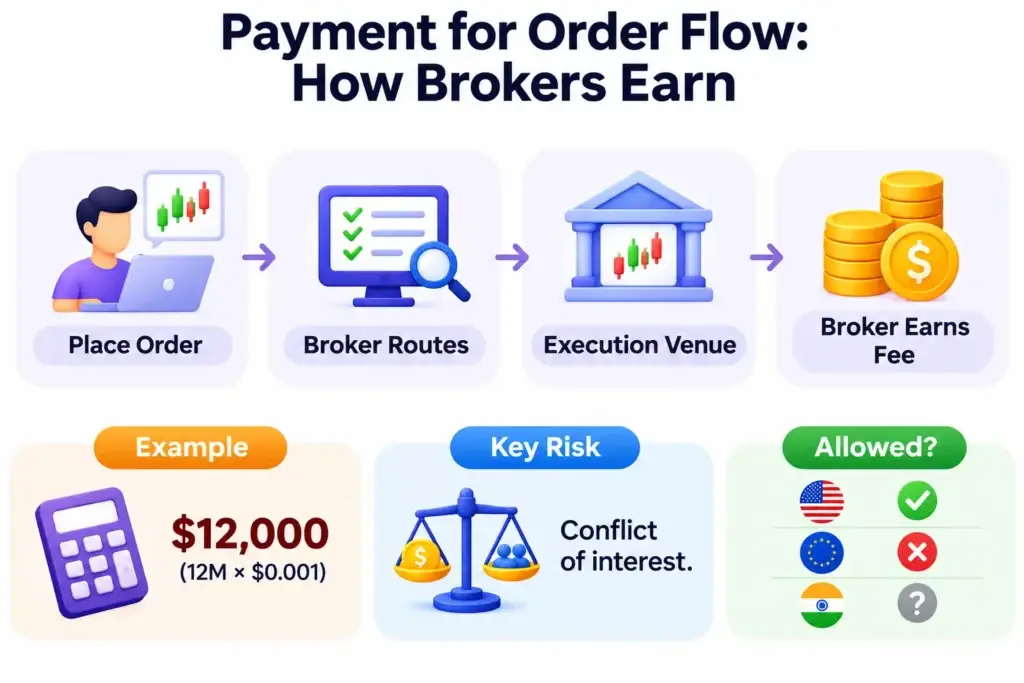
Payment for order flow is an arrangement in which a broker receives compensation for routing customer orders to a particular market center or execution provider.
In markets where this practice is permitted, an execution firm may pay for access to retail order flow because it sees an economic opportunity in executing those transactions. The execution firm may earn revenue from market-making activities, including the economics of buying and selling securities at different prices.
The broker may receive compensation under a commercial routing agreement. The precise payment structure depends on the agreement, security type, order characteristics, and governing regulations.
How a Payment for Order Flow Transaction Works
- The investor submits an order. A customer enters an instruction to buy or sell an eligible security.
- The broker evaluates the order. Relevant validation, risk, and routing processes determine how the order can be handled.
- The order reaches an execution venue. Depending on the market structure, the destination may be an exchange, market maker, or another authorized execution provider.
- The execution provider handles the transaction. The trade is executed under applicable market and regulatory conditions.
- The broker may receive routing compensation. Where permitted, the agreed payment is recorded and disclosed according to the relevant requirements.
Importantly, the investor’s order should not be routed solely to maximize the broker’s compensation. In the United States, brokers are subject to best-execution responsibilities and order-routing disclosure requirements. They must consider execution quality and applicable obligations when selecting how orders are handled.
A Hypothetical Payment for Order Flow Calculation
Consider a hypothetical U.S. brokerage receiving compensation on a defined category of eligible orders. Assume its arrangement pays an illustrative $0.001 for each eligible share routed and executed, and that the eligible volume reaches 12 million shares in a month.
Illustrative Order-Routing Revenue
Eligible executed volume: 12,000,000 shares
Assumed payment: $0.001 per share
Illustrative gross PFOF revenue: $12,000 per month
Hypothetical calculation only. The payment rate is an assumption, not a current market benchmark. Actual arrangements can have different payment bases, restrictions, and economics. This calculation does not include execution-related expenses, rebates paid out, or compliance costs.
This example demonstrates the relationship between eligible order volume and routing revenue. However, it does not establish whether the orders received competitive execution. That question requires separate examination of prices, execution speed, price improvement, fill likelihood, and other relevant factors.
Why Payment for Order Flow Creates a Conflict of Interest
The central concern is that a broker may receive greater compensation from one destination than another. This creates a potential conflict between the broker’s commercial interest and the investor’s interest in obtaining favorable execution.
For example, an execution venue offering a higher routing payment is not automatically providing the strongest execution outcome for every order. A broker needs policies and supervisory processes that account for this distinction.
Transparent order-routing disclosures and execution-quality reports help investors and regulators evaluate these arrangements. In the United States, Regulation NMS Rules 605 and 606 address aspects of execution quality and order-routing disclosure.
From a business perspective, sustainable order-routing revenue must be evaluated alongside the cost of compliance, monitoring, reporting, and maintaining customer trust.
Is Payment for Order Flow Allowed Everywhere?
No. Payment for order flow is jurisdiction-specific.
The United States has a regulatory framework addressing order-routing compensation and disclosure. The European Union, by contrast, has introduced a prohibition on the relevant practice under Article 39a of MiFIR, with certain transitional arrangements having ended by June 30, 2026.
For an India-focused business, founders should not assume that a U.S.-style PFOF agreement is an available revenue strategy. The applicable securities-market framework, broker relationships, exchange rules, and regulatory permissions must be examined independently.
The lesson is simple: a revenue mechanism that works under one market structure cannot be copied into another jurisdiction merely because the same trading interface can be built.
2. Securities Lending: How Brokerage Firms Earn From Customers’ Shares
Securities lending is the temporary transfer of eligible securities from a lender to a borrower under an agreement requiring the securities to be returned. Borrowers pay compensation for access to the securities, often to support short-selling, market-making, settlement, or other authorized activities.
In certain brokerage arrangements, securities held in customer accounts may become available for lending under applicable rules and customer agreements. The firm performing or facilitating the lending may earn a portion of the associated fees.
However, a customer simply owning shares does not mean the platform can automatically lend them. Fully paid lending programs require appropriate agreements, protections, and operational controls. The legal treatment of margin securities may differ from fully paid customer securities.
How a Securities Lending Arrangement Works
- A qualifying security is identified. A borrower needs access to a security for an eligible purpose.
- A securities lender makes it available. The lender or authorized intermediary evaluates whether the security can be lent.
- Collateral and loan terms are established. The arrangement specifies collateral, fees, obligations, and other protections.
- The security is temporarily transferred. The borrower receives the securities under the lending agreement.
- Fees accrue while the loan is active. The lending parties receive compensation according to the contract.
- The securities are returned or recalled. The loan ends according to its terms and applicable procedures.
Securities lending involves specialized custody, collateral, settlement, and risk-management infrastructure. It is not merely a switch that an ordinary investing application can activate without a participating financial institution.
How Securities Lending Fees Are Calculated
The economics depend on the value of securities on loan, the agreed borrowing fee, the duration of the loan, and how revenue is shared between the parties.
Borrowing demand varies across securities. Widely available shares may attract relatively modest fees, while securities with high borrowing demand and limited available supply may command higher rates. Rates can change, and lending activity may stop when demand disappears.
Illustrative Securities Lending Revenue
Average value of securities on loan: $5,000,000
Assumed annualized borrowing fee: 3%
Assumed loan duration: 30 days
Illustrative gross loan fee: $5,000,000 × 3% × (30 ÷ 360) = $12,500
Assumed broker revenue share: 40%
Illustrative broker revenue: $5,000
Hypothetical example using a 360-day calculation convention. The fee, duration, and revenue share are invented solely to demonstrate the calculation. Actual rates, agreements, day-count conventions, collateral arrangements, and eligible balances differ. Net profit would also account for relevant expenses and risks.
This demonstrates why securities lending revenue is not simply proportional to total customer assets. The relevant measure is how much eligible stock is actually lent, at what rate, and for how long.
A platform may have a large investment portfolio base but relatively little securities-lending income if borrowing demand is weak or the securities cannot be lent under its arrangements.
Why Customers May Participate in Fully Paid Lending
Some fully paid lending programs offer investors a share of the lending revenue when their eligible holdings are borrowed. This may create incremental income from securities they continue to hold economically.
However, participation carries important trade-offs. Depending on the applicable program, shares on loan may no longer carry ordinary voting rights for the lender, payments replacing dividends can have different tax treatment, and the lending arrangement introduces counterparty and collateral risk.
In the United States, securities on loan under fully paid lending arrangements do not receive the same Securities Investor Protection Corporation protection as ordinary securities held in a protected brokerage account. Collateral arrangements are therefore a critical part of the program.
Operators should explain these risks clearly rather than presenting securities lending as risk-free passive income.
What Can Reduce Securities Lending Profitability?
Borrowing demand can decline, fees can change, and securities may be recalled. Collateral management, operational processing, and customer payments also reduce the amount retained by the lending institution.
The operator must also consider the cost of controls for borrower default, loan valuation, collateral maintenance, corporate actions, recordkeeping, and settlement.
Consequently, securities lending is better modeled as a variable institutional revenue stream than as a predictable fee earned on every customer portfolio.
3. Margin Interest: How Brokers Earn When Investors Borrow to Trade
Margin lending allows eligible investors to borrow money against qualifying collateral in their brokerage accounts. The borrowed funds can increase purchasing power, but they also increase financial exposure.
The lending institution charges interest on outstanding borrowing balances. This can create recurring revenue even when a customer is not actively placing new trades.
For brokerage businesses with eligible margin-lending operations, margin interest can be an important source of income because it depends on financed balances and borrowing duration, not solely on the number of transactions executed.
How Margin Interest Works
Suppose an eligible investor wants to purchase securities worth $20,000 but provides $12,000 of their own funds. Under an approved margin arrangement, the remaining $8,000 may be financed by the broker or another lending institution.
The institution charges interest on the outstanding loan according to the applicable account agreement. If the investor repays part of the balance, the amount on which interest accrues may decline.
Interest calculations depend on the agreement, including the annual rate, daily balance methodology, compounding, and applicable charging conventions.
A Hypothetical Margin Interest Calculation
Illustrative Margin Lending Revenue
Average outstanding margin loans: $10,000,000
Assumed annual customer interest rate: 10%
Assumed annual financing cost: 5%
Illustrative annual interest income: $1,000,000
Illustrative annual funding cost: $500,000
Illustrative annual net interest spread: $500,000
Hypothetical arithmetic, not an actual broker interest rate or return forecast. This simplifies average outstanding balances and assumes constant rates. Credit losses, hedging, capital, servicing, compliance, and other costs are not deducted, so the spread is not net profit.
The difference between the lending rate and the institution’s cost of funding is an important part of margin economics. But a positive spread does not guarantee profitability.
The lender must account for credit risk, collateral volatility, operational expenses, regulatory capital requirements, and unexpected liquidity needs. Rapid changes in market prices can increase the difficulty of managing those risks.
Why Margin Lending Is Riskier Than Ordinary Transaction Fees
A transaction fee is earned from providing a service. A margin loan involves extending credit against collateral whose value can change quickly.
If the market value of collateral falls, the customer may be required to deposit additional funds or securities. The lender may liquidate positions under the account agreement to restore required margin levels.
In extreme market conditions, a customer’s collateral can decline faster than positions can be liquidated. This creates potential losses for the lender as well as the investor.
Therefore, margin lending requires eligibility assessments, exposure limits, collateral valuation, monitoring, margin-call procedures, and clearly documented customer agreements.
Why Margin Interest Revenue Changes Over Time
Margin income is influenced by interest rates, financing costs, market conditions, customer borrowing behavior, and risk appetite.
When borrowing balances decline, interest income may fall even if the number of registered customers remains stable. Rising funding costs can also compress margins when customer rates do not increase proportionately.
Founders should model average outstanding balances and net financing spreads rather than assuming every active trader becomes a margin borrower.
Payment for Order Flow vs. Securities Lending vs. Margin Interest: Which Is More Sustainable?
There is no universal winner among the three revenue streams. Their economic attractiveness depends on the institution’s operating model, jurisdiction, capital resources, customer base, and risk-management capacity.
| Factor | PFOF | Securities lending | Margin interest |
|---|---|---|---|
| Revenue driver | Eligible routed order flow | Active loans and borrow fees | Outstanding customer loans |
| Revenue stability | Sensitive to activity and regulations | Sensitive to borrowing demand | Sensitive to balances and interest spreads |
| Main infrastructure | Order routing and execution supervision | Custody, collateral, and loan processing | Lending, collateral, and credit risk controls |
| Main concern | Execution conflicts | Counterparty and collateral risk | Credit and funding risk |
| Access to revenue | Permitted routing arrangements | Authorized lending relationships | Authorized credit provision or financing partnership |
A brokerage with significant borrowing balances may earn substantial margin income but also carry funding and credit obligations. Another institution may earn from lending high-demand securities without having the same customer financing exposure.
Payment for order flow can be economically tied to transaction volume, but its viability depends heavily on market structure and regulatory permission.
For founders, diversification is useful only when each revenue stream is legally accessible, operationally manageable, and economically positive after associated costs.
What Else Can Zero-Commission Brokerage Businesses Earn From?
Although the three mechanisms above explain important parts of the model, they do not represent every possible revenue source.
Depending on the legal and commercial structure, a financial platform may receive revenue from premium subscriptions, investment research, market data, permitted account services, technology APIs, or contracted referral arrangements.
Some licensed financial institutions may also earn net interest income on eligible cash-related balances, subject to customer asset protection rules and the applicable custody and banking arrangements. Customer cash cannot simply be treated as unrestricted operating capital.
Other businesses may monetize advisory services or enterprise software rather than customer orders or assets. These models have different regulatory requirements and revenue-recognition rules.
For readers exploring broader brokerage economics, the discount brokerage revenue model breakdown provides complementary context on subscription income, brokerage charges, and platform-level monetization.
The key distinction is that an investing interface, a licensed broker, a clearing institution, and a software provider may all participate in one customer experience while earning from different activities.
How Zero-Commission Trading Platforms Turn Revenue Into Profit
Generating revenue is not the same as generating profit. Brokerage platforms incur substantial costs related to customer verification, infrastructure, market data, clearing relationships, cybersecurity, customer support, fraud monitoring, and regulatory operations.
For licensed financing and securities-lending activities, there are additional funding, collateral, liquidity, capital, and risk-management requirements.
A founder comparing revenue models should therefore calculate contribution after the direct expenses associated with each stream, rather than adding gross income figures and treating the result as operating profit.
A Practical Brokerage Unit-Economics Framework
Revenue and Contribution Framework
Total eligible revenue = Permitted order-routing income + Retained securities-lending income + Margin interest income + Other earned service revenue.
Contribution = Total eligible revenue − Direct execution costs − Funding expenses − Lending-related expenses − Variable servicing and operational costs − Relevant credit losses.
Operating result = Contribution − Fixed personnel, technology, licensing, compliance, and other overhead.
Illustrative management framework. Exact accounting classification and recognition depend on the entity’s contractual role and applicable accounting standards. Avoid adding gross securities-lending fees when the platform is entitled to recognize only a net share.
This framework makes it easier to understand whether growth improves profitability. A brokerage may increase executed orders while also experiencing higher clearing and servicing costs. A financing business may earn more interest while taking on additional capital and credit exposure.
For a software-only platform, the relevant calculation may be entirely different: subscription revenue, API access fees, permitted referral payments, and enterprise service income, minus integration, support, data, infrastructure, and acquisition costs.
What Happens When Trading Activity, Borrowing Demand, or Interest Rates Change?
One of the most important financial weaknesses of a concentrated brokerage model is its dependence on conditions the operator cannot fully control.
Scenario 1: Trading Activity Declines
If a permitted PFOF arrangement pays according to eligible volume, lower trading activity can reduce revenue. Fixed technology and compliance expenses may remain relatively stable, reducing operating leverage.
A business that depends heavily on routing compensation should evaluate whether recurring service revenue can help absorb periods of reduced activity.
Scenario 2: Securities Borrowing Demand Falls
When borrowers no longer need particular securities, lending volume and fee income can decline. Even a large base of customer holdings does not guarantee a stable lending book.
Forecasts should distinguish total securities under custody from average loaned value and account for the possibility that loans are recalled or borrowing rates change.
Scenario 3: Margin Balances or Financing Spreads Shrink
Reduced borrowing balances can decrease interest income. Higher funding costs can compress the spread between the interest charged to customers and the cost of financing the loans.
Stress tests should evaluate the combined effects of declining collateral values, higher funding costs, customer repayment behavior, and potential credit losses.
These scenarios demonstrate why historical revenue performance should not be treated as a guaranteed forecast. Sustainable planning requires understanding the economic drivers behind the numbers.
Why Regulations Change the Zero-Commission Business Model Across Markets
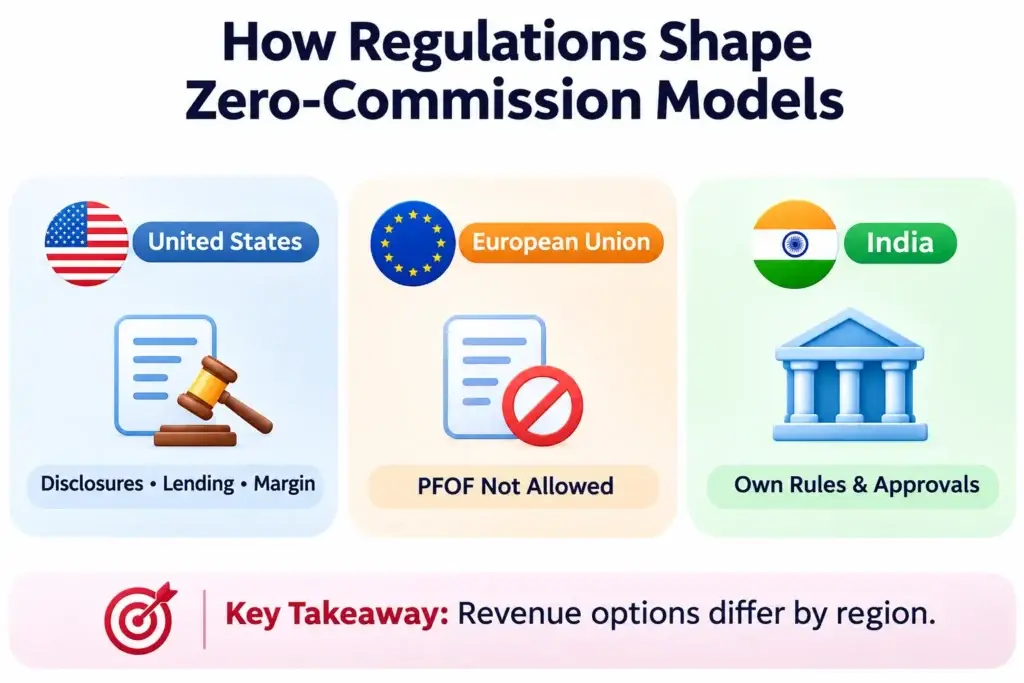
Financial regulation is not merely an administrative step completed after product development. It determines which commercial activities a business can legally perform and how customers must be protected.
United States: Execution Disclosures, Lending Protections, and Margin Rules
In the United States, order-routing practices operate within a framework addressing broker obligations and disclosures. Relevant requirements include execution-quality reporting, order-routing disclosures, and best-execution responsibilities.
Fully paid securities lending is subject to customer agreements and collateral protections. Margin lending involves credit agreements, interest disclosures, and risk controls.
These revenue mechanisms should therefore be evaluated together with the costs of maintaining suitable supervisory systems and customer protections.
European Union: Restrictions on Payment for Order Flow
The European Union’s MiFIR framework prohibits the relevant receipt of third-party compensation for directing client orders to particular execution venues. Transitional exemptions for qualifying arrangements were time-limited and ended by June 30, 2026.
This means a business evaluating European operations should not build its forecast around receiving prohibited routing payments. Revenue planning should instead focus on services and arrangements permitted under the applicable framework.
India: Avoid Importing a Foreign Brokerage Revenue Model
India’s securities market has its own broker-registration requirements, exchange arrangements, client asset protections, margin regulations, and securities lending and borrowing framework.
A founder operating in India should not assume that U.S.-style order-flow payments, fully paid customer securities lending, or margin financing practices can be adopted unchanged.
Whether a business can earn a particular type of income depends on its legal entity, approvals, role in the transaction, and the rules governing that activity. The treatment of client securities and collateral is particularly important.
Before finalizing a revenue forecast, obtain qualified advice about the relevant securities, exchange, banking, lending, and data-protection requirements.
Why a Trading Software Provider Cannot Automatically Earn Brokerage Revenue
Founders sometimes assume that owning the trading application means owning the commercial rights associated with every customer order, investment balance, or financed transaction.
That assumption is incorrect. A technology provider may supply the interface, account dashboards, API connectivity, or order-management tools while a separate licensed institution executes trades, holds customer securities, or extends credit.
In such an arrangement, revenue entitlement follows contracts and regulatory permissions, not merely ownership of the software.
| Business role | Typical responsibility | Potential commercial model |
|---|---|---|
| Licensed broker | Customer brokerage relationship and regulated execution services | Permitted brokerage, routing, financing, and other services |
| Clearing or custody institution | Clearing, custody, settlement, or authorized financing functions | Contracted clearing, custody, financing, or lending income |
| Trading software operator | User experience, connectivity, analytics, and platform services | Subscriptions, software licensing, APIs, permitted referrals |
| Technology development partner | Builds, customizes, integrates, and maintains software | Development, deployment, support, and integration fees |
These functions may be combined within a properly authorized organization, but they should not be treated as interchangeable.
For founders evaluating fintech application engineering and integration services, defining each institution’s responsibilities before choosing the software architecture can prevent expensive redesign and unrealistic revenue assumptions.
What Technology and Operational Controls Support These Revenue Models?
Revenue strategies involving securities and customer funds require reliable financial records. A polished trading dashboard is only one part of the operating environment.
The underlying systems may need to support order records, reconciliation, authorized account relationships, collateral information, disclosures, financial reporting, and audit trails. Exact requirements vary according to which activities the operator or its regulated partners perform.
Order-Routing and Execution Records
Where order-routing arrangements are relevant, operators need accurate information about order submission, destination, execution, timing, and applicable compensation. These records support reconciliation, supervision, and reporting.
The objective is not simply to identify which venue generated the most revenue. Execution outcomes and investor protection must remain central to the process.
Securities Lending and Collateral Records
Authorized securities lending requires tracking eligible assets, loan status, borrowing rates, collateral, recalls, corporate actions, and contractual revenue sharing.
When a financial institution provides this functionality, the connected trading application may display permitted information, but the authoritative records and legal responsibilities remain governed by the relevant custody and lending arrangements.
Margin Accounts and Risk Monitoring
Margin lending operations need accurate records of loan balances, interest accrual, collateral valuations, margin requirements, risk exposure, and repayments.
Market volatility can change account risk quickly. Systems therefore need dependable data and controlled processes for the financial institution to identify breaches and take appropriate action.
These requirements demonstrate why revenue design, regulated partnerships, and technology architecture should be considered together rather than as separate decisions.
A Founder Framework for Evaluating a Zero-Commission Revenue Strategy
Before making revenue projections, founders should determine which activities their proposed organization is actually authorized and equipped to perform.
Regulatory Eligibility
Is the revenue stream permitted, and does the operator have the necessary legal capacity or authorized partners?
Revenue Entitlement
Which institution receives income, and what share can the platform contractually recognize?
Economic Durability
How sensitive is the model to trading activity, lending demand, rates, funding costs, and market volatility?
Operational Readiness
Can the business support disclosures, reconciliation, risk monitoring, customer protection, and financial reporting?
This framework helps distinguish an attractive theoretical revenue idea from a model that can be implemented responsibly.
For example, a startup offering analytics and trading connectivity may have a compelling subscription business even without receiving revenue from customer order routing or securities lending. Its competitive advantage may be the quality of the tools it provides rather than ownership of the underlying brokerage economics.
Similarly, a licensed financial institution considering margin lending should evaluate capital and risk requirements rather than assuming the difference between lending and financing rates represents guaranteed profit.
How Customer Trust Influences the Profitability of Commission-Free Trading
A zero-commission offer can reduce the visible cost of entering the market, but long-term customer retention depends on much more than the advertised fee.
Investors need confidence that their orders are handled appropriately, their securities are protected, financing terms are understandable, and important account information is accurately presented.
Confusing disclosures or unexplained charges can weaken trust even when the platform’s advertised transaction commission is genuinely zero.
This makes education and transparent onboarding important commercial activities. Acquisition campaigns should explain the product’s actual value proposition without implying that investing is risk-free or that zero commission eliminates all costs.
The stock trading platform user-acquisition and trust strategy provides additional context for positioning financial products around credibility, education, and long-term user relationships.
For founders, customer trust should be treated as an operating asset. A model that generates short-term revenue while weakening transparency can create reputational, retention, and regulatory costs that outweigh its immediate financial benefit.
Common Mistakes Founders Make When Planning Zero-Commission Brokerage Revenue
Mistakes to Avoid
Mistake 1: Assuming Every Zero-Commission Broker Uses PFOF
Revenue models differ by company and jurisdiction. PFOF is not universally available or used.
Mistake 2: Treating Customer Securities as Freely Lendable
Securities lending depends on eligibility, legal agreements, collateral protections, and the role of authorized institutions.
Mistake 3: Counting Gross Interest as Profit
Margin lending carries funding, capital, credit, liquidity, and operating costs that reduce economic returns.
Mistake 4: Copying a Foreign Revenue Model Without Regulatory Review
Brokerage rules differ across markets. Revenue planning must be aligned with the specific jurisdiction and legal entity.
Mistake 5: Confusing Software Ownership With Financial Authorization
Owning application code does not grant a license to execute trades, hold client assets, lend securities, or extend regulated credit.
Mistake 6: Ignoring Investor Outcomes
Order execution quality, transparent pricing, risk disclosures, and customer protections remain essential even when the visible commission is zero.
How Miracuves Supports Founders Evaluating Trading Platform Economics
Understanding brokerage revenue is a necessary step before selecting the technical foundation for a financial product. The software should be designed around the operator’s actual business role, authorized integrations, and commercial model.
Miracuves offers ready-made trading software foundations and customization services for founders who need branded interfaces, broker connections, administrative workflows, and source-code ownership. Its six-working-day deployment proposition applies to qualifying ready-made implementations within the agreed scope.
That deployment timeline is separate from broker approvals, exchange connectivity permissions, regulatory registration, or the authorization required to engage in financing and securities-lending activities.
A founder planning an independent software platform may need subscriptions, API access, analytics, and broker integration capabilities. A licensed brokerage may have a different set of requirements involving financial records, risk controls, and regulated operations.
Clarifying those differences early helps prevent unnecessary engineering and avoids building a revenue strategy around financial activities the software operator cannot legally perform.
Final Thoughts: Zero Commission Is a Pricing Strategy, Not a Complete Business Model
Zero-commission trading platforms can generate revenue through payment for order flow, securities lending, margin interest, and other financial or technology services. But each revenue stream operates under different commercial, operational, and regulatory conditions.
Payment for order flow depends on eligible routing arrangements and execution obligations. Securities lending depends on borrowing demand, available assets, collateral, and customer agreements. Margin interest depends on outstanding credit balances, financing costs, and risk management.
For founders preparing the technology side of an investment business, exploring White-Label Trading Platform can provide a useful starting point for assessing order workflows, broker connectivity, administrative requirements, and future customization.
The strongest business model is not necessarily the one offering the most revenue streams. It is the one where every source of income is legally permitted, commercially justified, clearly disclosed, and supported by reliable financial operations.
Commission-free trading can remove an obvious barrier to participation. Long-term profitability, however, depends on what the business earns after delivering trustworthy services, protecting investors, and meeting its ongoing obligations.
Frequently Asked Questions
How do zero-commission trading platforms make money?
Depending on their legal structure and jurisdiction, zero-commission brokerage businesses may earn revenue from payment for order flow, securities lending, margin interest, subscriptions, account services, and other permitted arrangements. Not every broker uses every revenue stream, and independent software operators may earn primarily from technology services.
What is payment for order flow in stock trading?
Payment for order flow is compensation a broker receives for directing eligible customer orders to a particular execution venue. Where permitted, these arrangements are subject to applicable order-handling, investor-protection, and disclosure requirements. The practice is restricted or prohibited in certain jurisdictions.
How does securities lending generate brokerage revenue?
Securities lending generates income when eligible securities are temporarily transferred to borrowers for a fee. A brokerage or clearing institution may retain an agreed portion of that income. Actual earnings depend on borrowing demand, securities on loan, fee rates, loan duration, and contractual revenue sharing.
How do brokers earn money from margin interest?
Eligible customers borrow funds against securities collateral and pay interest on outstanding margin balances. The lending institution may earn a spread between customer interest income and its financing cost, but this is not pure profit because credit, capital, liquidity, and operating expenses also apply.
Does zero-commission trading mean investing is completely free?
No. A zero advertised trading commission does not eliminate all possible investment costs. Investors may still face bid-ask spreads, applicable exchange or regulatory charges, foreign-exchange conversion costs, margin interest, and other disclosed service fees.
Is payment for order flow legal in every country?
No. Rules vary by market. The United States has order-routing disclosure and execution obligations, while the European Union prohibits the relevant PFOF arrangements under MiFIR Article 39a. Founders must review the applicable local framework before including PFOF in a revenue forecast.
Can a trading software platform earn margin or securities lending income automatically?
No. Software ownership does not grant authorization to extend credit, hold customer assets, or lend securities. Those activities require the appropriate legal structure, permissions, financial institution relationships, customer agreements, and operating controls. A software-only business may instead earn subscriptions, API fees, or other permitted service revenue.
Which zero-commission brokerage revenue stream is the most profitable?
There is no universally most profitable stream. PFOF depends on permitted order-routing activity, securities lending on borrowing demand and fees, and margin interest on financed balances and risk-adjusted spreads. Profitability must be evaluated after direct expenses, capital requirements, compliance costs, and potential losses.
Miracuves is an independent software development company. We are not affiliated with, connected to, sponsored by, or endorsed by any company or product named in this article.
Terms such as “X Clone” are used descriptively. It is how the software industry refers to building a platform with functionality comparable to a known service, and how clients search for it.
The entire design and codebase of our products is built by our own team. Our products contain no code, design, graphics, or content originating from any third-party website or applications.
All third-party names and marks referenced in this article are the property of their respective owners, referenced solely to identify the services discussed.