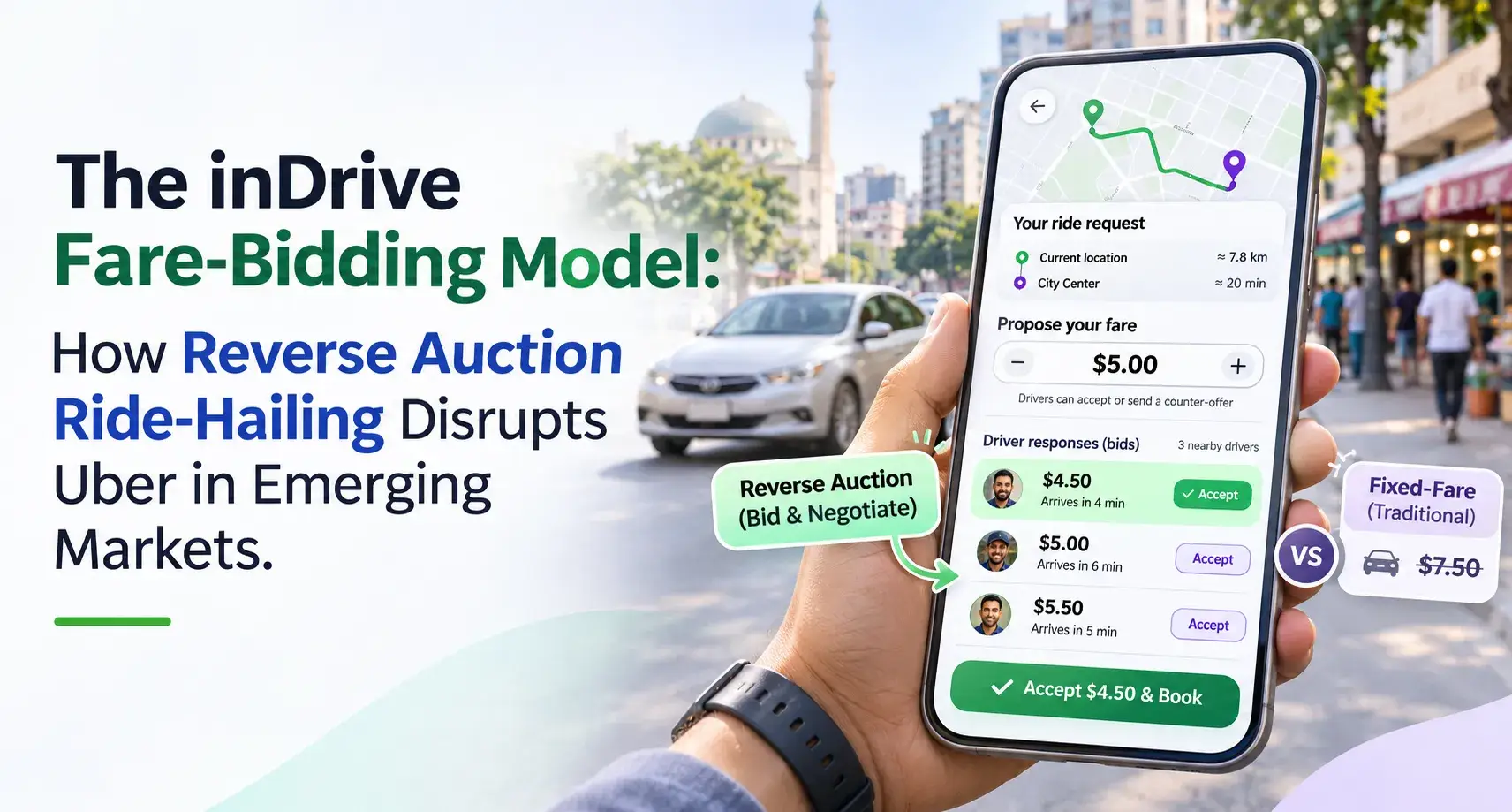
For years, digital ride-hailing has largely followed a familiar pricing pattern: a passenger enters a destination, receives a calculated fare, and decides whether to book. But an alternative approach is changing how riders and drivers think about the value of a journey.
Reverse-auction fare bidding introduces a different pricing relationship. Instead of accepting only a platform-generated amount, passengers can suggest what they are willing to pay, while drivers decide whether the proposed fare makes economic sense for them.
This change is particularly relevant in emerging markets, where income levels, travel patterns, transport availability, and operating costs can vary considerably within the same city.
The opportunity is not simply to offer lower prices. It is to discover fares that both sides consider acceptable, potentially enabling journeys that might otherwise never take place.
For mobility entrepreneurs, the important question is whether this additional pricing freedom can create a more accessible and sustainable transport marketplace.
Essential Insights
Key Takeaways
- Reverse-auction-style fare bidding gives passengers and drivers greater influence over the price of individual journeys.
- Negotiated fares can improve price discovery when transport demand, income levels, and driver operating costs vary widely.
- Driver choice matters as much as passenger affordability because rides are completed only when both parties agree.
- Negotiation can expand mobility access, but it can also create booking delays and unsuccessful requests.
- Successful marketplaces must balance pricing flexibility with matching efficiency, safety, and financially sustainable operations.
What Is Reverse-Auction Fare Bidding in Ride-Hailing?
Reverse-auction fare bidding is a pricing approach in which a passenger initiates a journey request with a proposed fare and eligible drivers can respond according to their willingness to complete the trip.
Unlike a conventional auction, where buyers compete by increasing their offers, this arrangement begins with a passenger stating a price and drivers responding to the request.
However, describing the process as a pure reverse auction would be misleading. Drivers may make counteroffers, and passengers can choose based on price, pickup time, vehicle suitability, or other available information. The lowest response does not necessarily win.
The more precise economic concept is bilateral fare negotiation within a digital mobility marketplace.
How a Negotiated Fare Is Reached
- The passenger identifies a journey. The pickup location and destination establish the transport requirement.
- An initial fare is proposed. The passenger chooses an amount they are comfortable paying, subject to applicable platform rules.
- Eligible drivers evaluate the opportunity. Drivers consider the route, pickup distance, time commitment, and expected earnings.
- Responses create a choice. Drivers may accept the proposed fare, decline the request, or suggest another amount.
- The passenger selects an acceptable offer. The final decision can consider both price and convenience.
- The fare is agreed before the journey. The confirmed amount becomes the basis for the trip, subject to disclosed terms and applicable regulations.
This process introduces human price discovery into a digitally coordinated transport service. The platform still facilitates discovery, communication, and matching, but the final price can reflect the preferences of the people making the journey possible.
Why Fare Negotiation Is Particularly Relevant in Emerging Markets
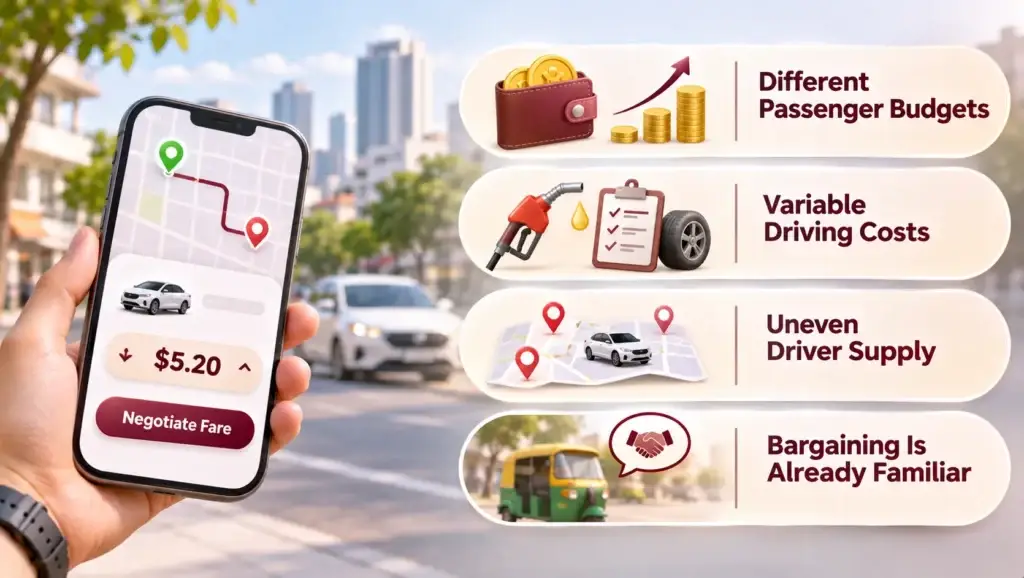
Emerging markets are not uniform. A dense metropolitan commercial district, an outer residential neighbourhood, and a smaller regional city can have very different transport conditions.
Yet these environments share several challenges that make flexible pricing worth examining.
1. Passenger Budgets Differ Significantly
A ride that appears reasonably priced to one passenger may be unaffordable to another. This becomes important when households are sensitive to relatively small differences in transport expenditure.
Negotiation allows passengers to communicate their willingness to pay rather than respond only to an initial system-generated quote.
The economic benefit depends on whether drivers can serve that demand profitably. An affordable proposed fare is not automatically a viable fare.
2. Local Driving Costs Are Highly Variable
Drivers evaluate more than the distance between pickup and destination.
Fuel expenditure, traffic congestion, vehicle maintenance, unpaid pickup distance, and the likelihood of finding another passenger all influence whether a trip is worthwhile.
A driver already travelling toward a requested pickup may find a particular offer attractive. Another driver located farther away may reasonably require more compensation.
Direct fare negotiation allows some of these individual circumstances to influence the booking decision.
3. Transport Supply Is Unevenly Distributed
Some neighbourhoods have abundant driver availability, while others experience shortages during specific hours or days.
Rigid prices may fail to reflect these differences accurately, particularly where historical trip data is limited or demand changes unpredictably.
Negotiation can introduce flexibility, although it cannot solve a shortage of available drivers on its own.
4. Price Bargaining Is Already Familiar in Some Local Transport Markets
In some cities, passengers are accustomed to discussing fares with independent transport providers before travelling.
A digital negotiation mechanism can preserve aspects of that familiar behaviour while introducing structured journey records and clearer booking information.
But the cultural fit must be tested locally. Passengers who prioritise speed and predictability may prefer receiving a final price immediately.
The Economics Behind Passenger-Driver Fare Negotiation
The central economic principle is simple: a journey becomes possible when the passenger’s maximum acceptable payment is sufficient to satisfy the driver’s minimum acceptable compensation.
Economists describe this process as price discovery.
Consider a hypothetical journey where a passenger is willing to pay up to 220 local currency units and a driver would accept at least 180 units after considering the relevant trip costs.
There is a potential agreement range between those values.
If both parties identify an acceptable amount within that range, the journey can proceed. If their expectations do not overlap, no mutually beneficial agreement exists under the current conditions.
The example is illustrative, not a published market price or a guarantee of earnings.
Illustrative price-discovery example
Illustrative local currency units only. This visual supplements the hypothetical example above and does not represent actual market pricing.
Why Price Discovery Can Create Additional Rides
A single automated fare may not always reflect an individual passenger’s willingness to pay or a specific driver’s willingness to accept a trip.
Imagine a journey that is unattractive at the initial displayed price. One nearby driver might still find it worthwhile because their next destination is close to the passenger’s drop-off point.
Negotiation makes it possible for that driver and passenger to identify an agreement without requiring every driver in the area to accept the same economics.
This does not mean negotiation is superior for every journey. It means that flexible pricing can uncover opportunities hidden by a single-price decision.
What Economic Research Suggests
A January 2026 Oxford Economics study, conducted in collaboration with a mobility platform, examined in-app fare negotiation across seven emerging markets in Latin America, South Asia, and North Africa.
The study reported that some surveyed riders and drivers completed more journeys because of fare negotiation. It also identified potential improvements in accessibility, affordability, and the alignment between fares and driver costs.
These findings support the idea that negotiated pricing can expand transport opportunities. However, the survey responses should not be interpreted as universal causal evidence or a guarantee of better performance in every city.
Operators still need local data to determine whether pricing flexibility improves real-world outcomes.
How Negotiated Pricing Changes the Relationship Between Riders and Drivers
Ride-hailing marketplaces depend on two groups with different priorities.
Passengers want affordable, timely, reliable transportation. Drivers want worthwhile compensation, manageable operating costs, and the freedom to evaluate journey opportunities.
A negotiated pricing model gives both sides a more explicit role in the transaction.
| Marketplace dimension | Platform-determined pricing | Negotiated fare pricing |
|---|---|---|
| Initial price | Generated by platform pricing rules | Proposed by the passenger, often with fare guidance |
| Driver participation | Driver responds to a quoted trip | Driver can evaluate and potentially counteroffer |
| Passenger control | Accept or decline the displayed fare | Propose a fare and choose among suitable responses |
| Price certainty | Usually available immediately | Established after an agreement |
| Potential friction | Quote rejection or later cancellation | Additional negotiation and matching time |
| Core strength | Fast, consistent quoting | Flexibility for individual journey circumstances |
On smaller screens, scroll horizontally to view the complete comparison.
Neither approach is inherently superior. The relevant question is which pricing experience produces reliable matches and sustainable economics in a particular market.
Can Fare Bidding Improve Driver Earnings?
Negotiation can give drivers greater control over the compensation they are willing to accept. But control over a proposed fare is different from earning more money.
A driver might receive a higher agreed amount for an individual journey but still earn less over a shift if negotiations take longer, pickup distances increase, or too many requests go unmatched.
Consequently, driver income should be evaluated through the complete working session rather than the fare displayed for one trip.
Three Economic Factors That Matter to Drivers
- Net earnings per occupied hour: Income remaining after relevant expenses, considered against time spent transporting passengers.
- Unpaid operating time: Time spent travelling to pickups, waiting for responses, or searching for another request.
- Trip acceptance efficiency: The share of worthwhile requests that convert into completed journeys without excessive delay.
Suppose a driver secures a slightly higher fare but spends substantially longer waiting for the passenger to accept it. The apparent gain may disappear when evaluated against total working time.
This is why fare flexibility and marketplace matching efficiency must be assessed together.
Why Negotiated Fares Can Expand Access to Underserved Areas
Transport accessibility involves more than price. It also depends on whether a vehicle is actually available to complete the journey.
Passengers in peripheral neighbourhoods, smaller towns, or less frequently served routes may struggle to obtain reliable transportation because drivers consider some trips commercially unattractive.
Negotiated fares can create additional matching possibilities in these situations.
A passenger may propose a fare that reflects their budget, while drivers evaluate whether their current location, return-trip expectations, or schedule make the journey feasible.
In some circumstances, the agreed fare may be lower than an alternative quote. In others, passengers may voluntarily offer more to attract a driver to a difficult pickup location.
The underlying advantage is flexibility, not permanently lower prices.
However, where few drivers are available, negotiation cannot create additional vehicle capacity. Operators may still need better driver coverage, clearer service boundaries, and appropriate supply incentives.
The Hidden Trade-Off: Pricing Freedom Versus Booking Speed

Every additional decision in a booking process introduces some degree of friction.
A passenger requesting an immediate journey might value a quick confirmation more than the opportunity to negotiate. Another passenger planning a less urgent trip may be willing to compare responses.
Drivers face a similar trade-off. Reviewing multiple requests and submitting counteroffers takes attention and time, with no certainty that the passenger will choose their response.
Negotiation can therefore improve price flexibility while making the matching process more complicated.
When Negotiation May Be Most Useful
It can be particularly relevant for price-sensitive journeys, variable-distance trips, markets with heterogeneous driver costs, and locations where conventional pricing frequently leaves requests unfulfilled.
When Immediate Pricing May Work Better
Immediate fare confirmation may be preferable for time-sensitive travel, tightly scheduled pickups, highly standardised routes, or passengers who place a premium on speed and convenience.
This suggests that market conditions, not ideology about pricing, should guide the decision.
For a closer examination of unsuccessful negotiations, the related guide on what happens when a driver does not accept a proposed fare explains the operational recovery problem in greater detail.
How Fare Negotiation Can Change Market Competition
Ride-hailing businesses compete on several connected dimensions: fare affordability, driver availability, pickup speed, reliability, safety, and service consistency.
Negotiated pricing changes the competitive equation by turning price flexibility into an element of the user experience.
A passenger may choose a service because they can express their budget. A driver may participate because they can evaluate the economic attractiveness of individual trips.
But these advantages are conditional.
A marketplace with weak driver coverage will struggle regardless of how flexible its pricing is. Similarly, a service with low fares but unreliable pickups may fail to retain riders.
Lower Fares Are Not the Same as Stronger Unit Economics
For operators, gross booking value alone does not reveal whether the marketplace is healthy.
Every completed journey may involve payment-processing charges, customer support, incentives, and other operating expenses.
If passengers consistently negotiate prices that leave drivers with unattractive earnings, supply quality can deteriorate. If drivers consistently demand more than passengers are willing to pay, booking conversion may suffer.
Successful pricing must support a viable transaction for the passenger, driver, and platform simultaneously.
Which Metrics Reveal Whether a Fare-Bidding Marketplace Is Working?
Founders evaluating a negotiated-pricing marketplace should measure its actual transaction quality rather than assume that higher bidding activity indicates success.
| Metric | What it measures | Why it matters |
|---|---|---|
| Completed-request rate | Completed rides divided by eligible requests | Shows whether the marketplace turns demand into transportation |
| Time to agreement | Time between the first fare offer and confirmation | Reveals negotiation friction |
| Pickup waiting time | Time from confirmation until vehicle arrival | Measures convenience after matching |
| Driver net earnings per hour | Earnings after relevant expenses relative to working time | Shows whether participation is economically worthwhile |
| Fare disagreement rate | Share of trips generating pricing complaints | Indicates clarity and trust |
| Repeat rider rate | Share of riders returning within a defined period | Indicates whether the experience creates lasting value |
On smaller screens, scroll horizontally to view all metric definitions and business implications.
These metrics should be segmented by city, neighbourhood, time of day, journey distance, and driver availability.
A high-performing model in a dense city centre may behave differently in a lower-density service area.
What Mobility Entrepreneurs Should Evaluate Before Adopting Negotiated Pricing
Before choosing a pricing approach, founders should examine how people currently travel, how drivers earn, and what prevents existing transport demand from becoming completed journeys.
Market-readiness framework
Founder Decision Signals
Demand: Are passengers rejecting existing transport options because of affordability, or because vehicles are unavailable?
Supply: Do drivers have enough completed journeys to sustain reliable participation?
Behaviour: Are local customers comfortable negotiating digitally, or do they prefer immediate prices?
Efficiency: Does fare flexibility produce more completed trips without creating unacceptable delays?
Trust: Are agreed fares, service expectations, and dispute procedures clearly communicated?
The answers should be supported by local interviews, observed trip patterns, and measured marketplace performance wherever possible.
Founders should also consider local transport regulations. Fare caps, minimum charges, licensing, driver eligibility, and passenger protection requirements can affect whether and how negotiated pricing is permitted.
For a wider view of marketplace operation, the Miracuves transportation and mobility industry resource connects pricing decisions with driver utilization, matching, and service reliability.
Common Misconceptions About Reverse-Auction Ride-Hailing
Misconception 1: The Lowest Fare Always Wins
Not necessarily. A passenger may prefer a closer driver, a shorter pickup time, or a more suitable vehicle even when another response offers a lower amount.
Misconception 2: Negotiation Always Makes Travel Less Expensive
Negotiated fares can create opportunities for lower prices, but shortages, difficult journeys, and driver operating costs can result in higher accepted amounts.
Misconception 3: More Counteroffers Mean a Healthier Marketplace
A large number of counteroffers can signal participation, but it may also indicate a persistent gap between passenger budgets and driver expectations.
Misconception 4: Driver Choice Automatically Guarantees Higher Earnings
Drivers must consider the entire working session, including unsuccessful negotiations and unpaid waiting time. Individual fare gains do not necessarily translate into improved net earnings.
Misconception 5: Fare Flexibility Removes the Need for Pricing Rules
Clear policies still matter. Fare guidance, consumer protection, final-price confirmation, and applicable legal limits can help maintain trust.
Operators exploring these issues can read more about responsible boundaries for fare bidding.
Where Fare Negotiation Fits Into the Future of Urban Mobility
The long-term opportunity for negotiated fare pricing is not necessarily replacing every automated pricing system.
Different journeys create different passenger expectations and driver constraints. A predictable daily commute may benefit from quick fare confirmation, while an irregular or underserved route may benefit from more pricing flexibility.
This creates a strong case for evaluating pricing models according to local demand, service urgency, and marketplace maturity.
For founders who have established that negotiated fares fit their target market, the next step is determining whether the operating model can support transparent bookings, driver participation, reliable payments, and accountable administration.
Conclusion: The Real Disruption Is Who Gets to Influence the Fare
Reverse-auction-style fare bidding challenges the assumption that a digital transport platform must determine every journey price on behalf of its users.
By allowing passengers and drivers to participate in price discovery, negotiated fares can create new opportunities for affordable journeys, driver choice, and transport access.
The model is particularly relevant where income differences, operating costs, and transport availability make a single pricing approach difficult to apply consistently.
But flexibility alone does not build a sustainable marketplace.
The stronger business decision is to evaluate whether negotiated pricing improves completed trips, protects driver economics, keeps booking times reasonable, and creates an experience passengers want to use again.
For mobility entrepreneurs, that distinction matters more than choosing a pricing mechanism because it appears disruptive. The goal is to make more economically viable journeys possible without compromising reliability or trust.
Frequently Asked Questions
What is reverse-auction fare bidding in ride-hailing?
Reverse-auction fare bidding is a pricing mechanism that allows passengers to propose a fare for their journey instead of automatically accepting a platform-generated price. Drivers can accept the proposed amount, decline the request, or submit a counteroffer. The passenger then chooses an acceptable offer based on factors such as fare, pickup time, and driver availability. This creates a more flexible pricing experience where both parties influence the final cost of the journey.
How does negotiated fare pricing differ from dynamic pricing?
Dynamic pricing relies on platform algorithms that adjust fares based on demand, driver availability, distance, traffic conditions, and other variables. Negotiated fare pricing allows passengers and drivers to participate directly in determining the final amount. While dynamic pricing prioritizes automated price adjustments, fare negotiation emphasizes individual preferences and mutual agreement. Both models have advantages depending on market conditions and passenger expectations.
Why is reverse-auction ride-hailing gaining attention in emerging markets?
Reverse-auction ride-hailing is attracting attention in emerging markets because passengers often have different purchasing capacities, while drivers face varying operating expenses. Negotiated pricing allows riders to communicate their budgets and drivers to evaluate whether specific journeys are financially worthwhile. This flexibility may improve transportation accessibility in price-sensitive markets, particularly where conventional fare calculations do not accurately reflect local conditions.
Does fare bidding always result in cheaper rides?
No. Fare bidding does not guarantee lower transportation costs. Passengers may secure more affordable journeys when several drivers are available and willing to negotiate. However, fares can increase during periods of limited driver availability, high demand, difficult pickup conditions, or longer journeys. The final amount depends on the passenger’s willingness to pay, the driver’s expectations, and whether both parties reach an agreement.
Can negotiated fare bidding increase driver earnings?
Negotiated fare bidding can give drivers greater control over the fares they accept, potentially improving earnings on certain journeys. Drivers can evaluate pickup distances, operating costs, journey duration, and expected compensation before accepting a request. However, higher individual fares do not automatically translate into higher overall earnings. Drivers must also consider waiting time, unsuccessful negotiations, fuel expenses, and the number of completed trips during their working hours.
What are the biggest challenges of a fare-bidding ride-hailing marketplace?
The main challenges include extended booking times, unrealistic passenger offers, unsuccessful negotiations, inconsistent driver availability, and potential disagreements over accepted fares. If negotiations take too long, passengers may abandon their requests. Similarly, drivers may avoid trips that do not adequately compensate them. Marketplace operators must balance pricing flexibility with efficient matching, transparent booking conditions, appropriate fare controls, and reliable service delivery.
Is negotiated fare pricing suitable for smaller cities and underserved locations?
Negotiated fare pricing can be suitable for smaller cities and underserved areas where passenger budgets, transport availability, and driver operating costs vary significantly. It may help riders and drivers find mutually acceptable fares for journeys that would otherwise remain unfulfilled. However, the model’s effectiveness depends on having sufficient participating drivers, realistic fare expectations, reliable pickup coverage, and appropriate local transport regulations.
What should entrepreneurs evaluate before launching a fare-negotiation mobility platform?
Entrepreneurs should assess passenger demand, driver availability, operating costs, local regulations, and booking preferences. They should also monitor ride completion rates, driver earnings, and booking times. Miracuves offers a ready-made fare-negotiation solution with a 6-day deployment option.
Miracuves is an independent software development company. We are not affiliated with, connected to, sponsored by, or endorsed by any company or product named in this article.
Terms such as “X Clone” are used descriptively. It is how the software industry refers to building a platform with functionality comparable to a known service, and how clients search for it.
The entire design and codebase of our products is built by our own team. Our products contain no code, design, graphics, or content originating from any third-party website or applications.
All third-party names and marks referenced in this article are the property of their respective owners, referenced solely to identify the services discussed.