
Key Takeaways
- Agency management helps live streaming platforms recruit, train, monitor, and retain a reliable supply of active hosts.
- A complete agency system connects host onboarding, activity tracking, virtual gifts, commissions, withdrawals, and moderation.
- Live streaming platform monetization becomes more scalable when host and agency earnings are calculated transparently.
- Agency dashboards should provide clear visibility into host performance, gift revenue, commission records, and payout status.
- Strong admin controls help operators manage approvals, disputes, transfers, revenue-sharing rules, and suspicious activity.
Agency Management Signals
- Define agency eligibility, contracts, regional permissions, commission rates, activity targets, and payout cycles.
- Connect every host to the correct agency so gift earnings and commissions can be attributed accurately.
- Track live hours, sessions, viewers, gift value, audience retention, policy violations, and host performance.
- Create clear rules for host transfers, independent creators, agency suspensions, disputes, and historical earnings.
- Give administrators control over revenue splits, withdrawals, account approvals, reports, audit logs, and regional settings.
Real Insights
- A large number of registered hosts has little value when only a small percentage stream consistently.
- Agency incentives should reward active hours, audience quality, gifting performance, retention, and policy compliance.
- Transaction-level revenue calculations reduce the payout confusion created by manual monthly reconciliation.
- Better agency operations create more active rooms, stronger viewer engagement, higher gift revenue, and improved host retention.
- Miracuves develops agency-aware live streaming platforms with host recruitment, virtual gifting, configurable revenue sharing, payout workflows, and admin controls.
A live streaming entertainment platform does not grow only because it has video rooms, gifts, chat, leaderboards, or wallet features. Those modules matter, but they do not solve the hardest early-stage problem: who will go live every day and keep viewers engaged?
That is where agency management becomes important.
In many gifting-led live entertainment platforms, agencies act as the supply engine. They recruit hosts, train performers, manage streaming discipline, push activity targets, track earnings, and help the platform maintain a consistent creator base. For founders, this matters because viewer retention depends heavily on live availability. If users open the app and find empty rooms, inactive creators, or low-quality sessions, the monetization loop weakens before it has a chance to mature.
A strong agency system connects host onboarding, performance monitoring, gift earnings, platform commission, agency share, withdrawal approvals, moderation, and reporting into one operational layer. Without that layer, the founder may still have an app, but not a scalable entertainment business.
For businesses planning to launch a gifting-led live entertainment product, Miracuves offers a live streaming platform solution that includes agency-aware workflows, virtual gifting, configurable revenue sharing, creator engagement features, and admin control. This article explains the business logic behind that agency layer so founders can understand what they are actually building.
What Is Agency Management in a Live Streaming Entertainment Platform?
Agency management is the system that allows a live streaming platform operator to work with talent agencies, host recruiters, creator managers, and performance teams inside one structured environment.
In simple terms, an agency recruits hosts for the platform. Those hosts go live, receive gifts, build audiences, participate in battles, and generate engagement. In return, the agency may receive a share of the host’s earnings, a commission from gifted revenue, or incentives based on activity and performance.
From the outside, this may look like a simple creator onboarding process. Inside the product, it is much more complex.
A real agency management system usually includes:
- Agency registration and approval
- Agency profile and contract setup
- Host recruitment and assignment
- Host transfer or reassignment rules
- Streaming hour tracking
- Gift and earnings tracking
- Revenue split configuration
- Agency commission calculation
- Host payout records
- Admin dispute management
- Performance reports
- Moderation and compliance workflows
This matters because live streaming platforms depend on reliable creator supply. Unlike short video platforms, where uploaded content can keep working after publication, live entertainment needs people online at the right time. If host supply drops, the platform feels inactive immediately.
Agency management helps founders avoid that problem by turning host recruitment into a measurable, controlled, and monetization-aware process.
Why Host Recruitment Is Different From Normal Creator Onboarding
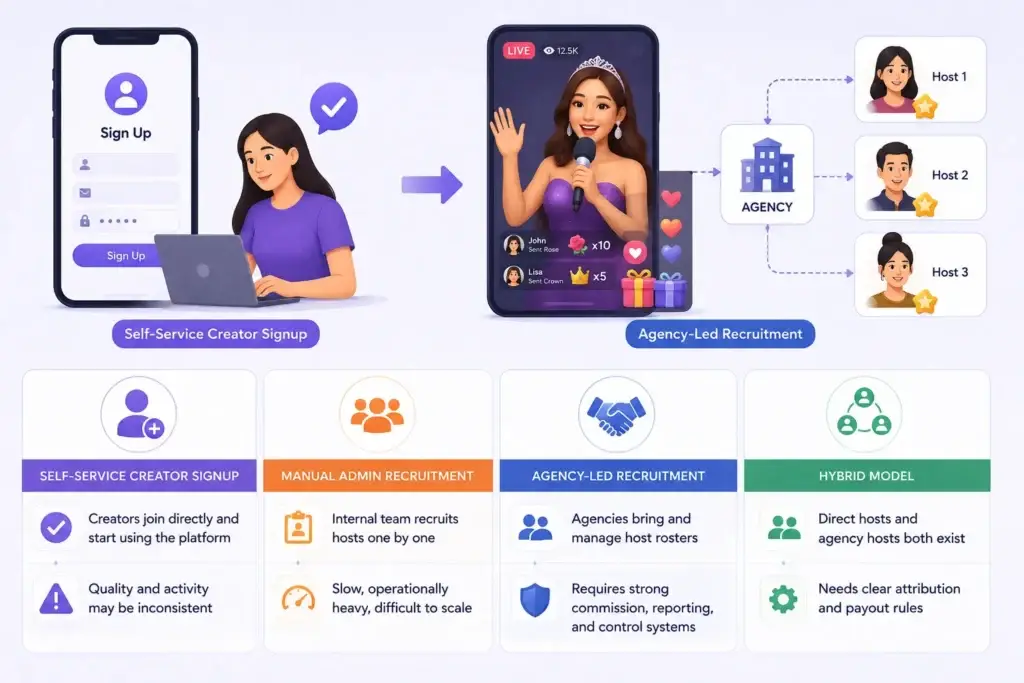
Image Source: AI-generated visual by Miracuves
A video content platform can grow with self-service creator signups. A live entertainment platform usually needs more structure.
A host is not just uploading content. A host is performing live, responding to viewers, encouraging gifting, joining battles, maintaining streaming schedules, following platform rules, and building a repeat audience. That requires consistency.
This is why host recruitment often works through agencies. Agencies already understand performer sourcing, training, motivation, and retention. They can recruit hosts faster than a platform operator trying to do everything manually.
For founders, the difference is important:
| Creator Onboarding Type | How It Works | Founder Risk |
|---|---|---|
| Self-service creator signup | Creators join directly and start using the platform | Quality and activity may be inconsistent |
| Manual admin recruitment | Internal team recruits hosts one by one | Slow, operationally heavy, difficult to scale |
| Agency-led recruitment | Agencies bring and manage host rosters | Requires strong commission, reporting, and control systems |
| Hybrid model | Direct hosts and agency hosts both exist | Needs clear attribution and payout rules |
The strongest model depends on the founder’s market. If the platform is targeting regional entertainment, voice rooms, talent shows, social discovery, or gifting-led communities, agency recruitment can provide faster supply creation.
The Full Live Streaming Agency Management Flow: From Recruitment to Revenue Split
Agency management works best when each step is structured. A weak setup may recruit hosts but fail during earnings calculation, payout disputes, or performance control. A strong setup makes the entire cycle trackable.
Here is the typical flow.
1. Agency Application and Approval
The process starts when an agency applies to join the platform. The platform operator should collect basic information such as business identity, region, contact details, recruitment capacity, preferred host category, and payout method.
The admin team then reviews the application before approval. This prevents low-quality or fraudulent operators from adding unverified hosts.
For a founder, this approval layer matters because agencies influence platform reputation. A poor agency can bring inactive hosts, spam accounts, or policy violations. A strong agency can bring trained creators who understand engagement and monetization.
2. Contract and Commission Setup
Once approved, the agency needs commercial rules. These rules define how much the platform keeps, how much the host receives, and how much the agency earns.
The agency contract may include:
- Commission percentage
- Region-specific rules
- Host category eligibility
- Minimum streaming targets
- Payout cycle
- Withdrawal rules
- Penalty or suspension logic
- Dispute resolution process
- Content and behavior guidelines
This is where many founders make a mistake. They treat agency commission as a simple number. In reality, the commission model shapes recruitment behavior. If the agency share is too low, serious recruiters may not prioritize your platform. If it is too high, platform margin becomes weak. The right structure needs to balance growth, retention, and profitability.
3. Host Recruitment and Assignment
After contract approval, the agency starts adding hosts. Each host should be connected to the correct agency in the backend so future earnings can be attributed properly.
A good host assignment system should answer:
- Which agency recruited this host?
- When was the host added?
- Is the host active, pending, suspended, or removed?
- Can the host transfer to another agency?
- Who approves a transfer?
- Which earnings belong to the old agency versus the new one?
- What happens if a host becomes independent later?
These questions are not theoretical. Once real money flows through gifts, disputes become likely unless the platform has clear ownership records.
4. Host Training and Activation
Recruitment does not automatically create revenue. Hosts must be activated.
Activation means helping hosts understand how to stream, how to engage viewers, how to use platform tools, how to join battles, how to encourage gifting without violating policy, and how to maintain consistent schedules.
Agencies often manage this layer because they are closer to the host community. The platform can support them with dashboards, training resources, announcements, performance targets, and host analytics.
The goal is not just to increase the number of registered hosts. The goal is to increase the number of active, high-quality, monetization-capable hosts.
5. Live Performance Tracking
Once hosts go live, the platform needs to track activity.
Important performance signals include:
- Total live hours
- Number of sessions
- Average session duration
- Viewer count
- Returning viewers
- Gift value received
- Battle participation
- Follower growth
- Reports or violations
- Host retention
- Withdrawal frequency
This data helps the platform and agency understand which hosts are growing, which need coaching, and which may be gaming the system.
Without performance tracking, founders only see revenue after the fact. With performance tracking, they can see the operating signals that create revenue.
6. Gift Earnings and Revenue Split Calculation
Virtual gifting is often the main revenue driver in live entertainment platforms. Viewers purchase platform currency, send gifts to hosts, and the platform calculates how that value is split.
A simplified revenue split may involve:
- Platform share
- Agency share
- Host share
For example, when a viewer sends a paid virtual gift, the system may calculate a platform commission, allocate an agency percentage, and credit the host’s balance. The exact percentages depend on the platform’s business rules and should be configurable by the operator.
The important technical point is timing. A strong platform calculates the split at the transaction level instead of relying only on manual month-end reconciliation. This gives hosts, agencies, and admins cleaner records.
For founders exploring a gifting-led streaming platform, this split logic is one of the most important backend decisions because it affects trust, retention, accounting, and dispute resolution.
7. Agency Dashboard and Reporting
Agencies need visibility. If they cannot see host performance, gift earnings, commission records, and payout status, they cannot manage their roster effectively.
An agency dashboard should usually show:
- Total hosts
- Active hosts
- Host-level earnings
- Agency commission
- Live hours
- Gift performance
- Ranking or incentive progress
- Pending withdrawals
- Violations or warnings
- Monthly reports
This turns the agency from an external recruiter into an accountable growth partner.
8. Payout Requests and Admin Approval
The payout layer converts creator earnings into real-world payments. This is where accuracy becomes essential.
A reliable payout system should support:
- Host earning records
- Agency commission records
- Withdrawal requests
- Minimum payout thresholds
- Admin approval or rejection
- Payment status tracking
- Transaction history
- Fee visibility
- Fraud review
- Audit logs
Founders should not treat payouts as an afterthought. A platform can survive a feature delay, but payout confusion can damage host trust quickly. Hosts and agencies need to believe that earnings are calculated fairly and paid according to clear rules.
Agency Revenue Split Models Founders Can Consider
There is no single perfect agency commission model. The right model depends on the platform’s maturity, region, host supply, monetization strength, and recruitment difficulty.
| Revenue Split Model | How It Works | Best For | Founder Consideration |
|---|---|---|---|
| Fixed agency percentage | Agency receives a fixed share of host-generated gift earnings | Simple early-stage launch | Easy to understand but may not reward top performance differently |
| Tiered agency commission | Agency earns higher rates when hosts hit targets | Growth-focused platforms | Encourages performance but needs accurate tracking |
| Region-based split | Agency share varies by country or market | Multi-region platforms | Useful where acquisition costs differ |
| Host category split | Premium hosts, new hosts, and event hosts may have different rules | Talent-driven platforms | Helps recruit high-value creators |
| Campaign-based incentives | Agencies earn bonuses for contests, events, or seasonal pushes | Platforms running live events | Good for short-term growth but should not distort long-term retention |
| Hybrid split model | Combines base commission with performance incentives | Scaling platforms | Flexible but requires stronger admin configuration |
A founder should not only ask, “What percentage should the agency receive?” A better question is, “What behavior should the commission model encourage?”
If the goal is rapid host recruitment, a generous early incentive may help. If the goal is quality, the split should reward active hours, gift performance, and retention. If the goal is regional growth, the model may need market-specific rules.
Founder Decision Signals: When Your Platform Needs Agency Management
Host Supply
If your platform needs many active hosts from day one, agency-led recruitment can help build supply faster than relying only on organic creator signups.
Revenue Visibility
If gifts, coins, wallet balances, and payouts are central to your business model, you need clear split calculation and reporting for hosts and agencies.
Regional Growth
If you are launching across multiple cities or countries, agencies can help localize host recruitment, language, content formats, and audience behavior.
Operational Control
If disputes, transfers, inactive hosts, and payout questions are likely, the admin panel must give your team control before problems scale.
Key Features an Agency Management Module Should Include
An agency layer should not be limited to a list of host names. It should work as a control center for recruitment, performance, revenue, and accountability.
Agency Management Features and Business Value
| Feature | Business Value | Founder Impact |
|---|---|---|
| Agency onboarding | Allows approved recruiters or talent partners to join the platform | Builds controlled host supply instead of relying only on random signups |
| Host assignment | Connects every host to the correct agency | Prevents attribution confusion during earnings and payout calculations |
| Commission configuration | Defines agency share based on platform rules | Lets the operator adjust incentives without rebuilding the product logic |
| Performance dashboard | Tracks live hours, gifts, viewers, activity, and host performance | Helps agencies coach hosts and helps admins identify growth opportunities |
| Payout tracking | Shows host and agency earnings, withdrawal status, and payment history | Improves trust and reduces disputes around money movement |
| Host transfer rules | Controls movement between agencies or independent status | Protects the platform from ownership disputes and unfair commission claims |
| Moderation visibility | Shows warnings, reports, strikes, and policy issues | Keeps agency growth aligned with platform safety and brand reputation |
| Admin override controls | Allows platform operators to approve, suspend, adjust, or review agency activity | Gives founders control when exceptions, fraud signals, or disputes appear |
Why Transparent Earnings Matter for Hosts and Agencies
In live streaming, trust is a product feature.
Hosts want to know how much they earned. Agencies want to know what their roster generated. Platform operators want to know whether the business is profitable. If the system cannot clearly explain gift value, commission, deductions, and withdrawal status, users may lose confidence even if the app experience looks polished.
Transparent earnings should show:
- Gift received
- Gift value
- Platform share
- Agency share
- Host share
- Conversion from gift value to host balance
- Withdrawal eligibility
- Fees or deductions
- Final payout status
This visibility becomes even more important when the platform runs competitions, PK battles, leaderboards, seasonal campaigns, or premium room formats. The more monetization surfaces you add, the more important it becomes to maintain one reliable earning logic.
A platform that hides or delays earnings data may reduce short-term complexity, but it increases long-term risk. Hosts and agencies are business participants. They need records they can understand.
Agency Management and User Retention: The Hidden Connection
Many founders think agency management is only an admin feature. It is not. It affects user retention.
When agencies recruit and manage better hosts, the platform gets more active rooms. More active rooms create more discovery options for viewers. More discovery options increase the chance that a viewer finds someone worth following, gifting, or returning to. That improves retention.
The connection looks like this:
Agency recruitment → active hosts → better live room supply → stronger viewer engagement → more gifts → better host income → higher host retention → stronger platform liquidity
This is why agency management should be treated as part of the growth engine, not just a backend tool.
For a live entertainment app with gifting and host monetization, the agency layer can become one of the strongest operational advantages when it is connected properly to revenue, reporting, moderation, and admin control.
Common Mistakes Founders Make With Agency Management
Treating agencies as simple user accounts
An agency is not just another profile. It needs recruitment authority, host visibility, earnings reports, commission rules, and accountability controls.
Calculating revenue splits manually
Manual calculations may work during testing, but they become risky when hosts, gifts, campaigns, and withdrawals scale. Transaction-level records reduce confusion.
Ignoring host transfer rules
When hosts move between agencies, the platform needs clear rules for ownership, historical earnings, future commission, and admin approval.
Overpaying for recruitment without tracking quality
A large host count does not guarantee engagement. Agencies should be evaluated by active hours, audience quality, gift performance, retention, and policy compliance.
How Admin Control Holds the Agency System Together
The admin panel is where the platform operator protects the business.
Even if agencies recruit hosts and hosts generate engagement, the platform owner still needs final control over approvals, earnings logic, withdrawals, reports, policy issues, and configuration.
A strong admin layer should help the operator:
- Approve or reject agencies
- Set commission rules
- View agency rosters
- Track host activity
- Review gift transactions
- Manage wallet and payout requests
- Investigate disputes
- Suspend suspicious accounts
- Monitor reports and violations
- Adjust regional rules
- Export financial records
- Review revenue performance
This matters because live streaming entertainment platforms involve money, attention, identity, and user-generated content. Without admin control, growth can create more risk than revenue.
A ready-made solution from Miracuves can help founders start with a structured product foundation instead of trying to invent every agency, gifting, payout, and admin workflow from zero.
Agency Management vs Direct Host Management
Not every platform needs agencies from day one. Some founders may begin with a small group of directly recruited hosts. Others may need agencies immediately because they are launching in a competitive category or multiple regions.
Here is a practical comparison.
| Model | Strength | Limitation | Best Use Case |
|---|---|---|---|
| Direct host management | More control over individual hosts | Slower recruitment and heavier internal workload | Early testing with a small creator group |
| Agency-led management | Faster supply growth and local recruitment | Requires strong commission and reporting systems | Regional entertainment, voice rooms, live gifting, talent communities |
| Hybrid model | Combines control with scale | Needs clear attribution and admin rules | Platforms scaling from early launch to multi-market growth |
For many founders, the hybrid model is the most realistic. Start with trusted direct hosts to validate engagement, then bring agencies into the platform once the monetization loop is clear.
What Founders Should Plan Before Launching an Agency-Led Live Streaming Platform
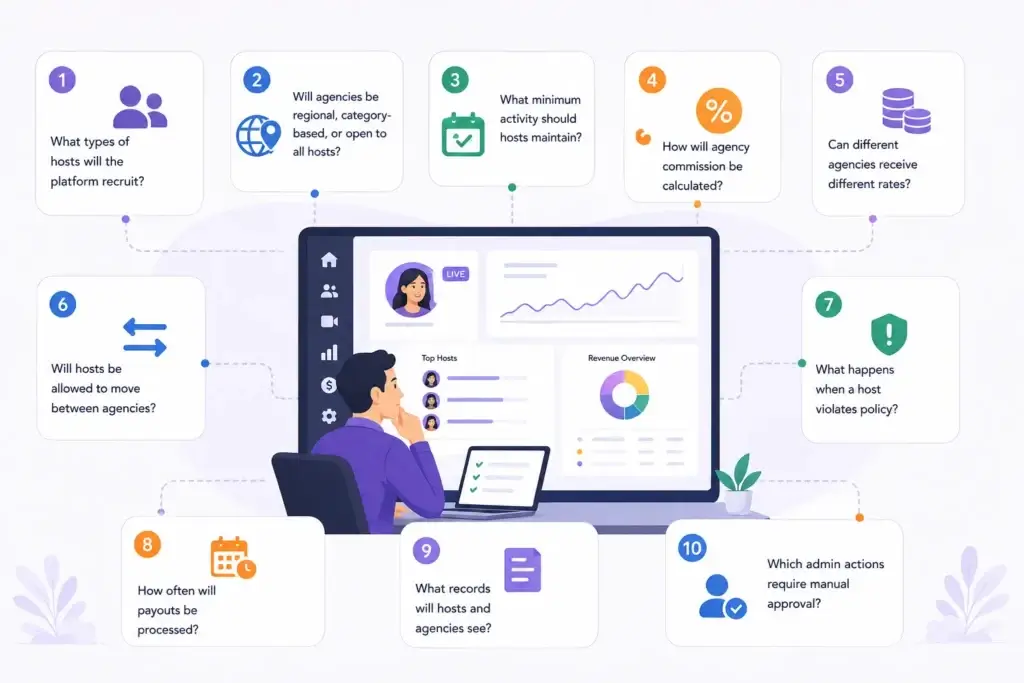
Image Source: AI-generated visual by Miracuves
Before launching, founders should define the operating model clearly. The app can support many workflows, but the business rules must come from the operator.
Important questions include:
- What types of hosts will the platform recruit?
- Will agencies be regional, category-based, or open to all hosts?
- What minimum activity should hosts maintain?
- How will agency commission be calculated?
- Can different agencies receive different rates?
- Will hosts be allowed to move between agencies?
- What happens when a host violates policy?
- How often will payouts be processed?
- What records will hosts and agencies see?
- Which admin actions require manual approval?
Answering these questions early helps avoid confusion after launch. It also helps the development team configure the right dashboards, earning rules, and admin workflows.
How Miracuves Helps Founders Build Agency-Aware Live Streaming Platforms
Miracuves helps founders build ready-made and white-label app solutions with source-code ownership, branded design, admin dashboards, monetization workflows, and faster deployment. For live streaming entertainment businesses, the agency layer is especially important because the platform must manage not only users and content, but also creator supply, gift earnings, commission rules, and payout trust.
With an agency-aware live entertainment platform, founders can plan the business around host recruitment, live engagement, virtual gifts, revenue sharing, moderation, and operational control from the beginning.
The goal is not to copy another platform blindly. The stronger approach is to understand the operating model, customize the experience for your target market, and launch with enough backend control to manage real users, real creators, and real money movement.
Final Thoughts: Agency Management Turns Host Supply Into a Scalable Business System
Agency management is not just a recruitment feature. It is the operating system behind host supply, live activity, gift earnings, performance control, and payout trust.
For founders, the real question is not whether agencies can bring creators. The better question is whether the platform can manage agencies properly once creators, gifts, commissions, and withdrawals start scaling.
A strong live streaming entertainment platform should give operators clear control over host recruitment, agency contracts, revenue split rules, performance dashboards, moderation, and payout approvals. When those systems work together, the platform becomes easier to grow, easier to manage, and easier to monetize.
Miracuves helps founders move faster with ready-made and white-label live streaming app foundations built around creator engagement, monetization, source-code ownership, and admin control.
FAQs
What is agency management in a live streaming platform?
Agency management is the system used to onboard talent agencies, assign hosts, track host performance, calculate agency commission, manage revenue splits, and control payouts inside a live streaming entertainment platform.
Why do live streaming platforms use agencies to recruit hosts?
Live streaming platforms use agencies because agencies can recruit, train, motivate, and manage hosts faster than a small internal team. This helps the platform maintain active live rooms and improve viewer engagement.
How does a live streaming revenue split work?
A live streaming revenue split usually divides virtual gifting revenue between the platform, the host, and sometimes the agency that recruited or manages the host. The exact percentage depends on the platform’s business rules.
What should an agency dashboard include?
An agency dashboard should include host lists, live activity, gift earnings, commission records, payout status, performance reports, warnings, and admin messages. This helps agencies manage their roster effectively.
Can hosts move from one agency to another?
Yes, some platforms allow host transfers, but this should be controlled through admin approval and clear rules. The platform must define how historical earnings, future commission, and agency ownership are handled.
Why is payout transparency important for live streaming hosts?
Payout transparency builds trust. Hosts and agencies need to see how earnings were calculated, what deductions were applied, when withdrawals were requested, and whether payments were approved or pending.
Is agency management needed for every live streaming app?
Not always. A small platform may start with direct host management. However, platforms that depend on regular live content, gifting, competitions, regional creators, or large host supply usually benefit from agency management.
How can Miracuves help build a live streaming entertainment platform?
Miracuves helps founders build ready-made and white-label live streaming entertainment platforms with creator workflows, virtual gifting, agency management, admin dashboards, revenue split logic, branding, and source-code ownership.
Miracuves is an independent software development company. We are not affiliated with, connected to, sponsored by, or endorsed by any company or product named in this article.
Terms such as “X Clone” are used descriptively. It is how the software industry refers to building a platform with functionality comparable to a known service, and how clients search for it.
The entire design and codebase of our products is built by our own team. Our products contain no code, design, graphics, or content originating from any third-party website or applications.
All third-party names and marks referenced in this article are the property of their respective owners, referenced solely to identify the services discussed.