















Key Takeaways
- Talent agencies help a live streaming entertainment platform recruit, onboard, train, and manage hosts at scale instead of relying only on direct creator acquisition.
- Agencies can improve host supply by coordinating schedules, performance goals, content quality, virtual gift activity, live-room participation, and creator retention.
- A structured agency model can give platform operators more predictable host activity while creating an additional management layer between individual creators and the platform.
Agency & Host Supply Signals
- Agency dashboards can manage host recruitment, creator verification, onboarding status, live hours, streaming schedules, performance targets, rankings, and account activity.
- Commission structures, host earnings, virtual gift revenue, bonuses, agency shares, payout eligibility, and settlement records help connect creator performance with agency incentives.
- Host activity, streaming frequency, active days, audience engagement, gift conversion, creator retention, and agency-level performance help operators measure the quality of their host network.
Growth & Operations Insights
- Agencies can help platforms expand into new regions or creator niches by bringing existing talent networks, local recruitment knowledge, and creator-management capabilities.
- Operators need agency approval rules, host ownership controls, commission settings, performance reporting, fraud monitoring, payout reconciliation, and dispute workflows to keep the model manageable.
- Miracuves develops customizable live streaming entertainment platforms with talent agency management, host onboarding, virtual gifts, creator earnings, commissions, payouts, analytics, moderation, and admin controls.
Live streaming entertainment platforms do not grow only because they have good video quality, gift animations, chat features, or attractive mobile screens. Those features matter, but the real growth engine is usually more operational: who brings the hosts, who trains them, who keeps them active, who helps them earn, and who creates enough live content supply to make users return every day.
That is where talent agencies become important.
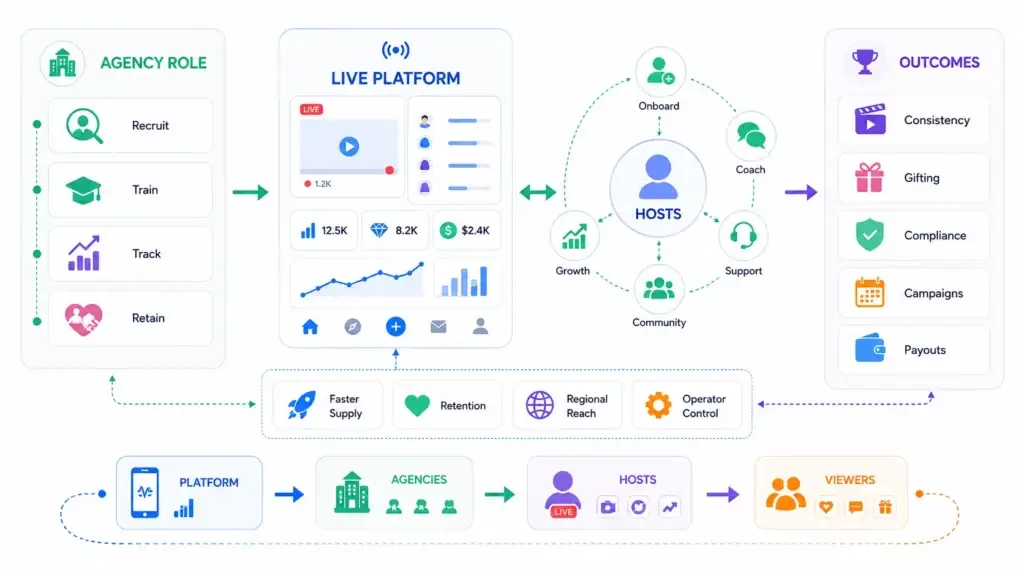
In a live streaming entertainment platform, talent agencies act as the bridge between the platform owner and the hosts. They recruit creators, onboard them, guide their content strategy, monitor activity, support earnings growth, and help the platform maintain a steady supply of live broadcasters. For founders building a gifting-led entertainment app, this agency layer can decide whether the platform feels active from day one or empty after the first launch campaign ends.
A viewer opens a live streaming app for entertainment, interaction, and real-time energy. If there are not enough hosts online, the app feels inactive. If the hosts are inconsistent, viewers do not build habits. If earnings are unclear, creators leave. If agencies have no dashboard or reporting flow, recruitment becomes manual and difficult to scale.
That is why founders should treat talent agency management as a core product layer, not an optional admin feature.
What Are Talent Agencies in a Live Streaming Platform?
Talent agencies are individuals, teams, or businesses that recruit and manage live streaming hosts on behalf of a platform. Their job is not just to “bring creators.” A serious agency helps creators understand how to stream consistently, engage viewers, increase gifting activity, follow platform rules, and improve earnings over time.
In simple terms, the platform provides the technology, the viewers provide attention, the hosts provide live entertainment, and agencies help organize the host supply.
A live streaming talent agency may handle:
- Recruiting new hosts and broadcasters
- Explaining platform rules and earning models
- Helping hosts choose content formats
- Tracking host activity and performance
- Supporting payout and reward understanding
- Managing creator retention
- Coordinating campaigns, events, and ranking pushes
- Reporting issues to the platform operator
- Growing sub-agencies or regional creator teams
For a founder, the benefit is leverage. Instead of building the entire host network internally, the platform can work with agencies that already understand creator sourcing, talent motivation, regional communities, and live entertainment behavior.
Why Host Supply Is the First Growth Problem in Live Entertainment Apps
Every marketplace has a supply problem. Food delivery platforms need restaurants. Ride-hailing apps need drivers. Rental marketplaces need listings. Live streaming entertainment platforms need hosts.
Without hosts, there is no live content. Without live content, viewers have no reason to stay. Without viewers, hosts do not earn. Without host earnings, agencies stop recruiting. This creates a loop that either compounds growth or quietly kills the platform.
The early-stage challenge is not only getting users to download the app. It is making sure that when users arrive, they find enough live rooms, personalities, formats, and interactions to keep them engaged.
This is why host supply must be planned before launch.
A founder should ask:
- How many hosts need to be live during peak hours?
- Which content categories will attract the first viewer base?
- Will hosts stream video, audio, games, talk shows, dating rooms, karaoke, or panel discussions?
- How will hosts understand earnings, rewards, and payout rules?
- Who will train new hosts if the platform team is small?
- How will inactive hosts be reactivated?
- How will top-performing hosts be retained?
Talent agencies help solve these questions because they turn host acquisition into a structured operating system.
The Talent Agency Model Creates a Scalable Recruitment Engine
Organic creator signups are useful, but they are unpredictable. Some creators register out of curiosity. Some stream once and disappear. Some do not understand the earning model. Some need coaching before they become engaging hosts.
A talent agency model gives the platform a more scalable way to build creator supply.
Instead of recruiting every host one by one, the platform can approve agencies that bring their own host networks. Each agency then becomes responsible for growing, managing, and supporting a roster of broadcasters. The agency earns based on host performance, so its incentive is tied to keeping creators active and productive.
This creates a better growth structure:
| Layer | Responsibility | Business Value |
|---|---|---|
| Platform owner | Provides app, rules, wallets, rooms, moderation, payouts, and analytics | Controls the ecosystem and monetization engine |
| Talent agency | Recruits, trains, manages, and motivates hosts | Builds creator supply without overwhelming the internal team |
| Host | Streams content, engages viewers, earns from gifts and rewards | Creates the live entertainment experience |
| Viewer | Watches, chats, follows, sends gifts, and joins communities | Drives engagement and platform revenue |
When this model works well, agencies become growth partners, not just external recruiters.
Why Agencies Improve Host Quality, Not Just Host Quantity
A weak platform thinks only about the number of hosts. A stronger platform thinks about host quality.
The difference matters.
A platform with 1,000 inactive or poorly trained hosts may still feel empty. A platform with 100 consistent, engaging, well-supported hosts can create stronger retention because viewers know they will find entertaining rooms at the right time.
Talent agencies can improve host quality by helping creators understand:
- How to open a live session confidently
- How to greet and retain new viewers
- How to encourage gifting without sounding forced
- How to use PK battles, rankings, and events
- How to avoid content violations
- How to create repeatable streaming schedules
- How to build a loyal fan base
- How to interpret earnings and performance data
This is especially important in entertainment-led platforms where success depends on personality, consistency, interaction, and emotional connection. A host may have potential but still need structure. Agencies provide that structure.
How Talent Agencies Support Creator Retention
Creator retention is one of the most underrated parts of live streaming platform growth.
Founders often focus on viewer acquisition first. But if hosts leave, viewers leave too. A platform cannot build habit if its creators are constantly rotating out.
Hosts usually leave for practical reasons:
- They do not understand how earnings work.
- They feel unsupported after onboarding.
- Their payouts are unclear or delayed.
- They do not know how to grow their audience.
- They feel moderation decisions are confusing.
- They do not see a path from beginner to high earner.
- Another platform or agency offers better guidance.
A strong agency layer reduces these risks.
When agencies can monitor host activity, explain rewards, guide streaming schedules, and help creators improve, hosts feel less alone. This matters because many early-stage creators are not professional entertainers. They need feedback, encouragement, and operational clarity.
For the platform owner, this improves supply stability. Instead of constantly replacing hosts, the business can compound around creators who improve over time.
The Agency Dashboard: What Platform Operators Should Build From Day One
If agencies are managed only through WhatsApp groups, spreadsheets, and manual payout messages, the model becomes difficult to scale. It may work for a small test group, but it breaks when there are hundreds of hosts, multiple regions, different commission rules, and active gifting volume.
A live streaming entertainment platform should give agencies a proper dashboard.
The agency dashboard should help agency owners and managers see what is happening inside their roster without depending on the platform team for every update.
Important agency dashboard features include:
| Feature | What It Does | Why It Matters |
|---|---|---|
| Agency approval workflow | Lets the admin approve or reject agency applications | Keeps recruitment controlled and reduces low-quality partners |
| Host invitation codes | Allows agencies to invite hosts under their roster | Makes attribution clear from the beginning |
| Host list management | Shows active, inactive, pending, and transferred hosts | Helps agencies manage supply properly |
| Contract settings | Supports commission, salary, or hybrid arrangements | Reduces confusion around earnings |
| Commission tracking | Shows agency share based on platform rules | Keeps incentives transparent |
| Host earnings reports | Displays creator performance and gift-based earnings | Helps agencies coach hosts better |
| Sub-agency controls | Supports larger agency networks with multiple managers | Useful for regional or category-based expansion |
| Transfer requests | Allows structured host movement between agencies | Prevents disputes and manual confusion |
| Performance analytics | Tracks streaming hours, gifts, rankings, and activity | Helps agencies identify top and underperforming hosts |
| Compliance and moderation view | Shows policy issues, reports, and warnings where relevant | Protects platform quality and brand trust |
The goal is simple: agencies should be able to run their creator business inside the platform, not outside it.
For a deeper breakdown of viewer, host, agency, family, moderation, gifting, wallet, and operator-side modules, founders can review the complete live streaming platform features. This gives a clearer view of how each panel supports creator supply, user engagement, and admin control.
How Revenue Splits Work Between Platform, Agency, and Host
Live streaming entertainment platforms often use virtual gifts, coins, diamonds, beans, rewards, or similar wallet-based systems. The exact naming depends on the platform, but the business logic is usually similar.
A viewer buys platform currency. The viewer sends a gift during a live stream. The system records the transaction. The host receives an earning value based on platform rules. The agency may receive a commission because it recruited or manages that host. The platform keeps its share.
This sounds simple, but it becomes complex at scale.
The platform needs to track:
- User wallet balance
- Gift purchase history
- Host earning balance
- Agency commission
- Platform commission
- Bonus campaigns
- Refunds or disputed transactions
- Withdrawal eligibility
- Fraud or abuse signals
- Tax or compliance records where required
This is why founders should not treat virtual gifting as only a front-end animation. It is a financial and operational workflow. If the revenue split is unclear, agencies will not trust the platform. If agencies do not trust the platform, they will not bring their best hosts.
Transparent earnings logic is one of the strongest ways to attract serious agency partners.
Founders who want to understand how viewer coin purchases, virtual gifts, host earnings, agency commissions, and platform revenue work together can explore the full live streaming platform business model. This helps clarify how a creator platform can monetize without depending only on subscriptions or ads.
Talent Agencies Help Platforms Localize Faster
Live entertainment is highly local. Viewers often prefer hosts who understand their language, humor, culture, festivals, music, social norms, and regional entertainment style.
A central platform team may not understand every market deeply. Talent agencies often do.
This gives agencies a major advantage in regional expansion. They can help the platform identify:
- Which host categories work in a specific region
- What streaming hours are most active
- Which language communities are underserved
- Which cultural events can become campaigns
- What kind of rewards motivate local creators
- Which moderation rules need clearer communication
- Which creators already have offline or social media influence
For founders entering markets such as India, Southeast Asia, MENA, LATAM, or creator-heavy regional communities, agency-led expansion can reduce trial-and-error. Agencies bring human context that algorithms and ads cannot fully replace.
Founder Decision Signals: When You Need an Agency Layer
Not every video app needs talent agencies. But most live entertainment platforms built around gifting, daily streaming, creator rankings, and host earnings should seriously consider it.
You likely need an agency layer if:
- Your platform depends on daily live host availability.
- Your monetization model includes virtual gifts or creator rewards.
- You want to launch in multiple regions or languages.
- You need structured host onboarding.
- You expect agencies or recruiters to bring creators.
- You want commission-based creator acquisition.
- You need transparent host and agency payouts.
- You want to run PK battles, rankings, contests, and reward campaigns.
- Your internal team cannot manually manage every creator relationship.
You may not need a full agency module if your product is mainly a private video community, a closed coaching app, a webinar tool, or an enterprise live event platform where creators are already known and centrally managed.
The decision depends on your supply model. If growth depends on many independent hosts joining, streaming, earning, and staying active, then agency management should be part of the foundation.
Budget planning should also account for the complexity of agency dashboards, gifting ledgers, payout workflows, moderation tools, and admin reporting. Founders comparing different build options can review the key factors that influence live streaming app development cost before finalizing the launch scope.
Common Mistakes Founders Make With Live Streaming Agencies
Mistake 1: Building the Viewer App First and Thinking About Hosts Later
A polished viewer experience is useless if there are not enough hosts online. The host supply plan should be built before launch, not after user acquisition begins.
Mistake 2: Managing Agencies Manually for Too Long
Manual tracking may feel faster in the beginning, but it creates disputes later. Once gift volume, commissions, and withdrawals increase, spreadsheets become risky.
Mistake 3: Hiding Earnings Logic From Hosts and Agencies
Creators and agencies need clarity. If they cannot understand how earnings are calculated, they may assume the platform is unfair even when the system is working correctly.
Mistake 4: Treating All Hosts the Same
Beginner hosts, professional entertainers, regional influencers, audio-room hosts, and high-gift performers need different support. Agencies help segment and coach them better.
Mistake 5: Ignoring Moderation Until Something Goes Wrong
Live content is unpredictable. Platforms need reports, warnings, restrictions, appeals, and audit trails. Agencies should also understand the platform’s safety expectations so they can train hosts properly.
Talent Agencies and Community Structures Work Better Together
Some live entertainment platforms also use families, teams, clubs, guilds, or community groups. These structures are different from agencies but often support similar goals.
Agencies focus on recruitment, management, earnings, and professional host supply. Families or creator groups focus more on belonging, competition, contribution, and social retention.
Both can work together.
For example:
- Agencies recruit and train hosts.
- Families create identity and competition.
- PK battles create real-time engagement.
- Leaderboards create status.
- Gifts create monetization.
- Admin controls keep the system manageable.
This layered model helps a platform become more than a video tool. It becomes an entertainment economy where creators, agencies, viewers, and communities all have reasons to participate.
What Founders Should Look for in an Agency-Aware Live Streaming Platform
Before choosing a development route, founders should check whether the platform supports agency operations natively. A basic live streaming app may include video rooms and gifting, but that does not mean it can support agency-led growth.
Look for these capabilities:
- Host registration and approval
- Agency registration and admin approval
- Host invitation and attribution
- Agency roles and permissions
- Commission and contract configuration
- Host transfer workflows
- Gift ledger and earnings history
- Payout request management
- Agency-level analytics
- Moderation and reporting workflows
- Multi-room live streaming formats
- Wallet and virtual currency management
- Admin controls for campaigns and rankings
- Scalable backend support for live activity
When comparing vendors, founders should choose a live streaming app development company that can clearly explain agency workflows, host onboarding, gift-based revenue splits, payout logic, moderation controls, and source-code ownership. For readers evaluating a launch-ready product path, the Miracuves live streaming entertainment platform shows how agency, host, viewer, gifting, and admin flows can work together inside one ecosystem.
Talent Agencies Are Also a Monetization Strategy
Many founders think of agencies only as recruitment partners. That is too narrow.
Agencies also affect monetization.
A good agency helps hosts stream more consistently, improve viewer interaction, participate in campaigns, and increase gifting moments. This can directly influence coin purchases, gift volume, paid interactions, and event participation.
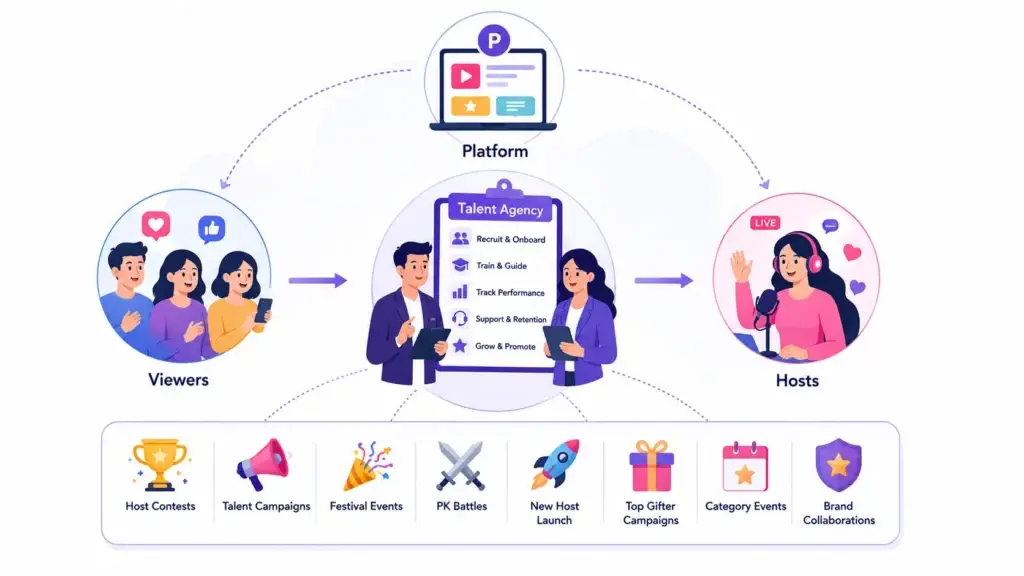
Agencies can also help the platform run:
- Host contests
- Regional talent campaigns
- Festival events
- PK battle tournaments
- New host launch weeks
- Top gifter campaigns
- Category-based live events
- Brand-sponsored creator sessions
When agencies understand how the platform earns, they can help hosts create moments that encourage viewer participation without damaging trust or making the experience feel forced.
This matters because live streaming monetization works best when revenue feels connected to entertainment, recognition, and community—not pressure.
For deeper context on revenue design, founders can also read Miracuves’ guide on live streaming monetization for video platforms and the breakdown of coins and virtual gifts in creator apps.
How Talent Agencies Reduce Founder Risk
A live streaming platform has many risks: low host activity, poor retention, payout disputes, weak content quality, moderation issues, and unclear monetization.
Talent agencies do not remove every risk, but they reduce several of them.
They help founders avoid launching with an empty room problem. They create a structured creator acquisition channel. They support host education. They improve communication between the platform and creators. They also help identify which content categories are working before the founder spends heavily on paid user acquisition.
The founder benefit is business clarity.
Instead of asking, “How do we get random people to stream?” the better question becomes, “Which agencies can bring the right hosts, and what platform controls do they need to perform well?”
That shift changes the entire launch strategy.
Ready-Made vs Custom Development for Agency Management
Founders usually have two routes: build the entire agency system from scratch or start with a ready-made live streaming foundation that already includes the core workflow.
| Build Route | Best For | Strength | Risk |
|---|---|---|---|
| Custom development | Highly unique platform models with unusual agency rules | Maximum flexibility | Longer development cycle, higher planning load, more testing required |
| Ready-made foundation | Founders who want to validate a live entertainment model faster | Faster launch, existing host/viewer/admin logic, lower starting complexity | Needs careful customization to match region, policy, branding, and payout rules |
| Hybrid approach | Businesses that want speed first and deeper customization after validation | Balances speed and control | Requires clear roadmap and ownership of source code |
The right choice depends on the founder’s goal. If the platform needs to test demand quickly, a ready-made foundation may be more practical. If the platform has a deeply unique creator economy, custom development may be more suitable.
A ready-made live streaming entertainment platform can help founders test creator supply, agency workflows, gifting behavior, moderation needs, and viewer retention faster than starting every module from zero.
Miracuves helps founders evaluate this decision by mapping the product scope, host supply strategy, monetization model, admin control needs, and launch path before development begins.
Practical Agency Workflow for a New Live Streaming Platform
A founder can think about the agency model in stages.
Stage 1: Define the Host Supply Strategy
Before onboarding agencies, define what kind of hosts the platform needs. Entertainment hosts, audio hosts, gaming hosts, lifestyle creators, regional performers, educators, musicians, or social chat hosts may all require different onboarding.
Stage 2: Create Agency Eligibility Rules
Not every recruiter should become an agency. The platform should define approval criteria, expected host count, category focus, region, content standards, and performance expectations.
Stage 3: Configure Commission and Contract Logic
Agency earnings must be transparent. Decide whether agencies earn a percentage of host gifts, milestone bonuses, salary-based incentives, or a hybrid structure.
Stage 4: Give Agencies a Dashboard
Agencies should be able to track hosts, earnings, activity, rankings, and pending actions. Without this, the platform team becomes the reporting department.
Stage 5: Monitor Quality and Safety
The platform should track reports, policy violations, inactivity, user complaints, and unusual gifting behavior. Agencies should help maintain host quality, not only increase host count.
Stage 6: Reward the Right Behavior
Reward agencies for sustainable performance: active hosts, quality streams, viewer retention, clean moderation history, and consistent earnings growth. Avoid rewarding only raw recruitment numbers.
Related reading: structuring a multi-currency economy for a live streaming platform and From Host Recruitment to Revenue Split.
Final Thoughts: Agencies Turn Live Streaming Into an Operating System
Talent agencies matter because live streaming platforms are not just software products. They are creator supply systems, entertainment marketplaces, monetization engines, and community ecosystems.
A founder who ignores agencies may still launch an app, but may struggle to keep enough hosts active. A founder who builds agency management properly can create a more scalable path for host recruitment, creator retention, regional growth, and gifting-led monetization.
The real lesson is simple: video features attract attention, but host supply creates habit. Agencies help build that supply. When agencies, hosts, viewers, wallets, rewards, moderation, and admin controls work together, the platform has a stronger chance of becoming active, monetization-ready, and growth-ready.
For founders planning a live entertainment product, Miracuves can help build a white-label, source-code-owned foundation with host, agency, viewer, gifting, and admin workflows aligned with your launch strategy. You can review the agency-aware live streaming app solution or talk to Miracuves experts to map the right launch path.
FAQs
What are talent agencies in live streaming apps?
Talent agencies are recruitment and management partners that help live streaming platforms bring in hosts, train them, monitor performance, support earnings, and improve creator retention. They help the platform build a steady supply of broadcasters.
Why do live streaming platforms need host agencies?
Live streaming platforms need host agencies because viewers expect active rooms and consistent entertainment. Agencies help recruit and manage hosts at scale, which reduces the risk of launching a platform with too little live content.
How do talent agencies make money in live streaming platforms?
Talent agencies usually earn commissions or incentives based on the performance of the hosts they recruit and manage. The exact model depends on the platform’s earning rules, virtual gifting system, contracts, and payout structure.
What features should an agency dashboard include?
An agency dashboard should include host management, invitation codes, commission tracking, contract settings, earnings reports, performance analytics, transfer requests, sub-agency controls, and moderation visibility where relevant.
How do agencies improve creator retention?
Agencies improve creator retention by giving hosts guidance, content feedback, earning clarity, schedule support, campaign participation, and help with platform rules. This makes hosts more likely to stream consistently and stay active.
Are talent agencies useful for small live streaming startups?
Yes, especially if the startup depends on daily host activity. Even a small platform can use agencies to build early creator supply, test content categories, and avoid relying only on random organic host registrations.
What is the difference between agency management and creator management?
Creator management focuses on individual hosts. Agency management adds a business layer where approved partners recruit, organize, and support multiple hosts under one structure. This helps the platform scale creator supply more efficiently.
Can Miracuves help build a live streaming platform with agency features?
Yes. Miracuves helps founders launch live streaming entertainment platforms with host, viewer, agency, gifting, payout, moderation, and admin workflows. The final scope depends on branding, integrations, launch region, and customization needs.
Miracuves is an independent software development company. We are not affiliated with, connected to, sponsored by, or endorsed by any company or product named in this article.
Terms such as “X Clone” are used descriptively. It is how the software industry refers to building a platform with functionality comparable to a known service, and how clients search for it.
The entire design and codebase of our products is built by our own team. Our products contain no code, design, graphics, or content originating from any third-party website or applications.
All third-party names and marks referenced in this article are the property of their respective owners, referenced solely to identify the services discussed.