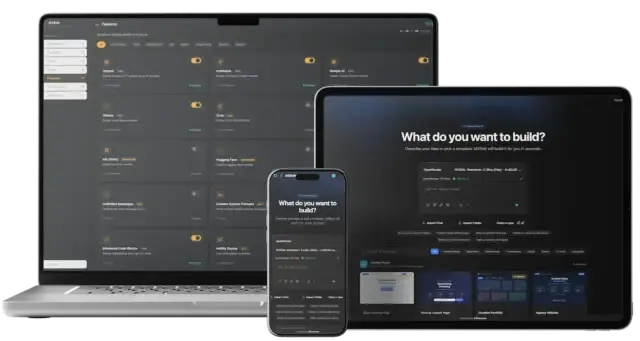
















White Label Live Streaming App - Rooms, Gifting, Agencies & Creator Payouts
This live-streaming platform is built to run the full entertainment loop. It offers fifteen room formats spanning one-person video, voice rooms and PK arenas, plus a coin economy of four currencies with revenue splits you configure, families and talent agencies, a square feed next to short videos, and moderation tooling covering reports, strikes and appeals.
One monorepo produces three surfaces: a 44-route web app for viewers and hosts, a 15-section admin panel for operators, and an Expo mobile app for the core flows. All of them talk to a NestJS backend that exposes 200 endpoints across 74 database models.
Launch live in 6 Days with
- Agency-Native
- Gift-Economy
- Low-Latency
- Room-Flexible
- White-Label
- Docker-Deployed
Activity stream
- Host signup acceptedHost waitlist
- A voice room gift goes outGift records
- Shares divided: platform, agency, hostEarnings division
- PK match kicked offPK matchups
- A live stream gets reportedContent review line
- Host earnings releasedWithdrawals
- Diamonds turned into beansWallet
- An agency code invites a hostAgency controls
The Product in Brief
coin sales, gift commission, the agency cut, VIP and games
deploy the same build under several brands
the source code is fully yours, and nothing is billed per seat
our name appears nowhere in the app, the stores or the admin
Ship It Under Your Own Name
Nothing in the product, the app stores or the admin carries a supplier brand, so the platform reads as something your company built rather than something it licensed.
Families and Agencies Do the Recruiting
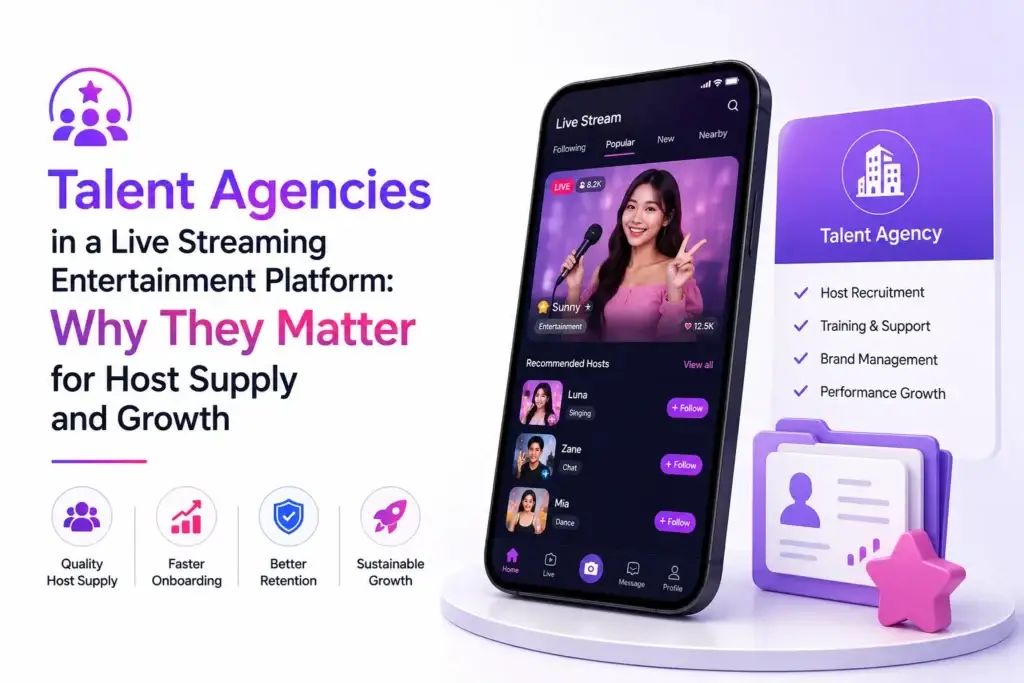
Talent agencies and in-app families both recruit and retain hosts on performance-based shares, so streamer supply grows through partners instead of through payroll.
01See it live
Live in Action
Live Demo - App, Admin, Agency, Host Consoles & Android Build
Rather than take our word for it, open the platform yourself, with nothing to install. Sign in with a demo email, join a room, send a gift, watch the coin balance move, then find that same activity waiting in the admin, agency and host consoles. Look out too for fan clubs, the task center, the mic queue, nearby, rankings, both themes and the language switcher.
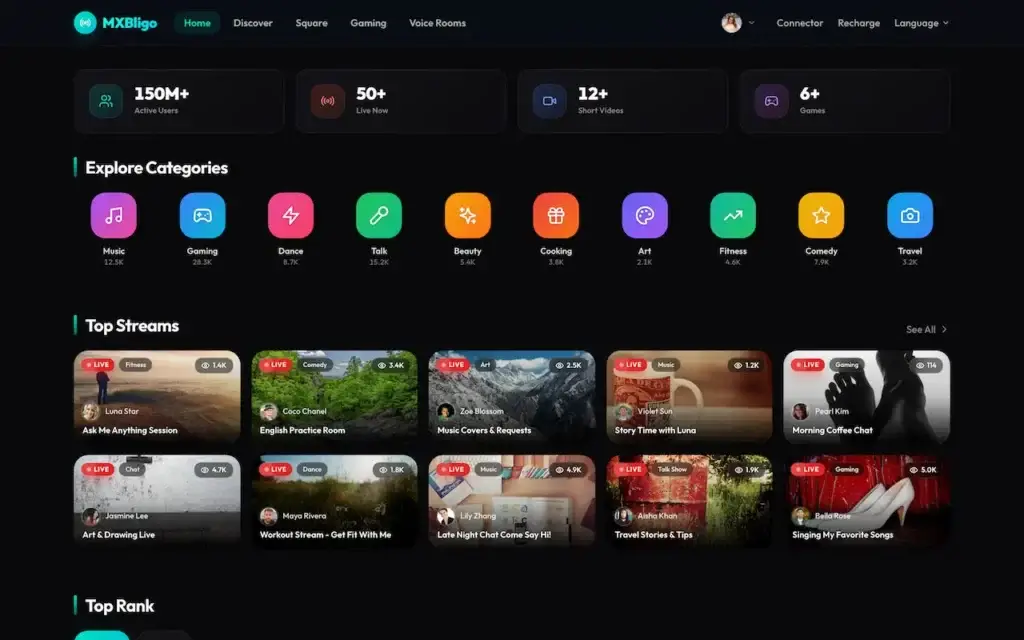
The Main App, Rooms And Wallet
Viewers and hosts share one web app: a wall of real live broadcasts, chat and gifting inside rooms, multi-currency top-up, paid 1-on-1 calls, PK battles and three in-room games. Nothing is emailed. Every seeded @demo.mxbligo.com profile, priyanand@, camiladrt@ and hanakob@ among them, takes code 123456. Dubai Majlis is the paid room: entry fee, passcode 123456, paywall and coin spend.
- 1Open the web app and type a demo email
- 2Use code 123456 at the verification step
- 3Take a look at Live Wall, Rooms, PK, Wallet and Games
brunosalg@demo.mxbligo.com | code 123456
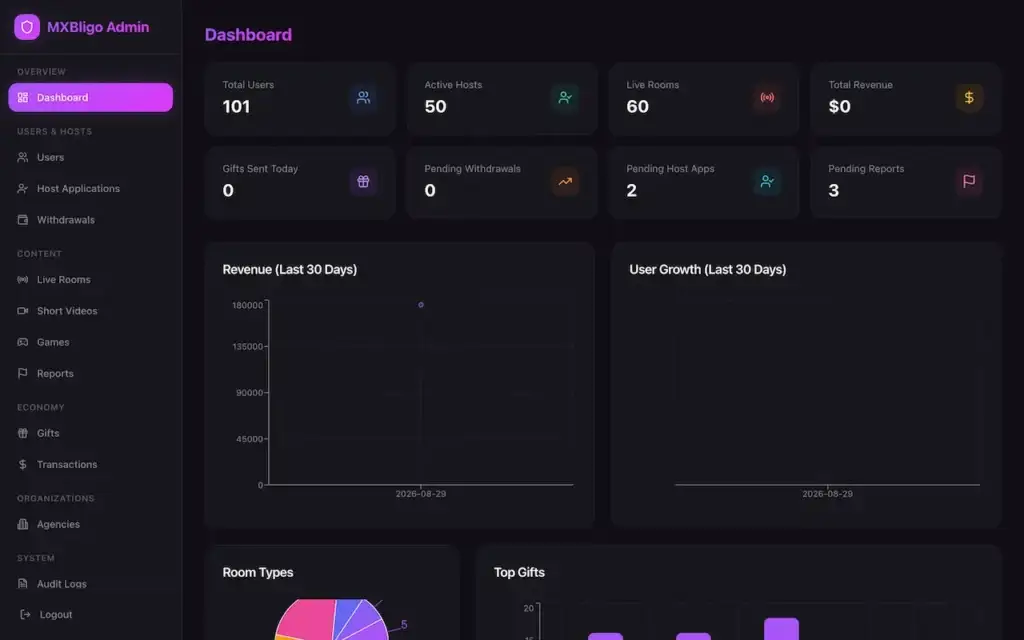
Admin Console, Commissions And Payouts
All the controls that drive the app sit in this console: gift prices, commissions, room fees, payouts, feature toggles, moderation and the PK monitor. Each of the two staff accounts sees the full console, limited by what its role allows. Access to the owner (super-admin) account stays withheld.
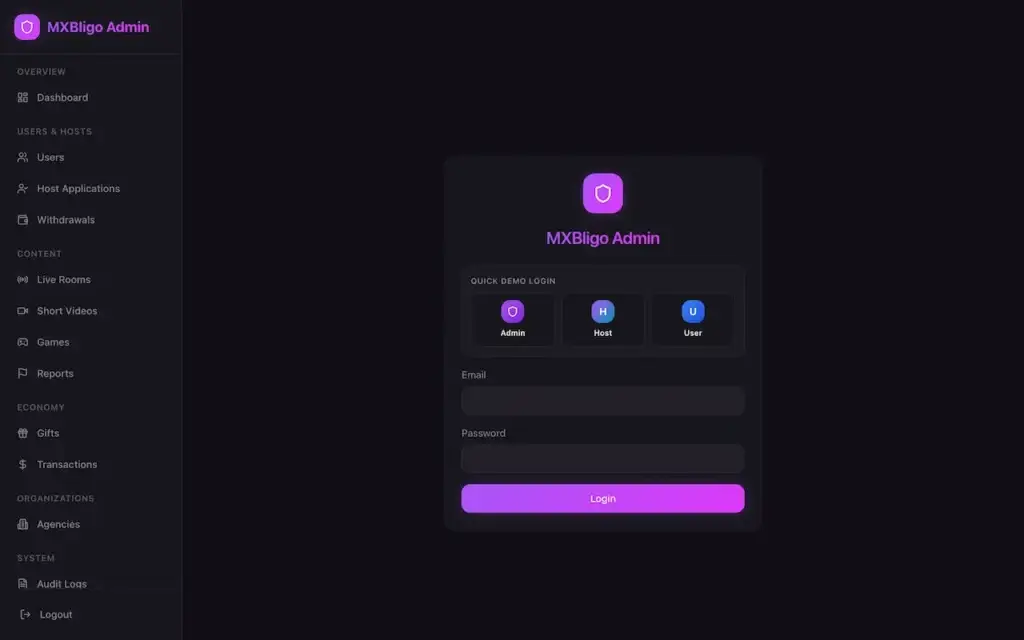
- 1Use your browser to open the admin console
- 2Pick a Quick-Fill chip or a staff login below
- 3Explore: Commissions, Gifts, Payouts, PK Monitor
moderator@demo.mxbligo.com | Staff@12345finance@demo.mxbligo.com | Staff@12345
Branded Android Build
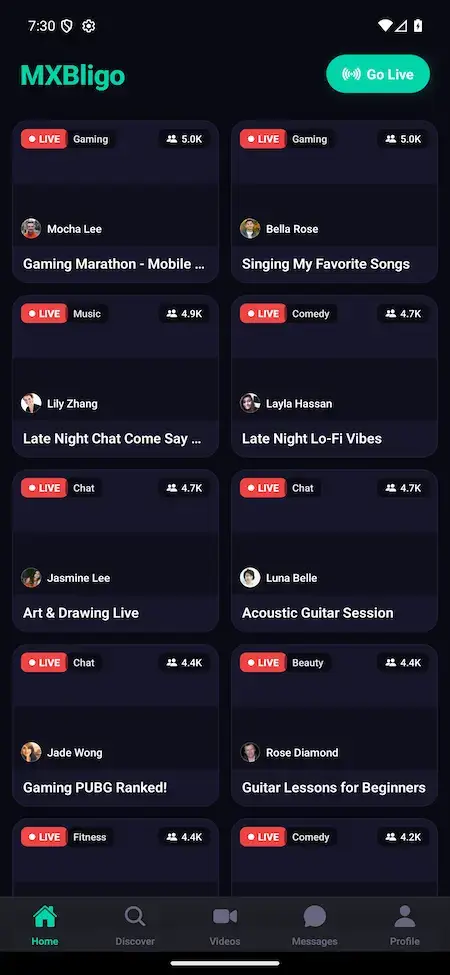
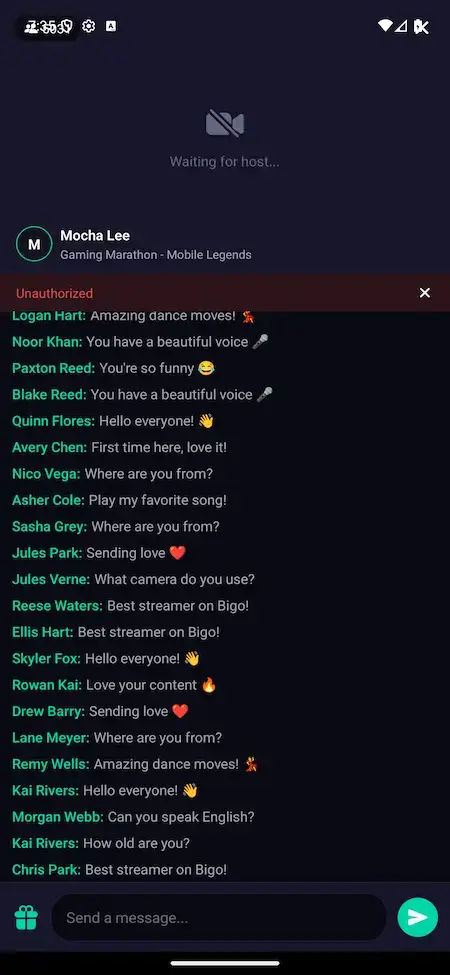
A release build of the Android app: 289 MB, Android 7.0 and up, installable on any arm64 device. It replaces the earlier test build in place without signing you out.
- 1Copy the APK to your Android device
- 2Install it, or update over the test build
- 3Explore: Live Wall, Rooms, Gifts, Wallet
Agency Console For Host Rosters
Agency partners get their own console for hosts, earnings and payouts. The demo agency sits on the sign-in screen, and one tap enters its ID and code.
- 1Use your browser to reach the agency console
- 2Tap the demo agency row
- 3Explore: Hosts, Earnings, Payouts
Agency Code 88014 | Agency ID 410227Host Console For Income And Payouts
Each host has a back office for monthly diamonds and coin income, payment history, video call earnings, withdrawals and followers, plus a link into the web studio to go live. Hosts never type a password: the agency console’s host list opens it with a signed magic link.
- 1Sign in to the agency console
- 2Choose a host from its host list
- 3The magic link opens that host’s console
No password | magic link taken from the agency host listTry the Flow
Platform Walkthrough: Go Live, Gifting, PK & Payouts
The tour presents the platform from where the operator sits rather than as a feature list. A host first picks a room format, goes live and receives an Agora publisher token, so you can see the route from one click to a live broadcast. A viewer then joins, buys a coin top-up and sends a gift, and that single transaction is traced through its split: the platform's share, the agency's cut plus the diamonds that go to the host. After that, two hosts compete in a PK battle with live scoring on gift value. Later the host converts diamonds into beans and submits a withdrawal request, which appears in the operator console next to the report queue as well as the host application queue, together with the settings that define the split. Want to see a specific flow? Ask, and we will open it live with data loaded.
Schedule a live walkthrough call.Screen Inventory Tour
Platform Flows - Viewer, Host, Agency & Moderator Dashboards
Here are the screens that matter, on every surface: room discovery by type, language and country; a go-live flow in which the room format is chosen; the live room with seats, chat and a gift drawer; PK battle screens with live scoring; a wallet for beans, diamonds and coins; the square feed alongside short videos; agency and family dashboards; and an operator console with queues for audits, reports, withdrawals and host applications.
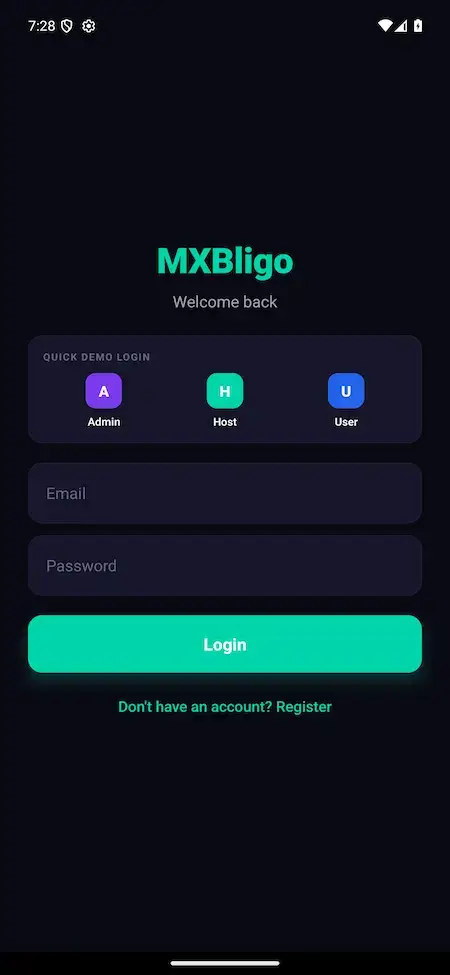
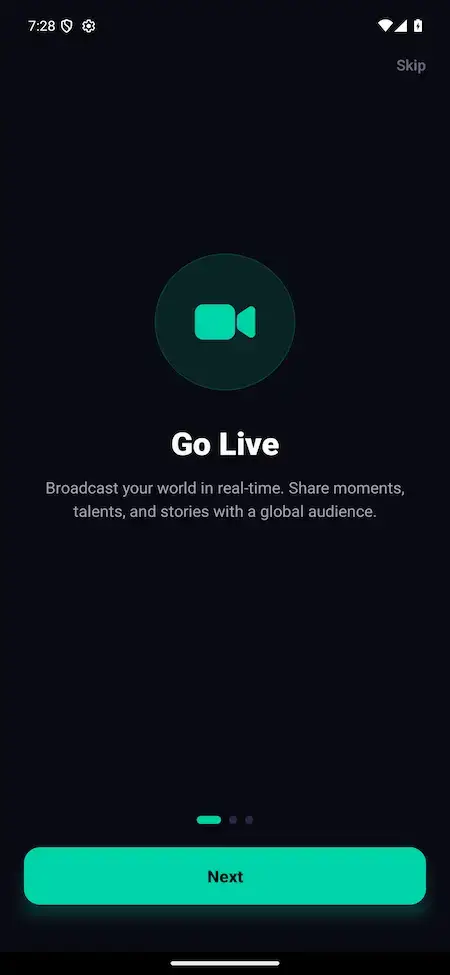
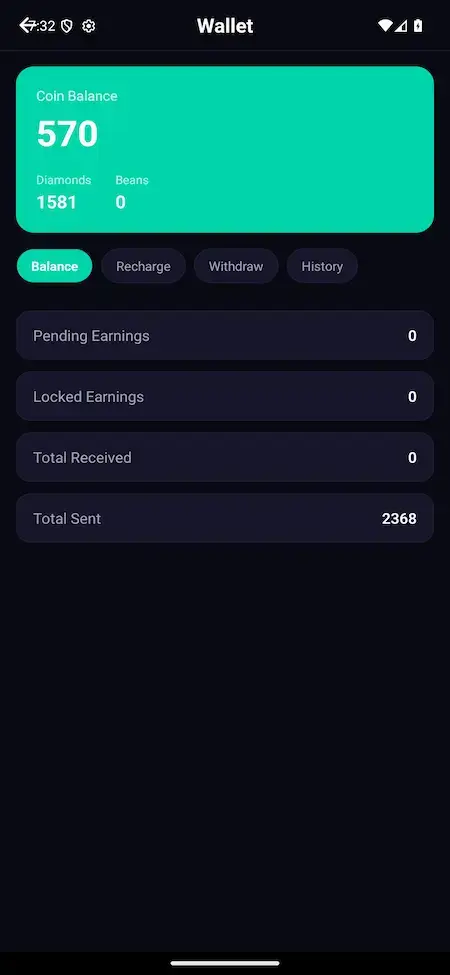
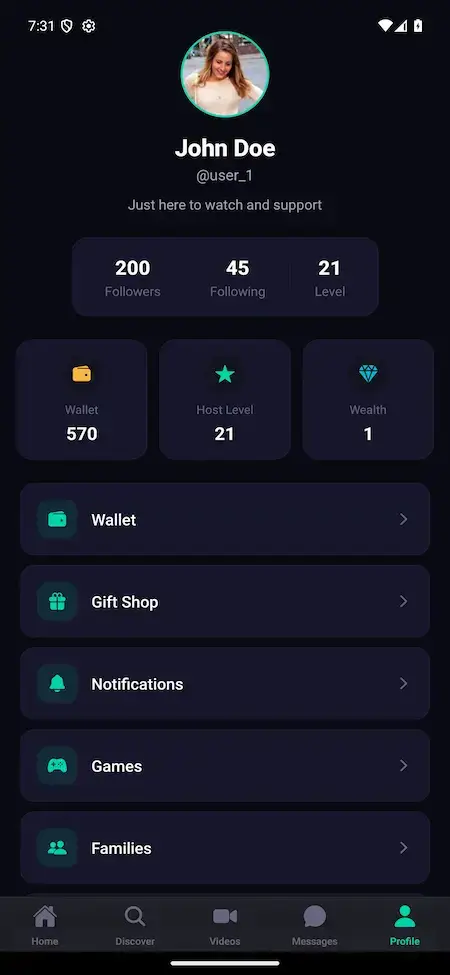

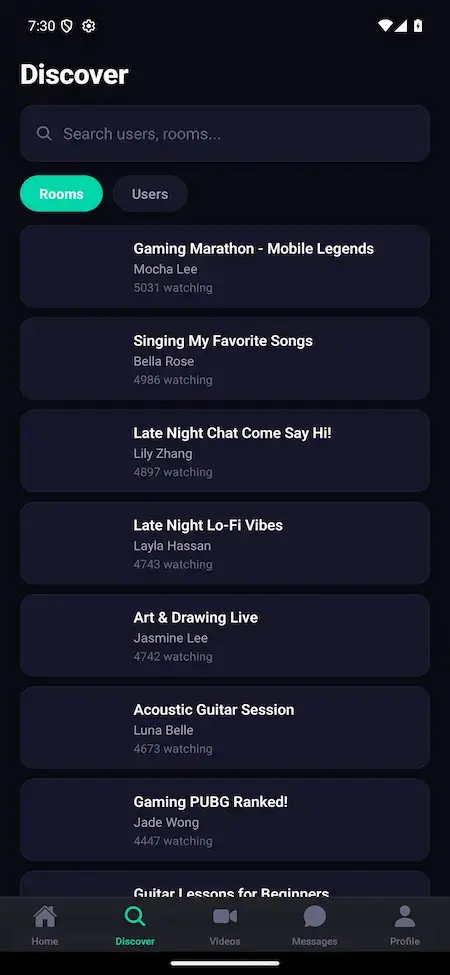
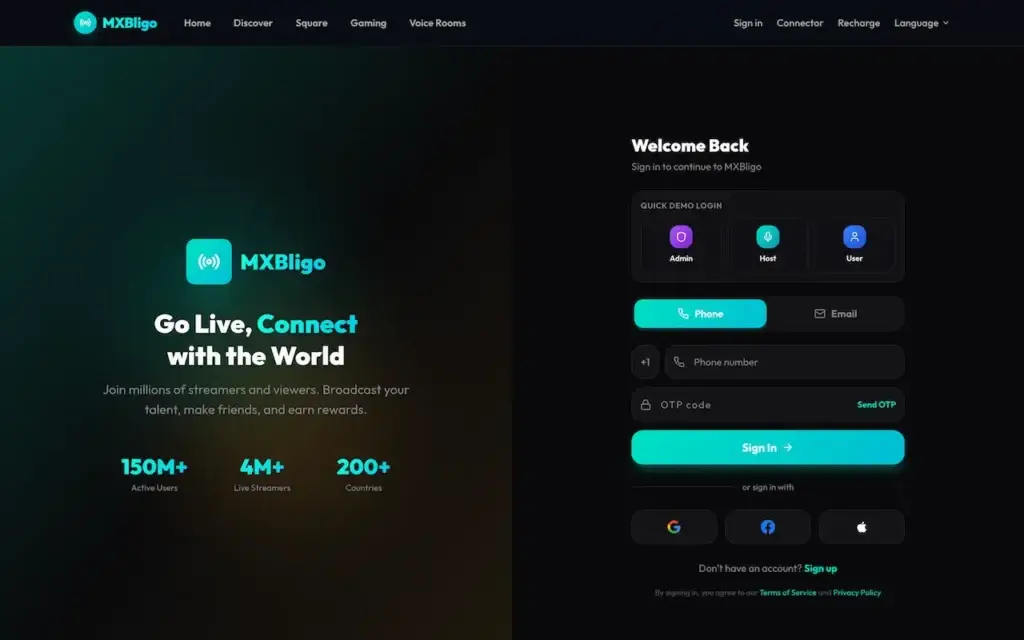
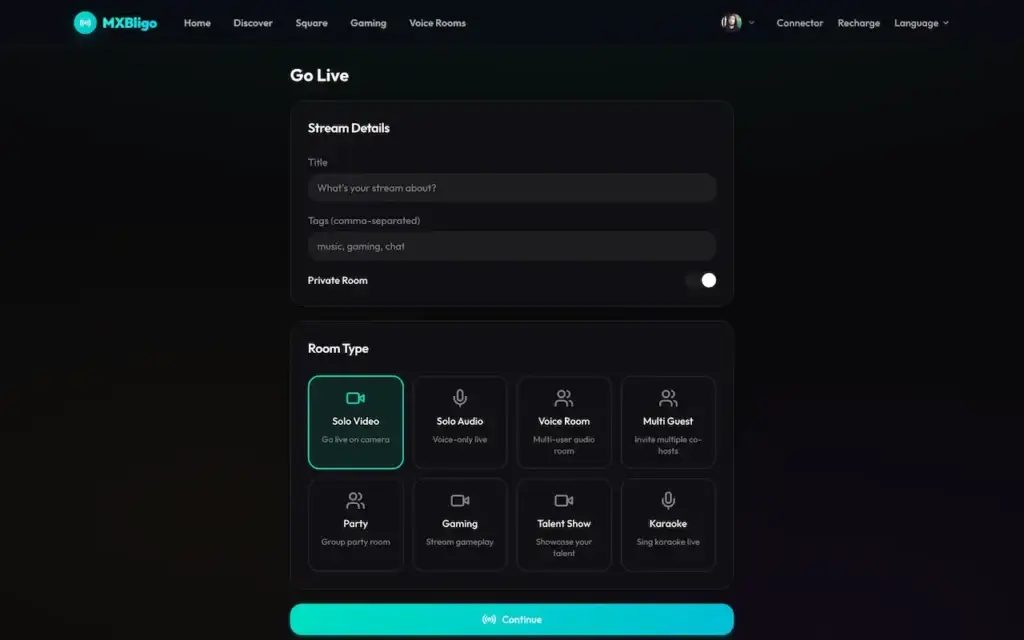
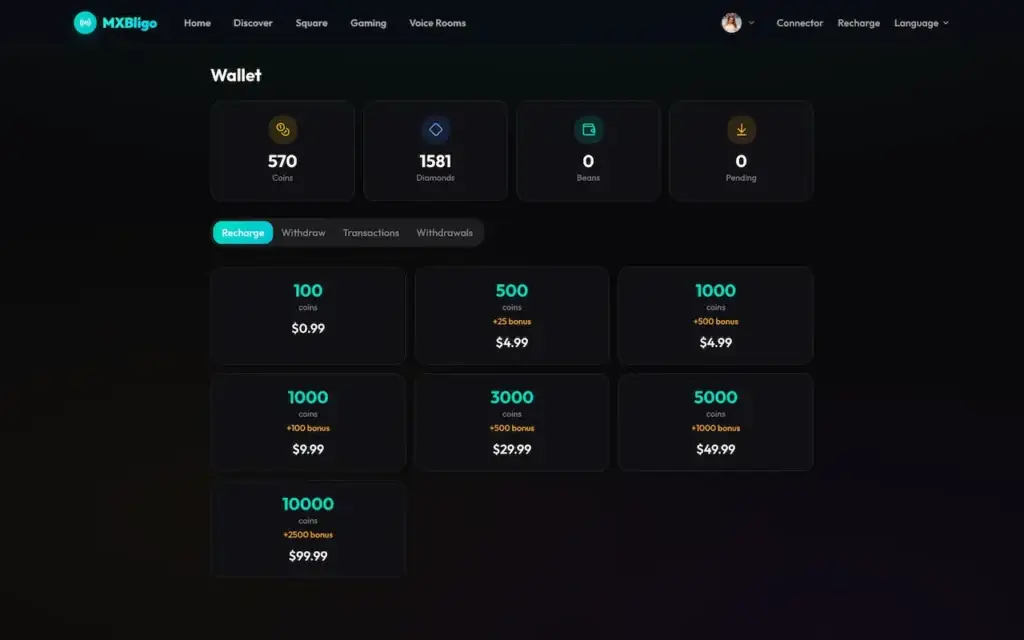
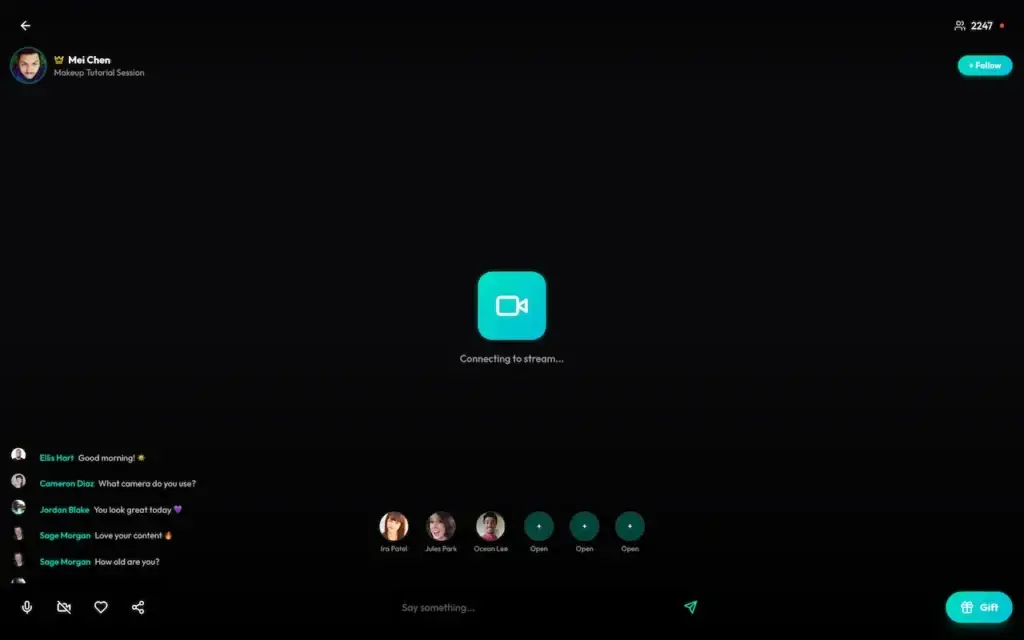

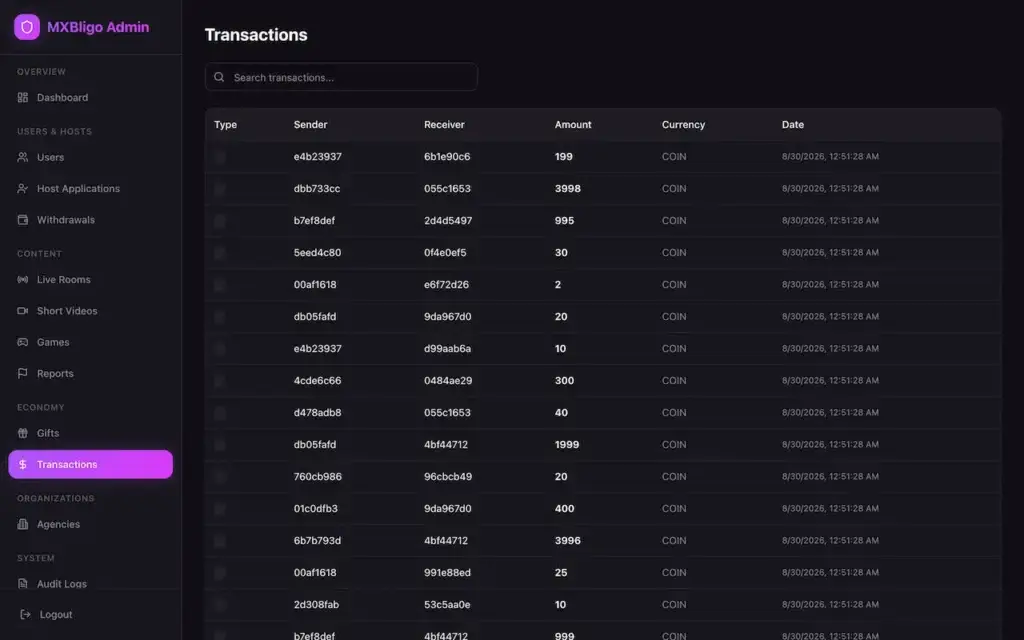
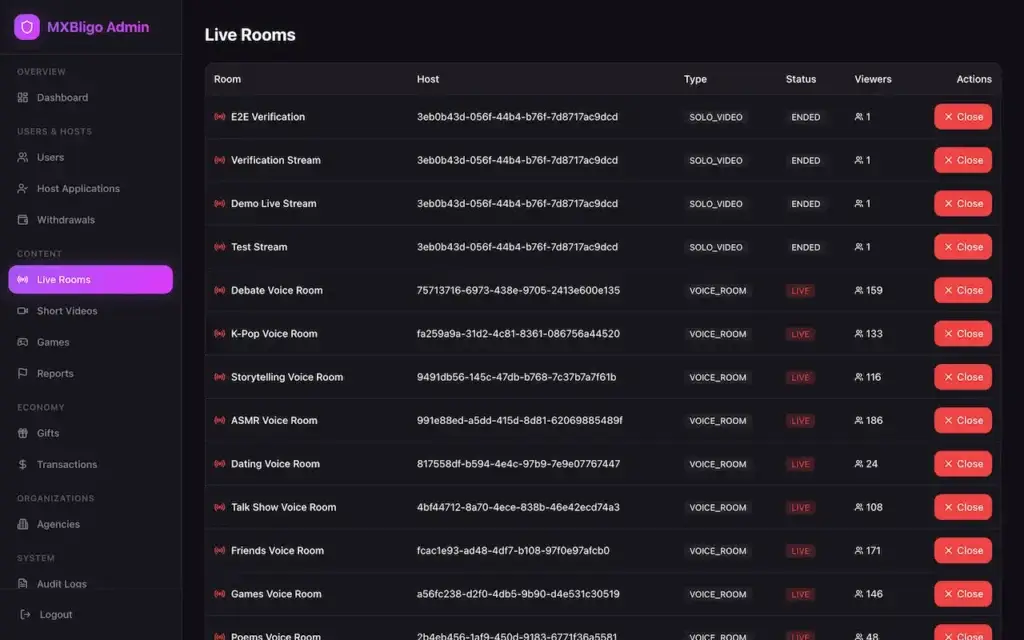
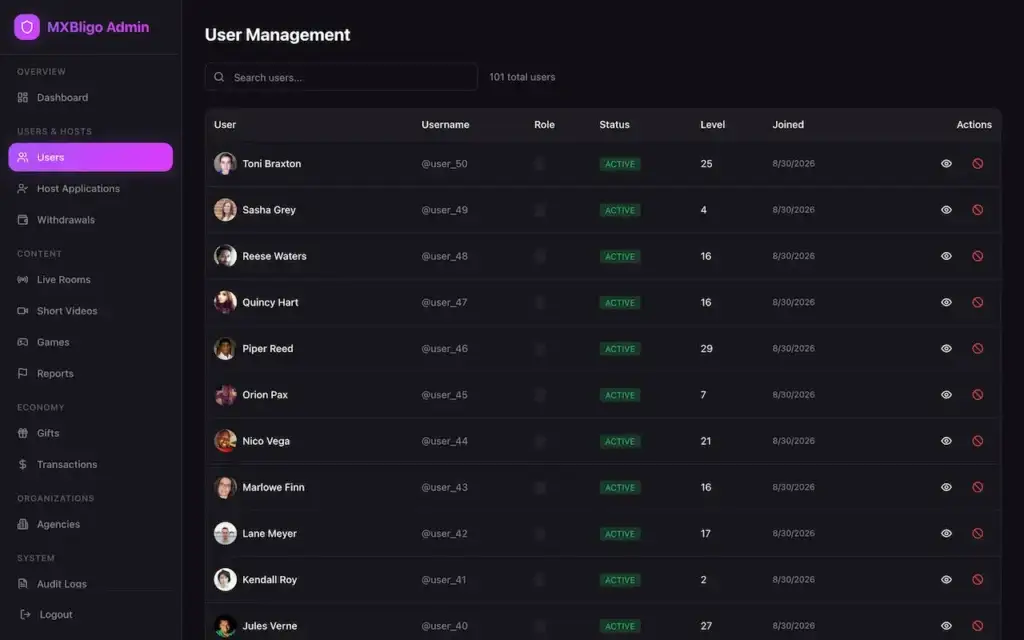


The flows trace a viewer moving from discovery to a first gift, a host going from application and approval through to a live broadcast and a payout request, an agency manager inviting a host and then watching earnings, and an operator taking a filed report all the way to a resolved appeal. The web app delivers the complete experience, while the Expo mobile app takes care of the essential viewer and host journeys.
Schedule a call and we will show you the surface that matters to you, populated with live data.
02References
Straight Answers
Reference Deployments - What This Platform Really Does
The Miracuves portfolio holds no live-streaming deployment yet. Instead of passing off borrowed proof, the points below describe properties of the build itself, and each can be shown in the live demo above.
Fifteen room formats from solo video to voice rooms, karaoke, dating and subscriber-only, each with its own seat defaults. Demonstrable in the main app.
Coins, diamonds, beans and points with a configurable split across platform, agency, host, family and co-host. Demonstrable in the main app and the admin console.
Agencies with contracts, host invitations, transfers and earnings, plus families with roles, contribution tracking and treasury. Demonstrable in the agency console.
Reports across seven content types, strikes, appeals, bans, mutes, blocked keywords and an audit log. Demonstrable in the admin console.
Illustrative Scenario
Modeled Reference - Streaming and Gifting Rollout
This is an example setup of how a live entertainment operator might configure the platform. No client engagement is described, and each figure belongs to the software, not to a result reported by any customer.
Gifting-Driven Live Streaming Platform
The setup for an operator whose revenue rests on keeping hosts, with talent agencies doing the recruiting and a coin economy handling monetization.

- Hosts churn out when their earnings are unclear and payouts drag
- Agencies tracking talent in spreadsheets since the platform offers them no interface
- Gift accounting that stops reconciling as volume grows
- Hosts choose from fifteen room formats to match what they broadcast
- Agency and family tiers that turn recruitment into how the platform grows
- Four currencies, with revenue splits and withdrawals you can configure
- Low-latency audio and video from Agora on both web and mobile
- Coins, diamonds, beans and points, split 30/10/60 by default
- Six PK battle formats, family and agency among them
- A square feed and short videos, plus 45 modeled game types
- An audit trail, plus moderation by reports, strikes and appeals
This page shows a modeled reference deployment, not work done for a client. Everything listed above ships in the base build, and our live demo can show it. The figures describe the platform itself, not results reported by any customer.Named client deployments are published elsewhere · Real engagements, with figures their clients reported, are listed in the Miracuves portfolio.
03The product
The Basics
What Is a White Label Live Streaming App?
It is a finished social broadcasting product you put your own name on. Hosts go live with audio or video, viewers watch and send virtual gifts, talent agencies recruit and manage those hosts, and a coin economy converts attention into money. What it takes off your hands are the genuinely hard parts of this category: keeping media low-latency at volume, running a gift ledger that reconciles, and giving professional recruiters an agency layer worth working inside.
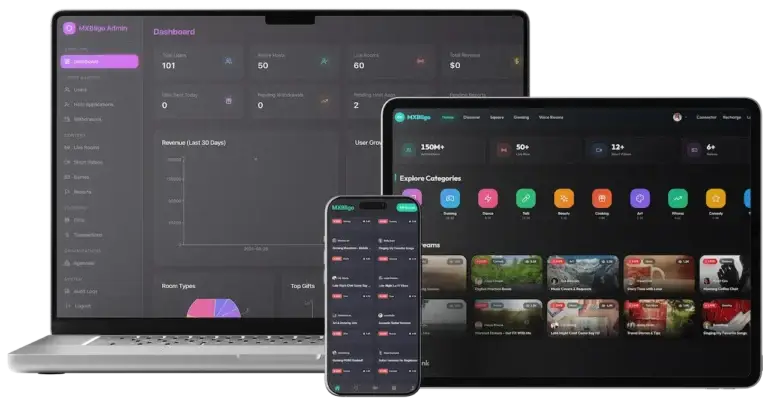
More Than A Video Player
The value lies in the moderation queue, the agency contracts and the gift ledger. With an SDK you get a video feed, and the entire economy beneath it stays yours to solve.
Owned, Not Rented
The monorepo, the Prisma schema and the Compose stack all transfer to you. No per-seat charge, no waiting on a vendor roadmap, and ordinary PostgreSQL underneath it all.
A Production Candidate, Graded Openly
The build grades itself in the open: nine out of ten on feature completeness, one out of ten on testing. No test suite, no migrations, no observability layer yet. Closing that is scoped pre-launch work, quoted rather than assumed.
Built for Web, Mobile & Admin
What a Live Streaming Script Has to Solve
The video player is not where teams get stuck. The difficult parts are a revenue split that varies per region and per room type, an agency structure that handles host transfers along with contracts, and moderation tough enough for live user-generated content. Exactly those parts are already built.
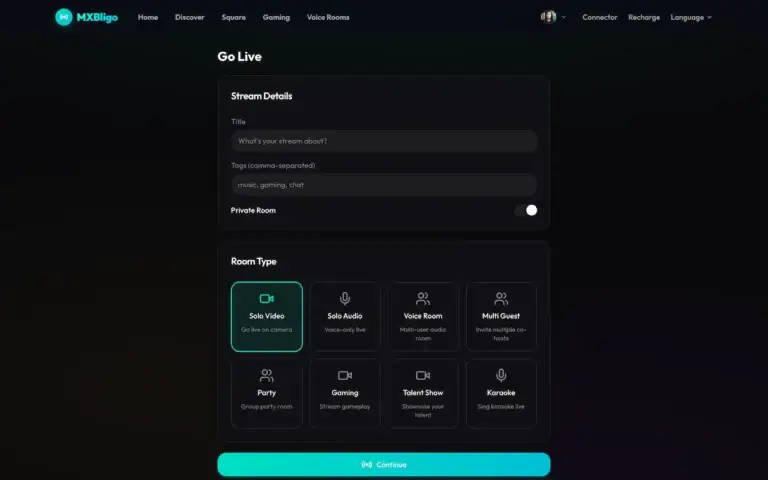
- 01Seat management across fifteen room formats
- 02Four currencies with splits you configure
- 03PK battles, agencies and families
- 04A square feed, short videos and 45 game types
- 05Strikes, appeals and audit logs for moderation
Shipped: seventy-four Prisma models over 1,839 schema lines, more than two hundred endpoints across seventeen NestJS modules, forty-four web routes, fifteen operator routes, an Expo mobile build and a seven-service Compose deployment.
Everything Included
Platform Features - Rooms, Gifting, Agencies, Games & Moderation
Each item here is present in the running demo, and we can show it to you if you ask. When an item relies on an external provider account, a hosting decision or hardening ahead of production use, we note that next to it instead of skipping past it.
Fifteen Room Styles
The platform comes with fifteen pre-configured formats, each with its own seat defaults. They are solo video and solo audio, voice room, multi-guest and co-host, panel and party, karaoke and gaming, talent and talk show, plus dating, private, subscriber-only and events.
- Seat defaults set per type across fifteen room formats
- Language tags, age restriction and private rooms
- Nearby rooms by distance
- Guests can onboard and browse with no account
Seats You Can Control
Occupants can be requested, approved, locked or removed, and their microphone and camera toggled. That is what makes a six-seat audio room something you can actually run rather than a static grid.
- Requesting, approving, locking and kicking from seats
- Seat occupants get mic and camera controls
Media On Your Own Agora
Low-latency audio and video on your own Agora account, with publisher and subscriber tokens issued server-side, working across both the web and mobile clients.
- Low-latency audio and video via Agora
- Server-issued publisher and subscriber tokens
- Socket.IO room chat, rate-limited
- Call history on one-to-one audio calls and video calls
One Transactional Gift Ledger
Eight gift categories write into a single transactional record that debits the sender coins, credits the recipient diamonds and updates the room total together, or not at all.
- Eight gift categories, combo and luxury among them
- Coins, diamonds, beans and points
- Top fans ranked by gift value, plus profile visitors
Splits You Set
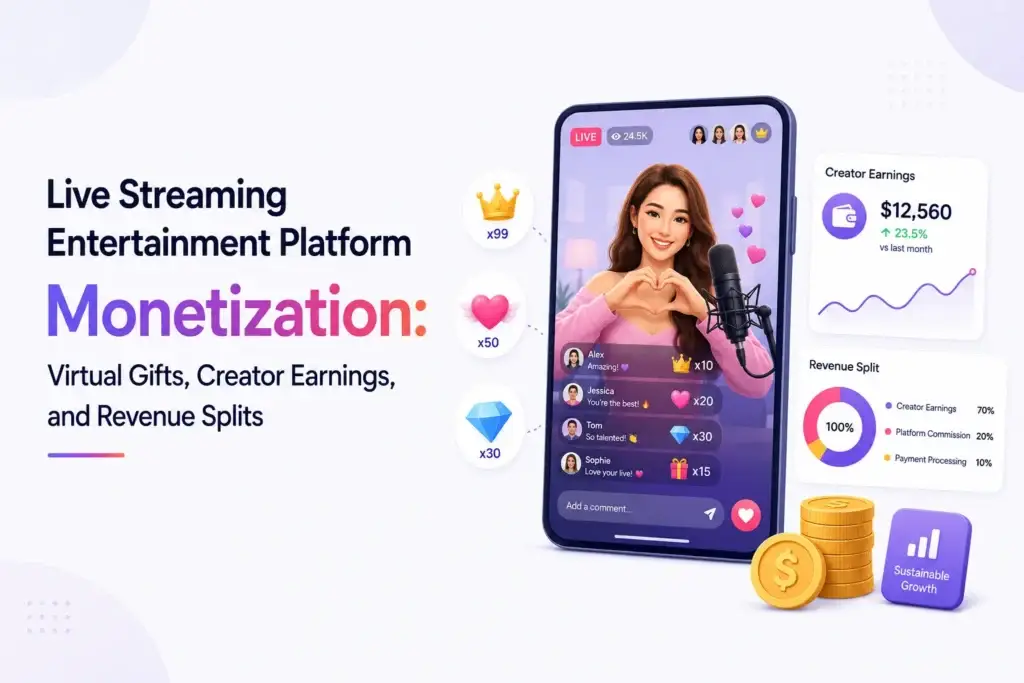
The default split is 60 percent host, 30 percent platform and 10 percent agency, and it can be varied by room type, by gift category and by region.
- A split between platform, agency and host that you configure
Diamonds, Then Beans, Then Cash
Gifts land as diamonds, diamonds convert to beans, beans leave as currency less a five percent fee, and every withdrawal waits on operator approval.
- Recharge packages with bonus coins
- Fifteen-route operator admin panel
The Agency Layer
Agencies are created and approved, invite hosts by code, carry six member roles, sign contracts on commission or salary, move hosts between them and set sub-agency rates.
- Agencies are created and approved, and invite hosts
- Contracts covering six agency member roles
- Sub-agency rates and host transfers
- Agency earnings tracking
The Family Layer
A leader runs one family, picks between three join policies, assigns four member roles, tracks contribution, holds a treasury and takes the group into family-versus-family battles.
- Families can be created under three join policies
- Roles of member, elder, co-leader and leader
- Contribution tracking and family treasury
- Family ranking and leaderboards
Six PK Formats
Battles come in six formats - tournament, agency, family, room, team and one-versus-one - scored live on the gift value each side attracts.
- Live-scored PK battles in six formats
- Winner determination and revenge battles
- Leaderboards by gift value
- Family and agency battle aggregation
Short Video And Square Feed
Clips up to 200MB carry captions and hashtags into discover and following feeds, alongside a square feed that takes text, image, video and poll posts.
- Uploads of short videos up to 200MB
- Captions, hashtags and music metadata
- Trending, discover and following feeds
- Polls, text, image and video posts in the square feed
- Follow, block and mutual followers
- Search by username and hashtag
Games And Retention Loops
Forty-five game types are modeled and seven are built into the web client, sitting beside a lucky wheel, missions, timed events and streaks for daily check-in.
- Forty-five game types modeled
- The web app has seven built-in games
- Streak rewards for daily check-ins
- Platform events, missions and a lucky wheel
- Quiet hours across six notification categories
- Push and session tracking via device binding
Moderation And Trust
Seven content types can be reported, producing strikes, violation records and appeals, with bans, mutes, shadow bans, a keyword blocklist and a complete moderation log behind them.
- Reports across seven content types
- Strikes, violation types and appeals
- Records of bans, mutes and shadow bans
- A moderation action log and blocked keywords
- Sign-up by email or phone, verified with OTP
- JWT auth, bcrypt, and refresh token rotation
- Tickets for support, with attachments and an SLA
- Thirteen legal and policy pages
The platform is handed over complete as software. You must supply your own accounts and credentials for MinIO, SMTP, Twilio, Stripe, Agora and Firebase Cloud Messaging. The documentation is also upfront about what is absent: a test suite, Prisma migrations, structured logging or APM, and GDPR erasure or retention. It further notes that Socket.IO's Redis adapter, which multi-instance deployments need, is not installed. These are all pre-launch items, so nothing comes as a surprise.
Run the Streaming Platform With No Dev Team
Admin Panel - Hosts, Withdrawals, Safety & Configuration
Fifteen routes put users, hosts, money, content and policy behind a single operator surface. It is the part of a broadcasting build most teams postpone and then never come back to.


Back-Office Sections
- 01
Dashboard
Revenue charts, user growth, a breakdown by room type and the top gifts across eight KPI cards. This is the screen an operator opens first each morning.
- 02
Users And Roles
Search the user base, ban and unban, verify accounts and assign roles, with every one of those actions written to the audit log.
- 03
Host Approvals
The queue standing between an ordinary account and the right to broadcast, carrying legal name, identity document, biography and specialties for review.
- 04
Withdrawals
Every bean-to-cash request lands here for an operator to approve or refuse. This is the control that keeps payout fraud off the platform.
- 05
Room Monitoring
Observe rooms while they run, close the ones breaking policy, and promote the ones worth surfacing in discovery.
- 06
The Report Queue
One queue resolves or dismisses reports raised against users, rooms, streams, messages, videos, posts and comments.
- 07
Gift Library
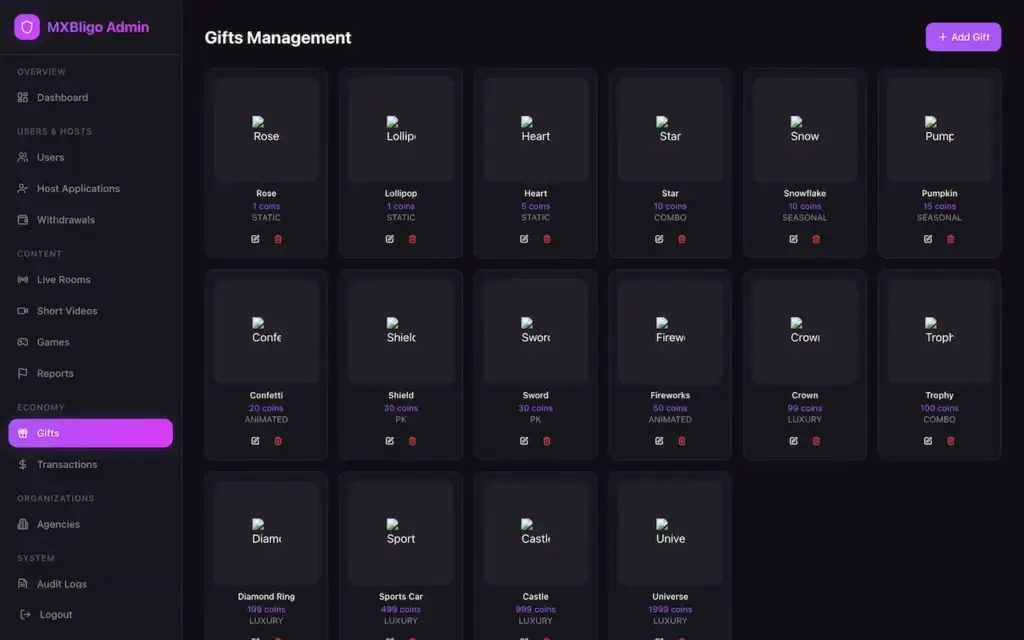
Gift items are created and retired in eight categories, and price and animation type decide what a viewer can actually send.
- 08
Game Library
Complete CRUD across all forty-five modeled game types, which puts the game mix under operator control rather than ours.
- 09
Agencies
Agencies are approved and suspended here, the gate deciding who may recruit hosts and draw a share of their earnings.
- 10
Settings And Audit
Share percentages, withdrawal ceilings, streaming limits and feature toggles, sitting beside a paginated trail of operator actions.
- Eight KPI cards and revenue charting
- Ban, unban, verify and role assignment
- An approval queue for host applications
- Approve or refuse each withdrawal
- Watch rooms, force-close them, feature them
- Resolve reports and moderate short video
- Manage both the gift and game catalogs
- Agency approval, audit trail, revenue settings
Admin sessions, the demo accounts and role checks are all hardened during deployment, and all three appear in the documentation. Share your security requirements with us and we will scope whatever else you need.
04What the live streaming package holds, and its cost
The Full Package
In the Box - Complete Source Code, Store Listing & Rollout
What you receive is a finished platform that is ready to deploy: the application source, the schema underneath it, and the documentation a technical buyer will want to inspect. Ownership is yours outright - there is no runtime license, no per-seat charge and no reliance on our future roadmap.
Backend
NestJS 10 on Node 20: seventeen modules, forty-five services and more than two hundred endpoints, each fronted by guards, interceptors and a global validation pipe.
- npm workspaces inside a Turborepo monorepo
- Seventeen NestJS 10 backend modules
- Two hundred-plus documented endpoints
- Modify, extend and redeploy as you like
$ prisma db push The Data Model
PostgreSQL 16 sits behind 1,839 lines of Prisma schema: seventy-four models and twenty-nine enums that span the wallet, moderation, families, agencies, gifts and rooms.
- Seventy-four models over 1,839 schema lines
- Twenty-nine enums for every lifecycle state
- JSONB and full-text search on PostgreSQL 16
- Seeded gifts, games and demo accounts

The Web Client
Forty-four routes and fifty components on the Next.js 14 App Router, covering discovery, live rooms, the wallet, both feeds and thirteen policy pages.
- Forty-four routes on Next.js 14
- React 18 paired with Tailwind and Zustand
- Discovery, live rooms, wallet and feeds
- Thirteen legal and policy pages

Admin Suite
A second Next.js 14 application across fifteen routes, handling hosts, withdrawals, rooms, reports, catalogs, agencies, audit and settings.
- Fifteen operator routes on Next.js 14
- Applications, withdrawals and moderation queues
- Catalog management for gifts and games
- Revenue settings and the audit log
The Mobile Build
Expo SDK 50 covering the core viewer and host journeys, now shipping as an Android release build of 289 MB, for Android 7.0 and up, installable on arm64 and replacing the earlier test build in place.
- Mobile built on Expo SDK 50
- Covers the core viewer and host journeys
- Android 7.0+ release build, 289 MB
- Finished to your scope during delivery

The Real-Time Layer
Agora RTC carrying media on your own account, Socket.IO carrying chat and presence, and Redis 7 sitting behind both for cache and rate limiting.
- Agora RTC wired into web and mobile
- Socket.IO rooms and presence
- Cache, presence and rate limits on Redis 7
- S3-compatible storage through MinIO
$ docker compose up -d The Deployment Stack
Seven services in one Compose stack, Nginx in front, PostgreSQL, Redis and MinIO behind it, with a GitHub Actions pipeline and a runbook alongside.
- A Compose stack of seven services
- Reverse proxy configuration for Nginx
- Continuous integration via GitHub Actions
- Runbook for deployment and operations
$ open docs/ The Docs Package
Ten documents cover the testing roadmap, deployment, security, integrations, admin, web, API, schema and architecture.
- Ten technical documents
- Entity diagram, schema and API reference
- Assessment of security and compliance
- Pre-production checklist and testing roadmap
Use the demo logins above for the app and the admin, agency and host consoles, or book a walkthrough and we will show you a host going live, a gift splitting across platform and agency, and a withdrawal landing in the operator queue, run against your own commercial model.
Stated Pricing
What Our White Label Live Streaming App Costs in 2026?
With Miracuves, a live-streaming and gifting platform typically starts at about $4,299 for a launch-ready white label live streaming platform, and the price rises with infrastructure complexity, mobile depth, the integrations you need for media and payments, and the pre-launch hardening scope.
Professional
ReadyMade Out-of-Box EditionOperators like: Startups in live streaming, creator platforms and regional entertainment operators
You receive the solution exactly as the demo shows it, carrying your branding and hosted on your own infrastructure.
Get StartedEnterprise
Bespoke, Compliance & Large-VolumeOperators like: Entertainment groups, telcos, media houses and talent agency networks
Have it built to fit your circumstances and business needs, tailored to your requirements.
Request a QuoteSee Every Angle of Our White Label Live Streaming App
Four guides to a live streaming platform you own: rooms to payouts, the fixed price, the questions for any provider, and why gifting carries the whole platform.
Features
Rooms to payouts: 15 room formats and 6 battle formats in the base build, with one gift split three ways on 74 database models.
See the full breakdown →Development Cost
$4,299 paid once for the whole monorepo, six days to go live and 0% kept from your gifts: one fixed price, with the honest list beside it.
See exact pricing →Provider
Four routes compared on what a live streaming platform must get right: when the revenue split is applied, how many separate currencies exist, and who approves a withdrawal.
Compare options →Business Model
Six income lines, each one a setting: coin sales, platform share of gifts, agency share, withdrawal fees, VIP membership and game wagering, with one gift in three shares.
See the playbook →05Who it is for
Know Your Buyer
Which Teams Need This White Label Live Streaming Platform?
It fits operators entering live entertainment where, in their markets, gifting, talent agencies and social gaming actually carry monetization.
For founders breaking into live entertainment who want the room engine, coin economy and agency layer operating on day one, not in year two.
Agencies already in business that manage hosts elsewhere and now want a platform of their own, where the dashboard for agencies and the contract model are central.
For operators in emerging markets, where gifting with coins and social gaming are standard, and who need targeting by country, language and region from the day they launch.
For teams moving beyond short video or social toward live, who place short videos and the square feed next to live rooms instead of as a standalone product.
For operators built around voice rooms, talk shows and karaoke, who lean on seats and audio formats and have no use for video.
For delivery partners speeding up a client build from a working base, with over 200 endpoints already documented and a NestJS backend, built in modules, that is ready for extension.
When your business rests on recruiting hosts and keeping them, with an economy that pays them accurately enough for them to stay, an owned platform becomes a long-term asset instead of a channel rented from somebody else.
Talk to Our TeamApplicable Scenarios
Use Cases - Live, Voice, Agency & Regional
Which room formats lead determines what kind of operator this becomes. A video-first product leans on solo and multi-guest rooms; a voice social app on seats and karaoke; an agency network on contracts and earnings. Every one of those is configuration, not a fork you then maintain.
Swipe · 6
A video-led platform in which viewers send gifts to hosts who broadcast alone or with guests, and PK battles create the competitive spikes that make gifting worth doing at all.

An audio-led social product made up of karaoke, talk shows and seat-based rooms, with formats and seat management carrying the whole experience and no video anywhere.

A network led by agencies, where talent managers recruit, contract and take their share, and the agency dashboard with its host transfer flows is the product itself.

A social gaming product in which the lucky wheel and forty-five modeled game types sit alongside live rooms, converting idle time into coin spend.

A regional expansion using country, language and region targeting across discovery, with revenue splits configured separately per region.

An integrator delivery, extending a documented NestJS backend of more than two hundred endpoints instead of opening an empty repository.

A single platform, configured many ways. The scenarios listed earlier all sit on one schema with the same three surfaces. You choose the room formats to enable, the game mix, the gift catalog and the split percentages, and no scenario needs its own branch to maintain.
Talk to Our TeamIndustries
Industries We Serve
The white label live streaming platform suits any operator building live social entertainment.
one platformYour platform
- 01LsVideo Broadcasting
- 02VaAudio & Voice Communities
- 03TaCreator Agencies
- 04KmSinging & Songs
- 05SgCommunity Games
- 06DsDating & Social Layer
- 07CpInfluencer Platforms
- 08ReLocal Entertainment
- 09GeVirtual Gift Economies
- 10TsChat Shows & Discussions
- 11EcContests & Gatherings
- 12AbAgencies & Platform Developers
Startups building a live streaming business draw on the full stack, from the room engine to payouts. Earnings tracking, transfers and contracts serve talent agency networks. Voice social operators work with audio formats and the seat model, while the dedicated room type serves karaoke and music platforms. Social gaming operators combine live rooms with the forty-five game types that are modeled. Dating platforms rely on one-to-one calls and the dating room format. Creator platforms add live to short videos, plus the square feed. Regional entertainment groups configure country, language and revenue per region. Systems integrators deliver client projects built on a NestJS backend that is documented. The media and entertainment platform development overview covers the wider sector. Custom work beyond this product is available through video streaming app development, one of our services.
Miracuves’ white label live streaming platform is built as a live entertainment platform that is agency-aware and adaptable to any gifting-led social business, with multi-region support where your footprint requires it and entirely white-labeled under your brand.
06Under the hood
From First Step to Last
How the Platform Works - Register, Go Live, Gift, Split & Withdraw
Viewers see a grid of live video, but beneath it sits an ordered pipeline of identity, media, ledger and payout. What follows traces one route, from a signup through to a host withdrawal.
The Path from Signup to a Settled Payout
Swipe · 6
- 1Signup & Welcome Flow
Sign-up works with an email address or phone number plus a one-time passcode, and visitors can look around as guests before creating any account.
- Sign up by email or phone, verified with an OTP
- Guest onboarding with limited features
- Devices bound for push notifications and security
- Profile built from a username, avatar and birthday
- 2Host Request & Sign-Off
No one can go live until an operator signs them off. Each application includes identity and specialty details for the reviewer.
- Application listing real name, ID and bio
- Admin panel queue where operators review applicants
- Approval notification to the applicant
- Where an agency is involved, invitation through a host code
- 3Starting a Stream
A host chooses from fifteen room formats; the backend then produces a room record, participant and seat records, plus an Agora publisher token.
- One of fifteen options chosen as the room format
- Creation of the room, a participant record and seat zero
- Agora publisher token generated
- Room listed among active rooms so it can be discovered
- 4Browse & Engage
Audiences browse rooms filtered by type, country and language, connect through Socket.IO, and take part via chat and seat requests.
- Rooms found by filtering on type, country and language
- Joining over Socket.IO, with presence tracked in Redis
- Room chat with rate limiting
- Seat requests, approvals and microphone control
- 5Tipping & Payout Splits
Treat a gift as a financial event rather than an animation: the cost, the split and every balance change within a single database transaction.
- Sender's coins reduced by quantity multiplied by price
- Value divided between the platform, agency and host
- Diamonds credited to the receiver and totals refreshed
- Live push of the gift event to everyone in the room
- 6Beans to Bank Payouts
Money matters continue once the stream ends. Diamonds turn into beans, beans feed a withdrawal request, which an operator then approves.
- Beans issued for diamonds at the rate you configure
- Host submits a withdrawal request
- Operator checks the request in the admin withdrawals queue
- A fee of five percent deducted at payout
How It’s Built
Platform Architecture & Request Path Behind Rooms
- 01Layer 01
One Repo, Four Apps
One Turborepo workspace contains NestJS for the backend, Next.js for the web app and the admin panel, and Expo for mobile, alongside shared packages for config, types and utils.
- 02Layer 02
Nginx at the Edge
A reverse proxy routes /api requests to the backend and /admin requests to the admin panel, with everything else going to web, and rate limiting plus SSL termination are managed there.
- 03Layer 03
Checked Request Path
Each request first meets Helmet and CORS, then compression, a global validation pipe, the throttler guard and the JWT guard, ahead of any controller.
- 04Layer 04
Streams Off the App Server
Audio and video travel over Agora, meaning the backend hands out tokens instead of relaying streams, and that is why the server tier stays stateless and inexpensive.
- 05Layer 05
Sockets for Live Events
Chat, gifts, seats and presence run through Socket.IO backed by Redis, so the real-time layer stays apart from the REST API.
- 06Layer 06
Gifts Recorded as Ledger Entries
In one Prisma transaction a gift debits the sender, divides the value, writes the record and credits the receiver, which means balances stay reconciled instead of drifting.
Under the Hood
Tech Stack - NestJS, Next.js, Agora & PostgreSQL
Three things decide whether a broadcasting platform holds up: media that stays low-latency, a socket layer that survives thousands of simultaneous viewers, and a gift ledger an auditor can actually follow. This is what sits behind each of them.
Backend
NestJS 10 · Node 20 · TypeScript 5- Dependency injection across seventeen modules
- A global validation pipe, guards and interceptors
- Swagger generated over 200-plus endpoints
- Passport and JWT, refresh tokens rotated
Postgres Storage Tier
PostgreSQL 16 · Prisma 5 · 74 Models- Twenty-nine enums over 1,839 schema lines
- Full-text search and JSONB both available
- Every gift wrapped in a database transaction
- Applied via db push; migrations remain pre-launch work
Web & Admin Panel
Next.js 14 · React 18 · Tailwind- App Router emitting standalone Docker output
- Forty-four public routes, fifteen operator routes
- State handled by Zustand, little ceremony
- Thirteen legal and policy pages ready
Live Audio & Video
Agora RTC · Socket.IO 4 · Redis 7- Audio and video carried by Agora
- Publisher and subscriber tokens issued server-side
- Chat, gifts and presence over Socket.IO rooms
- Redis holding cache, presence and rate limits
Billing & Notifications
Stripe · Twilio · FCM · SMTP- Coin recharge and subscriptions through Stripe
- One-time passcodes over Twilio SMS
- Push delivered by Firebase Cloud Messaging
- Nodemailer sending via your own SMTP
Deployment
Docker Compose · Nginx · MinIO- One seven-service stack, local and production
- Rate limiting at the Nginx reverse proxy
- Object storage on S3-compatible MinIO
- Builds driven by GitHub Actions
every third-party provider runs on an account you own, Agora, Stripe, Twilio, Firebase Cloud Messaging, SMTP and MinIO or any S3 equivalent among them. The documentation does not hide what is unfinished and neither will we: there is no test suite whatsoever, the schema is applied through prisma db push instead of migrations, nothing provides structured logging, APM, metrics or alerting, GDPR erasure and retention are unimplemented, and the Socket.IO Redis adapter required to run more than one backend instance is absent. Mobile, by contrast, now ships as an Android release build that weighs 289 MB, supports Android 7.0 and up and runs on arm64. Everything above is mainstream and straightforward to hire for, with no proprietary framework anywhere and a schema that ports to any PostgreSQL instance.
Build to Scale
Built for Growth: Indexed Reads, Stateless Media and a Mapped-Out Path
Where the architecture can be ordinary it is, and where broadcasting forces a choice it specialises: video handed to Agora, a relational schema indexed around discovery, and sockets kept clear of the API. What has not been built yet is written down as a path rather than presented as finished.
Media Lives Elsewhere
Because Agora carries the streams, your hosting bill tracks API calls rather than concurrent video minutes.
- Server-issued publisher and subscriber tokens
- Low-latency delivery worldwide via Agora
- The backend holds no media state at all
- One token flow shared by web and mobile
Presence Held In Redis
Redis holds the rate-limit counters, online presence and active rooms, so none of it lives in application memory.
- Finding a room is what users do most, and that query filters on type, country and language before anything else is fetched
- Per-room viewer counts kept current; distance calculation for nearby rooms
Gifting Is Transactional
Gifting runs inside a transaction, so a failure cannot leave a sender debited and a host uncredited.
- Chat, gifts, seat changes and presence all travel over Socket.IO
- Rooms, authentication and auto-reconnect all work
One Compose Definition
One seven-service Compose definition runs the same way on a laptop and in production.
- No two markets want the same product; the stack stays deliberately mainstream so that changing it is ordinary engineering rather than archaeology
- A new capability comes down to a route, a NestJS module and a Prisma model
- A new provider is an environment variable
- Every framework in that list, from NestJS and Next.js through to Prisma, PostgreSQL and Redis, is one you can hire for without difficulty
The Ceiling Is Stated
The opening ceiling is stated at 100 rooms and 5,000 sockets, together with exactly what changes to pass it.
- The growth figures sit ten times above that
- Runs single-instance out of the box
The Gap We Name
Running more than one instance needs a Redis adapter for Socket.IO, and that adapter is absent from the build today. We would rather say so here.
- PostgreSQL connection pooling
- A CDN ahead of media and static assets
- Clustering across Redis, PostgreSQL and MinIO
Better you read this now than meet it during a load test. As a single instance the build carries a launch audience comfortably. Going beyond that needs the Redis adapter, connection pooling and clustering, and we scope that work into deployment rather than assuming it away.
07Security and trust
Built to Be Audited
Platform Security - Documented, Graded & Stated Without Spin
A dedicated assessment covers the security posture, and the notable thing about it is how openly it scores itself: 5 out of 10, with ten named items to finish before anything goes public. Handing you that list up front is more useful than letting you discover it later.
- 01 · Auth
Authentication Is The Strong Point
Refresh-token rotation on JWT, bcrypt hashing and device binding. The assessment singles out authentication as the strongest area of the codebase.
- Sessions and Token Protection: Admin tokens shift into an HttpOnly, Secure, SameSite cookie, each token gets an identifier backed by a Redis denylist so it can be revoked, and refresh tokens are tied to a device fingerprint.
- 02 · Pipeline
Guards Run Before Controllers
Before a request reaches a controller it passes a throttler, Helmet, CORS and a global validation pipe, and protected routes carry their own JWT guard.
- Day-One Preparedness: Real certificates behind Nginx HTTPS, an upload body limit lifted to fit 200MB videos, structured logging with alerting, and Prisma migrations in place of db push, all before production data exists.
- 03 · Audit
Staff Actions Are Logged
Two separate logs record what staff do, one for operator actions and one for moderation decisions, both queryable from the panel itself.
- 04 · Credentials
Seeded Logins Come Out First
Seeded admin, host and viewer logins exist for evaluation only. Stripping them and rotating those accounts is the first job before launch.
- Key and Secret Rotation: Demo credentials hardcoded in web, admin and mobile get stripped out, seeded accounts are rotated, and every default secret inside the environment files is replaced. This block comes first, ahead of any public exposure.
- 05 · RBAC
Global Guard And Role Alignment
Route protection and role checks are reconciled before go-live, so any route added later is protected by default.
- Access Control Hardening: Every route protected by default and role checks reconciled across moderation and support, before go-live.
- 06 · Open items
The Rest Of The List
Credential storage, admin sessions, payment confirmation, migrations, tests, an observability layer and a GDPR erasure path, all closed as scoped pre-launch work.
- Billing Accuracy: Signed Stripe webhook confirmation is in place before the first real payment.
- Privacy Safeguards: Hashed room passwords and field-level encryption for KYC data land before launch, with GDPR erasure, retention and consent added as scoped work.
What exists is genuine: refresh-token rotation on JWT, bcrypt hashing, device binding, Helmet headers, CORS, a global validation pipe, a throttler, per-controller JWT guards, a CSRF header check on mutating calls, and an audit log sitting behind operator actions. What is missing is equally genuine and set out below. We close those items as scoped hardening before you launch, rather than leaving them for you to find.
Talk to Us About Security and CompliancePre-Launch Sign-Off
Trust and Safety Readiness: What the Software Delivers, and What Is Left in Your Hands
What you receive is white label live streaming software rather than a license or a certification. Miracuves builds the moderation and safety tooling described here and hands it over. Operating a live platform safely remains your responsibility as operator, covering your policies, your moderators, their response speed and whatever local law requires of you.
The controls needed on any platform that hosts live user content ship in the build: reports across seven content types, strikes, appeals and violation records, bans, mutes and shadow bans, a keyword blocklist, short video moderation, a complete moderation log, room monitoring that includes force-close, age-restricted private rooms, an audit trail of operator actions, and host applications reviewed before going on air. GDPR erasure, retention and consent are not implemented right now, and this page treats them as scoped work. Certification is not part of the software, and Miracuves displays no compliance badge on the operator's behalf.
Handed Over at Delivery
Reporting and blocking are available to users, while operators work from a moderation queue that follows strikes and appeals and records an action log. The package also covers keyword blocking, per-room age restriction and privacy, host approval before going on air, a way to force-close live rooms, plus thirteen legal and policy pages to adapt. All of it is delivered as source code you own.
Work That Remains With the Operator
Your terms and community guidelines remain yours to write, along with the people who staff your moderation queue and how fast they act, age checks and identity checks on hosts beyond the scope of the host queue, and the way you handle takedown and law-enforcement requests. The software supplies your team with tools, yet it does not make the decisions.
Coins, Gifts and Cash-Outs
In-app currencies, namely coins, gifts, diamonds and beans, convert at rates you set. Coin purchases by viewers go through Stripe, using your own merchant account, while host payouts go through the licensed payment provider the operator uses. Meeting the virtual currency and creator payout rules of every market where you operate is your job.
Regional Regulation Governs
Your obligations shift with market and audience. The UK applies its Online Safety Act, the EU pairs GDPR with the Digital Services Act, COPPA is relevant in the US where users might be under 13, and India enforces the IT Rules 2021. Have qualified counsel confirm what applies to you, because Miracuves does not provide legal advice.
08Grow the platform
- Fifteen kinds of rooms
- Four-currency system
- Agencies & family groups
- Moderation toolkit
How add-ons work
- 1Take the modules you want
Pick modules for launch day or add them afterward, and the core is never rebuilt.
- 2Quote follows each module
Scope and price are put in writing for each module on its own.
- 3Supplied with source code
Like the core, modules come as source code that belongs to you.
Go Further
Add-Ons - Hardening, Testing, Mobile & Scale
As delivered the platform is feature-complete and demonstrable. What follows is what operators most often add on top, either because a third-party account is involved or because the documentation flags it as outstanding before production.
Hover to hold · drag to move around
- 01Safety & compliance
Lockdown Ahead of Go-Live
The ten immediate items named in the documentation: demo credentials, the global guard, RBAC alignment, admin cookies, secret rotation, HTTPS, upload limits and password hashing.
Security · Locking Down - 02Quality & upkeep
Regression Checks
The build contains no test files whatsoever today. Unit, integration and end-to-end coverage is scoped work, and a testing roadmap already exists to follow.
Testing · Test Depth - 03Phones & growth
Phone App Plan
An Android release build is part of the platform today: 289 MB, Android 7.0 and up, arm64, and it upgrades the earlier test build in place. Whatever you want from the app beyond that build is scoped against your roadmap.
Mobile · Android - 04Quality & upkeep
Metrics and Tracing Tools
Nothing provides structured logging, APM, metrics or alerting today. Adding that layer is the difference between incident response and guesswork.
Monitoring · Tracing
- 05Quality & upkeep
Prisma Schema Changes
Schema is applied through db push, which stops being safe the moment production data exists. Converting to a proper migration history is cheap, early work and it matters.
Schema Changes · Rollback - 06Phones & growth
Multiple Server Instances
Installing the Socket.IO Redis adapter, adding connection pooling and clustering is what carries the platform past one backend instance.
Scale · Many Instances - 07Safety & compliance
GDPR & Compliance
The policy pages exist; erasure, retention and consent mechanisms do not. For the EU and comparable jurisdictions this is required work.
Compliance · GDPR - 08Phones & growth
Content Delivery Network & Streams
Hosted by you, MinIO is S3-compatible. When upload volume rises, the next step is to front short video and static assets with a CDN.
Media · CDN
More Creator Products
Working on a Creator Platform? Our Range Spans the Full Market.
Our white label live streaming platform sits within a full creator suite. Should your roadmap reach past live streaming and gifting, these products fit alongside it.

01Short-form video platform: algorithmic discovery, creator monetization, plus a full moderation stack.
Explore Solution

02A subscription platform for creators covering paywalled content, tipping and direct messages from fans.
Explore Solution
03Gamification and a virtual gift economy for creator communities, delivered through social audio rooms and live streaming.
Explore Solution
04Fan membership platform with subscriptions, paid content, messaging and live streaming.
Explore Solution09The business case
Where Platform Owners Profit
Revenue Models - Gifts, Subscriptions, Agencies & Games
Revenue on a live-streaming platform comes from multiple sources simultaneously, and each one is modeled on its own here, letting an operator adjust one lever while the rest stay untouched.
- 01
Virtual Coin Bundles
Viewers pay for coins with Stripe, using your own merchant account. That purchase starts the revenue funnel, and it is where real money first enters the economy.
- 02
Gift Cut
From each gift the platform retains a configurable share, 30 percent by default, taken when the transaction happens instead of being reconciled later.
- 03
Agency Cut
An agency's cut is configurable and defaults to 10 percent, and that is the reason professional recruiters are willing to bring hosts to your platform in the first place.
- 04
Payout Handling Fees
A 5 percent fee applies to bean-to-cash withdrawals, so cashing out adds revenue instead of being a cost to the platform.
- 05
VIP Memberships
Tiers running from Free through Bronze, Silver and Gold up to Diamond come with badges and benefits, adding predictable recurring revenue alongside transactional gift income.
- 06
In-Game Spending
Forty-five modeled game types support coin wagering, so the gaps between streams give viewers one more way to spend coins.
| Revenue stream | How it is charged | Take rateTypical range | What sets the ceiling |
|---|---|---|---|
| Virtual Coin Bundles | A card or wallet processor deducts a percentage plus a fixed amount from each coin purchase. | PayPal payment links: 3.49% + 0.49 USD. Square in-app API cards: 2.9% + 30c. | The fixed component. On Square's rate a $4.99 bundle loses about 9% to processing and a $49.99 bundle about 3.5%, so bundle sizing moves net revenue more than the percentage does. |
| Gift Cut | The platform's share is set aside as the gift is sent, before the host balance is credited. | Instagram credits creators a fixed $0.01 per Star. YouTube pays 70% of Supers. | Net-of-fees accounting. YouTube measures its 70% after sales tax and iOS App Store fees, and Instagram's rate depends on which Stars pack a viewer bought, so no published split is a clean cut of the sticker price. |
| Payout Handling Fees | A deduction is taken when a host's balance leaves for a bank account or digital wallet. | PayPal Payouts: 0.25 USD flat through its API, or 2% capped at 1.00 USD. | Which rail you route through. The flat API fee suits many small withdrawals; the percentage method suits larger ones, and international sends are capped at 20.00 USD. |
| VIP Memberships | Tiered monthly access is billed by card or store, and the biller takes its cut every cycle. | Twitch splits subscription revenue 50/50 by default, 60/40 or 70/30 on Plus tiers. | Streamer expectations. Twitch reaches 60/40 at 100 Plus Points and 70/30 at 300, and dropped its US$100K cap on the 70/30 tier, so successful hosts know what a premium split looks like. |
How to read this. The processor figures are published price lists from PayPal and Square; the payout fee is PayPal's Payouts table as of its October 2026 update. Gift benchmarks come from YouTube Help and the Instagram Help Center, and the subscription tiers from Twitch's own announcement, which describes the 50% default as the standard rate. All of those are published terms. The small-bundle percentages are our arithmetic on Square's rate. Read the table as modeling input only: it is not a quote for your build and says nothing about future income.
All the rest of the product serves to raise how frequently a viewer wants to send one.
Market Benchmarks
Independent Market Benchmarks for Live Streaming Apps, 2025-2026 Data
Revenue models of our own appear higher up, while the figures below have outside origins. JOYY, Huya, Twitch and Ofcom released them, and they are reproduced exactly as published. They indicate what companies that run on live streaming plus virtual gifting actually earn, and how audiences behave, so a business case can be tested against sources you are able to verify.
JOYY's Live Streaming Revenue Reached $1.53bn in 2025
JOYY, the Nasdaq-listed company that owns Bigo Live, recorded US$1,529.7 million of revenues from live streaming in 2025. That equals 72.0 percent of total net revenues of US$2,124.2 million, a decline from the US$1,788.0 million of 2024. ARPU for live streaming came to US$365 versus US$391 the year before, while advertising revenues climbed to US$442.7 million. Source: Form 20-F annual report from JOYY, filed on 28 April 2026.
Huya Generated RMB 4.59bn From Live Streaming
Huya, a game live streaming platform listed on the NYSE, saw its live streaming revenues fall 3.2 percent in fiscal year 2025 to RMB4,594.0 million (that is US$656.9 million). Total net revenues were RMB6,502.4 million, a 7.0 percent increase. Advertising, game-related services and other revenues rose by 43.1 percent, reaching RMB1,908.4 million. Source: the Huya results covering the fourth quarter along with fiscal year 2025, dated 17 March 2026.
Twitch Viewers Watched 8.6bn Hours of Gaming in 2026
Twitch reports gaming content on its platform drew more than 8.6 billion viewing hours from 1 January up to 1 September 2026. Streams carrying the DropsEnabled tag produced 1.6 billion hours, an increase of 46 percent, while the number of users who took part and claimed Drops grew 15 percent to 40 million. The numbers come from Twitch itself and are global and rounded, taken out of the State of Gaming 2026 report that Twitch published on 9 September 2026.
Live Streams Watched, Shared or Posted by 69% of UK Men
Published by Ofcom on 7 May 2025, the study titled Adults' Media Use and Attitudes covers internet users in the UK who were 16 or over during 2024. A higher share of men than women uploaded, shared or watched live streaming content: 69 percent versus 61 percent. Men were also likelier to stream live themselves, at 21 percent of men versus 13 percent of women.
JOYY Inc., Annual report on Form 20-F for the fiscal year ended December 31, 2025, filed 28 April 2026 - sec.gov
HUYA Inc., Reports Fourth Quarter and Fiscal Year 2025 Unaudited Financial Results and Announces Cash Dividend (Form 6-K, Exhibit 99.1), 17 March 2026 - sec.gov
Twitch, Twitch State of Gaming 2026, 9 September 2026 - blog.twitch.tv
Ofcom, Adults' Media Use and Attitudes Report 2025, 7 May 2025 - ofcom.org.uk
The numbers are survey findings, platform statistics and reported results that come straight from each publisher, unaltered. They describe the market rather than how any platform built by Miracuves performs, and none of it should be read as a forecast of revenue for your business.
Market Timing
Why Start a Live Streaming Business in 2026?
Gifting rather than advertising pays for live entertainment, so income arrives immediately instead of waiting on scale. The operators pulling ahead are the ones whose hosts stay put, and hosts stay where agency support is genuine and payouts land accurately.
01Supply Is The Real Constraint
Audiences follow hosts, and whether hosts arrive and remain comes down to how clearly they can see their earnings and how well their agency is supported. That makes the host experience your growth engine, not the marketing budget.
02Gifting Pays Immediately
Where ad-funded video waits for an audience, a gift economy earns on the very first broadcast. That single difference reshapes how the business needs funding.
03Agencies Deliver Supply In Bulk
One agency can deliver dozens of hosts at once. Without a native layer carrying contracts and earnings, professional recruiters have no reason to pick you over anyone else.
04Seat Logic Is Deceptively Hard
Requesting, approving, locking and removing occupants, with microphone and camera control, across fifteen formats, is exactly the engineering most streaming templates leave out.
05Moderation Cannot Wait
Live user-generated content needs reporting, strikes, appeals, bans and keyword blocking from launch day, not retrofitted after the first incident.
06The Build-or-Buy Question
Building the equivalent yourself spans media, economy, agencies, games and moderation across several years. A white-label deployment is running on your own server in six working days.
Product Inventory Counts
Prisma Table Count
API Endpoints
Live Room Variants
Game Formats
This is the layer that swallows the years. Among its parts are a four-currency ledger, fifteen room formats with functioning seat logic, PK scoring, moderation designed for live user content, and agency contracts that include transfers; every one is dull, mandatory and slow to perfect.
Why the Economics Work
Marketability, Revenue Potential & Upside to Come
What makes this category unusual commercially is that income begins immediately. A gift is a purchase rather than an impression, which means a hundred active hosts are already generating transactions while an advertising-funded rival is still assembling inventory.
- 01
Six Income Streams
Six levers that work independently of each other: coin sales and game participation, commission on gifts, VIP subscriptions, withdrawal fees and the agency share.
- 02
Earning From The First Stream
The first broadcast can earn. Nothing waits on the audience threshold that advertising economics demand.
- 03
The Agency Network Is The Moat
An agency network delivering hosts in volume is genuinely hard to copy, and it is payout accuracy that keeps those agencies from taking their talent elsewhere.
- 04
Optionality At Exit
You hold the monorepo and the schema on ordinary PostgreSQL. In diligence, seventy-four documented models read as an asset rather than a black box someone has to explain.
- Coin Sales
- Gift Commission
- Agency Share
- Withdrawal Fees
- VIP Subscriptions
- Game Participation
A platform's moat is its supply of hosts and its agency network, never its feature list.
- 01Hosts rarely switch platforms on a whim
- 02Their recruiting agencies also have reasons to remain
- 03Onboarding quick enough to grow that supply
- 04You hold the full record instead of a third party that can change the revenue split without you
Income Walkthroughs by Stage
The case for owning the stack is simple. In live entertainment the durable asset is made of host relationships and the agency network, and both belong to whoever runs the infrastructure. That is precisely why renting someone else’s platform has a ceiling built into it.
A curated launch in which recruiting hosts and paying them correctly matter far more than raw scale, and the portal finally replaces the spreadsheet.
An operation at market scale where recruitment is delegated to agencies and the competitive spikes come from PK battles.
A multi-market platform where regional revenue configuration and the game catalog turn a single deployment into several national businesses.
10Why Miracuves
Why Miracuves
Miracuves vs Other White Label Live Streaming Vendors
Several routes lead to a live streaming platform: off-the-shelf scripts, freelancers, agencies, or owning the infrastructure outright.
The Miracuves Case for Founders
- 01
The Agency Layer Is Built In
Contracts, invitations, host transfers, sub-agency rates and earnings all modeled. Off-the-shelf scripts hand you rooms and leave professional recruitment entirely unbuilt.
- 02
Fifteen Room Styles
Each format arrives with its own seat defaults, from solo, voice and multi-guest to karaoke, dating, subscriber-only and more. Most templates ship a single video room and stop there.
- 03
An Economy, Not A Counter
Four currencies with splits configurable by room type, gift category and region, instead of one coin balance and a percentage frozen in the code.
- 04
Source Code Is Yours
The whole Turborepo monorepo, TypeScript on PostgreSQL, yours to change and deploy. No per-seat charge and no provider in a position to alter the terms later.
- 05
Written For Diligence
Ten documents covering architecture, schema, API, security and the testing roadmap. Enough to survive an investor review, not just a demo.
- 06
We Document the Limits
The platform ships without a test suite, migrations or observability, and security items remain open. The documentation grades each one, and this page repeats them so nothing surprises you afterwards.
See Why Clients Pick Us as Their #1 Partner for Ready-Made Clone Solutions
| Criteria | MiracuvesMiracuves white label live streaming platform | Generic Clone Script | Custom Dev Agency |
|---|---|---|---|
| Time to Launch | 6 days (Production) | Unknown / DIY | 6-9+ months |
| Source-Code Ownership | ✔ Full | Often limited / encrypted | Usually yes |
| Feature Depth (Category Leader Parity) | High (feed, live, monetization) | Basic (upload & feed only) | Depends on budget |
| Security & Compliance | Documented, graded & candidly open | Minimal | Varies widely |
| Scalability & Performance | Agora takes the media load, with a documented scaling path | Rarely considered | Depends on architecture |
| Monetization Options | Multiple (coins, gifts, subs) | Limited / needs custom work | Custom (more time & cost) |
| Admin & Analytics | Full-fledged dashboard | Very basic or missing | Custom build (extra cost) |
| Cost vs Speed vs Quality | Balanced | Cheap but risky | High cost, slow |
| Ongoing Support & Updates | Available with clear plans | Usually none | Depends on contract |
Changelog
Release Log for the Platform: Version History plus Later Upgrades
| Version | Date | What’s New |
|---|---|---|
| v2026.1 | Aug 2026 | First release, a live streaming platform: moderation, PK battles, families, agencies, a four-currency economy and 15 room formats. |
Let’s build together
Time to turn your idea into a live streaming platform.
We provide a free consultation, a defined schedule and direct answers. Winning your trust ranks above speeding a sale.
- Reply in 24 hrs
- Free consultation
- No lock-in contracts
- Full source code ownership
11Learn more
Blog & Resources
Live Streaming Software - Latest Reading List & How-Tos
Follow current guides, trends and case studies about talent agency operations, gifting economies, creator monetization and live streaming.

Product4 questions
01What does a white label live streaming app actually include?
A white label live streaming app is a complete social broadcasting product that you brand as your own. The Miracuves platform ships fifteen room formats, from single-host video through to multi-guest audio; viewers buy coins and spend them on virtual gifts; talent agencies sign hosts and earn a share of what those hosts generate; and family groups give regulars somewhere to belong. Underneath sit a NestJS backend of more than 200 endpoints, 74 Prisma models, a 44-route web client, a 15-route operator panel and an Expo mobile build.
02How does the coin and gift economy work?
Four in-app currencies drive the economy. Real money arrives as coins, bought by viewers through Stripe, using your own merchant account. When coins are spent on a gift, a single database transaction lowers the sender’s balance, divides the value among platform, agency and host, and gives the recipient diamonds. Diamonds are converted into beans, and beans can be turned into withdrawable cash minus a 5 percent fee after an operator approves the request, with the payout handled by the licensed payment provider the operator uses. Out of the box the platform takes 30 percent, the agency 10 percent and the host 60 percent, and the split can be adjusted by room type, gift category and region.
03Why do agencies and families matter in this category?
In live streaming, host supply arrives in bulk through recruiters. An agency on the platform is a talent organization: it recruits hosts, holds their contracts on commission or salary, and takes an agreed share of their earnings, 10 percent by default. A platform without an agency layer gives those recruiters no reason to bring anyone at all. Families are the retention counterpart: social groups with leaders, ranks, contribution tracking and a shared treasury, built to hold viewers rather than to sign talent. Both are built into the Miracuves platform, including family and agency PK battles.
04What state are the mobile apps in?
The white label live streaming platform includes an Expo SDK 50 build covering the main viewer and host journeys, with push through Firebase and the same Agora media layer; as an Android release build it is now available to try today: 289 MB, built for Android 7.0 and up. Any arm64 device can install it, and it replaces the earlier test build in place without losing the session. An iOS TestFlight build is available on request from the demo section.
Budget & delivery time6 questions
05What does a white label live streaming platform cost?
The Miracuves white label live streaming platform opens at $4,299 as a one-time price for a deployment that is branded and live, and the full source code comes with no revenue share. What moves that figure is the hardening you want finished before launch, how deep the mobile build needs to go, which media and payment providers you connect, and the infrastructure you run it on. Enterprise builds for entertainment groups, telcos, talent agency networks and media houses are quoted on custom scope.
06How quickly can we be live?
After rebranding and configuring, we need six working days to have the platform operating on your own infrastructure. Additional calendar time usually originates with you: provider accounts (Agora, Stripe, messaging), gift and game catalogs, server access and brand assets must all be in our hands before the work can be completed. Pre-production hardening is quoted separately, and we say clearly how much time it adds. Our delivery figures are on the Miracuves facts page.
07Is the platform ready for a public launch?
It is feature-complete and fully demonstrable, but its documentation grades it a production candidate rather than a finished system: feature depth scores 9 out of 10 and testing scores 1 out of 10, because the repository contains no test files yet. Before opening to the public the platform needs demo credentials removed and seeded secrets rotated, route protection and role checks reconciled, admin sessions hardened, real certificates on HTTPS, Stripe webhook signatures verified, and Prisma migrations in place of db push. As scoped pre-launch hardening, Miracuves completes these items, and we would rather you heard that now.
08What load does a single deployment carry?
The documentation sets starting targets of 100 simultaneous rooms, each holding 500 viewers, and 5,000 socket connections held open in one deployment. Its growth targets are an order of magnitude higher and depend on work missing from the current build: PostgreSQL connection pooling, clustering, a CDN placed ahead of media, and the Socket.IO Redis adapter so more than one instance can run. Because video travels through Agora, streaming load does not reach your own servers, and the scale-out work is scoped by Miracuves as part of deployment.
09What does the platform not ship with?
Missing are a test suite, Prisma migration history, structured logging or APM, and GDPR erasure, retention or consent tooling. The Socket.IO Redis adapter required for multi-instance is not installed. External providers all run on accounts you own - Stripe, Agora, Twilio, Firebase and your SMTP host among them. Apart from the provider accounts, each one is a scoped add-on from Miracuves, and we would rather set that out here than let it surface after you have paid.
10How does an operator realistically reach first revenue?
Operators typically start with hosts they have recruited instead of open registration, since the quality of hosts is what keeps the first viewers around. Coin sales and gift commission can be collected beginning with the first stream. Agencies tend to appear when there are enough hosts for recruiting to pay off, and subscriptions come later, once a badge is something people want. The schema already holds all of this, so turning each piece on is configuration, not development. Hardening before production is the one non-optional item, and we scope it alongside the launch rather than after it.
Safety, trust & privacy2 questions
11Is it legal to operate a live streaming platform of this kind?
Your commercial terms, your host contracts and your name are on the platform from day one. The software follows patterns shared across the live streaming category and nothing proprietary to a single operator, and each policy that counts is yours to set, including agency agreements, payout rules, moderation thresholds and revenue splits. What applies to you turns on your operating locations and your user base. Trust and safety tooling ships with the software: an audit trail, host approval ahead of broadcasting, room age restriction, a keyword blocklist, bans, appeals, strikes and reports. Staying with you as the operator are your policies, your moderators, the job of checking host age and identity, and whatever local law requires of you, such as India’s IT Rules 2021, COPPA in the US, the UK Online Safety Act or the EU Digital Services Act. Host payouts go through the licensed payment provider the operator uses. Because Miracuves gives no legal advice, have qualified counsel confirm your route.
12What has to be hardened before launch?
In the platform documentation, ten items are flagged as immediate, ordered by priority: remove the demo credentials and rotate each seeded account, reconcile role checks, make every route protected by default, harden how admin sessions are stored, rotate every default secret, and finally real certificates behind HTTPS plus hashed room passwords. Following those are a proper Prisma migration history and verification of Stripe webhooks. Miracuves delivers this work as scoped pre-launch hardening.
Licensing & Miracuves3 questions
13What exactly do we own at handover?
All of it. With the Miracuves white label live streaming platform the Turborepo monorepo transfers in full. That means a NestJS backend of 17 modules, a Next.js client across 44 routes, a Next.js operator panel across 15, the Expo mobile build and a Prisma schema of 74 models. It also includes the Nginx configuration, the GitHub Actions pipeline and the seven-service Docker Compose stack. You can modify, extend and redeploy it all, with no per-seat fee or revenue share.
14What makes Miracuves suited to white label live streaming apps?
Building software since 2010, Miracuves has delivered 9,000+ projects for 6,000+ clients, along with 90+ ready-made solutions, with every figure on the Miracuves facts page. In the case of white label live streaming apps, that means a four-currency economy, fifteen room formats and the agency layer are already built, and the platform goes live after six working days, and the one-time payment is $4,299, plus full ownership of the source. The gaps - open security items, no migrations, no test suite - are published too, so purchase brings no surprises. Support includes 12 months of product evolution, priority bug fixes for 6 months and 60 days of platform guidance.
15How hard is a live streaming platform to displace?
Features are not the moat; supply and the agency network are. A host with an established following, an agency affiliation and a payout history rarely relocates, and the agencies who recruited that host have reasons of their own to stay. What the platform adds is onboarding quick enough to grow the supply, an economy precise enough to hold on to it, and a complete record that belongs to you instead of a third party able to change your revenue split.
Disclaimer
Miracuves is an independent software development company. We are not affiliated with, connected to, sponsored by, or endorsed by Bigo Live, ChillChat, or any other live streaming or social audio service.
Read our full Legal Notice & Disclaimer →“White label live streaming app” describes a category of product, not any one company. Brand names appear elsewhere on this site only to describe the kind of platform being built and the terms buyers search for.
The entire design and codebase is built by our own team. The product contains no code, design, graphics, or content originating from any third-party live streaming website or application.
No streams, gifts, music or effects are supplied with the platform. Moderating live rooms, verifying the age and identity of hosts, and meeting the rules that apply to virtual currency and creator payouts in each market you operate in are your responsibility. All third-party names and marks are the property of their respective owners.