Key Takeaways
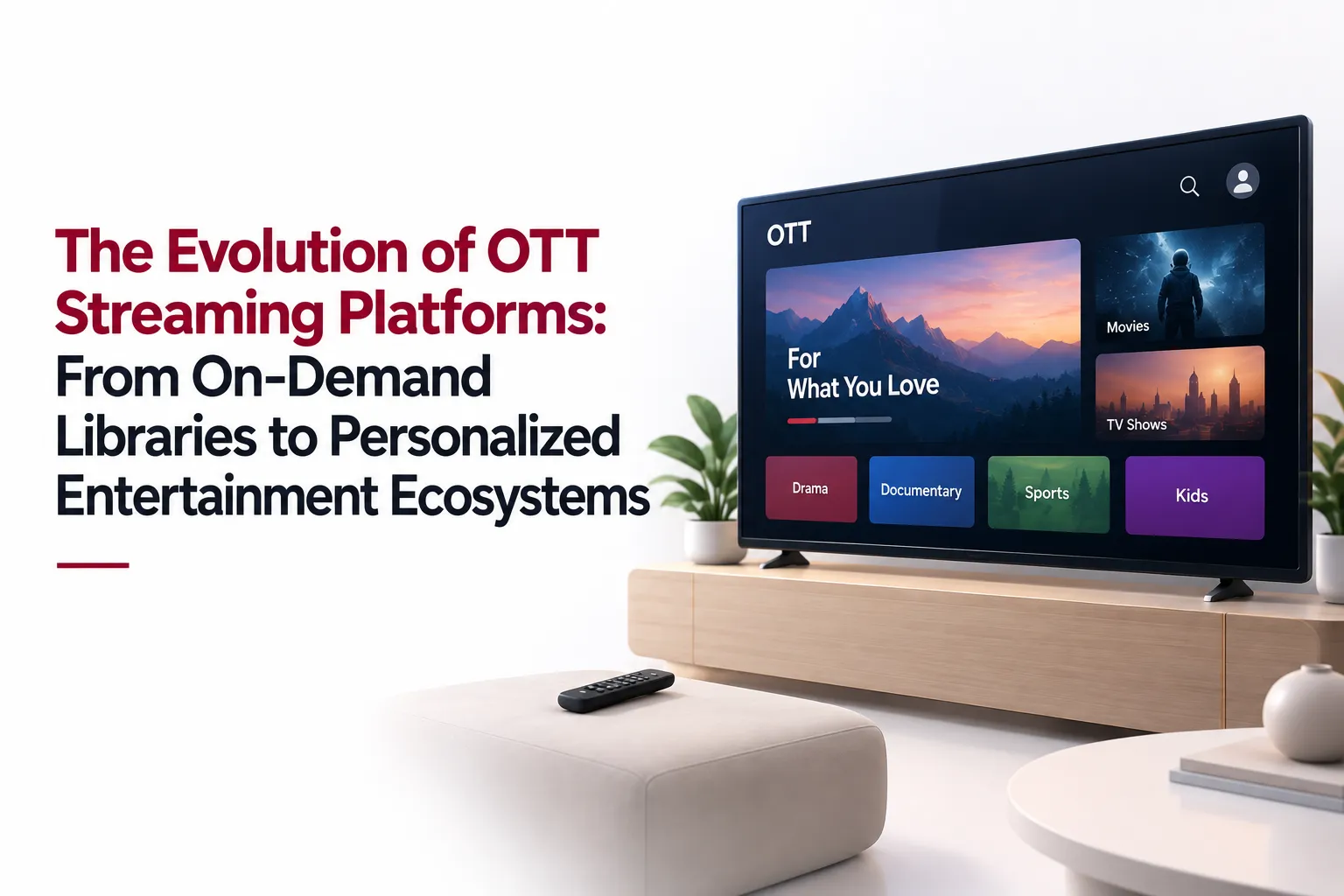
- Modern OTT platform evolution have evolved from simple on-demand video libraries into personalized entertainment ecosystems with recommendations, multiple content formats, and flexible access models.
- Today’s platforms combine content discovery, live and on-demand streaming, subscriptions, advertising, profiles, watchlists, payments, notifications, and multi-device viewing.
- Platform growth increasingly depends on understanding viewer behavior and delivering relevant content, smooth playback, flexible monetization, and consistent experiences across devices.
Platform Evolution Signals
- Early OTT services focused mainly on searchable content libraries and video playback, while newer platforms add live content, originals, short-form video, downloads, and interactive experiences.
- Streaming architecture now connects content management, transcoding, CDN delivery, DRM, payments, advertising, analytics, recommendations, and user identity within one ecosystem.
- Subscription-only models have expanded toward ad-supported tiers, rentals, pay-per-view, bundles, free access, premium plans, and hybrid monetization strategies.
Personalization & Ecosystem Insights
- Personalized home screens, recommendations, continue-watching rows, viewer profiles, search behavior, and contextual notifications help platforms reduce discovery friction.
- Operators should track watch time, completion rates, content discovery, recommendation clicks, subscription conversion, churn, device usage, and repeat viewing to refine the entertainment experience.
- Miracuves develops customizable OTT streaming platforms with personalized discovery, live and on-demand video, flexible monetization, content management, recommendations, analytics, payments, and admin controls.
Entertainment did not change only because movies and shows moved online. It changed because viewers gained control.
Earlier, people adjusted their schedule around television programming, DVD availability, cinema releases, or cable packages. Today, viewers expect content to be available instantly, across devices, with personalized recommendations, flexible pricing, and a viewing experience that remembers what they like.
That shift is the real streaming revolution.
Netflix played an important role in shaping this behavior. It began with online DVD rentals before moving into streaming in 2007, and later expanded streaming access across more than 190 countries. But the bigger lesson for founders is not to copy one global platform. The lesson is to understand how OTT streaming platforms evolved from simple video libraries into full entertainment ecosystems.
For startups, media companies, creators, educators, fitness brands, and regional content owners, this evolution creates a practical opportunity: build a focused streaming platform around a specific audience, content strategy, monetization model, and retention loop.
Why the OTT Revolution Was Never Just About Moving Video Online
The first wave of digital entertainment solved an access problem. Viewers wanted content without waiting for broadcast schedules, physical rentals, or limited local availability.
On-demand streaming answered that need.
But once access became normal, expectations changed. Viewers started asking for more than availability. They wanted the platform to understand them.
Modern streaming users now expect:
- Personalized home screens
- Continue-watching rows
- Watchlists
- User profiles
- Search and category filters
- Recommendations based on interests
- Multi-device viewing
- Subtitles and alternate audio
- Flexible subscription or one-time access
- Smooth payment and renewal flows
This is why OTT streaming platforms are no longer just content libraries. They are product ecosystems where content, data, design, pricing, and retention work together.
For readers who want to understand the product mechanics behind this shift, Miracuves has a helpful guide on how a Netflix-style app works.
Phase 1: On-Demand Libraries Made Entertainment More Convenient
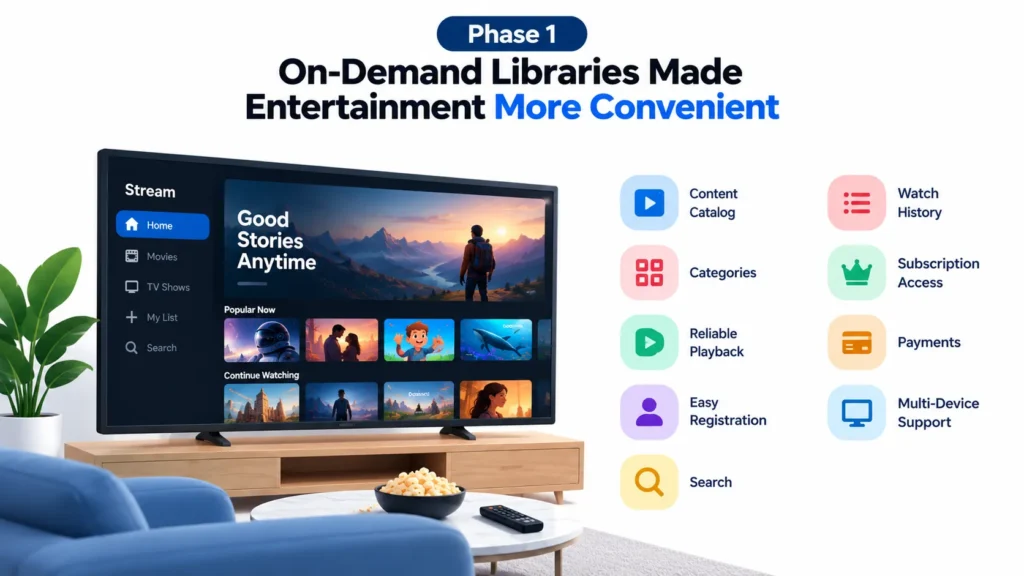
The earliest major streaming shift was convenience.
Instead of waiting for a program to air, users could browse a catalog and watch whenever they wanted. This changed the relationship between the viewer and the platform. The platform became a destination, not just a distribution channel.
For founders, this phase still matters because every OTT product begins with the basics:
- A clear content catalog
- Organized categories
- Reliable playback
- Simple registration
- Search and filtering
- Watch history
- Subscription or access rules
- Payment workflows
- Device compatibility
A platform that fails at these basics will struggle even if the content is strong. Users do not separate content quality from product experience. If discovery is weak, playback breaks, or payments feel confusing, the content may never get a fair chance.
Phase 2: Multi-Device Access Changed Viewing Habits
Streaming became more powerful when entertainment followed the user across devices.
A viewer might start a movie on a smart TV, continue it on a phone during travel, and finish it later on a laptop. This changed how platforms had to think about user experience.
Multi-device access requires more than responsive design. It needs account continuity.
A strong OTT platform should remember:
- Which profile is watching
- Where the viewer paused
- What titles were saved
- What has already been watched
- Which device is being used
- Which plan or purchase unlocks the title
- Whether playback rights have expired
This is why “continue watching” became more than a convenience feature. It became a habit loop. The user returns because the platform remembers their journey.
Phase 3: Personalization Turned Content Discovery Into a Growth Engine
A large content library can become a problem if users cannot find what matters to them.
Personalization solves this by reducing decision fatigue. Instead of making every user browse the same homepage, the platform can highlight content based on profile behavior, genre interest, watch history, language, location, or manually curated segments.
Personalization can include:
- Recommended titles
- Trending content by category
- Continue-watching rows
- Similar-content suggestions
- Personalized banners
- Region-specific collections
- Genre-led shelves
- Language-based discovery
- User-specific notifications
For early-stage founders, personalization does not always need to begin with complex artificial intelligence. Many platforms can start with smart curation, segmented categories, featured rows, and admin-controlled content placement.
The business goal is simple: help users find something worth watching faster.
Phase 4: OTT Platforms Became Monetization Systems
Streaming platforms no longer depend on only one revenue model. A modern OTT business may combine subscriptions, rentals, pay-per-view, advertising, bundles, premium access, and producer revenue sharing.
The right model depends on content type and user behavior.
How OTT Monetization Evolved
| Model | Best Use Case | Founder Decision |
|---|---|---|
| Subscription | Large or regularly updated content libraries | Works when users see recurring value. |
| Rental | Movies, special releases, courses, or premium titles | Useful when users want one-time access. |
| Pay-per-view | Live events, sports, concerts, workshops, and exclusive drops | Works when demand is tied to one specific event or title. |
| Ad-supported access | Large audiences with high watch time | Useful for price-sensitive users, but needs ad controls. |
| Freemium access | Platforms that want users to sample content before upgrading | Works when free content leads to paid conversion. |
| Producer revenue sharing | Creator-led, partner-led, or marketplace-style content networks | Requires transparent tracking, approvals, and payout logic. |
A regional movie platform may combine subscriptions and rentals. A fitness streaming platform may use monthly memberships and premium programs. A learning platform may sell course bundles. A live-event platform may rely on pay-per-view and replay access. A creator-led platform may mix subscriptions with exclusive premium content.
To compare monetization options in more depth, review the OTT platform business model before finalizing your access strategy.
Phase 5: Streaming Moved From Broad Catalogs to Niche Communities
The biggest streaming platforms trained users to expect convenience, but they also created space for focused platforms.
A new OTT business does not need to serve everyone. In many cases, a narrower content focus can create stronger positioning.
Examples include:
- Regional film libraries
- Independent cinema platforms
- Kids learning video apps
- Fitness and wellness streaming
- Professional training platforms
- Religious or spiritual content libraries
- Sports coaching platforms
- Documentary communities
- Creator-led premium video channels
- Corporate learning portals
Niche OTT platforms can win by understanding a specific audience better than broad platforms do. They can personalize the homepage, pricing, communication, content calendar, and community experience around a narrower group.
That is where the entertainment ecosystem idea becomes powerful. The platform is not just hosting videos. It is shaping a relationship between content, audience, creators, payments, and retention.
Phase 6: Creator and Producer Participation Changed the Platform Model
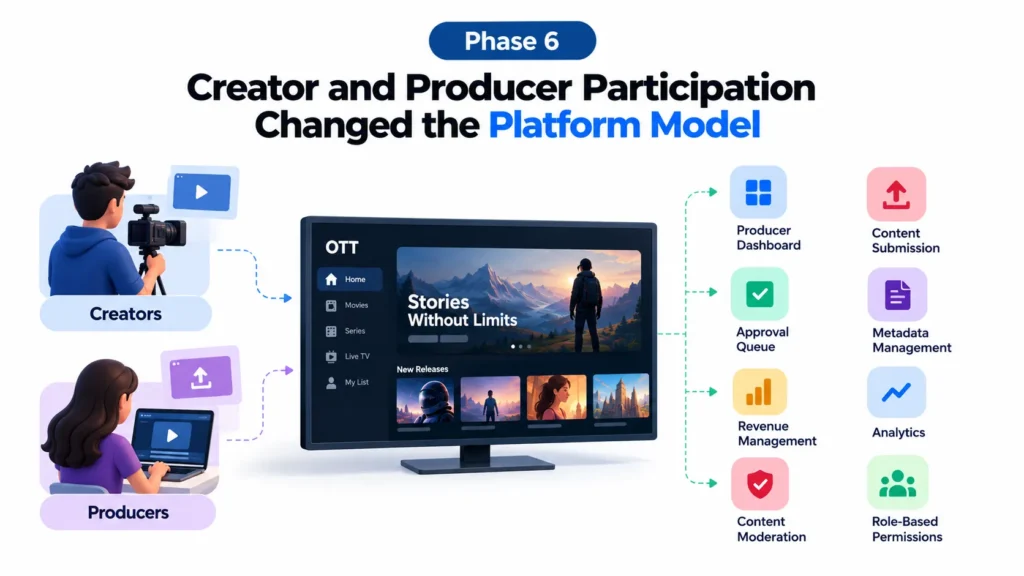
Traditional streaming platforms usually centered on licensed or owned content. Modern OTT platforms can also support creator-led or producer-led ecosystems.
This changes the product requirement.
If multiple producers or creators contribute content, the platform may need:
- Producer dashboards
- Content submission workflows
- Approval queues
- Metadata management
- Watch-minute tracking
- Revenue-share calculations
- Payout requests
- Performance analytics
- Content moderation
- Role-based permissions
Without these workflows, the operator may be forced to manage everything manually through emails, spreadsheets, and developer requests. That limits scale.
This is why a modern OTT platform must be planned as an operating system for content, not only a frontend for viewers.
The Admin Layer Is What Turns Streaming Into a Business
A viewer sees the homepage, video player, payment screen, and watchlist. The business owner sees something else: content operations.
The admin layer controls the platform behind the scenes. It helps the operator manage:
- Users and profiles
- Content categories
- Banners and featured rows
- Subscriptions
- Rentals
- Pay-per-view unlocks
- Coupons and offers
- Payments and invoices
- Producer approvals
- Revenue-share workflows
- Analytics and reports
- Access permissions
- Security settings
If you are planning trials, subscriptions, rentals, coupons, or producer-led content, review the OTT platform features that support viewer, producer, and operator workflows.
Founders who want to understand deeper backend planning, video delivery, and platform scalability can also read this streaming architecture guide.
Founder Decision Signals for Modern OTT Platforms
Audience Focus
If your platform serves a specific niche, personalization and content curation become more important than simply uploading a large catalog.
Monetization Fit
Subscriptions work for recurring value, while rentals and pay-per-view work better for one-time premium demand. The model should match viewing behavior.
Operational Control
Admin control over content, users, payments, plans, coupons, reports, and approvals helps founders adapt without depending on developers for every change.
Launch Speed
A ready-made OTT foundation can help validate the market faster when the core workflows already match the business model.
Why Personalization Is Now a Business Requirement
Personalization directly affects retention.
When users open a streaming platform and immediately see relevant titles, they spend less time deciding and more time watching. That creates more sessions, more watch time, and more chances for subscription renewal or one-time purchases.
Personalization can also help the operator make better decisions.
For example:
- If users watch regional dramas more than action titles, the platform can promote regional collections.
- If users drop off after browsing, the homepage may need stronger categories.
- If users rent premium titles but avoid subscriptions, the pricing model may need adjustment.
- If one creator drives high watch time, the platform may need deeper creator-led bundles.
- If a title gets views but low completion, the platform should not treat views alone as success.
This is why analytics and personalization should work together. A personalized platform learns from behavior and gives the operator better signals.
Common Mistakes Founders Should Avoid
Building Only a Video Library
A video library may be enough for a small archive, but a serious OTT business needs user flows, monetization, analytics, content control, and retention workflows.
Copying a Global Platform Without a Niche Strategy
A new streaming business should define its own audience, content category, pricing model, and market position instead of copying a broad entertainment platform feature by feature.
Ignoring the Admin Dashboard
Without admin control, every change to banners, pricing, content visibility, offers, and reporting can become a technical dependency.
Choosing One Revenue Model Too Early
Many OTT platforms benefit from combining subscriptions, rentals, pay-per-view, freemium access, advertising, or partner-led monetization based on user behavior.
How Miracuves Helps Founders Build OTT Entertainment Ecosystems
Miracuves helps founders build ready-made and white-label OTT platforms with branded user experiences, admin dashboards, source-code ownership, monetization workflows, and launch-ready product foundations.
The goal is not to recreate a global streaming giant feature by feature. The stronger strategy is to build a platform around your own audience and business model.
That may mean:
- A regional OTT platform with subscriptions and rentals
- A fitness streaming app with membership plans
- A learning video platform with course bundles
- A creator-led platform with premium drops
- A live-event platform with pay-per-view access
- A producer-led content network with revenue sharing
Founders who want to launch under their own brand can explore Miracuves’ white-label video streaming platform for a broader OTT and VOD foundation.
For businesses ready to evaluate a launch-ready OTT product, Miracuves’ streaming platform foundation can help review viewer apps, admin control, monetization workflows, content operations, and delivery scope.
When the ready-made scope fits the requirement, Miracuves can support 6-day solution delivery, helping founders move faster without building every core workflow from zero.
Final Thoughts: The Future of OTT Is Personalized, Flexible, and Niche
Netflix changed entertainment by helping make on-demand streaming a mainstream habit. But the next wave of OTT growth is not only about large catalogs. It is about sharper audience focus, smarter personalization, flexible monetization, and stronger platform control.
Founders now have room to build streaming platforms for specific communities, languages, interests, creators, learning needs, events, and content categories.
If your idea extends beyond subscription video into creator platforms or other video-led digital products, the video content platform solutions page can help you compare related launch paths.
The strongest OTT platforms do not simply store videos. They help users discover what to watch, remember their preferences, support multiple revenue paths, give operators control, and turn content into a repeatable business.
If you are already comparing budget and vendor options, you can review Miracuves’ pages on development budget planning and choosing an OTT development partner.
FAQs
What is the evolution of OTT streaming platforms?
OTT streaming platforms evolved from basic on-demand video libraries into personalized entertainment ecosystems. Modern platforms now include recommendations, user profiles, watchlists, continue watching, subscriptions, rentals, pay-per-view, analytics, and admin control.
How did Netflix change entertainment?
Netflix helped shift entertainment from fixed schedules and physical rentals toward on-demand digital access. Viewers became used to watching content when they wanted, across devices, with personalized discovery and subscription-based access.
Why is personalization important in OTT platforms?
Personalization helps users find relevant content faster. It can improve retention, reduce browsing fatigue, increase watch time, and help operators understand which content categories perform better.
Do OTT platforms need more than video playback?
Yes. Video playback is only one part of the product. A scalable OTT business also needs content management, payments, subscriptions, analytics, admin control, user access rules, security settings, and monetization workflows.
Which monetization models work for OTT platforms?
OTT platforms can use subscriptions, rentals, pay-per-view, freemium access, ad-supported viewing, sponsorships, bundles, premium content, corporate licensing, and producer revenue sharing. The right model depends on content type and user behavior.
Can a niche OTT platform compete in the streaming market?
Yes. A niche OTT platform can focus on a specific audience such as regional films, education, fitness, documentaries, sports coaching, spiritual content, creator communities, or corporate learning. Niche focus can make positioning and retention clearer.
Why is the admin dashboard important for OTT founders?
The admin dashboard lets the operator manage content, users, subscriptions, payments, coupons, banners, reports, approvals, and platform settings. This control helps the business adapt without depending on developers for every small change.
Can Miracuves help launch an OTT streaming platform?
Yes. Miracuves helps founders launch ready-made and white-label OTT platforms with branded apps, admin dashboards, monetization workflows, source-code ownership, and faster deployment. A 6-day launch may apply when the ready-made scope matches the project requirements.
Miracuves is an independent software development company. We are not affiliated with, connected to, sponsored by, or endorsed by any company or product named in this article.
Terms such as “X Clone” are used descriptively. It is how the software industry refers to building a platform with functionality comparable to a known service, and how clients search for it.
The entire design and codebase of our products is built by our own team. Our products contain no code, design, graphics, or content originating from any third-party website or applications.
All third-party names and marks referenced in this article are the property of their respective owners, referenced solely to identify the services discussed.