
Key Takeaways
- An OTT Streaming Platform connects content discovery, viewer accounts, subscriptions, access permissions, video playback, recommendations, payments, and watch history within one digital ecosystem.
- Viewers move from browsing movies and series to selecting content, confirming access rights, starting playback, continuing across devices, and managing subscription plans.
- Reliable OTT experiences depend on searchable content catalogs, personalized discovery, secure entitlements, adaptive streaming, fast playback, and synchronized subscription status.
Discovery & Playback Signals
- Content discovery can use search, genres, categories, trending titles, personalized recommendations, watchlists, continue-watching rails, and regional content collections.
- When viewers select a title, the platform checks content availability, account permissions, subscription entitlements, device rules, and regional restrictions before playback begins.
- Adaptive bitrate streaming, CDN delivery, video transcoding, DRM, subtitles, audio tracks, playback controls, and resume points help provide consistent viewing across web, mobile, and smart TVs.
Access & Subscription Insights
- Access rules can distinguish free content, subscriber-only titles, premium releases, rentals, pay-per-view content, plan-specific catalogs, and restricted viewing regions.
- Subscription workflows should manage plans, free trials, checkout, recurring billing, upgrades, renewals, cancellations, failed payments, entitlement updates, and account access.
- Miracuves develops customizable OTT streaming platforms with content discovery, subscriptions, secure access, adaptive playback, recommendations, watchlists, payments, analytics, and admin controls.
An OTT streaming platform is a digital video platform that delivers movies, shows, live content, courses, creator videos, or premium media directly to viewers through the internet. Instead of relying on traditional cable or satellite distribution, viewers can open an app or website, browse content, choose a title, and start watching on demand.
Most people understand OTT platforms from the viewer side: open the app, search for something, press play, and watch. But behind that simple experience, many systems work together. The platform must manage content, users, subscriptions, payments, playback, recommendations, analytics, admin controls, and security.
For founders, this matters because an OTT platform is not just a video player. It is a complete digital business system. Content discovery helps users find titles. Access rules decide who can watch what. Playback infrastructure delivers video smoothly. Subscription workflows connect monetization with user access. Admin dashboards help operators manage the platform after launch.
This guide explains what an OTT streaming platform is, how it works, and what founders should understand before building or launching one.
What Is an OTT Streaming Platform?
An OTT streaming platform is a video delivery platform that lets users watch digital content over the internet. OTT stands for “over the top,” which means the content reaches the viewer directly through internet-connected devices instead of traditional broadcast or cable systems.
An OTT platform can support many types of content, including:
- Movies
- Web series
- TV-style shows
- Documentaries
- Live events
- Sports clips
- Educational videos
- Fitness programs
- Creator-led videos
- Regional entertainment
- Religious or devotional content
- Premium paid content
From the viewer’s side, the platform feels simple. A user creates an account, browses the catalog, chooses a title, and starts watching. From the business side, the platform must handle catalog management, access rules, subscriptions, playback delivery, analytics, payments, recommendations, and admin controls.
That is why founders should not think of an OTT platform as only a media library. It is a content business, subscription system, delivery engine, and user experience layer combined.
How an OTT Streaming Platform Works
An OTT streaming platform works through a connected journey. Content enters the platform, admins organize it, users discover it, access rules are checked, the video is delivered, and analytics help the operator improve the experience.
| Workflow Stage | What Happens | Why It Matters |
|---|---|---|
| Content Upload | Videos, thumbnails, trailers, subtitles, and metadata are added to the platform. | Creates the content library users will browse and watch. |
| Content Organization | Admins assign categories, genres, languages, tags, age ratings, and publishing rules. | Makes content easier to search, filter, recommend, and manage. |
| User Discovery | Viewers find content through homepage rows, search, filters, watchlists, and recommendations. | Helps users reach relevant content faster. |
| Access Check | The system checks login status, subscription plan, payment status, rental expiry, or PPV access. | Protects premium content and paid access. |
| Video Playback | The platform delivers video through streaming infrastructure, CDN, player logic, and adaptive quality. | Creates the actual viewing experience. |
| Engagement Tracking | Watch history, completion rate, searches, and content interactions are recorded. | Improves analytics, recommendations, and retention decisions. |
| Subscription Management | Plans, renewals, invoices, failed payments, upgrades, downgrades, and cancellations are managed. | Connects viewer access with recurring revenue. |
The important thing is that each workflow affects the next one. Poor metadata weakens discovery. Weak access rules hurt monetization. Poor playback creates churn. A weak subscription setup creates support issues. A poor admin dashboard slows daily operations.
Content Discovery: How Users Find What to Watch
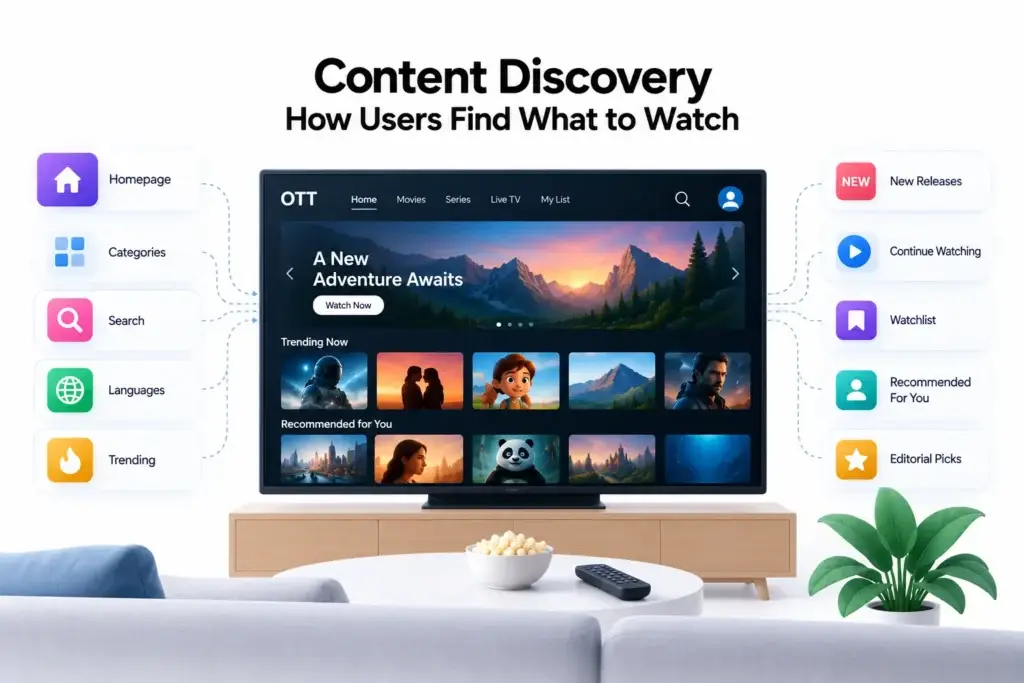
Content discovery is the system that helps users move from “I want to watch something” to “This is the title I want to play.”
A streaming platform may have hundreds or thousands of videos, but a large catalog does not automatically create value. Users need a simple way to find relevant content. If they cannot discover the right title quickly, they may leave even when the library is strong.
Content discovery usually includes:
- Homepage banners
- Category rows
- Genre filters
- Search bar
- Language filters
- Trending sections
- New release sections
- Continue Watching
- Watchlist
- Recommended for You
- Popular in Your Region
- Recently Added
- Editorial collections
For founders, discovery is one of the most important product decisions because it affects engagement and retention. Users do not subscribe only because content exists. They stay when the platform repeatedly helps them find something worth watching.
Why Metadata Matters in Content Discovery
Metadata is the information attached to each piece of content. It may include title, description, genre, language, duration, cast, release year, tags, subtitles, age rating, region, category, season, and episode number.
Metadata helps the platform organize, search, filter, recommend, and report on content.
For example, if a user frequently watches regional crime thrillers, the platform can recommend similar content only if the catalog has useful genre, language, and tag data. If metadata is incomplete, the recommendation system has very little to work with.
Good metadata also helps admins understand what content is performing well and where the library has gaps.
Access Control: How OTT Platforms Decide Who Can Watch What
Access control decides whether a viewer is allowed to watch a specific title. This is especially important for platforms that offer subscriptions, rentals, pay-per-view access, free content, premium releases, or regional catalogs.
When a user clicks a title, the platform may check:
- Is the user logged in?
- Is the content free or paid?
- Does the user have an active subscription?
- Is the title included in the user’s plan?
- Has the rental expired?
- Has the pay-per-view payment been confirmed?
- Is the title available in the user’s region?
- Is the user allowed to stream on this device?
- Are parental controls or age restrictions active?
These checks protect the business model. Without access control, paid content may become available to unpaid users, or paid users may be blocked by mistake.
For a deeper monetization view, this OTT streaming business model guide explains how subscriptions, premium access, rentals, and platform costs work together.
Common OTT Access Rules
| Access Type | How It Works | Best Use Case |
|---|---|---|
| Free Access | Users can watch selected content without payment. | Trailers, samples, promotional videos, or ad-supported content. |
| Subscription Access | Users pay recurring fees to unlock a library or content category. | Large or regularly updated content libraries. |
| Rental Access | Users pay once to watch a title for a limited time. | Premium movies, early releases, or special content. |
| Pay-Per-View Access | Users pay for one specific event, title, or stream. | Live events, concerts, sports, workshops, or exclusive shows. |
| Regional Access | Content availability changes based on location or licensing rules. | Regional catalogs, language-based libraries, and licensed content. |
| Age-Based Access | Users see or watch content based on age rating or profile controls. | Family accounts, kids profiles, and maturity-filtered content. |
Playback: What Happens When a User Presses Play
Playback is the most visible part of an OTT platform. The user taps play and expects the video to start quickly, look clear, and continue without buffering.
Behind the screen, the platform may perform several steps:
- Check whether the user can access the video.
- Request the correct video file or stream.
- Deliver the video through streaming infrastructure.
- Adjust video quality based on network speed.
- Load subtitles or audio tracks where needed.
- Track watch time and playback position.
- Save resume-watching progress.
- Report errors or buffering events.
Playback depends on both product and infrastructure decisions. A basic video player is not enough for a serious streaming platform. The backend, CDN, video encoding, player controls, subtitles, device support, and analytics all affect the viewing experience.
For founders, playback quality directly affects trust. Users may forgive a limited catalog in the early stage, but they usually do not forgive repeated buffering, broken playback, missing resume logic, or poor mobile performance.
Subscriptions: How OTT Platforms Turn Access Into Revenue
Subscriptions are one of the most common OTT monetization models. Users pay weekly, monthly, quarterly, or annually to access content.
A subscription system needs more than a payment button. It should manage:
- Plan creation
- Pricing
- Free trials
- Renewals
- Upgrades
- Downgrades
- Failed payments
- Invoices
- Refunds
- Coupons
- Account status
- Access rules
- Cancellation workflows
- Admin reporting
The subscription engine must connect payment status with content access. If a user pays successfully, access should update correctly. If a renewal fails, the system should handle reminders, grace periods, or access restrictions based on business rules.
If feature planning is your next step, this OTT platform feature planning page explains how viewer, content, and admin-side modules work together.
Recommendations: Why OTT Platforms Personalize Content
Recommendations help users find content faster. Instead of showing the same homepage to everyone, an OTT platform can use user behavior and content metadata to suggest more relevant titles.
Recommendation signals may include:
- Watch history
- Genre preference
- Language preference
- Search behavior
- Watchlist activity
- Completion rate
- Recently watched titles
- Trending content
- Similar content tags
- Regional popularity
- Editorial picks
A new platform does not always need advanced AI from day one. It can start with metadata, categories, manual collections, and simple behavior-based rows. As the platform grows, recommendations can become more personalized.
For founders, recommendations matter because they affect retention. Better discovery means more watch time. More watch time can improve subscription value. Stronger subscription value can reduce churn.
Admin Dashboard: How Operators Manage the Platform
The admin dashboard is where the business controls the OTT platform. Without a strong admin layer, every small change may require developer support.
A practical OTT admin dashboard should help operators manage:
- Users
- Profiles
- Content uploads
- Titles and metadata
- Categories and genres
- Subscriptions
- Rentals
- Pay-per-view access
- Payments and invoices
- Coupons
- Banners
- Homepage rows
- Recommendations
- Reports
- Content approval
- Support issues
- Admin roles
- Activity logs
The admin dashboard is important because OTT platforms change constantly. New content gets added. Pricing changes. Users need support. Campaigns go live. Reports need review. Strong admin control helps teams move faster.
Analytics: How OTT Platforms Learn From Viewer Behavior
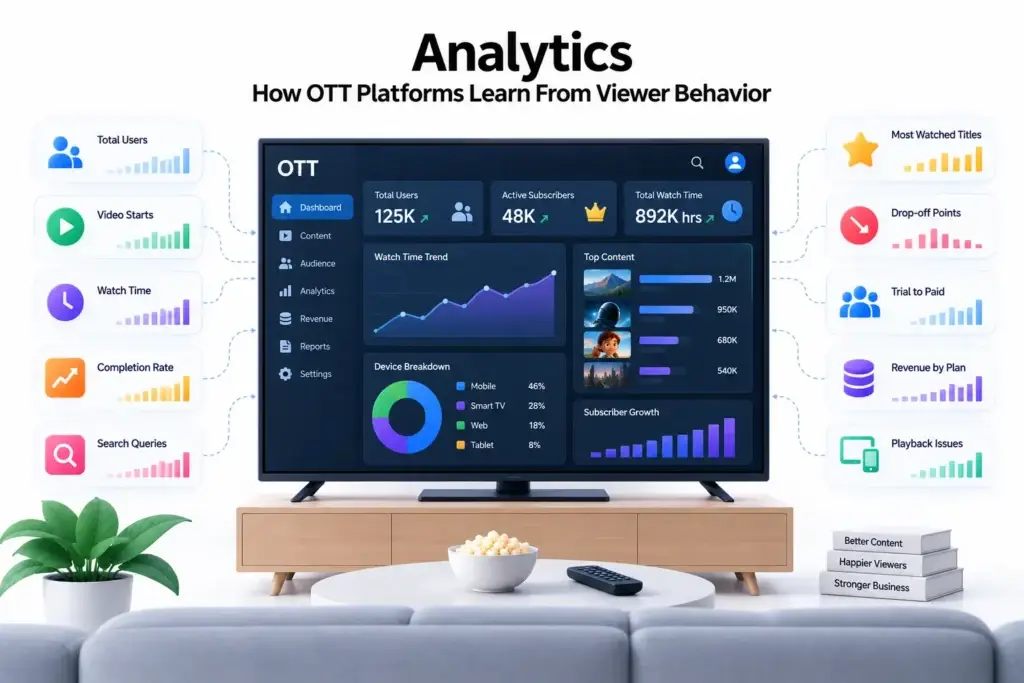
Analytics help founders understand what users actually do inside the platform. Without analytics, the business is guessing.
Useful OTT analytics include:
- Total users
- Active subscribers
- Video starts
- Watch time
- Completion rate
- Drop-off points
- Search queries
- Most watched titles
- Least watched titles
- Recommendation clicks
- Trial-to-paid conversion
- Cancellation trends
- Revenue by plan
- Device-level playback issues
- Buffering reports
Analytics connect product decisions with business decisions. If viewers search for content that does not exist, that may signal a content gap. If many users abandon a title early, the issue may be content quality or expectation mismatch. If playback errors are high on mobile, the platform may need performance improvements.
Because subscriptions and user trust depend on stable access, founders should also review OTT platform security planning before launch.
Founder Decision Signals Before Building an OTT Streaming Platform
Content Depth
If your library has enough repeat value, subscriptions can work well. If the catalog is smaller, rentals, pay-per-view, or premium releases may be better starting points.
Discovery Needs
If users may struggle to find relevant titles, prioritize metadata, search, filters, categories, watchlists, Continue Watching, and recommendation rows.
Playback Quality
If your audience watches on mobile networks or multiple devices, plan adaptive playback, CDN delivery, subtitles, resume logic, and performance tracking early.
Monetization Control
If you plan subscriptions, rentals, PPV, coupons, or premium access, your payment workflows must connect correctly with user access and entitlement rules.
How Founders Can Use OTT Platform Logic for Their Own Streaming Business
The goal is not to copy a major streaming brand. The goal is to understand how the model works and adapt the right workflows to your own audience.
A founder may build a platform for regional movies, independent films, fitness training, education, religious content, music performances, creator communities, live events, or premium niche content. Each idea may need a different catalog structure, monetization model, content workflow, and launch strategy.
For example, a regional film platform may need subscriptions and premium rentals. An education platform may need course-style content organization. A live event platform may need pay-per-view access. A creator-led platform may need producer dashboards and revenue sharing.
Founders planning a branded streaming product can review the Miracuves Netflix clone solution when they need a ready-made OTT foundation with subscriptions, playback, admin control, monetization workflows, and source-code ownership.
Custom OTT Build vs Ready-Made Platform Foundation
Founders usually have three options: build from scratch, use a ready-made white-label foundation, or choose a hybrid approach.
| Build Path | Best For | Founder Consideration |
|---|---|---|
| Custom OTT Development | Highly differentiated streaming products with unique workflows. | More flexibility, but higher planning, development, testing, and launch effort. |
| Ready-Made White-Label Foundation | Founders who need content, playback, subscriptions, payments, and admin control faster. | Useful for faster validation when standard OTT workflows are already included. |
| Hybrid OTT Build | Businesses that want a launch-ready base plus selected custom modules. | Balanced route when speed matters but the business model still needs differentiation. |
If budget planning is your next step, this OTT platform development cost guide can help you understand how features, integrations, monetization scope, and customization influence final pricing.
Founders comparing build partners can also use this guide on choosing the right OTT development partner before deciding between custom development, ready-made deployment, or a hybrid approach.
For founders who want a branded streaming product without building every workflow from zero, a white-label video streaming platform can provide a faster foundation for testing subscriptions, content access, and monetization.
Common OTT Platform Mistakes Founders Should Avoid
1. Treating the Platform as Only a Video Player
A video player alone cannot manage users, subscriptions, access rules, metadata, payments, recommendations, analytics, and admin workflows.
2. Building a Catalog Without Discovery Logic
A large library does not help if users cannot find relevant titles. Search, filters, metadata, watchlists, and recommendation rows should be planned early.
3. Adding Subscriptions Without Access Rules
Subscriptions must connect payments with content access. Without entitlement checks, users may be blocked incorrectly or access paid content without payment.
4. Ignoring Playback Quality
Buffering, broken resume logic, missing subtitles, and poor mobile playback can damage trust even when the content library is strong.
5. Underbuilding the Admin Dashboard
If operators cannot manage content, users, plans, payments, banners, reports, and approvals from the dashboard, daily platform operations become slow.
How Miracuves Helps Founders Launch OTT Platforms Faster
Miracuves helps founders, agencies, studios, and content-led businesses launch ready-made and white-label OTT platforms with branded apps, source-code ownership, admin control, content workflows, subscription logic, rental access, and monetization-ready foundations.
This matters because founders often lose time rebuilding standard OTT modules from zero: user login, content catalog, playback access, subscription flows, payment workflows, analytics, recommendations, and admin controls. A ready-made foundation helps teams focus faster on content, audience, pricing, launch strategy, and retention.
Where the ready-made scope fits the business requirement, Miracuves can support a 6-day launch path for faster market validation.
Founders exploring broader entertainment and video-first products can also review Miracuves’ video content platform solutions for OTT, creator, short video, and streaming app models.
Final Thoughts: An OTT Platform Is a Complete Viewing and Revenue System
An OTT streaming platform is not just an app where users watch videos. It is a connected system that manages content discovery, account access, playback, subscriptions, payments, recommendations, analytics, and operations.
For viewers, the experience should feel simple. They open the app, find something relevant, press play, and continue watching across devices. For founders, the platform needs much deeper planning. Every workflow affects engagement, trust, monetization, and retention.
The stronger decision is not to copy another streaming brand. It is to understand how OTT platforms work, choose the right content model, plan access and subscriptions clearly, and launch with a foundation that can support real users.
After the platform basics are clear, founders should also plan their OTT streaming platform go-to-market strategy so content, subscriptions, retention, and acquisition work together.
FAQs
What is an OTT streaming platform?
An OTT streaming platform is a digital video platform that delivers movies, shows, live content, courses, or premium videos directly to users over the internet through apps, websites, and connected devices.
How does an OTT platform work?
An OTT platform works by uploading and organizing content, helping users discover videos, checking access rules, delivering playback through streaming infrastructure, managing subscriptions, and tracking viewer behavior through analytics.
What is content discovery in an OTT platform?
Content discovery is the process that helps users find relevant videos through search, categories, filters, homepage rows, watchlists, Continue Watching, recommendations, and personalized sections.
How do subscriptions work in OTT platforms?
Subscriptions allow users to pay recurring fees for access to content. The platform manages plans, renewals, payments, invoices, upgrades, downgrades, cancellations, and access rules.
Why is playback quality important for OTT platforms?
Playback quality affects viewer trust and retention. Smooth playback depends on video encoding, CDN delivery, adaptive streaming, subtitles, resume logic, device support, and performance monitoring.
What is access control in OTT streaming?
Access control decides whether a viewer can watch a title based on login status, subscription plan, payment status, rental expiry, pay-per-view purchase, region, device rules, or age restrictions.
Do OTT platforms need recommendations?
Yes. Recommendations help users find relevant content faster. A new platform can start with metadata-based and category-based recommendations, then improve personalization as user behavior data grows.
Can Miracuves help launch an OTT streaming platform?
Yes. Miracuves helps founders launch ready-made and white-label OTT streaming platforms with branding, source-code ownership, admin control, content workflows, subscription logic, monetization options, and faster deployment. A 6-day launch may apply where the ready-made scope fits the business requirement.
Miracuves is an independent software development company. We are not affiliated with, connected to, sponsored by, or endorsed by any company or product named in this article.
Terms such as “X Clone” are used descriptively. It is how the software industry refers to building a platform with functionality comparable to a known service, and how clients search for it.
The entire design and codebase of our products is built by our own team. Our products contain no code, design, graphics, or content originating from any third-party website or applications.
All third-party names and marks referenced in this article are the property of their respective owners, referenced solely to identify the services discussed.