


Key Takeaways
- An OTT streaming platform architecture connects content management, video processing, streaming delivery, subscriptions, recommendations, user accounts, payments, and analytics within one scalable ecosystem.
- Core components include a content management system, media storage, transcoding, CDN delivery, DRM, playback services, subscription billing, recommendation engines, and admin controls.
- Platform reliability depends on fast video delivery, secure content access, accurate entitlement checks, scalable infrastructure, and consistent viewing experiences across mobile, web, and smart TVs.
Architecture & Streaming Signals
- Content management workflows should support movies, series, episodes, metadata, artwork, subtitles, languages, publishing schedules, regional availability, and licensing rules.
- Streaming delivery typically connects media ingestion, transcoding, adaptive bitrate streaming, cloud storage, CDN distribution, DRM, playback APIs, and device-specific video players.
- Load balancing, caching, monitoring, failover, autoscaling, playback analytics, and error tracking help maintain performance during traffic spikes and popular content releases.
Subscription & Recommendation Insights
- Subscription architecture should manage plans, recurring billing, renewals, free trials, upgrades, cancellations, payment failures, user entitlements, and premium content access.
- Recommendation systems can use watch history, completion rates, searches, genres, likes, device behavior, recency, and content similarity to personalize discovery without making feeds repetitive.
- Miracuves develops customizable OTT streaming platforms with content management, video delivery, subscriptions, DRM, recommendations, multi-device playback, analytics, payments, and admin controls.
Building a Netflix-style OTT streaming platform is not just about uploading videos, creating a homepage, and adding a payment gateway. A real OTT platform works because multiple systems operate together: content management, video processing, streaming delivery, user access, subscriptions, recommendations, analytics, admin workflows, and security controls.
For founders, this architecture matters because every technical decision affects the business. A weak content management system slows down publishing. Poor video delivery increases buffering. A basic subscription setup creates access issues. A shallow recommendation layer makes users spend more time searching than watching.
This guide explains how OTT streaming platform architecture works from a product and business perspective, so you can plan a streaming platform that is easier to launch, manage, monetize, and scale.
Building a custom streaming product? See our OTT app development service for scope, team and delivery.
Why OTT Architecture Matters Before You Start Development
A streaming platform has two major sides. The first is the viewer-facing experience: browsing, search, profiles, watchlists, playback, payments, and recommendations. The second is the operational system behind it: content upload, encoding, storage, publishing, subscription control, analytics, moderation, and admin management.
If these systems are not planned early, founders often face problems after launch. Videos may take too long to process. Users may pay but fail to unlock content. Admin teams may need developer help for simple catalog updates. Recommendations may feel random. Playback may work in testing but fail when real users arrive.
If you are still exploring the basics of how major streaming products operate, this guide on how streaming platforms work can help before you go deeper into OTT architecture.
A strong OTT platform separates the product into clear architecture layers:
| Architecture Layer | What It Controls |
|---|---|
| Content layer | Titles, metadata, thumbnails, trailers, languages, categories, publishing rules |
| Application layer | Users, profiles, watchlists, search, subscription access, notifications |
| Streaming layer | Video storage, transcoding, CDN delivery, adaptive playback |
| Business layer | Subscriptions, rentals, pay-per-view, coupons, revenue reporting |
| Data layer | Watch history, engagement analytics, billing events, logs, recommendations |
| Admin layer | Content control, user management, plan setup, reporting, role-based access |
When these layers are planned correctly, the platform becomes easier to improve over time. You can add new content formats, test pricing models, introduce regional catalogs, improve recommendations, and expand to more devices without rebuilding the entire product.
The Core Architecture of an OTT Streaming Platform
A practical OTT platform architecture works like a connected chain. Content enters the system, gets processed, becomes available in the catalog, is delivered securely to viewers, and generates data that improves discovery and monetization.
Here is a simplified view:
OTT Platform Workflow Stages
| Stage | What Happens | Business Impact |
|---|---|---|
| Content Ingestion | Videos, trailers, metadata, posters, and subtitles are uploaded | Builds the content library |
| Video Processing | Files are validated, transcoded, packaged, and prepared for playback | Improves device compatibility |
| Catalog Publishing | Content is categorized, scheduled, approved, and made visible | Improves content operations |
| Access Control | User plans, payment status, and entitlement rules are checked | Protects paid content |
| Streaming Delivery | CDN and adaptive bitrate playback deliver video to users | Reduces buffering and improves experience |
| Recommendations | User behavior and content metadata shape discovery | Improves engagement |
| Analytics | Watch time, drop-offs, subscriptions, and revenue are tracked | Helps founders make smarter decisions |
The goal is not only to make videos playable. The goal is to make the platform manageable, monetization-ready, and scalable.
For a more detailed module-level breakdown, you can also review this OTT platform feature planning page, which explains how viewer, content, and admin-side features work together.
Content Management Architecture: The Operational Backbone of OTT
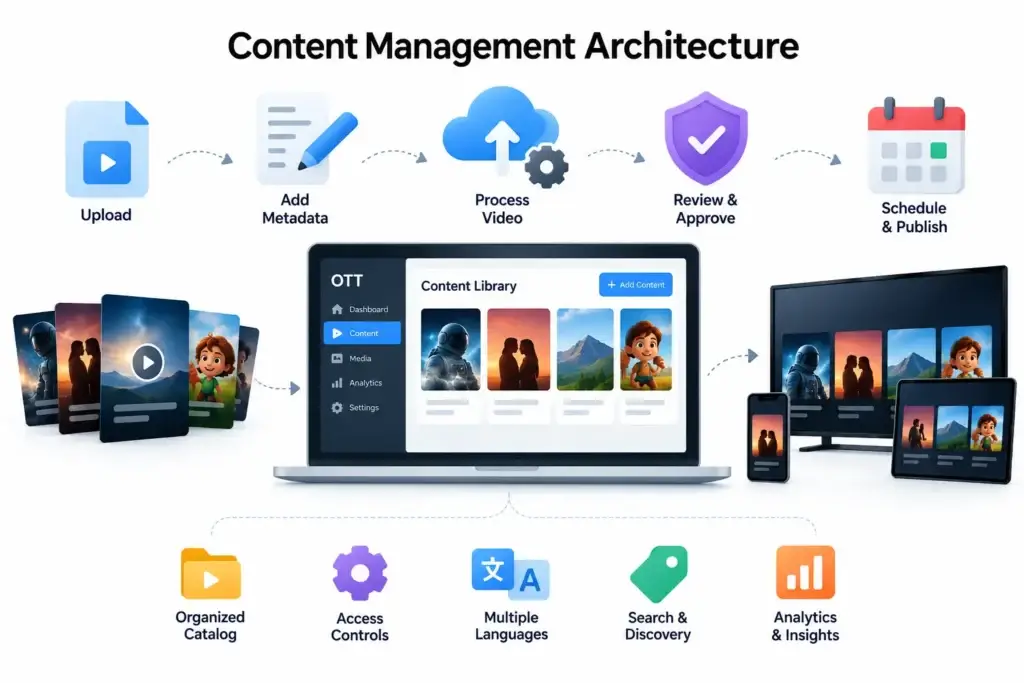
Content management is where the streaming business becomes organized. A founder may begin with a small library, but the system should still support growth: more titles, seasons, episodes, trailers, languages, subtitles, content partners, publishing schedules, and access rules.
A strong OTT content management system should not work like a basic file uploader. It should act as the control center for the content catalog.
If you want to compare architecture planning with a practical feature checklist, this OTT feature planning guide can help you decide what should be included at launch and what can wait until the scale stage.
Content Ingestion and Upload Workflow
Content ingestion is the process of bringing video assets into the platform. Depending on the business model, this may happen through admin uploads, studio submissions, creator uploads, producer panels, or content-provider workflows.
A useful ingestion workflow should collect:
- Original video file
- Title and description
- Genre and category
- Language and subtitle files
- Poster, thumbnail, and banner image
- Trailer or preview clip
- Age rating or content advisory
- Season and episode details if applicable
- Content type such as movie, series, short film, live event, or course
- Access type such as free, subscription-only, rental, pay-per-view, or bundled
- Publishing status such as draft, pending review, scheduled, live, archived, or expired
This structure helps the operator manage the platform without confusion as the content library grows.
Metadata and Catalog Structure
Metadata decides how content is discovered. If metadata is weak, search, filters, recommendations, and analytics become weak too.
Useful OTT metadata includes:
- Genre
- Language
- Cast and crew
- Duration
- Release year
- Region
- Tags
- Category
- Age rating
- Popularity score
- Completion rate
- Related titles
- Episode number
- Season number
- Publishing date
These fields are not only for display. They power search filters, recommendation rails, homepage sections, public landing pages, content reporting, and personalized viewing experiences.
Publishing and Approval Controls
Founders often underestimate how important publishing control is. A growing OTT platform may need different roles for uploaders, reviewers, editors, finance teams, support teams, and admins.
A practical publishing workflow may look like this:
- Content is uploaded by an admin, studio, producer, or internal team.
- Metadata, posters, trailers, subtitles, and category information are added.
- Video processing begins.
- The content is reviewed for quality and publishing readiness.
- An authorized team member approves, rejects, schedules, or archives the title.
- The title goes live based on access rules.
- Analytics begin tracking views, watch time, completion, and revenue.
This workflow helps the business maintain quality while expanding the catalog.
Streaming Delivery Architecture: From Upload to Smooth Playback
The streaming delivery layer is different from the normal application backend. A standard web app serves pages, forms, and API responses. An OTT platform must prepare and deliver heavy video files across devices, networks, and locations.
The goal is simple: when a user taps play, the video should start quickly, adjust to the connection, and continue with minimal buffering.
Video Storage Should Be Separate From the App Server
Videos should not be stored and delivered directly from the main application server. That creates performance pressure and makes scaling harder.
A better setup separates responsibilities:
| System | Responsibility |
|---|---|
| Application backend | Users, profiles, subscriptions, access rules, metadata, admin logic |
| Object/media storage | Original and processed video assets |
| Transcoding system | Converts videos into playback-ready formats |
| CDN | Delivers video from locations closer to viewers |
| Video player | Handles playback, bitrate switching, subtitles, and user controls |
This separation keeps the product more reliable. The application server decides whether a user can watch a title. The media delivery layer handles the actual video stream.
Transcoding Prepares Video for Multiple Devices
When a video is uploaded, the original file may be too large or not optimized for every device. Transcoding creates multiple versions of the same video at different resolutions and bitrates.
A typical video processing workflow includes:
- Upload original source file
- Validate file type and quality
- Generate thumbnails and previews
- Create different playback renditions
- Package the video for streaming
- Attach subtitles and audio tracks
- Mark the asset ready for publishing
For founders, transcoding matters because playback quality directly affects trust. A platform can have excellent content, but users will leave if videos buffer, fail, or look poor on mobile networks.
Adaptive Bitrate Streaming Improves Viewer Experience
Adaptive bitrate streaming allows the player to switch between video qualities based on network conditions.
For example, a viewer may start on strong Wi-Fi, move to mobile data, and then return to better bandwidth. The player should adjust video quality without forcing the user to restart playback.
This is especially important in markets where viewers use mixed networks, older phones, shared Wi-Fi, or fluctuating mobile connections.
CDN Delivery Reduces Playback Friction
A content delivery network helps distribute video from locations closer to the viewer. Instead of every user pulling video from one origin server, CDN nodes cache and deliver content nearer to the viewer’s region.
For OTT platforms, CDN planning affects:
- Playback start time
- Buffering risk
- Bandwidth cost
- Regional performance
- Traffic spike handling
- Live event reliability
- Origin server load
Founders should not treat CDN as an afterthought. It is one of the most important pieces of streaming infrastructure because it directly affects both user experience and operating cost.
Subscription and Entitlement Architecture: Protecting Access and Revenue
Subscription logic is not just a payment screen. It is an access-control system.
When a viewer opens a video, the platform must know:
- Is the user logged in?
- Is the subscription active?
- Is this title included in the selected plan?
- Has the rental expired?
- Is the pay-per-view purchase valid?
- Is the content available in the user’s region?
- Is the user allowed to stream on this device?
- Has the payment gateway confirmed the transaction?
This is where entitlement architecture becomes important. Entitlement means the user has the right to access specific content at a specific time under specific business rules.
Since every monetization model affects access rules, founders should also understand the OTT streaming business model before finalizing subscription, rental, or pay-per-view workflows.
Core Subscription Modules an OTT Platform Needs
| Module | Purpose |
|---|---|
| Plan management | Create monthly, annual, free, premium, family, or custom plans |
| Trial logic | Manage trial periods, expiry rules, and trial-to-paid conversion |
| Payment gateway | Handle checkout, renewals, refunds, invoices, and failed payments |
| Webhook handling | Update access automatically when payment events happen |
| Entitlement rules | Decide which user can access which title, category, or plan |
| Rental access | Unlock content for a limited time |
| Pay-per-view access | Allow one-time paid access to selected content |
| Coupon management | Support campaigns, discounts, and promotional offers |
| Admin reporting | Track revenue, active subscribers, cancellations, and plan performance |
The business risk is clear. If payment status and access rules are not connected properly, users may pay and still lose access, or users may access premium content without an active plan. Both problems damage trust and revenue.
Subscription Architecture Should Support More Than One Model
Many OTT founders begin with one monetization model and later add others. A platform may start with subscriptions, then introduce rentals, live event passes, premium category unlocks, or bundled content access.
That is why the subscription system should be flexible from the beginning. It should allow the admin team to create plans, map content to plans, change pricing, configure coupons, and review subscriber performance from the dashboard.
Recommendation Architecture: Helping Viewers Find the Right Content Faster
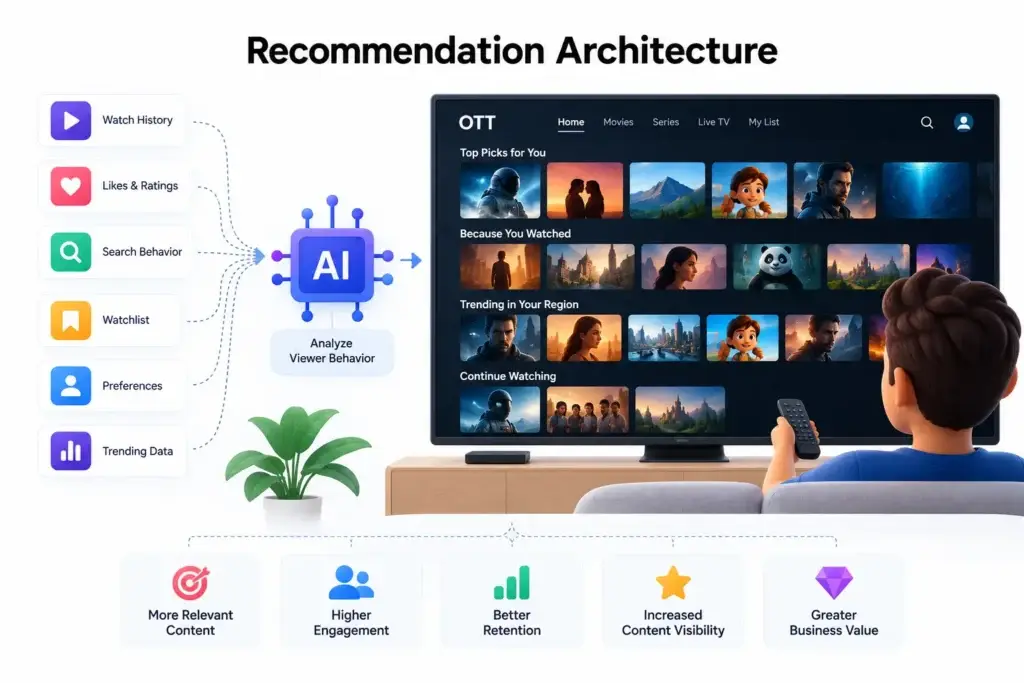
Content discovery is one of the biggest success factors in OTT. Users do not want to browse endlessly. They want the platform to understand what they like and surface relevant titles quickly.
Recommendation architecture can start simple and become more advanced over time. A new platform does not always need complex machine learning on day one. It needs a sensible discovery system that can use available data and improve as user behavior grows.
Useful Recommendation Signals
An OTT recommendation system may use:
- Watch history
- Completion percentage
- Genre preference
- Language preference
- Search behavior
- Watchlist activity
- Recently watched content
- Trending titles
- Similar content tags
- User ratings or likes
- Category-level engagement
- Regional popularity
- Editorial promotions
The best early recommendation systems often combine rules, metadata, popularity, and behavior.
For example, if a user watches several regional thrillers, the platform can recommend similar titles based on language, genre, content tags, and completion trends. As the platform grows, more advanced personalization can be added.
Recommendation Rails That Improve the Home Screen
OTT recommendations usually appear as content rails. Each rail should have a clear purpose. Random rows create clutter. Strategic rows help viewers decide what to watch.
Useful recommendation rails include:
| Recommendation Rail | Purpose |
|---|---|
| Continue Watching | Brings users back into unfinished content |
| Because You Watched | Shows similar titles based on viewing history |
| Trending in Your Region | Adds local relevance |
| New Releases | Promotes fresh content |
| Top Picks for You | Personalizes the homepage |
| Popular in Your Language | Supports regional discovery |
| Recently Added | Helps new titles get visibility |
| Premium Picks | Pushes monetized content |
| Watch Again | Encourages repeat viewing |
| Editor’s Choice | Gives the operator manual content control |
For founders, recommendations are not only a user experience feature. They also help distribute attention across the catalog. If viewers only watch the homepage hero banner, the rest of the library may remain invisible. Better discovery increases the value of the full content investment.
Admin Dashboard Architecture: Where the Operator Controls the Business
An OTT platform needs a strong admin dashboard because the business changes constantly. Content teams add titles. Finance teams review subscriptions. Support teams resolve account issues. Marketing teams update banners. Leadership reviews performance.
If the admin dashboard is weak, the operator depends on developers for routine decisions. That slows down execution.
Important Admin Controls for OTT Platforms
A practical OTT admin dashboard should support:
- User management
- Profile management
- Content upload and approval
- Category and genre management
- Language and subtitle control
- Subscription plan setup
- Coupon and offer configuration
- Rental and pay-per-view settings
- Homepage banner control
- Content rail management
- Payment and invoice visibility
- Producer or content partner workflows
- Analytics and reporting
- Role-based admin access
- Support and dispute workflows
- Abuse reporting
- Activity logs
The admin layer is where architecture becomes business control. A platform that can be managed from a dashboard is easier to operate, test, and improve.
Analytics Architecture: Measuring What Viewers Actually Do
OTT analytics should not be limited to total users and total revenue. Operators need to understand how viewers behave inside the platform.
Useful OTT analytics include:
| Metric | Why It Matters |
|---|---|
| Video starts | Shows which titles attract clicks |
| Average watch time | Measures engagement depth |
| Completion rate | Shows whether content keeps attention |
| Drop-off points | Helps identify weak content or playback issues |
| Most watched titles | Guides content investment |
| Search queries with no results | Reveals content gaps |
| Recommendation click-through rate | Measures discovery quality |
| Trial-to-paid conversion | Shows subscription effectiveness |
| Cancellation patterns | Helps improve retention |
| Revenue by plan | Shows monetization performance |
| Device-level playback issues | Reveals technical friction |
| Buffering and playback errors | Helps improve streaming delivery |
Once analytics start showing content demand, retention patterns, and subscription behavior, the next step is planning your OTT streaming platform go-to-market strategy around real viewer behavior.
This data helps founders make better decisions. If users abandon videos in the first few minutes, the issue may be content quality, expectation mismatch, playback performance, or positioning. If many users search for a category that does not exist, that may become a content acquisition opportunity.
Security and Content Protection in OTT Platforms
Streaming platforms need security at several levels. The goal is not only to protect user accounts but also to protect premium content, payment flows, user data, and platform operations.
Important security layers include:
- Encrypted data transfer
- Secure payment gateway integration
- Role-based access control
- Admin activity logs
- Signed playback URLs
- Session monitoring
- Device limits
- Concurrent stream limits
- Content moderation workflows
- Abuse reporting
- Privacy-conscious data handling
- DRM-ready playback workflows where required
No architecture can remove every risk, but a thoughtful protection strategy reduces avoidable exposure. Founders distributing premium or licensed content should plan content protection early because rights, devices, regions, and access rules can shape the platform before launch.
Founder Decision Signals Before Choosing an OTT Build Path
Launch Speed
If your goal is to validate the market quickly, avoid building every OTT workflow from zero. A ready-made foundation can help you move faster with core modules like content catalog, playback, subscriptions, and admin control already planned.
Content Operations
If your platform will manage movies, series, episodes, trailers, languages, subtitles, or producer-submitted content, prioritize a strong content management workflow before launch.
Streaming Quality
If users expect smooth playback across devices and networks, focus on video storage, transcoding, adaptive bitrate streaming, CDN delivery, subtitles, and playback performance monitoring.
Monetization Control
If your OTT platform will use subscriptions, rentals, pay-per-view, coupons, or bundled access, make sure payment status and entitlement rules are connected properly.
Viewer Retention
If users leave after watching one title, improve discovery with Continue Watching, watchlists, personalized rows, recommendation rails, regional content, and new release visibility.
Admin Ownership
If your team needs control after launch, the admin dashboard should manage users, content, plans, payments, banners, analytics, approvals, roles, and reports without developer dependency.
The right build path depends on launch goals, content strategy, budget, feature scope, and how much control the founder needs after launch.
Custom OTT Development vs Ready-Made Platform Foundation
Founders usually have two main paths. They can build the OTT platform from scratch, or they can start with a ready-made white-label foundation and customize it around their content, audience, brand, and monetization model.
A fully custom build gives maximum flexibility, but it usually requires more time, planning, engineering coordination, QA, and ongoing technical management. A ready-made foundation can be more practical when the founder wants to validate demand faster and avoid rebuilding standard OTT workflows from zero.
| Build Path | Best For | Founder Consideration |
|---|---|---|
| Custom OTT development | Highly differentiated products with unique workflows | More flexibility, but higher planning and development commitment |
| Ready-made white-label foundation | Founders who need content, playback, subscriptions, admin control, and faster launch | Faster validation with room for branding and customization |
| Hybrid approach | Businesses that need a launch-ready base plus selected custom modules | Balanced route when speed matters but the business model still needs differentiation |
f budget planning is your next step, review this OTT platform development cost breakdown to understand how features, integrations, architecture, and customization influence final pricing.
For founders who want a faster route to a branded streaming product, the Miracuves Netflix clone solution can act as a launch-ready foundation with OTT workflows, admin control, monetization logic, and source-code ownership.
Founders comparing build partners can also use this guide on choosing the right OTT development partner before deciding between custom development, ready-made deployment, or a hybrid approach.
The stronger decision is not to copy another platform blindly. It is to use a proven product structure and adapt it around your market.
Common OTT Architecture Mistakes Founders Should Avoid
1. Building the UI Before Planning the Streaming Pipeline
A polished homepage cannot fix weak video processing, poor CDN planning, or unstable playback. Streaming delivery should be planned before the interface is finalized.
2. Treating Subscriptions as Only a Payment Gateway
Subscriptions require entitlement checks, renewal logic, plan mapping, failed payment handling, invoices, rental expiry, and content access rules. A payment button alone is not enough.
3. Ignoring Admin Workflows
If admins cannot manage plans, users, content, banners, categories, and reports, the platform becomes hard to operate after launch.
4. Launching Without Content Discovery Logic
Without search, filters, watchlists, Continue Watching, and recommendation rails, users may struggle to find relevant content even when the library is strong.
5. Forgetting Content Rights and Access Rules
A streaming platform should be built around the actual content model. Licensed content, producer-submitted content, regional catalogs, and premium titles may all require different approval, access, and protection workflows.
How Miracuves Helps Founders Launch OTT Platforms Faster
Miracuves helps founders, startups, agencies, and content-led businesses launch streaming platforms using ready-made and white-label app foundations that can be customized around brand, content model, monetization, and operational workflows.
For founders planning a video product, the advantage is speed with control. Instead of building every module from zero, a launch-ready foundation can include core workflows such as user access, content catalog, playback, subscriptions, admin management, and monetization configuration.
Miracuves also offers broader video content platform solutions for founders exploring OTT, creator, short video, and entertainment-focused app models.
Miracuves can also support a 6-day launch route for ready-made solutions where the scope fits the standard deployment path. This is useful when the business goal is to test the market faster, validate content demand, launch under your own brand, and retain source-code ownership for future customization.
Final Thoughts: Build the Architecture Before You Build the App
A streaming platform succeeds when the architecture supports both the viewer experience and the business operation behind it. Content management keeps the catalog organized. Streaming delivery keeps playback smooth. Subscriptions protect revenue. Recommendations improve discovery. Analytics guide smarter decisions. Admin control keeps the platform manageable.
For founders, the real question is not only “Can we build an app like Netflix?” The better question is: “What architecture do we need to launch, operate, monetize, and improve an OTT platform without creating avoidable technical debt?”
When that answer is clear, development becomes more strategic. You can decide what to build custom, what to configure, what to launch first, and how to scale after real users begin watching.
FAQs
What is OTT streaming platform architecture?
OTT streaming platform architecture is the technical and operational structure behind a video streaming platform. It includes content management, video processing, storage, CDN delivery, user accounts, subscriptions, recommendations, analytics, security, and admin control.
What are the most important modules in an OTT platform?
The most important modules include content management, video upload, transcoding, adaptive playback, CDN delivery, subscription management, entitlement checks, user profiles, search, recommendations, admin dashboard, analytics, and secure payment handling.
Why is content management important for OTT platforms?
Content management helps operators upload, organize, approve, publish, categorize, and update videos. It also supports metadata, language options, subtitles, banners, access rules, and catalog workflows that affect discovery and monetization.
How does a streaming delivery pipeline work?
A streaming delivery pipeline usually starts with video upload, then moves through validation, transcoding, packaging, storage, CDN distribution, playback authorization, and adaptive streaming through the video player.
What is entitlement management in OTT subscriptions?
Entitlement management decides whether a user can access a specific title. It checks login status, subscription plan, payment status, rental expiry, device rules, regional rules, and content access permissions before playback starts.
Do new OTT platforms need advanced AI recommendations from day one?
Not always. A new platform can begin with metadata-based recommendations, watch history, trending content, editorial rails, and category-based suggestions. More advanced machine learning can be added as the platform collects enough user behavior data.
Why should founders separate video storage from the application server?
Video files are heavy and bandwidth-intensive. Separating video storage from the application server improves performance, reduces server pressure, and allows the platform to use CDN delivery for smoother playback.
Can Miracuves help launch an OTT streaming platform faster?
Yes. Miracuves helps founders launch ready-made and white-label streaming platforms with branding, source-code ownership, admin control, and faster deployment. A 6-day launch may be available for ready-made solutions when the scope fits the standard rollout.
Miracuves is an independent software development company. We are not affiliated with, connected to, sponsored by, or endorsed by any company or product named in this article.
Terms such as “X Clone” are used descriptively. It is how the software industry refers to building a platform with functionality comparable to a known service, and how clients search for it.
The entire design and codebase of our products is built by our own team. Our products contain no code, design, graphics, or content originating from any third-party website or applications.
All third-party names and marks referenced in this article are the property of their respective owners, referenced solely to identify the services discussed.



