



Launching a regional ecommerce marketplace is not just about adding product listings, sellers, carts, and payments. The real challenge is building a commerce system that fits how buyers, sellers, logistics partners, and platform operators behave in a specific market.
A regional marketplace may need local payment preferences, multilingual content, seller onboarding rules, delivery zones, product category controls, commission settings, regional tax logic, cash-led purchase flows, and customer support workflows. These details decide whether the platform feels practical for real users or becomes difficult to operate after launch.
For founders, the main question is not, “How many features can we add?” The better question is, “Which marketplace features reduce launch risk, support seller adoption, improve buyer trust, and keep operating costs under control?”
This guide explains the core features, business decisions, cost factors, and launch considerations founders should evaluate before building a regional ecommerce marketplace.
Key Takeaways
- A regional ecommerce marketplace should be designed around local buyer behavior, seller readiness, payment preferences, delivery coverage, and marketplace operations.
- Core features should support buyers, sellers, delivery workflows, payments, reviews, returns, and admin control from the beginning.
- Cost depends on feature scope, mobile apps, seller tools, integrations, customization, payment gateways, logistics complexity, and scalability requirements.
- Founders should avoid overbuilding before validating category demand, seller supply, and fulfilment reliability.
- Miracuves helps founders move faster with ready-made, white-label marketplace foundations that include source code, branding flexibility, admin control, and 6-day deployment for ready-made solutions.
Why Regional Ecommerce Marketplaces Need Different Planning

A broad ecommerce marketplace can look simple on the surface. Buyers search, sellers list products, payments are processed, and orders are delivered. But regional commerce behaves differently because every local market has its own operating patterns.
In one region, buyers may prefer cash on delivery. In another, card payments and wallets may dominate. Some sellers may be digitally mature, while others may need assisted onboarding. Some cities may support same-day delivery, while smaller areas may require scheduled fulfilment or third-party shipping.
That is why regional marketplace planning should include:
- Local payment behavior
- Seller onboarding readiness
- Delivery coverage and fulfilment limitations
- Language and currency expectations
- Category-level product demand
- Return and refund expectations
- Admin controls for regional operations
- Trust-building workflows for buyers and sellers
A founder who understands these variables can launch a platform that fits the market instead of forcing users into a generic ecommerce experience.
What Founders Should Validate Before Building the Platform
Before choosing features or estimating cost, founders should validate the business foundation. A marketplace does not grow only because the technology works. It grows when supply, demand, trust, pricing, fulfilment, and operations work together.
1. Is the Marketplace Category Broad or Focused?
A regional ecommerce marketplace can start as a broad multi-category platform or a focused vertical marketplace.
A broad model may include electronics, fashion, home goods, beauty, groceries, accessories, and daily essentials. This creates larger market potential but also increases operational complexity. A focused model may begin with one strong category, making it easier to onboard sellers, control quality, and build category-specific trust.
For many founders, the smarter first step is to start with a category where demand is visible, sellers are accessible, and logistics can be managed reliably.
2. Are Sellers Ready to Operate Digitally?
Seller readiness directly affects product quality, stock accuracy, fulfilment speed, and customer experience. Some sellers can manage dashboards, inventory, prices, orders, invoices, and returns independently. Others may need admin support, bulk uploads, assisted onboarding, or simplified seller tools.
A founder should evaluate whether sellers need:
- Self-service registration
- Admin-approved onboarding
- Product upload support
- Bulk catalogue import
- Commission visibility
- Order and return dashboards
- Payout tracking
- Promotion tools
The seller experience matters because a marketplace without active sellers becomes an empty storefront.
3. How Will Orders Be Fulfilled Regionally?
Delivery is one of the biggest differences between a normal ecommerce idea and a working regional marketplace. Founders need to decide whether fulfilment will be handled by sellers, platform-managed delivery teams, courier integrations, or a hybrid model.
Each model changes cost, control, and customer experience.
If sellers fulfil their own orders, the platform may scale faster but quality can vary. If the platform controls delivery, the founder gets more consistency but also takes on operational responsibility. If third-party logistics are used, integration quality and service coverage become important.
4. What Trust Signals Will Buyers Need?
Regional buyers may hesitate to purchase from unknown sellers unless the platform creates trust. Trust is built through product quality, seller verification, secure payments, clear return rules, visible reviews, order tracking, customer support, and dispute handling.
For marketplace founders, trust is not only a brand issue. It is a product architecture issue.
The platform should make it easy to manage:
- Seller verification
- Product approval
- Buyer reviews
- Refund requests
- Order disputes
- Abuse reports
- Payment records
- Support tickets
- Admin audit logs
These controls help founders build a safer marketplace as transaction volume increases.
Core Regional Ecommerce Marketplace Features Founders Should Evaluate
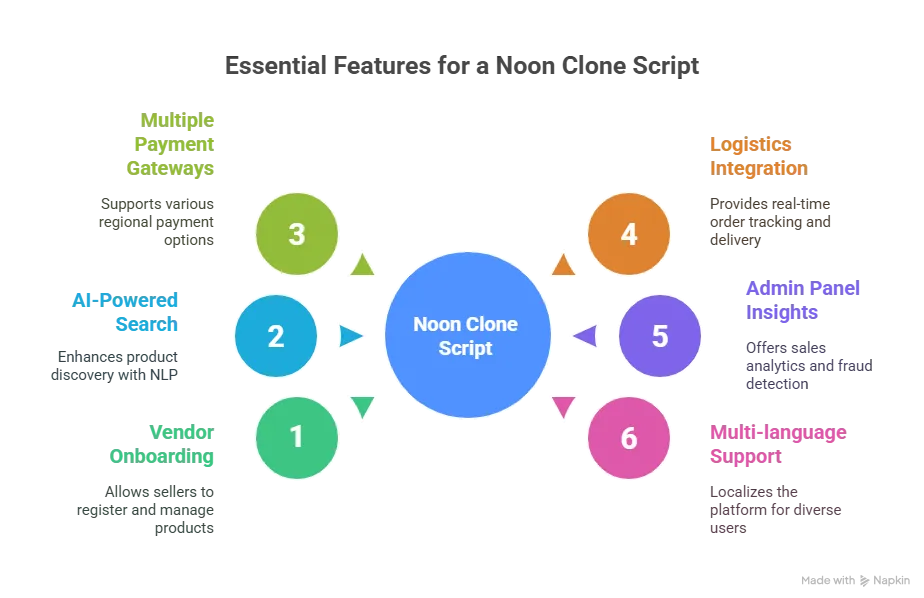
A regional marketplace should include features across buyer apps, seller dashboards, delivery workflows, and admin controls. The strongest platforms are not simply feature-heavy. They are operationally complete.
Regional Ecommerce Marketplace Feature Evaluation Table
| Feature Area | Business Value | Founder Impact |
|---|---|---|
| Buyer app or storefront | Lets customers browse products, search categories, add items to cart, place orders, and track purchases. | Creates the main demand-side experience and directly affects conversion. |
| Seller dashboard | Allows vendors to manage products, pricing, stock, orders, discounts, and payouts. | Improves seller adoption and reduces manual platform support. |
| Admin dashboard | Controls users, sellers, categories, products, commissions, orders, refunds, disputes, and reports. | Gives the founder operational control without depending on developers for every small change. |
| Regional catalogue management | Supports different product availability, pricing, and categories by city, zone, or service area. | Helps the platform adapt to local inventory and demand differences. |
| Payment gateway integration | Supports online payments, wallets, cards, payment links, or cash-led flows depending on market behavior. | Reduces checkout friction and supports local purchase habits. |
| Delivery and shipping workflows | Manages delivery zones, shipping charges, order allocation, tracking, and fulfilment status. | Prevents order confusion and improves customer confidence. |
| Returns and refund management | Defines how buyers request returns, how sellers respond, and how admins resolve issues. | Protects buyer trust and reduces support chaos after launch. |
| Ratings and reviews | Helps buyers evaluate products and sellers before purchasing. | Builds marketplace trust and improves seller accountability. |
| Promotions and coupons | Allows sellers or admins to run discounts, campaigns, and offers. | Supports acquisition, repeat purchases, and seasonal sales. |
| Analytics and reporting | Tracks orders, revenue, sellers, products, conversion, refunds, and customer behavior. | Helps founders make better decisions after launch. |
Buyer-Side Features That Improve Marketplace Conversion
The buyer experience should make product discovery, checkout, payment, and order tracking feel simple. Regional ecommerce users may compare products across sellers, check delivery availability, look for discounts, read reviews, and expect clear communication after purchase.
Important buyer-side features include:
- Account registration and login
- Homepage banners and category navigation
- Product search and filters
- Product detail pages
- Seller information
- Wishlist and cart
- Coupons and offers
- Multiple payment options
- Delivery address management
- Order tracking
- Return and refund requests
- Ratings and reviews
- Push notifications
- Customer support access
The goal is not to overload buyers with features. The goal is to remove uncertainty at each step of the purchase journey.
A strong regional marketplace should answer buyer questions quickly:
Can this product be delivered to my location?
Is the seller reliable?
What is the total cost?
When will the order arrive?
What happens if the product is wrong or damaged?
When these questions are handled inside the product experience, conversion improves naturally.
Seller-Side Features That Help Vendors Stay Active
A regional ecommerce marketplace depends on seller participation. Sellers need tools that help them list products, update stock, manage prices, process orders, run offers, and track earnings.
A seller dashboard should not be treated as a secondary feature. It is one of the most important growth levers in the platform.
Useful seller-side features include:
- Seller registration and approval
- Store profile management
- Product listing tools
- Bulk product upload
- Inventory updates
- Price and discount management
- Order acceptance and fulfilment
- Return request handling
- Sales reports
- Payout visibility
- Customer review visibility
- Promotion participation
If sellers cannot manage their store easily, the admin team ends up doing operational work manually. That increases cost and slows down marketplace growth.
For founders, seller-side simplicity is often more important than adding advanced buyer-facing features too early.
Admin Controls That Decide Whether the Marketplace Can Scale
The admin dashboard is where the founder or operations team controls the marketplace. It should provide visibility and decision-making power across users, sellers, categories, orders, payments, commissions, promotions, disputes, and reports.
Admin controls are especially important for regional ecommerce because local operations can change quickly. A founder may need to adjust delivery areas, approve new sellers, pause unreliable vendors, change commission rates, feature certain products, or resolve disputes.
Key admin features include:
- User management
- Seller approval and verification
- Category and product management
- Commission configuration
- Order management
- Refund and dispute handling
- Payment and payout records
- Coupon and campaign controls
- Delivery zone management
- Notification management
- Role-based access control
- Reports and analytics
- Activity logs
Without a strong admin layer, the platform may launch successfully but become difficult to manage as transactions increase.
Payment, Payout, and Commission Logic
Payments are not just a checkout feature. They affect trust, seller participation, accounting, refunds, and platform revenue.
A regional marketplace may need to support different payment options based on local behavior. This can include online payment gateways, cards, wallets, bank transfer support, payment links, cash on delivery, or hybrid payment workflows.
Founders should evaluate:
- Which payment methods buyers prefer
- How seller payouts will be calculated
- Whether commissions differ by category
- How refunds affect seller settlements
- How payment failures are handled
- Whether wallet or credits are required
- How invoices and transaction records are generated
Commission logic should also be planned early. A platform may earn through category commissions, seller subscriptions, featured listings, promoted products, delivery charges, convenience fees, or advertising placements.
The monetization model should be simple enough for sellers to understand and flexible enough for the founder to adjust after launch.
Logistics and Delivery Features for Regional Operations

Delivery expectations vary by region. Some customers expect same-day delivery. Others accept scheduled delivery if pricing is better. Some products need controlled handling, while others can move through standard courier networks.
The platform should support fulfilment decisions such as:
- Seller-managed delivery
- Platform-managed delivery
- Third-party logistics integration
- Delivery partner app
- Zone-based delivery charges
- Minimum order value rules
- Order status updates
- Delivery proof
- Failed delivery workflows
- Return pickup support
Founders should avoid assuming that logistics can be “added later.” Delivery affects customer satisfaction, seller trust, refund rates, and support workload.
A marketplace that gets product discovery right but fulfilment wrong will struggle to retain buyers.
Security and Trust Features Founders Should Not Ignore
Marketplace trust depends on identity, payment safety, seller behavior, records, and dispute control. Security should be part of the platform foundation rather than an afterthought.
For a regional ecommerce marketplace, important trust and security layers include:
- Encrypted data transfer
- Secure payment gateway integration
- Role-based access control
- Seller verification
- Admin approval controls
- Activity logs
- Fraud monitoring signals
- Refund and dispute workflows
- Review moderation
- Abuse reporting
- Permission-based dashboards
These features help the founder manage marketplace risk as more buyers, sellers, and orders move through the platform.
Security and compliance requirements may vary by market, payment provider, operating model, and legal jurisdiction. Founders should confirm final requirements with the right legal, payment, and compliance partners before launch.
What Actually Affects Regional Ecommerce Marketplace Development Cost?
The cost of building a regional ecommerce marketplace depends on scope, complexity, integrations, design, technology, and launch requirements. A simple buyer-seller marketplace costs less than a multi-region platform with mobile apps, seller dashboards, delivery partner workflows, multiple payment gateways, advanced analytics, and custom integrations.
Founders should evaluate cost through business logic, not just feature count.
Major Cost Factors
| Cost Factor | Why It Matters | Cost Impact |
|---|---|---|
| Buyer app or web storefront | Creates the main shopping experience | Medium to high |
| Seller dashboard | Enables vendor self-management | Medium |
| Admin dashboard | Controls marketplace operations | High strategic value |
| Mobile apps | Adds Android and iOS development scope | Medium to high |
| Payment integrations | Supports checkout, refunds, and settlements | Medium |
| Delivery workflows | Adds logistics, tracking, zones, and fulfilment logic | Medium to high |
| Regional customization | Includes language, currency, tax, delivery, and category rules | Medium |
| Design customization | Aligns the platform with brand and user experience goals | Medium |
| Security controls | Protects users, sellers, payments, and admin access | Medium |
| Analytics and reporting | Helps founders monitor growth and operations | Medium |
| Scalability requirements | Affects backend architecture and long-term performance | Medium to high |
| Post-launch support | Helps resolve bugs, improvements, and operational needs | Variable |
The final cost should always be confirmed based on selected modules, integrations, branding, and customization requirements.
Ready-Made Marketplace Foundation vs Custom Development
Founders usually evaluate two routes: building from scratch or starting with a ready-made marketplace foundation.
Both can work, but they serve different needs.
| Build Route | Best For | Advantages | Tradeoffs |
|---|---|---|---|
| Ready-made marketplace foundation | Founders who want faster launch, market validation, and controlled cost | Faster deployment, pre-built workflows, admin controls, source-code ownership, white-label branding | May require customization for unique business logic |
| Custom development | Founders with highly unique workflows, large budgets, and longer timelines | Full flexibility from day one | Higher cost, longer build time, greater planning risk |
| Hybrid approach | Founders who want speed plus customization | Start with core workflows, then customize based on market needs | Requires clear scope control |
For many regional ecommerce founders, a ready-made foundation can reduce avoidable development time because core workflows such as buyer browsing, seller tools, cart, checkout, order management, admin controls, and marketplace monetization are already available.
Founders exploring a faster path can review Miracuves’ ready-made MENA ecommerce marketplace foundation as a practical next step for understanding how a multi-vendor commerce platform can be launched with branding, source code, admin control, and 6-day deployment for ready-made solutions.
Founder Decision Signals
Speed
If your priority is testing demand quickly, avoid spending months building every buyer, seller, payment, and admin workflow from zero.
Cost
Cost rises when the platform needs multiple apps, advanced seller tools, delivery logic, custom design, and several integrations.
Scalability
A marketplace should support more sellers, more products, more orders, and more regions without breaking admin visibility.
Market Fit
Start with a clear region, category, and seller group before expanding into a broader multi-category marketplace.
Common Mistakes Founders Should Avoid
Mistakes Founders Should Avoid
Building too broadly from day one
A regional marketplace does not need to launch with every category. Starting too broad can weaken seller quality, inventory control, fulfilment reliability, and marketing focus.
Treating seller tools as optional
If sellers cannot manage products, inventory, orders, and payouts easily, the platform operator ends up carrying the operational burden manually.
Ignoring delivery complexity
Delivery zones, shipping fees, fulfilment ownership, return pickup, and failed delivery workflows should be planned before launch, not after complaints begin.
Choosing features without revenue logic
Every major feature should support buyer conversion, seller adoption, operational control, retention, or monetization. Otherwise, development cost rises without improving the business model.
How Miracuves Helps Founders Launch Faster
Miracuves helps founders build ready-made and white-label ecommerce marketplace platforms designed for faster launch, source-code ownership, custom branding, seller workflows, buyer experiences, admin control, and monetization-ready operations.
For founders planning a regional commerce launch, this approach can reduce development risk because the core product foundation is already available. Instead of starting with blank architecture, founders can begin with a launch-ready base and customize it around region, category, payment preference, fulfilment model, and business goals.
Miracuves’ ready-made solutions can be deployed in 6 days, depending on final scope and customization requirements. This helps founders move from planning to market validation faster while still keeping control over branding, features, and source code.
If you want to explore broader marketplace options, you can also review Miracuves’ eCommerce app solutions, white-label marketplace software, and eCommerce app development services.
Final Thoughts
A regional ecommerce marketplace succeeds when technology, seller operations, buyer trust, payments, delivery, and admin control work together. Founders should not evaluate the platform only by counting features. They should evaluate whether the product can support real marketplace behavior in their target region.
The right platform foundation should help buyers discover and purchase confidently, help sellers manage their business, help admins control marketplace operations, and help founders test demand without unnecessary development delays.
For founders who want to move faster, a ready-made and customizable marketplace foundation can be a practical route. It allows the business to launch, learn from users, improve category strategy, and scale with more confidence.
FAQs
What is a regional ecommerce marketplace?
A regional ecommerce marketplace is an online platform that connects buyers and sellers within a specific city, country, region, or local market. It usually supports localized product discovery, seller onboarding, payment options, delivery zones, pricing rules, and marketplace operations.
What features should a regional ecommerce marketplace include?
A regional ecommerce marketplace should include buyer registration, product search, categories, cart, checkout, payment integration, seller dashboard, inventory management, order tracking, returns, reviews, admin dashboard, commission control, and reporting.
What affects the cost of building a regional ecommerce marketplace?
Cost depends on the number of apps, design scope, seller tools, admin dashboard complexity, payment integrations, delivery workflows, language and currency support, security features, analytics, and customization requirements.
Should founders build from scratch or use a ready-made marketplace foundation?
Founders who need highly unique workflows may choose custom development. Founders who want faster launch, lower build risk, and quicker market validation can start with a ready-made marketplace foundation and customize it around their business model.
Why is seller onboarding important in a regional marketplace?
Seller onboarding affects product availability, catalogue quality, inventory accuracy, order fulfilment, and buyer trust. If sellers struggle to use the platform, the marketplace becomes harder to operate and scale.
How important is the admin dashboard for ecommerce marketplace operations?
The admin dashboard is critical because it allows the platform operator to manage sellers, buyers, categories, orders, commissions, payments, refunds, disputes, promotions, reports, and access controls from one place.
Can Miracuves help launch a regional ecommerce marketplace faster?
Yes. Miracuves helps founders build ready-made and white-label ecommerce marketplace platforms with source code, branded design, admin control, seller workflows, and 6-day deployment for ready-made solutions, depending on selected scope and customization.
Miracuves is an independent software development company. We are not affiliated with, connected to, sponsored by, or endorsed by any company or product named in this article.
Terms such as “X Clone” are used descriptively. It is how the software industry refers to building a platform with functionality comparable to a known service, and how clients search for it.
The entire design and codebase of our products is built by our own team. Our products contain no code, design, graphics, or content originating from any third-party website or applications.
All third-party names and marks referenced in this article are the property of their respective owners, referenced solely to identify the services discussed.