Key Takeaways
- Startups may choose a ready-made regional ecommerce marketplace over custom development to reduce initial launch time and technical complexity.
- A ready-made foundation can include buyer, seller, product, order, payment, delivery, and admin workflows.
- Custom development provides greater architectural freedom but requires more planning, engineering, testing, and operational preparation.
- Source-code ownership allows founders to customize regional workflows and expand the product after launch.
- The right choice depends on business validation, feature complexity, regional requirements, available budget, and long-term product strategy.
Platform Decision Signals
- Choose a ready-made platform when launch speed, controlled costs, and early market validation are the main priorities.
- Consider custom development when the business requires highly specialized commerce logic or proprietary infrastructure.
- Confirm support for local currencies, languages, payment methods, taxes, shipping rules, and regional product categories.
- Review seller onboarding, catalog management, commissions, settlements, returns, disputes, and delivery operations.
- Compare total ownership costs, including customization, integrations, deployment, maintenance, support, and future scaling.
Real Insights
- A faster technical launch creates value only when seller acquisition, fulfillment, pricing, and customer support are also prepared.
- Ready-made software becomes restrictive when source-code access and meaningful customization are unavailable.
- Custom development becomes risky when startups underestimate marketplace operations, edge cases, integrations, and testing.
- Regional success depends on adapting payments, language, logistics, merchandising, and customer experience to local behavior.
- Miracuves develops ready-made and customizable regional ecommerce marketplaces with source-code ownership, seller workflows, payments, delivery, and admin controls.
Launching an ecommerce marketplace is not just about building an app. It is about connecting buyers, sellers, payments, catalogue, inventory, logistics, reviews, commissions, refunds, and admin operations into one working business system.
For startups, this creates a difficult decision early on: should you build a custom ecommerce marketplace from scratch, or should you start with a ready-made regional marketplace foundation that can be branded, customized, and launched faster?
Custom development gives maximum flexibility, but it also demands more time, budget, planning, testing, and technical management. A ready-made regional ecommerce marketplace gives founders a working product base with buyer flows, seller tools, checkout, admin control, and marketplace operations already structured.
That is why many ecommerce startups now choose a ready-made marketplace route before committing to a long custom build. The goal is not to avoid customization. The goal is to avoid spending months building basic marketplace infrastructure before proving that the business model works.
Miracuves helps founders launch white-label and source-code-owned ecommerce marketplace platforms with branded design, admin control, seller workflows, and faster deployment, making it easier to move from idea to validation without starting from zero.
What Is a Ready-Made Regional Ecommerce Marketplace?
A ready-made regional ecommerce marketplace is a pre-built multi-vendor commerce platform that can be customized for a specific market, business model, language, currency, seller network, delivery flow, and brand identity.
Instead of building buyer apps, seller dashboards, admin panels, product catalogue systems, checkout flows, commission logic, and order management from scratch, the startup begins with an existing marketplace foundation.
The regional layer matters because ecommerce behavior changes from market to market. A marketplace operating in one region may need different payment options, fulfilment rules, tax handling, delivery expectations, languages, categories, return workflows, and seller onboarding standards.
A strong regional ecommerce marketplace usually includes:
- Buyer app or web storefront
- Seller panel for product and order management
- Admin dashboard for business control
- Product catalogue and category management
- Cart and checkout flow
- Payment gateway integration
- Commission and payout logic
- Order tracking and fulfilment workflows
- Ratings and reviews
- Promotions, coupons, and offers
- Delivery partner or logistics management
- Notifications and customer communication
- Reporting and marketplace analytics
For a startup, the value is not only technical. The real value is speed to market. A ready-made foundation allows founders to test whether buyers will purchase, sellers will join, and the marketplace model can generate repeat transactions.
Read More : Regional Ecommerce Marketplace Business Model: How Sellers, Buyers, Logistics, and Local Markets Connect
Why Custom Development Becomes Risky for Early-Stage Marketplace Startups
Custom ecommerce development sounds attractive because everything can be built exactly as imagined. But early-stage founders often discover that the challenge is not only development. It is decision overload.
Before the first real users arrive, the startup has to decide how products will be listed, how sellers will be verified, how commissions will work, how refunds will be handled, how delivery zones will be managed, how admin roles will be structured, how payments will be reconciled, and how disputes will be resolved.
When all of this is built from scratch, the founder pays for every assumption before knowing whether the market actually wants the platform.
Custom development can become risky because:
- Timelines can stretch when requirements keep changing.
- Development cost can increase with every new module.
- Core marketplace flows require repeated testing.
- Payment, seller, order, and logistics workflows need careful coordination.
- Founders may spend too much budget on infrastructure before demand validation.
- Technical delays can slow seller acquisition and marketing plans.
- Every small operational change may require developer involvement.
This does not mean custom development is wrong. It means custom development should match the stage of the business. If the startup has a proven model, large funding, unique workflows, or enterprise-level requirements, custom development may be suitable. But if the main goal is to enter the market, validate demand, and start operations faster, a ready-made marketplace foundation can be a more practical route.
Why Startups Prefer a Ready-Made Marketplace Foundation
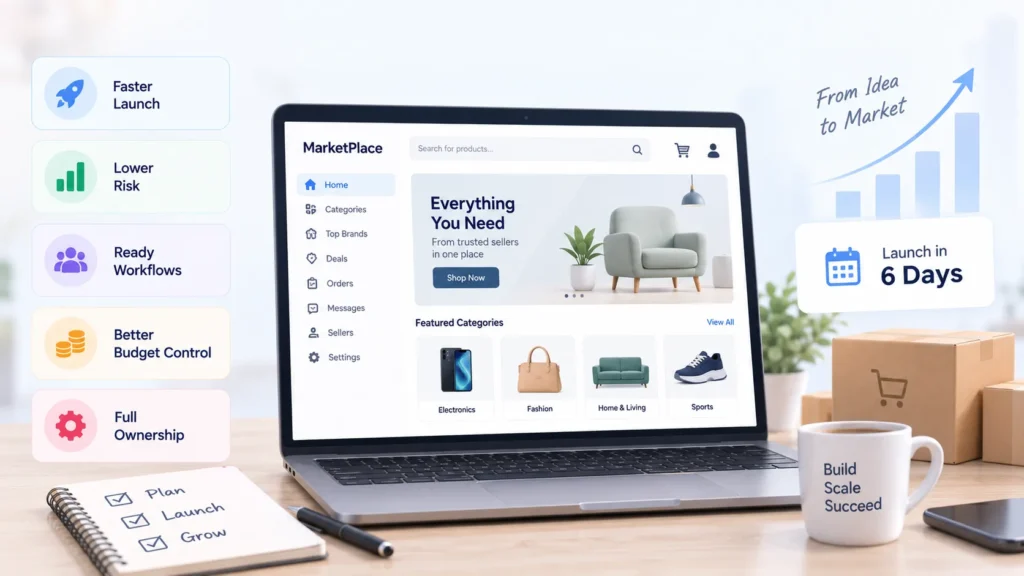
Image Source: AI-generated visual by Miracuves
Startups choose ready-made ecommerce marketplace platforms because they want to reduce uncertainty. They are not only buying software. They are buying a faster path to operational clarity.
A marketplace has two sides: buyers and sellers. If the product takes too long to launch, the founder cannot test either side properly. Sellers may lose interest, early marketing momentum may fade, and competitors may capture the market narrative first.
A ready-made marketplace foundation helps startups move faster because essential modules are already available. The founder can focus on branding, categories, seller acquisition, regional customization, pricing strategy, and launch planning.
1. Faster Launch Without Rebuilding Core Marketplace Modules
The biggest advantage is speed. A ready-made marketplace platform already includes core ecommerce workflows such as product browsing, seller listings, cart, checkout, order management, admin controls, and payment integration readiness.
This matters because founders do not need to wait for every basic feature to be designed, coded, tested, and connected from scratch. Instead, the team can customize the product for the target region and prepare for launch.
Miracuves’ ready-made ecommerce marketplace approach can support faster deployment, with relevant solutions designed for a 6-day launch when the scope fits a ready-made implementation.
2. Lower Execution Risk Before Market Validation
Early-stage startups do not always know which categories will perform, which sellers will convert, which payment method buyers will prefer, or which delivery model will scale. Building a fully custom platform before answering these questions can be expensive.
A ready-made marketplace helps reduce this risk by allowing the startup to test the business in the real market sooner. Once customer behavior and seller performance become clearer, the platform can be improved with stronger customization.
This approach is especially useful for regional ecommerce businesses where the founder may need to test local buying habits, seller supply, fulfilment challenges, and price sensitivity.
3. Built-In Seller and Admin Workflows
A marketplace is only as strong as its operational control layer. Founders need to manage sellers, products, commissions, orders, disputes, payments, content, promotions, and customer issues from one admin dashboard.
Custom development often underestimates this backend complexity. A startup may focus heavily on the buyer-facing app but later realize that seller onboarding, product approvals, refund handling, and commission tracking are what keep the business running.
A ready-made marketplace foundation gives founders a more complete operational starting point. The admin panel becomes the control room where the platform operator can monitor activity, resolve issues, and adjust marketplace settings without depending on developers for every minor action.
4. Better Budget Control
Custom ecommerce marketplace development can become expensive when features are added during the build. Every new payment flow, seller rule, catalogue setting, delivery logic, or admin permission can affect the final cost.
A ready-made model gives the founder more budget predictability because the core product foundation already exists. The startup can prioritize spending on what matters most for launch:
- Branding and user experience
- Seller onboarding
- Regional payment integrations
- Catalogue structure
- Delivery and serviceability logic
- Marketing campaigns
- Customer support setup
- Post-launch improvements
Instead of spending most of the early budget on rebuilding standard marketplace infrastructure, the founder can direct more investment toward market entry.
5. Source-Code Ownership and Long-Term Flexibility
One common concern with ready-made platforms is control. Founders do not want to feel locked into a limited system that cannot evolve.
That is why source-code ownership matters. When the startup owns the source code, the product can be customized, extended, audited, and improved over time. This creates a stronger long-term foundation than renting a closed platform with limited flexibility.
A source-code-owned marketplace gives founders the ability to adapt the platform as the business grows. New seller rules, regional features, integrations, design changes, analytics layers, and monetization models can be added based on actual market needs.
For founders exploring a regional commerce launch, Miracuves’ regional ecommerce marketplace solution can act as a practical next step when they want a white-label foundation with business-ready marketplace flows.
Ready-Made Marketplace vs Custom Development: Startup Decision Table
| Decision Factor | Ready-Made Regional Marketplace | Custom Development | Founder Impact |
|---|---|---|---|
| Launch speed | Faster because core marketplace modules already exist | Slower because each module must be planned and built | Ready-made is better for founders who want faster market validation |
| Initial cost control | More predictable because the base platform is already developed | Can increase as features, integrations, and revisions expand | Ready-made helps preserve budget for seller acquisition and marketing |
| Customization | Customizable on top of an existing foundation | Fully custom from the beginning | Custom development suits highly unique models; ready-made suits faster execution |
| Marketplace operations | Admin, seller, order, and catalogue flows are already structured | Operational flows must be designed and tested from scratch | Ready-made reduces early operational uncertainty |
| Regional readiness | Can be adapted for local payments, language, delivery, and categories | Everything must be scoped and developed separately | Ready-made supports quicker regional localization |
| Best use case | Startup launch, market testing, regional marketplace entry, faster validation | Unique enterprise workflow, complex proprietary model, heavily funded build | The right choice depends on business stage, not only feature ambition |
Founder Decision Signals
Speed
Choose ready-made when launch timing matters more than building every feature from scratch. This is useful when seller onboarding, marketing, or regional expansion plans are already waiting on the product.
Cost
Choose ready-made when the startup needs better budget control. A pre-built foundation helps reduce avoidable spending on standard marketplace modules.
Scalability
Choose ready-made when the platform must support buyers, sellers, orders, catalogue, payments, and admin workflows from day one, while still allowing future customization.
Market Fit
Choose ready-made when the founder needs to validate categories, pricing, seller participation, fulfilment, and repeat purchases before investing in a deeper custom build.
What Regional Ecommerce Startups Actually Need at Launch
A regional ecommerce marketplace does not need every advanced feature on day one. But it does need the right operational foundation.
Many founders make the mistake of thinking the first version is only about product listings and checkout. In reality, the marketplace also needs seller controls, delivery settings, payment readiness, admin visibility, support workflows, and monetization logic.
Buyer Experience
The buyer side must make product discovery, selection, checkout, payment, tracking, and support feel simple. If the buying journey feels confusing, the marketplace loses trust before it has a chance to build repeat behavior.
Important buyer-side elements include:
- Fast product search
- Category-based browsing
- Product detail pages
- Cart and checkout
- Multiple payment options
- Order tracking
- Ratings and reviews
- Offers and coupons
- Return or support request flow
- Notifications
Seller Experience
Sellers are the supply engine of the marketplace. If sellers cannot upload products, manage inventory, track orders, and understand payouts easily, they may stop using the platform.
A strong seller panel should support:
- Seller registration
- Business profile management
- Product uploads
- Catalogue and inventory updates
- Price and discount control
- Order acceptance and fulfilment
- Sales reports
- Payout visibility
- Review management
- Support communication
Admin Control
The admin dashboard is where the marketplace operator controls the business. This is especially important in regional commerce because local rules, seller behavior, product categories, fulfilment issues, and customer support needs can change quickly.
Admin control should include:
- User and seller management
- Product approval workflows
- Category management
- Commission settings
- Order monitoring
- Payment and payout tracking
- Coupon and promotion management
- Delivery settings
- Dispute and refund handling
- Reports and analytics
- Role-based access control
A ready-made foundation from Miracuves can help founders start with these marketplace layers already structured, then customize them for their regional business model.
Monetization Models a Regional Ecommerce Marketplace Can Use
A marketplace should be designed with monetization clarity from the beginning. Revenue does not come only from selling products. A platform operator can create multiple revenue lines depending on the market, seller base, and category strategy.
| Monetization Model | How It Works | Why It Matters for Startups |
|---|---|---|
| Commission per order | The marketplace earns a percentage from every completed sale | Simple, scalable, and directly tied to transaction volume |
| Seller subscription | Sellers pay monthly or yearly for access to marketplace tools | Helps create recurring revenue from serious sellers |
| Featured listings | Sellers pay to highlight products or stores | Useful when competition increases inside categories |
| Delivery fees | Platform earns from fulfilment or delivery coordination | Works well when the marketplace controls logistics |
| Advertising placements | Brands or sellers pay for promotional visibility | Useful after traffic and seller competition increase |
| Service fees | Small buyer or seller fees added to transactions | Can improve margins when positioned transparently |
| Premium seller tools | Advanced analytics, promotion tools, or catalogue support | Helps monetize high-performing sellers |
The right monetization model depends on the marketplace stage. Early on, startups should keep monetization simple enough to attract sellers and buyers. As activity grows, the platform can introduce more advanced revenue layers.
Why Regional Localization Matters More Than Extra Features
Founders often ask for more features when they should be asking for better localization.
A regional ecommerce marketplace succeeds when it fits local buyer expectations and seller behavior. That means language, currency, delivery rules, category priorities, payment habits, trust signals, and support workflows matter as much as design.
For example, a regional marketplace may need:
- Local language content
- Region-specific product categories
- Local payment gateway integration
- Cash, card, wallet, or bank-transfer options depending on market behavior
- Delivery radius and serviceability rules
- Seller verification workflows
- Tax or invoice configuration
- Local promotions and festive campaigns
- Return rules aligned with customer expectations
- Customer support flows suited to the region
This is where ready-made plus customization becomes valuable. The founder does not need to build the full commerce engine from zero. Instead, they can focus customization on the parts that make the platform feel local and trustworthy.
Security and Trust Layers Founders Should Not Ignore
Ecommerce marketplaces handle user data, seller information, payment flows, order records, and customer support issues. Security should not be treated as an afterthought.
A startup should plan for practical trust layers such as:
- Secure payment gateway integration
- Encrypted data transfer
- Role-based admin access
- Seller verification
- Customer account protection
- Activity logs
- Order and payment records
- Refund and dispute workflows
- Review moderation
- Abuse reporting
- Permission-based dashboards
Trust is especially important in a regional marketplace because buyers may be trying a new platform for the first time. Sellers also need confidence that orders, payouts, and disputes will be handled properly.
A ready-made platform with admin controls and structured workflows gives founders a better starting point for building that trust.
Mistakes Founders Should Avoid
Building Too Much Before Validating Demand
Many founders spend heavily on advanced features before confirming whether buyers will order and sellers will stay active. A better approach is to launch with the right marketplace foundation, test demand, and then improve based on real usage.
Ignoring Seller Operations
A marketplace is not only a buyer app. Sellers need product management, order visibility, inventory control, payout clarity, and support workflows. Weak seller tools can limit supply growth.
Treating Admin Control as Optional
The admin dashboard controls commissions, users, sellers, products, payments, disputes, and reports. Without strong admin control, the founder may struggle to manage daily operations.
Choosing Custom Development Only for Prestige
Custom development should solve a real business need. If the startup only needs to validate a regional marketplace model, a ready-made foundation may be faster and more cost-efficient.
When Custom Development Still Makes Sense
Ready-made marketplace development is not the right answer for every startup. Custom development can be a better choice when the business model is highly unique, the workflows are not similar to standard marketplace patterns, or the company already has strong technical leadership and enough budget for a longer build.
Custom development may make sense when:
- The product requires unusual marketplace logic.
- The startup has proprietary operational workflows.
- The platform needs deep enterprise integrations.
- The company has already validated demand.
- The product roadmap requires heavy custom architecture.
- The budget and timeline can support a longer development cycle.
The key is to choose based on stage. Early-stage founders usually need learning speed. Growth-stage or enterprise teams may need deeper custom engineering.
For many startups, the strongest path is not ready-made versus custom forever. It is ready-made first, customize intelligently, validate faster, and then scale the platform based on proven usage.
How Miracuves Helps Startups Launch Regional Ecommerce Marketplaces Faster
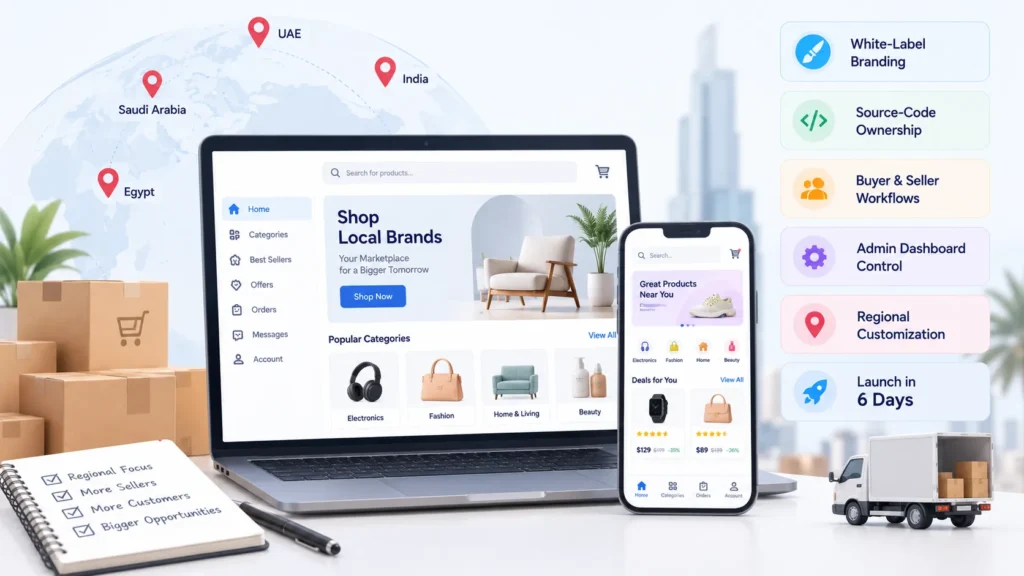
Image Source: AI-generated visual by Miracuves
Miracuves helps founders launch ready-made and white-label ecommerce marketplace platforms that can be customized for regional business needs. Instead of building every buyer, seller, payment, order, and admin workflow from scratch, startups can begin with a launch-ready foundation and shape it around their target market.
For ecommerce founders, this means faster execution and better focus. The early stage of a marketplace business should not be spent only on development delays. It should be spent on seller onboarding, product category planning, pricing strategy, delivery operations, customer acquisition, and repeat purchase growth.
With Miracuves, startups can get a marketplace foundation that supports:
- White-label branding so the platform matches the startup’s own identity.
- Source-code ownership for better long-term control and future customization.
- Buyer and seller workflows to manage browsing, listings, orders, payments, and fulfilment.
- Admin dashboard control to monitor sellers, products, commissions, orders, reports, and platform activity.
- Regional customization for local categories, payment preferences, delivery rules, and business operations.
- Faster launch planning with Miracuves’ 6-day delivery approach where the ready-made scope fits the project requirements.
This approach helps founders enter the market sooner and start learning from real users instead of waiting months to validate basic marketplace assumptions. Once the platform is live, startups can improve features, refine operations, add integrations, and scale based on actual buyer and seller behavior.
Related reading: why startups choose a ready-made grocery delivery platform.
Final Thoughts: Build Faster, Validate Smarter, and Customize With Purpose
Startups do not win only because they build a marketplace. They win when they launch at the right time, onboard the right sellers, solve local buyer needs, manage operations clearly, and improve based on real market behavior.
Custom development can be powerful, but it is not always the smartest first move. For many regional ecommerce startups, a ready-made marketplace foundation offers a faster and more practical path. It helps founders avoid rebuilding standard modules, control early costs, reduce launch risk, and focus on the parts of the business that create traction.
The better question is not “Can we build everything from scratch?” The better question is “What should we build now, what should we customize, and what should we validate before spending more?”
For founders who want speed, control, and a practical ecommerce marketplace foundation, Miracuves offers a ready-made route to launch, learn, and scale with more confidence.
FAQs
What is a ready-made regional ecommerce marketplace?
A ready-made regional ecommerce marketplace is a pre-built multi-vendor platform that can be customized for a specific market, brand, language, payment flow, delivery model, and seller network. It helps startups launch faster because the core buyer, seller, order, checkout, and admin workflows are already structured.
Why do startups choose ready-made marketplace platforms over custom development?
Startups choose ready-made marketplace platforms because they reduce launch time, lower early development risk, improve budget control, and help founders validate demand faster. Instead of building every module from scratch, founders can focus on sellers, buyers, operations, and marketing.
Is a ready-made ecommerce marketplace customizable?
Yes. A strong ready-made ecommerce marketplace can be customized for branding, categories, user experience, payment gateways, delivery rules, seller workflows, commission logic, and regional requirements. The level of customization depends on the platform, source-code access, and launch scope.
When should a startup choose custom marketplace development?
Custom development makes sense when the business model is highly unique, the startup has already validated demand, or the platform requires complex proprietary workflows. It can also be suitable for funded teams with longer timelines and deeper technical requirements.
What features should a regional ecommerce marketplace include?
A regional ecommerce marketplace should include buyer browsing, product catalogue, seller panel, admin dashboard, cart, checkout, payments, order tracking, delivery management, commissions, reviews, promotions, reporting, and support workflows. Regional features such as local language, local payments, delivery zones, and tax settings may also be important.
How does a ready-made marketplace help with market validation?
A ready-made marketplace helps founders launch sooner and test real buyer and seller behavior. Instead of waiting months for custom development, startups can validate product categories, pricing, seller interest, order flow, fulfilment, and repeat purchase potential in the live market.
Does Miracuves offer fast deployment for ecommerce marketplace solutions?
Yes. Miracuves offers ready-made and white-label marketplace solutions with source-code ownership, branded deployment, admin control, and faster launch support. Where the ready-made scope fits the business requirement, Miracuves can support a 6-day solution delivery approach.
Can a ready-made marketplace support future scaling?
Yes, if the platform is built with source-code ownership, scalable backend logic, admin control, and customization flexibility. Founders can start with a ready-made foundation and then add new features, integrations, analytics, seller tools, and monetization models as the marketplace grows.
Miracuves is an independent software development company. We are not affiliated with, connected to, sponsored by, or endorsed by any company or product named in this article.
Terms such as “X Clone” are used descriptively. It is how the software industry refers to building a platform with functionality comparable to a known service, and how clients search for it.
The entire design and codebase of our products is built by our own team. Our products contain no code, design, graphics, or content originating from any third-party website or applications.
All third-party names and marks referenced in this article are the property of their respective owners, referenced solely to identify the services discussed.