
Key Takeaways
- Marketing should begin before the social shopping marketplace becomes publicly available.
- Pre-launch activity should build a focused waitlist and secure early seller participation.
- Launch-week campaigns should turn attention into group participation and first purchases.
- Post-launch marketing should prioritize retention, marketplace liquidity, and seller activity.
- Growth should be measured through completed groups, repeat purchases, and active sellers.
Marketing Readiness Signals
- Select a clear niche, launch region, customer segment, and initial product category.
- Onboard enough sellers and hero products before driving buyer traffic.
- Prepare waitlists, community outreach, referral incentives, and influencer previews.
- Set up email, push notifications, retargeting, seller campaigns, and loyalty workflows.
- Track acquisition cost, first-order conversion, group completion, retention, and seller participation.
Real Insights
- A large waitlist has limited value when users are outside the target category or region.
- Buyer acquisition can fail when the marketplace launches without sufficient product supply.
- Referral rewards should encourage completed purchases, not only registrations or shares.
- Retention usually improves through better offers and fulfillment, not constant discounts.
- Miracuves develops social shopping marketplaces with referral, campaign, seller, and analytics workflows.
Launching a social shopping marketplace is not the same as launching a normal ecommerce store.
A traditional ecommerce app can begin with a product catalogue, paid ads, product pages, checkout, and delivery workflows. A social shopping marketplace needs something more difficult: coordinated user behavior. Buyers must discover deals, invite others, join campaigns, share products, trust sellers, and return often enough for the marketplace to feel active.
That is why marketing cannot begin after the app goes live.
For founders, the stronger approach is to plan growth in two stages: pre-launch demand building and post-launch marketplace activation. Pre-launch marketing creates awareness, trust, early users, seller participation, and category focus. Post-launch marketing turns that early interest into group purchases, repeat orders, referrals, seller campaigns, and long-term retention.
This guide explains how founders can build a practical marketing plan for a social shopping marketplace without confusing marketing activity with real marketplace growth.
Why Social Shopping Marketplaces Need a Different Marketing Plan
A social shopping marketplace grows through interaction, not only through product discovery.
In a normal ecommerce model, the marketing goal is usually simple: bring users to product pages and convert them into buyers. In a social shopping model, the goal is broader. You need users to invite others, participate in offers, share deals, return for limited-time campaigns, and trust the platform enough to buy from multiple sellers.
That changes the marketing strategy.
The platform has to create small moments of participation:
- A buyer shares a deal with friends.
- A group purchase becomes more attractive as more users join.
- A seller promotes a limited-time offer.
- A community member posts a discount inside a WhatsApp, Telegram, Facebook, or local group.
- A returning buyer opens the app because they expect fresh campaigns.
- A user feels rewarded for inviting someone else.
This is why the marketing plan should not depend only on ads. Paid campaigns can bring traffic, but they cannot create marketplace energy on their own. The product, sellers, discounts, referral system, and community layer must work together.
For founders planning a coordinated buying model, the foundation matters. A launch-ready social commerce platform should support seller campaigns, group offers, user referrals, admin controls, and analytics so that marketing does not depend only on manual work.
Read More: How Social Group Buying Works: A Complete Guide for Ecommerce Businesses
Pre-Launch Stage: Build Demand Before the Marketplace Goes Live
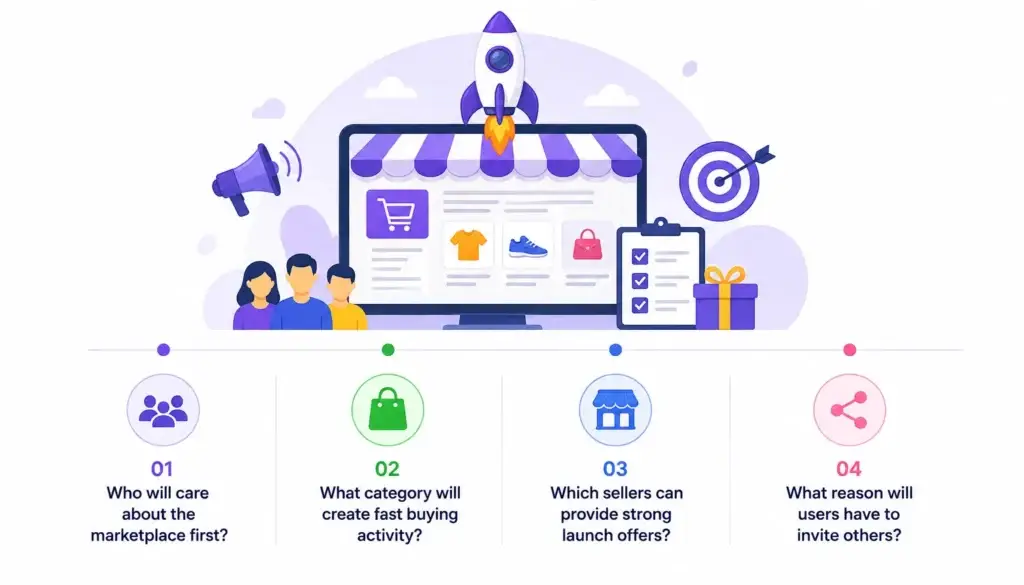
Image Source: AI-generated visual by Miracuves
Pre-launch marketing is where many founders either create momentum or quietly lose it.
The goal before launch is not to announce everything. The goal is to validate interest, choose a focused buyer segment, onboard early sellers, prepare launch offers, and build a community that is ready to act when the platform opens.
A strong pre-launch plan answers four questions:
- Who will care about the marketplace first?
- What category will create fast buying activity?
- Which sellers can provide strong launch offers?
- What reason will users have to invite others?
Without these answers, launch week can become expensive. The founder may spend on ads, get app installs, and still see weak orders because the marketplace has no clear community or campaign logic.
Step 1: Choose a Focused Launch Niche Instead of Targeting Everyone
A social shopping marketplace should not begin by trying to sell every product to every buyer.
Broad marketplaces are difficult to market at the beginning because the message becomes weak. If the platform says “buy everything at better prices,” users may not understand why they should download another shopping app. But if the platform starts with a clear niche, marketing becomes sharper.
Strong launch niches can include:
- Budget fashion for college students
- Beauty and skincare bundles
- Home essentials for families
- Local grocery group deals
- Electronics accessories
- Baby and parenting products
- Festival and seasonal shopping
- Local farm-to-table products
- Value-focused household items
The niche should be selected based on repeat purchase potential, seller availability, discount flexibility, community sharing behavior, and operational feasibility.
For example, beauty products may work well if influencers can explain bundles and sellers can offer campaign pricing. Grocery and household essentials may work well if users reorder frequently. Student fashion may work well if peer sharing and group discounts create social momentum.
The founder’s first decision is not “How many categories can we launch?” It is “Which category can create the fastest proof of demand?”
Step 2: Build a Waitlist Around a Specific Launch Promise
A generic waitlist rarely works.
“Join our marketplace launch” is not a strong reason for users to sign up. A better waitlist gives users a clear benefit, such as early access, first group deal access, referral rewards, member-only discounts, or launch-week coupons.
Examples of stronger waitlist hooks include:
- “Get early access to launch-week group deals.”
- “Invite friends and unlock first-order rewards.”
- “Join the early shopper list for local bundle discounts.”
- “Be first to access community-only shopping campaigns.”
- “Get notified when seller-funded launch offers go live.”
The waitlist should collect more than email addresses. Founders should also capture category interest, location, preferred product type, and sharing source. This helps the team understand which audience segments are most ready before spending heavily on paid acquisition.
A good waitlist is not only a database. It is an early signal of marketplace demand.
Step 3: Recruit Sellers Before Recruiting Too Many Buyers
Marketplace founders often focus heavily on buyer acquisition and forget that sellers are also part of the growth engine.
A social shopping marketplace needs sellers who can participate in campaigns, offer attractive pricing, fulfil orders reliably, and promote deals to their own audience. If sellers are passive, the marketplace becomes dependent on the founder’s ad budget.
Before launch, founders should identify sellers who can support:
- Launch-week discounts
- Bundle offers
- Group purchase pricing
- Limited-time campaigns
- Seasonal deals
- Influencer or community promotions
- Repeat purchase offers
- Seller-funded coupons
Seller onboarding should also include campaign education. Many sellers understand product listing, but not all sellers understand social commerce. They may need guidance on how group offers, referral traffic, campaign timing, and community promotions work.
The stronger the seller-side preparation, the easier it becomes to create marketplace activity after launch.
Step 4: Create Community Channels Before App Promotion Begins
Social shopping grows faster when users have somewhere to talk, share, ask questions, and invite others.
This does not mean every founder needs to build a massive community before launch. It means the launch plan should include practical channels where early users can gather.
Useful pre-launch community channels include:
- WhatsApp groups
- Telegram channels
- Instagram broadcast channels
- Facebook groups
- Local community pages
- Student communities
- Deal-hunting groups
- Influencer-led communities
- Email lists
- SMS lists for local commerce
The community should not be filled only with promotional posts. It should share product previews, seller stories, upcoming deals, polls, category voting, referral reminders, and launch countdowns.
For a social shopping marketplace, community is not just a marketing channel. It is part of the buying behavior.
Step 5: Prepare Launch Campaigns Before the First User Arrives
Many founders launch the app first and then start thinking about offers. That creates a weak first impression.
Before launch, the team should prepare campaign assets, seller commitments, push notification flows, email sequences, influencer content, referral rules, and launch-week discount logic.
A practical launch campaign plan should include:
| Launch Asset | Purpose | Founder Decision |
|---|---|---|
| Hero launch offer | Gives users a reason to act quickly | Choose one strong offer instead of many weak offers |
| Seller campaign calendar | Keeps the marketplace active | Confirm seller participation before launch |
| Referral reward | Encourages user-led sharing | Reward meaningful action, not fake signups |
| Community announcement kit | Makes sharing easier | Prepare copy, images, and deal links |
| Influencer brief | Keeps creator messaging consistent | Promote specific deals, not vague app downloads |
| Email and push flows | Brings users back during launch week | Use behavior-based messages |
| Analytics dashboard | Measures what works | Track campaign, seller, and referral performance |
A launch without campaign preparation is only a product release. A launch with prepared offers, sellers, communities, and referral flows becomes a market test.
Read More: Group-Buying Marketplace Features and Pricing: What Founders Should Evaluate Before Launch
Founder Decision Signals
Speed
If the launch campaign is already planned, founders can test real demand faster instead of spending weeks adjusting offers after the app goes live.
Cost
Community sharing, seller-funded campaigns, and referral loops can reduce dependence on paid ads when planned correctly.
Scalability
Campaign workflows, seller dashboards, and admin controls help the marketplace scale promotions without relying on manual coordination.
Market Fit
Waitlists, category polls, seller demand, and group deal participation show whether the market is responding before large acquisition budgets are spent.
Launch Week: Turn Attention Into Marketplace Activity
Launch week should not be judged only by downloads.
A social shopping marketplace can get app installs and still fail to create real activity. The stronger metrics are group participation, first purchase rate, referral activity, seller campaign performance, and repeat visits.
During launch week, the marketing goal is to make the platform feel active immediately.
That means users should see live offers, clear categories, attractive group deals, seller participation, easy sharing, and timely reminders. The app should not feel empty, confusing, or dependent on users figuring everything out alone.
Launch week should focus on four growth actions:
- Get users to browse.
- Get users to join or create a deal.
- Get users to invite others.
- Get users to complete the first purchase.
Everything else supports these actions.
Post-Launch Stage: Build Retention, Referrals, and Seller-Led Growth
Post-launch marketing begins once real users start interacting with the marketplace.
At this stage, founders should stop guessing and start reading behavior. Which campaigns create purchases? Which sellers attract repeat buyers? Which categories get shared? Which referral incentives lead to quality users? Which notifications bring people back without damaging trust?
Post-launch growth depends on iteration.
The best founders treat marketing as a product system, not a collection of random campaigns. They test offers, refine seller participation, improve onboarding, adjust category focus, and build stronger loops around what users already do.
Step 6: Use Referral Loops That Reward Real Buyer Behavior
Referral marketing is powerful in social shopping, but only when the rewards are designed carefully.
If the platform rewards every signup too aggressively, it may attract low-quality users who never buy. If the reward is too weak, users may not bother sharing. The right referral system should reward actions that support marketplace growth.
Better referral reward triggers include:
- Reward after the invited user places a first order.
- Reward when a shared deal reaches participation.
- Reward when a group purchase is completed.
- Reward both inviter and invitee after meaningful action.
- Offer category-specific referral coupons.
- Give limited-time referral boosters during launch campaigns.
The goal is not to maximize referral codes. The goal is to create buyer-led growth that improves order activity.
For founders, referral design should connect directly with unit economics. A referral reward is only useful if it brings users who buy, return, and invite others.
Step 7: Make Sellers Active Growth Partners
In a social shopping marketplace, sellers should not only upload products. They should help create demand.
Seller-side marketing can include:
- Seller-funded coupons
- Limited-time group deals
- Bundle campaigns
- Sponsored product placements
- New-arrival promotions
- Seasonal collections
- Community-exclusive offers
- Live or interactive product drops
- Repeat-buyer incentives
The platform operator should give sellers clear campaign tools and performance visibility. Sellers should understand which campaigns generated traffic, conversions, repeat orders, and revenue.
When sellers can see results, they are more likely to participate in future campaigns. This creates a healthier marketplace because growth is not dependent only on the platform’s central marketing team.
Miracuves helps founders plan these marketplace workflows through white-label commerce solutions that can support seller participation, admin control, campaign visibility, and monetization planning.
Step 8: Use Push Notifications Carefully and Based on Behavior
Push notifications can bring users back, but they can also damage trust if they feel generic or excessive.
A social shopping marketplace should use notifications based on user behavior, not only marketing schedules.
Useful notification triggers include:
- A group deal is close to completion.
- A user’s preferred category has a new offer.
- A seller followed by the user launches a campaign.
- A referral reward is about to expire.
- A cart or saved product has a limited-time discount.
- A community deal is ending soon.
- A repeat-purchase category has a new bundle.
- A completed order unlocks another benefit.
The key is relevance. A notification should feel like a useful reminder, not noise.
Founders should monitor opt-out rates, uninstall patterns, click-through rates, conversion rates, and purchase activity after notifications. If notifications drive clicks but not purchases, the message may be attractive but the offer may not be strong enough.
Step 9: Build Content and SEO Around Buyer Problems, Not Only Product Keywords
Content marketing for a social shopping marketplace should not only focus on brand announcements.
The strongest content supports real buyer and seller questions. This can include category guides, product comparisons, seller stories, savings tips, community shopping guides, seasonal buying plans, and explainers around group purchase benefits.
Useful content angles include:
- How to save more on household essentials through group deals
- Best beauty bundles for monthly skincare routines
- How local sellers can increase orders through community shopping
- Why group buying works for family and neighborhood purchases
- How to choose trusted sellers in a social shopping marketplace
- Festival shopping checklist for budget-conscious buyers
- How referral rewards work in community commerce
For SEO, the marketplace should avoid relying only on high-competition commercial keywords. Long-tail educational queries often attract users earlier in the decision journey and support brand trust.
For Miracuves editors, this is also the reason this blog should link to the money page with supportive anchors instead of repeating the money page keyword aggressively.
Step 10: Track Marketplace Metrics That Show Real Growth
Downloads do not prove marketplace health.
A founder needs metrics that show whether buyers, sellers, and campaigns are working together. The right analytics help the team decide what to improve after launch.
| Metric | What It Shows | Why It Matters |
| Waitlist conversion rate | How many early users became active users | Shows pre-launch demand quality |
| First-order conversion | How many users made their first purchase | Shows onboarding and offer strength |
| Group participation rate | How many users join buying campaigns | Shows whether the social shopping mechanic is working |
| Group completion rate | How many campaigns reach the required activity | Shows campaign quality and sharing behavior |
| Referral conversion rate | How many invited users take meaningful action | Shows whether referral rewards attract real buyers |
| Repeat purchase rate | How often buyers return | Shows retention and category fit |
| Seller campaign participation | How many sellers actively run promotions | Shows seller-side marketplace health |
| Coupon abuse rate | Whether discounts are attracting low-quality behavior | Protects unit economics |
| Push notification conversion | Whether reminders lead to purchase behavior | Helps refine lifecycle messaging |
| Category-level revenue | Which categories create actual demand | Guides expansion decisions |
A social shopping marketplace grows when these metrics improve together. If only traffic increases but group completion, repeat purchase, and seller participation stay weak, the marketing plan needs adjustment.
Read More : Why Startups Choose Ready-Made Social Commerce Platforms Over Building From Scratch
Pre-Launch vs Post-Launch Marketing Plan for Social Shopping
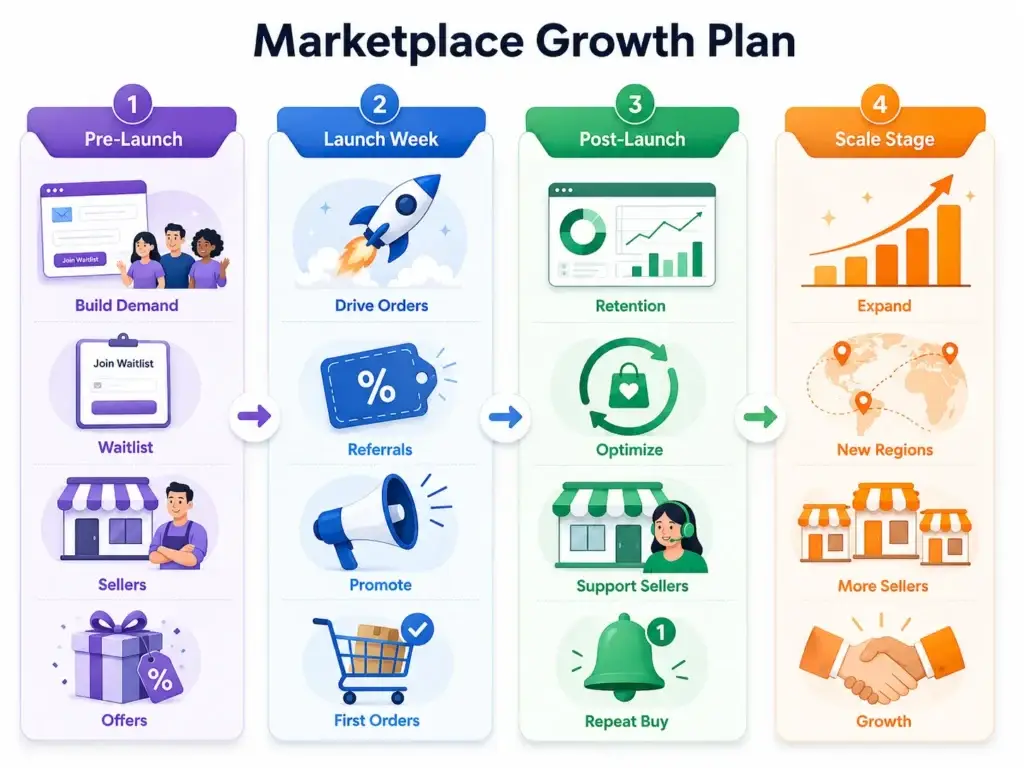
Image Source: AI-generated visual by Miracuves
| Stage | Main Objective | Best Channels | Key Actions | Success Signal |
| Pre-launch | Build demand before release | Waitlist, social media, communities, seller outreach, influencer previews | Choose niche, onboard sellers, prepare launch offers, collect early users | Strong waitlist quality and seller participation |
| Launch week | Convert attention into activity | Referral campaigns, launch offers, push, email, paid ads, community posts | Promote hero deals, activate referrals, drive first orders | First-order conversion and group participation |
| Post-launch | Improve retention and marketplace liquidity | CRM, seller campaigns, retargeting, SEO, influencer campaigns, loyalty flows | Test offers, optimize notifications, support sellers, track metrics | Repeat purchase, group completion, and seller campaign growth |
| Scale stage | Expand categories and regions | SEO, paid acquisition, partnerships, regional communities, seller programs | Add categories, improve operations, expand seller base | Sustainable order growth and stronger unit economics |
Common Marketing Mistakes Founders Should Avoid
Launching without a focused category
A broad marketplace can sound ambitious, but it often weakens early marketing. Start with a category where users share deals, sellers can offer campaign pricing, and repeat purchase behavior is likely.
Depending only on paid ads
Paid ads can create traffic, but social shopping growth depends on referrals, seller campaigns, community sharing, and retention workflows.
Ignoring seller-side marketing
Sellers need campaign tools, offer guidance, and performance visibility. If sellers are inactive, the marketplace can feel empty even when buyers arrive.
Overusing discounts without tracking quality
Discounts can drive orders, but they can also attract low-quality users. Track repeat purchase, referral quality, coupon abuse, and campaign profitability.
Platform Readiness: The Marketing Plan Only Works If the Product Supports It
A social shopping marketplace cannot grow through marketing alone.
If the app does not support seller campaigns, referral tracking, discount controls, product visibility, group purchase logic, admin review, notifications, analytics, and secure payment flows, the marketing team will end up doing too much manually.
Before launch, founders should check whether the platform can support:
- Buyer onboarding
- Seller onboarding
- Product and category management
- Group deal creation
- Referral workflows
- Coupon and discount rules
- Push notification triggers
- Seller campaign dashboards
- Admin reporting
- Payment and order tracking
- Refund and dispute workflows
- Review and trust controls
- Fraud and abuse monitoring
This is where a ready-made foundation can help founders move faster. Instead of building every marketplace workflow from zero, Miracuves can help businesses launch a white-label social commerce platform with source-code ownership, branded design, admin control, and growth-ready marketplace flows.
For founders who want to explore the product foundation behind this model, visit the Pinduoduo-clone launch-ready social commerce platform page.
Final Thoughts: Growth Starts Before the Marketplace Goes Live
The strongest marketing plan for a social shopping marketplace does not begin after launch.
It begins when the founder chooses the first category, builds a waitlist, prepares seller campaigns, creates community channels, plans referral mechanics, and defines what marketplace success should look like.
After launch, growth depends on iteration. Founders need to track which deals are shared, which sellers perform, which categories retain buyers, which referrals convert, and which notifications lead to repeat purchases.
The real goal is not just to acquire users. It is to create a marketplace where buyers, sellers, offers, and communities keep activating each other.
That is how a social shopping marketplace moves from a launch event to a growth system.
FAQs
What is a social shopping marketplace marketing plan?
A social shopping marketplace marketing plan is a structured strategy for attracting buyers, onboarding sellers, creating group deal activity, encouraging referrals, and improving repeat purchases before and after launch. It combines community building, seller campaigns, referral rewards, content marketing, lifecycle messaging, and marketplace analytics.
Why should marketing begin before launching a social shopping marketplace?
Marketing should begin before launch because social shopping depends on participation. Founders need early buyers, active sellers, launch offers, community channels, and referral incentives ready before the app goes live. Without pre-launch preparation, the marketplace may attract traffic but struggle to create real buying activity.
What should founders do before launching a social commerce marketplace?
Before launch, founders should choose a focused niche, build a waitlist, onboard sellers, prepare launch-week offers, create community channels, plan referral rewards, and set up analytics. These steps help the platform launch with demand instead of starting from zero.
What are the best post-launch marketing strategies for a group buying marketplace?
The best post-launch strategies include referral campaigns, seller-funded promotions, push notifications, category-specific offers, retargeting, influencer-led campaigns, community deal sharing, loyalty rewards, and SEO content around buyer needs.
How do sellers help grow a social shopping marketplace?
Sellers help grow the marketplace by running limited-time offers, bundles, group discounts, seasonal promotions, sponsored listings, and community-exclusive campaigns. When sellers actively promote offers, the marketplace becomes more dynamic and less dependent on central paid advertising.
Are paid ads enough for social shopping marketplace growth?
Paid ads can help attract early users, but they are not enough alone. A social shopping marketplace also needs referral loops, seller campaigns, community sharing, retention workflows, trust signals, and repeat purchase strategies.
What metrics should founders track after launch?
Founders should track first-order conversion, group participation, group completion, referral conversion, repeat purchase rate, seller campaign activity, coupon abuse, push notification conversion, and category-level revenue. These metrics show whether the marketplace is actually growing, not just getting traffic.
How can Miracuves help founders launch a social shopping marketplace?
Miracuves helps founders launch ready-made and white-label marketplace platforms with branded design, source-code ownership, admin control, seller workflows, product management, payment flows, and growth-ready commerce features. This helps founders move faster from planning to market validation.
Miracuves is an independent software development company. We are not affiliated with, connected to, sponsored by, or endorsed by any company or product named in this article.
Terms such as “X Clone” are used descriptively. It is how the software industry refers to building a platform with functionality comparable to a known service, and how clients search for it.
The entire design and codebase of our products is built by our own team. Our products contain no code, design, graphics, or content originating from any third-party website or applications.
All third-party names and marks referenced in this article are the property of their respective owners, referenced solely to identify the services discussed.