
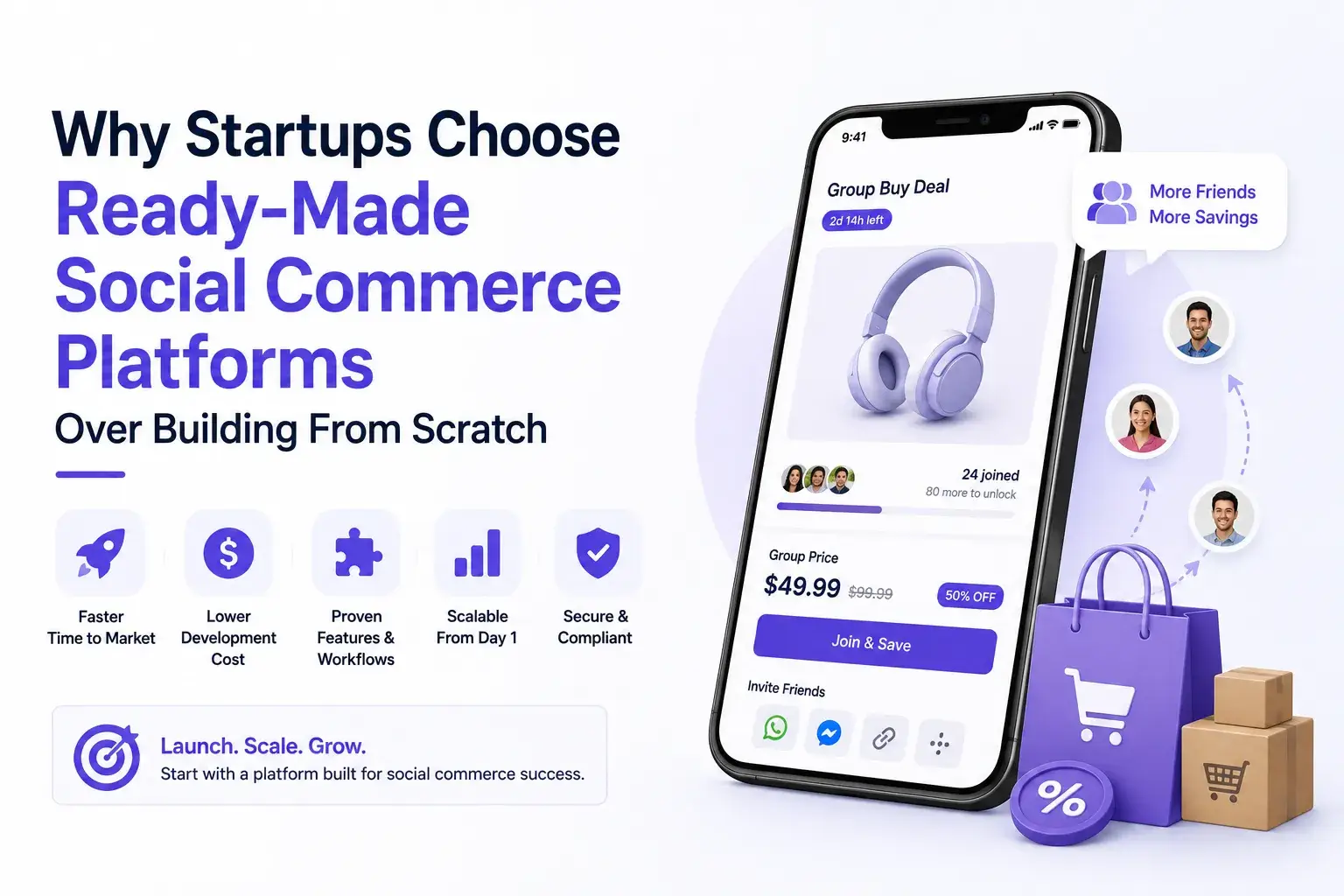
Key Takeaways
- Ready-made social commerce platforms help startups test demand before making a large engineering investment.
- Core marketplace workflows are already available and can be adapted to the business model.
- Custom development offers deeper control but requires more time, budget, and technical resources.
- Source-code ownership allows startups to customize and expand the platform over time.
- The right choice depends on validation goals, differentiation, available resources, and launch urgency.
Build-vs-Buy Signals
- Choose a ready-made foundation when the business model still needs real-market validation.
- Identify which features create differentiation and which are standard marketplace infrastructure.
- Review customization options, integrations, security, scalability, and ownership rights.
- Choose custom development when the product requires unique workflows or proprietary architecture.
- Evaluate the cost of delayed learning, merchant onboarding, customer feedback, and revenue.
Real Insights
- Early-stage startups usually need market evidence before perfect technical architecture.
- Building every standard workflow from scratch does not automatically create differentiation.
- A faster launch is valuable only when the platform supports meaningful customer testing.
- Ready-made and custom development can be combined through a phased technology strategy.
- Miracuves provides ready-made social commerce foundations with customization, source code, and deployment support.
Launching a social commerce business involves far more than creating a storefront and adding products.
A startup may need customer accounts, seller management, product discovery, group purchasing, payments, promotions, order tracking, notifications, analytics, administration tools, and scalable infrastructure before it can even begin testing its business model.
This creates an important early decision:
Should the startup build the technology from scratch or begin with a ready-made social commerce platform?
There is no universal answer. Businesses with highly specialized requirements may eventually benefit from fully custom development. However, startups that are still validating demand often need something different: speed, predictable scope, lower technical risk, and enough flexibility to test the market.
That is why many founders evaluate ready-made platforms before committing to a long development cycle.
What Is a Ready-Made Social Commerce Platform?
A ready-made social commerce platform is a pre-developed software foundation containing the core components needed to operate a social shopping or marketplace business.
Instead of engineering every module from the beginning, startups begin with an existing technical base and customize elements such as branding, business rules, integrations, workflows, and selected features.
Depending on the solution, the platform may already include capabilities such as:
- Customer registration and profiles
- Product and category management
- Seller or merchant management
- Group purchasing workflows
- Shopping cart and checkout
- Payment integration
- Order management
- Promotional tools
- Notifications
- Administrative controls
- Reporting and analytics
The important distinction is that ready-made does not necessarily mean fixed.
A well-structured platform can provide a starting foundation while still allowing a business to adapt the experience around its own market.
Read More: Group-Buying Marketplace Features and Pricing: What Founders Should Evaluate Before Launch
Why Building From Scratch Can Be Difficult for Early-Stage Startups
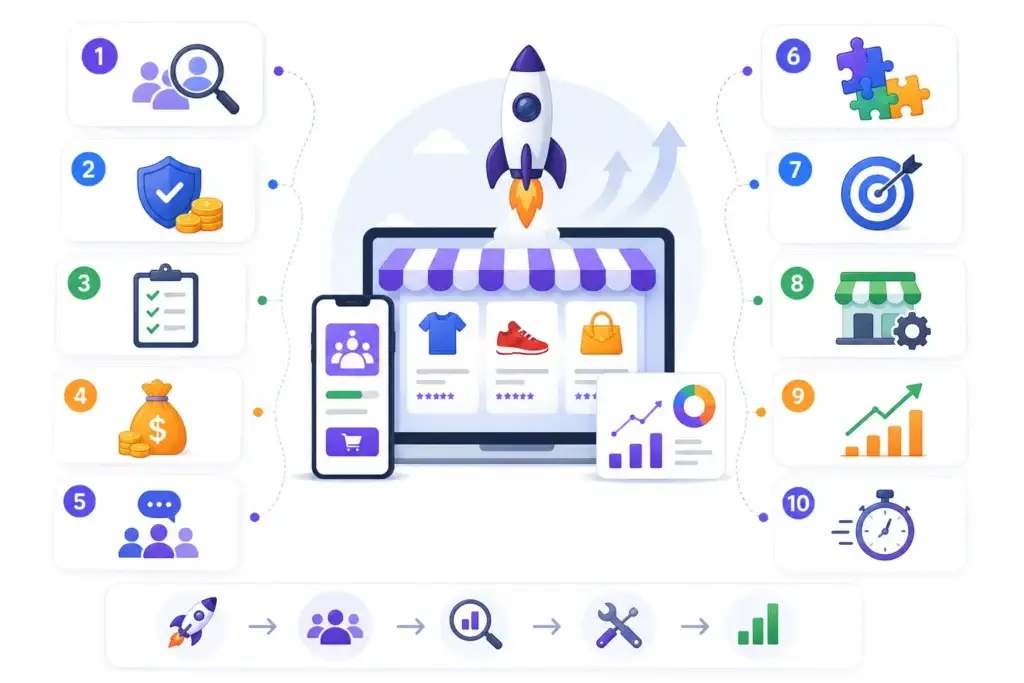
Image Source: AI-generated visual by Miracuves
Custom development provides significant control, but that control comes with additional responsibilities.
Before launching, a startup may need to complete product discovery, architecture planning, interface design, frontend development, backend development, API integration, database configuration, payment implementation, testing, security reviews, infrastructure setup, and deployment.
Every additional workflow creates dependencies.
For example, introducing group purchasing may affect inventory management, pricing logic, checkout, notifications, refunds, order status, customer communication, and merchant reporting.
For an established company with validated demand and a dedicated technology organization, that investment may make sense.
For an early-stage startup, however, the biggest question is often not:
“Can we build it?”
It is:
“Should we invest heavily before we know customers want it?”
That difference changes the technology strategy.
1. Faster Market Validation
One of the strongest reasons startups consider ready-made technology is the ability to test their business model earlier.
A startup rarely knows with certainty how customers will behave before launch.
Founders may have assumptions about:
- Which products generate interest
- Whether customers will invite others
- Which promotions improve conversion
- How merchants respond to the model
- What acquisition channels work
- How frequently users return
- Which purchasing mechanics create engagement
These assumptions are better tested with real users than debated internally for months.
When much of the underlying platform already exists, teams can spend more time adapting the business experience and less time recreating foundational commerce infrastructure.
The goal is not simply launching quickly.
The goal is learning quickly.
2. Lower Upfront Development Risk
Building a marketplace from zero requires several technical disciplines working together.
Costs may include:
- Product management
- UI/UX design
- Mobile development
- Web development
- Backend engineering
- Database architecture
- Quality assurance
- Cloud infrastructure
- Security implementation
- Third-party integrations
- Ongoing maintenance
These investments happen before the startup has necessarily proven product-market fit.
A ready-made foundation changes the risk profile because many common technical components already exist.
The business can concentrate its initial investment on areas that create differentiation rather than paying to rebuild standard functions such as authentication, catalog management, checkout, and administrative workflows.
3. More Predictable Product Scope
One of the hidden challenges of custom development is scope expansion.
A seemingly straightforward marketplace idea can quickly grow into dozens of requirements:
A basic checkout needs payment handling.
Payment handling requires transaction statuses.
Transactions require refunds.
Refunds need administrative controls.
Administrative controls require permissions.
Permissions introduce different user roles.
Soon, a relatively simple idea becomes a much larger software project.
With an existing platform, startups can inspect the available workflows before development begins and identify:
- What already exists
- What requires configuration
- What needs customization
- What should be postponed
This makes MVP planning more practical.
Instead of asking “What could we build?”, teams can prioritize “What must we launch with?”
4. Better Use of Startup Capital
Early-stage capital is usually competing across several priorities.
Technology is only one of them.
A social commerce startup may also need funding for:
- Customer acquisition
- Seller onboarding
- Inventory partnerships
- Operations
- Customer service
- Promotions
- Logistics
- Compliance
- Content
- Hiring
Spending a large share of available capital on software before validating demand can restrict the startup’s ability to invest in these other areas.
Using an established technical foundation can help founders reserve more resources for proving the actual business model.
For many startups, software does not need to be completely original on day one.
The business proposition needs to be compelling.
5. Earlier Feedback From Real Customers
Internal testing can reveal bugs.
It cannot fully reveal whether customers understand or value the business model.
Once real users interact with a social shopping experience, founders can begin answering more meaningful questions:
- Do customers understand group purchasing?
- Are invitations being shared?
- Where do users abandon checkout?
- Which offers generate repeat purchases?
- What causes customers to create or join groups?
- Which merchant categories perform best?
- What causes customer-support requests?
- Which features are rarely used?
These insights can influence the product roadmap far more than assumptions made before launch.
A ready-made approach can therefore become part of a test → learn → improve strategy rather than simply a shortcut to development.
6. Reduced Engineering Complexity During the MVP Stage
Social commerce platforms combine several systems.
There is the traditional commerce layer:
- Products
- Pricing
- Cart
- Checkout
- Orders
- Payments
Then there is the marketplace layer:
- Vendors
- Commissions
- Catalog controls
- Merchant administration
And there may be a social layer:
- Sharing
- Referrals
- Group participation
- Promotional mechanics
- Notifications
Connecting all of these systems reliably can create considerable engineering complexity.
Startups using an existing foundation begin further along the development path.
Their engineering resources can then focus on integrations, localization, business-specific rules, optimization, and differentiating features rather than basic platform construction.
7. Easier MVP Prioritization
Founders often make the mistake of treating their first release like the final version of the product.
That usually creates unnecessary development.
An MVP should answer a limited number of important questions.
For a social shopping startup, those might be:
- Can we attract relevant merchants?
- Will customers participate in collaborative purchasing?
- Can we acquire users efficiently?
- Does the pricing model encourage sharing?
- Can the business generate sustainable transaction volume?
Features that do not help answer those questions may not belong in the first release.
A ready-made platform provides a practical base from which startups can activate essential workflows while delaying lower-priority customization.
This supports a more disciplined launch strategy.
8. Faster Merchant and Operational Testing
Customers are only one side of a marketplace.
Startups must also understand how merchants, administrators, support teams, and operations staff interact with the platform.
Real-world testing may uncover questions such as:
- How long does merchant onboarding take?
- Is product upload straightforward?
- How should commissions be calculated?
- What happens when inventory changes during a group purchase?
- How should canceled orders be handled?
- What information does customer support need?
- Which reports are useful to sellers?
These operational requirements are difficult to predict completely before a business begins processing real activity.
Launching on an existing foundation allows founders to identify operational gaps earlier and customize based on evidence.
9. A Clearer Path to Iterative Customization
Choosing ready-made technology at the beginning does not mean a startup must avoid customization forever.
The opposite can be true.
Once real usage data becomes available, businesses can make better decisions about what deserves custom investment.
For example, a startup might discover that:
- Referral behavior is central to acquisition
- A specific group-purchase flow improves conversion
- Certain merchant tools reduce onboarding friction
- A unique recommendation model improves retention
Those findings provide a stronger justification for deeper development.
Instead of funding custom features because they might matter, the startup can invest because data shows they do matter.
This creates a more efficient sequence:
Launch → validate → measure → customize → scale
10. Faster Response to Market Changes
Early-stage companies frequently change direction.
Pricing may change.
Target audiences may shift.
Merchant categories may expand.
Customer acquisition strategies may evolve.
New integrations may become necessary.
A long development project based on assumptions made months earlier can become misaligned with the market before it launches.
Starting with a configurable software foundation gives startups an opportunity to enter the market sooner and make decisions based on actual conditions.
Speed therefore matters not only for beating competitors.
It also reduces the amount of time a company operates without customer feedback.
Ready-Made vs Building From Scratch: A Practical Comparison
| Consideration | Ready-Made Foundation | Building From Scratch |
|---|---|---|
| Initial launch preparation | Typically shorter | Typically longer |
| Upfront engineering effort | Lower | Higher |
| MVP validation | Easier to begin earlier | Usually starts after core development |
| Initial customization | Based on existing architecture | Broad control from the beginning |
| Technical planning | More focused on adaptation | Full architecture required |
| Standard commerce workflows | Often already available | Must be developed |
| Early-stage risk | Generally more controlled | Greater initial commitment |
| Best suited for | Validation and faster market entry | Highly specialized validated requirements |
Neither approach is automatically superior.
The correct decision depends on the startup’s stage, requirements, resources, and competitive advantage.
When Does Building From Scratch Make More Sense?
Ready-made platforms are not suitable for every business.
Custom development may be appropriate when a company has:
A highly unusual business model
If the core transaction logic is fundamentally different from standard marketplace or social commerce workflows, adapting an existing foundation may create unnecessary constraints.
Proprietary technology as the main competitive advantage
If unique software architecture, algorithms, data processing, or infrastructure represents the core intellectual property of the business, custom engineering may be strategically important.
A validated product with mature requirements
Companies that already understand exactly how customers behave can make better long-term architecture decisions than a startup working from assumptions.
Significant internal engineering resources
Organizations with experienced product, design, development, DevOps, security, and QA teams may be better positioned to manage an end-to-end custom build.
Complex enterprise integrations
Some businesses require deep connections with legacy systems, proprietary infrastructure, specialized compliance environments, or highly customized operational processes.
In those situations, custom development may provide greater architectural control.
When Does a Ready-Made Platform Make More Sense?
A ready-made approach is particularly worth evaluating when a startup:
- Wants to validate the business before making a large engineering investment
- Needs to reach customers sooner
- Has limited technical resources
- Requires common marketplace and social shopping functionality
- Wants to test merchant and customer workflows
- Needs clearer initial scope
- Plans to customize further after collecting real usage data
The key question is whether building foundational technology creates meaningful differentiation.
If customers do not care whether your authentication system, shopping cart, admin panel, or order-management infrastructure was created from scratch, those components may not deserve the majority of your early investment.
Read More: How Social Group Buying Works: A Complete Guide for Ecommerce Businesses
What Should Startups Evaluate Before Choosing a Ready-Made Platform?
Not all platforms provide the same level of quality or flexibility.
Before making a decision, evaluate several areas carefully.
Source-Code Access
Understand what you actually receive and whether your team can modify the platform as the business grows.
Customization Flexibility
Determine which workflows, designs, integrations, and business rules can be adapted.
Architecture
Review whether the technical foundation can support your expected usage and future requirements.
Security
Ask how authentication, permissions, payments, sensitive information, and administrative access are handled.
Third-Party Integrations
Check compatibility with payment providers, analytics systems, communication tools, logistics services, and other infrastructure relevant to your market.
Deployment Options
Understand where the application can be hosted and how production environments are configured.
Post-Launch Support
Clarify responsibilities for deployment assistance, bug fixes, upgrades, customization, and ongoing technical support.
Scalability
Consider what happens if transaction volumes, merchants, users, products, or geographic markets increase.
The objective is not merely finding software that launches quickly.
It is finding a foundation that can support learning and growth without creating unnecessary technical restrictions.
How to Decide: A Simple Build-vs-Buy Framework
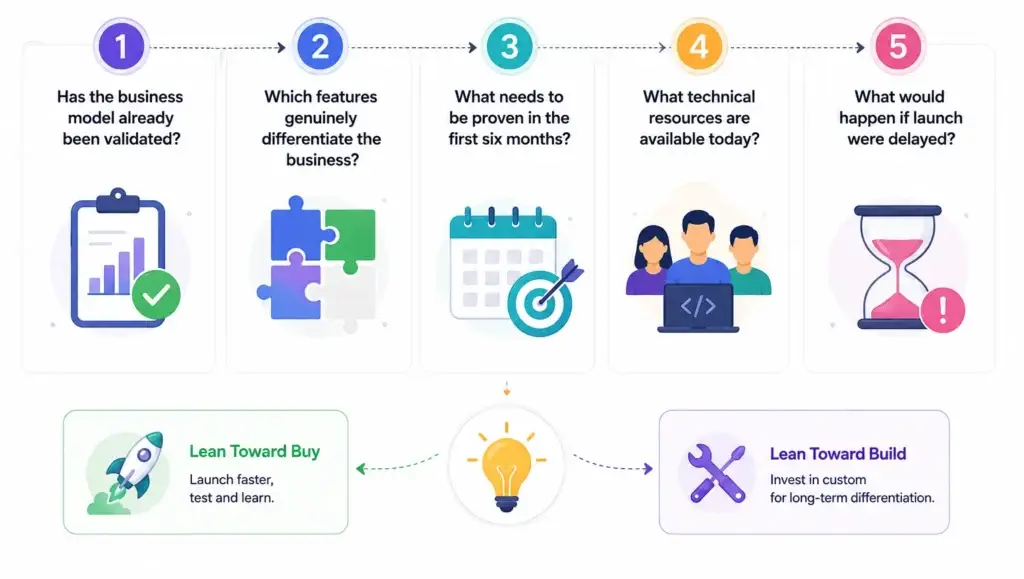
Founders can simplify the decision by answering five questions.
1. Has the business model already been validated?
If not, minimizing the cost and time required to reach real customers may be more valuable than perfect architecture.
2. Which features genuinely differentiate the business?
Separate proprietary value from standard platform infrastructure.
3. What needs to be proven in the first six months?
Build the technology strategy around those learning objectives.
4. What technical resources are available today?
A development strategy should reflect the team you actually have, not the team you hope to hire later.
5. What would happen if launch were delayed?
Consider not only engineering cost but also lost learning, missed merchant relationships, delayed revenue, and slower market feedback.
These questions usually reveal whether the business needs a completely custom platform immediately or a faster foundation for experimentation.
How Miracuves Fits Into the Decision
Choosing between a ready-made platform and building from scratch depends on a startup’s launch timeline, budget, technical resources, and long-term goals.
Miracuves provides ready-made technology foundations that help businesses start with existing marketplace and social commerce functionality instead of developing every component from zero. This can reduce initial development effort and allow startups to focus more on market validation, merchant onboarding, customer acquisition, and operations.
For founders, the key is not simply comparing feature lists. They should evaluate whether the platform can support important business needs such as:
- Customer and merchant management
- Group purchasing workflows
- Payments and order management
- Promotions and referrals
- Third-party integrations
- Administrative controls
- Future customization
A ready-made foundation can also make it easier to adapt the product after launch. As customer behavior, operational needs, and growth priorities become clearer, startups can invest in the features and workflows that create the most value.
Businesses evaluating this approach can explore Miracuves’ ready-made social commerce solution to better understand its capabilities, customization options, and suitability for their launch strategy.
Final Thoughts
For early-stage startups, the most expensive mistake is not always choosing the wrong technology.
Sometimes it is spending too much time and capital building technology before validating the business behind it.
Ready-made social commerce platforms can provide startups with a practical way to test assumptions, enter the market earlier, gather user feedback, and prioritize custom development based on real evidence.
Building from scratch remains valuable when proprietary technology or highly specialized workflows justify the investment.
But when the immediate goal is market validation, the better question may not be:
“How much can we build before launch?”
It may be:
“What is the fastest responsible way to learn whether this business works?”
For many startups, beginning with a proven technical foundation can make that learning process faster, more focused, and easier to manage.
Frequently Asked Questions
What is a ready-made social commerce platform?
It is a pre-developed technical foundation containing common commerce, marketplace, administrative, and social-shopping functionality. Businesses can typically configure or customize the foundation around their branding and operational requirements.
Is a ready-made platform suitable for an MVP?
It can be particularly useful for MVP development when the business needs to test customer demand, marketplace operations, purchasing workflows, or merchant participation without first creating every technical component from zero.
What is the main difference between ready-made and custom development?
Ready-made development begins with an existing software foundation, while custom development starts by designing and engineering the platform specifically for the business from the beginning.
Can a ready-made social shopping platform be customized?
Customization depends on the provider and architecture. Startups should evaluate source-code access, integrations, interface flexibility, business rules, and technical limitations before selecting a platform.
When should a startup consider custom development?
Custom development becomes more compelling when the business has validated requirements, proprietary technology is central to its competitive advantage, workflows are highly specialized, or the company has the resources to support a longer engineering cycle.
Why is faster market validation important for startups?
Early customer and merchant activity gives founders evidence about demand, purchasing behavior, operational problems, retention, and feature priorities. Those insights can help determine where future product investment should be concentrated.
Miracuves is an independent software development company. We are not affiliated with, connected to, sponsored by, or endorsed by any company or product named in this article.
Terms such as “X Clone” are used descriptively. It is how the software industry refers to building a platform with functionality comparable to a known service, and how clients search for it.
The entire design and codebase of our products is built by our own team. Our products contain no code, design, graphics, or content originating from any third-party website or applications.
All third-party names and marks referenced in this article are the property of their respective owners, referenced solely to identify the services discussed.