

Key Takeaways
- Social group buying rewards customers for purchasing products together.
- A campaign activates when the required number of participants joins within the set time.
- Successful campaigns combine clear discounts, simple sharing, and trustworthy fulfillment.
- Merchants can increase order volume by offering lower prices to completed buying groups.
- The model works across groceries, fashion, beauty, local products, and other repeat-purchase categories.
Group-Buying Signals
- Set understandable group sizes, discount levels, campaign periods, and completion rules.
- Show participants how many buyers are still required before the deal activates.
- Automate payments, confirmations, refunds, and failed-campaign communication.
- Give sellers tools to manage products, inventory, campaigns, orders, and fulfillment.
- Track invitations, completed groups, conversion rates, margins, and repeat purchases.
Real Insights
- Group buying is effective only when the collective discount feels worth sharing.
- Complicated thresholds and reward rules can reduce campaign participation.
- Higher order volume has limited value when discounts remove the merchant’s margin.
- Operational reliability matters as much as the customer-facing social experience.
- Miracuves develops social commerce platforms with group deals, seller tools, and campaign controls.
Social group buying is changing how ecommerce businesses attract customers, generate demand, and encourage product discovery. Instead of relying only on traditional discounts or individual purchases, this model allows shoppers to join together and unlock better prices, special offers, or shared benefits. The result is a more interactive shopping experience where customers do more than simply browse and buy—they participate, share, invite others, and help complete a purchase goal.
For ecommerce businesses, social group buying can create opportunities to increase engagement, move inventory faster, improve product visibility, and benefit from customer-driven promotion. It combines elements of social commerce, community shopping, referral behavior, and demand aggregation into a single purchasing journey. However, successful group buying requires more than offering lower prices. Businesses need clear campaign rules, transparent pricing, smooth payment flows, reliable inventory management, and a simple sharing experience.
In this guide, we will explain how social group buying works, why customers participate, how merchants can benefit, and which strategies can make group-buying campaigns more effective. We will also explore common campaign models, important platform features, potential challenges, and key factors ecommerce businesses should consider before introducing collaborative purchasing into their broader online commerce strategy.
What Is Social Group Buying?
Social group buying is an ecommerce model where customers join together to purchase a product under a shared deal.
Instead of every shopper purchasing independently at the same price, a business can create an offer that becomes more attractive when a certain number of people participate.
For example, a product may normally sell for $50.
A merchant could offer it for $42 when five customers join the same buying group.
The shopper therefore has an incentive to invite friends, family members, colleagues, or other buyers to participate.
This creates an important difference between traditional ecommerce and group buying.
In conventional ecommerce, the purchasing journey usually looks like this:
Discover → Compare → Add to Cart → Pay
With social group buying, the journey can become:
Discover → Join a Deal → Share → Reach the Group Requirement → Purchase
The social interaction becomes part of the transaction itself.
That is why the model sits at the intersection of social commerce, community shopping, ecommerce promotions, and demand aggregation.
How Does Social Group Buying Work?
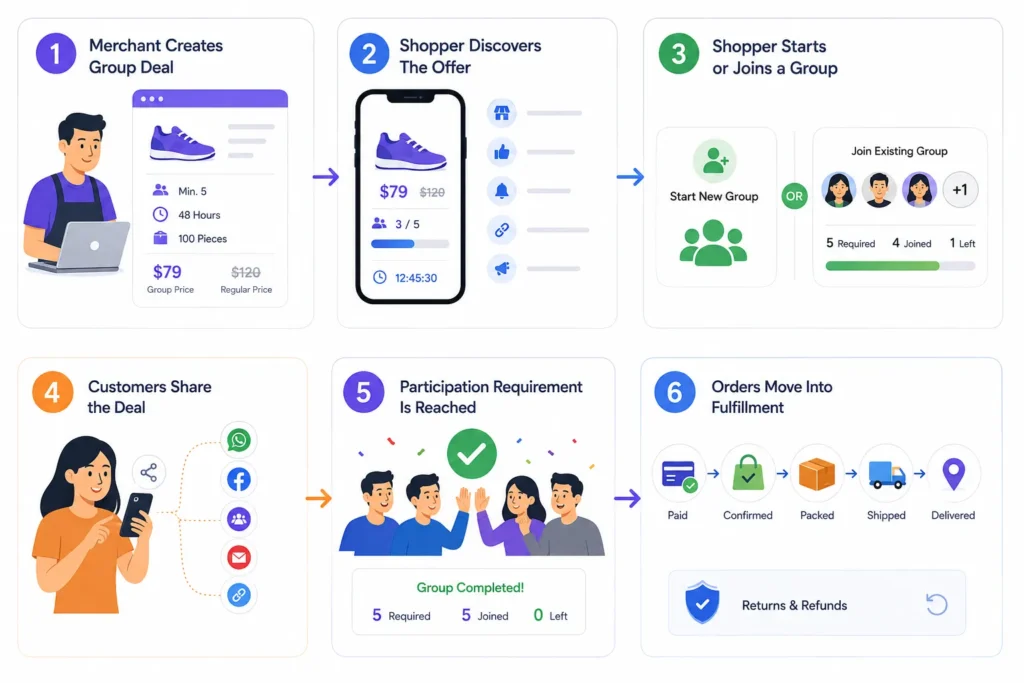
Although implementations differ between marketplaces, the basic group-buying process normally involves a few core stages.
1. A Merchant Creates a Group Deal
The process begins when a merchant selects a product and defines the conditions of the campaign.
These conditions may include:
- Regular product price
- Group purchase price
- Minimum number of participants
- Maximum group size
- Campaign duration
- Available inventory
- Product variations
- Delivery conditions
For customers, these rules should be easy to understand.
Complex campaign conditions can create friction and reduce trust.
A strong group-buying experience makes the value proposition immediately clear:
Join the group, help reach the required number of buyers, and receive the advertised deal.
2. A Shopper Discovers the Offer
Customers can discover group deals through a marketplace, product page, social feed, recommendation system, notification, referral link, or promotional campaign.
The offer usually highlights information such as:
- Group price
- Regular price
- Number of participants required
- Number of shoppers already participating
- Remaining campaign time
These signals help shoppers quickly understand whether joining the deal is worthwhile.
3. The Shopper Starts or Joins a Buying Group
Depending on the platform, a customer may either:
Start a new group
or
Join an existing group
Starting a group can make the shopper responsible for encouraging others to participate.
Joining an existing group can be easier because some of the participation requirement has already been met.
For example:
Required shoppers: 5
Current shoppers: 4
Remaining: 1
A customer seeing this situation may be more willing to join because the deal appears close to completion.
4. Customers Share the Deal
Social sharing is one of the most important characteristics of the model.
Participants may share a group offer through:
- Messaging apps
- Social networks
- Community groups
- Referral links
- Direct invitations
This turns existing customers into potential distribution channels for the campaign.
Instead of the merchant being responsible for generating every visit, participants have a reason to help attract additional buyers.
5. The Participation Requirement Is Reached
When enough shoppers join, the group-buying condition is completed.
The platform can then process the campaign according to its predefined rules.
If the required number of buyers is not reached before the deadline, the system should clearly explain what happens next.
Depending on the marketplace model, that could include cancellation, refund processing, deal expiration, or another predefined outcome.
Transparent rules are important because shoppers need to understand the commitment they are making before joining.
6. Orders Move Into Fulfillment
Once the transaction conditions have been satisfied, the order continues through the normal ecommerce fulfillment process.
That may include:
- Payment confirmation
- Merchant notification
- Inventory allocation
- Packing
- Shipping
- Delivery tracking
- Returns or refunds
Group buying changes the way demand is generated and prices are unlocked, but businesses still need dependable ecommerce operations behind the campaign.
Why Does Group Buying Appeal to Customers?
The model is effective because it combines several customer motivations.
Better Perceived Value
The most obvious motivation is price.
Customers may receive better pricing by participating collectively instead of purchasing individually.
The difference does not always need to be enormous.
The customer simply needs to feel that joining the campaign provides meaningful additional value.
Shared Shopping Experience
Traditional online shopping can be highly individual.
Group buying introduces a collaborative element.
People can discover products together, share offers, invite contacts, and work toward a common purchase condition.
This can make shopping feel more interactive.
Urgency
Many group deals operate within a defined time window.
A visible deadline encourages customers to make a decision rather than postponing the purchase indefinitely.
The important point is to use urgency transparently.
Customers should be shown genuine campaign conditions rather than artificial pressure.
Progress Toward a Goal
A deal requiring five participants becomes more compelling when four have already joined.
Progress indicators give customers a clear sense of how close the group is to completing its objective.
This is one reason participant counters and campaign status information can play an important role in the buying experience.
Why Ecommerce Businesses Use Group Buying
Group buying is not simply a discount mechanism.
When structured carefully, it can influence customer acquisition, demand generation, merchandising, and inventory planning.
Demand Aggregation
Instead of receiving isolated purchases over a long period, merchants can encourage several customers to purchase within the same campaign.
This concentrates demand.
For businesses that benefit from volume-based economics, consolidated orders can create operational opportunities that individual purchases may not provide.
Organic Product Sharing
Customers participating in a deal have a reason to invite other buyers.
This creates a built-in sharing loop:
Customer discovers deal → joins → shares → new customer discovers deal → joins
Not every campaign will become viral, but the model creates a natural incentive for customer-to-customer distribution.
Faster Inventory Movement
Group campaigns can also support inventory strategies.
Businesses may use targeted group offers for:
- Seasonal products
- Overstocked items
- New product launches
- Limited collections
- Bulk-purchase opportunities
- Time-sensitive inventory
Rather than simply applying a site-wide discount, a merchant can attach specific participation conditions to the offer.
Customer Engagement
Group campaigns provide more interaction than a standard product listing.
Shoppers can follow participation progress, invite others, monitor deadlines, and return to check campaign status.
This gives ecommerce businesses another way to engage customers around products.
Product Demand Validation
Group-buying campaigns can also reveal useful demand signals.
A merchant can observe which products attract participation, which price points generate interest, and which audiences are willing to share offers.
These insights can contribute to future merchandising and promotional decisions.
Group Buying vs Traditional Ecommerce Discounts
Group buying and standard discounts may look similar because both can offer customers a lower price.
However, the underlying mechanics are different.
| Traditional Discount | Social Group Buying |
|---|---|
| Customer buys independently | Multiple customers participate |
| Discount is immediately available | Offer may depend on group conditions |
| Limited social interaction | Sharing can be part of the purchase journey |
| Demand remains individual | Demand can be aggregated |
| Merchant drives most promotion | Customers can help distribute the offer |
| Purchase does not depend on other buyers | Campaign may require participant thresholds |
A normal coupon reduces price.
A group-buying campaign connects the price or offer to collective participation.
That difference changes both customer behavior and marketplace mechanics.
Important Elements of a Successful Group-Buying Experience
Simply adding discounted products is not enough.
Businesses need to design the entire participation journey carefully.
Clear Group Pricing
Customers should immediately understand:
- Original price
- Group price
- Savings
- Participation requirements
Ambiguous pricing can reduce trust.
Visible Participant Progress
A group deal should communicate how many buyers are required and how many have already joined.
For example:
7 of 10 shoppers joined
This makes campaign progress easy to understand.
Transparent Countdown
If a campaign expires, clearly show the deadline.
Customers should know exactly how much time remains to complete the group.
Simple Sharing
Sharing should require as little friction as possible.
Useful options can include copyable invitation links and direct sharing to commonly used communication channels.
Reliable Payment Handling
Payment behavior must be clear before a customer joins.
The customer should understand when payment is authorized, when it is captured, and what happens if the campaign does not succeed.
Inventory Visibility
Group campaigns should remain synchronized with available inventory.
Businesses should avoid collecting demand for inventory that cannot actually be fulfilled.
Clear Refund and Cancellation Rules
Customers need straightforward policies covering unsuccessful groups, merchant cancellations, unavailable products, and refunds.
Trust becomes especially important when a transaction depends on several participants.
Common Types of Group-Buying Campaigns
There is no single way to structure group buying.
Different ecommerce businesses can use different campaign formats.
Minimum Participant Deals
The lower price becomes available when a minimum number of customers join.
Example:
Minimum participants: 8
Group price: $35
Tiered Group Pricing
The price improves as participation increases.
For example:
- 5 buyers → $45 each
- 10 buyers → $40 each
- 20 buyers → $35 each
This gives customers an additional incentive to continue sharing after the initial threshold has been reached.
Time-Limited Group Deals
Customers must complete the group before a campaign deadline.
These campaigns combine collective purchasing with time-based urgency.
Community Buying
Groups may be organized around a shared location, workplace, community, interest, or membership.
This approach can be useful where customers already have a natural reason to coordinate purchases.
Bulk or Collective Purchasing
Businesses and communities can aggregate demand to access volume-based pricing.
The same underlying principle can apply to consumer ecommerce, B2B procurement, educational purchases, subscriptions, and other categories.
Where Can the Social Group-Buying Model Work?
The model can be adapted to many product categories, but it works best when there is a genuine reason for buyers to coordinate.
Examples include:
Grocery and Fresh Produce
Local communities can combine demand for larger product quantities or scheduled deliveries.
Beauty and Personal Care
Repeat-purchase products, bundles, and limited campaigns can encourage customers to invite friends.
Fashion
Group promotions can support seasonal campaigns, collections, and inventory movement.
Consumer Electronics
Accessories and selected products may work well when a merchant can offer better economics at higher volumes.
Local Commerce
Community-based sellers can organize buying campaigns around neighborhoods or geographic areas.
B2B Procurement
Small businesses can potentially coordinate demand for supplies and benefit from collective purchasing power.
The important question is not:
“Can we add group buying to this category?”
A better question is:
“Does coordinating multiple buyers create genuine value for the customer or merchant?”
If the answer is no, a conventional ecommerce promotion may be simpler.
Social Group Buying and Social Commerce
Group buying is one form of social commerce, but the two terms are not identical.
Social commerce broadly describes shopping experiences where social interaction contributes to discovery, engagement, recommendation, or purchasing.
This can include:
- Referral commerce
- Community shopping
- Influencer-led discovery
- Live shopping
- Social product sharing
- Collaborative purchasing
- Group buying
Group buying is more specific.
It connects multiple buyers around a shared purchasing condition.
A business can therefore operate a social commerce strategy without group buying, while a well-designed group-buying experience naturally contains social-commerce elements.
Challenges Ecommerce Businesses Should Consider
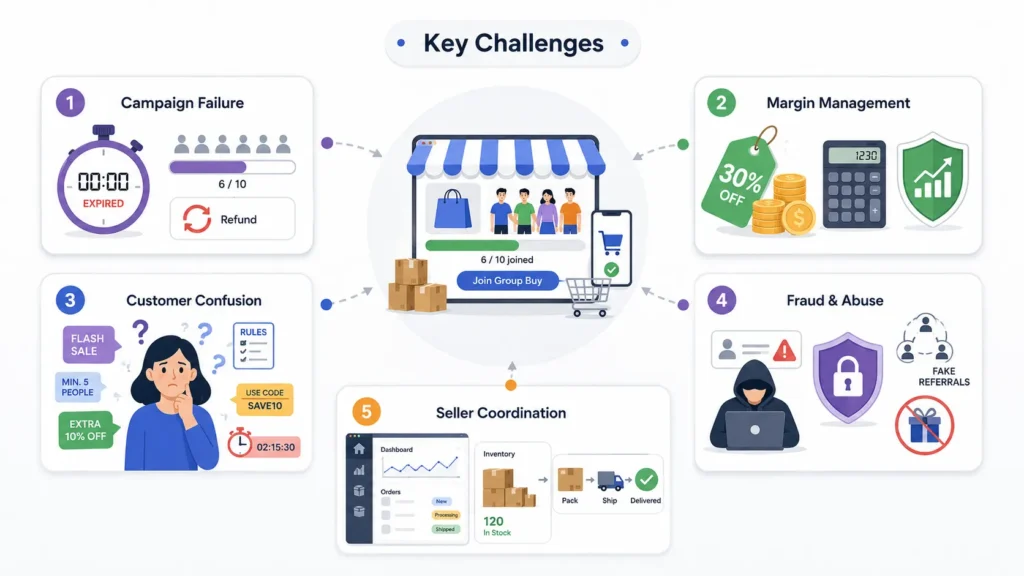
Image Source: AI-generated visual by Miracuves
The model introduces opportunities, but it also creates operational complexity.
Campaign Failure
Not every group will reach its required number of participants.
Businesses need an automated and transparent process for unsuccessful campaigns.
Margin Management
Discounts should be calculated carefully.
Increasing order volume is not useful if campaign economics create unsustainable margins.
Merchants should understand their:
- Product cost
- Fulfillment cost
- Transaction fees
- Marketing expenses
- Minimum viable margin
before defining group pricing.
Customer Confusion
Too many thresholds, conditions, timers, reward rules, and pricing levels can make a campaign difficult to understand.
Simplicity usually improves participation.
Fraud and Abuse
Referral incentives and group promotions can attract misuse if businesses do not have appropriate account, payment, and transaction controls.
Seller Coordination
On a multi-vendor marketplace, merchants need tools to create campaigns, manage products, update inventory, and fulfill resulting orders.
Operational workflows are therefore just as important as the customer-facing experience.
Read More About: Group-Buying Marketplace Features and Pricing: What Founders Should Evaluate Before Launch
How to Plan a Group-Buying Strategy
Businesses considering this model can start with a simple framework.
Step 1: Define the Customer Benefit
Identify why customers should participate.
Is the benefit:
- Lower pricing?
- Exclusive access?
- Bulk savings?
- Community purchasing?
- Limited inventory?
The value proposition should be immediately understandable.
Step 2: Select Suitable Products
Not every product needs a group campaign.
Start with products where concentrated demand creates a clear commercial advantage.
Step 3: Determine the Threshold
Choose the number of buyers required to make the campaign economically viable.
Avoid selecting arbitrary participation targets.
Step 4: Define Pricing
Calculate the standard price, group price, expected margin, and any tiered incentives.
Step 5: Set Campaign Rules
Decide:
- How long the campaign lasts
- What happens if it succeeds
- What happens if it fails
- When customers pay
- How refunds work
- How inventory is reserved
Step 6: Design the Sharing Journey
Make invitations easy.
Customers should be able to understand the benefit and share it without navigating through complicated steps.
Step 7: Measure Campaign Performance
Useful metrics may include:
- Deal participation rate
- Group completion rate
- Average participants per campaign
- Share-to-join conversion
- Average order value
- Repeat participation
- Merchant campaign performance
- Campaign cancellation rate
These measurements help businesses determine whether group buying is actually improving ecommerce performance.
Technology Needed for a Group-Buying Marketplace
A basic ecommerce store handles products, carts, checkout, payments, and orders.
A group-buying marketplace introduces additional coordination requirements.
A platform may need to manage:
- Group campaign creation
- Participant thresholds
- Campaign deadlines
- Dynamic or tiered pricing
- Participant tracking
- Deal status
- Social sharing
- Seller workflows
- Inventory synchronization
- Order processing
- Payments
- Refunds
- Notifications
- Marketplace administration
The important distinction is that group buying should operate as a coordinated purchasing workflow rather than merely appearing as a promotional label on a product.
For founders who want to manage group campaigns, seller workflows, checkout, payments, inventory, refunds, and marketplace administration from one foundation, a Marketplace eCommerce Platform can provide the operational base needed for social group buying.
Businesses evaluating how these mechanics fit into a broader ecommerce product can explore Miracuves’ social commerce platform solution to understand how group purchasing, seller workflows, and marketplace operations can be combined in one system.
Is Social Group Buying Right for Every Ecommerce Business?
No.
Group buying is most useful when collective purchasing creates genuine economic or customer value.
It may make sense when:
- Customers are price sensitive
- Products benefit from volume-based purchasing
- Shoppers naturally share products with others
- Merchants can support campaign-based pricing
- The audience already participates in communities
- The business benefits from concentrated demand
It may be less appropriate when products are extremely personalized, purchase frequency is very low, inventory is highly unpredictable, or margins do not support group incentives.
Businesses should therefore evaluate the model based on unit economics and customer behavior rather than adopting it simply because it is popular in social commerce.
Future of Community-Driven Ecommerce
Online shopping continues to evolve beyond the traditional search-and-checkout journey.
Customers increasingly discover products through communities, creators, recommendations, private groups, messaging channels, and social interactions.
Group buying adds another layer by turning customers from individual purchasers into participants in a shared transaction.
For ecommerce businesses, the broader opportunity is not simply to offer lower prices.
It is to create purchasing experiences where community, discovery, participation, and commerce work together.
Businesses that understand these mechanics can decide whether collaborative purchasing belongs within their ecommerce strategy and how it should be implemented without making the customer journey unnecessarily complicated.
Final Thoughts
Social group buying changes ecommerce by connecting purchasing decisions to collective participation.
Rather than treating every customer as an isolated buyer, the model gives shoppers a reason to join deals, invite others, and help generate enough demand to unlock an offer.
For merchants, the potential benefits include concentrated demand, customer-driven sharing, stronger campaign engagement, and new ways to structure ecommerce promotions.
But successful implementation requires more than discounts.
Businesses need clear campaign rules, transparent pricing, dependable payments, accurate inventory, simple sharing, and strong marketplace operations.
When those components work together, social group buying can become a practical ecommerce strategy rather than just another promotional tactic.
FAQs
What is social group buying?
Social group buying is an ecommerce model where multiple customers participate in the same purchasing offer. A special price or benefit may become available when the required number of shoppers joins the campaign.
How does group buying work in ecommerce?
A merchant creates a campaign with a price, participation requirement, and deadline. Customers join the offer and may invite others. Once the required conditions are reached, participating customers receive the deal according to the campaign rules.
Why do customers join group-buying deals?
Customers may participate to receive better pricing, access special offers, shop with friends or communities, and benefit from collective purchasing.
How does group buying benefit merchants?
It can help merchants concentrate demand, encourage organic sharing, create campaign engagement, move selected inventory, and test customer interest in products or pricing.
What is the difference between social commerce and group buying?
Social commerce is a broad category covering shopping influenced by social interaction. Group buying is a specific model where multiple customers coordinate around the same purchasing condition.
Can group buying work for a multi-vendor marketplace?
Yes. Multiple merchants can run their own campaigns if the marketplace provides appropriate tools for product management, campaign rules, inventory, orders, payments, and administration.
What should businesses consider before introducing group buying?
Businesses should evaluate product margins, customer behavior, participation thresholds, campaign rules, inventory availability, payment processes, refund policies, and whether collective purchasing creates meaningful customer value.
Miracuves is an independent software development company. We are not affiliated with, connected to, sponsored by, or endorsed by any company or product named in this article.
Terms such as “X Clone” are used descriptively. It is how the software industry refers to building a platform with functionality comparable to a known service, and how clients search for it.
The entire design and codebase of our products is built by our own team. Our products contain no code, design, graphics, or content originating from any third-party website or applications.
All third-party names and marks referenced in this article are the property of their respective owners, referenced solely to identify the services discussed.