
Key Takeaways
- Prevent Seat Booking Clashes in Ticketing Apps. The backend must ensure that the same seat cannot be successfully allocated to two customers for the same performance.
- Real-time seat locking temporarily protects selected seats during checkout. A valid hold should identify the seats, performance, reservation owner, and expiration time.
- A visual seat map alone cannot prevent double booking. The backend must remain the authoritative source for deciding whether a reservation succeeds.
- Atomic reservation operations are essential for handling simultaneous requests. When two customers request the same seat, only one should be able to acquire the valid reservation.
- Database constraints provide an important final layer of protection. Proper inventory rules should prevent duplicate confirmed allocations even if an application-level defect occurs.
- Seat holds must have server-enforced expiration. A browser countdown is only a customer-facing indicator; the backend must determine when a reservation actually expires.
- Expired holds must be released carefully. The system should verify that the reservation still belongs to the original hold before making inventory available again.
- Payment and seat reservation cannot be designed independently. If payment succeeds after a hold expires, the platform must reconcile the payment without assigning a seat that has already been sold elsewhere.
- Idempotency prevents duplicate bookings and financial effects. Repeated payment callbacks or client retries should produce the same business result rather than creating another ticket or transaction.
- WebSockets improve real-time availability visibility but do not guarantee inventory safety. The server must still reject conflicting reservations even when customers receive stale or delayed seat-map updates.
- Group bookings require atomic handling when all selected seats must be reserved together. If one requested seat is unavailable, the system should avoid creating an unintended partial reservation.
- Reserved seating and general admission require different inventory rules. A numbered seat needs unique allocation, while general admission typically requires atomic capacity management.
- Failure recovery must be part of the reservation architecture. Server crashes, cache failures, delayed payment notifications, and failed expiration workers should not create conflicting inventory states.
- Load testing should simulate real booking contention. Testing simultaneous requests, payment delays, duplicate callbacks, expired holds, and reconnecting clients helps reveal double-booking risks before launch.
- The key success metric is inventory correctness. A reliable ticketing system should maintain zero duplicate confirmed allocations while providing clear conflict handling, recovery, and checkout performance.
Imagine two customers opening the same cinema seat map at exactly the same moment. Both see seat G12 available. Both select it, proceed to checkout, and attempt to pay. If the platform processes these actions without reliable reservation controls, it could accidentally confirm the same seat for two different customers.
This is one of the most important technical challenges in online ticketing. A dependable White-Label Ticket Booking App needs more than a visual seat-selection interface. It must coordinate concurrent booking requests, temporarily reserve inventory, verify payment outcomes, and ensure that each individual seat is sold no more than once for the same performance.
Real-time seat locking makes this possible by giving an eligible customer temporary priority over selected seats while checkout is in progress. Other customers can still view the seating layout, but they cannot successfully reserve seats that are already held by another active booking session.
However, a visible countdown or a colored seat map does not by itself prevent double booking. The actual protection comes from backend concurrency controls, durable inventory records, reservation expiration rules, and a payment-confirmation process that cannot accidentally create duplicate tickets.
This guide explains how real-time seat locking works, why booking clashes happen, how successful ticketing systems handle simultaneous checkout attempts, and what founders should evaluate before launching a cinema or event reservation service.
Why Seat-Booking Clashes Happen During Online Checkout
A seat-booking clash occurs when two or more booking attempts compete for the same limited inventory. In a cinema, the inventory may be a numbered seat for a specific showtime. At a concert, it may be a numbered seat in a particular event session or a limited number of tickets in a designated category.
The problem arises because several independent actions take place between opening a seat map and completing a purchase. Customers browse, select seats, apply offers, confirm details, move to payment, and sometimes return after an external payment authentication step.
During that interval, another customer may attempt to purchase exactly the same inventory.
The Race Condition Behind a Double Booking
A race condition occurs when the outcome of an operation depends on the timing of concurrent requests. Consider a system that checks whether seat G12 is available and then updates its status in a separate step.
Customer A requests G12. The system reads its status as available. Before Customer A’s update completes, Customer B requests the same seat and receives the same available status.
If both requests are permitted to write a successful reservation without an appropriate concurrency guard, the platform can create conflicting records.
This is sometimes described as a time-of-check-to-time-of-use problem. The state that was true when the system checked the seat may no longer be true when it attempts to reserve it.
The solution is not simply to check availability more frequently. The reservation operation itself must enforce the rule that only one competing attempt can succeed.
Why Visual Seat Availability Is Not Enough
A seat map is a presentation of inventory information. It can indicate which seats appear available, held, sold, or unavailable, but the information may already be changing while it is displayed.
Even a seat map that refreshes frequently can show information that becomes outdated milliseconds later. Network latency, browser connectivity, caching, and simultaneous user actions make perfect visual synchronization unrealistic.
The backend must therefore remain authoritative. A customer can request a seat based on the most recent display, but the server must decide whether the reservation actually succeeds.
What Is Real-Time Seat Locking in Ticket Booking?
Real-time seat locking is a reservation mechanism that temporarily prevents competing customers from acquiring the same seat while an active customer completes an eligible booking process.
A successful temporary hold usually includes the selected seat identifiers, the applicable performance or session, a reservation owner or token, an expiry timestamp, and a booking-state reference.
The purpose is to provide a short, controlled checkout window without treating the seat as permanently sold before the payment and booking processes are completed.
The Four Important Seat States
| Seat state | Meaning | Customer action |
|---|---|---|
| Available | No active hold or confirmed sale prevents reservation | Customer may request the seat |
| Held | A valid temporary reservation owns the seat | Other customers cannot reserve it |
| Booked | A confirmed booking permanently allocates the seat for that performance | Seat is not available for another purchase |
| Unavailable | Seat is blocked for operational or venue reasons | Seat is not offered for purchase |
Actual implementations may use additional states such as payment pending, cancellation pending, refund in progress, or release scheduled. The fundamental distinction remains the same: a temporary hold is not a confirmed sale.
A correctly designed state machine also prevents invalid transitions, such as changing a seat directly from available to confirmed without the required verification or reopening a sold seat because an old expiration job ran late.
How Real-Time Seat Locking Works: From Selection to Confirmation
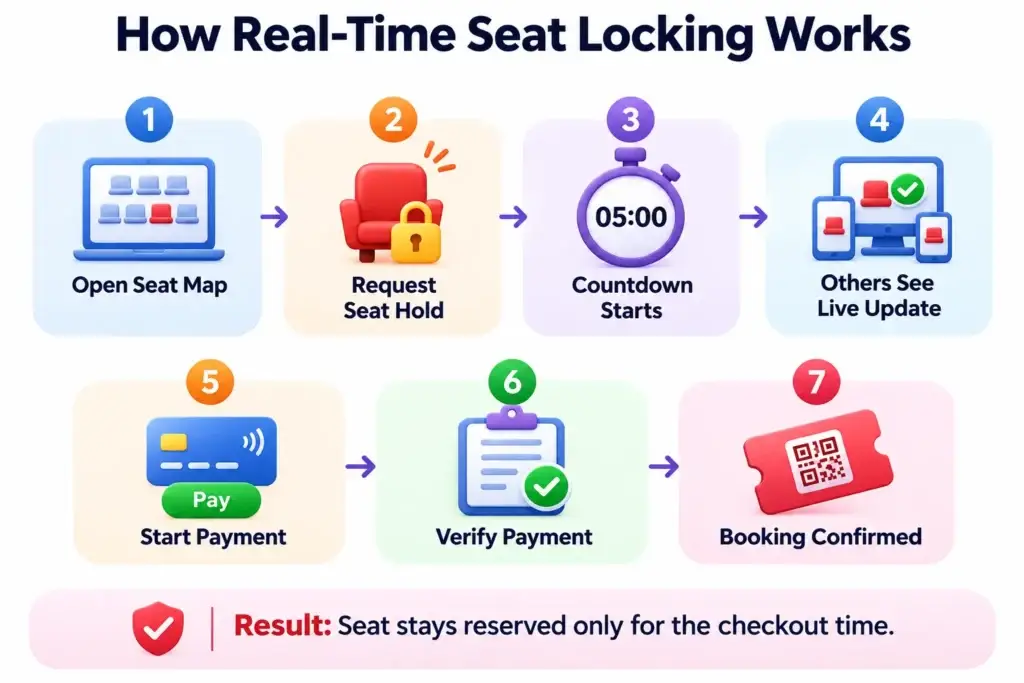
A typical reserved-seat checkout can be understood through seven stages. Each stage has a different responsibility, and the system needs explicit rules for what happens if any stage fails.
Step 1: The Customer Opens a Performance-Specific Seat Map
The application retrieves the seating layout and current availability for a specific performance, not just for the physical auditorium.
This distinction matters because seat G12 may be available for the afternoon show but already booked for the evening show. Seat identity must therefore include the relevant event or showtime reference.
The browser receives the information needed to display available seats, temporarily held seats, permanently sold seats, and any operationally restricted areas.
Step 2: The Customer Requests a Temporary Hold
When the customer selects a seat and proceeds toward checkout, the application sends a reservation request to the backend.
The server checks the authoritative inventory state and attempts to acquire the seat through an atomic reservation operation. If another active reservation has already acquired it, the new request fails cleanly.
A successful hold creates a reservation reference that identifies the customer session, selected performance, allocated seats, and expiry time. The client should use this server-issued reference during subsequent checkout operations.
Step 3: A Countdown Begins
The reservation remains valid for a limited period. The application may show a countdown indicating how long the customer has to complete the next part of checkout.
The countdown is useful for communication, but the authoritative expiration must be enforced by the server. Changing the clock in a browser or sending an altered expiry timestamp should not extend reservation ownership.
A five-minute hold is one possible design. The appropriate duration depends on payment methods, expected customer behavior, event demand, and the commercial cost of keeping seats unavailable.
Step 4: Other Customers Receive an Updated View
After the hold is created, the ticketing system publishes the changed seat status to connected customers. Real-time technologies such as WebSockets can update their seat maps without requiring manual page refreshes.
This improves customer experience by reducing the number of users attempting to select seats already held by someone else.
However, the live update does not create the reservation guarantee. The backend’s atomic inventory decision provides that protection. The real-time message only communicates the latest state.
Step 5: The Customer Starts Payment
The platform associates a payment attempt with the active booking reference. The payment service may redirect the customer, request additional authentication, or wait for approval from a bank or wallet provider.
During this process, the booking system must preserve the relationship between the payment attempt and the inventory reservation. Creating unrelated payment attempts without consistent identifiers increases the risk of duplicate charges or confusing booking states.
Step 6: The Backend Verifies the Payment Result
After payment, the system verifies the result through an authenticated gateway response or an appropriate provider-side verification process. A browser redirect or a customer-facing success screen should not alone be trusted as proof that funds were successfully captured.
The server confirms that the payment belongs to the correct booking, matches the expected amount and currency, and has not already been processed.
If the reservation is still valid and the business’s confirmation conditions are satisfied, the booking moves to a confirmed state. If payment has succeeded but the hold is no longer valid, the system must reconcile the transaction without assigning inventory that may already belong to another customer.
Step 7: The Booking Becomes Final
Once confirmation succeeds, the platform records the final seat allocation and produces the customer’s ticket or booking entitlement.
Ticket generation, notifications, and entry credentials can follow as separate operations, provided the system ensures that they reference the same confirmed booking.
The venue’s entry-checking process should validate the actual booking entitlement, not merely trust that a QR image exists.
What Happens When Two Customers Select the Same Seat at Exactly the Same Time?
This is the defining test of a seat reservation engine. Imagine Customer A and Customer B both request seat G12 for the 7:30 PM performance.
Both requests arrive while the seat appears available on their screens. The backend must resolve the conflict without creating two successful holds.
Illustrative Simultaneous Booking Scenario
12:00:00.000 — Seat G12 is available for the selected performance.
12:00:00.010 — Customer A sends a hold request.
12:00:00.011 — Customer B sends a competing hold request.
12:00:00.013 — An atomic reservation operation accepts Customer A.
12:00:00.014 — Customer B’s request detects the existing reservation and fails.
12:00:00.020 — Both clients receive the appropriate state or conflict response.
Illustrative timestamps only. Actual processing times vary. The invariant is that only one valid reservation can own the same seat for the same performance, regardless of the order in which clients display results.
The losing customer should receive a clear message explaining that the seat is no longer available, ideally with refreshed alternatives. A generic server error makes the platform appear unreliable even when its concurrency controls worked correctly.
Importantly, the system should not lock the entire auditorium just because two customers are competing for one seat. Reservation granularity should be appropriate to the inventory being sold, allowing independent seats or appropriately defined ticket categories to remain purchasable.
The Technical Foundation: Atomic Reservations, Distributed Locks, and Database Constraints
Several technical approaches can support safe seat reservations. The correct design depends on the database, architecture, peak traffic, inventory model, and failure-recovery requirements.
No single technology name guarantees correctness. The central requirement is a consistent rule that the platform enforces even when requests overlap, services restart, or external systems respond late.
Atomic Database Updates
An atomic operation ensures that a critical inventory change behaves as one indivisible unit. For example, a database can accept a seat reservation only when the stored state still satisfies the expected condition.
If the state has already changed, the competing update affects no eligible row or produces a controlled conflict. This prevents two successful reservation requests from being created through a naive read-then-write sequence.
Database transactions also help keep related changes consistent. The application may need to update seat state, create a hold record, and record an inventory event without leaving partially committed results.
Optimistic Concurrency Control
Optimistic locking commonly uses a version number or other concurrency token associated with an inventory record.
When the application reads the seat, it also reads the current version. Its attempted update succeeds only if that version is still current. A competing successful update changes the version, causing a later stale request to fail.
This approach works well when conflicts are manageable and transactions can retry or report a clean availability change. It still requires careful design for multi-seat reservations and for transactions involving several records.
Distributed Reservation Locks
Ticketing applications often run on multiple backend instances. A lock held only in one server’s local memory will not protect reservations processed by another server.
A distributed locking mechanism can coordinate requests across instances. An atomic key-acquisition operation with a defined expiration can temporarily establish which reservation owns a given seat.
However, a distributed lock should not be treated as the only protection against overselling. Cache failures, lease expiration, network partitions, delayed requests, and service restarts can all complicate lock ownership.
A durable database constraint or conditional transaction should enforce the final inventory invariant, with lock ownership tokens or fencing mechanisms used where appropriate to reject stale operations.
Database Uniqueness and Booking Integrity
A properly designed ticket inventory model can enforce that each performance-seat combination has no more than one active confirmed allocation. The exact schema depends on whether seats are individually represented, pooled, or assigned at a later stage.
For reserved seating, constraints should prevent duplicate confirmed allocations even if an application-level defect reaches the database. Temporary holds may require separate tables, status-aware constraints, or carefully controlled transaction rules.
The database becomes the final authority for confirmed inventory, while cache and real-time infrastructure can accelerate reservation handling and customer feedback.
Why Seat Holds Need an Expiration Timer
Without expiration, a customer could select a popular seat, abandon checkout, and leave the inventory blocked indefinitely.
Time-limited holds solve this problem by giving the customer a reasonable opportunity to complete the purchase while protecting the venue’s ability to resell abandoned inventory.
The correct hold duration is a commercial and operational decision. Short holds improve inventory circulation, but may create friction for customers using slower payment methods. Long holds provide more flexibility but may temporarily reduce availability during busy on-sales.
What Happens When a Seat Hold Expires?
When a hold reaches its authoritative expiry time, the system determines whether it remains eligible for release. It must check whether the reservation has already progressed into a confirmed sale or a protected payment-finalization state.
If the reservation is genuinely expired and no longer protected, the inventory can become available for another customer. The seat-map interface then receives or retrieves the updated state.
A scheduled expiry task should never blindly delete whichever lock currently exists. It must verify that the lock or reservation still belongs to the original hold, because the seat could have been released and acquired by another customer in the meantime.
Should Every Booking Have the Same Hold Duration?
Not necessarily. Payment type, event demand, group size, accessibility arrangements, and operational policies can affect the appropriate timing.
For example, an externally authenticated payment may require a different finalization policy from an immediate wallet transaction. Extending holds should still be controlled by the backend and bounded to prevent indefinite reservations.
Operators should document exactly when a hold begins, what may extend it, what happens when payment is already in progress, and when inventory may be made available again.
The Hardest Checkout Problem: Payment Succeeds After the Seat Hold Expires
A particularly difficult failure scenario occurs when payment confirmation arrives after the reservation deadline. The customer may have approved the payment before expiry, but a network delay or external provider may deliver the final result later.
The platform must distinguish payment success from confirmed seat ownership. Receiving money does not automatically mean that inventory remains available.
Scenario A: Payment Completes Within a Valid Hold
The payment is verified and the reservation still owns the selected seats. The platform finalizes the allocation, records a confirmed booking, and proceeds to ticket issuance.
Scenario B: Payment Fails
The platform records the failure and releases the inventory according to its established rules. Any payment retry should remain associated with the correct reservation and should not accidentally create a duplicate charge or booking.
Scenario C: The Hold Expires Before Payment Confirmation
The platform must check the authoritative reservation and payment states. If the seat was already released and legitimately acquired or sold elsewhere, the delayed payment cannot be used to confirm the original seat.
The system should instead follow its documented exception policy, such as initiating a refund or reversal, offering an alternative where appropriate, and notifying the customer.
One possible architecture is to transition a reservation into a controlled payment-finalization state before the ordinary hold deadline, with strict time bounds and recovery rules. The exact approach depends on gateway behavior and inventory policy.
These scenarios demonstrate why payment processing and seat locking cannot be designed independently. For a deeper discussion of gateway failures and delayed callbacks, see the ticketing checkout failure and payment recovery guide.
Why Idempotency Is Essential for Preventing Duplicate Bookings
Payment providers and backend services may retry messages when network connections fail or a response is not received. A single financial event can therefore arrive more than once.
If every repeated payment notification creates a new booking, the system may issue duplicate tickets, duplicate settlements, or inconsistent accounting entries.
Idempotency means that repeating an operation with the same intended identity does not create additional business effects after the first successful processing.
How Idempotent Booking Confirmation Works
The platform assigns a stable identifier to the booking or payment operation and records external event identifiers when available. Before applying an incoming payment result, the backend checks the durable record of that operation.
If the event has already been processed, the system acknowledges the duplicate without issuing another ticket or repeating the financial change.
Crucially, the duplicate check and the creation of the corresponding business result must be transactionally safe. A simple separate query asking whether an event exists can itself suffer from concurrency problems when two identical notifications arrive together.
Database uniqueness rules and controlled transactions help make idempotency reliable even when multiple server instances process messages concurrently.
How WebSockets Keep Seat Availability Updated Across Customers
Customers expect the seat map to change when another person reserves or purchases inventory. Real-time communication improves that experience.
WebSockets allow the backend to send availability updates over an established connection. When a seat changes from available to held, the platform can broadcast the relevant update to viewers of the same performance.
The client then redraws the affected seat without requiring the customer to refresh the entire page.
Real-Time Updates Are Not the Source of Truth
A customer may temporarily lose connectivity, miss a message, or reconnect after several state changes. The application should therefore have a way to recover the authoritative current inventory snapshot.
Useful designs include version numbers, sequence identifiers, or snapshot refreshes after reconnecting. The objective is to prevent the browser from continuing to show stale seat availability indefinitely.
Even when the interface is temporarily outdated, the server’s reservation operation must continue to reject invalid or conflicting holds.
Why Polling Alone Has Limitations
Polling requests the latest seat status at intervals. It can be appropriate for smaller systems, but frequent polling creates repeated requests, and longer polling intervals can leave users viewing stale information.
A real-time push mechanism reduces unnecessary repeated checks, although it introduces connection management and recovery requirements.
The appropriate communication method depends on expected traffic and architectural needs. Neither approach replaces the requirement for correct server-side inventory operations.
Group Bookings: How to Prevent Partial Seat Reservations
Group checkout introduces additional complexity because a customer may want several adjacent seats rather than one individual seat.
Suppose a family selects four seats. If the system reserves three successfully but loses the fourth to another customer, the group may no longer want the transaction.
A robust ticketing system should define whether the selected seats are acquired as an all-or-nothing group. For many reserved-seating purchases, the desired behavior is atomic group reservation: every requested seat becomes held for that booking, or none does.
This is more complicated than holding seats independently. The system must evaluate all selected seats against the current authoritative state and commit the required inventory changes consistently.
When an atomic group hold fails, the application can offer alternative adjacent seats or ask the customer to revise the selection. It should not silently substitute a different seating arrangement without the customer’s consent.
Why Group Payment Splitting Requires a Separate Policy
Some event platforms allow multiple people to contribute toward one booking. This raises questions about how long inventory remains protected, whether partial payments are sufficient, and what happens when one participant fails to pay.
The reservation system needs explicit ownership and deadline rules. A split-payment workflow should not create multiple independent claims on the same seats or leave inventory permanently held while individual participants decide whether to contribute.
Reserved Seats vs. General Admission: Not All Ticket Inventory Uses the Same Locking Rules
Numbered cinema seats and general-admission event passes represent different types of inventory.
A reserved seat is uniquely identified by the performance and seat reference. General-admission inventory may instead be represented by a capacity count for a specific ticket category or entry zone.
| Inventory model | Reservation rule | Main risk |
|---|---|---|
| Numbered cinema seating | One confirmed allocation per seat and showtime | Same seat sold twice |
| Numbered theatre seating | One confirmed allocation per seat and event session | Duplicate reserved-seat allocation |
| General admission | Atomic decrement or reservation of ticket capacity | Overselling category capacity |
| Timed entry or activity slots | Capacity enforcement per scheduled time interval | Overbooking the same time slot |
For a general-admission category with 100 remaining tickets, the platform must ensure that simultaneous customers cannot collectively reserve 101. An atomic capacity operation can protect this invariant without creating a unique physical seat record for every pass.
For businesses supporting several event formats, the events and ticketing industry architecture overview provides broader context on seat maps, timed inventory, checkout workflows, and venue operations.
What Happens When the Booking Server or Reservation Cache Fails?
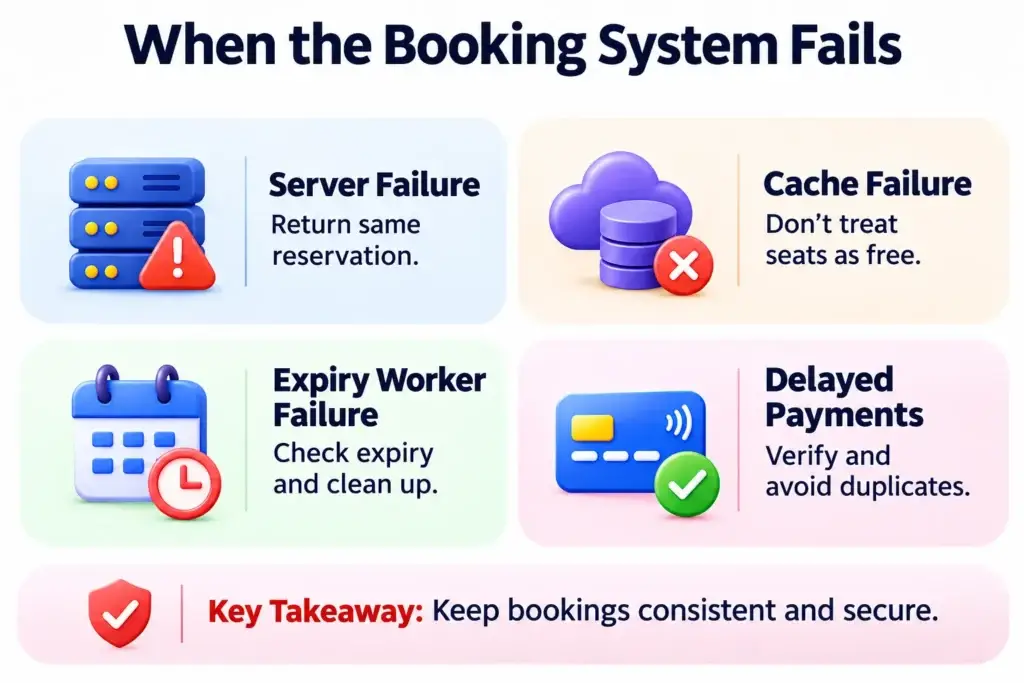
Concurrency controls must remain dependable under imperfect operating conditions. A system that works when every service responds immediately may still experience booking errors during partial outages.
Server Failure After a Hold Is Created
A server may terminate after successfully reserving seats but before returning a response. The customer may retry because no confirmation appeared.
The platform should identify that the retry belongs to the same intended reservation, using a stable idempotency key or reservation identifier. It should return the existing valid result or a controlled status rather than creating a second unrelated reservation.
Cache Failure During Checkout
If a distributed cache becomes unavailable, the system must not assume that all cached seats are free. Doing so could create conflicting reservations while previous holds remain valid in durable records.
A safe recovery policy may temporarily restrict new reservations, reconstruct the authoritative state, or use a verified database-backed operation until coordination is restored.
The correct behavior depends on how the platform distributes reservation authority between its database and caching layer.
Expiration Worker Failure
A background worker responsible for releasing expired holds may stop temporarily. The system should not rely only on that worker to determine whether a reservation is valid.
Reservation checks should consider authoritative expiry times and ownership rules. Recovery workers can then reconcile stale records without accidentally removing a newer hold or reopening a confirmed booking.
Delayed or Duplicate Payment Notifications
Payment providers may retry callbacks or deliver them after a temporary network failure. The booking system must authenticate messages, reject unauthorized state changes, and process duplicate events safely.
The financial ledger and the reservation record should also be reconciled when a provider reports success but ticket confirmation could not be completed.
Why Seat-Locking Reliability Matters During High-Demand Ticket Sales
Major events can generate sudden spikes in customer traffic. Thousands of people may open the same seat map, with many attempting to reserve limited popular sections at once.
During these periods, the pressure is not evenly distributed across the system. A small group of popular seats may receive many competing requests, while other inventory remains relatively uncontested.
Operators need to consider both system throughput and concentrated contention. The platform should continue rejecting conflicting reservations correctly even when the checkout experience becomes slower.
Avoid Turning Contention Into a Platform-Wide Bottleneck
Locking an entire event inventory for every single-seat request would unnecessarily serialize unrelated reservations. Systems should use suitable inventory identifiers, lock granularity, and transaction boundaries.
Requests for different independent seats should be able to progress without waiting for one global lock whenever the inventory model permits it.
Use Waiting Rooms Carefully
A virtual waiting room can help control how many customers enter the purchasing process simultaneously during extreme demand. It can reduce load on seat maps and checkout services.
However, admission to a waiting room does not reserve a seat. Inventory must still be allocated through the authoritative reservation process.
Queue fairness, session expiration, reconnect behavior, and bot protection should be considered separately from seat ownership.
How to Test a Ticketing System for Double-Booking Risks Before Launch
Founders should request evidence that the booking engine behaves correctly under overlapping requests and failure conditions. A successful demonstration with a single customer is not sufficient.
Useful tests should verify both correctness and customer experience. The system must not oversell inventory, but it should also respond clearly when reservations fail or expire.
| Test scenario | Expected result | Risk being tested |
|---|---|---|
| 100 simultaneous requests for one seat | At most one active successful reservation | Race conditions |
| Two requests for different seats | Both can succeed independently | Unnecessary global blocking |
| Group request includes one unavailable seat | No partial group hold if all-or-nothing is required | Partial reservations |
| Customer abandons checkout | Expired hold becomes eligible for release | Stranded inventory |
| Payment succeeds after expiry | Reconciliation without conflicting confirmation | Paid-but-unbooked cases |
| Duplicate payment callback | Only one booking and financial effect | Duplicate processing |
| Backend crash after hold creation | Retry recovers original reservation outcome | Ambiguous transactions |
| Viewer reconnects after missing updates | Current authoritative seat state is restored | Stale seat maps |
The numbers used in a load test should reflect the expected launch profile. A platform may need to test at multiples of its forecast peak to understand how it behaves when demand exceeds expectations.
There should also be a clear definition of success. Zero duplicate confirmed seats is a core correctness invariant, while request latency, error rate, recovery time, and successful checkout percentage help evaluate operational performance.
Operational Metrics That Reveal Seat Reservation Problems
Even well-designed systems require monitoring after launch. Booking problems can arise through new integrations, unexpected traffic patterns, configuration errors, or changes to event inventory.
Operators should monitor metrics that explain where customers encounter friction and whether inventory controls are functioning correctly.
- Hold acquisition success rate: The share of eligible hold requests that successfully reserve their requested inventory.
- Reservation conflict rate: The share of requests rejected because another valid allocation already owns the inventory.
- Hold expiration rate: The proportion of holds that expire before becoming confirmed bookings.
- Payment-to-booking reconciliation exceptions: Cases where financial success and booking confirmation do not align.
- Seat-map update delay: The time between an authoritative state change and its appearance in connected clients.
- Duplicate confirmed allocations: A critical integrity metric that should remain zero for unique reserved seats.
- Booking finalization latency: The time required to reconcile payment and persist the final ticket allocation.
- Recovery backlog: Reservations or payments awaiting resolution after failures.
A high reservation-conflict rate during a popular event is not automatically a technical defect. It may simply reflect strong competition for limited seats. The important question is whether rejected attempts are handled correctly and whether the booking engine remains responsive.
Similarly, an unusually high hold-expiration rate may point to payment friction, an unsuitable timer, automated traffic, or customers holding seats without genuine purchase intent.
Seat Locking and Revenue Protection: Why Reliability Matters to Venue Operators
A double-booked seat creates more than a technical inconvenience. It can force venue staff to resolve disputes at entry, relocate customers, issue refunds, or compensate attendees for an experience that could not be delivered as promised.
During a sold-out event, those problems can damage trust and increase support expenses at the moment when staff are under the greatest pressure.
Overly aggressive locking creates a different commercial problem. If abandoned holds remain active too long, customers who want to purchase may see inventory as unavailable even though no confirmed sale exists.
The operational goal is therefore twofold: prevent conflicting confirmed allocations while returning legitimately abandoned inventory to sale promptly.
A reliable reservation engine supports that balance through controlled expiry, accurate availability, sound payment reconciliation, and clear exception handling.
What Founders Should Ask Before Choosing a Seat Reservation Engine
When evaluating ticketing technology, founders should ask about correctness guarantees and operational failure behavior rather than accepting a live seat map as proof of concurrency safety.
- What guarantees that two customers cannot confirm the same seat for one performance?
- Is availability enforced through atomic transactions, uniqueness rules, or another durable mechanism?
- How are temporary holds identified, owned, and expired?
- Can one expired reservation accidentally release another customer’s newer hold?
- How are group reservations handled when one selected seat becomes unavailable?
- What happens when payment confirmation arrives after the reservation deadline?
- Are repeated gateway callbacks and client retries processed idempotently?
- How do seat maps recover from missed real-time updates?
- What load and failure tests have been performed against the current implementation?
- How are booking conflicts, payment exceptions, and inventory changes audited?
The answers should form a written booking correctness contract. This document describes the conditions under which a reservation is accepted, confirmed, expired, canceled, or reconciled after a failure.
Founders managing several venues may also need to consider operator permissions, inventory synchronization with physical box offices, settlement rules, and integrations with external ticketing partners.
For more complex venue networks, marketplace architecture and integration support can be relevant when several operators must share event inventory, booking responsibilities, and commercial workflows.
How Miracuves Helps Founders Evaluate Reliable Ticketing Infrastructure
Miracuves provides a ready-made entertainment ticketing foundation that includes seat selection, temporary holds, real-time inventory visibility, checkout workflows, and venue administration. This can reduce the need to create every standard ticketing module from the beginning.
Its published solution architecture describes distributed reservation locking, version-checked inventory updates, five-minute holds, and verified payment callbacks. These capabilities should still be demonstrated and tested against the proposed venue setup, inventory configuration, and expected launch traffic.
For qualifying ready-made deployments, Miracuves offers six-working-day delivery of the agreed software foundation. Additional integrations, specialized booking rules, external payment accounts, venue onboarding, and custom operational requirements may involve separate scope and timelines.
The practical decision is not simply whether a product displays seats attractively. It is whether the booking engine can maintain inventory correctness when customers compete, sessions expire, payments arrive late, and backend services experience failures.
Final Thoughts: Reliable Seat Booking Starts With Correct Inventory Ownership
Preventing seat-booking clashes is fundamentally an inventory-consistency problem. A ticketing platform must ensure that every seat or admission entitlement is allocated according to clear rules, even when thousands of customers interact with the system simultaneously.
Real-time seat locking reduces conflicts during checkout, but the strongest protection comes from atomic reservation operations, durable database constraints, authoritative expiration rules, verified payments, and idempotent booking confirmation.
For founders exploring a White-Label Ticket Booking App, these technical principles provide practical criteria for evaluating reservation reliability, checkout integration, and operational readiness beyond the appearance of the customer-facing interface.
The objective is not merely to make a seat appear unavailable when someone clicks it. It is to guarantee that the business can explain who owns that seat, how long the ownership remains valid, when the sale becomes final, and what happens if any part of the transaction fails.
When those responsibilities are well defined, a ticketing platform can protect customer trust, reduce avoidable operational disputes, and support more dependable cinema and event sales.
Frequently Asked Questions
How do ticketing apps prevent two customers from booking the same seat?
Ticketing apps use authoritative server-side reservation controls, such as atomic database updates, transaction rules, distributed locks, and uniqueness constraints. Only one competing request can acquire a valid reservation for the same seat and performance. Other requests receive an availability conflict.
What is real-time seat locking during checkout?
Real-time seat locking temporarily reserves selected inventory for an eligible customer while checkout proceeds. The hold has a defined owner and expiry time. If the booking is not completed under the platform’s rules, the inventory becomes eligible for release.
How long should a cinema ticket seat remain locked?
There is no universal ideal duration. Some systems use approximately five minutes, but the appropriate window depends on payment methods, customer behavior, demand intensity, and venue policy. The server must enforce expiry, and any extensions should be controlled and bounded.
Can WebSockets alone prevent double booking?
No. WebSockets help display seat-status changes to connected users, but they do not provide the authoritative inventory guarantee. The backend needs atomic reservation operations and durable integrity controls to prevent conflicting allocations.
What happens if payment succeeds after a seat lock expires?
The platform must reconcile the verified payment with the authoritative reservation state. If the original seat has been legitimately released or acquired elsewhere, the delayed payment must not create a conflicting booking. A documented refund, reversal, or alternative-resolution process may be necessary.
What is the difference between a seat hold and a confirmed booking?
A hold is a temporary claim that protects inventory while checkout is underway. A confirmed booking is a finalized entitlement recorded after the applicable payment and validation conditions have been met. The two states must not be treated as interchangeable.
How can a ticketing platform handle multiple adjacent seats safely?
For an all-or-nothing group booking, the system checks and reserves all requested seats atomically. If one seat is unavailable, the entire group reservation fails without retaining a partial set. The customer can then choose another arrangement.
How should founders test seat locking before a major event sale?
Test simultaneous requests for the same inventory, independent reservations, group holds, expiry races, payment delays, duplicate callbacks, server failures, and client reconnections. Verify that no seat is confirmed twice and that failed attempts receive understandable responses.
Miracuves is an independent software development company. We are not affiliated with, connected to, sponsored by, or endorsed by any company or product named in this article.
Terms such as “X Clone” are used descriptively. It is how the software industry refers to building a platform with functionality comparable to a known service, and how clients search for it.
The entire design and codebase of our products is built by our own team. Our products contain no code, design, graphics, or content originating from any third-party website or applications.
All third-party names and marks referenced in this article are the property of their respective owners, referenced solely to identify the services discussed.