
Key Takeaways
- A ticketing platform payment system should coordinate cards, UPI, wallets, payment gateways, booking status, seat inventory, refunds, and transaction confirmation in one reliable checkout flow.
- Supporting multiple payment methods gives users flexibility while payment orchestration helps route transactions, track status changes, and maintain accurate booking records.
- When a gateway fails or payment confirmation is delayed, the platform must protect seat inventory, avoid duplicate charges, recover transaction status, and clearly communicate the outcome to the buyer.
Payment Method & Routing Signals
- Card payments can involve authorization, authentication, gateway processing, issuer responses, capture, refunds, and settlement before the booking reaches its final payment state.
- UPI and wallet flows may use redirects, app handoffs, QR payments, callbacks, webhooks, transaction references, and status checks to confirm whether a booking should proceed.
- Payment orchestration can distribute transactions across gateways using availability, payment method, success rate, routing rules, transaction value, or temporary provider outages.
Failure & Recovery Insights
- Gateway failures should trigger controlled retries, fallback routing, status verification, timeout handling, idempotency checks, and seat-release rules rather than creating duplicate bookings.
- Operators should monitor payment success rate, gateway latency, failed transactions, pending payments, retry outcomes, refund status, reconciliation mismatches, and booking-payment inconsistencies.
- Miracuves develops customizable ticketing platforms with multi-method payments, gateway integrations, transaction tracking, refunds, payment failover, reconciliation, digital tickets, analytics, and admin controls.
A ticketing platform does not lose revenue only when people fail to discover an event. It also loses revenue when checkout breaks at the wrong moment.
For entertainment, cinema, sports, concerts, plays, and activity booking platforms, payment is not just the final step of the customer journey. It is the point where seat holds, booking status, gateway response, user trust, refund logic, and partner settlement all meet.
A simple checkout can work when traffic is low. But ticketing platforms face a very different problem. Customers often try to buy the same seat, same showtime, or same limited-capacity slot within a short time window. If the payment gateway delays, UPI approval expires, a wallet deduction succeeds without a proper callback, or a card authorization fails after the seat is held, the platform must know exactly what to do next.
That is why modern ticketing platforms use multi-gateway checkout, verified webhooks, payment status mapping, retry flows, refund workflows, and failover logic. The goal is not only to collect money. The goal is to confirm the right booking, release the wrong hold, prevent duplicate tickets, and keep the user informed.
For founders planning an online event booking business, this payment layer is one of the most important parts of the product foundation. Miracuves helps founders launch ticketing platforms with ready-made checkout, booking, admin, and settlement workflows, while still allowing payment gateways and regional payment methods to be configured around the target market.
Why Payment Architecture Matters More in Ticketing Than Normal Ecommerce
In standard ecommerce, a failed payment usually means the user can try again later. The product remains in stock, the cart can stay active, and the business may still recover the order.
Ticketing is different.
A seat, showtime, event slot, or entry pass is time-sensitive inventory. Once the show begins or capacity is sold out, the opportunity cannot be recreated. If a payment flow fails during a peak booking window, the platform must decide whether to keep the seat locked, release it, retry the payment, allow a new gateway, or mark the booking as abandoned.
This is where ticketing payment systems become operational infrastructure.
A strong payment layer should answer questions like:
- Has money actually been captured?
- Did the payment fail, expire, or remain pending?
- Is the seat still locked for this customer?
- Should the booking be confirmed, cancelled, or kept in review?
- Can the customer retry without losing the selected seat?
- Should the platform switch to another gateway?
- What happens if the gateway callback arrives late?
- How will the refund and settlement records stay accurate?
For founders, these questions matter because payment confusion quickly becomes support load. Every unclear transaction can turn into a customer complaint, a refund request, a venue dispute, or a reconciliation problem.
A platform such as Miracuves’ white-label ticketing foundation treats checkout as part of the broader booking flow, not as an isolated payment form. To understand how payment connects with discovery, seat selection, booking confirmation, and entry, founders can also explore this guide on the online ticketing ecosystem.
The Core Payment Methods a Ticketing Platform Usually Needs
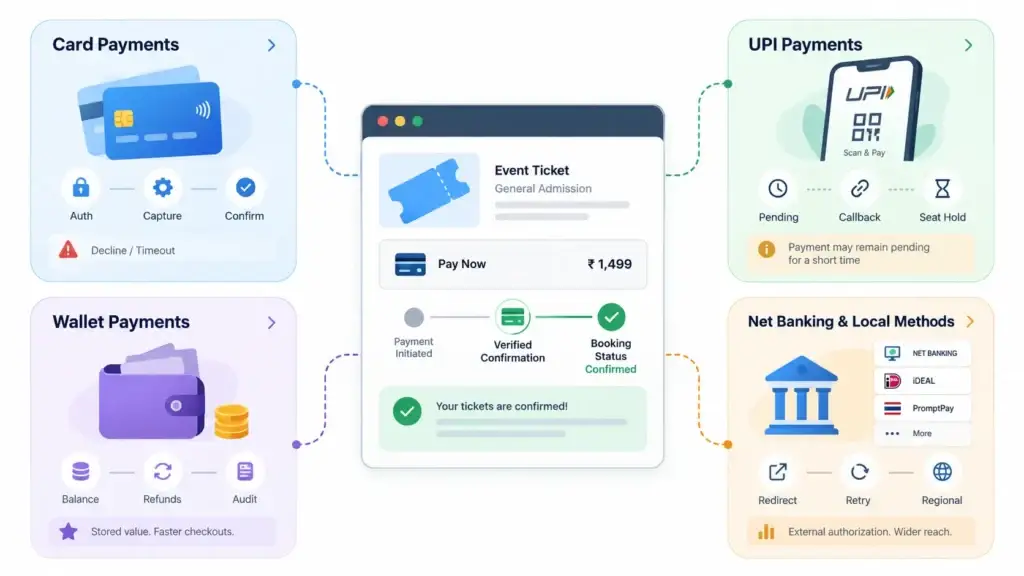
A serious ticketing checkout should not depend on one payment method. Different users prefer different payment experiences, and each method has its own approval behavior, failure pattern, and refund expectation.
1. Card Payments
Card payments remain important for users who prefer credit cards, debit cards, stored cards, or international payment options. In a ticketing platform, card payments usually involve authorization, authentication, capture, and confirmation.
The challenge is that card payments may fail due to authentication issues, insufficient balance, bank decline, timeout, expired card details, risk checks, or gateway downtime.
A good ticketing platform should not instantly create a confirmed ticket just because the frontend screen says “success.” It should wait for verified confirmation from the payment gateway before changing the booking status.
2. UPI Payments
UPI is especially important for India-focused ticketing businesses. The customer may approve payment through a UPI app, scan a QR code, or use a collect request. The approval may happen quickly, but it can also remain pending for a short period before the final status arrives.
This creates a common ticketing problem: the user may think they paid, while the platform is still waiting for final confirmation.
A strong UPI flow should handle:
- Pending approval
- User timeout
- Failed authorization
- Delayed gateway callback
- Duplicate retry attempts
- Refund or reversal scenarios
- Booking status visibility inside the user account
For limited seats, the hold timer must work carefully with the UPI payment window. If the hold expires too soon, a genuine customer may lose the seat. If the hold remains too long, other users are blocked from buying available inventory.
3. Wallet Payments
Wallet payments can improve repeat bookings because users may already have stored balance, cashback, reward credits, refund credits, or promotional balance inside the ecosystem.
For ticketing platforms, wallets are useful because they can support:
- Faster repeat checkout
- Refund-to-wallet flows
- Loyalty-linked credits
- Gift card balances
- Promotional campaigns
- Partial wallet plus gateway payments
The operational risk is ledger accuracy. A wallet balance should never be treated as a simple number that updates loosely. It needs transaction entries, debit records, credit records, refund records, admin visibility, and audit history.
4. Net Banking and Local Payment Methods
Some users still prefer bank redirects or local payment options. These flows often depend on third-party pages, external authorization, and gateway callbacks. The platform must handle users who close the page, return late, or experience a failed redirect.
For founders targeting multiple regions, local payment method support becomes a market expansion decision. The checkout should be flexible enough to add regional gateways and payment rails without rewriting the whole booking engine.
How Multi-Gateway Checkout Works Behind the Scenes
Multi-gateway checkout means the platform can connect to more than one payment gateway and route transactions based on business rules.
This does not mean randomly showing several payment buttons. A proper multi-gateway setup includes gateway selection logic, transaction tracking, webhook validation, retry rules, reconciliation, and refund mapping.
A ticketing platform may route payments based on:
- Payment method, such as card, UPI, wallet, or local bank method
- Gateway uptime or health status
- Transaction value
- Currency or geography
- Success rate history
- Refund support
- Settlement speed
- Platform fees or gateway charges
- Event type or organizer requirement
For example, one gateway may perform better for cards, another may support UPI more reliably, and another may be suitable for international cards or wallet payments. The platform should be able to route intelligently without forcing operations teams to manually change settings during a high-demand event.
Payment Method vs Platform Logic
| Payment Method | What Can Go Wrong | Platform Logic Needed | Founder Impact |
|---|---|---|---|
| Cards | Authentication failure, bank decline, timeout, duplicate attempt | Authorization tracking, secure callback validation, retry flow, refund mapping | Reduces support tickets and protects confirmed booking accuracy |
| UPI | Pending approval, late success callback, expired collect request | Pending status, timed hold handling, verified webhook confirmation | Helps avoid customer confusion when money movement and ticket status do not update instantly |
| Wallets | Balance mismatch, failed debit, incorrect refund credit | Ledger-based balance updates, transaction history, admin audit logs | Improves trust in loyalty, refunds, cashback, and repeat purchase flows |
| Net Banking | Redirect failure, abandoned session, delayed confirmation | Return URL handling, status polling, cancellation fallback | Protects bookings when users leave and return from external bank pages |
| Multiple Gateways | Gateway downtime, uneven success rates, refund mismatch | Routing rules, failover, provider-level reconciliation | Improves checkout resilience during peak booking windows |
What Payment Gateway Failover Means in Ticket Booking
Payment failover is the ability to continue checkout when a gateway becomes unavailable, slow, rejected, or unsuitable for a transaction.
In a ticketing platform, failover must be more careful than in a normal checkout because the customer may already have a seat locked. If the platform simply starts a new payment without managing the previous attempt, it can create duplicate payment attempts, unclear booking status, or delayed confirmations.
A practical failover flow may look like this:
- Customer selects seats or tickets.
- Platform creates a temporary booking hold.
- Customer chooses a payment method.
- Gateway A fails, times out, or returns an unavailable status.
- Platform records the failed attempt.
- Customer is offered another gateway or payment method.
- Booking remains valid only within the allowed hold window.
- Final confirmation happens only after verified payment success.
- Failed attempts remain visible for support and reconciliation.
This flow protects both the user and the platform operator.
The worst version of failover is invisible switching without status clarity. The better version is controlled failover where every attempt has an ID, a timestamp, a gateway response, a booking relationship, and a final state.
Why Verified Webhooks Decide Whether a Ticket Should Be Confirmed
One of the most important rules in ticketing checkout is simple: the frontend cannot be the final source of truth.
A customer’s browser may show a success screen, fail to return from the payment page, close too early, refresh the page, or lose internet connectivity. The platform should not rely only on what happens in the browser.
Instead, the backend should wait for a verified payment gateway webhook or server-side confirmation. That webhook should be authenticated, matched against the correct booking, checked for amount accuracy, and then used to move the booking into a confirmed state.
A proper webhook process checks:
- Is the webhook actually from the gateway?
- Does the transaction ID match the booking?
- Does the paid amount match the expected amount?
- Is the currency correct?
- Has this webhook already been processed?
- Was the seat still valid at the time of confirmation?
- Should a QR ticket now be generated?
- Should settlement records be created?
This prevents fake success states, duplicate confirmations, and manual reconciliation chaos.
The Payment Statuses Every Ticketing Platform Should Track
A ticketing checkout should use clear payment statuses. Without them, support teams cannot explain what happened, customers do not know whether to retry, and admins struggle to reconcile revenue.
Useful payment states include:
- Initiated: Payment attempt has started.
- Pending: Awaiting customer authorization or gateway confirmation.
- Authorized: Payment approval received but not fully finalized where applicable.
- Captured: Money has been successfully collected.
- Failed: Payment did not complete.
- Expired: Payment window or seat hold ended.
- Cancelled: User or system cancelled the attempt.
- Refund Initiated: Refund has been requested.
- Refunded: Refund has been completed.
- Partially Refunded: Only part of the amount was returned.
- Disputed: Payment requires manual review or investigation.
These statuses should connect to booking states. A booking should not become confirmed until payment is captured or finally approved based on the payment method’s logic.
Payment status also needs to connect with the complete ticket booking journey from seat hold to check-in, so every confirmed ticket has a clear path from payment approval to QR generation, user notification, and entry validation.
How Seat Holds and Payment Windows Should Work Together
Ticketing platforms often use temporary holds to stop multiple customers from buying the same seat. The challenge is aligning the hold window with payment behavior.
If the hold is too short, genuine users may lose tickets while completing UPI approval or card authentication. If the hold is too long, seats remain unavailable even when users abandon checkout.
A balanced ticketing platform usually needs:
- A visible countdown timer
- Automatic hold expiry
- Payment attempt tracking
- Gateway timeout rules
- Seat release after failed or expired payment
- Grace handling for delayed callbacks
- Clear customer messaging
- Admin visibility into stuck bookings
This is one reason ticketing checkout should not be treated as a plug-and-play payment page. It is deeply connected to inventory correctness.
This is why seat inventory management in event ticketing platforms is closely tied to checkout design, especially when multiple users compete for the same limited-capacity seat, ticket type, or event slot.
Founder Decision Signals
Checkout Resilience
If one gateway failure can stop bookings during a high-demand event, the payment architecture is too fragile. Multi-gateway routing gives the platform more room to recover.
Seat Accuracy
Payment success should never override inventory truth. The platform must confirm tickets only when the seat hold, payment status, and booking record agree.
Refund Control
Failed events, cancelled shows, duplicate charges, and partial refunds need structured workflows. Manual refunds become risky as booking volume grows.
Admin Visibility
Operators need to see payment attempts, gateway responses, refund status, and settlement impact from one dashboard instead of chasing spreadsheets.
Common Payment Failure Scenarios in Ticketing Platforms
Payment failures are not always the same. Each failure type needs a different platform response.
Gateway Timeout
The user starts payment, but the gateway does not return a final response within the expected time. The platform should mark the transaction as pending or timed out, keep the booking hold only within the allowed window, and avoid confirming the ticket until a verified response arrives.
User Abandons Payment
The user reaches the payment page but closes the window or does not complete authentication. The platform should expire the payment attempt and release the hold when the timer ends.
Late Success Callback
Sometimes the gateway sends a success callback after the user session has expired. The platform must decide whether the booking can still be honored. If the seat has already been released and purchased by someone else, the workflow may need refund handling or admin review.
Duplicate Payment Attempt
A user may retry because the first attempt looked stuck. The platform should prevent two successful payments from confirming the same booking twice.
Amount Mismatch
If the paid amount does not match the booking amount, the platform should not automatically confirm the booking. This can happen due to discount errors, fee mismatch, currency issues, or gateway configuration problems.
Refund Delay
The booking may be cancelled, but the refund may take longer to process. The platform should show a clear refund status to the user and record the gateway reference for admin support.
How Wallets Improve Recovery After Failed Payments
Wallets can help ticketing platforms recover failed payments and reduce support friction.
For example, when an event is cancelled or a transaction needs to be reversed, the platform may offer wallet credit where legally and commercially suitable. This can help the user book again faster, especially for repeat entertainment purchases.
Wallets can also support split checkout. A customer may use wallet balance for part of the ticket value and pay the remaining amount through UPI or card.
However, wallet logic must be designed carefully. A wallet should include:
- Balance ledger
- Credit and debit entries
- Refund records
- Expiry rules for promotional credits
- Admin adjustments with reason logs
- User-visible transaction history
- Fraud monitoring
- Permission-based admin access
If wallet balance is handled loosely, the platform risks disputes, incorrect refunds, and loss of customer trust.
Refunds, Reversals, and Cancelled Event Workflows
Ticketing platforms need refund workflows for many scenarios:
- User cancels within the allowed cancellation window
- Organizer cancels the event
- Showtime changes
- Venue changes
- Duplicate payment is detected
- Payment succeeds after booking expiry
- Partial refund applies due to coupon, wallet, or fee rules
- Admin issues a goodwill adjustment
Refund logic should not live outside the platform in a manual spreadsheet. It should connect to the original payment method, booking record, event policy, customer notification, and settlement system.
For example, if a booking has already been included in partner settlement, the refund may affect the next payout cycle. If taxes, convenience fees, or platform charges are non-refundable based on the business rules, the platform must show that clearly before payment.
Good refund architecture improves trust because users can see what is happening without opening repeated support tickets.
How Payment Data Connects to Partner Settlement
Ticketing is often a marketplace-style business. The platform may need to split revenue between the platform owner, venue, event organizer, promoter, tax authority, and sometimes affiliate or marketing partners.
That means payment success is only the start. The platform must also calculate who gets paid, when, and how much.
These rules become part of the wider event ticketing revenue and settlement model, where commissions, convenience fees, organizer payouts, refunds, wallet adjustments, and platform earnings need to stay aligned.
Settlement workflows may include:
- Gross ticket value
- Platform commission
- Convenience fee
- Taxes
- Discounts and promo impact
- Wallet credit impact
- Refund deductions
- Organizer payout
- Venue share
- Settlement cycle
- Payout status
A ticketing platform without settlement clarity may still sell tickets, but operations become difficult as volume grows. Partners care about whether statements match their records. Admin teams care about whether payment, refund, and payout data reconcile cleanly.
This is why payment architecture should be planned together with admin reporting and settlement workflows.
Security Layers Needed in Ticketing Checkout
Payment security is not only about choosing a known gateway. The platform itself must handle payment data, callbacks, admin actions, and booking status changes responsibly.
A ticketing platform should consider:
- Encrypted data transfer
- Secure payment gateway integration
- Tokenized payment handling where applicable
- HMAC or signature-verified webhooks
- Role-based admin access
- Audit logs for refunds and manual adjustments
- Fraud checks on suspicious booking behavior
- Rate limits on checkout attempts
- Clear refund and cancellation records
- Activity logs for admin payment actions
The safest approach is to avoid storing sensitive card data directly unless the business has the required compliance structure. In most cases, the gateway should handle sensitive payment details while the platform stores transaction references, booking relationships, and status history.
Mistakes Founders Should Avoid
Confirming tickets from the frontend success page
A browser redirect is not enough proof of payment. Ticket confirmation should depend on backend verification, gateway response validation, and booking-status checks.
Using one gateway without a fallback plan
A single gateway can become a single point of failure during high-demand booking windows. Even if the platform launches with one provider, the architecture should allow future routing and failover.
Ignoring pending payment states
UPI, bank redirects, and some wallet flows may not resolve instantly. Treating every non-success as failure can frustrate genuine customers and create unnecessary refund work.
Separating refunds from booking history
Refunds should be connected to the original booking, event policy, gateway reference, wallet impact, and settlement record. Otherwise, finance and support teams lose context.
What Admin Teams Need to See During Payment Failures
When payments fail, customers usually contact support first. Support teams need clear answers quickly.
An admin dashboard should show:
- Booking ID
- User details
- Event, showtime, seat, or ticket type
- Payment method selected
- Gateway used
- Payment attempt history
- Gateway transaction ID
- Current status
- Webhook logs
- Refund status
- Seat hold status
- Settlement impact
- Manual action history
This visibility reduces guesswork. Instead of saying “please wait,” the support team can identify whether the transaction failed, remains pending, succeeded late, or needs refund review.
For founders, this matters because payment failure handling directly affects reputation. A customer may forgive a failed payment if the platform explains it clearly. They are less likely to forgive unclear status, duplicate charges, or missing refunds.
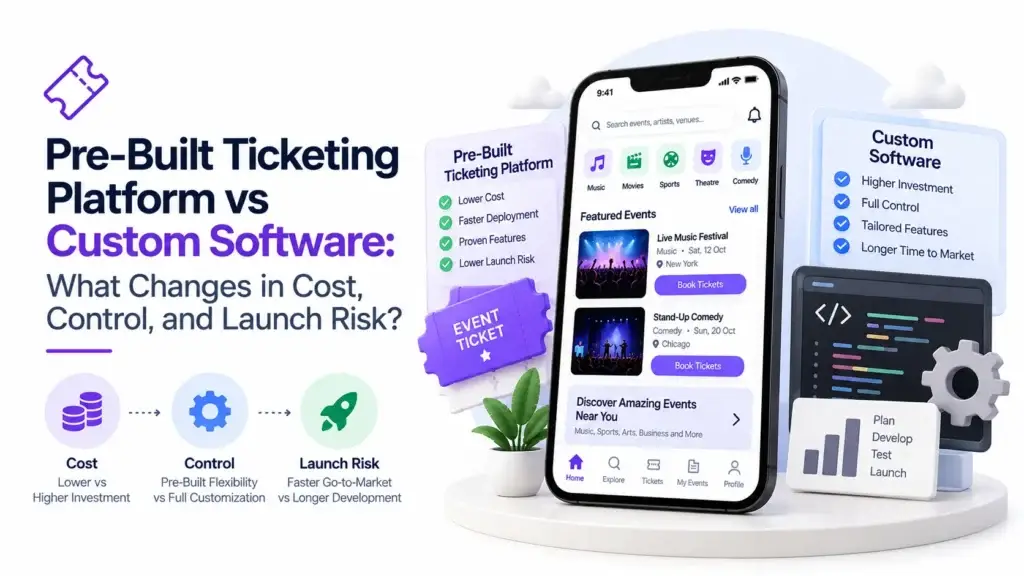
Ready-Made vs Custom Payment Architecture for Ticketing Platforms
Founders usually have two options: build the payment layer from scratch or start with a ready-made foundation and customize it.
Before choosing either route, founders should evaluate ticketing platform development cost factors, because gateway integrations, wallet logic, refund workflows, admin controls, and settlement reporting can all affect the final build scope.
| Build Route | What It Means | Payment Advantage | Risk to Watch |
|---|---|---|---|
| From-scratch build | Every checkout, payment, webhook, refund, and settlement flow is built custom | Maximum flexibility | Longer build cycle, more QA risk, delayed validation |
| Ready-made foundation | Core booking, checkout, payment, admin, and settlement workflows already exist | Faster launch and reduced foundational build effort | Must verify gateway fit, local payment requirements, and customization scope |
| Hybrid approach | Start with ready-made modules and customize advanced workflows | Balanced speed and flexibility | Needs clear technical scoping before launch |
A deeper comparison of a ready-made vs custom ticket booking platform can also help founders decide whether they need a faster launch foundation or a fully custom architecture for complex payment, seat inventory, and partner settlement requirements.
Miracuves’ ready-made ticketing solution is useful for founders who want to reduce the time spent building common ticketing workflows from zero. Where the selected scope fits, Miracuves can support a 6-day solution delivery path with white-label branding, source-code ownership, admin dashboard access, and configurable payment integrations.
A founder planning a city-based cinema booking app, regional event platform, or niche ticketing marketplace can use this type of foundation to validate faster, then expand payment methods, loyalty, settlement rules, and event categories as the business grows.
How to Plan a Payment-Ready Ticketing Platform Before Launch
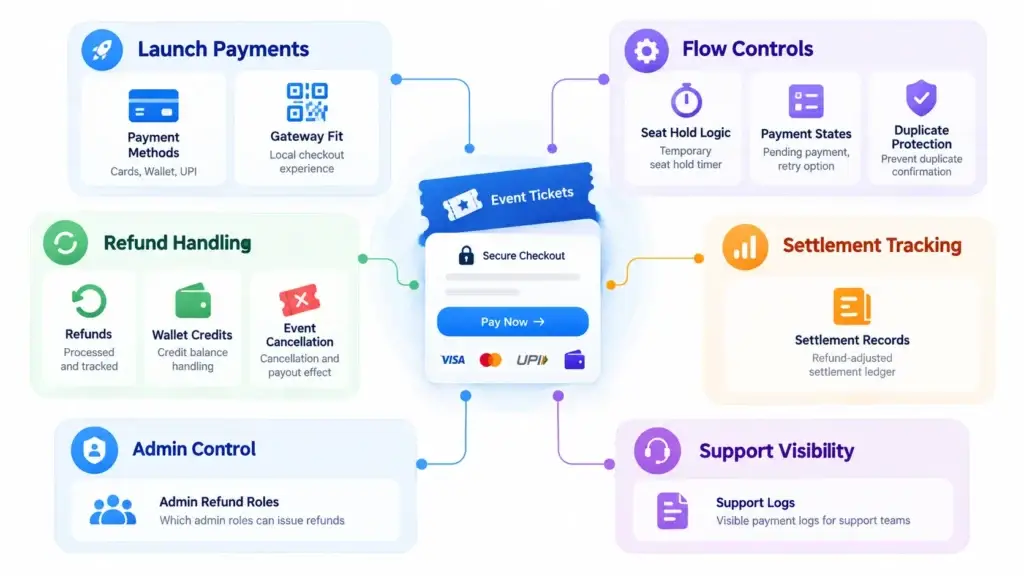
Before going live, founders should define the payment logic clearly. This prevents rushed decisions during launch week.
A practical planning checklist includes:
- Which payment methods are required at launch?
- Which gateway supports the strongest local checkout experience?
- What happens when a payment stays pending?
- How long should seat holds remain active?
- Can customers retry with another method?
- Can the platform prevent duplicate payment confirmation?
- How are refunds processed and tracked?
- How are wallet credits handled?
- How are event cancellations managed?
- How do settlement records change after refunds?
- What admin roles can issue refunds?
- What payment logs are visible to support teams?
This checklist is especially important for event launches, movie premieres, stadium ticketing, and limited-capacity experiences where demand may spike quickly.
Miracuves Perspective: Build Checkout as a Revenue Protection Layer
Payment architecture is not just a technical feature. It is a revenue protection layer.
A ticketing platform may have strong event discovery, attractive UI, and good venue partnerships, but if checkout fails under pressure, the business loses trust at the exact moment demand is highest.
The stronger approach is to treat cards, UPI, wallets, gateway routing, refunds, and settlements as one connected system. The payment layer should protect booking accuracy, customer confidence, venue relationships, and admin control.
Founders who want expert support for planning, customizing, and launching this type of booking infrastructure can also explore Miracuves as an event ticketing development partner.
Miracuves helps founders launch white-label ticketing platforms with source-code ownership, admin dashboards, payment gateway integration workflows, and faster deployment. For founders who want to evaluate the complete booking platform behind this checkout logic, the next step is to review Miracuves’ ticket booking platform solution.
Final Thoughts: Checkout Failure Is a Product Problem, Not Just a Payment Problem
Cards, UPI, wallets, and gateway integrations may look like backend details, but customers experience them as trust.
When a payment fails, the user wants to know whether the seat is still held, whether money was deducted, whether they can retry, whether a refund is coming, and whether the ticket is valid. If the platform cannot answer those questions clearly, the payment layer has not been designed deeply enough.
For founders, the practical lesson is simple: build payment resilience before the first major booking spike. A ticketing platform should be able to handle delayed callbacks, gateway downtime, failed attempts, wallet credits, refunds, and settlement impact without depending on manual fixes.
A stronger checkout foundation helps the business sell more confidently, support users faster, and build better relationships with venues and organizers.
FAQs
How do ticketing platforms handle payment gateway failures?
Ticketing platforms handle payment gateway failures by tracking payment attempts, keeping booking and payment statuses separate, using verified gateway callbacks, releasing seat holds after expiry, and allowing retry or failover where appropriate. The platform should never confirm a ticket only because the user reached a frontend success screen.
Why do ticket booking platforms need multiple payment gateways?
Multiple payment gateways help reduce dependency on one provider. If one gateway is slow, unavailable, or unsuitable for a specific payment method, the platform can route users to another option. This is especially useful during high-demand event launches.
How should UPI pending payments be handled in a ticketing app?
UPI pending payments should be shown clearly to the user while the backend waits for final confirmation. The platform should maintain the seat hold only within the defined hold window and confirm the ticket only after verified payment success.
What happens if payment succeeds after the seat hold expires?
If payment succeeds after the seat hold expires, the platform should check whether the ticket or seat can still be honored. If the inventory has already been released and sold, the transaction may need refund handling or admin review.
Can wallets reduce failed checkout problems in ticketing platforms?
Wallets can reduce checkout friction for repeat users by allowing stored balance, refund credits, cashback, gift cards, and partial wallet payments. However, the wallet must use ledger-based tracking so balances, refunds, and adjustments remain accurate.
Why are verified webhooks important in ticketing payments?
Verified webhooks help ensure that payment confirmation comes from the gateway and not from a manipulated or incomplete frontend response. This protects the platform from fake confirmations, duplicate tickets, and incorrect booking status updates.
How do refunds connect to partner settlement in event ticketing?
Refunds affect settlement because ticket revenue may be shared between the platform, venue, organizer, and other parties. A strong ticketing platform connects refunds to the original booking, payment method, event policy, and payout cycle.
What should founders check before launching payment features in a ticketing platform?
Founders should check gateway coverage, UPI and card flows, wallet logic, refund workflows, webhook verification, seat hold expiry, payment retry rules, admin logs, support visibility, and settlement reporting before launch.
Miracuves is an independent software development company. We are not affiliated with, connected to, sponsored by, or endorsed by any company or product named in this article.
Terms such as “X Clone” are used descriptively. It is how the software industry refers to building a platform with functionality comparable to a known service, and how clients search for it.
The entire design and codebase of our products is built by our own team. Our products contain no code, design, graphics, or content originating from any third-party website or applications.
All third-party names and marks referenced in this article are the property of their respective owners, referenced solely to identify the services discussed.