
Key Takeaways
- Community platform build strategy should focus on validating whether users join, post, reply, vote, and return before investing heavily in advanced features.
- The first version should prove the core community loop: Join → Post → Comment → Vote → Moderate → Discover → Return.
- Standard modules such as profiles, posts, comments, voting, moderation, notifications, and admin controls need to work reliably but do not always need to be built from zero.
- Moderation should be included from the first release because spam, abuse, poor content, and weak governance can damage trust before the community grows.
- Founders should invest deeper customization in the areas that create real differentiation, such as niche workflows, onboarding, governance, monetization, or specialized community structures.
Validation Signals
- First post rate shows whether new members understand the community well enough to start contributing.
- First reply rate and time to first response reveal whether discussions feel active and valuable to new users.
- Weekly active contributors and returning member rate provide stronger evidence of community value than total registrations alone.
- Moderator activity and report resolution time help founders understand governance workload and whether trust systems are working.
- Paid conversion, search-driven visits, and community creation can be evaluated after the core participation loop begins showing repeatable behavior.
Real Insights
- Overbuilding happens when founders confuse product completeness with market readiness and develop advanced modules before validating community demand.
- Underbuilding can be equally risky if the platform lacks moderation, notifications, navigation, analytics, or enough admin control to operate effectively.
- The smarter approach is a minimum reliable community system with enough functionality to create discussions, protect trust, measure behavior, and adapt quickly.
- Build-from-zero, launch-ready, hybrid, and hosted approaches can all work; the right choice depends on validation stage, uniqueness, timeline, ownership, and customization requirements.
- The strongest strategy is: build the standard foundation efficiently → customize where differentiation matters → validate the community loop → scale the product roadmap.
Building a community discussion platform from scratch sounds exciting at the beginning.
Founders imagine full control, custom workflows, unique design, flexible features, and a product that fits their exact market vision. That freedom can be valuable. But it also creates a common startup problem: teams spend months building standard community modules before they know whether people will actually join, post, comment, vote, moderate, and return.
A community product does not win because every possible feature is available on day one. It wins when the right audience finds a focused space, understands why it exists, participates early, and sees enough value to come back.
That is why startups need a build strategy before development begins.
A strong build strategy helps founders answer:
- What should be built now?
- What can be validated later?
- Which features are required for trust and engagement?
- Which modules are standard and should not consume months of custom effort?
- Which parts need deep customization?
- How much admin control is needed from the first release?
- What should the platform prove before larger investment?
This guide explains how startups can validate a community discussion platform faster without overbuilding from zero.
Why Startups Overbuild Community Platforms Too Early
Most early community platform mistakes come from a simple assumption: if the product has more features, users will value it more.
That is not always true.
A startup can spend months building advanced recommendation systems, complex badge logic, deep profile settings, multiple content formats, custom ranking algorithms, and monetization flows before discovering that the first audience only needed one focused community, simple posting, replies, voting, and reliable moderation.
Overbuilding happens when founders confuse product completeness with market readiness.
A community discussion platform should prove a few important things before the team invests heavily:
- Does the target audience care about the topic?
- Will users create content without being pushed every day?
- Do members reply to each other?
- Are the discussions useful enough to return to?
- Can moderators keep the space safe and organized?
- Which communities deserve expansion?
- Which monetization model feels natural?
- Which features are requested repeatedly by real users?
Until those signals are visible, more features can create more complexity without improving validation.
The Smarter Build Strategy: Prove the Community Loop First
A community platform’s core loop is more important than its feature list.
The basic loop is:
Join → Post → Comment → Vote → Moderate → Discover → Return
If this loop works, the platform has a chance to grow. If it does not work, advanced features will not save it.
For startups, the first build should focus on making this loop smooth, reliable, and measurable.
| Community Loop Stage | Founder Question | Required Product Support |
|---|---|---|
| Join | Can users understand the platform and enter the right community quickly? | Signup, onboarding, topic selection, profiles |
| Post | Can users start useful discussions easily? | Post composer, categories, media support where needed |
| Comment | Can members create meaningful replies? | Threaded comments, mentions, notifications |
| Vote | Can the community help surface useful content? | Upvotes, reactions, ranking logic |
| Moderate | Can the platform protect quality and trust? | Reports, queues, bans, role-based controls |
| Discover | Can users find relevant communities and posts? | Feeds, search, filters, tags |
| Return | Do users receive enough reasons to come back? | Push, email, in-app alerts, saved posts, reputation |
The first release does not need to be perfect. It needs to be strong enough to test whether the community behavior exists.
What Building From Zero Actually Requires
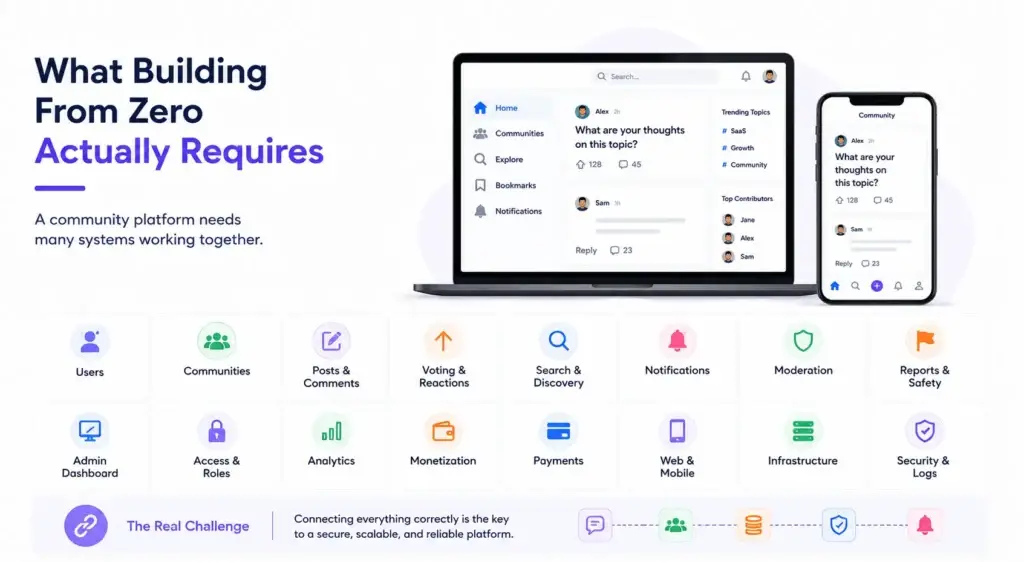
A community discussion platform looks simple from the outside because the visible interface is familiar: communities, posts, comments, voting, and profiles.
But under the surface, the platform needs multiple systems working together.
A full build may include:
- User registration and authentication.
- User profiles and activity history.
- Topic-based community creation.
- Community rules and descriptions.
- Post creation for text, links, images, polls, or media.
- Comment threads and nested replies.
- Voting, reactions, and ranking logic.
- Search and filtering.
- Saved posts and bookmarks.
- Notifications.
- Moderator roles.
- Report queues.
- Abuse reporting.
- Ban and appeal workflows.
- Admin dashboard.
- Role-based access control.
- Community ownership rules.
- Content visibility settings.
- Analytics and reporting.
- Monetization features.
- Payment or wallet integrations where relevant.
- Mobile and web experience.
- Scalable backend infrastructure.
- Security, logs, and permission controls.
The challenge is not only building these modules. The challenge is connecting them properly.
For example, a post is not just content. It connects to the user profile, community rules, moderation status, voting signals, search visibility, notifications, admin reports, and analytics. A moderator action is not just a button. It connects to permissions, audit logs, member history, report queues, and possibly appeal workflows.
This is why founders should separate standard platform requirements from true business differentiation.
Standard Features vs Differentiation: Know Where to Invest
A good build strategy asks a practical question:
Which parts of the platform must be unique, and which parts simply need to work well?
Standard community features usually include posts, comments, voting, communities, roles, notifications, moderation queues, and admin controls. These are expected by users. They need to be reliable, but they are rarely the reason the startup wins.
Differentiation may come from the niche, community structure, onboarding model, expert access, private groups, monetization logic, local market strategy, creator partnerships, or workflow integrations.
| Area | Standard Foundation | Differentiation Opportunity |
| Signup | Email, social login, profile setup | Invite-only onboarding, expert verification, cohort-based access |
| Communities | Topic spaces, rules, descriptions | Niche taxonomy, private groups, region-specific communities |
| Posts | Text, links, media, polls | Specialized templates, structured questions, product feedback formats |
| Comments | Replies, mentions, sorting | Expert answers, accepted responses, debate formats |
| Voting | Upvotes, reactions, ranking | Reputation-weighted voting, quality scoring, member trust levels |
| Moderation | Reports, bans, removals, queues | Community-led governance, custom rule engines, escalation workflows |
| Monetization | Memberships, ads, premium spaces | Paid expert communities, brand-sponsored spaces, creator revenue sharing |
| Admin | User, content, and community control | Business-specific dashboards, partner access, advanced reporting |
Once the startup understands which features are standard and which areas create differentiation, the next step is to connect the product strategy with revenue planning. For a deeper breakdown of memberships, premium communities, sponsored spaces, wallet-based engagement, and paid access models, review the community platform business model guide.
Startups should not spend excessive time reinventing the standard layer unless that layer is part of the core business advantage.
Build From Scratch, Ready-Made Foundation, or Hybrid: How to Decide
There is no single correct build route for every startup.
The right route depends on the business model, validation stage, budget, timeline, technical team, customization needs, and long-term ownership expectations.
Community Platform Build Strategy Comparison
| Build Route | Best For | Founder Tradeoff |
|---|---|---|
| Custom development from zero | Highly unique products with proprietary workflows, complex integrations, or unusual interaction models | Maximum flexibility, but higher planning, development, testing, and launch risk |
| Launch-ready platform foundation | Startups that need standard community modules, faster validation, admin control, and future customization | Faster market entry, but differentiation must come through positioning, branding, workflows, and community strategy |
| Hybrid approach | Founders who want a ready foundation plus selected custom modules | Balances speed and flexibility when the team knows which parts truly need customization |
| No-code or hosted tool | Small experiments, private groups, or early audience testing | Fastest to test, but limited ownership, customization, branding, and long-term platform control |
For founders exploring broader engagement products beyond community forums, Miracuves also provides social media app development services that can support feeds, profiles, member interactions, content publishing, notifications, moderation workflows, and scalable social product architecture.
The decision should not be emotional. It should be based on where the startup is in its validation journey.
If the product model is still unclear, avoid overbuilding. If the community model is clear but the startup needs faster entry, a launch-ready foundation may be more practical. If the product depends on a unique interaction system, deeper custom development may be necessary.
What the First Market Version Should Include
The first market version of a community discussion platform should not be overloaded. It should include the features needed to validate member behavior, community trust, and repeat engagement.
A focused first version may include:
- Branded web experience.
- Member registration and login.
- Member profiles.
- Topic-based community spaces.
- Post creation.
- Comments and replies.
- Voting or reactions.
- Search and discovery.
- Notifications.
- Report content button.
- Moderator roles.
- Admin dashboard.
- Community rules.
- Basic analytics.
- Mobile-responsive interface.
- Optional Android or iOS app depending on audience behavior.
- Payment or premium access only if monetization is part of the first validation goal.
The first version should answer this question:
“Can this audience form useful conversations in a branded space we control?”
If yes, the startup can expand. If no, the team should improve positioning, onboarding, content strategy, and community leadership before adding complex features.
Read more – Forum Software Alternatives for Startups: When a Community Discussion Platform Makes More Sense
Validation Signals Founders Should Track Before Scaling
A startup should not judge a community platform only by total signups.
Signups show interest. Participation shows value.
Important validation signals include:
| Signal | What It Shows | Why It Matters |
| First post rate | Whether new users feel confident contributing | Measures onboarding and community clarity |
| First reply rate | Whether users receive engagement after posting | Shows whether the platform feels alive |
| Time to first response | How quickly members get replies | Affects trust and repeat behavior |
| Weekly active contributors | How many members post, comment, vote, or report | Measures real participation |
| Returning member rate | How often users come back | Shows habit formation |
| Community creation rate | Whether users want to build new spaces | Indicates expansion potential |
| Moderator action volume | How much governance is needed | Helps estimate operational workload |
| Report resolution time | How quickly safety issues are handled | Protects trust and member confidence |
| Search-driven visits | Whether discussions attract future users | Supports long-term acquisition |
| Paid conversion where relevant | Whether users value premium access or features | Validates monetization readiness |
The goal is not to scale every metric at once. The goal is to identify whether the platform has a repeatable community loop.
Why Moderation Should Be Part of the First Build
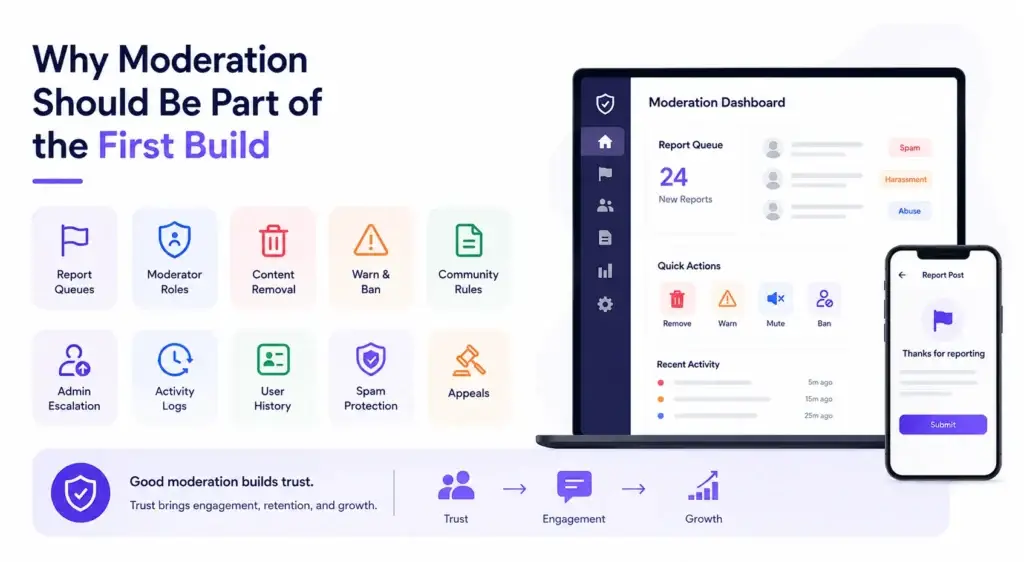
Moderation is often treated as a later-stage feature. That is a mistake.
User-generated content platforms can develop trust problems early. Spam, harassment, low-quality posts, repeated self-promotion, misinformation, and community disputes can hurt the product before it gets a chance to grow.
A community discussion platform should include moderation basics from the first version:
- Report queues.
- Moderator roles.
- Content removal controls.
- Warning and ban options.
- Community rules.
- Admin escalation.
- Activity logs.
- User history.
- Spam protection.
- Rate limits.
- Appeal workflows where relevant.
Moderation is not only about safety. It also shapes culture.
A community with visible rules, responsive moderators, and clean discussion spaces feels more trustworthy to new users. That trust improves participation, retention, and monetization potential.
Founder Decision Signals
Validation
If the main risk is whether users will join, post, comment, and return, build only what is needed to prove that loop before investing in advanced features.
Speed
If standard community modules are already known, a launch-ready foundation can help the startup move faster and focus more energy on positioning, content, and member acquisition.
Control
If the platform must be branded, customized, and extended over time, source-code ownership and admin control become important long-term decisions.
Complexity
If the product needs proprietary workflows, advanced integrations, or unusual interaction models, custom development may be justified from the beginning.
Why Admin Control Matters More Than Founders Expect
The admin dashboard is where the startup operates the platform after launch.
Without admin control, every small change becomes a developer task. That slows learning.
A founder should be able to manage:
- Users.
- Communities.
- Posts.
- Comments.
- Reports.
- Moderators.
- Roles and permissions.
- Categories and tags.
- Featured posts.
- Notification settings.
- Community rules.
- Banned users.
- Analytics.
- Monetization settings.
- Basic platform configuration.
Admin control is especially important during validation because founders need to adjust quickly. They may need to rename communities, change onboarding prompts, pin posts, assign moderators, remove spam, test premium access, or review which content drives engagement.
A platform that cannot be operated easily becomes difficult to improve.
Read more – Why Building a Community Discussion Platform From Scratch Takes Longer Than Founders Expect
How to Avoid Overbuilding Without Underbuilding
The opposite of overbuilding is not building too little.
Underbuilding creates its own problems. If the first version lacks trust, moderation, navigation, notifications, or admin control, users may leave before the founder can learn anything meaningful.
The smarter approach is to build the minimum reliable community system.
That means:
- Enough features to create real discussions.
- Enough moderation to protect trust.
- Enough admin control to manage operations.
- Enough analytics to measure validation.
- Enough branding to feel credible.
- Enough technical flexibility to extend later.
Avoid building features only because they sound impressive. Prioritize features that help users join, contribute, receive responses, return, and trust the space.
Mistakes Founders Should Avoid
Building every idea before testing demand
A community platform should validate member behavior first. Advanced features matter only after users prove they want the core community experience.
Skipping moderation in the first version
Trust problems can appear early. Report queues, moderator roles, rules, and admin controls should be planned before the platform opens to real users.
Choosing flexibility without considering time risk
Custom development can offer full flexibility, but it also increases planning, testing, and development effort. Founders should use it where uniqueness actually matters.
Measuring success only by registrations
Registrations do not prove community value. Track first posts, first replies, returning members, moderator activity, and weekly active contributors.
Launching without operational control
If every content, role, or community change requires developer support, the founder cannot learn quickly after launch.
How Miracuves Helps Startups Build a Community Platform Foundation Faster
Miracuves helps founders build white-label community platforms with source code, branded design, member workflows, moderation tools, admin dashboards, monetization options, and faster deployment.
Instead of spending the early stage rebuilding every standard community module from zero, founders can start with a product foundation that already supports the core platform logic: topic-based spaces, user profiles, post creation, comments, voting, reporting, role-based access, moderation workflows, admin controls, and monetization planning.
This gives startups more room to focus on the parts that actually create market advantage, such as niche positioning, seed content, member acquisition, moderator onboarding, community rituals, premium access strategy, and long-term product differentiation.
For founders who want to validate the community model before investing in deeper custom development, the community discussion platform solution from Miracuves is a practical next step because it connects faster launch with source-code ownership, branded control, and room for future customization.
A strong platform foundation can support:
- Topic-based communities.
- Member registration and profiles.
- Post creation and discussion threads.
- Voting and engagement workflows.
- Moderator roles and report queues.
- Admin dashboards.
- Notifications.
- Community rules.
- Premium or private access models.
- Analytics and reporting.
- Source-code ownership.
- Future customization.
Before finalizing scope, founders can also review the community platform features page to understand which product modules may support launch, moderation, engagement, and monetization goals.
If budget planning is part of the decision, the community platform development cost guide can help clarify how modules, customization, admin control, integrations, and launch scope affect investment.
For founders comparing build partners, the community platform development company page can help evaluate service capability, source-code ownership, moderation depth, and post-launch customization support.
Final Thoughts: Validate the Community Before Expanding the Build
A Reddit should not be judged by how many features it has on day one.
It should be judged by whether the right users join, contribute, receive replies, trust the space, and come back.
Startups that overbuild too early may lose time on features that users never needed. Startups that underbuild may fail to create enough trust and engagement to learn from the market. The smarter path is to launch with a focused, reliable foundation that supports the core community loop and gives founders enough control to adapt quickly.
The strongest build strategy is not custom development at all costs. It is not a rushed platform with weak controls either.
It is a balanced approach: build the standard foundation efficiently, customize where the business model truly needs differentiation, and validate the community before scaling the roadmap.
Miracuves can help founders move from idea to launch with a white-label solution, source-code-owned platform foundation designed for community workflows, moderation, admin control, monetization, and future customization.
FAQs
What is a community platform build strategy?
A community platform build strategy is the plan that decides which features should be built first, which modules can wait, which workflows need customization, and how the startup will validate user demand before expanding the product roadmap.
How can startups validate a community discussion platform faster?
Startups can validate faster by launching with a focused community, essential posting and discussion tools, voting, moderation, notifications, admin control, and analytics. The goal is to prove whether users join, post, reply, and return before adding advanced features.
Should a startup build a community platform from scratch?
Building from scratch makes sense when the product needs highly unique workflows, proprietary logic, or complex integrations. If the startup mainly needs standard community features and faster validation, a launch-ready foundation may reduce avoidable development risk.
What features should the first version include?
The first version should include user accounts, profiles, topic-based communities, post creation, comments, voting, search, notifications, moderation, report queues, admin dashboard, role-based access, and basic analytics.
Why do startups overbuild community platforms?
Startups often overbuild because they assume more features create more value. In reality, early success depends more on focused positioning, useful discussions, trust, moderation, and repeat participation.
What metrics show whether a community platform is working?
Useful metrics include first post rate, first reply rate, time to first response, weekly active contributors, returning member rate, moderator action volume, report resolution time, and search-driven visits.
Why is source-code ownership important for community platforms?
Source-code ownership gives founders more control over customization, integrations, deployment, future features, and long-term product direction. It reduces dependency on a generic hosted roadmap.
How can Miracuves help with community platform development?
Miracuves helps founders build white-label community platforms with source code, branded design, member workflows, moderation tools, admin dashboards, monetization options, and faster deployment support.
Miracuves is an independent software development company. We are not affiliated with, connected to, sponsored by, or endorsed by any company or product named in this article.
Terms such as “X Clone” are used descriptively. It is how the software industry refers to building a platform with functionality comparable to a known service, and how clients search for it.
The entire design and codebase of our products is built by our own team. Our products contain no code, design, graphics, or content originating from any third-party website or applications.
All third-party names and marks referenced in this article are the property of their respective owners, referenced solely to identify the services discussed.