
Key Takeaways
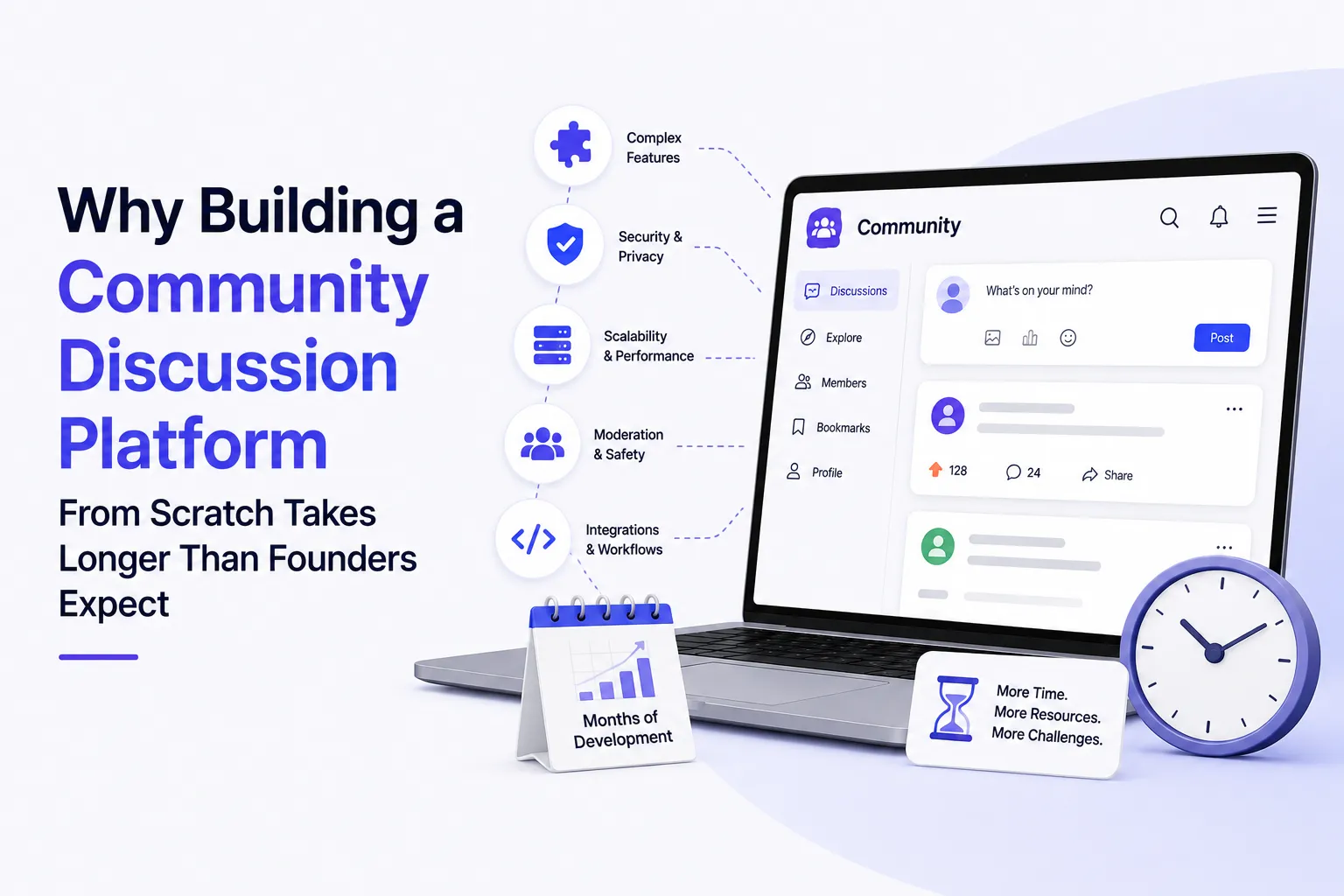
- Community discussion platform development takes longer than expected because the visible interface is only a small part of the complete product.
- Hidden complexity comes from permissions, moderation, voting logic, notifications, search, roles, admin controls, analytics, monetization, and edge cases.
- Threaded comments, multiple post types, ranking systems, and community-specific permissions can significantly increase development scope.
- Moderation requires complete workflows for reports, removals, bans, appeals, audit logs, user history, and rule enforcement.
- Founders should separate standard community infrastructure from features that create genuine product differentiation before building everything from zero.
Complexity Signals
- Every post can connect with permissions, community rules, voting, moderation status, notifications, search visibility, reputation, and analytics.
- Role-based access becomes complex because the same user may be a moderator in one community, a regular member in another, and restricted elsewhere.
- Search and discovery require indexing, filters, tags, trending logic, related discussions, and decisions around public, private, and premium content.
- Monetization adds subscription states, premium access rules, wallet logic, payment handling, reporting, and administrative workflows.
- Technical planning must also account for caching, background jobs, rate limiting, media storage, notification queues, monitoring, backups, and future scalability.
Real Insights
- The development timeline usually expands through edge cases rather than one unusually difficult feature.
- A report button is not a moderation system; real moderation requires review states, actions, escalation, history, and accountability.
- Admin dashboards are critical because founders need operational control over users, communities, content, reports, permissions, monetization, and analytics.
- Adding too many post types or advanced workflows before market validation can increase development time without proving community demand.
- The strongest approach is to build standard foundations efficiently, customize where the business truly differs, and validate participation before expanding the roadmap.
Building a community discussion platform from scratch often looks simple at the planning stage.
The visible product appears familiar: users create accounts, join topic-based spaces, publish posts, comment on discussions, vote on useful content, and follow active conversations. From the outside, it may feel like a standard social product with a few community features.
But once development begins, founders quickly discover that the real complexity is not the posting interface. The complexity sits underneath: permissions, moderation queues, content states, voting logic, notification rules, admin controls, community roles, reporting workflows, abuse handling, search, analytics, monetization, and scalable backend architecture.
That is why building from zero often takes longer than expected.
A community discussion platform development is not only a content feed. It is an operating system for user-generated conversations. Every action a user takes creates a chain of business, technical, safety, and moderation decisions. A post affects search, notifications, ranking, reports, analytics, and community rules. A comment affects thread depth, voting, moderation history, user reputation, and engagement metrics. A moderator action affects trust, audit logs, appeals, admin visibility, and legal risk.
For startups, the smarter question is not simply “Can we build it?” The better question is:
Which parts should we build from scratch, which parts are standard platform foundations, and which parts actually create business differentiation?
Why Community Platforms Look Simple but Build Slowly
A community discussion platform development feels simple because most users interact with only a few visible actions:
- Join a community.
- Create a post.
- Add a comment.
- Vote or react.
- Follow a topic.
- Report content.
- Receive notifications.
- Search for discussions.
But each of these actions has backend complexity.
When a user creates a post, the platform needs to decide:
- Is the user allowed to post in this community?
- Is the community public, private, restricted, or invite-only?
- Does the post need approval?
- Which content rules apply?
- Should media uploads be allowed?
- Should followers receive notifications?
- Should the post appear in search?
- Can other users vote or comment?
- What happens if the post is reported?
- Can moderators remove it?
- Should edit history be stored?
- Should the post count toward reputation?
- Should analytics record the action?
This is why the timeline expands. Every visible feature needs rules, edge cases, admin controls, database structure, and testing.
A basic post screen may be built quickly. A reliable publishing system for real community activity takes longer.
Read more – Community-Led Growth Strategy: Seed Content, Moderators, and Referral Loops for Discussion Platforms
The Hidden Systems Behind a Community Discussion Platform
A serious community product is made of multiple connected systems. Founders often plan the visible features first, but the hidden systems decide whether the platform can scale.
| Hidden System | What It Controls | Why It Adds Build Time |
|---|---|---|
| User identity | Signup, login, profiles, sessions, verification | Every action must connect to the correct member account |
| Community structure | Spaces, categories, rules, visibility, ownership | Each community may need different rules and access levels |
| Post engine | Text, links, media, polls, drafts, edits | Different post types need different validation and display logic |
| Comment system | Replies, nesting, sorting, mentions, deletion | Threaded discussions become complex as volume grows |
| Voting and ranking | Upvotes, reactions, scores, trending feeds | Ranking needs anti-abuse logic and performance planning |
| Moderation workflows | Reports, removals, bans, appeals, notes | Trust-and-safety controls require careful state management |
| Role-based access | Members, moderators, owners, admins | Permissions must work differently across communities |
| Notifications | Email, push, in-app alerts, digests | Notification rules multiply with posts, comments, mentions, and reports |
| Search | Posts, comments, communities, tags | Useful discovery requires indexing and filtering |
| Admin dashboard | User, content, community, report, and revenue control | Operators need visibility and control after launch |
| Monetization | Premium spaces, subscriptions, wallet, awards, ads | Payment and access logic adds business and technical complexity |
| Analytics | Member activity, engagement, reports, revenue | Founders need data to make product decisions |
This is why a founder may estimate a short build and later discover months of additional work.
The problem is not one large feature. The problem is the number of small systems that must work together.
User Accounts Are More Than Login Screens
User authentication may look like a standard module, but community platforms need deeper identity logic than a simple content website.
A community member may have:
- A public profile.
- A username.
- Avatar and bio details.
- Activity history.
- Community memberships.
- Saved posts.
- Notification preferences.
- Reputation points.
- Badges.
- Role assignments.
- Ban history.
- Report history.
- Subscription status.
- Wallet balance where relevant.
- Privacy settings.
The platform must also handle account recovery, spam signups, suspicious sessions, duplicate accounts, blocked users, and deleted accounts.
For founders, this matters because member identity is the foundation of community trust. If user identity is weak, moderation becomes harder, reputation becomes unreliable, and abuse becomes easier.
Community Creation Requires Rules, Roles, and Visibility Logic
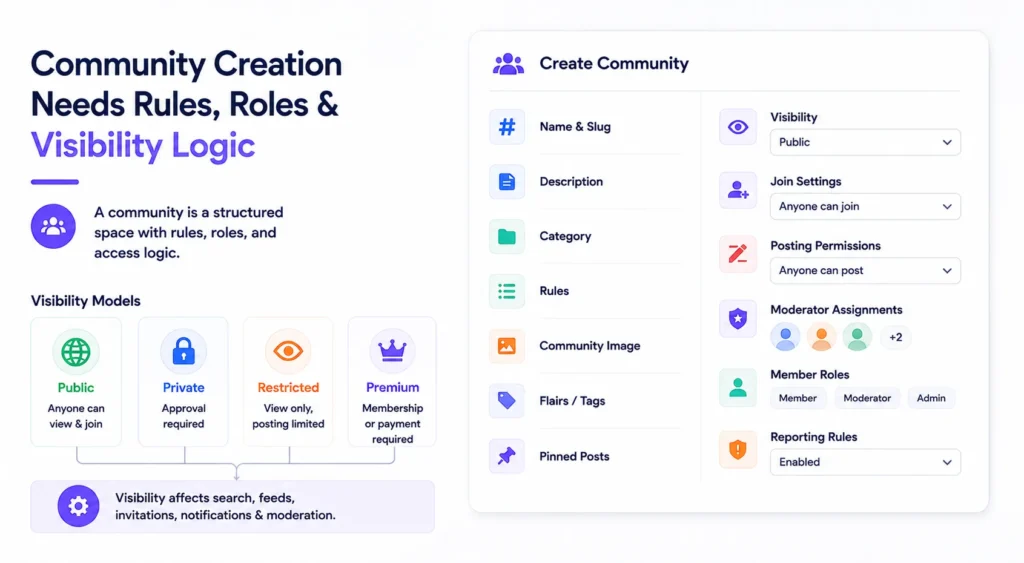
A community discussion platform is usually built around topic-based spaces. But creating those spaces involves more than adding a title and description.
Each community may need:
- Name and slug.
- Description.
- Category.
- Rules.
- Visibility settings.
- Join settings.
- Posting permissions.
- Moderator assignments.
- Member roles.
- Flairs or tags.
- Pinned posts.
- Community image or branding.
- Approval settings.
- Reporting rules.
- Analytics.
A public community may allow anyone to view and join. A private community may require approval. A restricted community may allow viewing but limit posting. A premium community may require payment or membership.
Each visibility model changes how the backend works. It affects search, feeds, invitations, notifications, analytics, and moderation.
That is why community creation becomes a product system, not just a form.
Read more – Trust and Safety Design for Community Discussion Platforms: What Founders Should Build Before Launch
Post Types Can Multiply Development Scope
Many founders begin with a simple idea: users should be able to post.
But “post” can mean many things.
A platform may need:
- Text posts.
- Link posts.
- Image posts.
- Video posts.
- Polls.
- Questions.
- Announcements.
- Live discussion threads.
- Wiki-style posts.
- Premium-only posts.
- Scheduled posts.
- Drafts.
- Cross-posting between communities.
Each post type affects development differently.
A text post needs formatting and validation. A media post needs upload handling, storage, compression, file limits, and moderation review. A poll needs voting rules, result visibility, expiry, and fraud prevention. A scheduled post needs background jobs. A premium post needs access control.
The more post types a founder adds early, the longer the build becomes.
A smarter approach is to start with the post types required for validation, then expand based on real user behavior.
Threaded Comments Are Harder Than They Look
Comments are one of the most important parts of a community discussion platform. They turn posts into conversations.
A basic flat comment list is simple. But serious communities often need threaded comments, reply nesting, sorting, comment voting, mentions, edit history, soft deletion, report handling, and moderator actions.
A threaded comment system needs to answer:
- How deep can replies go?
- How should replies be sorted?
- Can comments be voted on?
- Can users edit comments?
- Should edit history be stored?
- What happens when a parent comment is deleted?
- Should replies remain visible?
- Can moderators collapse, remove, or lock threads?
- Should users receive notifications for replies?
- How should large comment threads load quickly?
These questions affect database design and performance.
A post with ten comments is easy. A post with thousands of nested replies is different. Without proper architecture, thread loading becomes slow, moderation becomes messy, and the user experience suffers.
Voting and Ranking Need Anti-Abuse Planning
Voting looks like a small engagement feature. In reality, it shapes content visibility.
If voting decides what appears in feeds, then voting becomes part of the platform’s ranking system. That means it needs safeguards.
A voting system may need:
- Upvotes.
- Downvotes or reactions.
- Comment-level voting.
- Vote history.
- Duplicate vote prevention.
- Rate limits.
- Suspicious activity detection.
- Reputation-based weighting.
- Time decay.
- Trending formulas.
- Admin override.
- Moderator visibility.
- Abuse reporting.
Without safeguards, voting can be manipulated. Coordinated users may boost content, bury useful posts, harass new members, or distort the feed.
For founders, the lesson is simple: voting should not be treated only as a front-end button. It is a trust and ranking system.
Moderation Is Usually the Most Underestimated Layer
Moderation is where many custom builds slow down.
At first, founders may assume a simple “report” button is enough. But once real users arrive, reports need workflows.
A moderation system should support:
- Report categories.
- Report queues.
- Moderator review.
- Content removal.
- Warning messages.
- Temporary restrictions.
- Permanent bans.
- Appeal handling.
- Moderator notes.
- Removal reasons.
- Admin escalation.
- Audit logs.
- User history.
- Spam signals.
- Automated rule checks.
- Community-specific rules.
- Platform-wide policy controls.
The key issue is that moderation actions must be traceable.
If a post is removed, the admin team should know who removed it, why it was removed, what rule applied, whether the user appealed, and whether similar issues happened before.
That requires more than a button. It requires a workflow.
Read more – Forum Software Alternatives for Startups: When a Community Discussion Platform Makes More Sense
Why Moderation Adds More Scope Than Founders Expect
| Moderation Need | What Founders Often Expect | What the Platform Actually Needs |
|---|---|---|
| Reports | A report button | Report categories, queues, priority, status, history, and reviewer assignment |
| Content removal | A delete button | Removal reasons, soft deletion, audit records, notifications, and appeal logic |
| User bans | Block a user | Temporary bans, permanent bans, reason logs, ban expiry, moderator notes, and admin override |
| Appeals | Manual support emails | Structured appeal submission, review state, decision history, and escalation paths |
| Community rules | Static rule text | Rules connected to reports, removals, warnings, moderator actions, and user education |
| Audit logs | Not always planned early | Action history that lets operators reconstruct what happened after disputes or abuse |
Role-Based Permissions Create Deep Product Logic
Community platforms need more than a simple user/admin structure.
A scalable community discussion platform may include:
- Guest users.
- Registered members.
- Verified members.
- Community moderators.
- Community owners.
- Platform admins.
- Super admins.
- Premium members.
- Banned or restricted users.
- Business or partner accounts.
The same person may have different permissions in different communities. A user might be a moderator in one group, a normal member in another, and banned from a third.
That makes permissions more complex.
The platform must check permissions before actions such as:
- Creating posts.
- Commenting.
- Voting.
- Reporting.
- Inviting members.
- Editing community settings.
- Removing posts.
- Banning users.
- Viewing private spaces.
- Accessing premium content.
- Managing monetization.
- Viewing analytics.
If permissions are not designed properly, the platform may face security issues, moderation problems, and user trust concerns.
Notifications Can Become a Product of Their Own
Notifications are often underestimated because they look simple.
But a community discussion platform may need multiple notification types:
- Someone replied to your post.
- Someone replied to your comment.
- Someone mentioned you.
- Your post was approved.
- Your post was removed.
- Your report was reviewed.
- A moderator sent a warning.
- A community you follow has a new post.
- A saved discussion became active again.
- A private community invitation arrived.
- A premium membership is expiring.
- A weekly digest is ready.
Each notification needs rules.
Should it be sent by email, push, in-app alert, or all three? Should users control preferences? Should moderators receive urgent alerts? Should notifications be batched? Should digest emails be scheduled? Should sensitive moderation events be hidden from normal notification feeds?
These decisions add backend work, testing, and admin configuration.
Search and Discovery Are Not Optional for Discussion Products
A community platform becomes more valuable as discussions accumulate. But that value is lost if users cannot find old posts, answers, resources, and communities.
Search and discovery may include:
- Keyword search.
- Community search.
- User search.
- Tag filters.
- Category filters.
- Top posts.
- Trending discussions.
- Saved posts.
- Related discussions.
- Recommended communities.
- Popular topics.
- Public archive pages.
- SEO-friendly URLs.
Search is not just a technical feature. It affects retention and acquisition.
If discussions are public and indexable, search engines may bring new users to useful threads. If the platform is private, internal search becomes even more important because members need to find knowledge inside the community.
A founder should decide early which discussions are public, private, restricted, premium, or member-only. This decision affects SEO, onboarding, monetization, permissions, and trust.
Admin Dashboards Take Longer Because They Must Control the Business
The admin dashboard is where founders operate the platform after launch.
A weak admin dashboard creates dependency on developers for routine changes. A strong admin dashboard lets the operator manage users, content, reports, roles, communities, settings, monetization, and analytics.
A practical admin dashboard may need:
- User management.
- Community management.
- Content review.
- Report queues.
- Moderator assignment.
- Role permissions.
- Ban and appeal management.
- Category and tag control.
- Featured post settings.
- Notification settings.
- Community rule management.
- Payment and subscription settings.
- Wallet or credit controls where relevant.
- Revenue reports.
- Engagement analytics.
- Audit logs.
- System settings.
This is why admin dashboards can take a significant part of the build. They must expose platform logic safely without overwhelming the operator.
For founders, admin control is not a luxury. It is the difference between launching a product and running a business.
Monetization Adds Business Rules, Not Just Payment Buttons
Monetization can add significant development time because it changes access, permissions, reporting, user states, and admin workflows.
A community discussion platform may monetize through:
- Premium communities.
- Membership plans.
- Sponsored spaces.
- Promoted posts.
- Wallet credits.
- Awards.
- Creator or moderator incentives.
- Business accounts.
- Paid expert sessions.
- Private groups.
- Ads.
Each model has different logic.
A premium community needs access control. A membership plan needs renewals, cancellations, and expired access rules. A wallet system needs ledgers and balance tracking. Awards need spend history and reporting. Sponsored spaces need approvals and visibility rules.
Once founders understand which revenue model fits their audience, they can plan the monetization layer more accurately. For a deeper breakdown of subscriptions, premium communities, sponsored spaces, wallet-based engagement, and paid access models, review the community platform business model guide.
Custom Development Timeline Usually Expands Through Edge Cases
Founders often estimate based on happy paths.
A happy path is simple:
A user joins, creates a post, receives comments, and returns.
But real platforms must handle edge cases:
- What happens if a user deletes an account?
- What happens to their posts?
- Can banned users appeal?
- Can moderators disagree with each other?
- Can a private community become public later?
- Can a removed post still appear in search?
- Can a user edit a post after it has been reported?
- What if a payment succeeds but access fails?
- What if two moderators act on the same report?
- What if a spammer creates hundreds of accounts?
- What if a user wants data removed?
- What if a community owner becomes inactive?
These edge cases are where timelines grow.
A community discussion platform must remain consistent even when users behave unpredictably. That requires planning, testing, and careful backend design.
Technical Architecture Must Support Growth Before It Arrives
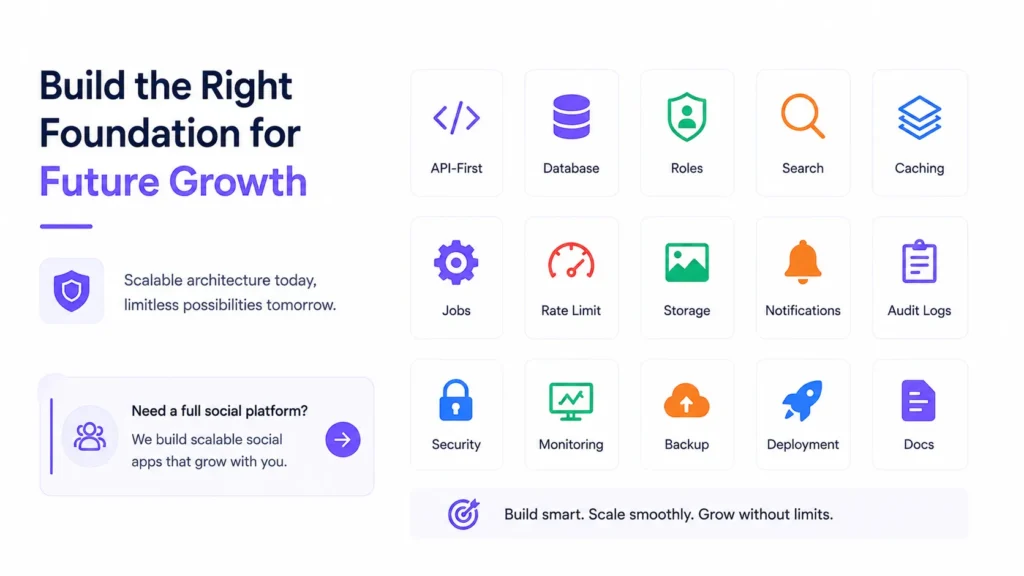
Early community products may not have heavy traffic. But architecture still matters because the wrong foundation can create expensive rebuilds later.
A scalable platform should consider:
- API-first backend design.
- Clean database schema.
- Role and permission architecture.
- Search indexing.
- Background jobs.
- Caching.
- Rate limiting.
- Media storage.
- Notification queues.
- Audit logs.
- Admin security.
- Monitoring and error tracking.
- Backup and recovery.
- Deployment workflow.
- Documentation.
For founders exploring broader engagement products beyond community forums, Miracuves also provides social media app development services that can support feeds, profiles, member interactions, content publishing, notifications, moderation workflows, and scalable social product architecture.
The goal is not to over-engineer the first version. The goal is to avoid architecture choices that block future growth.
Founder Decision Signals
Hidden Scope
If your roadmap includes communities, posts, comments, voting, moderation, notifications, roles, search, and admin control, the project is larger than a simple social feed.
Validation Risk
If the market is not validated yet, spending months on standard modules may delay learning. The first goal should be proving participation and repeat engagement.
Moderation Readiness
If the platform depends on user-generated content, trust-and-safety workflows should be part of the foundation, not added after problems appear.
Ownership
If the platform must evolve into a long-term owned asset, source code, admin control, and extensible architecture become important strategic decisions.
Mistakes Founders Should Avoid
Estimating only the visible screens
The build is not limited to feeds, posts, comments, and profiles. The real effort includes permissions, moderation, search, notifications, admin tools, analytics, and edge cases.
Adding too many post types too early
Every post type adds validation, storage, display, moderation, and analytics logic. Start with the formats needed to validate the community model.
Leaving moderation for phase two
Reports, bans, appeals, removal reasons, and audit logs are difficult to retrofit once users and disputes are already active.
Using one permission model for all communities
Community platforms need role-aware access. A member may have different permissions across different spaces, which must be planned early.
Building from zero without separating standard features from differentiation
Founders should invest custom effort where the business is unique, not on rebuilding standard community mechanics that users already expect.
When a Launch-Ready Platform Foundation Makes More Sense
Building from scratch can make sense when the product depends on a unique interaction model, deep enterprise workflow, unusual algorithm, custom compliance logic, or proprietary community structure.
But if the core need is a proven community product foundation, a launch-ready route may help founders move faster.
A launch-ready foundation can be useful when the startup needs:
- Topic-based communities.
- Member profiles.
- Post creation.
- Threaded comments.
- Voting and reactions.
- Moderation queues.
- Member and moderator roles.
- Admin dashboard.
- Notifications.
- Search.
- Private or premium spaces.
- Monetization options.
- Source-code ownership.
- Branded design.
- Future customization.
This approach does not remove the need for strategy. Founders still need audience positioning, seed content, moderators, onboarding, retention planning, and monetization decisions.
But it can reduce the time spent rebuilding standard community infrastructure.
How Miracuves Helps Founders Avoid Starting From Zero
Miracuves helps founders build white-label solution platforms with source code, branded design, member workflows, moderation tools, admin dashboards, monetization options, and faster deployment. Instead of spending the early stage rebuilding every standard community module from zero, founders can start with a product foundation that already supports the core platform logic: topic-based spaces, user profiles, post creation, comments, voting, reporting, role-based access, moderation workflows, admin controls, and monetization planning.
This gives startups more room to focus on the parts that actually create market advantage, such as niche positioning, seed content, member acquisition, moderator onboarding, community rituals, premium access strategy, and long-term product differentiation. For founders who want to validate the community model before investing in deeper custom development, the community discussion platform solution from Miracuves is a practical next step because it connects faster launch with source-code ownership, branded control, and room for future customization.
Before finalizing the launch scope, founders can review the community platform features page to understand which modules support communities, publishing, voting, moderation, admin control, and monetization.
If budget planning is part of the decision, the community platform development cost guide can help clarify how feature depth, integrations, customization, admin controls, and deployment scope affect investment.
For founders comparing build partners, the community platform development company page can help evaluate service capability, source-code ownership, moderation depth, and post-launch customization support.
Final Thoughts: The Delay Is Usually in the Details
Building a community discussion platform from scratch takes longer than founders expect because the visible interface is only a small part of the work.
The real timeline sits inside:
- Community permissions.
- Post types.
- Threaded comments.
- Voting and ranking logic.
- Moderation workflows.
- Member roles.
- Notifications.
- Search.
- Admin dashboards.
- Monetization rules.
- Analytics.
- Abuse prevention.
- Edge cases.
- Scalable architecture.
For startups, the strongest decision is not always to build everything from zero. It is to understand which features are standard, which workflows need customization, and which decisions help the team validate faster.
A focused launch-ready foundation can help founders reduce avoidable development effort while still keeping control over branding, source code, community strategy, and future customization.
Miracuves can help founders turn that strategy into a practical community platform foundation with admin control, moderation workflows, monetization options, and the flexibility to grow after launch.
FAQs
Why does building a community discussion platform from scratch take longer than expected?
It takes longer because the platform needs connected systems for users, communities, posts, comments, voting, moderation, notifications, permissions, search, admin control, analytics, and monetization. These systems must work together reliably.
What is the most underestimated part of community platform development?
Moderation is often the most underestimated part. Reports, bans, appeals, removal reasons, moderator notes, audit logs, and community rules require structured workflows, not just a report button.
What features should founders build first?
Founders should prioritize user accounts, topic-based communities, post creation, comments, voting, notifications, moderation basics, role-based access, admin dashboards, and analytics before adding advanced features.
Is custom development always the best option for a community platform?
Not always. Custom development is useful when the product has unique workflows or complex requirements. If the core platform mechanics are standard, a launch-ready foundation can reduce time and help founders validate faster.
Why are role-based permissions important in a community platform?
Role-based permissions help control what members, moderators, community owners, and admins can do. Without clear permissions, the platform may face security, moderation, and operational issues.
How does monetization increase development complexity?
Monetization adds access rules, payment handling, subscription states, wallet logic, reporting, refunds, premium spaces, and admin controls. It is more than adding a payment button.
What should startups validate before scaling the platform?
Startups should validate whether users join, post, comment, vote, receive replies, return, and trust the space. Participation and retention matter more than total signups.
How can Miracuves help founders launch a community discussion platform?
Miracuves helps founders launch white-label community platforms with source code, branded design, admin dashboards, moderation workflows, member roles, voting systems, monetization options, and faster deployment support.
Miracuves is an independent software development company. We are not affiliated with, connected to, sponsored by, or endorsed by any company or product named in this article.
Terms such as “X Clone” are used descriptively. It is how the software industry refers to building a platform with functionality comparable to a known service, and how clients search for it.
The entire design and codebase of our products is built by our own team. Our products contain no code, design, graphics, or content originating from any third-party website or applications.
All third-party names and marks referenced in this article are the property of their respective owners, referenced solely to identify the services discussed.