

Key Takeaways
- Forum software alternatives make more sense when startups need stronger engagement, moderation, member roles, monetization, mobile-first experiences, and platform ownership.
- Traditional forums remain useful for simple support boards, discussion archives, hobby groups, and communities focused mainly on threaded conversations.
- Modern community platforms add voting, feeds, notifications, reputation, private spaces, premium access, analytics, and structured moderation workflows.
- Startups should compare platforms based on their long-term community model rather than choosing a forum simply because it is familiar or inexpensive.
- A community discussion platform becomes more valuable when community participation, audience ownership, retention, or monetization is central to the business.
Platform Signals
- Choose a traditional forum when members mainly need categories, searchable threads, long-form replies, basic profiles, and simple moderation.
- Choose a community platform when you need voting, reactions, personalized discovery, member roles, private groups, premium spaces, and recurring engagement loops.
- Creator communities, SaaS communities, professional networks, publishers, gaming communities, and education platforms often benefit from more flexible community structures.
- Growing user-generated communities need report queues, warnings, restrictions, bans, appeals, moderator notes, action logs, and community-specific rules.
- Founders should also evaluate source-code ownership, branding control, API extensions, integrations, mobile support, data access, and future customization.
Real Insights
- The goal is not to replace forum software unnecessarily; a simple forum remains the better option when the business only needs structured discussions.
- Engagement loops matter when community growth depends on members returning, contributing, voting, following discussions, and inviting others.
- Plugin-based monetization may work initially, but deeper paid communities can require integrated permissions, payments, access rules, analytics, and admin controls.
- Source-code ownership becomes increasingly important when the community evolves into a core business asset requiring custom workflows and integrations.
- The strongest decision is to choose the platform model that matches how members will participate, how moderation will operate, how revenue may be generated, and how much long-term control the startup needs.
Traditional forum software helped early internet communities organize conversations around topics, threads, categories, and member replies. For support groups, hobby spaces, product discussions, and knowledge-sharing communities, forums created a structure that was far better than scattered comments or disconnected social posts.
But startup communities in 2026 often need more than a classic forum experience.
Founders are not only trying to host discussions. They want to build owned audience spaces, encourage member contribution, manage moderation, support mobile-first engagement, test premium communities, collect first-party data, run creator or expert-led spaces, and turn user-generated content into a long-term growth asset.
That is why many founders begin searching for forum software alternatives.
A modern community discussion platform can make more sense when the business needs stronger engagement loops, flexible member roles, voting, notifications, private communities, monetization options, admin dashboards, and scalable moderation workflows.
This guide explains when traditional forum software is enough, when a modern community platform is a better fit, and how founders should compare both before launch.
What Traditional Forum Software Does Well
Traditional forum software is built around structured conversations. It usually includes categories, threads, replies, member accounts, basic moderation, search, and administrator settings.
This model works well when the community mainly needs:
- Topic-based discussion archives.
- Support questions and answers.
- Long-form member replies.
- Public knowledge sharing.
- Simple user profiles.
- Category-based organization.
- Basic moderator controls.
- Searchable thread history.
For many businesses, that is enough.
A small support forum, a local hobby group, an internal discussion board, or a low-volume knowledge-sharing space may not need advanced feeds, reputation systems, premium access, mobile app workflows, or monetization modules.
The advantage of traditional forum software is simplicity. It gives structure without requiring a complex product strategy.
But simplicity can become a limitation when the community needs to behave more like a growth product than a discussion archive.
Read more – Community-Led Growth Strategy: Seed Content, Moderators, and Referral Loops for Discussion Platforms
Where Traditional Forums Start to Feel Limited
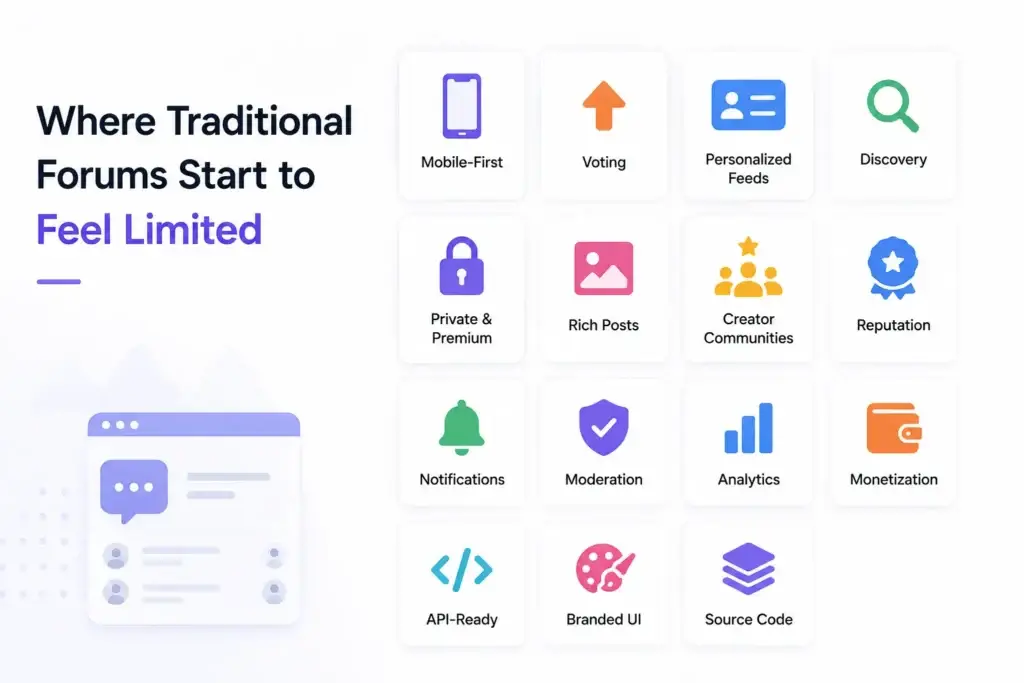
The limitations usually appear when a startup moves beyond basic conversations.
A founder may start with forum software and later realize they need:
- Better mobile-first experience.
- Voting or ranking systems.
- Personalized feeds.
- Topic-based discovery.
- Public, private, and premium spaces.
- Rich post types like images, videos, polls, and links.
- Creator or expert-led communities.
- Member reputation and badges.
- Notification loops.
- Stronger moderation workflows.
- Admin analytics.
- Monetization controls.
- API-based extension.
- Branded user experience.
- Source-code ownership.
- Custom product workflows.
These needs are not always obvious at the beginning. They appear when users start joining, posting, reporting content, requesting private groups, asking for better discovery, or expecting a smoother mobile experience.
That is when founders begin looking for a community discussion platform instead of a basic forum tool.
What Makes a Community Discussion Platform Different?
A community discussion platform is not just a newer-looking forum. It is a broader product system for member-led engagement.
It usually combines:
- Topic-based spaces.
- Posts and threaded comments.
- Voting or reactions.
- Member profiles.
- Community roles.
- Moderation queues.
- Report workflows.
- Admin controls.
- Notifications.
- Feeds and discovery.
- Search.
- Private or premium communities.
- Monetization options.
- Analytics.
- API-ready architecture.
The difference is the product mindset.
Traditional forum software focuses on organizing discussions.
A modern community platform needs more than basic thread creation. Founders should review the community platform features that support engagement, moderation, admin control, voting, member roles, private spaces, and monetization before finalizing the launch scope.
That difference matters for startups because community growth depends on more than storing conversations. It depends on making members want to return, contribute, invite others, and trust the space.
Forum Software vs Community Discussion Platform: Practical Comparison
Traditional Forum Software vs Community Discussion Platform
| Decision Area | Traditional Forum Software | Community Discussion Platform |
|---|---|---|
| Primary purpose | Organize topic-based threads and replies | Build an owned community with engagement, governance, and growth workflows |
| User experience | Thread and category focused | Feed, topic, community, profile, and notification focused |
| Engagement | Replies and views | Posts, comments, votes, reactions, saves, mentions, and recurring prompts |
| Discovery | Categories and search | Feeds, tags, trending posts, recommended communities, search, and saved discussions |
| Moderation | Basic admin and moderator controls | Report queues, action logs, bans, appeals, role-based workflows, and community-level rules |
| Member roles | Usually simple user/moderator/admin roles | Members, moderators, community owners, admins, premium members, and restricted users |
| Monetization | Often limited or plugin-dependent | Premium spaces, memberships, wallet credits, awards, sponsored spaces, or paid access |
| Startup fit | Good for simple discussion archives | Better for branded, scalable, growth-focused community products |
When Forum Software Is Still the Right Choice
A modern community platform is not always necessary.
Traditional forum software may be the better option when:
- The community is small and stable.
- Members mainly need long-form threaded discussions.
- The goal is a searchable archive, not daily engagement.
- Monetization is not a priority.
- Mobile app support is not required.
- Moderation needs are simple.
- The community does not need private or premium spaces.
- The business does not need deep customization.
- The team wants a lightweight discussion tool.
For example, a small product support forum, a club archive, a technical Q&A board, or a low-volume interest group may perform well with a traditional forum structure.
The key is not to overbuild.
If a forum meets the community’s needs, there is no reason to add complexity. The problem begins when the business expects forum software to behave like a modern social community product.
When a Community Discussion Platform Makes More Sense
A community discussion platform makes more sense when the community is expected to become part of the business model.
This is especially true when the founder wants to:
- Own the audience instead of depending only on external social channels.
- Build topic-based communities under one branded platform.
- Support member profiles and identity.
- Encourage voting, reactions, comments, and recurring discussions.
- Create private, restricted, or premium communities.
- Manage user-generated content safely.
- Give moderators structured workflows.
- Build mobile-friendly engagement.
- Add subscriptions, memberships, wallet credits, awards, or sponsored spaces.
- Track member activity and community health.
- Customize the platform around a niche.
- Retain source-code control for future changes.
A community platform is the better choice when the founder is not only hosting conversations but building a long-term owned community asset.
Read more – Why Building a Community Discussion Platform From Scratch Takes Longer Than Founders Expect
Startup Use Cases Where Forum Alternatives Work Better
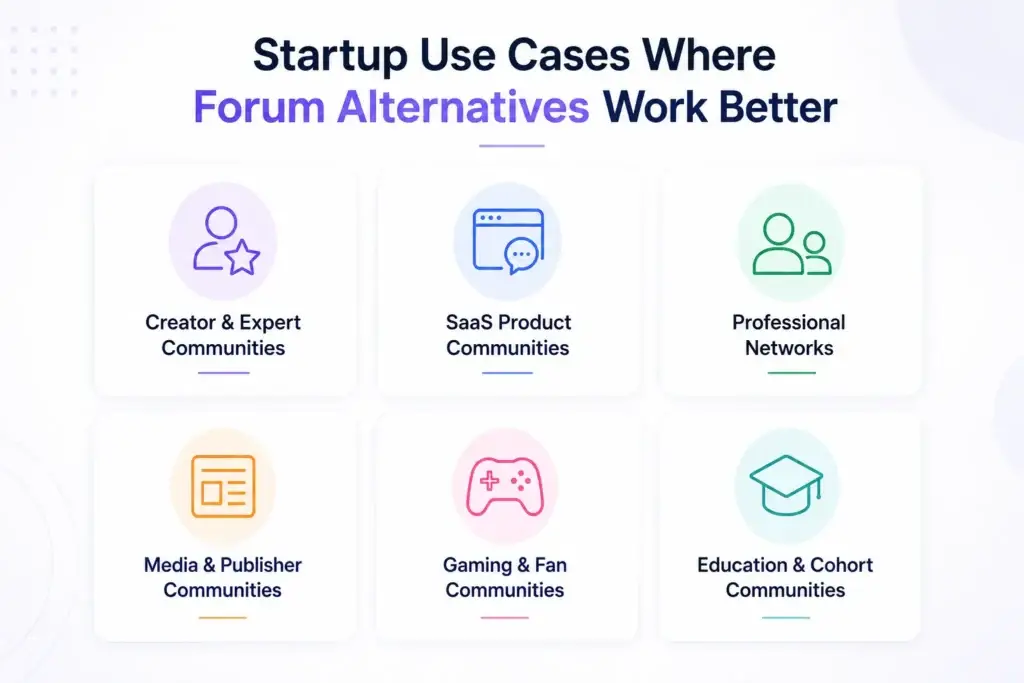
Different startup models need different community structures.
A traditional forum may be enough for a simple support archive, but a community discussion platform is often stronger for:
Creator and Expert Communities
Creators, coaches, educators, and experts may need private spaces, premium member access, exclusive discussions, badges, events, and direct community ownership.
SaaS Product Communities
SaaS companies may use community platforms for product feedback, feature requests, support discussions, roadmap conversations, onboarding groups, and user education.
Professional Networks
Professional communities often need reputation, member profiles, private groups, expert threads, moderation, and knowledge archives.
Media and Publisher Communities
Publishers may want to bring audience conversations in-house, manage moderation policy, collect first-party engagement data, and build sponsored or premium discussion spaces.
Gaming and Fan Communities
Fan and gaming communities need fast engagement, user identity, polls, media posts, events, role-based moderation, and recurring discussion rituals.
Education and Cohort Communities
Course platforms and learning brands may need member spaces, discussion prompts, instructor replies, private cohorts, progress-based groups, and structured Q&A.
If the community is central to retention, monetization, or audience ownership, a basic forum may become limiting.
Engagement Loops Matter More Than Thread Storage
A forum stores discussions. A community platform should create a reason to return.
This is where engagement loops matter.
A modern community discussion platform should support:
- New member onboarding.
- Topic recommendations.
- Followed communities.
- Reply notifications.
- Mention alerts.
- Weekly digests.
- Voting and ranking.
- Saved posts.
- Contributor recognition.
- Pinned discussions.
- Recurring prompts.
- Community announcements.
- Member badges.
- Moderator highlights.
These features do not exist only to make the platform look modern. They help users build habits.
For founders, this matters because community success depends on repeat participation. A platform with thousands of registered members but no active discussion is not a healthy community.
Moderation Is a Major Reason to Move Beyond Basic Forum Tools
User-generated content creates trust and safety responsibilities.
Traditional forums usually offer some moderation controls. But growth-focused communities often need more structured workflows.
A serious moderation layer may include:
- Report intake.
- Report categories.
- Moderator queues.
- Removal reason libraries.
- Warning systems.
- Temporary restrictions.
- Permanent bans.
- Appeal workflows.
- Moderator notes.
- Action logs.
- Admin escalation.
- Community-specific rules.
- Platform-wide policy controls.
- Spam and abuse signals.
This is especially important when communities grow across multiple topics. A member may be safe in one community, restricted in another, and under review at the platform level.
A community discussion platform gives founders more room to manage those realities without relying only on manual admin work.
Monetization: Why Forum Plugins Are Not Always Enough
Many forum tools can support monetization through plugins or third-party extensions. That may work for simple paid access or memberships.
But startups often need deeper monetization logic.
A modern community platform may support:
- Premium communities.
- Membership tiers.
- Paid expert spaces.
- Wallet credits.
- Awards.
- Sponsored communities.
- Promoted posts.
- Business accounts.
- Creator or moderator incentives.
- Private access packages.
Each model affects permissions, payments, content access, user roles, analytics, and admin control.
Once founders connect community access to revenue planning, they need more than a payment form. They need a monetization system that works with community structure.
For a deeper breakdown of memberships, premium spaces, sponsored communities, paid visibility, wallet-based engagement, and paid access models, review the platform business model guide.
Ownership and Customization: The Startup Decision That Matters Later
Startups often choose tools based on launch speed. That is understandable.
But long-term ownership also matters.
A hosted forum tool may be convenient, but it can limit what founders can customize later. A source-code-owned community platform gives the business more control over branding, workflows, integrations, monetization, deployment, and future product direction.
Founders should ask:
- Can we fully brand the platform?
- Can we customize member workflows?
- Can we add new community types later?
- Can we control moderation policy?
- Can we export or manage our data?
- Can we integrate payments, analytics, CRM, or AI tools?
- Can we create mobile apps or API-based extensions?
- Can our team modify the source code?
- Are we dependent on a third-party roadmap?
For founders exploring broader engagement products beyond forum alternatives, Miracuves also provides social media app development services that can support feeds, profiles, content publishing, notifications, moderation workflows, and scalable social product architecture.
These questions may not feel urgent at launch. They become important once the community starts growing.
Founder Decision Signals
Use a Forum When
You need simple topic threads, a searchable archive, basic member replies, and a lightweight discussion space without complex monetization or governance.
Use a Community Platform When
You need member roles, engagement loops, voting, moderation workflows, private spaces, monetization options, admin control, and future customization.
Watch for Growth Risk
If users will create content at scale, moderation, report queues, permissions, and audit history should be planned before growth creates operational pressure.
Think About Ownership
If the community is part of your long-term business asset, source-code control, branded experience, and extensible architecture become important decisions.
Cost and Scope: Forum Software vs Platform Foundation
Cost should not be compared only by upfront subscription fees.
A forum tool may look less expensive at the start, but founders should also consider:
- Plugin costs.
- Custom theme work.
- Integration limitations.
- Moderation gaps.
- Monetization restrictions.
- Mobile experience limitations.
- Migration effort later.
- Developer dependency.
- Support and hosting requirements.
- Brand and ownership constraints.
A community discussion platform may require more planning, but it can reduce future friction if the startup already knows it needs branded control, member roles, moderation workflows, monetization, and scalable engagement features.
If budget planning is part of your decision, the community platform development cost guide can help founders understand how feature depth, customization, integrations, admin controls, and launch scope affect investment.
Mistakes Founders Should Avoid
Choosing forum software only because it is familiar
A familiar interface is useful, but founders should check whether the platform can support mobile engagement, moderation, monetization, and future customization.
Overbuilding when a simple forum is enough
If the goal is only a small discussion archive, a full community platform may add unnecessary complexity. The platform choice should match the business model.
Ignoring moderation until the community grows
Report queues, bans, appeals, action logs, and community rules are easier to design early than retrofit after trust issues appear.
Depending too heavily on plugins
Plugins can help, but too many plugin-based workflows can create maintenance issues, inconsistent user experience, and limited customization control.
Forgetting the ownership question
If the community becomes a core business asset, founders need to think about source code, data access, integrations, branding, and long-term platform control.
How Miracuves Helps Founders Launch a Modern Community Platform
Miracuves helps founders build white-label community platforms with source code, branded design, member workflows, moderation tools, admin dashboards, monetization options, and faster deployment. For startups comparing forum software alternatives, this approach can be useful when the product needs more than thread storage and basic replies. It gives founders a stronger foundation for topic-based spaces, member profiles, voting, reporting, moderator roles, admin control, premium access, wallet-based engagement, and long-term customization.
A modern community platform foundation can support:
- Topic-based communities.
- Member registration and profiles.
- Post creation and discussion threads.
- Voting and reactions.
- Moderator roles and report queues.
- Admin dashboards.
- Notifications.
- Search and discovery.
- Private or premium spaces.
- Monetization options.
- Source-code ownership.
- Future customization.
Before finalizing the product scope, founders can review the community platform features page to understand which modules support engagement, moderation, admin control, and monetization.
For founders comparing service partners, the platform development company page can help evaluate technical capability, moderation depth, source-code ownership, and post-launch customization support.
For broader social engagement products beyond forum alternatives, Miracuves also provides social media app development services that can support feeds, profiles, content publishing, notifications, moderation workflows, and scalable social product architecture.
For founders who want a branded, launch-ready product foundation, the community discussion platform solution from Miracuves is the natural next step.
Final Thoughts: Choose the Platform Model That Matches the Community You Want to Build
Forum software is still useful when the goal is simple, structured discussion.
But if the startup wants a branded community asset with member identity, voting, moderation, notifications, private spaces, monetization, admin control, and future customization, a reddit may be the stronger choice.
The decision should not be based on trend or familiarity. It should be based on how the community will grow, how members will participate, how moderation will work, how revenue may be created, and how much control the business needs over the platform.
For founders, the best platform is not always the most complex one. It is the one that matches the community model, supports the growth strategy, and gives the business enough control to evolve after launch.
Miracuves can help founders move from forum-style planning to a launch-ready community platform foundation with white-label solution, source-code ownership, admin control, moderation workflows, and monetization-ready features.
FAQs
What are the best forum software alternatives for startups?
The best alternative depends on the startup’s goal. If the business needs voting, member roles, moderation workflows, notifications, premium spaces, monetization, and admin control, a community discussion platform is often a better fit than basic forum software.
When should a startup use traditional forum software?
Traditional forum software works well for simple discussion archives, support boards, hobby groups, and low-complexity communities where basic threads, replies, categories, and search are enough.
When does a community discussion platform make more sense?
A community discussion platform makes more sense when the founder wants a branded, scalable, growth-focused community with member identity, voting, private groups, moderation workflows, monetization, and future customization.
What is the main difference between forum software and a modern community platform?
Forum software is mainly designed to organize threads and replies. A modern community platform is designed to manage engagement, governance, discovery, member roles, monetization, and long-term community growth.
Can a community platform support monetization?
Yes. A community platform can support premium spaces, memberships, sponsored communities, promoted posts, wallet credits, awards, business accounts, and paid access models depending on the business strategy.
Why is moderation important when choosing a forum alternative?
As user-generated content grows, founders need report queues, bans, appeals, moderator notes, action logs, and community rules. Strong moderation protects trust, member safety, and platform reputation.
Is source-code ownership important for a community platform?
Source-code ownership is important when founders want long-term control over branding, workflows, integrations, deployment, monetization, and future customization.
How can Miracuves help with a community discussion platform?
Miracuves helps founders launch white-label community platforms with source code, branded design, member workflows, moderation tools, admin dashboards, monetization options, and faster deployment support.
Miracuves is an independent software development company. We are not affiliated with, connected to, sponsored by, or endorsed by any company or product named in this article.
Terms such as “X Clone” are used descriptively. It is how the software industry refers to building a platform with functionality comparable to a known service, and how clients search for it.
The entire design and codebase of our products is built by our own team. Our products contain no code, design, graphics, or content originating from any third-party website or applications.
All third-party names and marks referenced in this article are the property of their respective owners, referenced solely to identify the services discussed.