Key Takeaways
- The cross-platform Flutter vs native development decision should be based on product requirements, platform coverage, engineering resources, and long-term ownership costs—not framework popularity alone.
- Flutter can reduce duplicated engineering work when a startup needs similar functionality across both iOS and Android through a shared codebase.
- Native Swift and Kotlin can provide stronger financial value when a product depends heavily on platform-specific APIs, specialized hardware, advanced performance, or a single operating system.
- A realistic budget should include mobile development, backend infrastructure, integrations, testing, deployment, maintenance, security updates, and future feature development.
- Flutter does not eliminate platform-specific testing. iOS and Android still require validation for permissions, notifications, accessibility, device behavior, payments, and operating system changes.
- Startups can combine Flutter with native Swift or Kotlin modules when only selected features require direct platform-level capabilities.
- The best technology choice is the one that delivers the required product experience while preserving enough budget and runway for customer validation, iteration, and future growth.
For an early-stage startup, backend architecture is not simply a technical decision. It determines how quickly a product can launch, how much engineering capacity gets consumed by infrastructure, and whether the system can evolve as the business attracts customers.
Founders often face a difficult choice: should they build a distributed system using microservices from the beginning, or start with a modular monolith that keeps application components organized within one deployment?
Microservices promise independent scaling, separate deployments, and greater autonomy for engineering teams. However, these advantages introduce distributed communication, additional monitoring, infrastructure management, and operational responsibilities. A modular monolith offers a simpler starting point while preserving boundaries between important business functions.
Before investing in distributed infrastructure, founders should evaluate their product requirements and available microservices architecture and backend engineering options. The right backend should support actual business needs rather than technical complexity that may not deliver value during the early stages.
So, which architecture should startups choose? For many small engineering teams building their first market-ready product, a well-designed modular monolith provides a practical balance of development speed, maintainability, and scalability. Microservices become more compelling when independent deployment, workload isolation, organizational boundaries, or distinct operational requirements create measurable benefits.
This guide explains the technical differences, hidden expenses, architectural risks, and decision signals founders should consider before choosing their backend foundation.
Understanding the Difference Between Microservices and a Modular Monolith
The fundamental difference between these approaches is how application responsibilities are separated, deployed, and operated.
Both architectures can organize code around business capabilities such as authentication, payments, orders, inventory, reporting, and notifications. The distinction is whether those capabilities operate within a shared application process or across independent services communicating through network boundaries.
What Is a Modular Monolith?
A modular monolith is an application developed as one deployable system but structured into distinct modules with controlled responsibilities and dependencies.
Consider a subscription-based learning platform. Its backend might contain modules for user accounts, course management, subscriptions, payments, learning progress, and notifications.
In a modular monolith, these modules remain within one application, but each is responsible for its own business logic. Other modules communicate through clearly defined interfaces instead of directly modifying internal implementation details.
The application may use a shared physical database, but good module boundaries establish ownership of tables, entities, and business rules. This prevents unrelated modules from becoming tightly coupled through uncontrolled database access.
The primary advantage is organizational clarity without requiring separate networked deployments for every business capability.
What Are Microservices?
Microservices architecture divides a backend into independently deployable services, typically organized around specific business capabilities.
A marketplace could operate separate services for identity, product catalogs, ordering, payments, fulfillment, and notifications. These services communicate through APIs, messaging systems, or event-driven workflows.
Each service can potentially have its own deployment pipeline, resource allocation, scaling policy, and data ownership. This creates flexibility when different parts of the system have distinct technical requirements.
However, communication that previously happened inside one application now crosses a network. Engineers must handle timeouts, partial failures, version compatibility, observability, and data synchronization between independently operating components.
Microservices therefore offer architectural independence in exchange for additional operational complexity.
Why a Modular Monolith Is Different From a Traditional Monolith
The word monolith is sometimes associated with applications where business logic, database queries, interfaces, and background processes become difficult to separate.
That is a problem with application structure, not an unavoidable consequence of having one deployment.
A modular monolith deliberately establishes boundaries between capabilities. Developers can organize code around business domains, enforce dependencies, write module-level tests, and prevent unrelated components from accessing each other’s internal logic.
This distinction matters to founders because the alternatives are not simply a poorly organized application or a sophisticated distributed system. There is a middle ground that offers simplicity while preserving architectural discipline.
Microservices vs. Modular Monolith: A Practical Architecture Comparison
Comparing the architectures across engineering, operational, and business dimensions provides a clearer picture than focusing only on scalability.
| Decision Factor | Modular Monolith | Microservices |
|---|---|---|
| Deployment | One coordinated application deployment | Separate service deployments |
| Business Boundaries | Enforced through modules and interfaces | Enforced through service contracts and network boundaries |
| Initial Setup | Typically simpler | Typically more infrastructure and automation work |
| Internal Communication | Primarily in-process calls | APIs, messaging, and events |
| Data Consistency | Often simpler within one transactional database | Cross-service consistency requires additional design |
| Scaling | Scale the application and optimize individual workloads | Scale independently deployed services |
| Failure Isolation | Shared process may increase impact of certain failures | Potentially stronger isolation if dependencies are resilient |
| Debugging | Generally simpler within one application | Requires cross-service tracing and correlation |
| Release Independence | One deployable unit | Independent releases when contracts permit |
| Operational Ownership | Smaller operational footprint | Multiple services require ongoing ownership |
| Typical Startup Fit | Early product development with limited teams | Distinct workloads or independently operating teams |
| Future Flexibility | Modules may be extracted later | Services can evolve independently within agreed contracts |
Founder insight: Microservices are not inherently more scalable in every practical situation. A carefully optimized modular monolith can support substantial demand, while poorly designed microservices can create bottlenecks, cascading failures, and higher operating costs.
Why Early-Stage Startups Often Benefit From a Modular Monolith
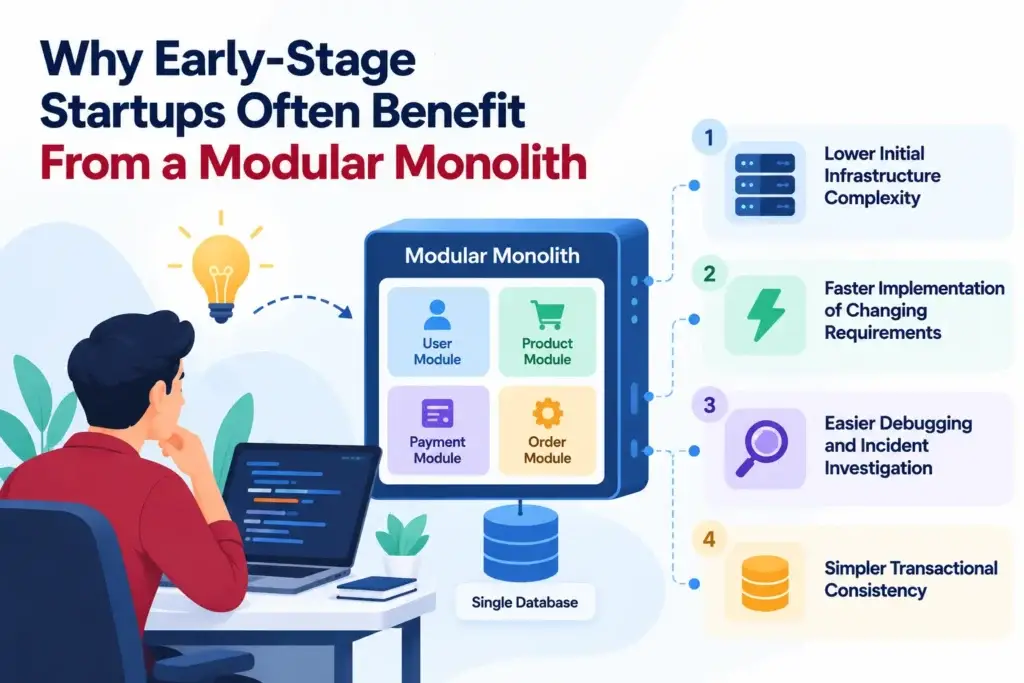
Startups typically face a different set of constraints from established organizations. Their priorities often include validating customer demand, releasing essential features, controlling cash burn, and adjusting product direction when assumptions change.
Under these conditions, backend simplicity becomes a business advantage.
1. Lower Initial Infrastructure Complexity
A modular monolith can operate through a relatively straightforward infrastructure setup: an application runtime, database, storage, cache where needed, monitoring, and a deployment pipeline.
Microservices may require individual deployment configurations, inter-service networking, service authentication, queue management, container coordination, and more extensive monitoring.
Each additional system requires engineering attention. For a startup with limited resources, that effort competes directly with customer-facing feature development.
2. Faster Implementation of Changing Business Requirements
Early-stage products change frequently. A marketplace may revise its commission structure, a subscription application may experiment with billing models, and a booking platform may introduce new cancellation rules.
In a modular monolith, developers can update multiple closely related modules within one repository and test their interactions as part of a coordinated release.
In microservices, the same change might require updated API contracts, event schemas, compatibility testing, and coordinated migrations across service boundaries.
When the business model is still evolving, keeping tightly related workflows together can reduce coordination overhead.
3. Easier Debugging and Incident Investigation
Imagine a customer pays successfully but the application does not activate their subscription.
In a modular monolith, engineers may be able to trace the relevant logic across payment and subscription modules within a single application execution context.
In a distributed architecture, the issue could involve a payment service, event broker, subscription consumer, delayed message, failed retry, or inconsistent state between databases.
Both designs can be debugged effectively, but the distributed approach typically requires additional instrumentation and operational expertise.
4. Simpler Transactional Consistency
Many startup applications depend on business operations that must complete consistently.
For example, a booking workflow may need to reserve inventory, create an order, and record payment state without allowing inconsistent records.
When related data exists within one transactional database, a modular monolith can often coordinate these changes using conventional database transactions.
Microservices with independent data stores may require event-driven consistency, compensating actions, idempotency controls, and careful handling of partial failures.
Those mechanisms are valuable when independence is necessary, but they add implementation and testing work that should be justified by product requirements.
When Microservices Become Worth the Additional Complexity
Microservices are not simply an advanced version of a monolith. They solve particular problems involving independent ownership, deployment, scaling, and failure boundaries.
The architecture becomes more attractive when these problems are already measurable or unavoidable because of the product’s operating model.
1. Independent Teams Need Independent Release Cycles
As a startup expands, different engineering teams may become responsible for payments, customer accounts, analytics, fulfillment, and other major domains.
If every team repeatedly waits for a coordinated application release, deployment dependencies may begin slowing product delivery.
Separating a well-defined domain into an independently deployed service can reduce these conflicts, provided the service owns its responsibilities and exposes stable contracts.
Simply creating separate repositories does not provide this benefit if every change still requires synchronized releases across the entire system.
2. Different Workloads Have Distinct Scaling Needs
A digital platform may contain workload patterns that differ substantially. User profile requests may be lightweight, while video processing, report generation, image transformation, or recommendation workloads consume more computing resources.
Running those workloads together may eventually become inefficient, especially when resource-intensive operations interfere with latency-sensitive requests.
Microservices allow distinct workloads to use independent resource allocations and scaling policies.
However, founders should first evaluate simpler alternatives such as background workers, queues, caching, and separate processing infrastructure. Not every scaling difference requires a full microservices architecture.
3. Certain Functions Require Stronger Isolation
Some businesses need to isolate high-risk operations, sensitive information, or workloads with specific availability requirements.
For example, a large financial platform may benefit from carefully separated transaction-processing and reporting systems. A content platform might isolate resource-intensive media processing from its primary user-facing APIs.
But service separation does not automatically guarantee security or fault isolation. Independent services still need controlled permissions, reliable network communication, resilience policies, monitoring, and incident response procedures.
4. Business Domains Have Become Stable Enough to Separate
One of the most overlooked requirements for successful microservices is understanding the boundaries between business capabilities.
When a startup is still discovering how orders, payments, users, and fulfillment should interact, extracting them into independent services can make future changes harder.
Once business rules and ownership responsibilities stabilize, a service boundary becomes easier to define. Teams can identify which data belongs to the service, what contracts it exposes, and how other components interact with it.
That clarity reduces the risk of creating a distributed architecture where services are technically separate but remain tightly dependent on each other.
The Hidden Cost of Microservices for Early-Stage Startups
The cost of microservices is not limited to cloud hosting. Distributed systems create additional requirements across the engineering lifecycle.
Founders should evaluate the recurring effort needed to operate the architecture, not merely the cost of deploying its first version.
Infrastructure and Deployment Overhead
Each independently deployed service needs configuration, release management, runtime resources, and monitoring appropriate to its responsibilities.
Before adopting independently deployed services, founders should evaluate how cloud infrastructure planning affects hosting expenses, deployment automation, observability, and long-term operational responsibilities.
Depending on system size, teams may also introduce API gateways, message brokers, service discovery, container orchestration, secrets management, and centralized logging.
Managed cloud services can simplify some responsibilities, but they do not eliminate the need for operational ownership. They also introduce usage-based expenses and platform dependencies.
Observability and Incident Response
When a request crosses multiple services, a single error log may not explain the failure.
Engineers need correlation identifiers, distributed tracing, centralized logs, latency monitoring, and clear alerts to understand how failures move through the system.
These capabilities improve reliability but increase instrumentation, maintenance, and investigation effort.
Founders preparing for production should understand how deployment pipelines, monitoring, backups, and rollback procedures fit together. The broader principles are explained in this production architecture and deployment guide.
Testing Across Network Boundaries
In a modular monolith, many interactions can be validated through unit tests and application-level integration tests.
Microservices require additional consideration for API compatibility, contract testing, network failures, message delivery, deployment ordering, and cross-service workflows.
A service might function correctly in isolation but fail when another service responds slowly, changes its contract, or becomes unavailable.
Testing these conditions takes planning and engineering capacity that small teams may not be ready to support.
Data Synchronization and Distributed Transactions
Separating databases can help services maintain independent ownership, but it makes workflows involving multiple domains more complicated.
Consider an order that requires inventory reservation, payment authorization, and fulfillment scheduling. If these actions are handled by separate services, one component might succeed while another fails.
Teams may need asynchronous events, compensating transactions, retry policies, idempotency keys, and reconciliation processes.
These patterns are important in distributed systems, but founders should recognize that architectural independence creates new categories of implementation responsibility.
Startup Backend Cost Comparison: A Practical Planning Model
Exact infrastructure costs vary by workload, hosting provider, database architecture, traffic, regional requirements, and service-level expectations.
Rather than relying on generic price claims, startups can compare the engineering activities required under each approach.
| Cost Component | Modular Monolith | Microservices |
|---|---|---|
| Initial architecture | Module boundaries and shared deployment design | Service boundaries, contracts, networking, and distributed data planning |
| Development environment | One primary application runtime | Multiple runtimes or service dependencies |
| CI/CD | One principal deployment pipeline | Independent service pipelines and compatibility controls |
| Cloud infrastructure | Typically simpler initial footprint | Potentially more components and baseline overhead |
| Testing | Module tests and application integration tests | Service, contract, resilience, and distributed workflow tests |
| Monitoring | Application metrics, logs, and traces as needed | Cross-service metrics, logs, traces, and dependency monitoring |
| Data integrity | Often simpler transactional coordination | Additional cross-service consistency mechanisms |
| Independent scaling | Application replicas and separated workers | Per-service resources and scaling policies |
| Operational staffing | Usually fewer distributed-system responsibilities | Greater need for platform and operational expertise |
An Illustrative Engineering-Effort Example
Imagine a startup with four developers building a marketplace backend containing accounts, listings, bookings, payments, messaging, and administration.
With a modular monolith, the team can create clear internal boundaries while sharing application infrastructure, deployment workflows, and testing conventions.
If the startup instead creates six independent services immediately, it must also establish service communication, authentication between components, independent runtime configuration, distributed debugging, and release coordination.
Those additional responsibilities do not necessarily improve bookings, payment completion, or customer retention. They may instead reduce the engineering capacity available for business-critical functionality.
Now consider the same business several years later, with independent teams managing payments, search, and fulfillment. If these domains need separate release cycles and exhibit different load patterns, extracting selected services may create enough operational value to justify the added complexity.
The financial difference lies in timing. An architecture that creates unnecessary overhead today may become valuable once the business encounters the constraints it was designed to solve.
Can a Modular Monolith Scale Without Becoming Microservices?
Yes. A modular monolith can scale substantially when engineers identify real bottlenecks and optimize the parts of the system responsible for them.
Many performance problems originate in slow database queries, inefficient data access, blocking background operations, expensive third-party integrations, or inadequate caching. These problems do not automatically require service decomposition.
Database Indexing and Query Optimization
A marketplace experiencing slow search results might have inefficient joins, missing indexes, or excessive database queries.
Before introducing a separate search service, the engineering team can profile database queries, optimize indexes, reduce unnecessary queries, and consider dedicated search infrastructure if genuinely required.
Caching Frequently Accessed Data
Product catalogs, public listings, configuration settings, and other frequently accessed information may benefit from caching.
A properly designed cache can reduce repeated database operations and improve response times without requiring multiple independent application services.
Cache invalidation and consistency still require careful implementation, particularly when users expect real-time information.
Background Queues and Separate Workers
Some activities do not need to execute during an interactive request. Email delivery, report generation, media processing, notifications, and selected integrations can run asynchronously.
Separating these activities into background workers allows the main application to respond quickly while longer-running tasks execute independently.
This operational separation does not require splitting the entire business domain into a microservice.
Horizontal Application Scaling
A stateless modular application can often run across multiple instances behind a load balancer. External session management, shared storage, and appropriate database capacity help support this approach.
The team can increase application capacity while keeping one coordinated codebase and deployment model.
Database contention, shared resources, and inefficient architecture may eventually limit this approach, but scaling the monolith should be evaluated before assuming distributed services are necessary.
The Distributed Monolith Trap: When Microservices Create More Problems Than They Solve
One of the most expensive architecture mistakes occurs when an application is divided into multiple services without establishing genuine independence.
This is commonly described as a distributed monolith.
Imagine an order service that cannot complete a request unless the customer, inventory, pricing, payment, and notification services all respond synchronously.
If every service must deploy together, shares database tables with other services, and depends on long chains of network calls, the startup may gain little operational independence.
Instead, it inherits network failures, complex deployments, difficult testing, and infrastructure overhead while retaining much of the coupling of a poorly structured monolith.
Successful service boundaries require careful decisions about domain ownership, data responsibility, asynchronous communication, version compatibility, and operational accountability.
For founders, the lesson is important: splitting code into separate services does not automatically produce a scalable architecture. Independence must exist in the design and in the way teams operate the system.
How to Design a Modular Monolith That Can Evolve Later
Starting with a modular monolith should not mean ignoring future scalability. A well-designed application can preserve options for extracting services as requirements change.
Define Modules Around Business Capabilities
Organize modules around capabilities such as billing, catalog management, bookings, identity, and fulfillment rather than dividing the entire application only into technical layers.
A strong modular backend starts with clear domain ownership and controlled dependencies. Following established modular software architecture principles can help startups organize business capabilities without introducing unnecessary distributed infrastructure.
Each module should contain the logic necessary to perform its assigned business responsibility.
Establish Clear Module Interfaces
One module should interact with another through defined interfaces or application-level contracts.
For example, the booking module should not directly change the internal payment module’s records. It should request a payment operation through a supported interface and receive a defined result.
These boundaries reduce accidental dependencies and make future extraction easier.
Assign Data Ownership Even When Using One Database
Using one physical database does not mean every module should freely modify every table.
Modules should have clear ownership of their data structures, business rules, and allowed access methods. Cross-module reporting can use designed interfaces or read models where needed.
This discipline reduces the cost of separating databases later if a module becomes an independent service.
Use Events When They Solve Real Coupling Problems
Application events can help modules react to important business changes without creating unnecessary direct dependencies.
For instance, an order-completed event could trigger a notification or analytics update.
However, not every internal method call needs to become an event. Introducing asynchronous communication also requires decisions about retries, ordering, failures, and duplicate delivery.
Use event-driven patterns when they improve boundaries or operational behavior, not simply to imitate a distributed architecture.
Enforce Boundaries Through Automated Checks
Documentation alone may not prevent developers from introducing cross-module dependencies under delivery pressure.
Teams can use architecture tests, package dependency rules, code review standards, and module-level test suites to preserve the intended structure.
These safeguards allow a modular monolith to remain maintainable as the product and engineering team grow.
When Should a Startup Move From a Modular Monolith to Microservices?
Architecture migration should begin with a documented problem rather than an arbitrary traffic milestone.
User count alone is a weak signal because workload complexity varies. A read-heavy application with effective caching behaves very differently from a platform handling continuous real-time transactions or computationally intensive media operations.
The following signals provide stronger evidence that service extraction may be worthwhile.
Release Bottlenecks
Independent teams repeatedly block each other’s production deployments.
Uneven Workload
One business capability requires substantially different resources or scaling policies.
Isolation Requirements
A component has specific availability, security, or operational boundaries that are difficult to achieve within the current deployment.
Stable Ownership
A team can own the extracted service’s code, contracts, monitoring, and incident response.
Clear Domain Boundaries
The capability has understandable data ownership and limited dependencies.
Measured Benefit
The anticipated improvement exceeds the additional infrastructure and operational cost.
A Safer Migration Strategy: Extract One Business Capability at a Time
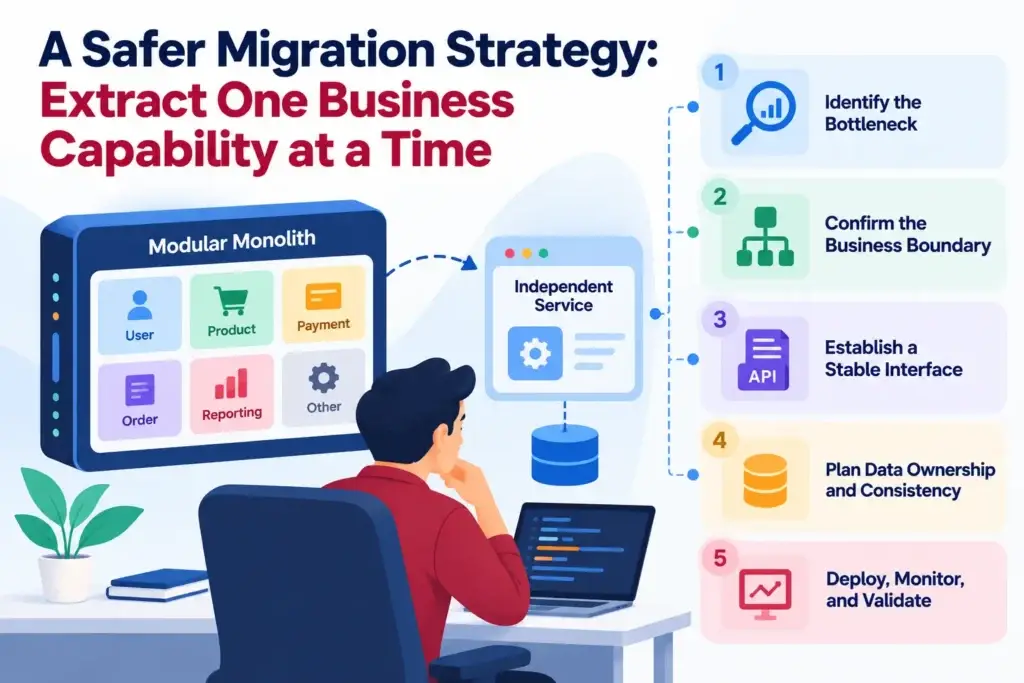
When the modular monolith begins reaching genuine organizational or technical constraints, a gradual extraction strategy can reduce migration risk.
Rather than rebuilding the entire backend, the engineering team can identify one domain with strong boundaries and a clear reason for independent operation.
Step 1: Identify the Actual Bottleneck
Use application metrics, deployment history, error rates, infrastructure utilization, and engineering feedback to understand the problem.
If the issue is a slow database query, service extraction may not help. If the problem is a resource-intensive processing module that routinely interferes with customer-facing requests, separating its runtime may be more useful.
Step 2: Confirm the Business Boundary
Determine which operations and data belong to the candidate service. Identify other modules that depend on those responsibilities.
Unclear ownership at this stage often leads to tightly coupled services and costly integration work.
Step 3: Establish a Stable Interface
Define the service’s API or event contracts before moving its implementation.
Consider authentication, request validation, compatibility, expected errors, timeouts, and retry behavior.
As backend components become independently deployable, well-structured API contracts help maintain predictable communication, version compatibility, and reliable integration between services.
A stable interface reduces the risk that changes in the new service will unexpectedly disrupt existing application workflows.
Step 4: Plan Data Ownership and Consistency
Identify how the extracted service will own its data and how other parts of the application will access the information they need.
Avoid allowing independent services to continue making uncontrolled changes to the same database tables. Where data must be replicated or synchronized, define consistency expectations and recovery mechanisms.
Step 5: Deploy, Monitor, and Validate Independently
Introduce the service gradually, using testing environments, controlled traffic routing, feature flags where appropriate, and clear rollback procedures.
Monitor latency, error rates, queue depth, infrastructure consumption, and deployment performance.
Only after the extracted service demonstrates a meaningful benefit should the team consider moving additional domains.
Backend Architecture Decisions Across Different Startup Business Models
Different startup products create different workloads. The architecture should reflect actual operational needs rather than a universal preference for microservices or monolithic applications.
| Startup Business Model | Likely Starting Approach | What Might Justify Extraction Later? |
|---|---|---|
| Appointment-booking platform | Modular monolith | Independent scheduling or high-volume notification workloads |
| Subscription SaaS product | Modular monolith | Separate compute-intensive analytics or enterprise isolation needs |
| Early-stage marketplace | Modular monolith | Distinct search, fulfillment, or transaction workloads |
| Food or grocery delivery platform | Modular monolith with background workers | High-volume dispatch or real-time tracking workloads |
| Media-heavy platform | Modular core with isolated processing workers | Large-scale transcoding or independent media pipelines |
| Regulated transaction platform | Evaluate isolation requirements early | Strict operational, audit, or data-separation needs |
| Multi-product enterprise platform | Architecture assessment required | Independent product teams and stable domain ownership |
These recommendations are starting assumptions rather than fixed rules. A marketplace with complex third-party integrations may need a different architecture from a marketplace with basic listings and payments.
For example, applications involving heavy media processing, personalized feeds, and real-time interactions introduce infrastructure concerns that ordinary transaction-based products may not face. A deeper look at scalable backend architecture for media-heavy platforms illustrates how workload characteristics influence infrastructure decisions.
How Engineering Team Size Influences Architecture Without Dictating It
Small teams generally benefit from fewer independent deployments because each engineer may already be responsible for several parts of the product.
Introducing numerous independently operated services can create additional work involving environment configuration, monitoring, incident response, and coordination.
As engineering teams grow, modular boundaries become increasingly valuable. They allow different developers to work on business capabilities without constantly changing unrelated components.
When several teams genuinely require independent delivery and operational ownership, microservices may become beneficial.
However, there is no universal engineering headcount that automatically requires migration. A relatively small team operating unusually complex workloads may need some independently deployed components, while a larger team maintaining a cohesive product may still operate effectively within a modular monolith.
The better question is not how many engineers a startup has, but how often their work is blocked by shared deployment, ownership, or runtime constraints.
Security and Reliability Considerations Before Choosing a Backend
Both architectures can be designed to support secure and reliable operations. The differences lie in where security boundaries are enforced and how failure scenarios must be handled.
Authentication and Authorization
A modular monolith can use centralized authentication and enforce authorization within application modules.
Microservices must also consider service-to-service identity, token validation, permission propagation, and access between independently operating components.
These additional controls can support strong isolation when implemented correctly, but they increase configuration and security review requirements.
Failure Handling and Resilience
A modular monolith may experience a broader outage if a critical shared process fails. It therefore needs appropriate health checks, resource controls, backups, and recovery procedures.
Microservices can isolate some failures, but networked dependencies also introduce new failure paths. Timeouts, retries, circuit breakers, and fallback behavior must be carefully designed to avoid cascading incidents.
Auditability and Data Protection
Applications handling sensitive information need appropriate access controls, encrypted communication, audit logging, and secure data management regardless of architecture.
Separating services may help establish specific technical boundaries, but regulatory compliance depends on the complete implementation, operating procedures, jurisdiction, and applicable legal requirements.
Founders should avoid assuming that choosing microservices automatically creates a compliant or more secure application.
Seven Questions Founders Should Answer Before Committing to Microservices
A practical architecture review should challenge assumptions before substantial engineering resources are committed.
- What business problem requires separate services? Identify a measurable operational or delivery issue.
- Can the product requirements still change significantly? Unstable domain boundaries may make early service extraction expensive.
- Do our teams genuinely need independent deployments? Separate services provide limited benefit if every release remains coordinated.
- Which workloads have substantially different resource needs? Determine whether background workers or targeted infrastructure changes could solve the problem.
- Can we support distributed monitoring and incident response? Independent services require operational accountability.
- How will data consistency work across services? Identify workflows involving payments, inventory, orders, and other shared business records.
- Will the expected benefit outweigh ongoing complexity? Compare the improvement against development, testing, infrastructure, and maintenance costs.
If these questions reveal no compelling reason for independent service operation, a modular monolith may be the more responsible starting choice.
If several answers demonstrate clear organizational or technical constraints, a phased microservices strategy deserves further evaluation.
Common Backend Over-Engineering Mistakes Startups Should Avoid
Mistake 1: Designing for Unverified Future Traffic
A startup may design its initial infrastructure for millions of hypothetical users despite having no validated acquisition channel or established usage pattern.
Planning for growth is useful, but architecture decisions should account for the difference between possible future traffic and demonstrated engineering constraints.
Mistake 2: Creating One Microservice for Every Database Entity
Separating users, addresses, orders, products, payments, and individual supporting entities into numerous services can produce excessive communication and unclear ownership.
Service boundaries should represent cohesive business responsibilities rather than automatically reflecting every table or data model.
Mistake 3: Introducing Sophisticated Infrastructure Before Establishing Operational Needs
Container orchestration, service meshes, complex message-processing systems, and extensive deployment automation can be valuable at the right scale.
However, introducing them prematurely may divert engineering attention toward infrastructure management instead of delivering essential product functionality.
Mistake 4: Ignoring Module Boundaries Because the System Is Still Small
Starting simple should not mean allowing unrestricted dependencies throughout the codebase.
Without boundaries, future changes become harder and separating modules later may require extensive refactoring.
Modular design provides a practical compromise: structure the product carefully today while avoiding unnecessary distributed infrastructure.
Mistake 5: Treating Microservices as a Guarantee of Scalability
Microservices can improve scaling flexibility, but they do not automatically fix inefficient queries, excessive synchronous dependencies, poor caching, or inadequate monitoring.
Architecture and implementation quality matter more than architectural labels.
A Practical Backend Architecture Roadmap for Early-Stage Startups
Founders can reduce long-term architectural risk by planning backend evolution around product milestones and observable constraints.
| Product Stage | Architecture Priority | Important Decision |
|---|---|---|
| Initial product validation | Simple, maintainable backend with clear modules | Can we release essential workflows reliably? |
| First production users | Monitoring, security, backups, and performance measurement | What are actual usage and failure patterns? |
| Growing product adoption | Database optimization, caching, workers, horizontal scaling | Which bottlenecks can be solved without service extraction? |
| Expanding engineering teams | Ownership boundaries and predictable releases | Are shared deployments limiting independent delivery? |
| Specialized workload growth | Selective service separation where justified | Which capability benefits from independent operation? |
| Multi-team platform operations | Service contracts, observability, independent ownership | Can each service be operated reliably and independently? |
This roadmap is not a mandatory progression. Some applications may remain modular monoliths for their entire useful life. Others may require selected independent services relatively early because of unusual workload or isolation requirements.
The purpose is to make architecture evolution deliberate rather than reactive or fashionable.
The Miracuves Perspective: Build the Backend Your Product Actually Needs
Miracuves approaches backend decisions through product requirements, engineering complexity, delivery priorities, and future ownership rather than assuming every startup should begin with distributed infrastructure.
For many early-stage products, a modular foundation can support faster development, clear business boundaries, and simpler operations. As real requirements emerge, targeted services can be introduced where independent scaling, ownership, or deployment creates measurable value.
Founders evaluating ready-made applications may also benefit from existing product foundations rather than rebuilding standard workflows unnecessarily. Miracuves offers six-working-day delivery for eligible ready-made solutions, subject to the selected product scope and implementation requirements.
That delivery model is separate from custom microservices engineering. A new distributed backend, specialized integrations, or a significant architectural migration requires its own technical scope and timeline.
The important business principle remains consistent: invest in the infrastructure your product needs to operate reliably, and preserve flexibility for the next stage of growth.
Final Verdict: Should Startups Begin With Microservices or a Modular Monolith?
For many early-stage startups with small teams, changing business requirements, and limited operational capacity, a modular monolith is a sensible starting architecture.
It provides a foundation for organized business logic, controlled dependencies, simpler deployments, and incremental performance optimization without requiring the team to operate multiple independent services immediately.
Microservices become more attractive when a startup has evidence that independent deployments, workload isolation, stable business boundaries, or distinct ownership structures will produce real operational benefits.
In some cases, a hybrid approach is appropriate: maintain a modular core while extracting a limited number of workloads that genuinely require independent operation.
The strongest architecture is not the one with the most services. It is the one that supports reliable product delivery, manageable operating costs, and future change without unnecessary engineering complexity.
Final Thoughts: Build for Today’s Product and Tomorrow’s Real Constraints
The debate between microservices and modular monoliths becomes more useful when founders stop treating architecture as a status symbol. A scalable backend begins with clear business responsibilities, well-managed dependencies, reliable operations, and evidence-based technical decisions.
A modular monolith can help an early-stage company preserve engineering resources while establishing a structured foundation. Microservices can support the next stage of growth when independent ownership and specialized workloads justify the additional responsibility.
For startups preparing to evolve an existing backend or assess distributed-system requirements, Miracuves’ microservices architecture support can help connect technical choices with implementation scope, operational readiness, and long-term maintainability.
Ultimately, avoiding over-engineering is not about choosing the simplest technology in every situation. It is about making complexity earn its place in the product.
Frequently Asked Questions About Microservices vs. Modular Monolith
Should an early-stage startup start with microservices?
Most early-stage startups should evaluate a modular monolith first, especially when they have small engineering teams and changing product requirements. Microservices become more useful when independent scaling, deployment, ownership, or isolation solves a measurable problem.
What is the main difference between a modular monolith and microservices?
A modular monolith organizes business capabilities within one deployable application using clear internal boundaries. Microservices divide capabilities into independently deployed services that communicate through network-based interfaces and events.
Can a modular monolith scale to support a growing startup?
Yes. A well-designed modular monolith can use database optimization, caching, background workers, and horizontal application scaling. Its practical capacity depends on workload characteristics, implementation quality, infrastructure, and operational requirements.
Are microservices more expensive than a modular monolith?
Microservices commonly introduce greater initial and ongoing operational complexity because teams must manage service communication, deployment pipelines, observability, distributed data, and fault handling. They can become cost-effective when independent scaling or team autonomy produces benefits that outweigh these expenses.
When should a startup migrate from a modular monolith to microservices?
Migration becomes worth evaluating when specific domains require independent releases, distinct scaling policies, stronger operational isolation, or dedicated team ownership. These needs should be demonstrated through engineering and operational evidence rather than assumed from projected traffic alone.
What is a distributed monolith?
A distributed monolith is a system split into multiple services that remain tightly coupled through shared data, synchronous dependencies, or coordinated releases. It can inherit the operational complexity of microservices without obtaining meaningful service independence.
Can startups combine a modular monolith with microservices?
Yes. A startup can retain a modular core while deploying selected workloads independently. This approach can be useful when specific capabilities have different resource needs or operational requirements, provided ownership and communication boundaries are clear.
Does a modular monolith prevent future migration to microservices?
No. Clearly defined modules, controlled dependencies, stable interfaces, and explicit data ownership can make future extraction easier. Migration still requires planning for network communication, data consistency, independent deployment, monitoring, and failure handling.
Miracuves is an independent software development company. We are not affiliated with, connected to, sponsored by, or endorsed by any company or product named in this article.
Terms such as “X Clone” are used descriptively. It is how the software industry refers to building a platform with functionality comparable to a known service, and how clients search for it.
The entire design and codebase of our products is built by our own team. Our products contain no code, design, graphics, or content originating from any third-party website or applications.
All third-party names and marks referenced in this article are the property of their respective owners, referenced solely to identify the services discussed.