

White Label Fractional Real Estate Platform - Multi-Currency, Arabic RTL & Owner Register
Own the platform underneath the fractional property clones, bought once and run on your brand. Investors take a slice of one named building, earn a pro rata share of the rent and can resell it.
Built for money that crosses borders: AED, USD and GBP, eight locales with Arabic right to left, and FX conversion between them. The source is yours; the license to operate is yours to secure.
Launch in 6 Days with AED, USD, GBPArabic RTLCountry ProfilesMulti-Currency WalletsResale MarketWhite-Label
⚡ The Platform in Brief
3
Base Currencies
AED, USD and GBP, each tied to a market profile
8
Interface Locales
Arabic among them, mirrored right to left
6
Revenue Levers
fees, FX spread and exit charges on your terms
0
Revenue Share
none: the source is yours, no per-investor fee
Software You Own, Permission You Secure
The platform carries no authorization, license or regulatory status and never holds client money, so the right to raise capital in your market comes from your own license or exemption.
A Register Any Regulator Can Read
Ownership is only ever appended, with certificates and audit search, so holdings on any past date come from a query, not a rebuild.
🚀 Want to sell fractional property shares in your market?






Try It Yourself
Live Demo - Investor, Operator, Finance & Partner Consoles
Each console below runs the delivered build on real infrastructure, loaded with sample data and locked to read only. A banner marks it as a demo environment where write operations are restricted, so explore the screens instead of finishing transactions. Start in the investor app, then sign in as the operator and view the same property from behind the counter.
INVESTOR APP
Fractional Investor App - Catalog, Wallet, Holdings & Resale
The investor's side of the platform. Browse individual properties, each with its own projections and due-diligence files, complete onboarding and KYC, subscribe with the agreement and evidence attached, fund a wallet in several currencies, track holdings, certificates and analytics, then list a stake for resale. Flip the language to Arabic and the whole screen mirrors.
-
Start the investor app from any browser
-
Sign in with the investor login shown below
-
Check: Catalog, Wallet, Holdings, Resale Market
-
Try: investor@demo.com | Demo1234!
OPERATOR CONSOLE
Operator Console - Deals, Underwriting, Register & Markets
The console your team runs the business from, split into about thirty workspaces. It holds the deal pipeline, underwriting and committee review, a property record of more than sixty fields, the ownership register, tenancies and rent roll, and the market settings: which countries you serve, the currency each prices in and the languages on offer.
-
Start the operator console from any browser
-
Sign in with the operator login shown below
-
Check: Deals, Underwriting, Register, Languages
-
Try: admin@demo.com | Demo1234!
FINANCE CONSOLE
Finance Console - Ledger, FX, Payout Batches & Approvals
Where money is handled, and with investors in several countries, the console to study most closely. Amounts sit in a double-entry ledger in integer minor units, balances are computed instead of saved, FX quotes and conversions draw on a bounded rate cache, payout batches move from calculation to approval to execution, and outgoing money needs a maker and a checker.
-
Start the finance console from any browser
-
Sign in with the finance login shown below
-
Check: Ledger, FX, Payout Batches, Approvals
-
Try: finance@demo.com | Demo1234!
PARTNER PORTAL
Partner Portal - Developer Submissions & Deal Intake
The intake route for developers and brokers, who send properties straight into your pipeline instead of mailing spreadsheets. It covers deal submission, the developer relationship record and the draft property that underwriting takes over. In the demo the portal is not yet restricted to a partner role; that access-control gap is one of the items closed in delivery hardening.
-
Start the partner portal from any browser
-
Sign in with the login shown below
-
Check: Submission, Developer Record, Draft Listing
-
Try: investor@demo.com | Demo1234!
See It Running
Video Walkthrough - Markets, Currencies, Subscription & Payouts
This recording covers what a Gulf rollout actually switches on, not a tour of every screen. It opens in the console on a country profile, where the currency and the entry minimum for that market are set, then changes the language to Arabic so you watch the layout mirror instead of simply swapping words. Next an investor buys into one named property in AED; the signed agreement and supporting evidence attach to the order, the allocation is appended to the ownership register and a certificate is issued. Last, the finance console runs a payout batch, converts the amount owed to an investor who holds in a second currency, and shows ledger entries that balance on both sides. If one step matters more to you than the others, book a call and we will walk through it with real data loaded.
Walk Every Screen
Screen Flows - Investor App, Operator Console, Partner Portal & Mobile
Four front ends share one versioned API, with 229 routes in the audited build. The investor app handles the catalog, each property’s projections and documents, onboarding and KYC, subscription and agreement signing, a wallet in several currencies, a portfolio carrying certificates and analytics, and the resale marketplace. The operator console spans about thirty workspaces, running from deal pipeline and underwriting through tenancies, rent roll and payout batches to compliance queues and audit search. Developers feed that pipeline through the partner portal, and a React Native app built on Expo SDK 52 puts the investor side on a phone.

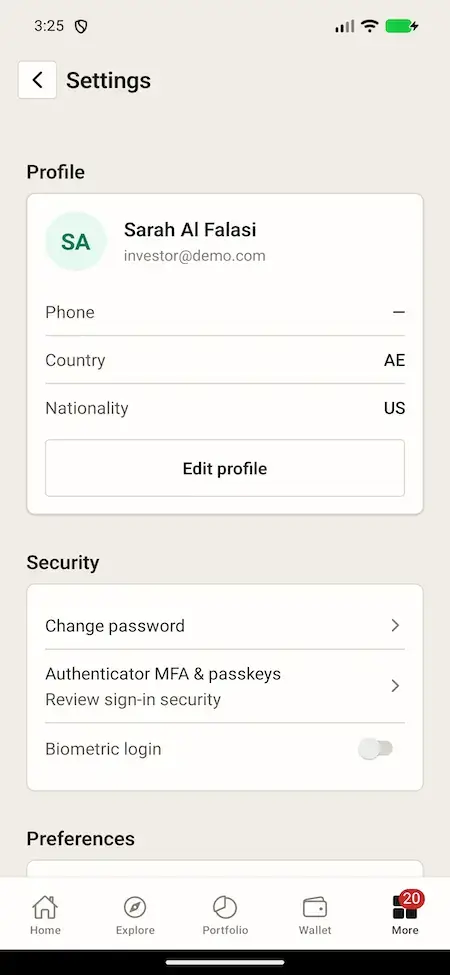
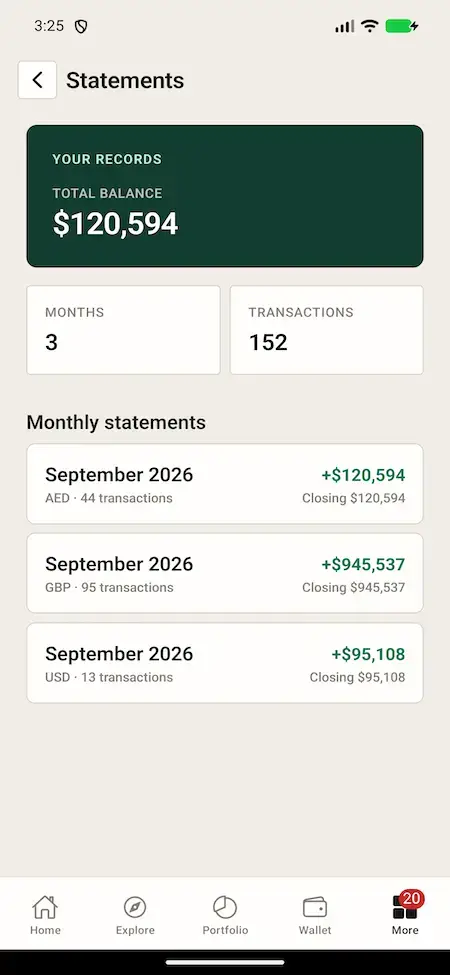
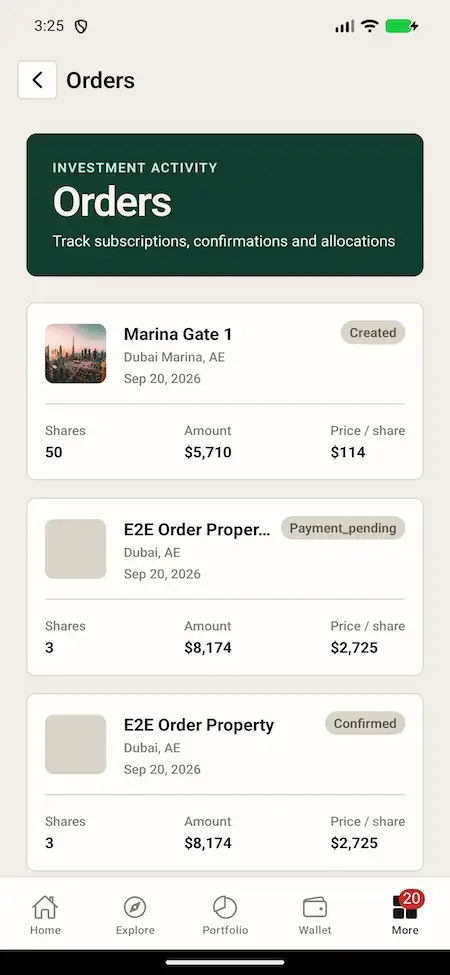
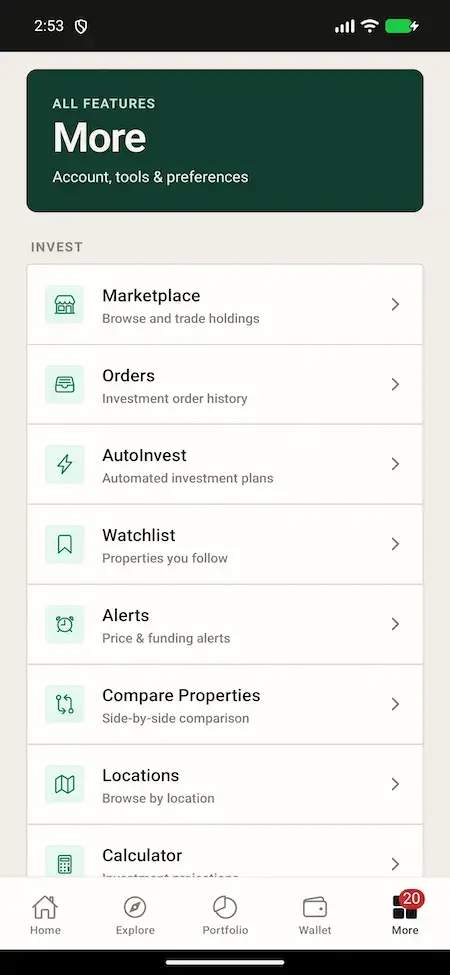
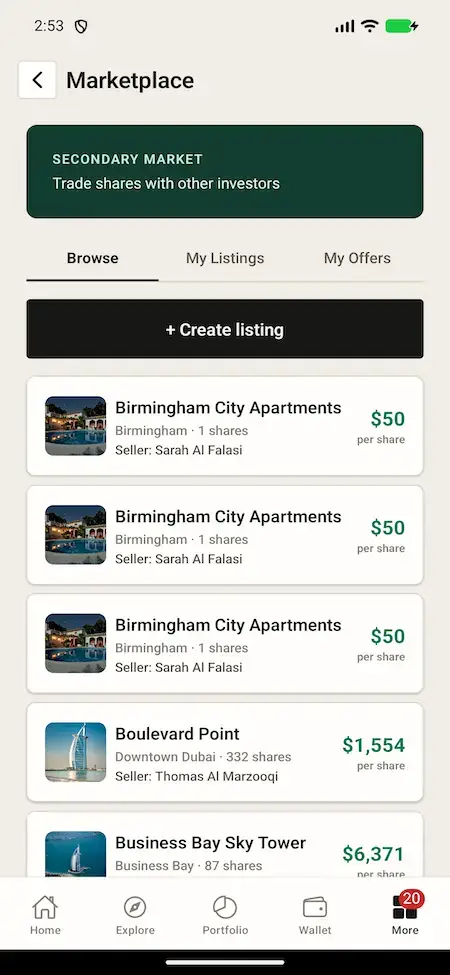
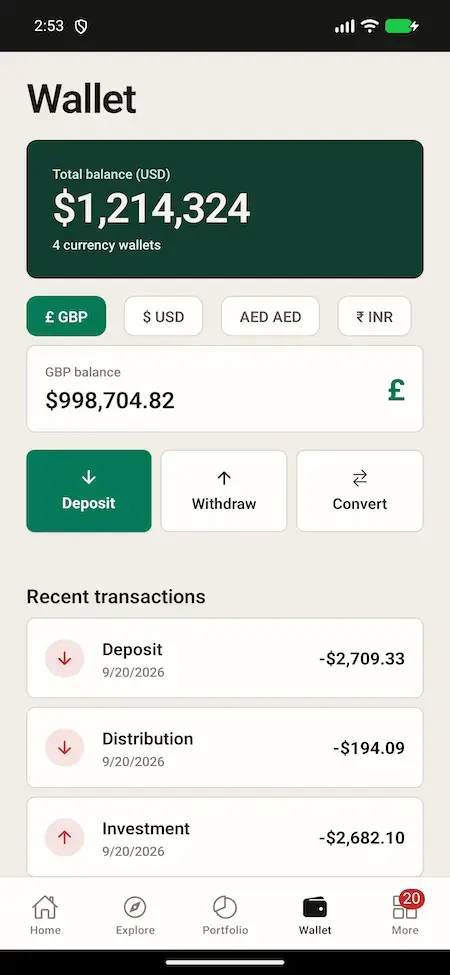
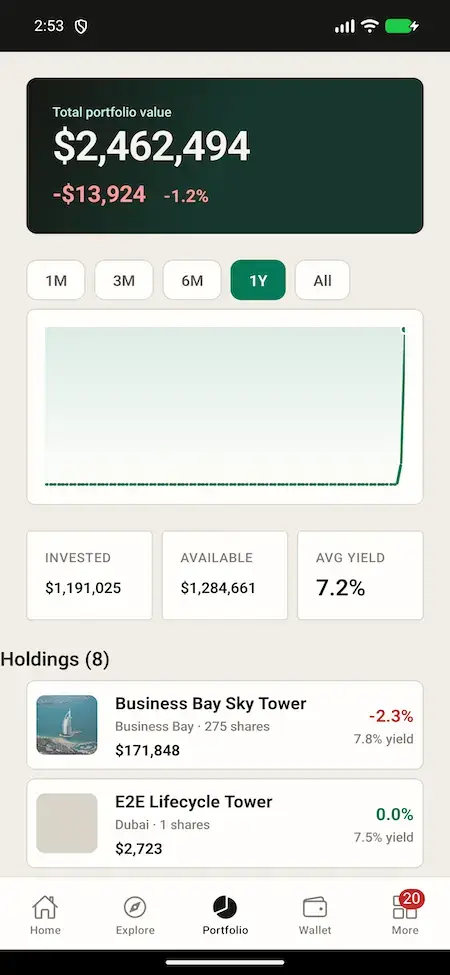
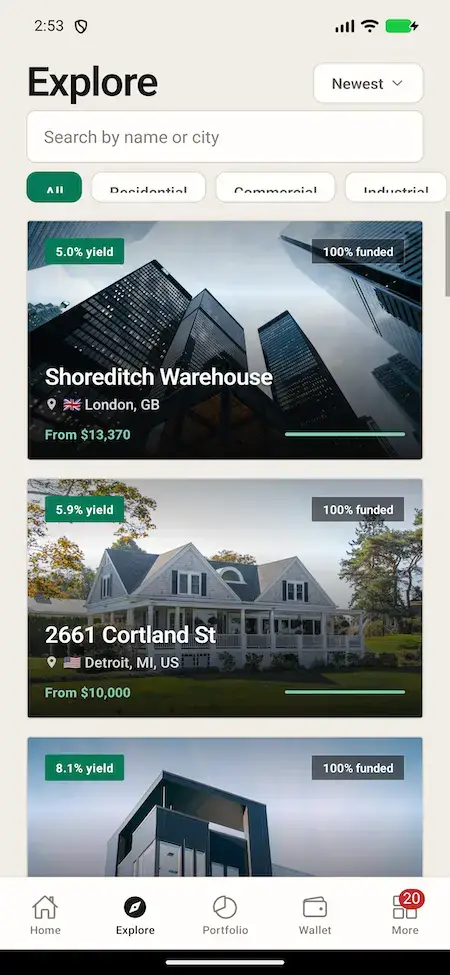
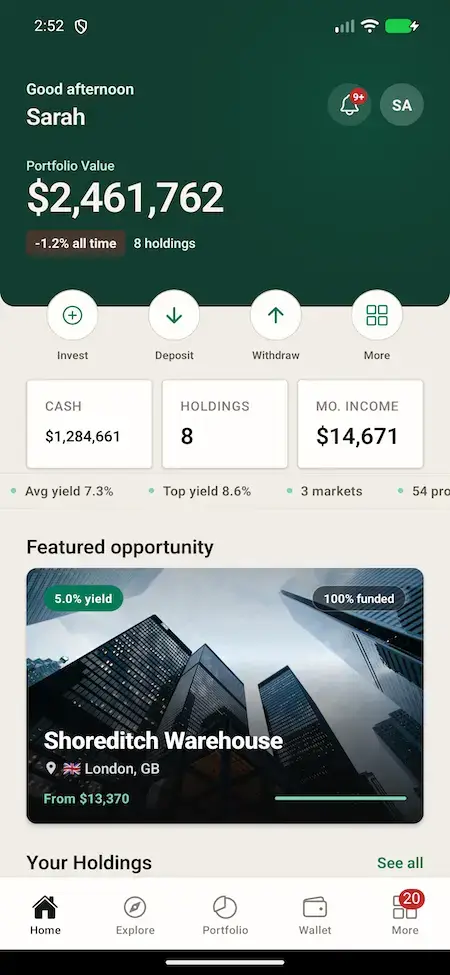
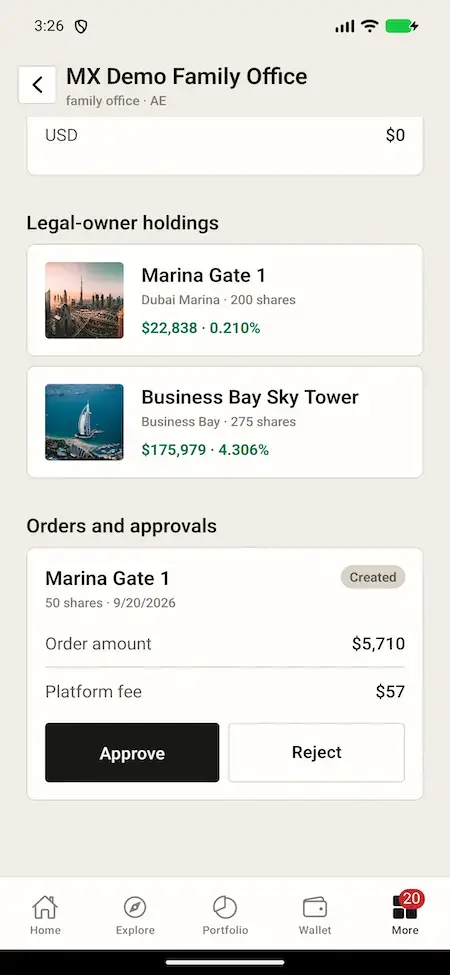
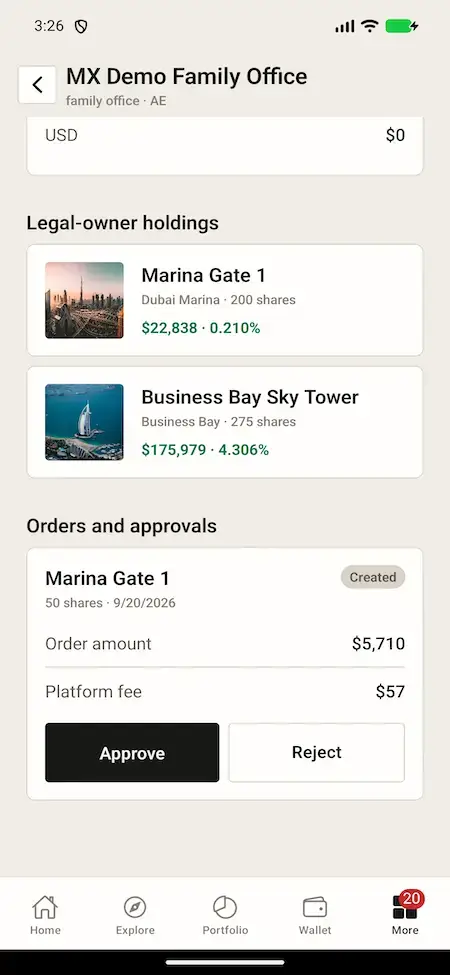
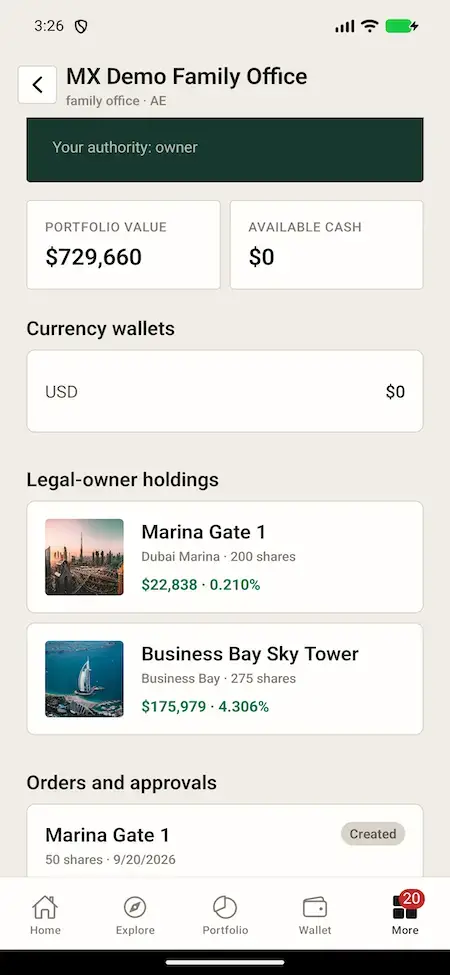
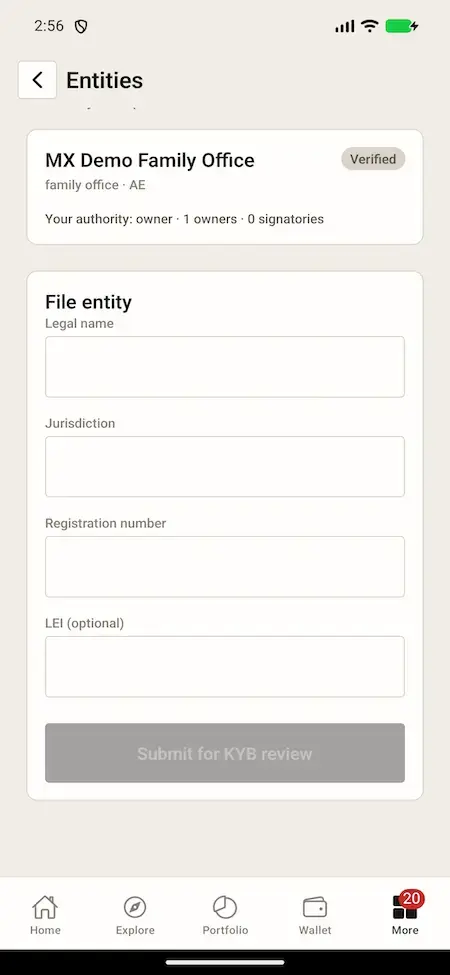
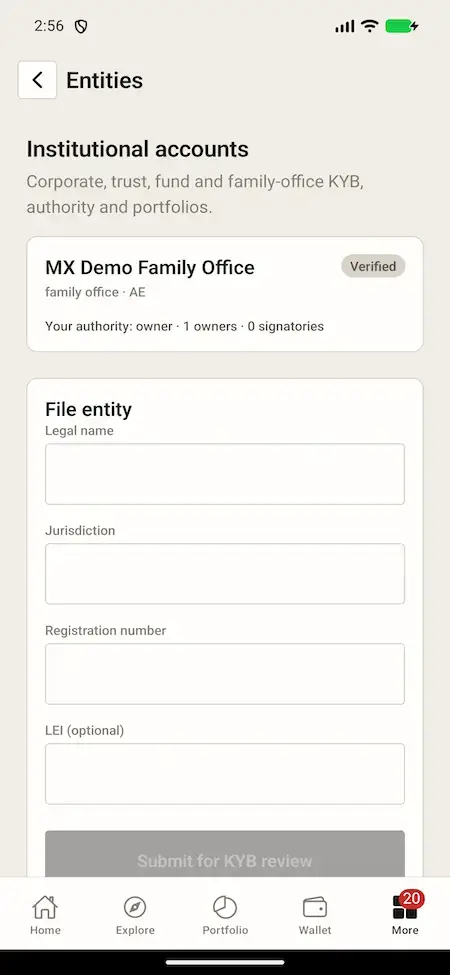
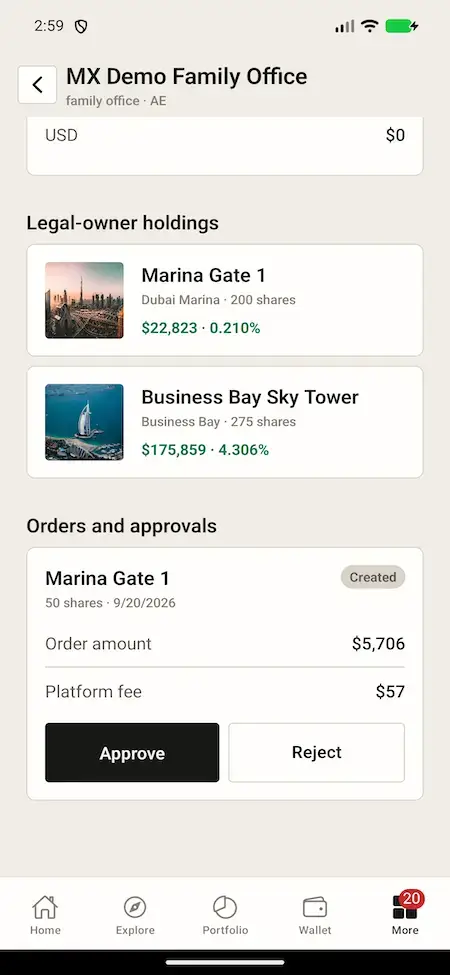
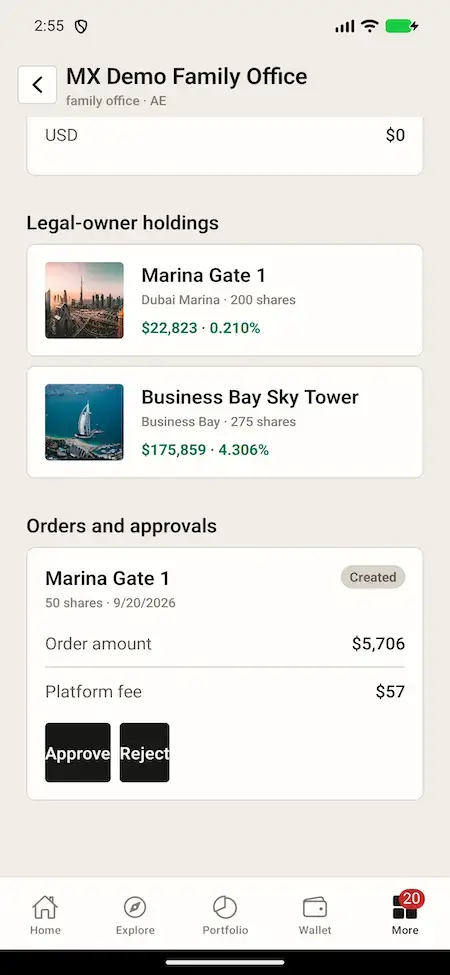
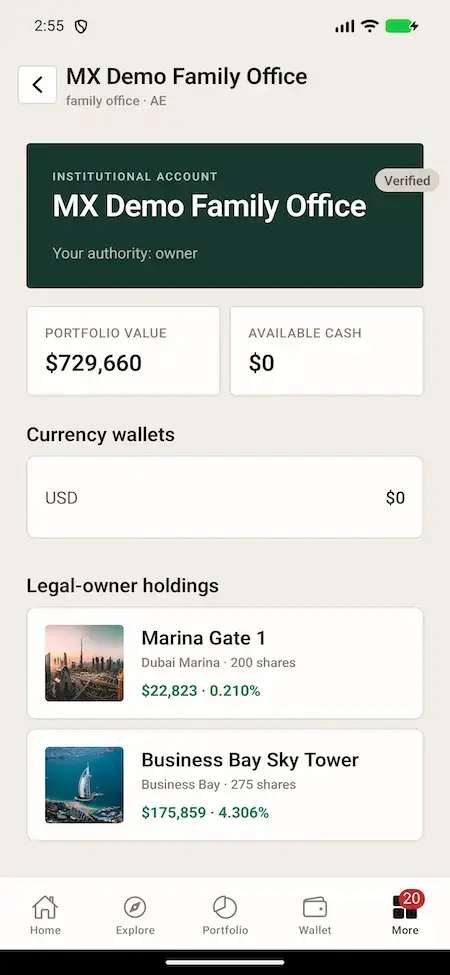
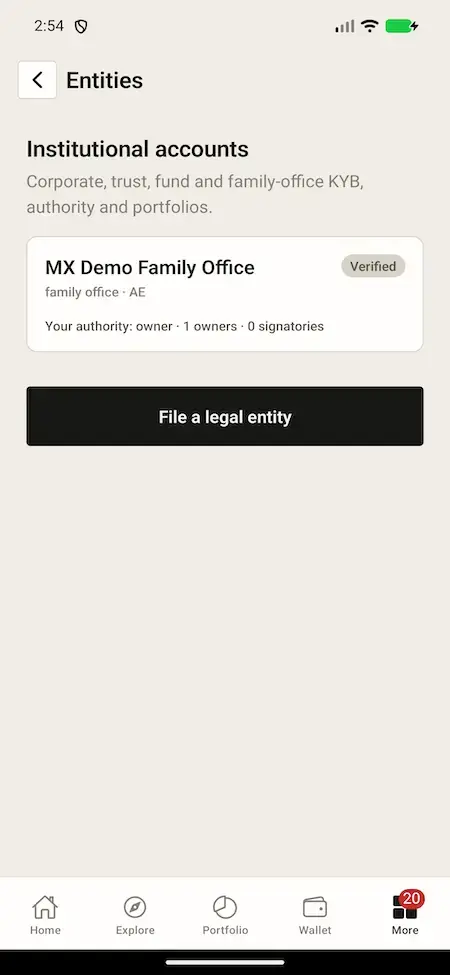
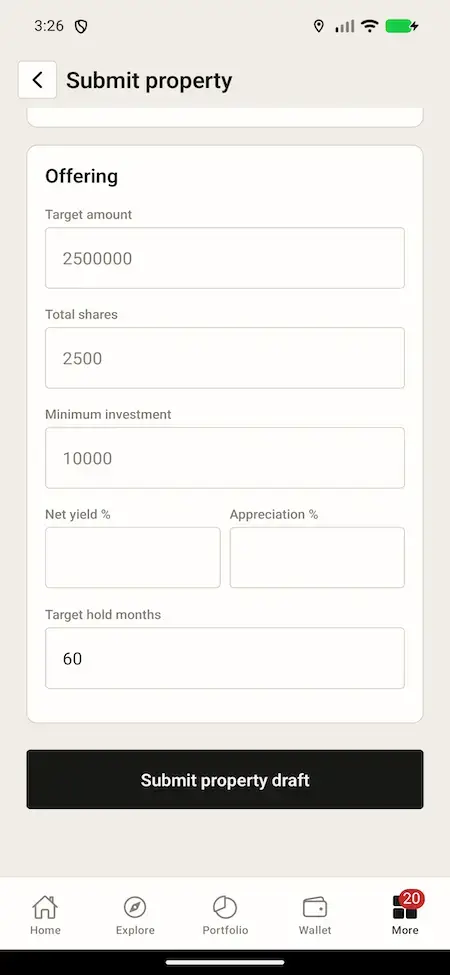
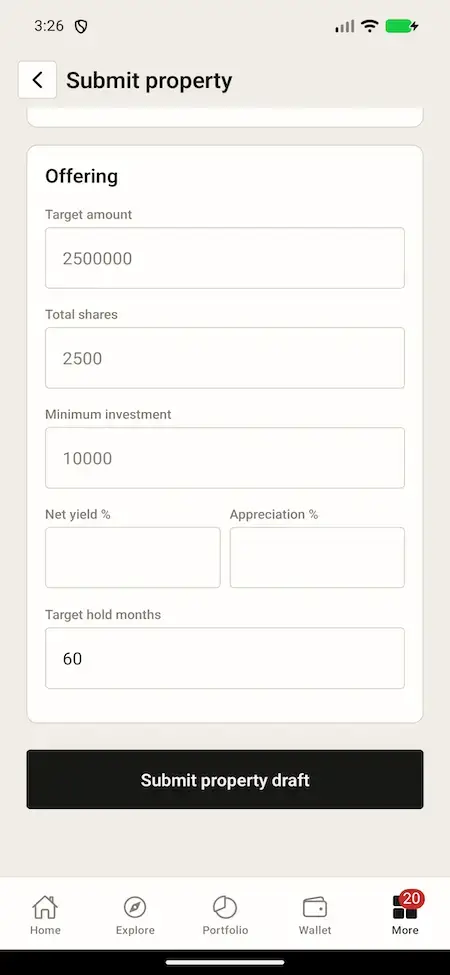
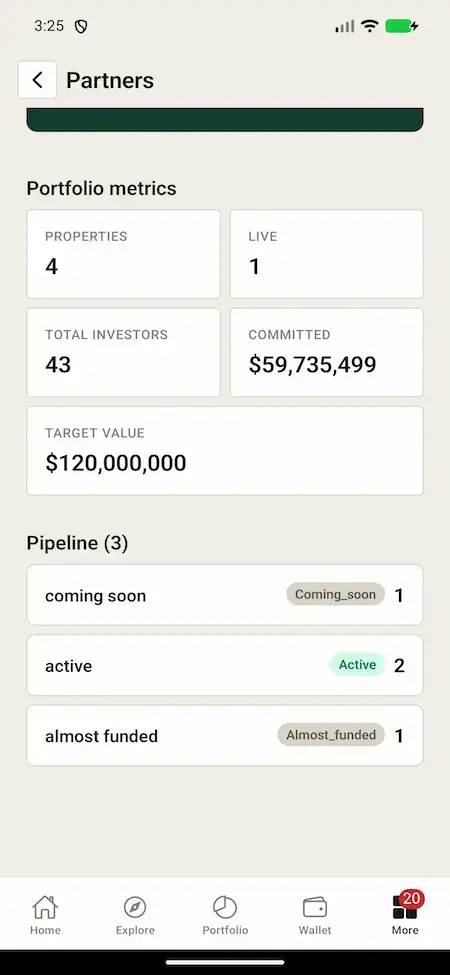
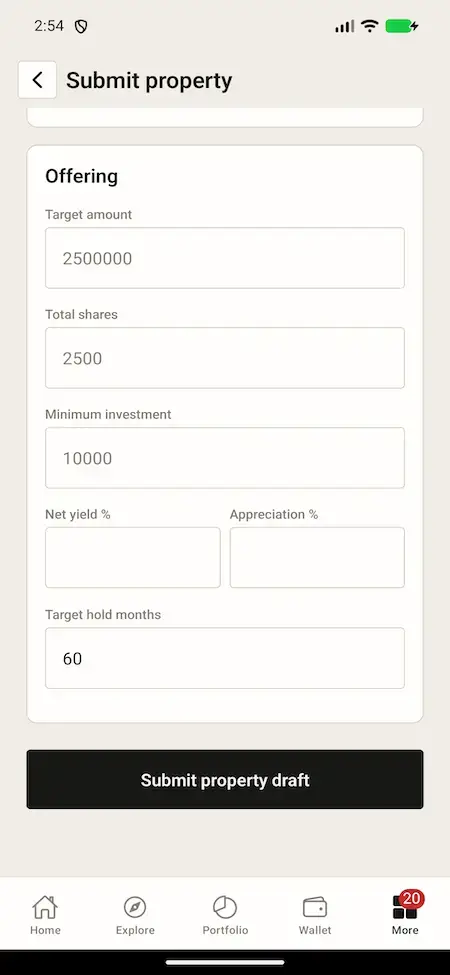
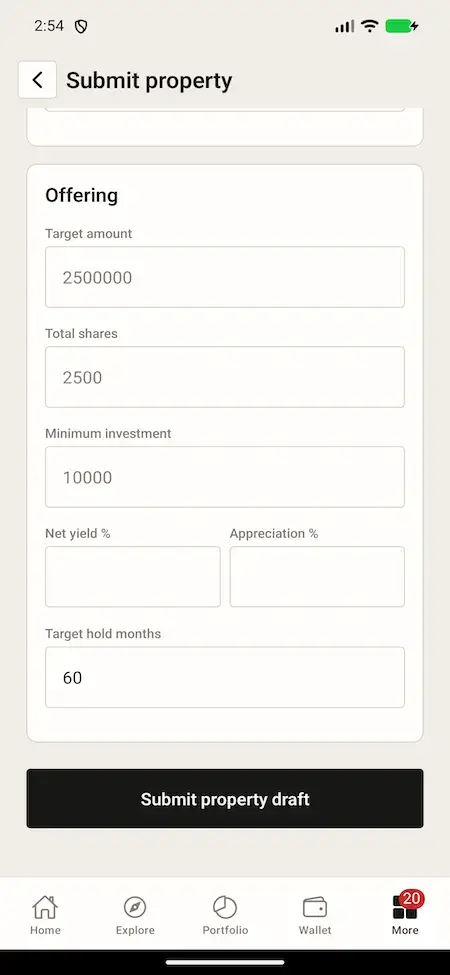
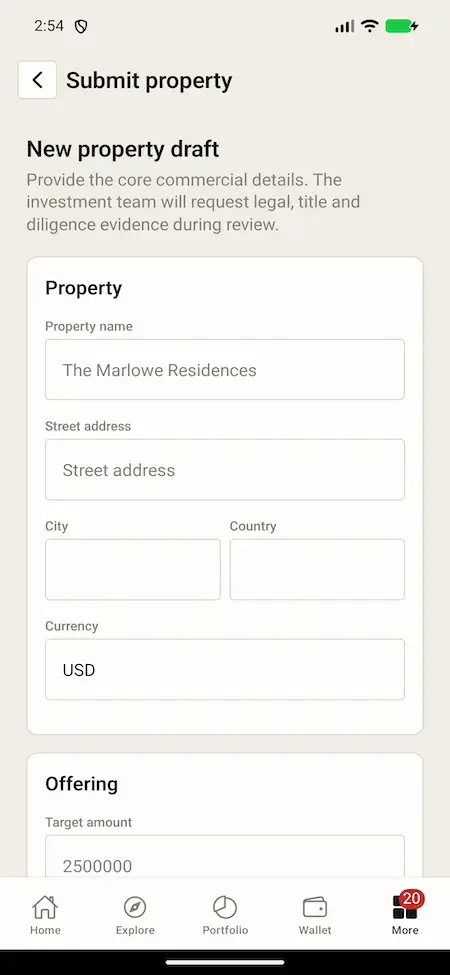
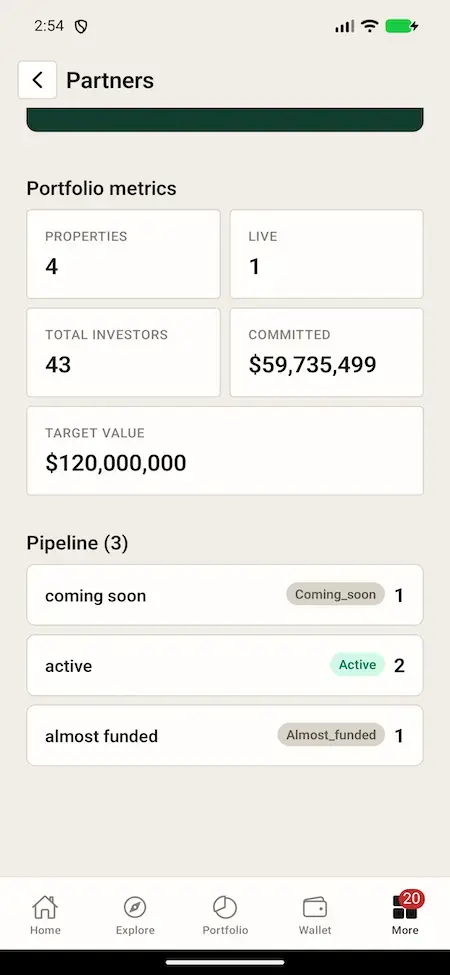
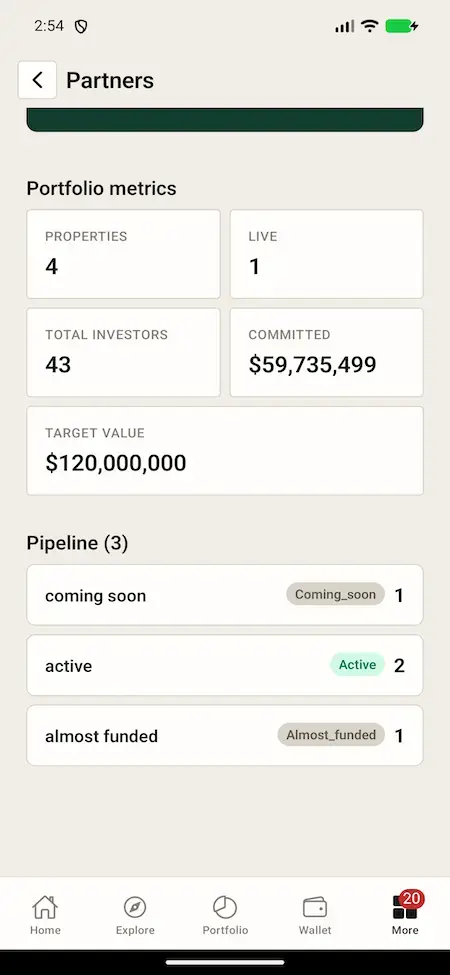
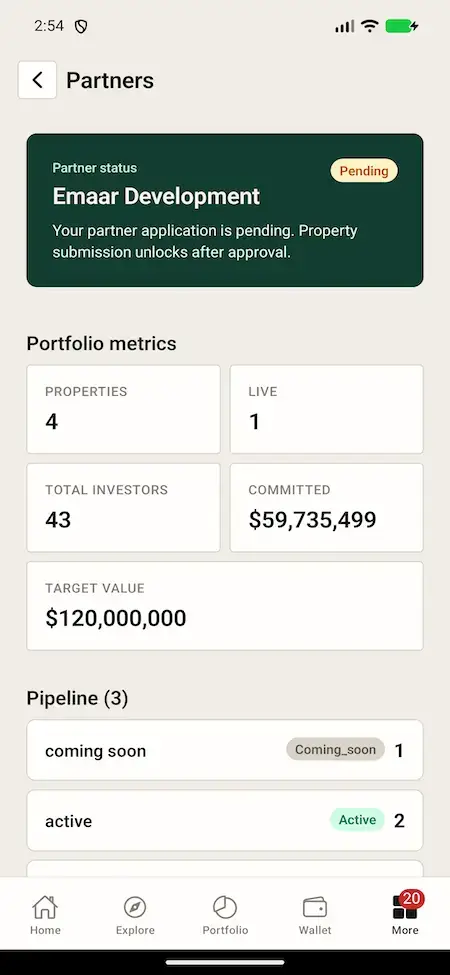
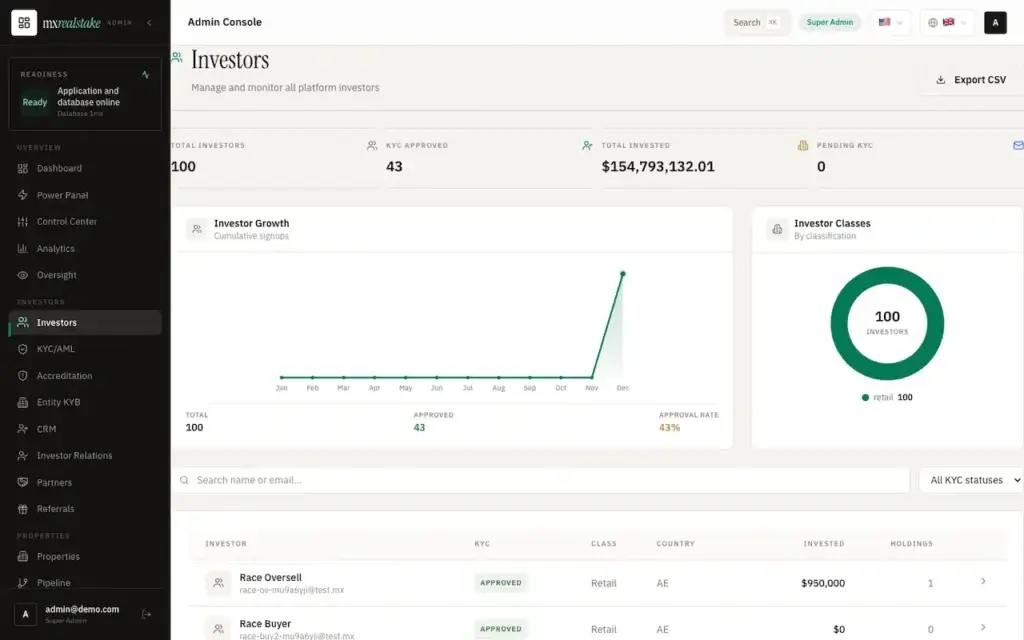
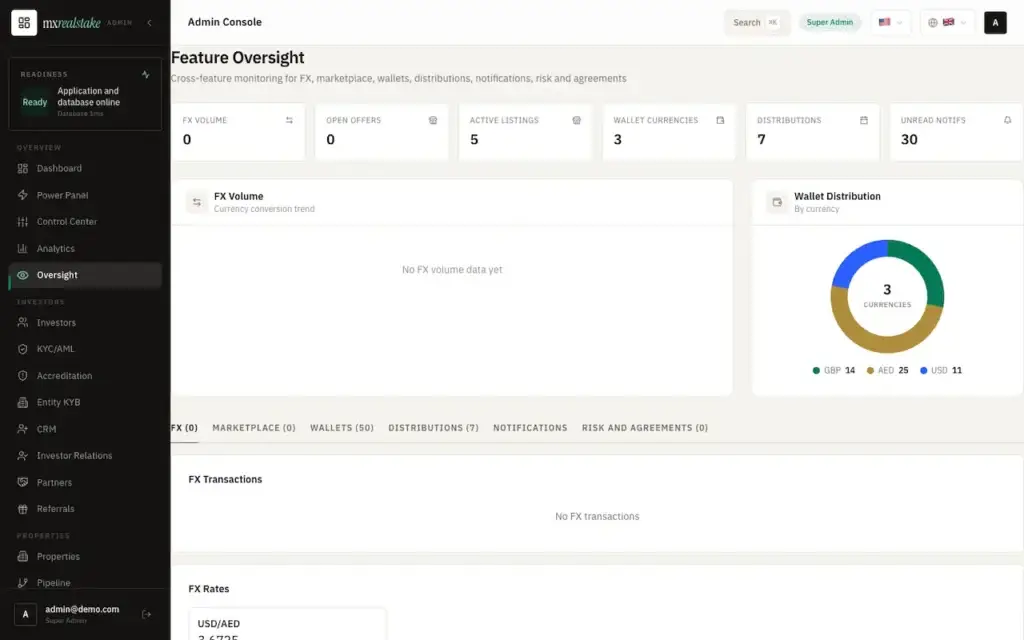
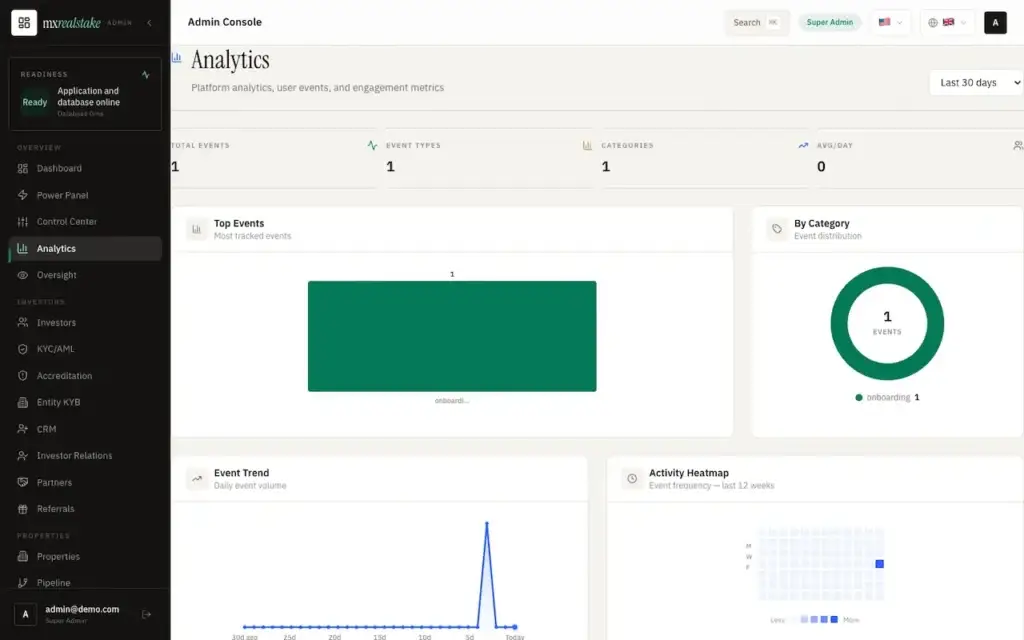
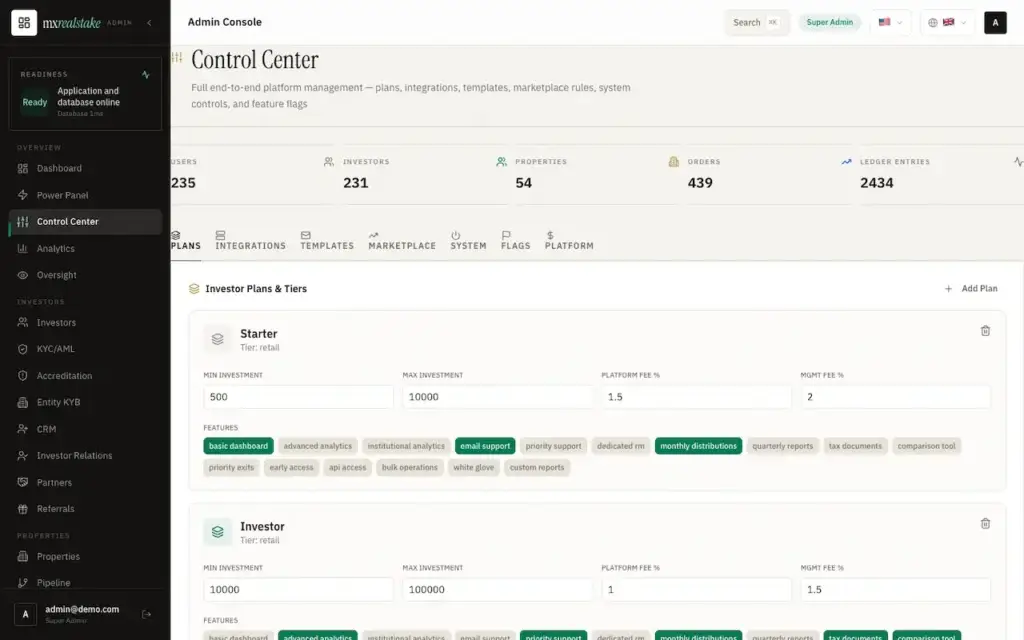
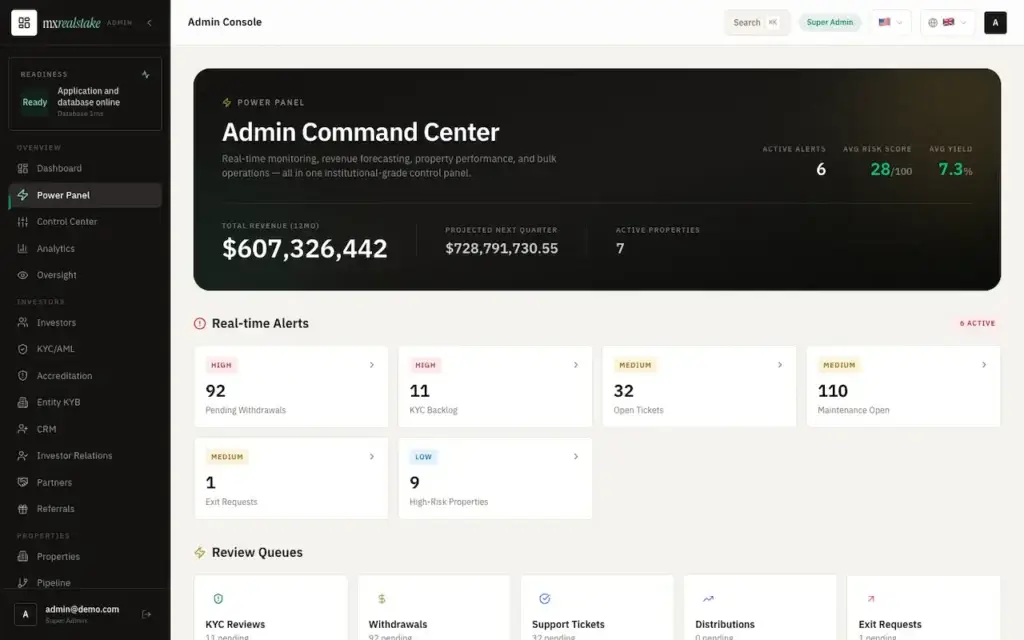
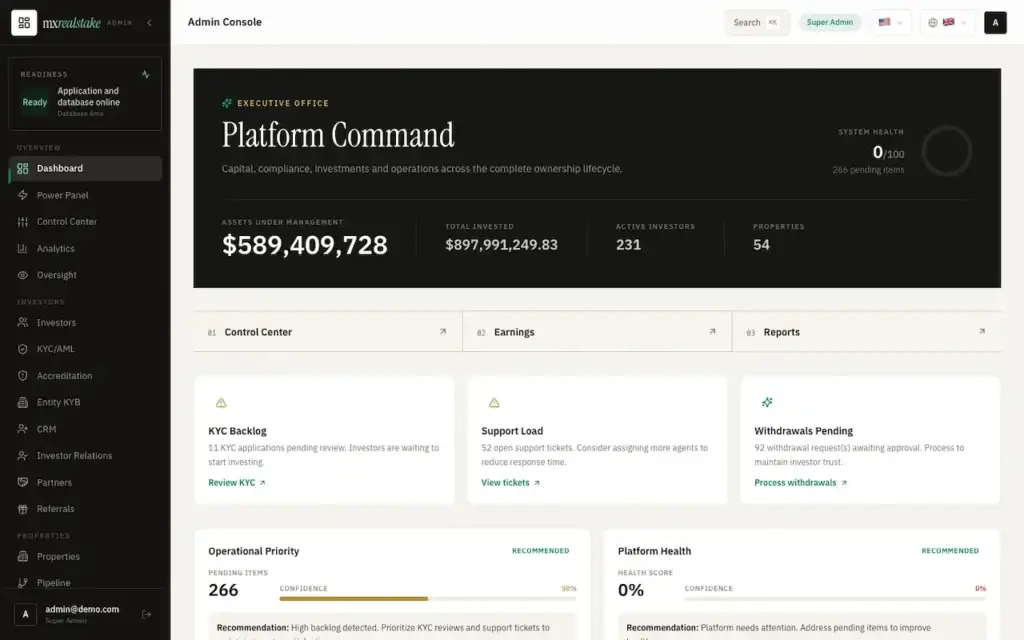
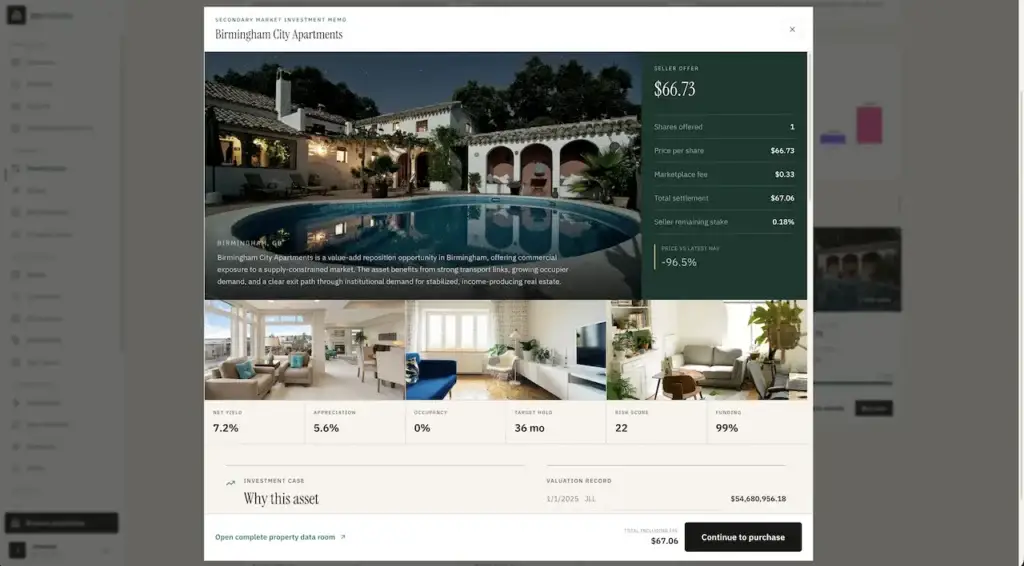
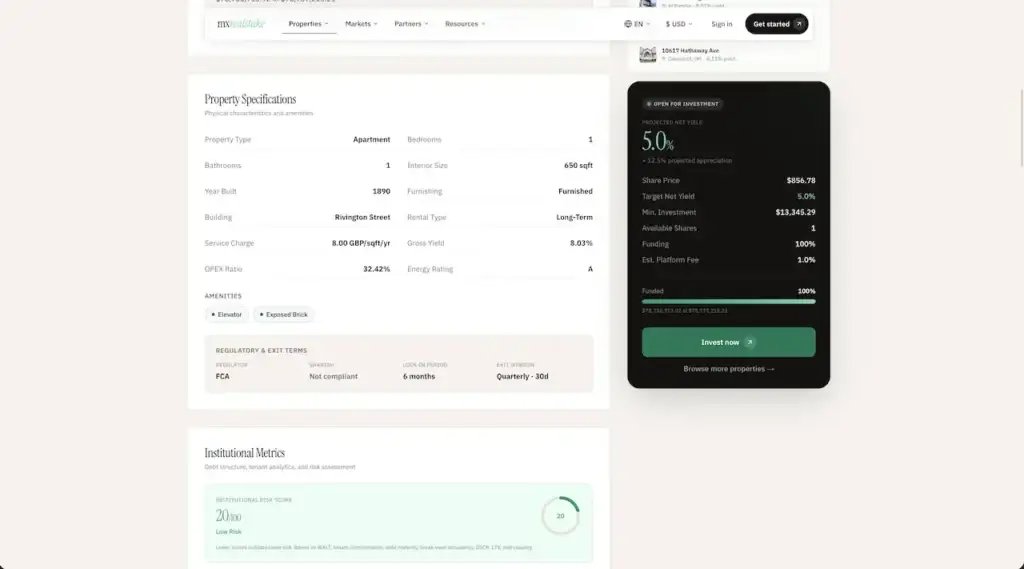
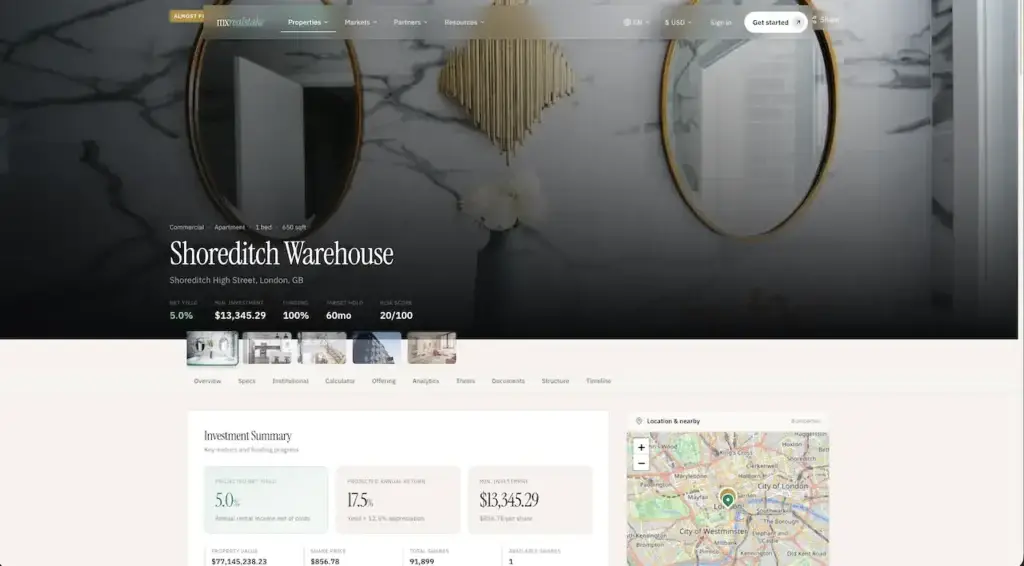
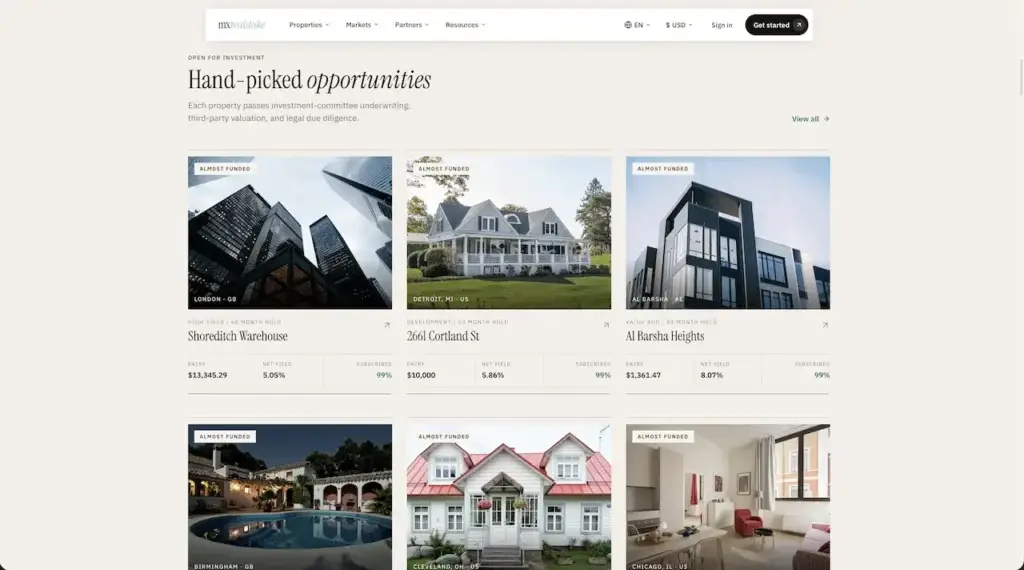
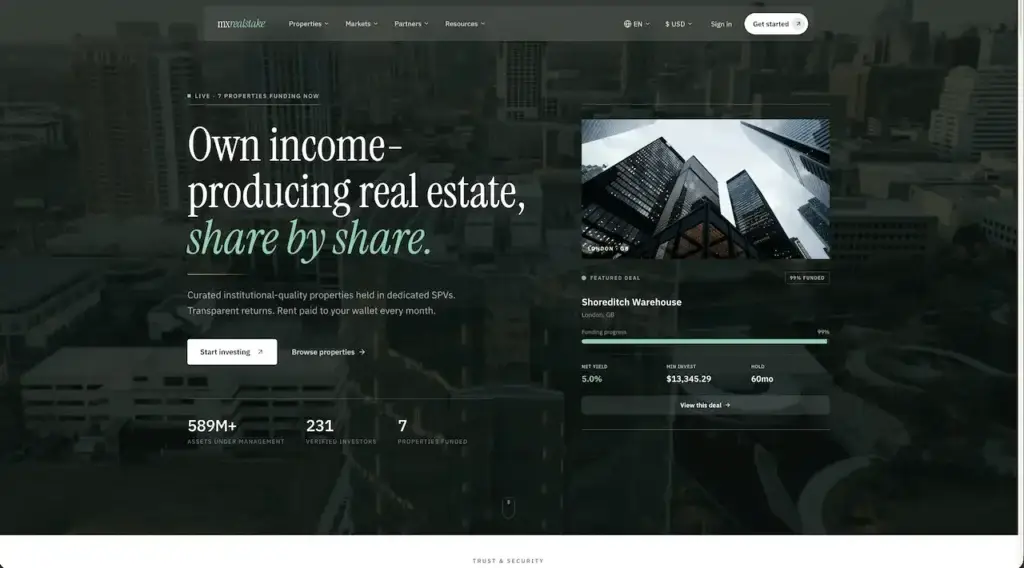
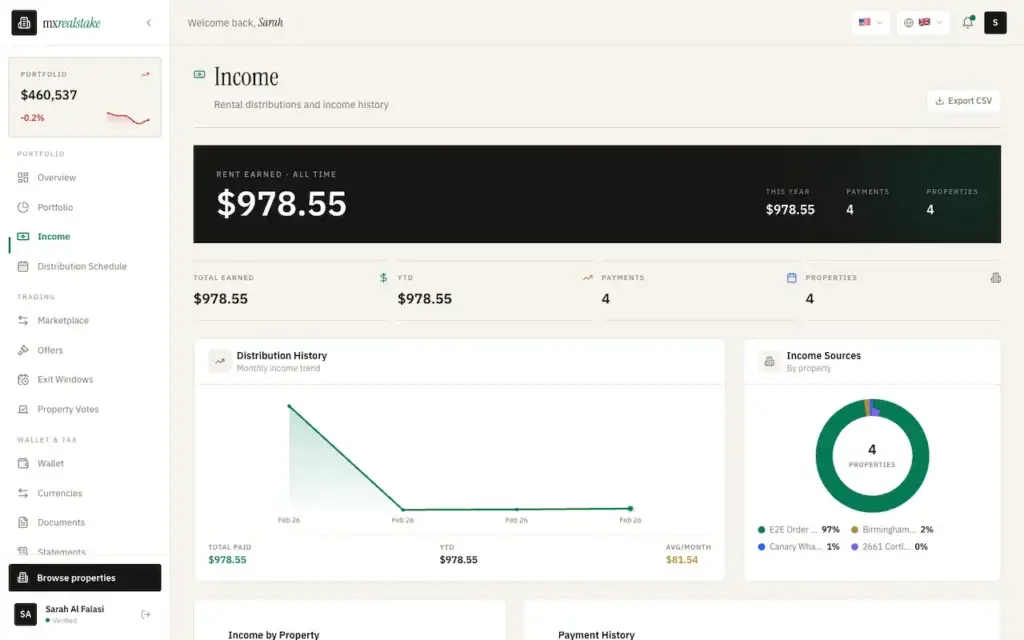
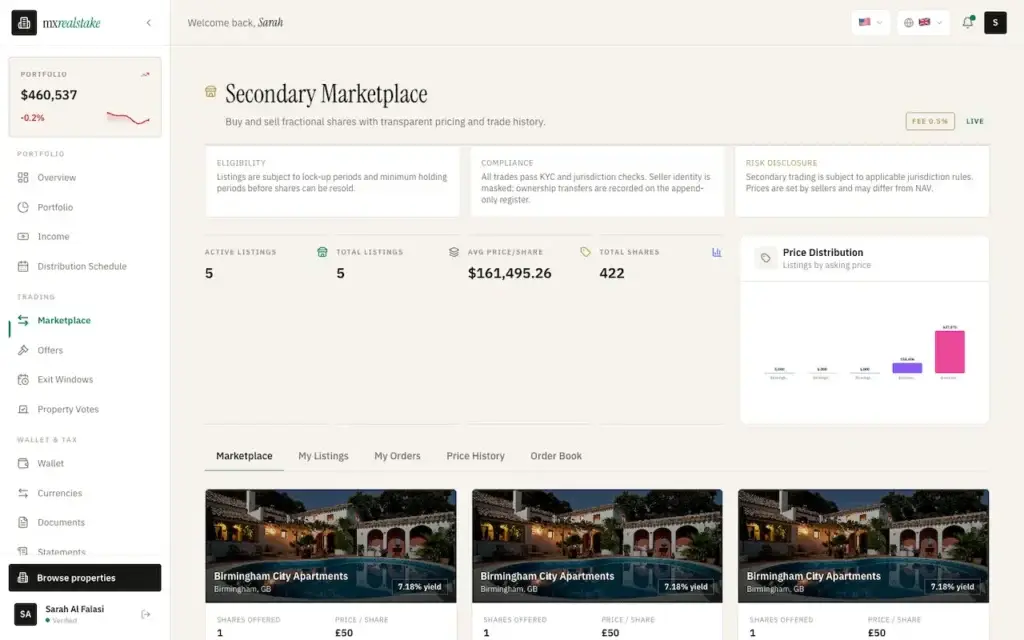
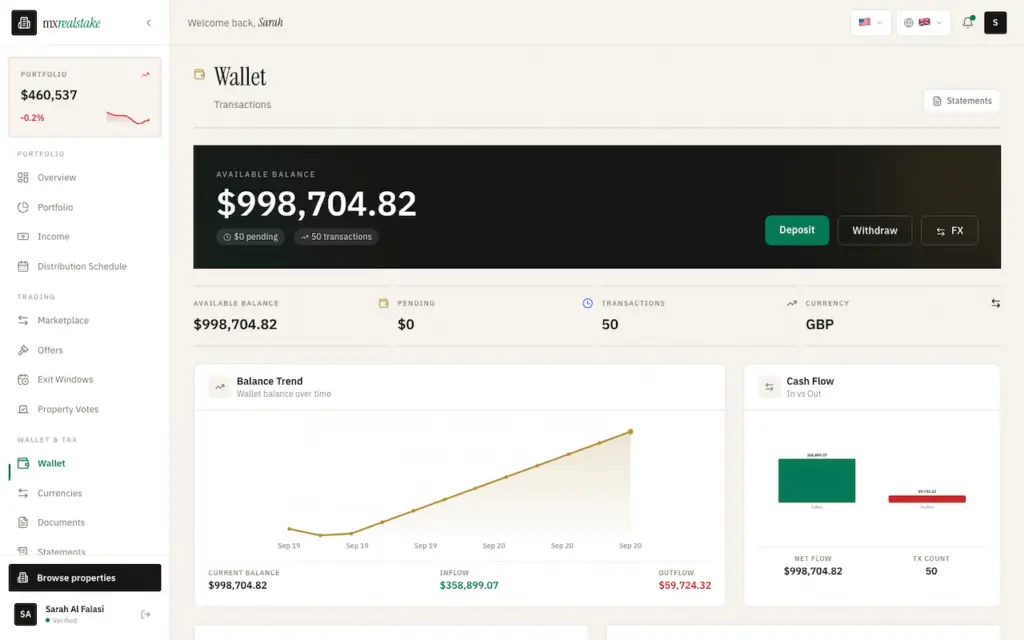
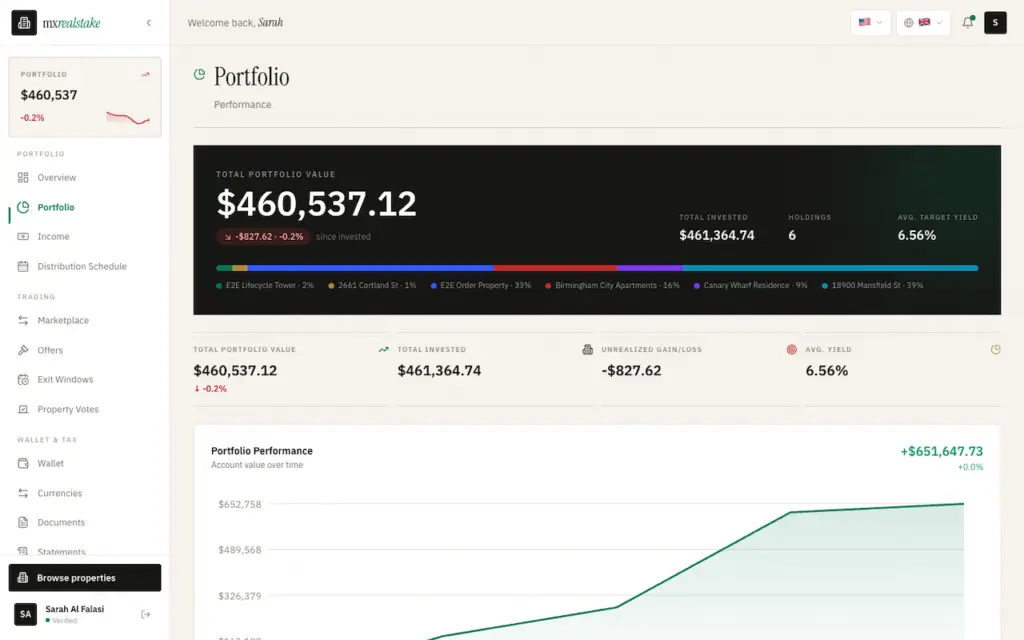
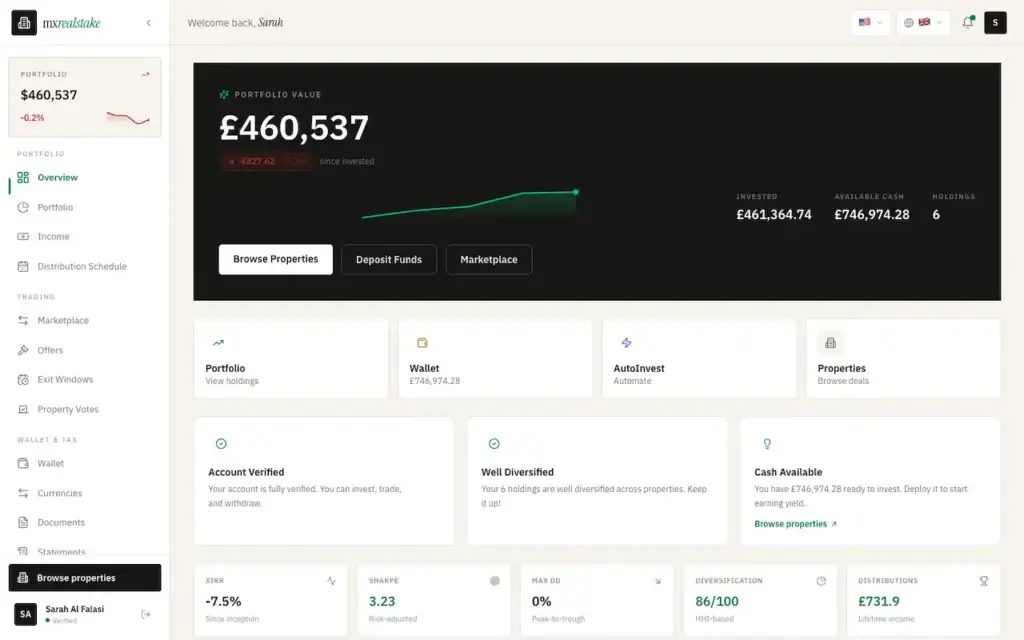
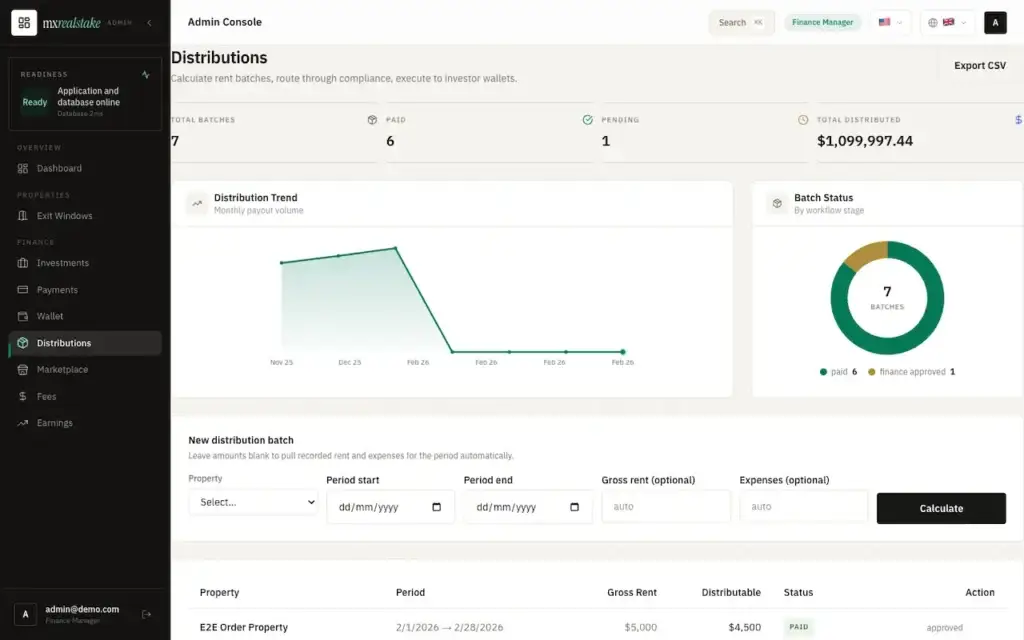
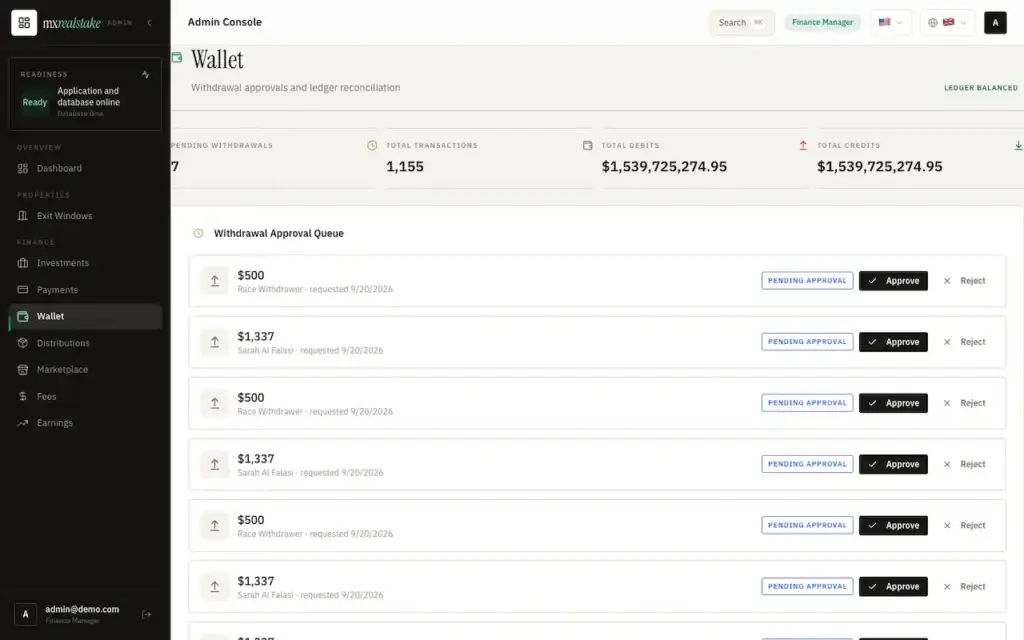
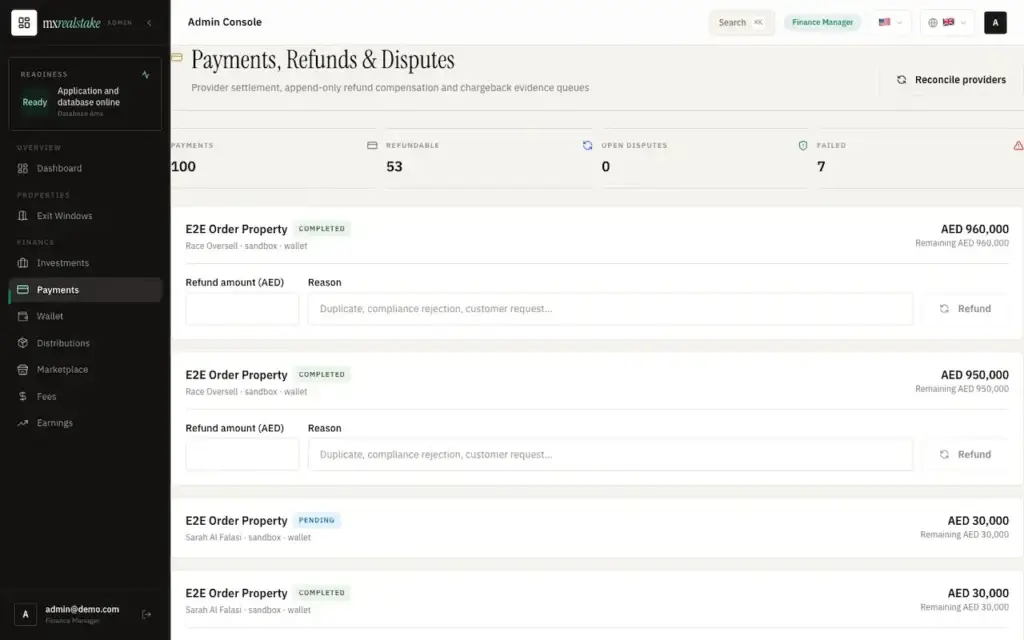
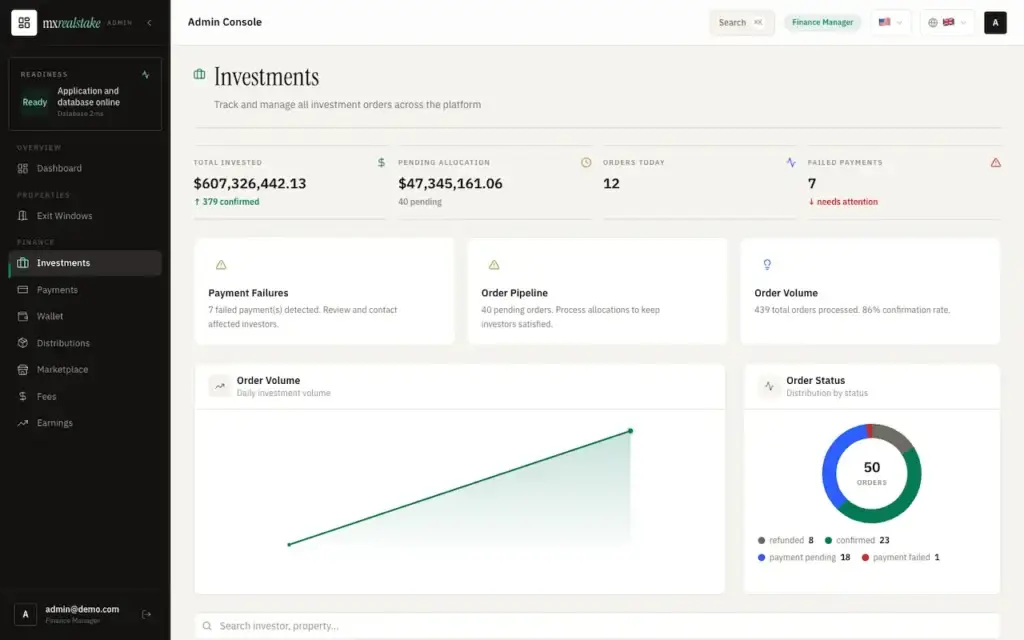
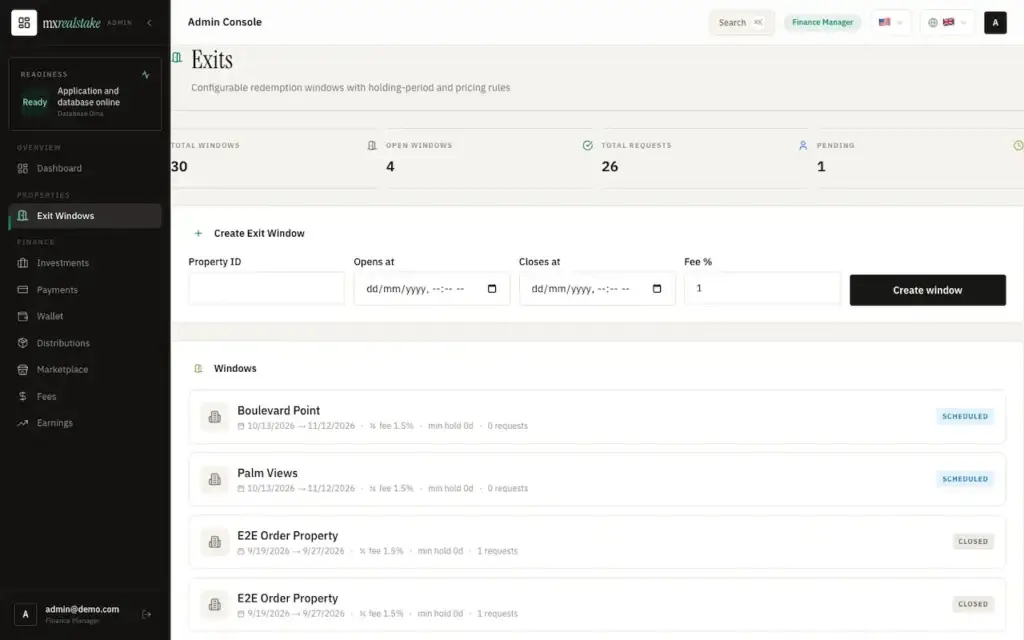
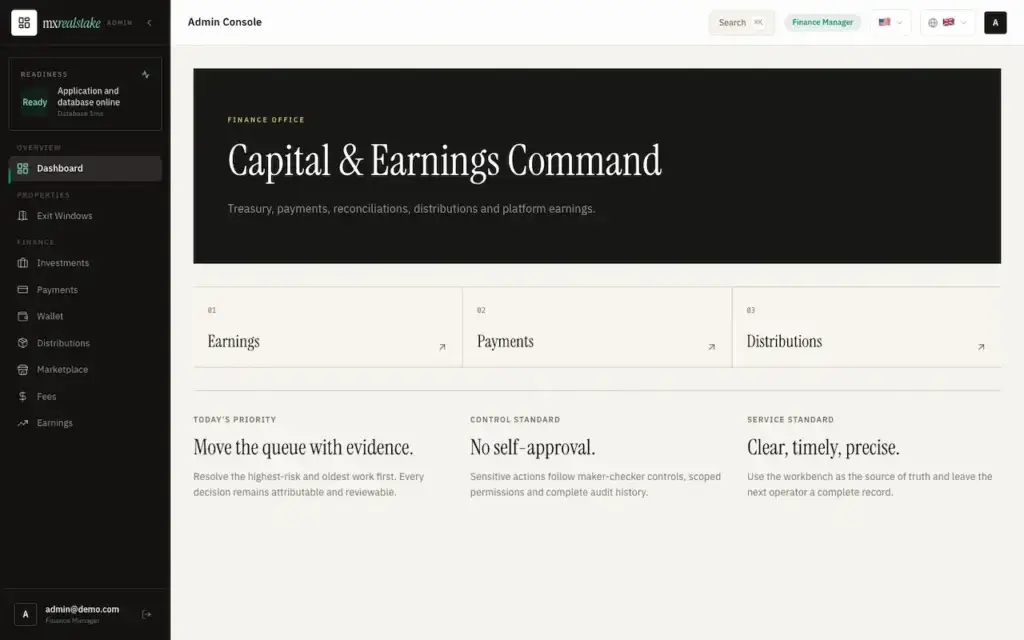
Page through the flows below and follow a single property end to end: a developer submits it, underwriting and the investment committee review it, an investor in Dubai buys in with dirhams while an investor in London holds the same building in pounds, and one payout batch pays both of them. The register, the ledger and the audit trail stay the same records throughout, which is exactly why you buy this instead of stitching it together.
No Borrowed Case Studies
Capability Statements - What the Base Build Contains
No client project exists to quote in this category yet. Miracuves has no named fractional property client, so the four statements below describe what ships in the base build instead of passing capability off as a testimonial. Real client deployments appear separately in our portfolio.
Hypothetical Operator
Modelled Reference - Gulf Operator Selling Fractional Property Across Borders
What follows is a modelled deployment, not a client project, and it carries that label on purpose. It sets out how the platform would be configured for an operator taking retail money into Gulf residential property while serving investors who live in three different countries. Each capability mentioned exists in the base build; the operator itself is fictional.
Gulf Fractional Ownership
Operator, Three Currencies
How the platform would be set up for a Gulf operator selling fractional stakes in property to retail investors living in three countries.
- A US-built product with translation pasted on top
- Investors paid in one currency who report in another
- No way to show who held which share last quarter
- AED as a true base currency, not dollars shown converted
- Arabic mirrored fully right to left, not just translated
- Each country profile holding currency, minimums and eligibility
- Wallets in three currencies with ledger-derived balances
- Currency conversion quoted through a bounded rate cache
- Eight languages, Arabic laid out right to left
- Payout batches cleared by compliance and finance
- UAE, US and UK profiles priced in AED, USD and GBP
A modelled deployment, not a client project. Every capability listed exists in the base build; the operator does not.
In Plain Terms
What Is a White Label Fractional Real Estate Platform?
It is the software behind fractional property investing: an investor buys a share in one named building instead of a unit in a pooled fund, is paid a pro rata cut of the rent, and can sell that share to another investor without waiting for the building itself to be sold. Your team finds the properties, underwrites them, keeps the ownership register and pays out distributions.
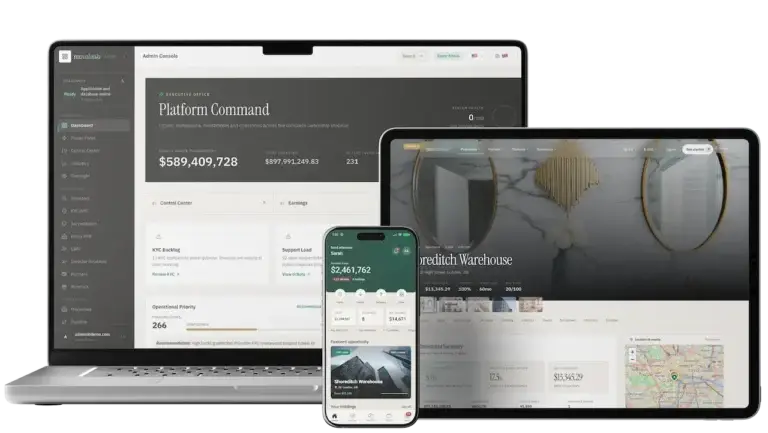
Four Surfaces, One API
An investor web app in Next.js 15 on React 19, an operator console of about thirty workspaces, a portal where developers submit properties and a React Native app on Expo SDK 52, all served by one versioned API of 229 routes.
Right to Left Is Built In, Not Added
Eight interface languages, Arabic included and laid out fully right to left. Mirroring a whole layout is harder than translating text, and it is the feature vendors promise most and deliver least.
Where the Real Work Sits: Money
Amounts live in a double-entry ledger in integer minor units with balances derived, writes from external input carry idempotency keys, and withdrawals and distributions need maker-checker approval. Cross-border FX sits on top of that ledger, never in place of it.
Fractional Ownership, Market by Market
Why a Gulf Platform Needs Its Own Setup
A Gulf deployment differs from an American one in its investors, not in how the investment works. An operator based in the UAE serves a mostly expatriate population, paid in dirhams, often saving and reporting in another currency, with a large part of the audience reading Arabic. Treat all of that as localization to add after launch and the result feels like a translated American product, because that is what it is.
-
AED, USD and GBP on UAE, US and UK profiles
-
Eight languages with Arabic laid out right to left
-
Ownership per property, kept in an append-only register
-
Resale market, so exiting needs no building sale
-
Your full source, no runtime license, no per-investor fee
That makes multi-currency support the wrong question to put to a vendor here. Ask instead whether the base currency, country profile, minimum ticket, eligibility test and text direction are settings, or assumptions hardcoded into software written for a single market. In this platform they are settings, and the demo proves it in roughly two minutes.
All in the Base Build
Platform Features - Markets, Currencies, Fractional Investing & Servicing
Each item below ships in the base build and can be seen in the read-only demo. It is ordered the way a regional operator meets it: choose your markets and their currencies first, and the rest follows from that choice.
Market Profiles
Profiles for the UAE, the US and the UK come preset, each with its own currency, minimum ticket and eligibility gates. Opening the market you really want is a configuration step, not a fork of the code.
- UAE, US and UK country profiles
- Base currencies in AED, USD and GBP
- Minimum ticket set per market
- Eligibility and suitability gates by profile
Arabic, Mirrored Right to Left
Eight interface languages, with Arabic mirrored right to left instead of translated in place. In the demo, change the language and check the wallet and order summary, not just the headings.
- Eight interface languages
- Arabic in a fully mirrored layout
- Language set per deployment, not only per user
- Locale-aware numerals, dates and currency
Wallets in Three Currencies
Balances come from the ledger rather than a stored figure anyone could edit, and FX quotes and conversion draw on a bounded rate cache, so loading a page never triggers a provider call.
- Wallets per currency with ledger-derived balances
- FX quotes and conversion, cached with bounds
- Deposit and withdrawal flows
- Plaid bank verification seam on the funding route
Ownership by Property
Each investor owns part of one named asset held in its own SPV with share classes, and every holding is appended to a register with a certificate instead of being inferred from transaction history.
- Property catalog searchable by location
- Side-by-side view of up to four properties
- Return calculator with local projections
- Due-diligence files for each asset
A Sixty-Field Property Record
More than sixty fields covering identity, fundraising, projections, physical spec, rental economics and regulatory data, so retail marketing and institutional underwriting work from one record.
- Onboarding and KYC with evidence kept
- Queues for accreditation and suitability
- Subscription agreements signed with evidence
- Orders guarded by idempotency keys
Investor Onboarding and KYC
Verification queues, accreditation handling, retained evidence and an escalation route; your KYC vendor is connected during delivery, so no provider is live out of the box.
- An SPV per property, with share classes
- Allocation appended to ownership
- Certificate issued on each allocation
- More than sixty property record fields
Subscribe, Allocate, Certify
Agreements signed with evidence attached, orders guarded by idempotency keys, then allocation, ownership append and certificate issue in one traceable chain.
- Holdings and certificates in one portfolio
- Sharpe, Sortino, volatility and XIRR
- Maximum drawdown and goal projections
- Spread by type, geography and currency
Resale Marketplace
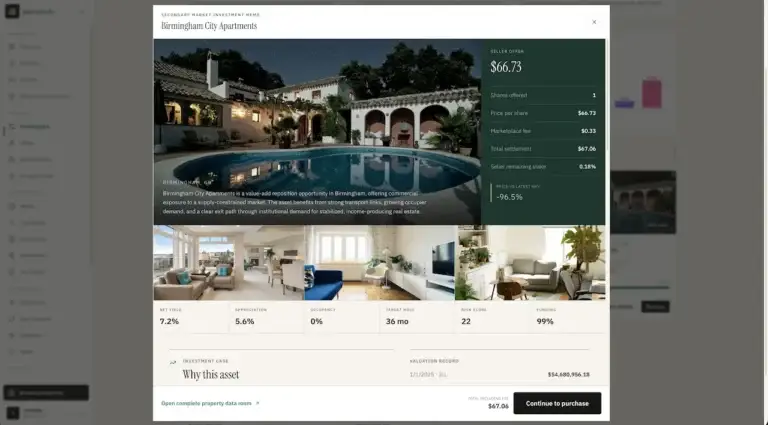
Stakes are listed, offers negotiated and ownership moved atomically after an investment memo at checkout, with scheduled exit windows too, so leaving never waits on a sale of the building.
- Resale listings between investors
- Offer negotiation plus an investment memo
- Ownership moved atomically on execution
- Exit and redemption windows on a schedule
Servicing and Rent Roll
Tenancy and lease records, rent receipts and expense logs, maintenance requests running through work orders, and a dashboard for property operations. This is the area where most fractional platforms run thin.
- Tenancies, leases and rent roll
- Rent receipts and expense logs
- Maintenance handled through work orders
- Operations dashboard per property
Rental Distributions
Each run moves through calculation, compliance review, finance approval and ledger execution with every approval on record, so paying investors is a controlled process, not a spreadsheet plus a bank transfer.
- Distribution runs with calculation
- Compliance sign-off, then finance approval
- Balanced entries on ledger execution
- Statements and tax summaries per investor
Investor Performance Analytics
Sharpe, Sortino, volatility, maximum drawdown and XIRR, plus diversification by type, geography and currency, which counts for more when one investor holds positions in three currencies.
- CRM: leads, pipeline stages, contact log, tags
- Helpdesk: SLAs, queues, macros, CSAT
- Investor announcements, messages, knowledge base
- Referral codes with rewards and sharing
Register, Audit Trail and Votes
A register that only appends, audit search, maker-checker wherever money leaves and share-weighted investor votes on proposals to sell a whole property, each kept as a record a reviewer can open.
- Ownership register, append-only
- Audit search over money paths
- Maker-checker for withdrawals and distributions
- Share-weighted votes on whole-asset sales
Note for buyers: the software arrives whole, and we tailor every installation to the operator who runs it. Your provider accounts, your jurisdictions, your fees and the security hardening described further down are configured with you during delivery, never shipped already switched on.
Six Ways to Earn
Revenue Models - Subscription, Ownership, Resale, Exit & FX Fees
Revenue on a fractional property platform comes from six sources, and once investors span borders one of them works differently from the rest: FX spread becomes a genuine line item instead of a rounding footnote, since a real share of subscriptions and payouts crosses a currency boundary coming in or going out.
Currency Spread
The gap between the rate quoted to an investor and the rate you actually get, earned on subscriptions, distributions and withdrawals. When investors hold in three currencies, this is a built-in revenue line, not a side effect.
Subscription Platform Fee
A percentage charged as money comes in at subscription and recorded against the order, so the investor's statement and your revenue report agree on the amount and the date.
Ownership Management Fee
A fee that accrues on holdings and is calculated straight from the register, not a side schedule, so it stays accurate on its own as shares change hands on the resale market.
Resale Trading Fee
Earned on trades between investors. It tracks liquidity instead of fundraising, so it becomes the line that keeps growing after the platform matures and fresh listings slow.
Distribution Fee
Deducted within the payout batch, worked out and approved in the same run that pays investors, so fee and payment reconcile to a single ledger execution.
Exit and Redemption Charges
Charged at scheduled exit windows and on redemptions, priced for the fact that you supply liquidity instead of making investors wait for a sale.
You set every rate. The platform keeps no cut of any of them, with no runtime license and no per-investor fee, so the model you plan before launch is still the model you run at scale.
No Developers Needed Day to Day
Operator Console - Markets, Register, Payouts & Compliance
About thirty workspaces make up the console, and on a regional rollout you start with the ones that define your markets: country profiles, currencies, minimums and the interface languages on offer. After that, daily work moves to underwriting, the register, distributions and compliance.
The Workspaces You Use
Markets and Their Currencies
The countries you sell into, the currency each prices in, the minimum ticket and the eligibility test that applies. On a regional platform this is the first screen that counts, and the one other products most often hardcode.
Languages and Formats
Eight interface languages with Arabic right to left, plus the matching numeral, date and currency formats. Which languages appear is operator data, not a new deployment.
Deal Intake
Developer and broker submissions land as draft properties, then move step by step until each one is ready for underwriting.
Underwriting and IC Review
A property record of more than sixty fields, an underwriting workflow and investment committee review, with each decision logged against the asset instead of lost in an inbox.
Ownership Register
Only ever appended to, with certificates on allocation and audit search across money paths, which turns the beneficial-owner question into a simple query.
Payout Runs
Batches are calculated, cleared by compliance, approved by finance and executed on the ledger, with maker-checker wherever money leaves and investor statements drawn from the same run.
Leases and Rent Roll
Leases, rent receipts, expenses and maintenance work orders, so servicing after the raise happens in the same system that took the money in.
Compliance Desk
KYC and accreditation queues, investor 360 records, audit search and maker-checker approvals. Your provider is connected during delivery, so a decision recorded in the platform matches the one the provider made.
CRM and Support Desk
Leads, stages, contact history and tags next to a support desk offering SLAs, queues, macros and CSAT, since a retail investor base produces tickets that need a home.
- Country profiles, currencies, minimums
- Interface languages with Arabic RTL
- Eligibility and suitability rules by market
- Fee schedule and FX spread settings
Reports and Exports
Activity feeds, tax summaries and investor statements, with export audit logs and formula-injection escaping set up in the hardening pass.
- Deal intake and underwriting
- Committee review with recorded decisions
- Register plus certificate issue
- Distribution runs with approvals
Got a team? during delivery the catalog of 30 roles is mapped to how you work, so who signs off a withdrawal, who handles a KYC case and who may edit a fee schedule are your calls, with route-level enforcement completed during delivery rather than left at defaults.
One Price, Owned
How Much Does a White Label Fractional Real Estate Platform Cost in 2026?
Pay once and the platform is yours: investor web app, operator console, partner portal, mobile client, full source and installation on servers you control. Most fractional ownership software is leased instead, with an onboarding charge, a monthly bill for as long as it runs and your investor records on the vendor’s infrastructure. Nothing here recurs: no fee per investor, no cut of what you raise. Delivery configuration, set out below, is quoted with you.
Which route suits
your markets?
Share your markets, currencies, timeline and budget, and we will tell you plainly which option fits. Honest guidance, never an upsell.
What Changes Hands
What's Included - Source Code, Investor Apps & Your Deployment
A single payment covers each component listed here. No tier holds anything back, no module checks in with a license server, and no part of it turns into a recurring bill after launch.
Complete Source
Every surface, from the investor web app and console to the partner portal and mobile client, is handed over with its Prisma schema and migrations, and none of it is encrypted.
- Code for all four surfaces on handover
- Readable code, no license server
- No charge per investor or per transaction
- Modify it, reskin it or give it to another team
Data Model
Ownership, SPVs, share classes, the ledger, distributions, tenancy, compliance and support, modeled across 77 Prisma models and 47 enums. This is the layer that costs most to get wrong and hurts most to rebuild.
- Investor web app on Next.js 15 and React 19
- Around 30 workspaces in the operator console
- Partner portal where developers submit assets
- Expo SDK 52 mobile client in React Native
Markets and Languages
Arabic right-to-left among eight locales, plus country profiles that turn currency, minimum ticket and investor eligibility into settings per market instead of hard-coded values.
- Schema of 77 models and 47 enums
- An audited build exposing 229 API routes
- Prisma migrations on PostgreSQL 16
- /api/v1 plus /api/mobile/v1, both versioned
Money Engine
Double-entry ledger with derived balances, idempotent writes on outside input, FX conversion and a distribution pipeline from calculation to ledger execution.
- Eight locales, including Arabic in right-to-left
- Country profiles for the UAE, US and UK
- Base currencies of AED, USD and GBP
- Numbers, dates and money formatted per locale
Ownership and Resale
Forward-only ownership register with certificates, plus a secondary market with negotiated offers, investment memos and atomic transfer, so holders can exit early.
- Integer minor units in a double-entry ledger
- Balances computed from entries, not saved
- Idempotency keys wherever outside input writes
- FX quotes and conversion over a bounded cache
Operations Console
About thirty in total, running from deal pipeline and underwriting to tenancy, rent roll, compliance queues, CRM and the helpdesk.
- Ownership register that only appends
- Certificates issued at allocation
- Resale market with atomic transfer
- Exit and redemption on set windows
Technical Documents
Ten technical documents, including the developer security handbook and the VAPT compliance review, give your reviewer written material to assess before anyone opens the code.
- 30 catalog roles to map onto your team
- Maker-checker for withdrawals and distributions
- Audit search over every money path
- Weighted investor votes on asset sales
Your Install, Your Brand
Set up on your servers, your domains and your own provider accounts, with your brand carried through every surface before any investor sees it.
- Ten documents in the technical suite
- Security handbook for developers
- VAPT review mapped to the OWASP top ten
- Installed on infrastructure you own
Plainly put: you receive a complete application plus the documents a technical or compliance reviewer will request. You do not receive a platform fit to accept public money on the first day, and the next sections list precisely what separates the two.
Explore Every Angle of the White Label Fractional Real Estate Platform
Four guides to owning a fractional property platform for investors in several countries: the features, the one-time cost, how to choose a provider, and how the fees work across borders.
Features
Fractional ownership features for investors in several countries: 3 preset country profiles, 8 interface locales with Arabic right to left, and a portal where developers submit buildings.
See the full breakdown →Development Cost
$6,099 once with no renewal, deployed on your servers in six days, 0% of your fees or FX spread taken, and the readiness work scoped in writing before investors arrive.
See exact pricing →Provider
Four kinds of fractional ownership seller compared, and nine checks to run on each: whose servers hold the records, whose license each market runs under, and which rate applies across currencies.
Compare options →Business Model
Why small tickets make the currency line matter, the order to switch fee lines on, and three operating shapes, from a developer selling small stakes to a brokerage with an expatriate client book.
See the playbook →Built For
Who Buys a White Label Fractional Property Platform?
It fits operators with a regional investor base and specific, named properties, who already know the listing page is the easy part. The hard part is the register, the distribution run and a clear answer when a reviewer asks who held which share on a given date.
Gulf Fractional Ownership Platforms
Operators Adding a Second Country
Developers Selling Fractions of Their Own Stock
Family Offices and Asset Managers
Syndicates Leaving the Spreadsheet
Buyers Who Need the Code In-House
The fit is strongest when several currencies and languages are needed at launch, not as a later phase, because that is exactly where software built for one market gets costly to adapt.
Where It Works
Use Cases - Gulf Retail, Cross-Border Holders, Arabic-First & Syndicates
The central case here: an operator selling fractions of named Gulf homes to retail investors, pricing in dirhams, and managing the rent roll and distributions in the system that raised the money.
Gulf Retail Fractions
In this region an investor base spread across borders is the default, not an advanced case. Multi-currency wallets with balances derived from the ledger, FX quotes and conversion over a bounded rate cache, and diversification analytics by currency exist because investors often earn, save and report in three currencies.
Investors Across Borders
Arabic-first is about layout before it is about translation. All eight locales ship, Arabic among them in right-to-left, and the place to check it in the demo is the wallet and order summary, not the headings, which are the easy part.
Arabic-First Screens
Residential portfolios bring the volume: lots of smaller assets, lots of small investors, and servicing work that scales with both. That is why tenancies, leases, rent receipts, expenses and maintenance work orders are part of the base build.
Residential Holdings
Commercial property alters the profile, not the platform. Bigger tickets, fewer holders, longer diligence and heavier paperwork per asset, all of which the property record, with its sixty-plus fields, and the due-diligence document sets already handle.
Commercial Property
Developers funding their own projects submit stock through the partner portal into a pipeline they run themselves, a different stance from listing on an outside marketplace, and one that keeps the investor relationship with the developer.
Developer-Led Raises
Private syndicates moving an existing book online ignore the acquisition features and care entirely about the register. What they gain is the append-only ownership record, the distribution batch and an audit trail, in place of a spreadsheet no auditor can trace.
Since minimum tickets, eligibility gates and country profiles are settings, one deployment can serve a low-ticket retail market and a high-ticket accredited market at once, with neither bent to suit the other.
Why Now
Why Gulf Fractional Ownership Is Worth Launching in 2026
Fractional ownership pays commercially only where three things coincide: property priced beyond ordinary buyers, rental yields worth paying out, and a large salaried investor population poorly served by conventional products. The Gulf is one of few regions where all three hold together, which is why the model has taken root there rather than everywhere.
Demand Already Exists
Many salaried expatriates cannot buy a whole unit and hold savings in more than one currency. That is the demand this kind of product was designed for.
Local Fit Is an Edge, For Now
Many rivals in this vertical are US-built products with translations bolted on. Arabic right-to-left and pricing native to AED show on the investor's first screen, and they are harder to add later than to build in.
Servicing Decides Survival
Raising the first round is the simple part. Distributions that reconcile, an accurate rent roll and a clear answer on who owns what decide whether the platform is still trading in its third year.
Resale Eases the Decision
A secondary market does more than any other feature to ease hesitation at subscription, since investors no longer fear being tied in until the building is sold. Retail buyers value it more than institutions do.
Ownership Is the Point
The fees are yours, the register is yours, and the data a buyer of your business or a regulator will one day request lives in your own database, not in a tenancy you pay rent on.
Licensing Is Yours to Obtain
All of the above is a software and market case, not a legal one. Whether you may raise money from the public in your chosen market is for your counsel and regulator to settle, with your own license or exemption, and buying this does not decide it.
The Build in Numbers
None of that makes the build any simpler. Listing pages are never the hard part here. The work sits in the cap table, each payout run, every KYC file and each beneficial-ownership query, and adding a second currency and a second reading direction makes all of them harder, not merely more decorative.
The Build Underneath
Tech Stack - PostgreSQL 16, Prisma, Next.js 15 & Expo SDK 52
Intentionally ordinary, because here the reviewer counts as much as the investor. PostgreSQL behind Prisma, one Next.js App Router for every web surface and an Expo client on mobile form a stack compliance teams know on sight and local developers can be hired to maintain.
Web & Console Surfaces
Next.js 15 · React 19 · Tailwind
- One App Router for public, investor and admin pages
- About thirty operator workspaces in a single shell
- Design tokens held in a shared UI package
- Right-to-left treated as a native mode, not a CSS patch
Locales and Markets
Arabic RTL · 8 locales · country profiles
- Locale chosen per deployment and per user
- Layout mirrored, not restyled
- Locale-aware formats for numerals, dates and money
- Profiles for UAE, US and UK holding currency and eligibility
Data Model
77 models · Prisma · PostgreSQL 16
- 47 enums and 77 models spanning the domain
- A property record of more than sixty fields
- Investor records linked to twenty-plus relations
- Versioned migrations instead of manual SQL
Ledger & Currency
Integer minor units · double-entry
- Balances read from entries, not from a saved total
- Idempotency keys on all writes from outside input
- Bounded rate cache in front of FX quotes
- Payout batches from calculation to ledger posting
API Layer
229 routes · versioned
- /api/v1 and /api/mobile/v1 kept apart
- 229 routes as audited
- One contract for web, console, partner portal and mobile
- Route-level permission checks completed in delivery
Mobile App
Expo SDK 52 · React Native 0.76
- The investor journey on a phone
- Same API contract as the web surfaces
- Document capture via your KYC provider integration
- App store submission scoped separately
Why these choices: nothing unusual, on purpose. Compliance reviewers know PostgreSQL and double-entry ledgers, and Next.js and React Native developers can be hired in every market this platform targets.
The Sequence
How It Works - Markets, Pipeline, Onboarding, Register & Payouts
Six stages, from choosing the markets you sell into to paying investors in whichever currency each one holds.
From Market Setup to Exit

Market Setup
Before listing a single property you pick the countries you will sell into. Each country profile holds its currency, minimum ticket and eligibility gates, and you choose the interface locales in the same pass.
- UAE, US and UK country profiles
- Base currency of AED, USD or GBP
- Minimum tickets and eligibility per market
- Eight locales, Arabic right-to-left included

Deal Sourcing
A property partner applies, which sets up a developer record, and then submits an asset to the pipeline as a draft. Underwriting takes it from the pipeline, not from someone's inbox.
- Partner application creating the developer
- Deals submitted straight into the pipeline
- Draft properties created and edited
- Clear record ownership from day one

Underwriting & Committee
The property record is filled in across more than sixty fields, due-diligence documents are attached, and the investment committee logs its decision on the asset itself.
- 60+ fields covering identity and economics
- Diligence files held against the asset
- Committee review with a recorded decision
- SPV and share classes set before launch

Onboarding & Subscription
Investors complete KYC, clear the suitability gate for their country profile, subscribe in their own currency and sign the agreement with evidence kept, after which the order is allocated.
- KYC and accreditation, evidence retained
- Suitability checks by country profile
- Subscriptions in each investor's currency
- Signed agreements with evidence on file

Ownership & Servicing
Each allocation is appended to the ownership register and produces a certificate. Servicing then happens on the platform that took the subscriptions: leases, rent received, expenses and maintenance.
- Ownership register, append-only
- A certificate for every allocation
- Tenancies, leases and the rent roll
- Expenses and maintenance work orders

Distributions & Exit
A distribution batch works out each investor's share, clears compliance review and finance approval, and posts to the ledger, converting currency for investors who hold in another one. Holders who want to leave can list on the secondary market instead of waiting for a sale.
- Calculate, then compliance, then finance sign-off
- Balanced entries posted to the ledger
- FX where holding currencies differ
- Resale listings, offers, atomic transfer
Every stage corresponds to real routes and real records, which is why the read-only demo is worth exploring and not just a diagram of intent.
Design Principles
Platform Architecture - One Domain & Derived Balances
Four Surfaces, One Model
Investor app, operator console, partner portal and mobile client are views onto a single versioned API backed by a single PostgreSQL schema, so every screen reads a property, an investor or a holding identically.
Markets Are Configuration
Country profile, base currency and interface locale are resolved per request from settings, not constants, and that is the structural reason a new market is a settings exercise and not a fork.
No Stored Balances
All amounts are integer minor units and every movement writes balanced double-entry rows. A balance is always a sum of entries, not a figure some process can let drift, and that is what makes reconciliation possible.
A Register That Only Grows
Ownership is recorded forward and never edited in place, with a certificate on each allocation, so who held what on any date can be answered without rebuilding history.
Retries Resolve Once
Orders and every write triggered by an outside callback carry idempotency keys, so a retry, a double click or a repeated provider callback produces one result, never two allocations.
Sign-Off Where Money Moves
Maker-checker on withdrawals and distributions is built into the flow, not left to a policy manual, and the 30 catalog roles are mapped onto your actual approval chain during delivery.
Load Profile
Built to Scale - Payout Batches, a Busy Ledger & Growing Document Stores
This is not a consumer marketplace load. Traffic stays moderate and predictable; the weight is in batch jobs, document storage and reporting, and those are what to size for.
The distribution run carries the most risk, since it reaches every investor in a property in one pass and moves money. It calculates, waits on compliance review and finance approval, then posts to the ledger, and running it twice is far worse than running it late.
Because balances are derived, reports read entries instead of a saved total. That is correct, but it makes the ledger the busiest table on the platform, so indexing and query design matter there more than anywhere else.
Documents pile up faster than investors do here, since each asset brings a due-diligence set and each subscription brings an agreement plus its evidence. Private, encrypted buckets with a retention policy are set up during delivery, never shipped open.
Currency conversion reads from a bounded rate cache instead of calling a provider for every page view, so cost and latency stay predictable when a catalog page shows prices in an investor’s second currency.
The Payout Run
The job that matters most. It reaches every investor in an asset, moves money, and needs compliance and finance approval before posting. Idempotent by design, because a double payment cannot be undone the way a late one can be.
The Busiest Table
Deriving balances is right and costly. Each balance read is an aggregation, so index design and disciplined queries on the ledger outrank every other optimization here.
Storage Outpaces Headcount
Diligence sets per asset plus agreements and evidence per subscription mean files grow faster than the investor count. Private buckets, encryption, malware scanning and retention rules are set up in delivery.
Cached Exchange Rates
Quotes and conversion go through a bounded rate cache, so showing a catalog in another currency costs one cache read, not a provider call, keeping latency and provider spend flat.
Reports Run Per Holder
Analytics, currency diversification and tax summaries are calculated for each investor, not each property, so they run as batch jobs away from the request path.
Retention Built Into the Model
Audit search, export logs and retention live in the data model from the start, because here the duty to report lasts longer than the investment does.
Reporting across currencies is the hidden cost: diversification by currency and tax summaries must be calculated investor by investor, not once per asset, which pushes them into batch processing instead of live requests.
Where the limits are: these are design properties of the base build, not throughput measured on a live deployment, because no production deployment exists to measure. Load testing against your expected volumes forms part of delivery.
Made for Scrutiny
Platform Security - Documented, Reviewed & Closed Out With You
Security is written down here, not just claimed. A developer security handbook and a VAPT compliance review mapped to the OWASP top ten come with the platform, giving your security team documents to assess instead of code to decipher. The review is frank, and what follows is drawn from it, not written around it.
Access Rules Built Around Your Approvers
Payment Callbacks Checked Properly
Real KYC Verification
Policy Settings, Completed in Delivery
Data Handling Configured for You
Your License Is Not in the Box
Written Down, Not Claimed
Ten technical documents, among them a developer security handbook and a VAPT review against the OWASP top ten. Few products in this space can give a reviewer that on the first day.
Sessions and Sign-In
Database-held opaque sessions in place of self-describing tokens, TOTP multi-factor with backup codes and WebAuthn passkeys, with session revocation meant to hold across every surface.
A Ledger That Balances
Amounts in integer minor units, balances derived from balanced entries and idempotency keys on writes from outside input, so a retried or repeated callback can never allocate twice.
Two Approvers Where Funds Leave
Withdrawals and distributions go through maker-checker, so any path where money leaves needs a second person by design, not by procedure.
An Evidence Trail
An ownership register that only appends, certificates on allocation, audit search across money paths and logged exports: the material an auditor or a buyer of the business actually requests.
Bring Your Own Auditor
Your own penetration testers or security auditors are welcome. They get the handbook, the VAPT review and the full source, which is what an external assessor needs to begin work.
Everything a regulated investment business is typically questioned on is in the design: opaque sessions held server-side in the database, a TOTP second factor plus backup codes, WebAuthn passkeys, double-entry bookkeeping with idempotent handling of external input, maker-checker approval for withdrawals and distributions, and an ownership register that only appends. What it lacks out of the box is live provider connections and policies enforced for your organization. Those are delivery tasks, they are listed below, and no deployment should face a real investor until each one is closed.
Beyond the Base
Add-Ons - Pre-Launch Hardening, Live Providers, New Markets & SSO
All of the above comes in the base package. The items below are scoped and priced on their own, and the first two are mandatory for any deployment that will handle real money, which is why they lead the list.
Hardening Before Launch
Permission checks per route on every admin surface, lockout and password policy with enforcement completed during delivery, session revocation, rate limits and the data-handling controls. This is what makes the base build fit to face an investor, and it cannot be skipped.
Your Providers, Connected
Your payment processor, connected with raw-body signature checks and settlement reconciliation, and your KYC vendor, with genuine callback verification and evidence retention. Until both run on your own accounts, the platform is a demo, not a business.
New Markets and Jurisdictions
Country profiles for the UAE, US and UK ship today. A fourth market brings its own currency, minimum ticket, eligibility test and reporting rules: configuration, plus the effort of getting those rules right.
More Languages
Eight interface locales are included. Another language, above all another right-to-left one, means translation plus layout checks on every surface, not simply dropping in a language file.
App Store Launch
The Expo client builds for iOS and Android from the source you hold. Signing, store listings, review and release management are separate work, and native KYC document capture, simulated in the demo build, comes through a provider integration, not as a shipped feature.
Sanctions and PEP Checks
Neither included nor implied anywhere on this page. Adding a screening provider, setting match handling and building the review queue is a defined project, and most regulators will expect it in place before you go live.
Single Sign-On for Staff
Putting operator console access behind your own identity provider, which the base build does not do and which institutional buyers and diligence teams usually raise.
Help Through Assessment
Support through your penetration test, security review or regulatory application, working from the handbook and VAPT review the platform already has instead of gathering evidence under pressure.
Building in Fintech & Real Estate? We Have the Whole Market Covered
Fractional ownership is one way to build a capital platform. If your plans reach past property, these products share similar foundations and sit comfortably alongside it.

Groww Clone
Investment app with mutual funds, goal-based saving and portfolio tracking for retail savers.
Zerodha Clone
Discount brokerage with order placement, margin, market data and reports for active retail traders.

Blueberry Markets Clone
Forex and CFD brokerage with multiple account types, risk controls and trade settlement.

Zillow Clone
Real estate marketplace with property search, listings, agent tools and lead capture for buyers and renters.
Why It Earns
Business Case - Fee Income, FX Spread & Owned Infrastructure
Demand for small property stakes is not the hard part of this business. Serving many small holders accurately is, because keeping the owner register exact, paying rent out cleanly and leaving an audit trail a reviewer accepts costs just as much when the typical stake shrinks.
Revenue From Six Sources
Fees on each subscription, a management fee accruing from ownership, resale fees, a charge inside each payout batch, exit and redemption fees, and FX spread. Living on subscription fees alone leaves you exposed to every quiet quarter.
Currency Conversion Recurs
When residents of the UAE, the US and the UK hold the same building, money changes currency as they invest and again as rent or proceeds come back, so the spread shows up every cycle.
Small Tickets, Same Servicing Cost
Keeping the register exact and paying out correctly takes the same effort for a small stake as a large one. That is why the operator console and the batch pipeline are the pieces worth owning outright.
Software You Own, Not Rent
A single purchase with the source transferred: no runtime license and no charge per investor. That is a different thing to hold on your books than a subscription that stops the month payments stop.
Expect a single market, a single currency and a short list of properties. Platform and management fees do the earning while resale activity stays thin, since holders rarely sell before the first cohort looks for an exit. Most of the year goes into servicing: showing that each payout reconciles, that the owner register stands up to a reviewer and that an investor asking to leave gets a truthful answer. Operators who chase raise speed over servicing quality usually find the weakness when repairing it costs the most.
Anyone can buy software and anyone can bid on buildings, so neither is the edge. The edge is a license in a market that is hard to enter, a register and payout record an acquirer can diligence, and investors who have already been paid correctly several times over. Arabic and multi-market localization give you a visible early lead with Gulf investors, and they are easier to build in than bolt on later, but a lead is not a moat. What lasts is being the operator whose figures always reconcile.
Three Illustrative Operating Shapes
None of the three setups below is a forecast or a client result; they are illustrative shapes. Each one names its levers so you can drop in your own figures, and every rate is one you choose, not one taken off the top before it reaches you.
One Market First
Country Profile Active
A single currency and a short list of properties.
Picture an operator opening in the UAE only, priced in AED, with a few residential buildings and a low minimum stake to test the funnel. Subscription and management fees do the earning here and resale stays quiet, since nobody sells before the first cohort wants an exit. The real test at this stage is servicing, not how fast money arrives.
Three-Currency Holders
Currencies Active
Same buildings, owners holding in AED, USD and GBP.
Those buildings now open to residents of three countries, each investing and being paid in a home currency. FX spread turns into a steady income line instead of a rounding detail, reporting by currency becomes genuine work, and each country profile applies its own minimums and eligibility rules inside the one deployment.
Resale Market Mature
Revenue Levers Active
Holders trading stakes while new offerings continue.
By now owners sell stakes to one another as well as buying into new buildings. Resale fees climb while fresh offerings slow, management fees accrue on a bigger register, and exit windows are priced as the liquidity service they really are. Here the register and the ledger stop looking like compliance cost and become what the business is worth.
Why Miracuves
Miracuves vs Other White Label Fractional Property Software Vendors
Why Multi-Market Operators Pick Us
What Sets It Apart
Open About the Gaps
We list the access-control, payment-callback and KYC-callback work still required before live money, and say outright that the platform holds no license and holds no client money. A vendor whose gap list is empty has usually not checked.
Arabic RTL From Day One
Eight locales including right-to-left Arabic, plus country profiles holding currency, minimum stake and eligibility. Many products in this space serve one market with a translation bolted on, and it shows on the very first screen.
Ledger Built on Double Entry
Amounts live in integer minor units, balances are derived, and writes triggered by outside input are idempotent. Systems that keep a balance column and nudge it up and down are the ones that fail to reconcile at the worst moment.
A Register That Only Grows
Each change of ownership is appended with a certificate instead of overwritten, so who beneficially owns a stake can still be answered a year on without rebuilding it from transaction history.
Ten Documents Behind the Code
A ten-document technical suite including the developer security handbook plus a VAPT review mapped to the OWASP top ten, so due diligence begins with written evidence instead of reverse-engineering.
Source Transferred, Nothing Rented
At handover everything moves to you, the code never calls back to us, and there is no charge per investor or per transaction, so the numbers in your launch model stay the numbers you run on.
Owning, Renting or Commissioning:
How the Routes to a Fractional Platform Compare
| Criteria | Miracuves Fractional Platform | Hosted Subscription Vendor | Custom Dev Agency |
|---|---|---|---|
| Time to Launch | Deployed in 6 days, hardening scoped apart | On the vendor's onboarding timetable | 6-9+ months |
| Source-Code Ownership | ✔ Full, transferred at handover | Not transferred; you license access | Usually yes |
| Fractional Ownership Depth | Per-property SPVs, owner register, resale market | Often a listings site with payments | Depends on budget |
| Compliance Tooling | Maker-checker, audit trail, VAPT review; no license included | Whatever the vendor exposes | Varies widely |
| Currencies & Locales | AED, USD, GBP; 8 locales incl. Arabic RTL | Often one market, translated | Built market by market |
| Revenue Levers | Six, every rate set by you | Tied to the vendor's plan tiers | Custom (more time & cost) |
| Operator Console | Roughly 30 operator workspaces | Investor screens first, thin back office | Custom build (extra cost) |
| How You Pay | $6,099 once, no monthly fee | Setup fee plus recurring rent | Large budget, long build |
| Ongoing Support & Updates | Offered under written support plans | Bundled into the subscription | Per the retainer contract |
The line between a platform a compliance reviewer can actually examine and a listings site with a checkout bolted on.
Industries
Where the Platform Fits
Nothing about the owner register, the ledger or the payout batch is tied to residential buildings. Any business that takes money from many investors against a named asset and then has to service them accurately runs on the same engine, which is why operators here tend to add asset classes well before they add countries.
- 🏙️ Gulf Fractional Property
- 🏘️ Fractional Residential
- 🏢 Commercial Property
- 🏗️ Property Developers
- 📊 Asset Managers
- 👔 Family Offices
- 🤝 Syndicators
- 🌍 Regional REITs
- 🏦 Proptech Platforms
- 🔑 Real Estate Agencies
- 💼 Investment Operators
- 📈 Capital Raising
Every vertical below shares one domain model, one ownership register and one payout pipeline. What differs is the asset record, the diligence pack and the regulator’s expectations around it, and that is configuration and delivery work, not a separate product.
Changelog
Fractional Real Estate Platform Changelog - Releases & Version History
| Version | Date | <span style="color: rgb(6, 6, 8); font-family: Montserrat, sans-serif; font-size: 13px; font-style: normal; font-variant-ligatures: normal; font-variant-caps: normal; font-weight: 700; text-align: left; white-space-collapse: collapse; background-color: rgb(255, 255, 255);">What's New</span> |
|---|---|---|
| v2026.1 | Sep 2026 | First fractional release: AED/USD/GBP country profiles, eight locales with right-to-left Arabic, an append-only owner register and batched distributions. |
Blog & Resources
Fractional Property Insights - Guides for Multi-Market Operators
Research, build notes and commercial analysis for operators running fractional property investment across the Gulf and beyond, written to be useful rather than to rank. Topics include how country profiles and currency choices shape a regional launch, why the payout run costs more than the listing page, what a compliance reviewer asks to see first, and where software you can buy ends and permission you must obtain begins.
FAQ
White Label Fractional Real Estate FAQ - Ownership, Currency, Licensing & Go-Live
What operators in this space really ask us, licensing questions included.
It lets investors own a slice of one specific building instead of units in a pooled fund, collect their share of rent pro rata, and resell that slice on a secondary market without waiting for the property to be sold. As operator you source and underwrite the properties, keep the ownership register and run each payout. This is the platform underneath the fractional property clones, and it ships as a Next.js 15 investor app on React 19, an operator console with roughly thirty workspaces, a partner portal for developers and an Expo SDK 52 React Native client, all over a PostgreSQL domain of 77 models and 229 API routes.
Yes, and nothing on this page matters more. Selling fractional interests is regulated, under rules that differ by country. The software holds no authorization, license or regulated status anywhere, neither holds nor safeguards client money, and runs no sanctions or politically exposed person screening. Deploying it gives you no right to raise money from the public. You obtain your own license, registration or exemption in each market, and the legal structure of each property, with your counsel and regulator. We supply software, not permission to operate. Better to read that now than halfway through an application.
A subscription charges you every month to use software that stays on the vendor’s servers, and your access usually lapses when the payments do. Here you pay $6,099 once, the full source is handed over and the platform runs on infrastructure you choose, with no monthly platform fee. Owning it does not make every cost disappear: your own license, hosting, KYC providers and payment gateways are still yours to pay. The difference is who keeps the code, the database and the investor register when the relationship ends.
Country profiles for the UAE, the US and the UK come configured, with AED, USD and GBP as base currencies. Each profile is more than a symbol: it sets that market’s minimum ticket, its eligibility and suitability checks and its formatting conventions. Switching on a fourth market is a settings job inside the software, yet getting its rules right is genuine work, so we scope it properly instead of pretending it is a menu choice.
Eight interface locales are included, and Arabic is mirrored to a true right-to-left layout rather than dropped into a left-to-right frame, with numbers, dates and currency formatted per locale. The fair test, for our build or any vendor’s, is to open the demo, switch to Arabic and inspect the wallet, the order summary and the portfolio table, not the headings. Headings are the easy part of right-to-left; tables and financial summaries are where a bolted on translation shows its seams.
More than a deployment, and we list it openly instead of hiding it. In the base build, admin surfaces are gated by one binary role check even though a 30-role catalog ships; the payment callback is verified with a custom digest that falls back to a sandbox secret; the KYC callback accepts a fixed sandbox signature; and the advertised lockout and password policy does nothing yet. Each of these is closed during delivery: permissions enforced route by route against your approval chain, your processor connected with raw-body signature checks and settlement reconciliation, your KYC vendor wired for genuine verification, and platform policy enforced at runtime. No deployment should meet a real investor until every item is finished.
No balance is stored as an editable figure: each one is derived from the double-entry ledger, and amounts sit in integer minor units so rounding never drifts. A single investor can hold more than one currency at once. FX quotes and conversions go through a bounded rate cache instead of hitting a provider on every page view, which keeps latency and provider spend predictable when a catalog shows prices in a second currency. Conversion takes place at subscription, at distribution and at withdrawal, and the spread on each one is among the six revenue levers you control.
A holder offers some or all of a stake, other investors put in offers, and the accepted offer settles as one atomic ownership transfer: the register gains a new entry, a fresh certificate is issued and the ledger books both sides together, so there is never a half-finished trade. For operators who prefer periodic liquidity to continuous trading, scheduled exit windows are available too. What software cannot promise is that a buyer turns up, which leads to the next question.
Then the investor keeps it, and nothing on the platform should ever have suggested otherwise. A secondary market makes selling easier; it does not make selling certain, and retail holders deserve to hear that their exit depends on someone wanting the stake at their price. Scheduled exit and redemption windows offer a predictable fallback, and whether you fund redemptions from your own balance sheet is a commercial and regulatory call, not a toggle.
All investor-facing identity: platform name, logo and color palette, domains, app store listings, notification emails and investor statements. Ownership goes deeper than the skin: the source, the database and every investor record are yours, handed over in full with the investor app, operator console, partner portal, mobile client and Prisma schema with migrations. No runtime license, nothing reports back to us, no fee per investor or transaction, plus the ten-document technical suite, security handbook and VAPT review included.
Six working days to a platform carrying your brand, running on your infrastructure, with your markets, currencies and locales set up. Those days cover deployment, branding and configuration only. They exclude the security hardening pass, live provider wiring, sanctions screening and any regulatory application; each is scoped on its own, and each still sits between a running deployment and a platform accepting public money. Bigger custom work takes two to eight weeks and is priced in writing before it begins.
Configured at delivery: permissions enforced on every route and mapped to your 30-role operating model; your payment processor with raw-body signature checks and settlement reconciliation; your KYC vendor with verified callbacks and evidence retention; lockout, password, session and rate-limit rules that actually apply; and production data handling covering private buckets, encryption, logged exports and retention. Out of scope entirely, and not implied anywhere on this page: regulatory authorization, custody or safeguarding of client money, sanctions and PEP screening, native mobile document capture, multi-tenant white label, and app store release management.
Put fractional ownership
on rails you own.
Walk us through your markets and licensing path. You get a written scope and a straight list of what launch still needs.
What White Label Actually Means Here
Most fractional ownership software is licensed by the month from a vendor that keeps the servers and the investor list. This is how the line is drawn on this platform instead.
Your platform name, logo, colors and domains in every market you open, the Arabic and English interfaces across all eight locales, the iOS and Android listings under your developer accounts, and the statements, notices and emails your co-owners receive in AED, USD or GBP. Country profiles and share classes are settings, so opening a market does not mean a new build.
All of the code: investor and operator web apps on Next.js, the Expo mobile apps, the PostgreSQL schema with its 77 models and the full 10-document technical suite. No license fee, no revenue share and no charge per fraction sold, and nothing stops you from modifying, extending or redeploying it.
It does not make you permitted to sell fractions of property in any market: the license, registration or exemption, each property's holding structure and the bank or trustee holding investor money are yours to arrange. The platform never holds investor funds, runs no sanctions or PEP screening until you connect a vendor and carries no regulator's certification; it is hardened around your deployment before launch. One installation runs one operator brand.
Miracuves is an independent software development company. We are not affiliated with, connected to, sponsored by, or endorsed by GetStake, Stake, Fundrise or any other fractional property investment platform.
“White label fractional real estate platform” describes a category of product, not any one company. Brand names appear elsewhere on this site only to describe the kind of platform being built and the terms buyers search for.
We supply software, not permission to operate. Obtaining any license, registration or exemption needed to sell fractional property interests in every market you accept investors from is your responsibility, as are investor eligibility checks, offering documents, custody of investor funds and the holding structure of each property. We do not advise on any of it.
The entire design and codebase is built by our own team. The product contains no code, design, graphics, or content originating from any third-party real estate investment website or application. All third-party names and marks belong to their respective owners.
