

Key Takeaways
- SPV Ownership Registers help property investment platforms maintain a clear record of who holds shares, units, or other investment interests connected to a property-owning entity.
- An SPV separates the legal ownership of the property from investors’ interests, meaning investors may hold shares or other rights in the entity rather than directly owning the underlying real estate.
- An ownership register should connect each holding to the correct investor, SPV, instrument or share class, quantity, effective date, transaction reference, and supporting evidence.
- A digital portfolio dashboard or cap table should not automatically be treated as the legally authoritative ownership record. Operational records need to remain synchronized with the applicable legal registers.
- Every subscription, share issuance, transfer, cancellation, and correction should have a traceable history so the platform can reconstruct how an investor’s current position was created.
- Accurate ownership records support more than compliance. They help determine distribution entitlements, voting rights, investor statements, transfer validation, tax reporting, and dispute resolution.
- Multi-product property platforms can use one investor account across several SPVs, but each investment must retain its own issuer, ownership position, financial obligations, restrictions, and transaction records.
- Strong controls such as transaction authorization, append-only event histories, quantity reconciliation, financial reconciliation, role-based access, and legal-register reconciliation help protect ownership accuracy as the platform scales.
When hundreds of investors contribute capital toward the same property, a fundamental question arises: who actually owns the building, and how is each investor’s interest recorded? In many fractional real estate arrangements, the answer involves a special-purpose vehicle (SPV), a legally defined ownership structure, and a carefully maintained investor ownership register.
These arrangements become particularly important when a business operates across different property investments and financial services. Founders evaluating multi-product property investment infrastructure need to understand how each property is legally held, how investor interests are allocated, and how those records remain accurate when subscriptions, distributions, transfers, and exits occur.
An SPV can establish a distinct entity for holding a property or specified investment assets. An ownership register records the relevant ownership interests and changes over time. Together, they provide an organizational and recordkeeping framework that helps investors, operators, administrators, and authorized reviewers understand who has rights over an investment.
However, an SPV does not automatically guarantee asset protection, and a digital ownership certificate is not automatically proof of direct ownership of real estate. The legal documents, applicable law, company records, and financial controls determine what investors actually own and which rights they can exercise.
This guide explains how SPVs and ownership registers work, how investors are represented within the structure, what happens when an investment changes hands, and why accurate ownership records become increasingly important as a property investment business grows.
What Is an SPV in Property Investment?
A special-purpose vehicle is a legal entity created to carry out a particular business or financial purpose. In real estate investment, an SPV may be established to acquire, own, finance, manage, or eventually dispose of a specific property.
Instead of requiring every investor to become a named owner on the property’s title documents, the SPV may hold the property while investors hold shares, membership interests, or other legally defined rights associated with the entity.
Consider an office building purchased by an investment company established specifically for that asset. The company acquires the property, becomes responsible for the obligations associated with ownership, and operates under its corporate and investment agreements. Investors acquire interests in the company according to the offering terms.
Economically, those investors may participate in rental income and changes in asset value. Legally, however, their rights generally arise through their investment instruments and the SPV’s governing documents, rather than through individual direct ownership of the building.
Why Property Investment Businesses Use SPVs
An SPV can provide a clearly defined ownership and governance boundary around an investment. This makes it easier to identify which entity owns the property, which contracts apply, where financing obligations sit, and how investors participate in economic outcomes.
Asset-specific entities can also make accounting and reporting more understandable. The performance of one property can be assessed against that property’s operating income, expenses, financing, and obligations instead of being mixed with unrelated assets.
Depending on the structure, legal separation may limit certain exposures between different entities. It does not eliminate all risks. Guarantees, cross-collateralization, contractual arrangements, regulatory duties, corporate conduct, and insolvency laws can affect how separation operates in practice.
For founders, the practical advantage is organizational clarity. Each investment can have a documented structure, identifiable rights, and records that support consistent administration throughout its lifecycle.
How an SPV Connects the Property, Investment Entity, and Investors
The simplest way to understand an SPV is to separate the ownership of the underlying real estate from the ownership of the entity that holds it.
Illustrative Property Investment Ownership Structure
Hold shares, units, or other permitted investment interests
Legal entity with governing documents, records, and obligations
Property held according to applicable title and financing arrangements
Simplified illustration. Some arrangements include holding companies, nominees, funds, custodians, or additional entities.
In this structure, investors are linked to the SPV through ownership or contractual interests. The SPV is linked to the property through its legally recognized ownership and contractual arrangements.
This distinction matters whenever an investor asks whether they directly own a percentage of the building. Owning 5% of the shares in an SPV is not necessarily equivalent to holding a direct 5% undivided interest in the land. Rights to income, voting, asset disposal proceeds, and information depend on the actual legal structure.
Can One SPV Hold Multiple Properties?
Yes, some structures allow a single entity to hold several assets. Others establish a separate SPV for each property, project, or investment arrangement.
A property-specific approach can make the economic position of an individual asset easier to distinguish. A multi-asset SPV may reduce the number of entities requiring administration but can combine investors’ exposure to multiple properties and create more complicated allocations.
Neither model is universally preferable. Entity formation, tax considerations, lender requirements, governance, investor disclosures, operating costs, and local regulation should guide the decision.
Legal Ownership vs. Beneficial Ownership: What Does an Investor Actually Hold?
Understanding ownership requires separating three concepts: legal title to the property, legal ownership of an investment interest, and the economic or beneficial rights attached to that interest.
The legal owner of the real estate may be the SPV itself. The legal holders of shares in that SPV are identified according to the relevant company law and shareholder records. A beneficial owner may be the person ultimately entitled to the economic benefits of an interest even when a nominee or another intermediary appears in the formal register.
The term beneficial ownership also has separate meanings in anti-money laundering and corporate transparency regulations. Those definitions may identify individuals who ultimately own or control an entity, rather than simply describing the person entitled to a particular dividend.
These distinctions are important for both investment reporting and compliance. A company may need one register to document its legal shareholders and additional records to identify beneficial owners or ultimate controllers.
| Ownership concept | What it identifies | Typical evidence |
|---|---|---|
| Property title | Entity or person legally recognized as owning the property | Land title and property registration records |
| Legal share ownership | Recognized shareholder or member of the SPV | Register of members and valid corporate documentation |
| Beneficial or economic interest | Person entitled to specified economic rights under the arrangement | Contracts, nominee records, declarations and supporting records |
| Platform holding | Investment position displayed in a digital account | Platform records reconciled with authoritative sources |
For example, if an investment platform displays that a user holds 200 shares, the display should correspond to an actual, supportable position in the relevant ownership structure. The dashboard alone should not be treated as sufficient legal evidence if formal registration or other documentation is required.
What Is an Ownership Register in a Property Investment Platform?
An ownership register is a structured record identifying holders of investment interests and the changes associated with those holdings. In a company-based arrangement, the legally required shareholder register or register of members may identify the persons formally recognized as members of the company.
A digital property investment business may also maintain an operational ownership ledger. This system records allocations, acquisitions, transfers, cancellations, and other events affecting individual investor positions.
Although these records can be connected, they are not always legally interchangeable. The authoritative register depends on the entity type, jurisdiction, governing documents, registrar arrangements, and rules governing the investment instruments.
What Information Should an Ownership Register Contain?
The information required in a legally mandated register varies by jurisdiction. For operational purposes, an investment business may also need to associate each holding with its relevant entity, interest class, investor identifier, transaction history, and supporting documentation.
- Investor identifier: A reference connecting the holding to the correctly verified investor or legal account holder.
- SPV identifier: The legal entity that issued or administers the relevant investment interest.
- Instrument or share class: The specific category of interest and its associated rights.
- Quantity: The number of shares, units, or other interests held.
- Effective date: When an allocation, transfer, or cancellation becomes legally or contractually effective.
- Transaction reference: A traceable link to the event creating the change.
- Supporting evidence: Applicable agreements, transfer instruments, approvals, and certificates.
- Status: Whether an event is pending, approved, completed, corrected, or otherwise restricted.
Not every operational field belongs in the statutory register. Sensitive identity documentation, payment details, and internal compliance notes may need to remain in separately protected systems, with appropriate references and access controls.
How Is an Ownership Register Different From a Capitalization Table?
A capitalization table, commonly called a cap table, summarizes the ownership composition of an entity. It helps operators understand the number and percentage of interests held by investors, founders, or other participants.
A legal register has a different purpose: it records ownership details required by the applicable legal framework. An operational event history provides an additional record of how holdings changed over time.
A cap table can be generated from accurate underlying ownership records, but a spreadsheet showing percentage holdings does not automatically replace legally required company records.
How Share Classes and Investor Allocations Work Within an SPV
Once an SPV has been established, the investment structure must determine what interests can be issued and what rights attach to them. Some arrangements use a single class of ordinary shares. Others use different share classes, membership units, or contractual instruments.
The rights attached to a class may concern voting, distributions, priority on liquidation, transfer restrictions, or participation in particular financial outcomes. Those rights must follow the legally binding documents rather than assumptions made by the software.
Illustrative Example: Allocating Interests in a Property SPV
Assume a fictional SPV has 100,000 issued ordinary shares, all with equal economic and voting rights for this simplified example. Four investors hold the following positions:
Illustrative SPV Ownership Register
| Investor | Shares held | Ownership percentage |
|---|---|---|
| Investor A | 40,000 | 40% |
| Investor B | 30,000 | 30% |
| Investor C | 20,000 | 20% |
| Investor D | 10,000 | 10% |
| Total | 100,000 | 100% |
Hypothetical calculation for educational purposes. It does not represent an actual SPV or investment offering.
The ownership percentage is calculated by dividing the investor’s relevant shares by the total issued shares of the applicable class or capital structure, subject to how rights and calculations are defined.
For example, Investor A owns 40,000 of the 100,000 equal ordinary shares and therefore holds 40% of that share capital in this simplified arrangement.
However, a 40% shareholding does not necessarily mean the investor can independently direct property management or demand 40% of the building’s sale price. Governance rules, liabilities, financing obligations, distribution priorities, and the SPV’s operating documents determine the actual rights and financial outcomes.
What Happens When New Shares Are Issued?
Issuing additional shares can change existing investors’ percentage ownership. This is known as dilution when their proportional interest decreases as the total number of issued shares increases.
Suppose the SPV issues 25,000 new ordinary shares to an additional investor, increasing the total to 125,000. If Investor A still holds 40,000 shares, that investor’s proportion falls from 40% to 32%.
A transfer of existing shares is different. When Investor A sells shares to Investor B, the total issued share capital generally remains unchanged. The ownership distribution changes, but new shares are not necessarily created.
Founders need to distinguish issuance from transfer because each event affects the register, cap table, transaction evidence, and potentially investor rights in a different way.
How Investment Subscriptions Become Recorded Ownership
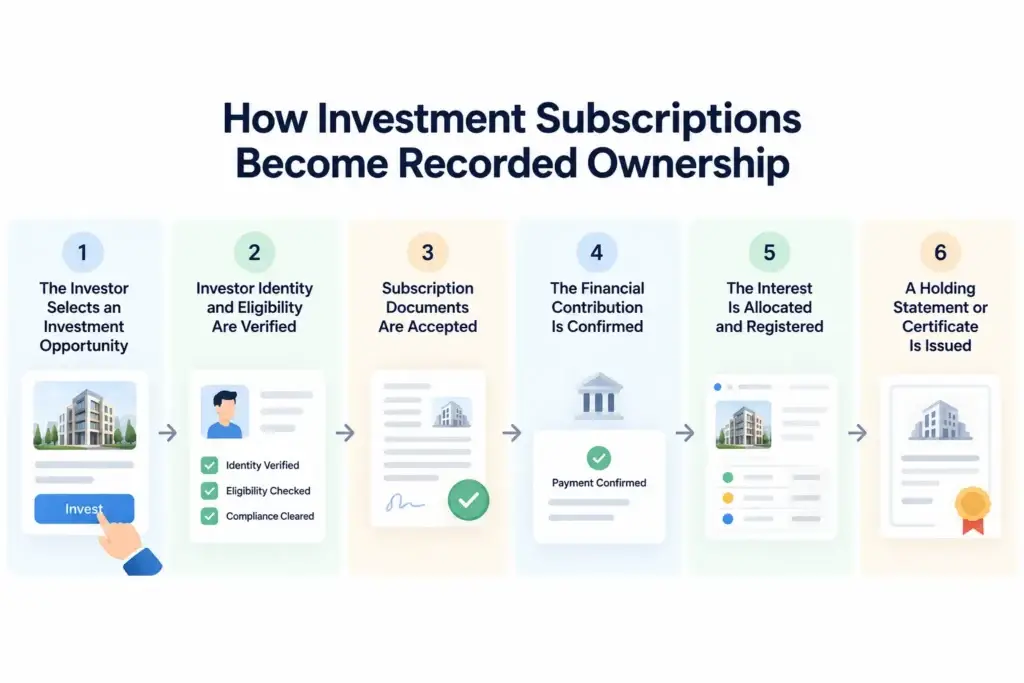
One of the most consequential processes in an investment platform is converting a submitted investment request into a legally recognized holding. The sequence requires financial, contractual, eligibility, and ownership controls to work together.
Step 1: The Investor Selects an Investment Opportunity
An investor reviews an offering associated with a specified property and the entity or investment structure through which participation will occur. The offering documents should make clear what is being acquired, what rights apply, and which conditions must be satisfied.
Step 2: Investor Identity and Eligibility Are Verified
Before accepting an investment, the operator may need to verify identity, conduct appropriate compliance checks, and determine whether the investor satisfies applicable eligibility and suitability requirements.
An individual may be eligible for one category of investment but not another. This is particularly relevant where different offerings or jurisdictions apply different restrictions.
Step 3: Subscription Documents Are Accepted
The investor accepts the appropriate agreements. These may describe the investment instrument, capital commitment, applicable risks, voting arrangements, distribution entitlements, restrictions on transfers, and the responsibilities of the issuing entity.
The platform should retain evidence of acceptance and associate the agreement with the correct investor and investment opportunity.
Step 4: The Financial Contribution Is Confirmed
Funds may be collected through an authorized payment provider, regulated intermediary, or another arrangement permitted for the business model. The payment record should identify the investment to which the contribution relates and whether it has been fully received, reconciled, or is still pending.
A payment notification alone should not be treated as proof of a valid ownership allocation. The terms of the issuance, acceptance of the subscription, and applicable company procedures must also be satisfied.
Step 5: The Interest Is Allocated and Registered
Once the required conditions are met, the appropriate authority approves or completes the allocation. The legally relevant ownership records are updated according to the entity structure and jurisdiction.
The operating system should associate the allocation with its underlying approvals, transaction reference, instrument details, quantity, and effective date. It should also make it possible to reconcile the investor-facing portfolio against the authoritative records.
Step 6: A Holding Statement or Certificate Is Issued
The investor may receive a digital confirmation, ownership statement, share certificate, or other document appropriate to the legal structure.
Such documents provide important evidence, but their legal status varies. A certificate should accurately reflect the authoritative record and should not promise property title or rights that the investor does not legally possess.
How Ownership Registers Change When Investors Transfer Their Interests
Ownership records are not static. Investors may acquire additional interests, sell part of a holding, transfer interests under an authorized arrangement, or receive adjustments following corporate actions.
Each event needs a properly documented basis. Otherwise, the platform may display ownership quantities that do not match the legal register or other authoritative records.
Example: A Partial Transfer Between Investors
Return to the hypothetical SPV with 100,000 issued ordinary shares. Investor A holds 40,000 shares and Investor B holds 30,000. Suppose Investor A transfers 5,000 shares to Investor B through a permitted and completed transaction.
After the transfer, Investor A holds 35,000 shares, while Investor B holds 35,000. Investors C and D retain their original positions. The total issued shares remain 100,000.
| Investor | Before transfer | Change | After transfer |
|---|---|---|---|
| Investor A | 40,000 | −5,000 | 35,000 |
| Investor B | 30,000 | +5,000 | 35,000 |
| Investor C | 20,000 | 0 | 20,000 |
| Investor D | 10,000 | 0 | 10,000 |
| Total | 100,000 | 0 | 100,000 |
The example illustrates a basic accounting principle for ownership quantities: a completed transfer reallocates interests between holders without changing the total outstanding amount.
In real operations, the transfer must also satisfy the governing agreements, relevant approvals, buyer eligibility checks, and requirements for legally effective registration.
For a more detailed discussion of what determines whether an investor can actually sell, see the related topic of secondary market liquidity, resale execution, and investor exit restrictions. Understanding transfer validity is only one part of the wider liquidity question.
Why Append-Only Ownership Histories Matter
A conventional database may allow an authorized employee to overwrite an ownership value directly. Although simple, this can make it difficult to explain how a holding reached its current balance or what the ownership position was on an earlier date.
An append-only event history addresses this problem by preserving events instead of silently replacing prior entries. For example, the system may record an original allocation of 1,000 shares, a subsequent acquisition of 200 shares, and a completed transfer out of 150 shares.
The resulting position is 1,050 shares. More importantly, authorized reviewers can trace the events that produced that position.
Corrections can be recorded through reversing or adjusting entries with appropriate authorization, rather than deleting the historical event. This supports auditability and helps identify the reasons for changes.
However, an append-only event ledger does not automatically replace the statutory register. It must be reconciled with the legally authoritative ownership record and managed under the applicable governance and retention requirements.
Historical Ownership Matters for More Than Audits
Knowing who owned an interest on a particular date can affect distribution entitlements, voting rights, investor statements, tax reporting, dispute resolution, and transfer validation.
Imagine an investor transferring shares shortly before a rental distribution is approved. The business may need to determine which investor is entitled to the payment under the applicable record-date and distribution rules.
Without reliable historical ownership information, the operator may struggle to determine the correct recipient. A transparent event history makes these calculations easier to verify, provided the legal rules and effective dates are correctly implemented.
How SPV Ownership Records Support Rental Income Distributions
SPV administration does not end when investors acquire shares. Where an investment provides income distributions, operators must determine the amount available for distribution and which investors are entitled to receive it.
The underlying property may generate rental revenue, but that revenue is not automatically equivalent to cash payable to investors. Property operating expenses, financing costs, reserves, taxes, management obligations, and other commitments may need to be considered before a lawful distribution can be declared.
The ownership records then help determine the appropriate allocation of a distributable amount based on the rights associated with each holding.
Illustrative Distribution Calculation
Assume the hypothetical SPV declares a lawful distribution of $20,000 to its ordinary shareholders. For simplicity, all 100,000 issued shares have equal distribution rights and the record date occurs before the partial transfer illustrated earlier.
Investor A, holding 40% of the relevant shares on that record date, would be entitled to $8,000. Investor B would receive $6,000, Investor C $4,000, and Investor D $2,000 before any applicable withholding or other adjustments.
If a transfer becomes legally effective before a later distribution record date, the distribution may be calculated from the updated holdings. The correct result depends on the governing distribution terms and the legal effective date, not simply on when an app screen changes.
Financial reconciliation is equally important. The declared distribution, payment instructions, actual cash movement, and investor statements should be consistent. If a payout fails, the ownership history should not be changed merely to make the payment records balance.
How SPVs Work Across Multiple Properties and Investment Products
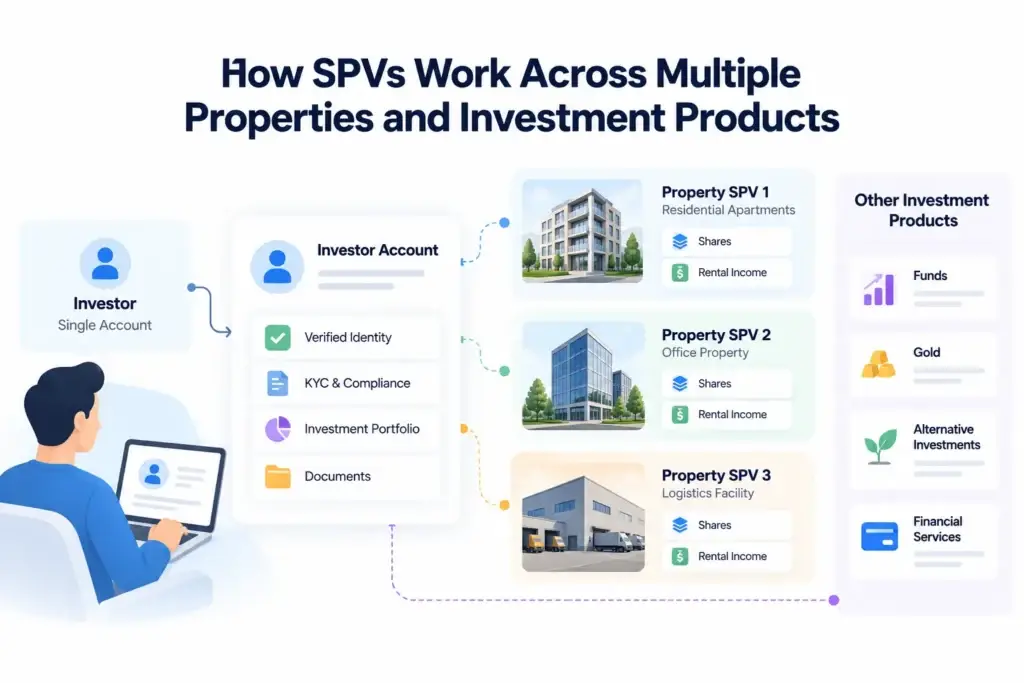
A multi-product investment business may support several property SPVs alongside additional investment or financial services. This introduces an important architectural distinction: sharing a customer identity is not the same as sharing ownership of every asset.
An investor might hold shares in one residential-property SPV, participate in a separate commercial-property investment, and use another financial product through the same customer account. The account may present a consolidated portfolio, but the legal entities, contracts, obligations, and financial entitlements remain distinct.
For founders building across multiple offerings, a shared identity and onboarding framework can improve convenience. The more important operational requirement is that each position remains connected to the correct issuer, asset, instrument, and transaction records.
Why Asset-Level Separation Matters
Imagine a platform with three property SPVs. The first holds residential apartments, the second owns an office property, and the third owns a logistics facility.
Even if the same investor participates in all three, rental income from one SPV should not be attributed to another without an authorized and legally valid transaction. Each entity has its own financial position, ownership arrangements, and obligations.
Any permitted intercompany transaction should be documented and accounted for appropriately. A consolidated platform dashboard should not obscure the underlying separation of legal entities.
One Investor Identity, Multiple Ownership Relationships
A central investor profile can identify the customer and connect approved investment positions across different entities. Each position still needs its own attributes, including issuer, quantity, ownership class, documents, restrictions, and effective dates.
This approach allows investors to review a wider portfolio without confusing the legal rights attached to individual holdings.
Businesses evaluating broader investment platform infrastructure should prioritize consistency between investor identity, financial records, and underlying investment ownership rather than focusing solely on the appearance of a consolidated portfolio.
How Ownership Records Connect With KYC and Beneficial Ownership Compliance
Investor identity verification and ownership recordkeeping are related but distinct processes. KYC establishes who an investor is and supports the checks appropriate for opening an account or participating in an investment. Ownership records establish what legally or economically relevant interests the investor holds.
For corporate investors, compliance may require understanding who ultimately controls or benefits from the investing entity. These checks can involve directors, shareholders, controlling persons, authorized signatories, and beneficial owners under the applicable regulatory definitions.
Changes in ownership may also affect whether new filings, disclosures, approvals, or reviews are necessary. The particular thresholds and duties depend on the jurisdiction and entity structure.
Why the Same Rules Cannot Be Applied in Every Market
A property investment arrangement operating in one jurisdiction may face different company registration, securities, financial promotion, disclosure, and investor protection requirements from one operating elsewhere.
For regional expansion, founders should assess local ownership permissions, corporate registration requirements, legal documentation, permitted investor categories, and reporting obligations before configuring investment workflows.
This is especially relevant to businesses evaluating regional requirements for Gulf property investment applications, where language, onboarding, documentation, and market-specific operational expectations should be considered together.
Compliance-ready software can support these processes, but it does not independently establish that an investment offering or operating company has the permissions required in its target market.
Do Blockchain Tokens Replace SPVs or Legal Ownership Registers?
Tokenization has introduced new ways to represent investment interests digitally. A token may be used to reference a security, ownership interest, entitlement, or other asset-related right, depending on the legal arrangement.
However, issuing a token does not automatically transfer title to a building or establish legal ownership of shares in an SPV. The token’s legal significance depends on the underlying agreements, issuance framework, applicable laws, and records recognized by the relevant authorities.
In some arrangements, a blockchain record functions as supporting evidence or a synchronized representation of an interest maintained in an authoritative register. In others, legally recognized digital securities infrastructure may play a more direct role. These approaches should not be treated as interchangeable.
The Importance of Synchronizing Digital and Legal Records
Suppose an investor transfers a token to another wallet, but the company’s legally required transfer process has not been completed. The token movement may not establish that the recipient has become the recognized shareholder.
Similarly, if an authorized transfer is completed in the legal register but the digital representation fails to update, the two records may show different ownership positions.
Operators need a documented process for determining the authoritative record, identifying inconsistencies, correcting synchronization failures, and preventing unauthorized transfers.
For founders, the practical lesson is that blockchain integration should reinforce legally valid ownership administration, rather than substitute for it without a sound legal basis.
Common SPV and Ownership Register Mistakes Founders Should Avoid
Ownership Administration Mistakes
Confusing Property Title With SPV Share Ownership
Investors should understand whether they own direct real estate interests, company shares, fund units, or other contractual rights. These instruments can provide different protections, governance rights, and financial entitlements.
Treating a Portfolio Dashboard as the Legal Register
Digital portfolio information must be reconciled to the applicable authoritative records. A visually correct dashboard cannot repair incomplete corporate registration or invalid transfer documentation.
Allowing Ownership Balances to Be Edited Without Evidence
Uncontrolled changes can undermine the accuracy of investor positions and historical reporting. Corrections should have documented reasons, approvals, and traceable adjustment records.
Mixing Financial Positions Across Separate SPVs
Different investment entities may have distinct financial obligations and investor rights. Consolidated reporting should preserve asset-level separation rather than silently pooling positions.
Ignoring Distribution Record Dates
Changes in ownership around a distribution period can affect who receives income. The correct entitlement must be determined using governing terms and legally relevant effective dates.
Assuming Tokenization Automatically Establishes Legal Ownership
A digital token may represent or evidence an interest, but the underlying legal structure determines whether it creates, transfers, or merely mirrors ownership rights.
What Controls Make an Investor Ownership Register Reliable?
Reliable ownership administration depends on both process design and technical controls. The objective is not merely to store balances. It is to demonstrate that each recorded position has a valid origin, that changes are authorized, and that historical records can be reconstructed accurately.
The most important controls should address transaction integrity, access permissions, financial reconciliation, exception handling, historical traceability, and the legal validity of the underlying records.
| Control | Operational purpose | Risk reduced |
|---|---|---|
| Transaction authorization | Validate issuance and transfer approvals | Unauthorized ownership changes |
| Append-only event history | Preserve historical allocation and transfer events | Loss of auditability |
| Quantity reconciliation | Compare issued, transferred, cancelled, and outstanding interests | Incorrect ownership balances |
| Financial reconciliation | Connect payments with corresponding investment events | Unexplained cash or allocation differences |
| Role-based access | Restrict sensitive modifications and approvals | Unauthorized staff actions |
| Periodic legal-register reconciliation | Compare operational records with legally authoritative records | Discrepancies between platform and legal ownership |
Why Idempotency Matters in Investment Allocations
Payment processors and external services may resend notifications when they do not receive an acknowledgment. If a platform treats every repeated notification as a new payment, it may create duplicate investor allocations.
Idempotency controls are designed to ensure that repeated processing of the same underlying event does not create additional economic or ownership outcomes.
For example, an allocation request associated with a confirmed subscription should be recognized as the same transaction if the payment notification is received twice. The platform should not double the number of shares simply because the external message was repeated.
These controls are particularly valuable when many investors subscribe simultaneously or when multiple systems exchange transaction events.
Why Exceptions Must Be Managed Explicitly
Not every transaction follows the expected path. Payments can fail, documents may be incomplete, eligibility decisions may change, and corporate actions may require corrections.
A responsible operating model should distinguish pending events from completed ones and require appropriate review before exceptions affect legally recognized investor holdings.
In particular, operators should not mark a subscription as legally allotted solely because funds have arrived or treat a transfer as complete while mandatory authorization remains outstanding.
Founder Decision Signals
Legal Clarity
Clearly define what investors legally own, whether shares in an SPV or another investment interest. Ensure every holding is linked to the correct legal entity, governing documents, and investor rights.
Record Accuracy
Maintain ownership records that trace every investor holding to an authorized subscription, share issuance, or transfer. Keep digital portfolios synchronized with legally recognized ownership registers.
Financial Integrity
Reconcile investor contributions, share allocations, rental distributions, and ownership changes. Reliable financial controls help prevent duplicate allocations, payment discrepancies, and incorrect investor entitlements.
Operational Scalability
Support multiple property SPVs through a unified investor platform while keeping each entity’s ownership, financial obligations, and transaction records separate. Automation can reduce manual administration as investments grow.
Founders considering fractional real estate investment infrastructure should assess how the available system represents investment entities, investor interests, allocations, transfer restrictions, and historical records before selecting a deployment approach.
Why an Integrated Ownership Foundation Matters for Faster Market Entry
Building a property investment business requires more than a property catalogue and payment form. It requires a dependable connection between legal entities, investor subscriptions, ownership records, financial transactions, compliance decisions, and ongoing investment administration.
Starting from a ready-made software foundation can reduce the need to create every investor-facing and operational workflow from the beginning. However, the software still needs to be aligned with the legal structure of the intended investment offering.
Miracuves provides ready-made and white-label investment software foundations intended to help founders move toward deployment faster. Its six-day solution delivery approach is relevant to suitable ready-made implementations, while the actual scope of customization, integration, legal review, and production readiness must be confirmed separately.
For businesses entering regulated investment markets, speed should not come at the expense of ownership accuracy. The stronger implementation approach is to establish legal and financial requirements first, then configure the platform’s operational processes around those requirements.
Final Thoughts: Ownership Accuracy Is the Foundation of Investor Trust
SPVs and ownership registers perform different but closely connected roles in property investment. The SPV establishes the entity through which an asset or investment arrangement is held, while the relevant ownership records identify who holds investment interests and how those interests change over time.
For investors, the most important outcome is clarity about their legal rights, economic entitlements, transfer restrictions, and supporting records. For operators, the priority is maintaining consistency across subscription events, financial transactions, distributions, ownership changes, and legally required registers.
As a business expands into multiple properties and financial products, this clarity becomes even more valuable. Shared digital accounts can simplify the investor experience, but they should never erase the legal and financial boundaries between separate investments.
For founders turning these ownership principles into an operational product, Miracuves offers a property investment platform with integrated ownership workflows that can be evaluated alongside the proposed SPV structures, investor rights, governance requirements, and relevant legal obligations.
Frequently Asked Questions About SPVs and Ownership Registers
What is an SPV in a property investment platform?
An SPV, or special-purpose vehicle, is a legally separate entity established for a defined purpose, such as holding a property. Investors may acquire shares or other interests in the SPV instead of owning the underlying real estate directly. Their rights depend on the legal documents and applicable laws.
Who legally owns a property held through an SPV?
The SPV may be the registered legal owner of the property, depending on the transaction structure. Investors typically hold shares, membership interests, or other legally defined rights associated with the entity rather than appearing individually on the property title.
What is an investor ownership register?
An investor ownership register records relevant investment holdings and ownership changes. A legally required shareholder register may identify recognized shareholders, while operational records can track allocations, transfers, dates, instruments, and supporting transaction evidence. The authoritative record depends on the legal structure.
What is the difference between an SPV ownership register and a cap table?
A cap table summarizes the distribution of interests in an entity. A legal ownership register records information required by the applicable company or investment laws. Both can describe ownership, but a cap table or dashboard does not automatically replace legally mandated records.
How are fractional property interests allocated to investors?
Investors usually complete the required eligibility checks, accept subscription documents, and provide investment funds through an authorized process. Once the relevant issuance conditions and approvals are satisfied, the interests are allocated and recorded according to the investment structure.
How does an ownership register change after a secondary market resale?
Following a valid and completed transfer, the appropriate ownership records are updated to reflect the reduction in the seller’s holding and the increase in the buyer’s holding. A transfer of existing shares generally does not increase total issued share capital.
Can one investor hold interests in multiple property SPVs?
Yes, subject to applicable eligibility and investment rules. An investor may hold interests in several separately established property entities. A consolidated platform account can display those positions while the legal ownership and financial obligations of each entity remain distinct.
Can blockchain tokens replace a legal shareholder register?
Not automatically. A digital token may represent or evidence an investment interest, but its legal effect depends on the governing documents and applicable law. Operators must determine whether the legally authoritative record is a statutory register, a recognized digital securities system, or another permitted mechanism.
Miracuves is an independent software development company. We are not affiliated with, connected to, sponsored by, or endorsed by any company or product named in this article.
Terms such as “X Clone” are used descriptively. It is how the software industry refers to building a platform with functionality comparable to a known service, and how clients search for it.
The entire design and codebase of our products is built by our own team. Our products contain no code, design, graphics, or content originating from any third-party website or applications.
All third-party names and marks referenced in this article are the property of their respective owners, referenced solely to identify the services discussed.