


Key Takeaways
- A short-form video hosting architecture should balance fast playback, reliable uploads, video processing, storage efficiency, CDN delivery, and infrastructure cost.
- Core components include object storage, transcoding, multiple bitrate renditions, thumbnails, caching, CDN distribution, metadata services, and scalable backend APIs.
- Cost control depends on reducing unnecessary storage copies, optimizing video formats, managing bitrate ladders, improving cache efficiency, and matching infrastructure capacity to real viewing demand.
Hosting Architecture Signals
- The upload pipeline should manage file validation, temporary storage, transcoding queues, compression, thumbnails, metadata extraction, moderation checks, and publishing status.
- CDN edge caching, adaptive bitrate streaming, video preloading, regional delivery, and efficient segment sizes can reduce startup delay while lowering repeated origin requests.
- Lifecycle rules, storage tiers, duplicate detection, failed-job cleanup, retention policies, monitoring, and automated scaling help control infrastructure as the video library expands.
Performance & Cost Insights
- Operators should monitor Time to First Frame, buffering, CDN cache hit rate, transcoding time, storage growth, bandwidth consumption, playback errors, and cost per streamed minute.
- Performance should not be improved through unlimited infrastructure spending; the stronger architecture prioritizes popular content, efficient encoding, smart caching, and scalable resource allocation.
- Miracuves develops customizable short-form video platforms with video hosting, transcoding, CDN delivery, adaptive streaming, storage management, feed performance, analytics, and admin controls.
A short-form video platform looks simple from the user side. People open the app, scroll through videos, upload content, follow creators, like clips, comment, and share.
Behind that smooth experience, the infrastructure is doing expensive work every second.
Every creator upload creates storage demand. Every view consumes bandwidth. Every scroll can trigger preloading. Every viral post increases CDN pressure. Every low-quality encoding decision can either protect the margin or quietly increase the monthly cloud bill.
This is why video hosting architecture should be planned before growth arrives. A founder may think the early goal is only to get users. But in a media-heavy product, success can become expensive if the platform is not designed to deliver video efficiently.
A normal social app can often scale with database, API, and notification improvements. A short-form video platform needs a stronger media layer because the feed is powered by repeated video delivery, not just text, images, or profile data.
For founders exploring a creator-led video product, Miracuves’ ready-made video sharing platform gives a faster route to launch while keeping backend, admin, creator, media delivery, and monetization workflows in view.
The Real Cost Equation Behind Short-Form Video Hosting
Video hosting cost is not only the price of storing files. It is a combination of storage, processing, delivery, caching, playback behavior, and operational control.
A founder should think about video cost in layers.
| Cost Layer | What Happens | Why It Matters |
|---|---|---|
| Upload storage | Creators upload original video files | Originals can be large, inconsistent, and expensive to store long-term |
| Transcoding | Videos are converted into playback-ready versions | Different devices and networks need different quality levels |
| Thumbnail generation | Preview images or short previews are created | Feed browsing becomes lighter and faster |
| CDN delivery | Videos are served from distributed locations | Better delivery improves playback but must be configured carefully |
| Origin requests | CDN pulls files from storage when not cached | Too many origin hits increase cost and latency |
| Playback preloading | The feed loads upcoming videos | Aggressive preloading can waste bandwidth when users scroll quickly |
| Analytics and logs | The system tracks plays, buffering, skips, and failures | Cost visibility helps founders identify waste early |
The challenge is balance. If the platform is too aggressive with compression, users may see poor visual quality. If the platform serves large files too often, cloud bills can rise faster than revenue. If caching is weak, the same popular content may repeatedly hit origin storage instead of being served efficiently from the edge.
Founders evaluating short-video platform development cost should look beyond the visible app build and include video processing, CDN usage, cloud storage, moderation workflows, playback performance, and long-term infrastructure control in their planning.
A well-planned architecture does not ask founders to choose between performance and cost. It helps them control both.
What Makes Short-Form Video Different From Normal Video Hosting?
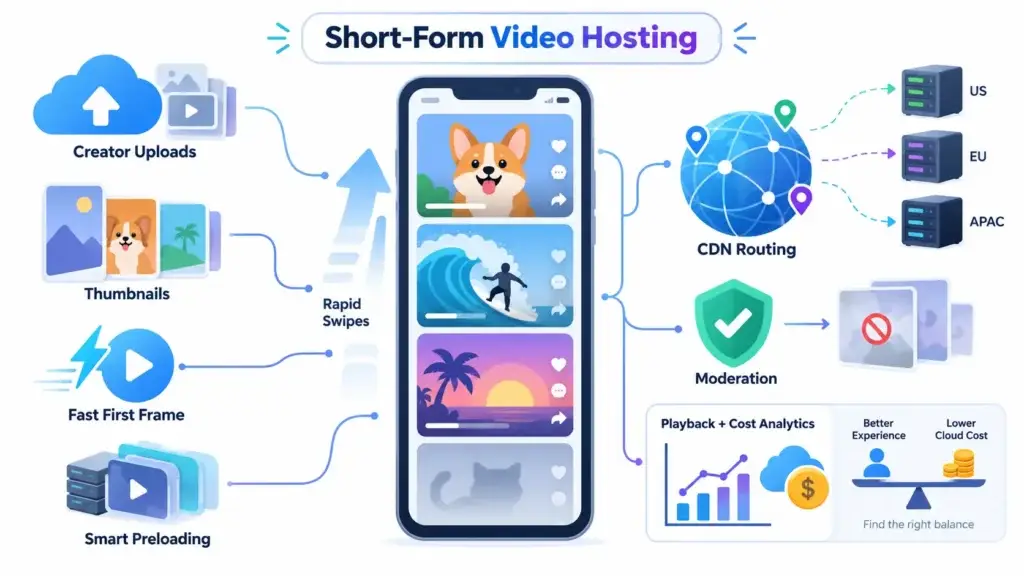
Short-form video has a different consumption pattern from long-form streaming.
In long-form streaming, a viewer usually chooses a video and watches intentionally. In a short-form feed, users scroll quickly. They may watch three seconds of one clip, skip the next five clips, replay one video several times, and then jump to a creator profile.
This behavior creates unique infrastructure pressure.
Short-form platforms need:
- fast first-frame loading
- intelligent preloading
- adaptive quality selection
- efficient thumbnails and previews
- low buffering during rapid swipes
- creator upload processing
- CDN routing for regional demand
- moderation workflows for user-generated content
- analytics that connect playback quality with cost
The feed experience depends on milliseconds, but the business model depends on margins. If the platform delivers too much video too early, the user may never notice the waste, but the founder will see it in the cloud bill.
That is why a short-form video platform needs feed-aware hosting architecture, not only generic file storage.
Core Components of a Cost-Aware Video Hosting Architecture
A scalable short-video product should separate the media workflow into clear layers. Each layer has a technical role and a business impact.
Video Hosting Architecture Layers
| Architecture Layer | What It Controls | Founder Impact |
|---|---|---|
| Upload Layer | File type, size, duration, creator upload reliability, and upload validation | Prevents messy inputs from creating storage, playback, and moderation problems later |
| Processing Layer | Compression, transcoding, thumbnails, previews, and queue-based media processing | Protects app performance by moving heavy video tasks away from the main app server |
| Storage Layer | Original files, optimized files, temporary assets, thumbnails, and lifecycle rules | Reduces waste by separating high-value media from temporary or low-demand files |
| CDN Layer | Edge delivery, cache behavior, regional routing, signed URLs, and origin protection | Improves playback speed while reducing repeated origin requests |
| Playback Layer | Adaptive quality, buffering behavior, preloading, retries, and first-frame speed | Improves retention without blindly increasing bandwidth usage |
| Analytics Layer | Cost per view, skips, buffering, watch time, failed playback, and delivery patterns | Helps founders identify where performance issues and cost leaks are happening |
These backend layers should work together with the visible short-form video platform features, including creator uploads, feed discovery, engagement actions, content controls, admin management, and monetization-ready workflows.
Upload Layer: Keep Creator Inputs Predictable
The upload layer is where the media lifecycle begins.
Creators may upload videos from different devices, networks, cameras, editing apps, and file formats. Without validation, the platform may accept files that are too large, too long, poorly encoded, duplicated, corrupted, or difficult to process.
A strong upload layer should define rules for:
- allowed file formats
- maximum file size
- video duration
- resolution limits
- upload retries
- resumable uploads
- creator draft handling
- moderation handoff
- failed upload cleanup
This is not only an engineering concern. It affects founder cost directly.
If the platform allows every upload without control, the backend may store unnecessary files, process videos that should have been rejected, and deliver inconsistent playback quality. Upload discipline keeps the rest of the system easier to manage.
For a short-form video business, the upload layer should also connect naturally with content safety. Reported, rejected, deleted, or duplicate videos should not continue consuming expensive storage after they are no longer useful.
Processing Layer: Compress, Transcode, and Prepare Videos Before Delivery
The processing layer turns unpredictable creator uploads into usable platform assets.
This usually includes compression, transcoding, thumbnail generation, preview generation, metadata extraction, and sometimes audio processing. For a short-form video platform, this work should usually happen through background queues instead of the main app server.
That matters because creator activity can spike suddenly. A campaign, influencer push, or regional trend can create a burst of uploads. If video processing runs on the same path as user browsing, the app can slow down exactly when the platform needs to feel reliable.
A practical processing pipeline should create:
| Processing Output | Purpose |
|---|---|
| Optimized playback file | Reduces file size while preserving usable quality |
| Multiple bitrate versions | Allows adaptive playback across different networks |
| Thumbnail image | Makes the feed and profile pages lighter |
| Preview segment | Helps reduce unnecessary full-video loading |
| Metadata record | Tracks duration, format, resolution, and processing status |
| Moderation status | Helps admins review or restrict unsafe content |
The goal is not to compress every video blindly. The goal is to prepare each video for efficient delivery based on quality, device, network, and feed behavior.
This is where architecture becomes a business advantage. The right processing layer can reduce waste before the video ever reaches the feed.
For founders planning a scalable creator video platform, queue-based media processing should connect with the wider backend architecture for short-video scale, so uploads, feeds, notifications, analytics, moderation, and video delivery do not depend on one fragile system path.
Storage Layer: Separate Originals, Optimized Files, and Temporary Assets
Many early platforms treat storage as one large bucket. Everything goes in, and the system serves whatever is available.
That approach may work in a demo. It becomes risky when users start uploading regularly.
A cost-aware storage design should separate different media types:
- original uploads
- optimized playback files
- thumbnails
- temporary processing assets
- failed uploads
- deleted or rejected content
- archived low-demand videos
Each type of media has a different business value. A newly trending video may need fast delivery. A failed upload may need cleanup. A rarely watched old video may not need the same storage priority as an active creator’s popular content.
Storage lifecycle rules are important because short-form platforms accumulate media quickly. Even if each clip is short, the volume can grow fast when creators upload every day.
Founders should ask one simple question: are we storing video because it creates value, or because nobody designed a cleanup strategy?
CDN and Routing Layer: Bring Popular Videos Closer to Users
A CDN helps deliver video from locations closer to users, reducing latency and lowering pressure on origin storage.
But simply adding a CDN is not enough. A poorly configured CDN can still create avoidable cost if cache rules are weak, origin requests are too frequent, or regional routing does not match real user demand.
A strong CDN strategy should consider:
- which assets should be cached aggressively
- how long thumbnails and previews should stay cached
- when signed URLs are needed
- how viral videos are prioritized
- which regions generate the most playback traffic
- when content should be invalidated or refreshed
- how to reduce unnecessary origin pulls
- how to protect the origin during spikes
Short-form video traffic is uneven. A small percentage of clips may drive a large share of views. This makes popularity-aware caching important. Viral content should not be treated the same way as a low-demand upload.
The more the platform understands demand patterns, the smarter the delivery layer becomes.
Playback Layer: Reduce Waste Without Hurting the Feed Experience
The playback layer decides what users actually receive.
This includes video quality, preload behavior, retry handling, buffering logic, first-frame speed, and fallback rules. It is one of the most important areas for balancing performance and cost.
Short-form apps need fast playback, but they should not load heavy video files too early. Many users scroll quickly, so aggressive preloading can waste bandwidth on videos the user never watches.
A better playback strategy may include:
- loading lightweight previews first
- delaying heavier video delivery until user intent is clearer
- using adaptive quality based on connection strength
- limiting unnecessary preloads
- tracking buffering and watch-time patterns
- switching quality when network conditions change
- prioritizing first-frame speed over maximum resolution
The founder’s goal is not to deliver the highest possible quality every time. The goal is to deliver the right quality for the user’s device, network, and behavior.
That difference can protect both user experience and cloud margins.
Playback quality should also be measured against real user experience signals such as time to first frame, buffering, swipe responsiveness, and failed playback events. For a deeper technical view, read this guide on short-video app performance benchmarks.
Analytics Layer: Track Cost Per View, Not Just Views
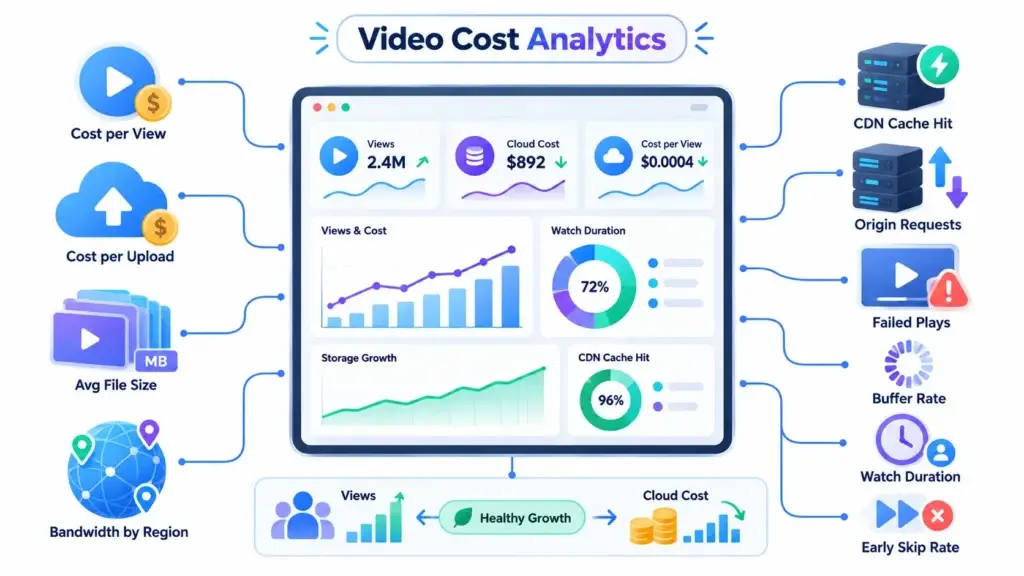
Many founders track views, likes, shares, and watch time. Those are important product metrics.
But for a video platform, technical cost metrics are just as important.
A founder should be able to monitor:
- average delivered file size
- cost per upload
- cost per view
- bandwidth by region
- CDN cache hit ratio
- origin request volume
- failed playback events
- buffering rate
- average watch duration
- skip rate in the first few seconds
- storage growth by media type
These metrics help founders understand whether growth is healthy.
For example, a campaign may generate more views, but if the app serves oversized files and creates poor cache behavior, the campaign may increase cost more than value. Without analytics, the founder only sees the cloud bill after the damage is done.
For example, a campaign may generate more views, but if the app serves oversized files and creates poor cache behavior, the campaign may increase cost more than value. This is where infrastructure connects with the short-form video platform business model, because hosting cost, creator engagement, ad inventory, subscriptions, and paid promotions all affect platform margins. Without analytics, the founder only sees the cloud bill after the damage is done.
Video hosting architecture should make cost visible before it becomes painful.
Founder Decision Signals: When Your Video Hosting Setup Needs Attention
Speed
If the feed feels slow during creator campaigns, the problem may be delivery architecture, not only app design.
Cost
If bandwidth or storage cost grows faster than user activity, review compression, cache behavior, CDN routing, and preload logic.
Scalability
If one popular video creates backend pressure, separate upload, processing, storage, and delivery workflows more clearly.
Market Fit
If engagement is strong but margins are shrinking, the product may have demand but weak infrastructure economics.
Dumb Storage vs. Optimized Video Delivery
The difference between a fragile platform and a scalable one is often not visible in the UI. Both may show a vertical feed. Both may support uploads. Both may have likes, comments, shares, and creator profiles.
The difference appears when traffic grows.
| Decision Area | Basic Storage Approach | Optimized Video Hosting Architecture |
|---|---|---|
| Upload handling | Accept files and store them directly | Validate, queue, process, compress, and standardize uploads |
| Playback quality | Serve similar quality to most users | Adapt quality based on device, network, and behavior |
| CDN setup | Add a CDN without deeper cache planning | Tune cache rules, regional routing, and origin protection |
| Viral content | Treat every video the same | Prioritize popular content for efficient edge delivery |
| Storage | Keep originals, processed files, and temporary assets together | Separate originals, optimized files, thumbnails, and temporary assets |
| Cost visibility | Review the bill after the month ends | Track cost-per-view and delivery patterns continuously |
| Founder outcome | Lower initial planning effort, higher scaling risk | Stronger cost control during growth |
A basic setup may help a founder reach a demo faster, but a production-ready short-video product needs stronger architecture behind the feed.
This is why Miracuves positions short-video development around both product experience and backend readiness. A scalable creator platform should not only look polished on the front end; it should also support upload control, media optimization, feed performance, creator workflows, monetization logic, and admin visibility from the backend.
Mistakes That Make Short-Form Video Platforms Expensive
Serving Original Uploads Too Often
Original files are often larger than what most users need. A short-form video platform should process uploads into efficient playback versions before broad delivery.
Using One Quality Level for Every User
A user on a small mobile screen and a strong Wi-Fi connection may not need the same video version as another user on a weak network. Adaptive delivery helps avoid waste.
Ignoring CDN Cache Rules
A CDN only helps when caching is planned properly. Weak cache behavior can create repeated origin requests and unnecessary delivery cost.
Loading Too Much Video Too Early
Short-form users scroll quickly. If the app preloads heavy files before user intent is clear, bandwidth can be wasted on videos that are skipped almost immediately.
Looking Only at Build Cost
The long-term cost of a short-video product includes hosting, bandwidth, storage, processing, CDN usage, moderation, and support. Architecture should protect the business after launch.
Security and Moderation Still Belong in Video Architecture
Cost optimization should never weaken platform control.
Short-form video products are user-generated content platforms. They need workflows for reporting, reviewing, restricting, and removing content. They also need admin access controls, activity logs, secure API communication, role-based permissions, and creator/account verification where relevant.
This matters for hosting because moderation decisions affect media delivery.
For example:
- rejected videos should not remain in expensive storage unnecessarily
- deleted videos should be removed from public delivery paths
- flagged content may need restricted access during review
- reported creators may require admin action history
- sensitive media actions should be logged
- abusive upload behavior may require rate limiting
Founders should also review short-video app security workflows when planning uploads, creator verification, content reporting, admin roles, media takedowns, abuse prevention, and permission-based dashboard access.
The media pipeline, moderation workflow, and admin dashboard should work together. If these systems are disconnected, the platform may continue storing or delivering content that no longer creates value.
For founder-led platforms, trust and cost control are connected. A safer platform is often a more efficient platform because admins can control what stays live, what gets reviewed, and what should be removed from storage.
How Miracuves Helps Founders Launch Faster Without Ignoring Hosting Economics
Building a short-form video platform from zero can take time because the product is not only a feed. It needs user apps, creator workflows, admin controls, upload handling, video processing, content moderation, monetization logic, and scalable delivery planning.
Miracuves helps founders move faster with ready-made and white-label creator platform foundations that can be customized around the business model, market, branding, and required workflows. For teams that need expert implementation support, Miracuves also works as a short-video platform development partner, helping align product workflows, admin control, branding, media architecture, and launch requirements.
For qualified ready-made scopes, Miracuves highlights 6-day solution delivery as a key advantage. That matters for founders who want to validate demand faster without waiting months for the first usable product version.
A short-video platform can still be customized around:
- brand identity
- creator onboarding
- upload and publishing flows
- video compression rules
- CDN and cloud setup
- feed behavior
- admin dashboard controls
- moderation workflows
- monetization models
- analytics and reporting
- source-code ownership
- post-launch scaling needs
For founders who want a faster path from idea to launch, the white-label short-video solution from Miracuves can act as the product foundation while this blog supports the deeper infrastructure decision behind it.
Related reading: Why Event-Driven Architecture Helps Short Video Apps Handle Millions of User Actions and Database Architecture for Video Platforms Handling Millions of Users and Engagement Events.
Final Thoughts: Performance and Cost Should Be Designed Together
A short-form video platform does not fail only because the feed is weak. It can also fail because the backend becomes too expensive to operate.
The strongest video hosting architecture is not the one that stores everything and serves the highest quality file every time. It is the one that understands user behavior, creator uploads, content popularity, device conditions, regional demand, and business margins.
Founders should treat video hosting as a product decision, not only a cloud decision.
Compression, CDN routing, storage lifecycle rules, adaptive playback, queue-based processing, moderation workflows, and analytics all work together to decide whether the platform can scale profitably.
Miracuves helps founders move from idea to launch faster with ready-made, white-label short-video app foundations built for branding, admin control, monetization, source-code ownership, and faster deployment.
FAQs
What is video hosting architecture for a short-form video platform?
Video hosting architecture is the system that manages how videos are uploaded, processed, stored, delivered, played, monitored, and removed. For a short-form video platform, this usually includes upload validation, compression, transcoding, thumbnails, CDN delivery, adaptive playback, storage lifecycle rules, and analytics.
Why do short-form video platforms need a CDN?
A CDN helps serve videos from locations closer to users. This can improve playback speed, reduce buffering, and lower pressure on origin storage. However, the CDN must be configured with proper cache rules, regional routing, and origin protection to avoid unnecessary cost.
How can founders reduce video hosting costs?
Founders can reduce video hosting costs by compressing uploads, creating adaptive bitrate versions, improving cache behavior, separating storage layers, using lifecycle rules, limiting unnecessary preloading, tracking cost per view, and monitoring CDN efficiency.
What is the biggest video infrastructure mistake in short-form apps?
The biggest mistake is treating video as a normal file upload. Short-form platforms need a dedicated media pipeline for processing, compression, thumbnails, adaptive playback, CDN delivery, moderation, and cleanup. Without that, cost and performance problems can grow quickly.
Does compression reduce video quality?
Compression can reduce quality if done poorly. A good compression strategy balances file size and visual clarity. The goal is not to make every video smaller at any cost, but to deliver the most suitable version for the user’s device, network, and playback behavior.
What should founders track after launching a short-video platform?
Founders should track cost per view, average delivered bitrate, bandwidth by region, CDN cache hit ratio, origin requests, storage growth, failed playback, buffering rate, skip rate, upload failures, and moderation-related media removals.
Can a ready-made short-video app still have scalable hosting architecture?
Yes. A ready-made short-video app can support scalable hosting when it includes proper upload workflows, media processing, CDN delivery, admin controls, source-code ownership, and room for infrastructure customization. Founders should review the architecture, not just the visible app features.
How does Miracuves support short-video platform launches?
Miracuves helps founders launch ready-made and white-label short-video platforms with source code, branded design, admin control, creator workflows, monetization options, and faster deployment. For qualified ready-made scopes, Miracuves can support 6-day solution delivery.
Miracuves is an independent software development company. We are not affiliated with, connected to, sponsored by, or endorsed by any company or product named in this article.
Terms such as “X Clone” are used descriptively. It is how the software industry refers to building a platform with functionality comparable to a known service, and how clients search for it.
The entire design and codebase of our products is built by our own team. Our products contain no code, design, graphics, or content originating from any third-party website or applications.
All third-party names and marks referenced in this article are the property of their respective owners, referenced solely to identify the services discussed.