Have you ever opened a vertical video feed to watch one clip, only to realize that several minutes have passed? Each swipe brings another video, sometimes closer to your interests than the last. What feels like effortless entertainment is often the result of a recommendation system continuously interpreting how viewers behave.
But what makes vertical video feeds so compelling? The answer goes beyond infinite scrolling, entertaining content, or attractive visuals. Two particularly useful signals are watch time and re-watch behavior. These help recommendation systems estimate whether a video captured attention, maintained interest, or encouraged a viewer to return to something they had already seen.
However, longer viewing does not always mean greater satisfaction. A person may replay a video because it is entertaining, confusing, informative, or difficult to understand. Someone may watch an entire clip simply because it is short.
Understanding these differences is essential for anyone studying how a vertical video feed algorithm works. For founders exploring how personalized video discovery fits into a real product, Miracuves offers a branded short-video platform foundation that can provide a starting point for evaluating content delivery and viewer engagement requirements.
Key Takeaways
- Watch time helps estimate viewer interest, but it must be interpreted relative to video duration and viewing context.
- Re-watches can signal strong engagement, although automatic loops and confusion can inflate replay activity.
- Completion rate and swipe-away behavior provide additional information about whether viewers found a video relevant.
- Effective recommendation systems evaluate multiple behavioral signals rather than relying on one engagement metric.
- Healthy feed optimization measures satisfaction, content diversity, and repeat visits instead of maximizing viewing time at any cost.
Why Vertical Video Feeds Capture Attention So Easily
Vertical video feeds combine several characteristics that make content discovery unusually convenient.
The videos occupy most of the mobile screen, removing competing visual elements. Playback often starts automatically, so viewers can begin consuming content without opening a separate player. Moving to the next video typically requires only one swipe.
These design choices reduce the effort needed to discover something new.
Three characteristics are especially important.
1. Low-Friction Content Discovery
Traditional video browsing often requires choosing a thumbnail, reading a title, and deciding whether to play a video. In a continuous vertical feed, the next piece of content appears immediately.
This makes moving between videos feel effortless. Viewers can quickly reject irrelevant content and continue exploring without interrupting the experience.
2. Unpredictable Content Rewards
Not every video is equally entertaining. Some are ordinary, while others are surprising, useful, or highly relevant.
That variation can encourage continued exploration because the viewer does not know what the next swipe will reveal.
This is sometimes described through the psychology of variable rewards. However, the existence of unpredictable content does not automatically prove that a particular feed causes addiction. User habits, content preferences, personal circumstances, and platform design all influence the experience.
3. Continuous Personalization
Recommendation systems can observe which videos viewers finish, skip, revisit, or interact with.
Over time, these observations can help the system estimate which content is most relevant to each person.
The result is a feedback loop:
Recommendation Process
How a Video Feed Learns From Viewer Behavior
The platform displays a video.
The viewer watches, skips, or interacts.
The system records eligible behavioral events.
Those events inform future recommendations.
The feed adapts as additional behavior becomes available.
This is an illustrative feedback loop, not the proprietary ranking process of any particular platform.
The key distinction is that personalization estimates interest. It does not directly reveal a person’s thoughts, emotions, or reasons for watching.
How Watch Time Influences the Vertical Video Feed Algorithm
Watch time measures how long someone spends viewing video content. It is one of the most useful forms of implicit feedback because viewers do not need to press a button to express interest.
For example, a viewer who leaves after two seconds may be less interested than someone who watches most of the video. But this interpretation becomes more complicated when videos have different durations.
Raw Watch Time vs. Average Watch Duration
Raw watch time represents accumulated playback time. Average watch duration typically describes the average time spent watching per view or playback, depending on the analytics system.
Consider two hypothetical videos:
- Video A: 12 seconds long, with an average watch duration of 11 seconds.
- Video B: 60 seconds long, with an average watch duration of 25 seconds.
Video B generates more viewing time per play, but Video A retains viewers through a much larger proportion of its duration.
Neither metric alone proves that one video delivers a better experience. The ranking system must consider duration, audience expectations, content type, and other signals.
Why Normalized Watch Time Matters
One straightforward measurement is the ratio between average watch duration and video length.
Watch-Time Analysis
Why Video Duration Changes the Interpretation
Video A · 12-Second Video
91.7%
11 seconds of average viewing divided by 12 seconds of total video duration.
Video B · 60-Second Video
41.7%
25 seconds of average viewing divided by 60 seconds of total video duration.
Illustrative examples only. These ratios help explain engagement measurement and are not universal recommendation-ranking weights.
For Video A, the ratio is approximately 91.7%. For Video B, it is approximately 41.7%.
These calculations are illustrative. They do not represent a universal recommendation formula.
A watch-time ratio can exceed 100% when replayed viewing is included in the numerator. That makes accurate event definitions important when comparing videos.
There is also a statistical problem: shorter videos are often easier to complete than longer ones. A ranking system that rewards raw completion rates without considering duration may systematically favor short clips, even when longer content delivers meaningful value.
More sophisticated approaches can compare viewing behavior against videos of similar length, format, audience, or context.
Why Re-Watch Signals Can Reveal Stronger Viewer Interest
A re-watch occurs when someone views content again after an earlier playback. Depending on the product, it may involve manually replaying the video, returning to it later, scrubbing backward, or allowing a clip to loop automatically.
These actions should not necessarily be treated as equivalent.
Deliberate Replays Can Indicate Content Value
Imagine a viewer watching a short cooking tutorial. They may replay it to understand an ingredient measurement or repeat a preparation step.
Another viewer might return to a humorous clip because the ending is enjoyable.
In both cases, the replay provides useful information: the content was worth revisiting.
However, the motivations differ. One replay indicates practical information retrieval, while the other suggests entertainment value.
A recommendation model may benefit from recognizing such patterns, but it should avoid assuming that every replay represents the same type of satisfaction.
Automatic Loops Can Inflate Engagement
Vertical video players frequently restart clips automatically. When a video is extremely short, a viewer may allow it to loop before deciding to swipe away.
If every loop is counted as a deliberate re-watch, the system risks overestimating interest.
For better interpretation, an analytics pipeline can distinguish between:
- Automatic replay after the video reaches its end.
- Manual replay triggered by the viewer.
- Seeking backward to revisit a particular moment.
- Returning to the same video during another session.
These events can be analyzed separately to determine which provide meaningful evidence of preference.
When Re-Watching Signals Confusion Instead of Satisfaction
A viewer may repeatedly revisit a segment because the instructions are unclear, the subtitles move too quickly, or an important detail is difficult to see.
In that situation, repeated viewing does not necessarily indicate high content quality.
That is why re-watch signals become more informative when interpreted alongside other events, such as saves, shares, follows, negative feedback, or subsequent viewing behavior.
Watch Time, Completion Rate, Re-Watches, and Skips: What Each Signal Means
A recommendation engine becomes more informative when it combines different measures of attention.
The following table explains how common engagement signals can contribute to feed-ranking decisions.
Understanding the Signals Behind Video Recommendations
Each metric provides information about viewer behavior, but no single signal tells the entire story.
| Signal | What It Measures | Possible Interpretation | Important Limitation |
|---|---|---|---|
| Watch time | Time spent playing a video | Content maintained attention | Longer videos naturally allow more viewing time |
| Completion rate | Percentage of eligible plays reaching the end | Viewers stayed through the content | Short clips may have a structural advantage |
| Re-watch rate | Frequency of repeated viewing | Content encouraged revisiting | Automatic loops may distort the result |
| Early swipe-away rate | Frequency of rapid departures | Weak relevance or an unconvincing opening | Accidental swipes and playback problems can interfere |
| Shares and saves | Explicit actions to distribute or retain content | Potential usefulness or social value | Some valuable content is rarely shared |
| Negative feedback | Actions expressing disinterest or concern | Potential dissatisfaction or relevance problems | Feedback can be sparse and context-dependent |
Why Video Completion Rate Does Not Tell the Whole Story
Completion rate sounds straightforward: if viewers finish a video, they probably liked it.
But completion can be heavily influenced by duration.
A six-second clip is relatively easy to finish. A ninety-second educational video demands more sustained attention.
If a ranking model directly compares their completion percentages without adjusting for duration, it may confuse ease of completion with content relevance.
Recent recommendation research has examined this issue by separating watch-time prediction from the biases introduced by video length, popularity, and viewing behavior.
For product teams, the practical lesson is simple: compare engagement within meaningful contexts before drawing conclusions.
Instead of ranking every video against every other video, analytics can evaluate performance across cohorts such as:
- Videos with similar durations.
- Similar content categories.
- New viewers compared with returning viewers.
- Similar network and playback conditions.
- Users with comparable prior interests.
This approach can produce more interpretable results than treating one metric as a universal measure of quality.
How a Recommendation Engine Turns Viewing Behavior Into Feed Rankings
Viewing signals become useful only when the system can translate them into predictions about which videos a person may want to see next.
A practical recommendation workflow can be understood in four stages.
Stage 1: Collect Meaningful Viewing Events
The application records relevant playback events, subject to its privacy controls and data collection policies.
Examples include playback start, playback progress, completion, replay, skip, and explicit engagement.
Event definitions must be consistent. For instance, a playback that never successfully starts should not automatically be treated as a viewer rejecting the content.
Stage 2: Interpret Viewer and Content Context
The recommendation pipeline considers information about the video and the current viewing situation.
Depending on the system, useful context might include content category, duration, language, recent interactions, viewing history, or similarity to other videos.
These features help distinguish a meaningful signal from an isolated action.
Stage 3: Estimate Relevance
A ranking model can estimate several outcomes, such as expected watch time, completion likelihood, or probability of an explicit positive interaction.
Rather than relying on one prediction, a system may combine different objectives into a ranking decision.
As an illustration, a conceptual model might use:
Stage 4: Rank, Deliver, and Learn
The system selects suitable videos, orders them for the user, and updates future predictions as additional feedback becomes available.
A useful feed should not simply repeat the same category indefinitely. It may also need to introduce unfamiliar creators, explore adjacent interests, and avoid repetitive recommendations.
That balance between relevance and discovery helps prevent personalization from becoming unnecessarily narrow.
The Hidden Difference Between High Watch Time and High User Satisfaction
One of the biggest mistakes in evaluating vertical video feeds is assuming that more time spent automatically means a better product experience.
A viewer might spend a long session scrolling because the content is enjoyable. Another might continue because interesting videos appear unpredictably, even though much of the session feels unrewarding.
Both sessions could produce substantial watch time, but the experiences are not equivalent.
Research analyzing real short-video viewing behavior has found that increased time spent does not necessarily come with a corresponding improvement in attention.
That distinction matters because engagement is a measurement of behavior, while satisfaction describes how positively a person evaluates the experience.
Signals That Can Complement Watch Time
To evaluate whether a feed provides lasting value, product teams can consider additional indicators:
- Voluntary return visits: Do viewers choose to return over time?
- Meaningful interactions: Do viewers save, share, follow, or engage with content they value?
- Negative feedback: Are users hiding content or reporting irrelevant recommendations?
- Content diversity: Does the feed introduce relevant new creators and ideas?
- Direct satisfaction feedback: Do user surveys or feedback tools indicate that sessions were worthwhile?
- User controls: Can viewers influence recommendations, manage preferences, and take breaks?
None of these indicators should be treated as a perfect measure of satisfaction. Together, however, they can provide a more balanced evaluation.
What Product Teams Should Measure Before Optimizing a Video Feed
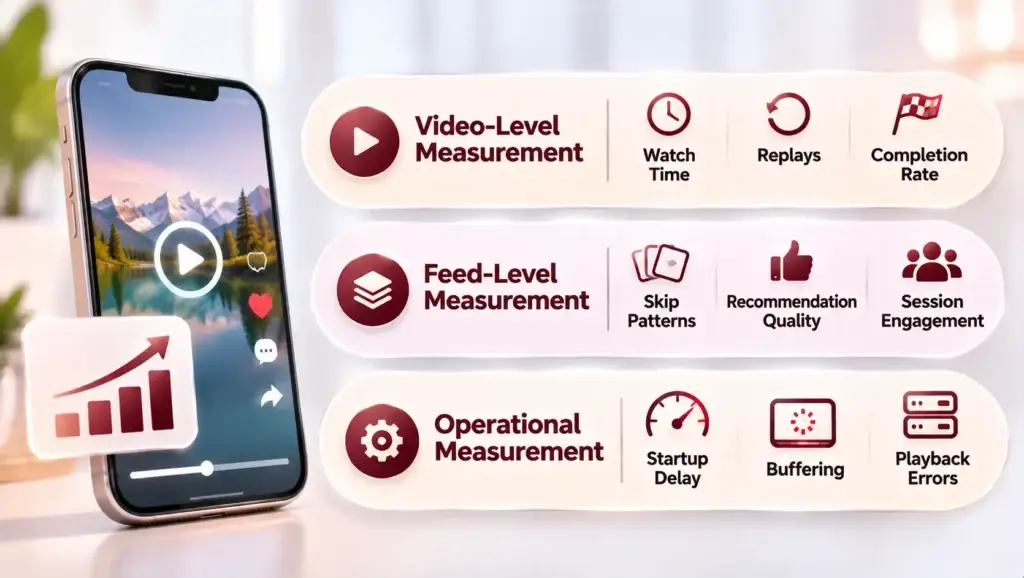
For founders and product operators, the challenge is not merely identifying whether users watch videos. It is understanding which behaviors indicate that the feed is improving.
A practical measurement framework separates individual-video engagement from overall feed quality.
Video-Level Measurement
At the content level, track average watch duration, normalized viewing time, completion rate, early exits, and replay behavior.
Where technically possible, distinguish intentional replays from automatic looping.
This helps identify whether individual videos are attracting attention and which presentation patterns might be influencing the results.
Feed-Level Measurement
At the recommendation-feed level, evaluate how different videos interact within the same browsing session.
Relevant questions include:
- Does a viewer repeatedly skip content from certain categories?
- Do recommendations improve after meaningful feedback?
- Is the feed repeatedly showing content from the same creators?
- Do playback failures appear to be causing early exits?
- Does greater session duration correspond with positive user feedback?
For reliable conclusions, product teams should test changes against clearly defined objectives and comparable user groups.
As the platform attracts new viewers, these metrics also need to be interpreted alongside acquisition and early retention. Miracuves’ guide to short-video platform user acquisition strategies explores related growth considerations without treating watch time as the only measure of product performance.
Operational Measurement
Recommendation quality also depends on video playback reliability.
Slow loading, buffering, encoding problems, and failed playback can create viewing patterns that resemble disinterest.
For example, a user who leaves during a stalled playback has not necessarily rejected the video’s topic.
This is why feed analytics should be interpreted alongside infrastructure measurements such as startup delay, rebuffering, and playback errors.
For a deeper technical explanation, see Miracuves’ guide to video streaming infrastructure for short-form content.
As content libraries and traffic grow, cloud infrastructure for video platforms becomes another important consideration. Reliable storage, encoding, and delivery systems can help teams distinguish genuine user-interest patterns from problems caused by technical performance.
Common Mistakes When Interpreting Watch-Time and Replay Data
Small errors in behavioral measurement can lead to misleading ranking decisions.
Treating Every Completed Video as a Strong Recommendation
Completion may indicate interest, but it can also reflect a video’s short duration. Compare completion performance against similar content before assigning excessive importance to it.
Counting Every Automatic Loop as Intentional Engagement
Automatic playback behavior can inflate replay metrics. Separate passive loops from deliberate actions whenever the event data allows.
Ignoring Early Swipe-Away Behavior
A feed needs to recognize weak matches as well as strong ones. Early exits can help identify relevance problems, provided accidental swipes and technical errors are considered.
Optimizing Only for Total Session Duration
Increasing session time does not guarantee that viewers are satisfied. Include negative feedback, content diversity, and voluntary returns in performance evaluation.
Overlooking Playback Infrastructure
Recommendation models can only learn effectively from trustworthy signals. Playback failures can introduce noise into behavioral data and reduce confidence in engagement analysis.
Video processing also affects the availability and playback consistency of content. Teams exploring these dependencies can review background processing workflows for creator platforms.
What Engagement Signals Mean for Founders Planning a Video Platform
For founders, the importance of watch time and re-watch signals is not limited to understanding recommendation theory.
These signals influence how teams evaluate content discovery, retention, creator visibility, and the overall user experience.
Before investing heavily in increasingly complex ranking models, a platform should establish reliable playback events, meaningful reporting, basic content discovery, and clear user feedback mechanisms.
The next step is to improve recommendations using observed behavior while maintaining transparency, moderation, and appropriate user controls.
This requires a strong technical foundation, but it does not mean every business needs to develop every video platform component from scratch.
Miracuves offers a ready-made approach to branded video platform launches that founders can explore when evaluating their options. Its standard solution is positioned around a 6-day delivery timeline, with final scope and customization requirements confirmed before launch.
The important business decision is not simply how quickly a feed can be deployed. It is whether the platform gives operators enough visibility and flexibility to understand user behavior and improve the experience after launch.
The Future of Vertical Video Feeds Is Better Relevance, Not Endless Attention
Recommendation systems will continue to develop more sophisticated ways to interpret viewing behavior. However, improved prediction does not eliminate uncertainty about what users genuinely value.
Watch time remains useful because it captures observed attention. Re-watch behavior adds another layer by identifying content that viewers revisit.
But both signals require context.
The most thoughtful approach combines behavioral measurement with content quality, technical reliability, explicit user feedback, and responsible personalization.
For viewers, this can mean more relevant discoveries and fewer repetitive recommendations. For creators, it can create opportunities for useful content to reach interested audiences. For platform operators, it provides a clearer basis for improving long-term product quality.
Ultimately, a successful vertical video feed should do more than encourage another swipe. It should make the next recommendation worth watching.
Conclusion: Why Watch Time and Re-Watch Signals Matter in Vertical Video Feeds
The success of a vertical video feed depends on more than endless scrolling and engaging content. Watch time, re-watch signals, completion rates, and swipe-away behavior help recommendation algorithms understand viewer preferences and deliver more relevant videos.
However, higher watch time does not always indicate greater satisfaction, and repeated views do not necessarily mean stronger engagement. An effective vertical video feed algorithm evaluates multiple behavioral signals together, considering video duration, user intent, content relevance, and playback quality.
For founders building short-video platforms, the real opportunity lies in creating personalized experiences that encourage meaningful engagement rather than simply increasing screen time. A reliable recommendation system, scalable video infrastructure, and accurate engagement analytics provide a stronger foundation for long-term retention.
If you’re planning to launch a short-video platform, Miracuves offers a ready-made, white-label foundation with source-code ownership and a 6-day delivery option, subject to project requirements. The goal is not just to launch faster but to build a platform that can continuously improve how users discover and interact with content.
Frequently Asked Questions
What Makes Vertical Video Feeds So Engaging?
Vertical video feeds combine full-screen presentation, easy navigation, automatic playback, and personalized recommendations. These features make content easier to discover and watch. Engagement also depends on content quality, viewer preferences, and how effectively the algorithm understands user behavior.
How Does Watch Time Affect Video Recommendations?
Watch time helps recommendation algorithms understand how interested viewers are in a particular video. Systems may analyze viewing duration alongside video length, completion rates, and other engagement signals to recommend relevant content. However, the importance of watch time varies depending on the platform and its ranking model.
Why Are Re-Watch Signals Important?
Re-watch signals indicate that viewers found a video worth watching again. This may happen because the content is entertaining, informative, or contains details worth revisiting. However, automatic loops and repeated viewing caused by confusion can also increase replay counts, so algorithms need to interpret these signals carefully.
Is Watch Time More Important Than Likes?
Watch time and likes both provide valuable information about user engagement. Watch time reflects viewing behavior, while likes represent direct interactions. Neither signal is universally more important because recommendation algorithms may assign different weights based on content relevance, user preferences, and other ranking factors.
What Is the Difference Between Watch Time and Completion Rate?
Watch time measures how long viewers spend watching a video, while completion rate measures the percentage of eligible plays that reach the end. For example, a longer video may generate more watch time but have a lower completion rate, whereas a shorter video may achieve a higher completion rate with less total viewing time.
Does Rewatching a Video Always Improve Its Ranking?
No, rewatching a video does not automatically improve its ranking. Although repeated views may indicate strong interest, recommendation algorithms also consider factors such as automatic loops, negative interactions, viewer preferences, and overall engagement patterns. Re-watch activity is most useful when evaluated alongside other behavioral signals.
What Does a High Swipe-Away Rate Indicate?
A high swipe-away rate may indicate that viewers are not interested in a video’s topic, opening, or presentation. However, quick swipes can also result from accidental interactions, slow loading, or playback issues. Recommendation systems should consider these factors before interpreting early exits as negative engagement.
Can a Video Feed Be Personalized Without Maximizing Screen Time?
Yes, a vertical video feed algorithm can prioritize relevant and meaningful content without focusing exclusively on increasing screen time. Recommendation systems can consider user satisfaction, content diversity, viewer feedback, and voluntary return visits. This approach helps platforms deliver personalized experiences while supporting long-term user engagement.
Miracuves is an independent software development company. We are not affiliated with, connected to, sponsored by, or endorsed by any company or product named in this article.
Terms such as “X Clone” are used descriptively. It is how the software industry refers to building a platform with functionality comparable to a known service, and how clients search for it.
The entire design and codebase of our products is built by our own team. Our products contain no code, design, graphics, or content originating from any third-party website or applications.
All third-party names and marks referenced in this article are the property of their respective owners, referenced solely to identify the services discussed.