



















Choosing a vertical drama streaming app platform is not the same as choosing a normal OTT app, short video app, or basic video player. This business model depends on short mobile episodes, fast story continuation, paid unlocks, coin wallets, subtitles, content publishing workflows, and an admin panel that gives the founder control after launch.
For founders, the wrong platform usually does not fail during the first demo. It fails later when the content team needs to reorder episodes, test free-episode limits, change unlock pricing, manage subtitles, review revenue by series, or control video delivery costs.
That is why founders should compare more than design screens. A strong platform should support the full business layer: viewing experience, catalog operations, monetization flexibility, admin control, video infrastructure, source-code ownership, and launch readiness.
If you are evaluating a launch-ready solution for this category, Miracuves’ vertical drama streaming app platform can help founders understand how a ready-made, white-label foundation supports faster market entry without starting from zero.
Key Takeaways
- A vertical drama streaming app platform should be compared on viewing experience, monetization logic, catalog control, scalability, and ownership.
- The platform should manage short episodes, locked content, coin wallets, subtitles, admin workflows, and revenue reporting.
- Founders should avoid platforms where pricing rules, free episodes, and content workflows require developer support for every small change.
- Video delivery costs, CDN setup, encoding, and playback performance matter before scaling user acquisition.
- A ready-made and white-label platform can reduce launch friction when it already includes the core business workflows.
Why Vertical Drama Platforms Need a Different Comparison Framework
Traditional streaming platforms are usually built around large libraries, subscriptions, search, watchlists, and multi-device viewing. Vertical drama platforms work differently.
The user behavior is faster. Viewers often enter through one story hook, watch short episodes in sequence, and reach a decision point where the next episode may require coins, VIP access, rewarded ads, or direct unlocks.
That means the platform is not only responsible for video playback. It must also support the business logic behind episodic monetization.
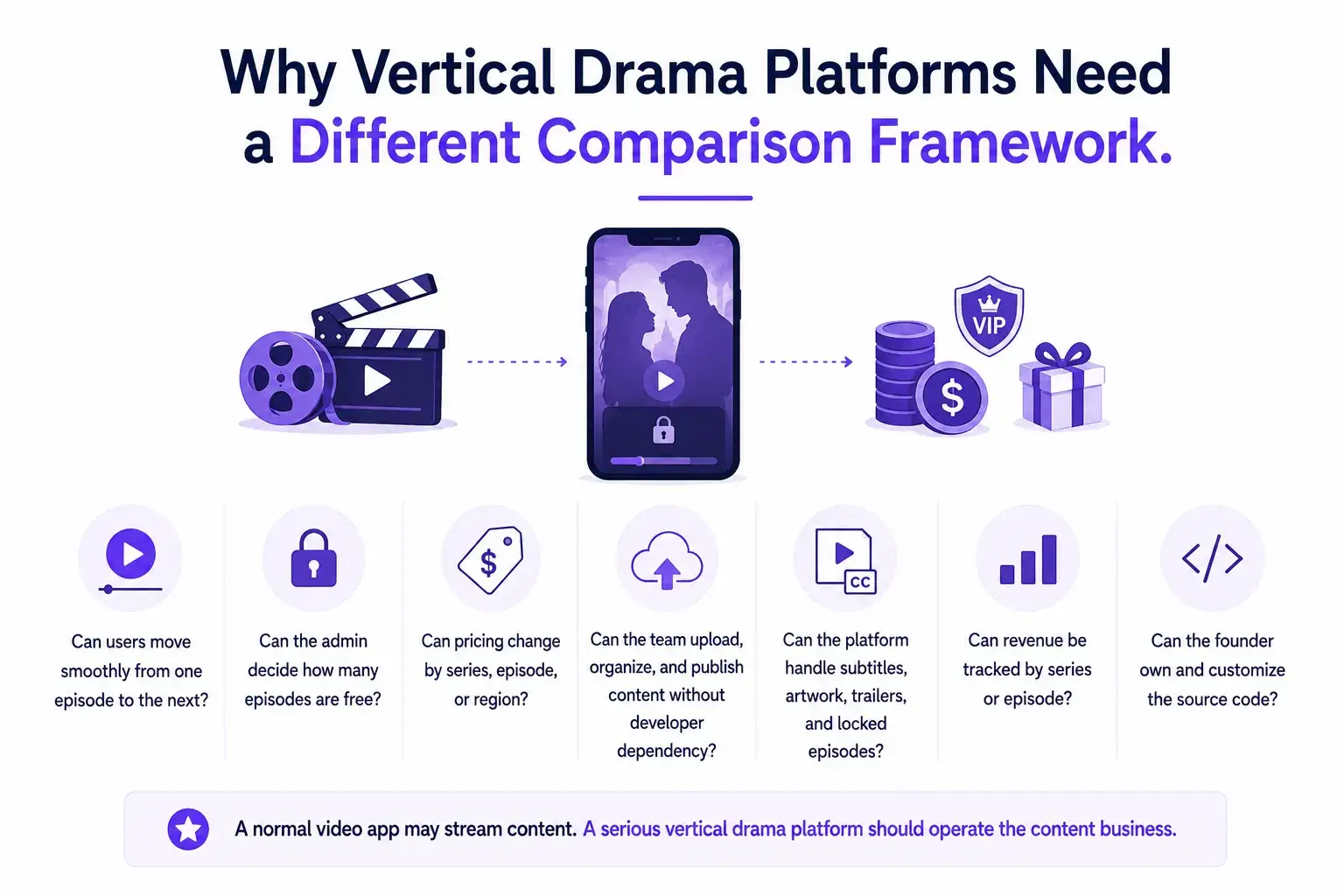
A founder should compare whether the platform can answer these questions:
- Can users move smoothly from one episode to the next?
- Can the admin decide how many episodes are free?
- Can pricing change by series, episode, or region?
- Can the team upload, organize, and publish content without developer dependency?
- Can the platform handle subtitles, artwork, trailers, and locked episodes?
- Can revenue be tracked by series or episode?
- Can the founder own and customize the source code?
A normal video app may stream content. A serious vertical drama platform should operate the content business.
Compare the Mobile Viewing Experience First
The viewing experience is the first layer founders should test. Vertical drama is mobile-first, so the app should feel natural in portrait mode. Users should not struggle to understand what is free, what is locked, what comes next, or how to continue watching.
Founders should compare whether the platform includes:
- Vertical full-screen playback
- Fast episode loading
- Next-episode continuation
- Continue-watching history
- Free and locked episode indicators
- Subtitle support
- Trailer or preview support
- Push notifications for new episodes
- Mobile-first title pages and posters
The real test is not whether the app can play a video. The real test is whether the app keeps the viewer moving through the story without confusion.
If the viewing flow feels slow, unclear, or interrupted, the platform may lose users before monetization even begins.
Compare Monetization Flexibility, Not Only Payment Integration
Many founders ask whether the app has payment gateway integration. That is important, but it is not enough.
A vertical drama streaming app platform needs monetization flexibility because founders may need to test different unlock models after launch. Some titles may work better with coins. Some may work better with VIP access. Some audiences may respond better to rewarded ads before paying.
The platform should support multiple monetization options, such as:
- Coin-based episode unlocks
- Coin pack purchases
- Bonus coins or promotional rewards
- VIP or subscription access
- Rewarded ad unlocks
- Direct paid access where needed
- Region-based pricing control
- Revenue reporting by series and episode
This flexibility matters because monetization is not fixed on day one. Founders usually need to test what users are willing to pay for, where they drop off, and how many free episodes are needed before a paid unlock feels natural.
A platform that hard-codes monetization rules can slow down growth experiments. A platform with admin-controlled pricing gives founders more room to adjust.
Compare Catalog Management Because the Library Becomes the Product
In this category, the content catalog is not just a storage folder. It is the product.
Each title may include episodes, seasons, subtitles, posters, trailers, descriptions, genres, language tags, pricing rules, publishing status, and performance data. If this system is weak, the content team will struggle as the library grows.
Founders should compare whether the platform supports:
- Series management
- Episode management
- Episode numbering and ordering
- Poster and thumbnail uploads
- Trailer or preview uploads
- Subtitle management
- Language and region controls
- Free and locked episode settings
- Scheduled publishing
- Content performance reporting
This is where many basic video platforms fall short. They may allow uploads, but they may not support the operational workflows required for a paid episodic content business.
For founders who want to understand the core modules required before launch, the vertical drama platform features page can help clarify what should be included in the product foundation.
Founder Comparison Table: What to Check Before Choosing a Platform
| Comparison Area | What Founders Should Check | Why It Matters |
|---|---|---|
| Viewing Experience | Vertical player, fast loading, locked episode labels, continue-watching flow | Improves viewer momentum and reduces early drop-off |
| Monetization | Coins, VIP access, rewarded ads, free episodes, paid unlock rules | Allows the business to test revenue models after launch |
| Catalog Control | Series, episodes, subtitles, posters, language settings, region controls | Keeps content operations manageable as the library grows |
| Admin Dashboard | User control, content control, pricing, reports, payments, permissions | Reduces dependency on developers for daily business changes |
| Video Infrastructure | Encoding, CDN, storage, caching, adaptive streaming, playback analytics | Helps control performance and streaming cost as usage increases |
| Ownership | Source code, hosting flexibility, customization rights, integration control | Protects long-term product flexibility and reduces vendor lock-in |
Compare the Admin Dashboard as a Business Control Room
The admin dashboard should not be treated as a small backend add-on. For a founder, the admin panel is where the real business is managed.
It should allow the operator to control users, content, pricing, subscriptions, coins, reports, staff roles, moderation, and platform settings from one place.
A strong admin dashboard should help the team manage:
- User accounts
- Series and episodes
- Locked and free content
- Coin packs and unlock settings
- VIP access
- Payment records
- Subtitles and language options
- Content moderation
- Staff permissions
- Analytics and reports
This matters because after launch, every small operational change should not become a developer task. If the content team wants to update an episode title, adjust a lock rule, or check revenue by series, the dashboard should support it.
A founder should choose a platform that gives business control, not only technical access.
Compare Video Delivery and Infrastructure Before Scaling
Video delivery can become one of the most important cost and performance areas for a streaming product.
A platform may work well with a small test library, but performance can change when the business starts uploading more episodes, running paid campaigns, or attracting users from multiple regions.
Founders should compare whether the platform has a clear approach for:
- Video encoding
- Adaptive streaming
- CDN integration
- Storage management
- Caching
- Playback speed
- Episode preloading
- Bandwidth monitoring
- Error tracking
- Playback analytics
The goal is not only smooth streaming. The goal is smooth streaming with cost control.
Every watched episode has a delivery cost. If infrastructure is not planned properly, growth can increase expenses faster than revenue. This is why founders should understand the platform’s video infrastructure before spending heavily on user acquisition.
Compare Source-Code Ownership and Long-Term Flexibility
Founders should always ask what they actually own after launch.
Some platforms may launch quickly but limit access to the source code, database structure, hosting setup, or customization rights. This may not look like a problem at the start, but it can create restrictions later.
Source-code ownership matters because it gives the founder more control over:
- Custom feature development
- Hosting decisions
- Payment gateway changes
- Third-party integrations
- Security reviews
- Performance optimization
- Product roadmap flexibility
- Future developer handover
This does not mean every founder should build everything from zero. It means the founder should compare ownership clearly before signing.
A ready-made, source-code-owned platform can help founders launch faster while still keeping long-term control over the product direction.
Compare Security, Moderation, and Rights Management
A vertical drama streaming platform handles user accounts, payments, content access, staff permissions, and sometimes licensed media assets. So security and operational trust should be part of the platform comparison.
Founders should check whether the platform supports:
- Secure payment gateway integration
- Encrypted data transfer
- Admin access control
- Role-based permissions
- Activity logs
- Abuse reporting
- Content moderation
- User account protection
- Rights and content reporting workflows
Rights management is especially important if the business licenses content from studios, creators, or production partners. The platform should help track how titles and episodes perform, because content partners may need transparent reporting.
Security should not be treated as a marketing add-on. It should be part of the platform foundation.
Compare Launch Readiness With Your First Market Goal
Not every founder needs the same launch scope.
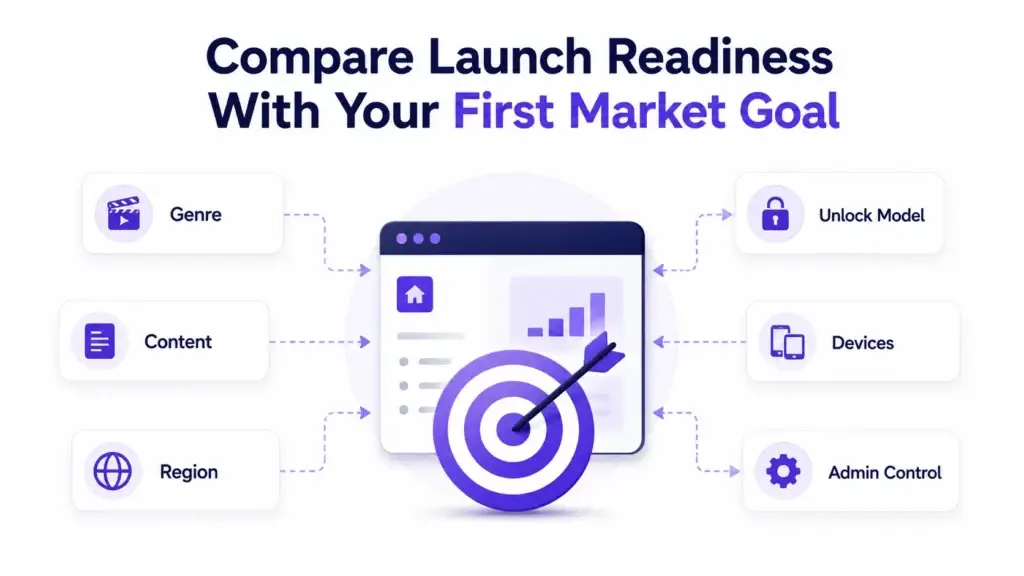
A studio launching original dramas, a publisher adapting stories, a regional media company, and a startup testing paid episodic content may all need different priorities. The right platform depends on the first market goal.
Before choosing a platform, founders should answer:
- Are we launching with one genre or many genres?
- Are we producing original content or licensing content?
- Which language or region comes first?
- How many episodes should be free before unlock?
- Will users pay through coins, VIP access, ads, or a hybrid model?
- Do we need only mobile apps or also a web platform?
- How much control does the content team need from the admin dashboard?
Once these answers are clear, platform comparison becomes more practical.
The best platform is not always the one with the longest feature list. It is the one that matches the founder’s launch strategy, content plan, and monetization model.
Founder Decision Signals
Speed
Choose a ready-made platform when the core viewing, catalog, monetization, and admin workflows already match your launch plan.
Cost
Compare not only development cost, but also customization, video delivery, maintenance, hosting, payment setup, and future changes.
Scalability
Check whether the platform can support more titles, users, payments, subtitles, traffic, and reporting without becoming difficult to manage.
Market Fit
Pick a platform that lets you test genres, free episodes, coin pricing, VIP access, and user behavior quickly after launch.
Mistakes Founders Should Avoid Before Choosing a Platform
Choosing a platform too quickly can create problems after launch. Founders should avoid decisions based only on demo screens, low upfront pricing, or generic video app features.
Mistakes Founders Should Avoid
Choosing a video player instead of a platform
A player can stream content, but a platform should manage episodes, locks, coins, subscriptions, subtitles, reporting, and admin workflows.
Ignoring monetization control
If free episodes, coin pricing, VIP access, and rewarded ads require code changes, the founder loses testing speed after launch.
Underestimating content operations
As the library grows, the team needs strong controls for episode ordering, subtitles, posters, publishing, and performance tracking.
Overlooking ownership terms
Without source-code ownership or customization control, the business may become dependent on one vendor’s limitations.
Ready-Made vs Custom Platform: What Should Founders Choose?
A custom platform gives maximum flexibility, but it usually requires more planning, more development effort, more testing, and more budget before launch.
A ready-made platform can be stronger when the founder already knows the core product pattern: vertical viewing, short episodes, paid unlocks, coin wallets, admin control, and content catalog workflows.
Ready-Made vs Custom Platform Comparison
| Build Option | Best For | Founder Tradeoff |
|---|---|---|
| Ready-made white-label platform | Founders who want core streaming, catalog, monetization, and admin workflows available faster | Faster launch with customization around branding, content, pricing, and market strategy |
| Custom platform from zero | Businesses with very unique architecture, complex personalization, or uncommon rights workflows | More flexibility, but longer development and higher execution risk before launch |
| Hosted third-party platform | Teams that want a quick test without managing technology ownership | Lower setup effort, but possible limits around source code, hosting, integrations, and customization |
The smarter decision depends on the founder’s stage. If the goal is to validate demand faster with a proven product structure, a ready-made white-label platform may be more practical. If the business requires a completely new experience or complex custom architecture, custom development may be the better long-term route.
Which Vertical Drama Platform Fits Your Business Model?
Choosing the right vertical drama streaming platform depends on your business model, target audience, content strategy, and long-term growth plans. While most short-drama platforms share core capabilities such as vertical video playback, episodic content, and monetization tools, their operational priorities can differ.
For example, some businesses prioritize episode-based purchases and coin monetization, while others focus on multilingual distribution, content catalog management, or viewer retention.
Miracuves offers several short-drama streaming solutions inspired by popular industry platforms. Understanding these categories can help founders evaluate the technology, monetization capabilities, and operational workflows that best match their business objectives.
1. ReelShort-Like Episode Monetization Platform: For Paid Episodes and Coin-Based Revenue
A ReelShort-like short drama streaming platform is particularly suitable for businesses that want to generate revenue through paid episodes, virtual coins, and VIP subscriptions.
This business model typically allows viewers to watch introductory episodes for free before unlocking premium content. Users can purchase virtual coins or access eligible episodes through VIP membership plans, creating multiple monetization opportunities.
Key platform capabilities to consider:
- Coin-based episode unlocks: Configure free and premium episodes with flexible coin requirements.
- Digital wallet management: Track coin purchases, rewards, spending history, and episode unlock transactions.
- VIP subscription access: Offer premium viewing options alongside individual episode purchases.
- Flexible paywall configuration: Determine when viewers encounter paid episodes and how premium access is presented.
- Revenue analytics: Evaluate episode purchases, paying-user behavior, and monetization performance.
Best suited for: Short-drama production companies, independent content owners, and streaming entrepreneurs focused on converting engaged viewers into paying subscribers or episode purchasers.
2. DramaBox-Like Multilingual Drama Streaming Platform: For Regional and International Expansion
A DramaBox-like multilingual streaming platform is designed around the operational priorities of businesses planning to serve audiences across multiple languages and geographical markets.
Expanding internationally involves more than translating the application interface. Platform operators must also consider regional content preferences, subtitles, right-to-left language support, payment methods, and localized viewing experiences.
Key platform capabilities to consider:
- Multilingual user interfaces: Deliver a localized application experience for audiences speaking different languages.
- Subtitle and localization management: Organize language-specific subtitle tracks for episodic content.
- Right-to-left language compatibility: Accommodate markets using languages such as Arabic and Hebrew.
- Regional content availability: Manage content distribution requirements across target markets.
- Localized monetization: Evaluate regional payment methods, supported currencies, and market-specific pricing strategies.
Best suited for: International entertainment companies, regional OTT operators, content distributors, and businesses planning to launch short-drama streaming services across multiple countries.
3. MoboReels-Like Content Publishing Platform: For Episodic Content and Catalog Management
A MoboReels-like vertical drama content platform is relevant for businesses that need organized workflows for managing, publishing, and distributing large volumes of short-form episodic content.
For studios operating multiple drama series, efficient content administration becomes increasingly important. Teams need to manage episodes, artwork, metadata, publishing schedules, and content availability without creating unnecessary operational complexity.
Key platform capabilities to consider:
- Centralized content management: Organize drama titles, episodes, genres, thumbnails, and related metadata.
- Episodic publishing workflows: Manage episode order, scheduled releases, and content availability.
- Catalog categorization: Structure content using genres, categories, and other discovery-related information.
- Subtitle organization: Associate supported subtitle files and language information with relevant episodes.
- Content performance reporting: Evaluate viewing activity and available episode-level performance metrics.
Best suited for: Drama production studios, digital content publishers, entertainment aggregators, and streaming businesses managing extensive episodic content libraries.
4. ShortMax-Like Viewer Engagement Platform: For Retention, Rewards, and Audience Growth
A ShortMax-like short drama engagement platform focuses on encouraging repeat viewing, strengthening audience participation, and supporting long-term user retention.
Acquiring viewers is only the beginning of growing a streaming business. Platform operators also need mechanisms that encourage users to return, discover additional series, and continue watching after their initial sessions.
Reward-based engagement and retention campaigns can support these objectives when configured according to the platform’s monetization strategy.
Key platform capabilities to consider:
- Daily check-in rewards: Encourage viewers to return through configurable rewards and streak-based activities.
- Referral programs: Provide eligible incentives for introducing new viewers to the platform.
- Rewarded advertising: Allow users to earn eligible rewards through supported advertising activities.
- Viewer engagement campaigns: Deliver targeted promotions, reminders, and incentives to relevant audience segments.
- Retention analytics: Monitor return viewing, user engagement, reward participation, and available conversion metrics.
Best suited for: Growth-oriented streaming startups, mobile entertainment brands, and businesses prioritizing repeat sessions, referrals, and ongoing audience engagement.
How Can Founders Choose the Right Vertical Drama Platform?
Each of these platform categories emphasizes a different business priority, but the underlying capabilities are not necessarily mutually exclusive.
A business focused on selling premium episodes may prioritize a ReelShort-like monetization experience. A platform entering international markets may place greater importance on DramaBox-like multilingual capabilities. Content-heavy streaming businesses may value MoboReels-like catalog management, while growth-focused applications may benefit from ShortMax-like engagement mechanisms.
Before selecting a platform, founders should evaluate the following considerations:
- Revenue model: Will the business primarily generate income through coins, subscriptions, advertisements, or a combination of methods?
- Target audience: Is the platform intended for one geographical market or multiple language regions?
- Content operations: How many drama series and episodes will the business manage, and how frequently will new content be published?
- Engagement strategy: Which mechanisms will encourage viewers to return and continue watching?
- Customization requirements: What changes will be needed to support the business’s branding, product experience, and operational workflows?
- Ownership and scalability: What source-code rights, deployment options, integrations, and long-term infrastructure requirements should be evaluated?
These considerations help founders identify the right platform configuration rather than selecting software based solely on similarities to an existing streaming application.
White Label Micro Drama App: Build Your Own Branded Streaming Platform
For businesses seeking a complete streaming solution under their own brand, the White Label Micro Drama App by Miracuves provides a broader platform option to evaluate.
Rather than choosing a solution based exclusively on one popular application’s operating model, founders can assess the available capabilities for vertical video streaming, episodic content publishing, coin monetization, VIP access, content administration, and viewer engagement.
A white-label approach enables businesses to focus on their own brand identity, content library, target markets, and monetization strategy while evaluating a ready-made software foundation.
Depending on the agreed platform package and customization scope, businesses can plan for branding requirements, application configuration, additional integrations, deployment, and source-code handover.
Ready to Launch Your Own Vertical Drama Streaming Platform?
Explore Miracuves’ white-label micro drama app and evaluate the features that matter to your business: vertical playback, episode monetization, content management, branding, localization, and platform customization.
Final Thoughts: Compare the Platform Like a Business System, Not Just an App
A vertical drama streaming app platform should be compared as a complete business system.
The founder should look beyond screens and ask whether the platform can support viewing behavior, locked episodes, monetization tests, catalog growth, subtitle management, video delivery, admin controls, reporting, security, and source-code ownership.
The right platform should help the business launch faster, test smarter, and keep enough control for future growth.
Miracuves helps founders build ready-made and white-label app platforms with source code, branded design, admin control, and faster deployment. For founders entering the vertical drama space, the goal is not only to launch an app. The goal is to launch a platform that can support content, monetization, and growth from day one.
FAQs
What is a vertical drama streaming app platform?
A vertical drama streaming app platform is a mobile-first video platform built for short serialized episodes, portrait playback, locked content, coin wallets, subscriptions, subtitles, and admin-led catalog management.
What should founders compare before choosing a vertical drama platform?
Founders should compare the viewing experience, monetization flexibility, catalog management, admin dashboard, video infrastructure, security features, ownership terms, and launch readiness.
Why is monetization flexibility important?
Monetization flexibility matters because founders may need to test different models after launch, such as coins, VIP access, rewarded ads, free episodes, or hybrid access. A flexible admin system makes these tests easier.
Why does catalog management matter in this category?
Catalog management matters because each title may include many episodes, subtitles, posters, trailers, pricing rules, language settings, and publishing controls. Weak catalog management can slow down daily operations.
Should founders choose a ready-made or custom platform?
A ready-made platform is useful when founders want to launch faster with proven workflows. Custom development is better when the business needs highly unique architecture, advanced personalization, or complex content rights logic.
Why does source-code ownership matter?
Source-code ownership gives founders more control over customization, hosting, integrations, security review, and long-term product development. It also reduces dependency on one vendor’s roadmap.
What admin features should a vertical drama app include?
The admin dashboard should include user management, content management, episode controls, coin settings, VIP access, payment records, subtitles, reports, moderation, permissions, and platform settings.
How can Miracuves help founders launch faster?
Miracuves helps founders launch ready-made and white-label app platforms with source code, branded design, admin control, monetization workflows, and faster deployment support.
Miracuves is an independent software development company. We are not affiliated with, connected to, sponsored by, or endorsed by any company or product named in this article.
Terms such as “X Clone” are used descriptively. It is how the software industry refers to building a platform with functionality comparable to a known service, and how clients search for it.
The entire design and codebase of our products is built by our own team. Our products contain no code, design, graphics, or content originating from any third-party website or applications.
All third-party names and marks referenced in this article are the property of their respective owners, referenced solely to identify the services discussed.