Key Takeaways
- Three routes, three risk profiles. Custom development carries schedule and scope risk, a ready-made app carries product-fit risk, and a subscription platform carries outgrowing risk.
- Count twelve months, not the build quote. Store accounts, hosting, card fees, AI usage, content, support and marketing all land in year one, whichever route you choose.
- A ready-made build is days, not quarters. The Miracuves ready-made app goes live in 6 working days of Miracuves work, plus store review, with Android and iOS apps and full source code.
- Fixed price versus open meter. The ready-made route is a one-time price of $3,399. Custom work is a scoped fee and a subscription never stops billing.
- Ownership is the quiet differentiator. Source code, your database and your coach and member relationships are assets. Check each quote for who holds them.
- Customize after launch, not before. Launch with the proven loop, watch real logging and retention data, then spend custom hours on the one thing your members ask for.
- Pick by constraint. A proven coaching model with a date suits ready-made; a genuinely new product suits custom; a cheap demand test suits a subscription platform.
Every founder who wants to start a weight-loss coaching business meets the same fork in the first week. You can hire a team and build the app from nothing, you can rent a platform by the month, or you can start from a finished product and make it yours. Weight loss app development looks like a technology choice, but it is really a decision about time, money and control.
The category has a proven shape. Noom made the pattern familiar: a short assessment, a daily food log, a lesson each day on eating habits and a coach who sees the member’s week. Buyers now expect that loop on day one, and the need behind it is large. The CDC reports that adult obesity prevalence in the United States was 41.9 percent in 2017 to March 2020, which is why so many founders, dietitians and wellness brands want a branded app of their own.
This guide compares the three routes the way a founder has to compare them: what each one needs in people and time, what it really costs across twelve months, what you own at the end and what you can change afterward. If you already know you want a finished product, the ready-made weight-loss coaching app from Miracuves is described in full on its own page. If you are still deciding, read on, because the right answer depends on your constraints rather than on any vendor.
One boundary first. This article is a decision guide. For the engineering sequence of a build, see our step-by-step guide to building a coaching app, and for dietitian-led businesses see our breakdown of nutrition app development cost. Here we stay on the choice between routes.
What a Weight Loss App Has to Contain Before It Is Worth Launching
Before comparing routes, fix the scope, because a route that omits half the scope is not cheaper, only incomplete. A coaching-grade weight-loss app is not a calorie counter with a chat box. It is a small business system with four surfaces.
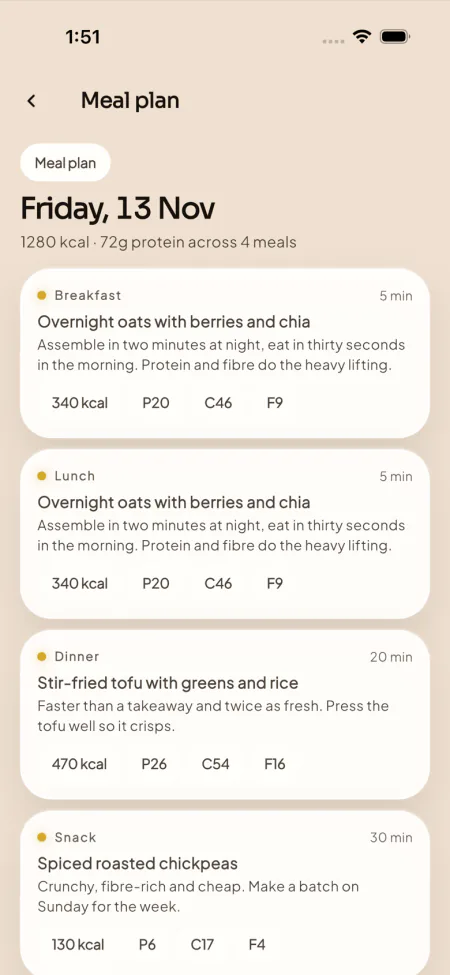
- The member app. Native Android and iOS apps plus a responsive web app, with an assessment that sets calorie, macro, water and step targets, a food diary, meal plans, lessons, progress charts and a coach thread.
- The coach side. A desk with a caseload, member detail, notes, follow-ups, appointments and earnings, so coaches can see a member’s diary before they reply.
- The operator console. Plans, prices, trials, coupons, coach pay, content, moderation, finance and feature switches that change without shipping a release.
- The commercial plumbing. Subscription billing, a store for physical products, rupee and card checkout, notifications and an audit trail.
Each of those four items is a project of its own when built from scratch, and the operator console is the one most often forgotten in early quotes. Without it, every price change, coupon or coach payout becomes a developer ticket. When you request quotes from any vendor, ask them to list all four surfaces by name, and treat a missing one as a cost that has not been priced yet.
Content is the other half of scope. Lessons, recipes, a food catalog and plan templates are not code, yet a launch without them is an empty app. A Noom-style behavior-change curriculum, with short daily lessons and a quiz question to close each one, takes writing time whichever route you choose. A ready-made app ships with a starter library of 10 courses and 30 lessons, so your team edits and extends content rather than starting from a blank page.
Founders also tend to underestimate how much of the decision is emotional. Building from scratch feels like ownership and a rented platform feels like risk, yet a finished product with its code in your hands delivers the ownership without the schedule. Judge each route by evidence you can check, such as a demo, a contract clause and a delivery date, rather than by how it feels in a sales call.
Route 1: Custom Development From Scratch
Custom development means a contract with an agency or a hired team to design and build exactly what you specify. It is the right answer for a small set of founders and the expensive answer for everyone else.
Team and time
A product with the four surfaces above needs, at minimum, a product owner, a designer, a backend engineer, a web engineer, a mobile engineer, a tester and a project manager. You can rent those roles from an agency or hire them, but you cannot skip them. Even compressed, discovery and design come first, then build in sprints, then testing across devices, then store review. Treat anything promising a full coaching platform in weeks with caution, and ask what is being left out.
A useful rule is to work backward from your launch date and ask the vendor to show the milestone plan. If a plan has no buffer for store review or for a second round of design feedback, it will slip. Slippage in a build is expensive because the team is billing while your launch campaign waits.
Budget and how it grows
Custom budgets are scoped fees, and the final number depends on the scope you agree. The shape matters more than any average: the quote grows with every screen, every integration and every revision, and the work that was not in the scope arrives as a change request. Founders who compare quotes should insist that every vendor prices the same written feature list, including the operator console, subscription billing, the coach side and both mobile platforms.
Risk
The dominant risks are schedule, scope and key-person dependency. A custom build can also produce a product that is excellent at the feature you cared about and fragile everywhere else, because every screen was a first draft. None of these risks makes custom wrong. They make it the right choice only when the thing you are building cannot be bought, which is the subject of the decision table later in this guide.
Hidden work deserves its own mention. Recurring billing needs webhook handling and failure states, mobile apps need push setup and store assets, and a coach side needs permissions that never leak one member’s data to another. Each is a normal engineering task, but together they are weeks of effort that never show on a feature list, and agencies that quote only the visible screens leave you to discover them later.
When custom is the right call
- Your differentiator is itself new engineering, such as a proprietary assessment model or a clinical workflow that no existing product contains.
- You are building a platform for many organizations on one instance, with tenant separation as the core product.
- You have an engineering team and a product leader already, and the build is part of a longer technical roadmap.
Route 2: A Ready-Made Noom-Style App
A ready-made app is a finished, working product that you brand, configure and launch as your own. The product has already been through design, build and testing, so the work that remains is yours: branding, content, pricing, store accounts and launch. This is how the Miracuves weight-loss app is offered, built on a platform called MXHealthy.
What you receive
The Miracuves ready-made app is a fixed, one-time price of $3,399, with no per-member fee and no revenue share. It includes native Android and iOS apps together, a responsive web app for members, a role-gated coach workspace, an operator console with 14 areas and the full source code. The stack is Next.js and TypeScript on the web, Flutter for mobile and PostgreSQL for data, with Stripe billing and rupee checkout side by side. Members can switch between English and Hindi, and Indian dishes are in the food catalog from the first day.
Time
A ready-made build goes live in 6 working days of Miracuves work once your branding, hosting, developer accounts and payment gateway are ready. Store review is separate and set by Apple and Google, so book it into the calendar. If you want custom changes, scope them in writing: custom work typically takes 15 to 30 days, and larger scope can take 45 to 60 days.
Risk
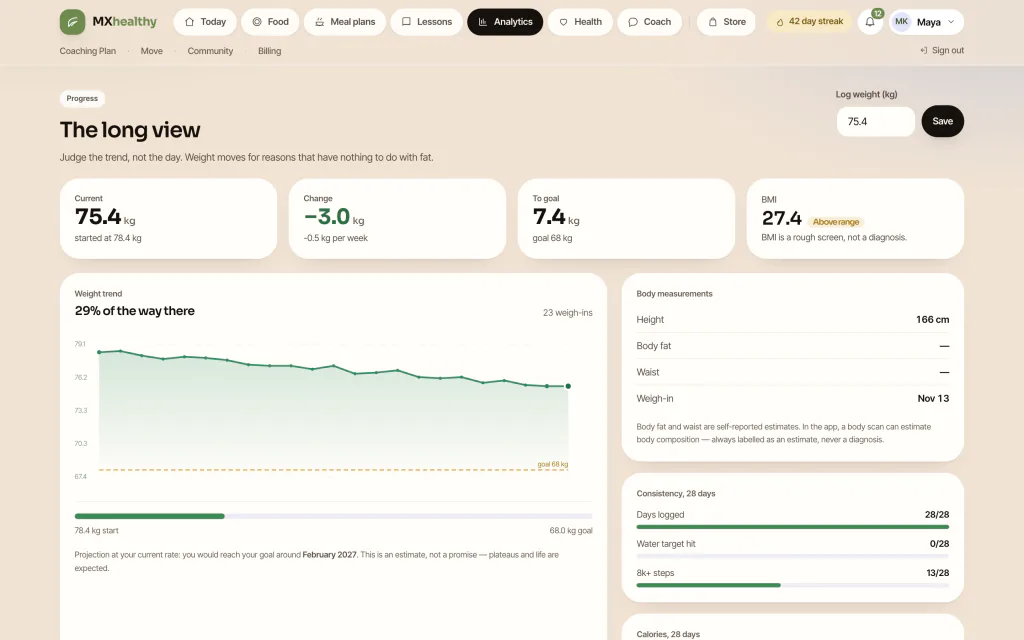
The risk here is product fit. A finished product will not match your idea in every corner, so the honest test is how much of your plan it already covers. Check it by opening the demo, logging a meal as a member, reading a lesson, replying as a coach and changing a price in the operator console. You can do that before you spend anything, and a live demo of the coaching app with member, coach and admin logins is open for that purpose.
A second risk is operational rather than technical. A ready-made app does not run itself. Your team still has to curate foods and lessons, recruit and manage coaches, answer members and market the offer. Founders who treat the app as the business tend to be surprised, and founders who treat it as the platform for a business they have already planned tend to launch smoothly.
Route 3: A Subscription Platform or No-Code Builder
The third route is a hosted platform that you configure rather than own. Coaches and brands use these to launch a basic client portal quickly, and they can be a sensible way to test whether anyone pays for your offer.
The trade-offs are structural. You accept the platform’s data model, so a feature the vendor did not build is a feature you wait for. Native Android and iOS apps are often a higher plan or an extra fee, and some platforms offer a web experience only. Source code is normally not included, and moving your members to another system later means exporting data and rebuilding trust.
The cost shape is the part founders underestimate. A subscription is cheap in month one and never ends, and many plans step up with member counts, coach seats or feature tiers. Multiply the plan you would need at your target member count by thirty-six months before you compare it with a one-time price.
Used well, this route is a demand test. Run it for a defined period, measure paid sign-ups and retention, and decide in advance what result would send you to an owned platform. Used without an exit plan, it becomes a recurring bill on someone else’s product.
The Twelve-Month Total Cost of Ownership
A build quote is a single line. Your actual first-year spend has at least ten lines, and half of them are identical whichever route you pick. Use the table below as a worksheet: fill in your own quotes for each cell rather than trusting any round number.
| Cost line (first 12 months) | Custom build | Ready-made app | Subscription platform |
|---|---|---|---|
| Software build | Scoped project fee, grows with change requests | One-time $3,399 | None, but a monthly plan fee starts on day one |
| Customization | Included in scope, changes billed as extra | Scoped in writing, 15-30 days typical | Limited to platform settings |
| Source code and data | Yes, if the contract says so | Full source code, your hosting and database | Usually no code, export varies |
| Hosting and database | Yours | Yours | Bundled in the plan |
| Store developer accounts | Yours: $99 a year for Apple, $25 once for Google | Yours: same accounts | Yours if you use native apps, sometimes bundled |
| Payment processing | Card and rupee gateway fees per transaction | Card and rupee gateway fees per transaction | Gateway fees plus platform fees |
| AI coach usage | Your provider cost | Your provider cost, per-member daily caps built in | Plan limit or add-on fee |
| Content and coaches | Your time and payroll | Your time and payroll, starter library included | Your time and payroll |
| Post-launch support | Retainer or hourly | 60 days platform guidance, 6 months bug resolution, 12 months product evolution | Vendor support tier |
| Marketing | Your plan, usually the largest line | Your plan, usually the largest line | Your plan, usually the largest line |
Two lines in that table are fixed facts you can check today. Apple charges 99 USD per membership year for the Developer Program, and Google Play charges a one-time 25 USD registration fee. Those numbers are small and identical on every route, which is exactly why they should not decide your choice.
The more interesting rows are the ones that differ. Software build and customization are where custom and ready-made separate, and the recurring plan fee is where the subscription route separates from both. Everything else, including marketing, content, coaches and payment fees, is a cost of being in the business, not a cost of the route.
What the table does not show
The table hides time. A custom build that arrives a quarter late carries a cost that never appears in a quote: a delayed campaign, a coach cohort waiting and a competitor that launched first. A ready-made app moves that cost to the front, because you know the build date before you commit.
It also hides ownership. With the custom and ready-made routes, the code, the database and the member relationships are yours. With a subscription platform they are shared with the vendor, and the cost of leaving is paid in migration effort. When two routes cost the same in year one, ownership usually decides year three.
Decision Table: Which Route Fits Which Situation
The comparison below puts the three routes against the constraints that actually decide the choice. Read down the column that matches your biggest constraint, not the column with the lowest first number.
| Your situation | Best fit | Why | Watch for |
|---|---|---|---|
| Proven coaching model, fixed launch date | Ready-made app | The product exists, so launch is days plus store review | Test the demo against your must-have list first |
| New product idea with no precedent | Custom development | You are paying for original engineering | Scope creep and schedule slip |
| Unsure anyone will pay | Subscription platform for a defined test period | Low commitment while you learn | Plan step-ups and export limits |
| No engineering team and no wish to hire one | Ready-made app | Support and product evolution come with it | Your team must run content and coaching |
| Need source code and data ownership | Ready-made app or custom | Both hand over the code | Confirm it in writing, including mobile |
| Many organizations on one instance | Custom development | Tenant separation becomes the core engineering work | Budget for tenant security from day one |
| Indian audience with rupee checkout and Hindi | Ready-made app | Rupee payments, Hindi and Indian foods are included | Plan the wider language packs as add-ons |
Founder Decision Signals: Which Route Fits Your Plan?
Model Is Proven
Can you describe your member, your coaching promise and your revenue lines in two sentences, with no feature that has never been tried elsewhere?
Date Is Fixed
Is there a launch date tied to a campaign, a cohort of members or a partner, so that a slipped quarter would cost real money?
Team Is Missing
Do you lack a standing engineering team, a product manager and a mobile specialist today, and do you want to avoid hiring all three first?
Ownership Matters
Do you need source code, a database you control and the freedom to change vendors without losing your members?
Budget Has A Shape
Is your budget a single approved amount rather than an open-ended monthly line that grows with every member?
Differentiator Is Known
Can you name the one thing your app does that no existing coaching product does, and does it need new engineering?
What to Customize After Launch, and What to Leave Alone
The biggest mistake in weight loss app development is customizing before you have users. A pre-launch wish list is a guess, while post-launch data tells you which guess was right. A good rule is to launch on the proven loop, collect eight to twelve weeks of behavior data, and then let the data order your backlog.
Changes that usually pay back first
- Content and branding. Your lessons, recipes, foods and voice are the cheapest and highest-value customization, and they live in the operator console rather than in code.
- Plans, prices and trials. Tier names, annual prices, trial length and coupons are runtime settings. Test them instead of debating them.
- Coach pay and commission. The coach pay model (flat retainer, pay for each client, pay for each session, or commission) can be changed as your coaching team grows.
- Nudges and onboarding. A message after a week without a weigh-in or a tuned first-week sequence often moves retention more than a new feature.
Changes that need real engineering
Some changes do need development hours. Connecting native wearable adapters is an available add-on, and so are smart scale and glucose monitor sync, live video coaching with group classes, a video lesson studio, a corporate wellness portal with employer billing and regional language packs beyond English and Hindi. All six are optional paid add-ons that Miracuves scopes and prices in writing before work starts, so you add them when a real member need appears rather than before.
The principle is the same on every route. Spend custom hours on something your own data says members want, and leave the proven loop alone. Rebuilding food logging or lesson delivery is almost never the best use of an engineering budget.
Run the same exercise on your own numbers before you decide. Note your target member count at month twelve, your planned monthly price and your expected coach cost per member. A route that looks cheaper on paper can lose once the member count in your plan multiplies a per-seat fee, and a route that looks expensive can win once you divide a one-time price across the members you expect to serve. The arithmetic takes ten minutes and is the best protection against a quote that flatters one route.
Security and Ownership Questions to Ask Any Vendor
A weight-loss app holds personal habits, weight history and coaching conversations. Whichever route you choose, ask each vendor to answer the same short list in writing.
- How are roles enforced, and is every request checked against the signed-in session rather than trusting the app?
- How are passwords stored, and are database queries parameterized throughout?
- Can members export their data and request deletion, and is there an audit trail for price, payout and content changes by operators?
- Where is the data hosted, and who holds the database credentials?
- Do card details ever touch your servers, or only provider references?
The Miracuves platform answers these concretely: identity always comes from the server session, roles are checked on pages and on every action, a member reaches only personal records while a coach reaches only assigned clients, queries are parameterized, sessions use secure cookies, card data stays with the payment provider, and export and deletion workflows support privacy requests. Operator changes to plans, prices, payouts and content are written to an audit trail, and AI usage is capped per member per day.
Ask the same questions of a custom agency and a subscription vendor. The answers you get, and how quickly, tell you more about the route than any brochure does.
A 90-Day Plan for the Ready-Made Route
Speed is only useful if the surrounding work keeps up. Here is a realistic first quarter for a founder who chooses the ready-made route.
- Weeks 0 to 1. Request your company verification number, open Apple and Google developer accounts as an organization, and prepare branding, hosting and your payment gateway. The ready-made build then goes live in 6 working days of Miracuves work.
- Weeks 1 to 3. Load your content, set plans, prices and trials in the operator console, connect your AI provider key and invite a small group of coaches and test members. Submit to the stores and allow for a rejection and resubmission.
- Weeks 3 to 6. Soft launch to a small cohort. Watch food-logging rates, lesson completion, coach reply time and week-one retention in the operator console.
- Weeks 6 to 12. Order your backlog from real data. Pick one or two custom changes or add-ons, have them scoped in writing and ship them while marketing scales.
The AI coach in this plan gives general guidance from the member’s own logged day and is not medical advice. Position it that way in your onboarding and your store listing, and route anything medical to a qualified professional. Your own claims about results should stay as careful as the product’s are.
How Miracuves Helps
Miracuves builds and ships ready-made apps for coaching and wellness businesses, and the weight-loss platform is the one described here. It combines a Noom-style behavior-change loop with an operator console, so you can run the business without a standing engineering team.
- Fixed price. A one-time price shown on the weight-loss coaching platform page, with source code included and no per-member fees.
- Fast launch. Live in 6 working days of Miracuves work, with store review separate.
- All surfaces. Android and iOS apps plus web, coach and operator surfaces (the console has 14 areas), built on Next.js, TypeScript, PostgreSQL, Flutter and Stripe plus rupee checkout, in English and Hindi.
- Custom work when you need it. Scoped in writing, 15 to 30 days for typical changes and 45 to 60 days for larger scope.
- Support after launch. 60 days of dedicated platform guidance, 6 months of priority bug resolution and 12 months of continuous product evolution.
If you want a starting point for the buyer questions around scripts and pricing, our buyer guide to ready-made coaching apps compares what should be in the box. For sector context across the category, see our healthcare solutions, and our team can walk you through the live demo on a short consultation.
Final Thoughts
Weight loss app development is easy to overcomplicate. Strip it down and you are choosing which risk you prefer to carry: schedule and scope with custom development, product fit with a ready-made app, or outgrowing the platform with a subscription. Total cost of ownership over twelve months, plus what you own at the end, usually settles it faster than feature lists do.
If your coaching model is proven and your launch date is real, a finished product is the lower-risk route, and you keep your custom budget for the one thing that sets you apart. Miracuves gives you that product at a fixed price, with source code, both mobile platforms and the support to grow it. Tell us your plan and we will scope it against the other routes, line by line.
Frequently Asked Questions
How long does weight loss app development take from scratch?
Plan in months, not days. A from-scratch product needs discovery, design, a member app for two platforms, a coach side, an admin console, billing, testing and store review. The exact length depends on scope, so ask every agency for a milestone plan with dates. A ready-made app compresses the build into days because the product already exists.
Who owns the app and the member data after launch?
That depends on the contract. With a Miracuves ready-made app you receive the full source code and run the platform on your own hosting and database, so members, coaches and content belong to your business. With a subscription platform, check data export and what happens to your accounts if you cancel.
Can I start with the ready-made app and customize it later?
Yes. Most founders launch on the proven loop of food logging, lessons, coaching and progress, then add changes once real usage data exists. Custom work is scoped and priced in writing before it starts, so the first launch is never delayed by a wish list.
Which team members do I need to run a weight-loss app after launch?
At minimum a content owner who curates foods, recipes and lessons, a coach or coach manager, someone who handles member support, and a person who watches the numbers in the operator console. You do not need an in-house engineering team on the ready-made route, because Miracuves provides platform guidance, bug resolution and product evolution after launch.
Does the app include both Android and iOS versions?
Yes. The Android and iOS apps come together in the same build, alongside a web version for members plus the coach and operator workspaces. You still need your own developer accounts with each store, and store review time is separate from the build time.
Can the AI coach replace my human coaches?
It is designed to work alongside them. The AI coach answers from the member day it can see, and on the coaching tier human coaches reply in the same thread. The AI coach gives general guidance and is not medical advice, and you connect your own AI provider key to switch it on.
Does the platform accept rupee payments and Hindi?
Yes. Rupee checkout sits alongside Stripe card billing, Indian dishes come loaded in the food catalog, and members can use English or Hindi. Other regional language packs are available as paid add-ons.
What are the ongoing costs after the build is paid for?
Expect hosting and database, your AI provider usage, payment processing fees, email and push delivery, store developer accounts, content and coach time, and marketing. These costs follow usage and are similar on every route. What changes by route is whether you also pay a recurring platform fee.
Is a subscription platform ever the right choice for a weight-loss app?
It can be, as a low-cost way to test whether people pay for your coaching offer before committing to a build. Check native Android and iOS apps, code access, export and the per-member pricing curve, and decide in advance at what member count you would move to an owned platform.
Miracuves is an independent software development company. We are not affiliated with, connected to, sponsored by, or endorsed by any company or product named in this article.
Terms such as “X Clone” are used descriptively. It is how the software industry refers to building a platform with functionality comparable to a known service, and how clients search for it.
The entire design and codebase of our products is built by our own team. Our products contain no code, design, graphics, or content originating from any third-party website or applications.
All third-party names and marks referenced in this article are the property of their respective owners, referenced solely to identify the services discussed.