

Key Takeaways
- The build is one line, not the budget. A nutrition app adds food data, AI usage, hosting, card fees, store accounts, content work and member support on top of the build, and most of those repeat every month.
- Three routes, three cost shapes. A ready-made platform is a one-time fixed price ($3,399 for the Miracuves build), custom development is a scoped project, and SaaS keeps billing every month you operate.
- Custom costs more than most founders expect. Clutch reports an average app project of $90,780 and an average timeline near 11 months, and a coaching app with member, coach and operator surfaces is not a small scope.
- Food data does not have to be expensive. The USDA publishes FoodData Central in the public domain, so the licensing bill depends on whether you need branded products or regional foods beyond it.
- AI usage is a variable cost you can cap. Photo logging and coach chat are billed per use by your AI provider, so set a per-member daily limit before launch and budget the cap, not the average.
- Card fees grow with revenue. At 2.9% plus 30 cents, a $29 plan costs about $1.14 to collect, so processing is usually the largest variable line after your own marketing.
- Two worked budgets show the shape. A 120-member dietitian clinic runs near $10,257 a year in running costs, while a 400-member coaching startup runs near $62,909, and most of the gap is people and marketing.
- Let your constraint pick the route. Ready-made fits a known coaching model on a deadline, custom fits a product nobody has built before, and SaaS fits a short trial where ownership does not matter yet.
Ask three agencies what a nutrition app costs and you will get three numbers that do not compare. One quotes the mobile apps only. Another includes a coach portal but not the admin side. A third prices a prototype that cannot take a payment. The founder is left comparing quotes that describe different products.
This guide fixes that by pricing the whole first year instead of the first invoice. It compares three routes to a working nutrition coaching app: a ready-made nutrition coaching platform that you buy outright, a custom build, and a SaaS subscription. It then lists the line items that rarely appear in a quote, and walks through two worked 12-month budgets, one for a dietitian clinic and one for a coaching startup.
A note on the numbers. Where a figure comes from a public source, it is linked. Where it is a planning assumption, the table says so, and you should replace it with your own. The Miracuves price is written as a live figure that always matches the product page: $3,399, paid once.
What a Nutrition App Really Costs in 2026
A serious nutrition app is not a single app. A member needs a place to set a goal, log meals, follow a plan and talk to a coach. A coach needs a caseload and notes. The business owner needs to set prices, run coupons, see revenue and pay coaches. That is at least three working surfaces, plus two mobile stores to publish on, and each one carries cost.
It helps to split the budget into four buckets before asking anyone for a quote:
- Build cost. The software itself: member apps, web app, coach portal, operator console and backend. This is where the three routes differ most.
- Fixed running cost. Store accounts, hosting, a database, backups, a domain and email. Small, and predictable month to month.
- Variable cost. Card fees, AI usage, push and email volume, and support hours. These rise with members and need cash on hand before payouts settle.
- Growth cost. Acquisition, creators, content and the staff time to onboard coaches. In most first years this is the largest bucket and the least predictable.
Most quotes only price the first bucket. A founder who budgets only that bucket discovers the other three in month four, usually when the first card fees and AI invoices arrive. The rest of this guide prices all four.
Three Routes and Their 12-Month Cost Shapes
The routes differ less in how good the app looks than in how the money moves. Here is the shape of each over twelve months.
| What you compare | Ready-made platform | Custom development | SaaS subscription |
|---|---|---|---|
| Build cost shape | One-time fixed price | Scoped project fee, often milestone-billed | Monthly fee for as long as you operate |
| Time to a working product | Days (6 working days for the Miracuves build) | Months for a multi-surface scope | Days to weeks |
| Android and iOS apps | Included together in the Miracuves build | Whatever you scope and pay for | Frequently web-only at the start; confirm per plan |
| Source code | Full source code handed over | Yours if the contract says so | Usually not yours |
| Change requests | Priced add-ons and scoped custom work | Full freedom, billed by effort | Limited to the vendor roadmap |
| Biggest year-one risk | Model fit with your business | Scope creep and delay | Outgrowing the platform or its pricing |
Route 1: A ready-made platform you own
A ready-made platform is a finished product that you rebrand, configure and run on your own hosting. The cost shape is simple: one fixed price for the software, then the running costs in the rest of this article. Nothing in the build line repeats. For the Miracuves build, that fixed price is $3,399, and it includes the member apps for Android and iOS, the browser app, the coach portal, a 14-area operator console, plus every line of source code.
The trade is fit. A ready-made platform fits a business whose model is already understood: subscription tiers, a coaching layer, meal plans, lessons and a small store. It fits less well if your product is itself a new idea. If your differentiator is a proprietary assessment or a new kind of clinical workflow, read the custom route below.
Route 2: Custom development
Custom development gives you exactly the product you specify and the longest bill. Clutch’s app development pricing guide, updated September 2026, reports that the average cost of app development projects is $90,780.11, with most projects it reviewed falling between $10,000 and $49,999 and an average timeline of about 11 months. The average sits well above the typical bracket because a smaller number of large projects pulls it up.
A coaching app that serves members on two phone platforms and the web, and also gives coaches and operators their own tools, is a large project by that measure. You also pay for the people who keep it alive afterward. The US Bureau of Labor Statistics reports a median annual wage of $135,980 for software developers, so an in-house maintenance hire is a six-figure line before benefits. Custom is the right route when the product itself is the point. It is a costly route when the model is already proven.
Route 3: SaaS or no-code subscription
A SaaS platform has the lowest entry cost and no end date. You pay monthly, often per member or per coach, and the vendor runs the servers. That suits a short pilot with a small group of clients. The cost shape becomes a problem when the business works: the fee rises with your success, you rarely own the code, and moving away later means rebuilding the member experience and asking clients to reinstall an app.
A useful test is to price the same twelve months at three sizes: 50, 300 and 1,000 members. If the SaaS fee at 1,000 members exceeds what a fixed-price platform plus hosting would cost, the subscription is a rental that you will want to end later. We cover how plan pricing and member counts interact in our guide to nutrition app monetization.
What Pushes a Nutrition App Build Up or Down
Before you compare quotes, check which of these scope drivers each quote includes. They explain most of the distance between a low and a high number.
- Number of surfaces. Member apps, web app, coach portal and operator console each need design, build and testing. A quote that lists only the mobile apps is not comparable to one that lists all four.
- Two mobile platforms. Shipping on Android and iOS from one Flutter codebase costs less than two native builds. Check that the quote says both platforms and both store submissions are covered.
- Food logging depth. Search alone is cheap. Barcode scan, photo recognition and plain-language logging need an AI provider and a tested confirmation screen so members can fix what the model gets wrong.
- Coaching tools. A coach desk with caseload, notes, appointments and a shared thread with the AI is a product in its own right. So are rate cards and monthly settlements for coach pay.
- Money features. Subscription tiers, trials, coupons, a store with orders and shipping zones, and payouts to coaches. Each adds states that have to be tested against edge cases such as refunds and failed renewals.
- Regional needs. Local payment methods, local foods and a second app language are all separate work items in a custom build.
- Admin control. Whether prices, trials and AI routing can be changed from a console or only by a developer decides your monthly change costs for years.
A ready-made platform packages most of these drivers into the base price, which is why its quote is short. With custom work, each driver is a line you negotiate.
The Line Items Founders Forget
These are the costs that rarely show up on a quote, in roughly the order a first-year founder meets them.
Food data and the catalog
A food log is only as useful as its food list. The USDA FoodData Central database is in the public domain and published under CC0, so a core catalog of generic foods can start free. Branded products, regional dishes and restaurant items are where licensing costs appear, and they are quoted per provider rather than listed on a price page. Indian dishes already sit in the Miracuves catalog, and your team curates the rest from the operator console. Budget staff time for that curation, because a catalog that members cannot trust is the quickest way to lose them.
AI usage
Photo meal analysis, plain-language logging and coach chat run on an AI provider you connect, and the provider bills per use. The cost is small per member and unbounded without a limit. The sensible control is a daily cap on calls and tokens per member, which the Miracuves operator console includes, plus a separate model route for each task so cheaper models handle simple jobs. Budget the capped figure, not the average. As a planning assumption this guide uses about $1 per member per month; test your own usage before you rely on it. The AI coach gives general guidance and is not medical advice, and your own copy should say so wherever it appears.
Hosting, database and backups
A platform with a web app and a PostgreSQL database needs a server, a managed or self-run database, backups and monitoring. For a young business this is tens of dollars a month, rising as media and members grow. The Miracuves platform runs as a single deployment per client, so you choose the host and the size. Budget the server, the database, an off-site backup and the time of whoever watches them.
Store accounts and review time
The Apple developer program costs $99 a year, while a Google Play developer account needs a one-time US$25 registration fee. Those are the cheap parts. The expensive part is calendar time: company verification, review and resubmission. A ready-made build can be configured in 6 working days of Miracuves work, but store review is separate and sits outside anyone’s control. Start both accounts, in the company name, before the build starts.
Card fees and store commission
Stripe’s standard US rate is 2.9% plus 30 cents per successful domestic card transaction. On a $29 plan that is about $1.14 per charge. Rupee checkout for Indian members has its own rate card from the payment partner you pick, so ask for it in writing. There is a second payment question that surprises first-time founders: if you sell digital subscriptions through in-app purchase, the store takes a commission. Apple’s Small Business Program lowers it to 15% for developers under $1 million in proceeds, but the standard rate applies above that. Decide your checkout path early, because it changes your margin more than any hosting choice.
Email, push and messaging
Reminders, receipts and coach nudges are part of what keeps a member active. Email and push delivery need provider credentials, and large volumes cost money. At small scale the bill is close to nothing; at tens of thousands of members it becomes a line to watch.
Content and curation
The platform ships with courses and lessons, but your brand will want its own voice. Plan staff hours for lessons, recipes, meal plans and the first set of challenges. This is the cost founders most often count as zero because no invoice arrives. It is still real time that someone is paid for.
Coaches, support and operations
Someone answers member messages, reviews health screening escalations and handles refunds. In a clinic that is the existing team; in a startup it is a part-time hire. If your coaches are paid on any of the four supported models, the monthly settlement is a cash-flow line you should model from the first coach.
Worked Budget 1: A Dietitian Clinic With 120 Members
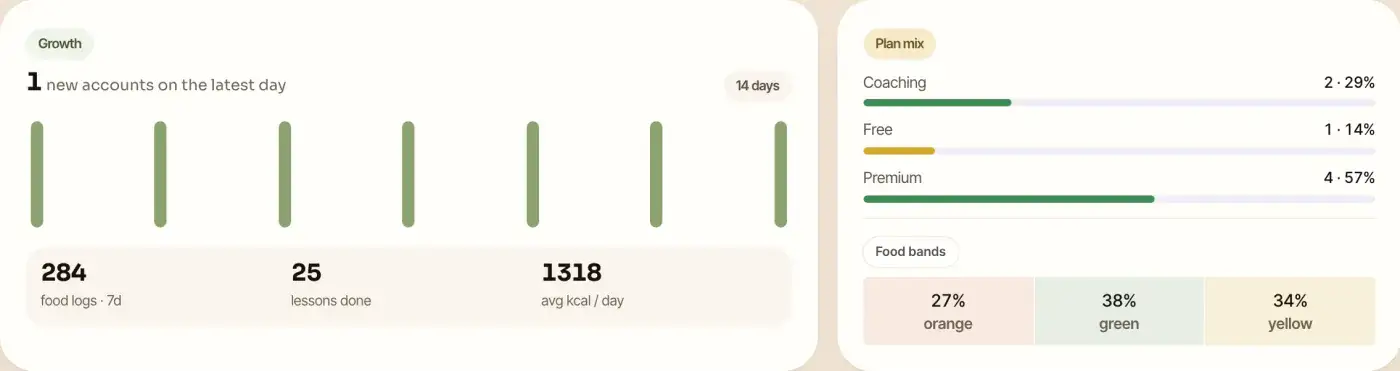
Take a small practice that moves its existing clients onto a branded app. It already has a client list, a team that writes plans and a regular income, so acquisition cost is low. The practice charges an average of $29 a month for app-based follow-up and expects 120 paying members across the year.
| Line item | Assumption | Cost over 12 months |
|---|---|---|
| Apple and Google Play accounts | $99 a year plus $25 once | $124 |
| Hosting, database and backups | $75 a month | $900 |
| Domain, email and push delivery | Flat yearly allowance | $150 |
| AI usage (food photos, coach chat) | 120 members at about $1 a month | $1,440 |
| Card processing | 120 members, $29 plan, 2.9% + 30 cents | $1,643 |
| Content and catalog setup | 60 hours of staff time at $40 | $2,400 |
| Marketing to existing and new clients | $300 a month | $3,600 |
| Running costs, 12 months | $10,257 |
Revenue at that size is about $41,760 a year, so running costs of $10,257 take roughly 25% of it before the build and before anyone’s salary. The largest lines are marketing and card processing, not hosting. Because the practice already holds a client base, a cut in marketing would push the percentage down quickly.
The build line comes on top and depends on the route. With the ready-made platform it is the fixed $3,399 once. With custom work it starts from the Clutch figures above. With SaaS it is the monthly fee multiplied by twelve, with hosting included. For a clinic that wants branded apps and its own client data, the practical comparison is usually between the first and the third. If you run a practice, our guide to a branded client app for dietitians walks through client onboarding and plan pricing in detail.
Worked Budget 2: A Coaching Startup With 400 Members
Now take a startup with no client base. It sells a $19 monthly coaching plan, pays for acquisition through creators and ads, and averages 400 paying members across the first year, which means it starts lower and ends higher. It hires a part-time support person once volume appears.
| Line item | Assumption | Cost over 12 months |
|---|---|---|
| Apple and Google Play accounts | $99 a year plus $25 once | $124 |
| Hosting, database and backups | $200 a month | $2,400 |
| Domain, email and push delivery | Flat yearly allowance | $300 |
| AI usage (food photos, coach chat) | 400 members on average at about $1 a month | $4,800 |
| Card processing | 400 members on average, $19 plan, 2.9% + 30 cents | $4,085 |
| Content and catalog setup | 80 hours at $40 | $3,200 |
| Part-time member support | $1,500 a month | $18,000 |
| Paid acquisition and creators | $2,500 a month | $30,000 |
| Running costs, 12 months | $62,909 |
Revenue is about $91,200 a year, and running costs are $62,909. The startup’s costs are dominated by acquisition and support, not infrastructure: those two lines together are about 76% of the total. This matters for route choice. If the build line eats the budget, nothing is left to buy members, and a coaching app with no members is a very expensive demo.
The same logic explains why the fixed-price route suits startups with a proven model. Every dollar not spent on a long build is a dollar available for acquisition. It also explains why a startup should stress-test its numbers: at $19 a month, card fees take about 4.5% of each charge, and a store commission on in-app sales would take far more.
| 12-month view (startup, 400 members) | Ready-made platform | Custom development | SaaS subscription |
|---|---|---|---|
| Build or platform line | $3,399 once | Clutch average $90,780, typical $10,000-$49,999 | Monthly fee, 12 times, with hosting included |
| Running costs shown above | All lines apply | All lines apply, plus maintenance staff | Hosting line replaced by the fee |
| Cost in year two | Running costs only | Running costs plus maintenance | Running costs plus fee again |
| What you own at the end | Platform and source code | Code, if the contract says so | A customer list and a subscription |
Ready-Made Does Not Mean Frozen: Custom Work and Add-Ons
A common objection to a ready-made platform is that it will not match the business exactly. In practice there are two ways to close the gap, and both are priced in writing before work begins.
Custom work on top of the base
Custom changes to the Miracuves build, such as a new plan type, an extra report for your dietitians or a screen that matches your intake process, are scoped and priced as a separate project. Plan on 15-30 days for typical custom work and up to 45-60 days for larger scope. This is different from a custom build from zero: you start from a working platform, so you pay for the change rather than for the foundation.
Paid add-ons
Six add-ons extend the base for businesses that need them, each priced on its own. They are native wearable adapters (an add-on) for step and sleep sync, smart scale and CGM sync as an add-on, live video coaching and group classes as an add-on, a video lesson studio add-on, a corporate wellness portal add-on for employer plans and regional language packs as an add-on on top of English and Hindi. Each is a paid add-on, so you only pay for the ones you launch with.
Treat each as a line in the year-one budget only if you can name the revenue it unlocks. A corporate wellness portal pays for itself if you have employers lined up. The video lesson studio add-on pays for itself if your brand sells instruction rather than tracking.
Because the source code is yours, any developer can extend the platform later, so a future change is not tied to a single vendor. That also changes your negotiating position on every later invoice.
Which Route Fits Which Founder
| Your situation | Best-fit route | Why |
|---|---|---|
| A practice with clients ready to move to an app | Ready-made platform | The model is proven, the team needs branded apps and own-data control, and nothing is gained by waiting for a long build. |
| A coaching startup validating a plan ladder | Ready-made platform | The budget should go to acquisition. Custom work can be added after real members show what they need. |
| A product whose assessment or workflow is entirely new | Custom development | The product is the differentiator, so paying for a unique foundation is justified. |
| A two-month test with 30 clients | SaaS subscription | A month-to-month fee is the lowest commitment when ownership does not matter yet. |
| An employer or insurer-facing program | Ready-made plus add-on | The corporate wellness add-on covers team plans and reporting, and custom work covers the rest. |
If your decision hinges on a weight-management build specifically, our companion guide on weight loss app development compares the build-versus-buy decision from that angle, including what to change after launch.
One more check is worth doing before you choose. Ask each vendor for the same three things in writing: the full list of surfaces and platforms in the price, the cost of the first change request after launch, and what happens to your code and data if you leave. A route that answers all three clearly is cheaper in practice than one that answers vaguely, whatever the headline number says.
Five Budget Mistakes That Sink a First Launch
Budgeting the build and nothing else
The build is paid once. Every other line repeats. If you reserve cash for the build only, the first quarter of running costs will arrive before the first quarter of revenue.
Using the average AI cost as the cap
Average usage hides the heavy users, who may log five photos a day. A hard per-member limit is cheaper than a surprise invoice, and it is easier to raise a cap later than to explain a bill.
Ignoring the checkout path
Whether you collect subscriptions by card or through the store changes margin by double digits on every plan. Decide it with your plan prices, not after launch.
Treating content as free
Lessons, recipes, meal plans and moderation take hours. If nobody owns them, the catalog goes stale and members leave. Name the owner and the weekly hours before you buy anything.
Launching with no growth money
A finished app does not bring members on its own. If the build absorbs the whole budget, you launch quietly to nobody. As a rule of thumb, hold back at least as much for the first six months of acquisition as you spend on the build.
Founder Decision Signals: Is Your Nutrition App Budget Ready?
Build Line Is Fixed
Do you hold a written price and timeline for everything you need at launch, or an estimate that depends on scoping later?
Running Costs Are Modeled
Have you priced hosting, AI usage, card fees and store accounts for your expected member count rather than a guess?
Checkout Path Is Chosen
Do you know whether members pay by card on your own checkout or through the stores, and what each path costs per plan?
Content Has an Owner
Is a named person responsible for lessons, recipes and catalog quality, with hours set aside each week?
Growth Cash Exists
Is there a separate acquisition budget for the first six months, not carved out of the build?
Exit Is Clear
If you leave this vendor, do you keep the code, the member data and the right to host it yourself?
How Miracuves Helps You Launch a Nutrition App on a Fixed Budget
Miracuves sells the build line as a single known number. Our ready-made nutrition coaching platform is built on MXHealthy and costs $3,399 once, with nothing charged per seat and no share of what you earn. It goes live in 6 working days of Miracuves work, with store review separate, and you receive the full source code.
What the price covers is the part most quotes split into extra lines:
- Android and iOS apps together, from one Flutter codebase, alongside a responsive browser app built with Next.js and TypeScript on PostgreSQL.
- A coach workspace covering caseload, member detail and earnings, so coaching work has a home from day one.
- An operator console with 14 areas, where your team changes pricing, trial lengths, discount codes, coach pay terms and AI routing without waiting on a store release.
- Stripe for cards plus rupee checkout, an English and Hindi interface, and a food catalog stocked with Indian dishes.
- Data controls built in: role checks on every action, sessions held on the server, parameterized SQL, and self-service export plus deletion requests for members.
After launch you are not left alone. Support runs in three tiers: 60 days of dedicated platform guidance, six months of priority bug resolution and a year of continuous product evolution. If your concept needs more than the base, custom work is scoped in writing at 15-30 days, or 45-60 days for larger scope, and the six paid add-ons cover wearables, devices, live video, video lessons, employer plans and extra languages.
The product page lets you sign in to the member, coach and operator sides before talking to anyone, then match the running costs in this guide to your own plan. If you want to see where the platform fits among health products, browse our healthcare solutions, our portfolio or the facts page for the figures we publish about ourselves.
Final Thoughts
The honest answer to what a nutrition app costs is a shape, not a number. A ready-made platform is a fixed build line followed by modest, predictable running costs. A custom build is a large scoped project followed by a team to maintain it. SaaS is a small monthly fee that never stops. The most useful thing a founder can do is price all twelve months for each route at the member count they actually expect.
For many practices and coaching startups the proven-model route leaves the most money for the work that grows a business: content, coaches and acquisition. Miracuves is built for exactly that decision, with a fixed price, source code you own and apps for both stores included. Start from your own member count, fill in the tables above and ask any vendor to match them in writing.
Frequently Asked Questions
How much does a nutrition app cost to build in 2026?
It depends on the route. A ready-made platform is a fixed one-time price, a custom build is a scoped project that Clutch data suggests often runs from tens of thousands of dollars upward, and SaaS is a monthly subscription. On top of the build, plan for hosting, AI usage, card fees, store accounts, content work and member support.
What are the ongoing costs of running a nutrition app?
The main recurring costs are hosting and database backups, AI usage for photo logging and coach chat, card processing, email and push delivery, the two store developer accounts, content upkeep and member support. Marketing is usually the largest line in the first year.
Is a food database included, or do I pay for one separately?
The Miracuves platform ships with a curated catalog that includes Indian foods, and your team extends it from the operator console. Public sources such as the USDA database are free to use, while branded or regional product data from commercial providers is licensed separately and priced per provider.
How much does AI food logging add to the cost?
AI logging is billed per use by the provider you connect, so the cost depends on how many members use photo or plain-language logging each day. Setting a daily cap per member keeps the bill predictable, and you can route each AI task to a model that suits its price.
Do I pay a store commission on subscriptions?
Only if members buy through the store billing system. Selling through your own card checkout avoids that commission but is subject to each store policy, so confirm the current rules before you set plan prices. Card processing fees apply either way.
How fast can a ready-made nutrition app go live?
The Miracuves ready-made build is live in 6 working days of Miracuves work, while store review time is separate and depends on Apple and Google. Custom work on top of the base typically takes 15-30 days, or 45-60 days for larger scope.
Is SaaS cheaper than owning the platform?
SaaS is cheaper in month one and usually more expensive by the end of year two, because the fee repeats and often grows with member count. Owning the platform costs more up front, but the build line does not repeat and the code stays yours.
What is the cheapest way to test a nutrition coaching idea?
A short SaaS pilot with a small group of clients is the lowest commitment. If the model works and you want your own brand, data and apps, moving to a ready-made platform you own avoids paying a growing subscription indefinitely.
What support comes after launch?
Miracuves provides 60 days of dedicated platform guidance, 6 months of priority bug resolution and 12 months of continuous product evolution. Because you hold the source code, you can also extend the platform with any developer later.
Miracuves is an independent software development company. We are not affiliated with, connected to, sponsored by, or endorsed by any company or product named in this article.
Terms such as “X Clone” are used descriptively. It is how the software industry refers to building a platform with functionality comparable to a known service, and how clients search for it.
The entire design and codebase of our products is built by our own team. Our products contain no code, design, graphics, or content originating from any third-party website or applications.
All third-party names and marks referenced in this article are the property of their respective owners, referenced solely to identify the services discussed.