


Key Takeaways
- community-driven platforms should go beyond posting and comments to include topic-based spaces, moderation, member roles, voting, search, notifications, monetization, and admin controls.
- Moderation is a core operating layer because growing communities need report queues, bans, appeals, audit logs, spam controls, and community-specific permissions.
- Community platform pricing depends on module depth, including web and mobile coverage, content types, moderation, monetization, search, infrastructure, and customization.
- The tech stack should support fast feeds, threaded discussions, role-based access, search indexing, notifications, media uploads, payments, and scalable APIs.
- Founders should define the community model, governance structure, monetization strategy, and ownership requirements before deciding how much to build.
Platform Signals
- Core product layers include member accounts, topic-based communities, publishing tools, threaded comments, voting, reputation, moderation, search, and notifications.
- Roles should distinguish members, moderators, community owners, admins, and platform operators instead of giving every privileged user the same access.
- Monetization can include premium memberships, paid communities, coin wallets, awards, sponsored spaces, featured posts, ads, and business accounts.
- A practical technical foundation can combine a modern frontend, API-first backend, relational database, caching, search, secure media storage, and monitoring.
- Security should include role-based access, session controls, audit logs, rate limiting, abuse reporting, upload validation, secure payments, and privacy-conscious data handling.
Real Insights
- A community discussion platform is not simply a social feed; its long-term value comes from topic structure, member contribution, governance, reputation, and searchable discussion history.
- Founders should build governance before aggressive growth because posting features without moderation can quickly create operational and trust problems.
- Pricing should be evaluated by module complexity rather than screen count because moderation, payments, search, media, and infrastructure can significantly change scope.
- Monetization works better after the community develops trust and contribution quality rather than activating every revenue model at launch.
- The strongest community platforms combine useful discussions, scalable governance, flexible monetization, admin visibility, source-code control, and an extensible technical foundation.
A strong community discussion platform is not just a feed where people publish random posts. It is a structured digital space where members gather around shared interests, create discussions, vote on useful content, follow topics, report problems, build reputation, and help shape the rules of the community itself.
For founders, this distinction matters.
A simple posting app may get users to publish content. A community-driven platforms gets users to return, participate, moderate, recommend, debate, and build value together over time. The product is not only the interface. The product is the interaction system behind it.
That system usually works through five connected layers:
- Members join topic-based spaces.
- Members create posts, questions, links, polls, or media discussions.
- Other members vote, comment, save, report, and share.
- Moderators and community owners enforce rules.
- The platform learns which communities, topics, and conversations deserve more visibility.
When these layers work together, the platform becomes more than a content board. It becomes a living knowledge and engagement network.
For founders planning to build an online discussion product, the goal should not be to copy another platform’s surface design. The better goal is to understand the mechanics that make member-led communities useful, safe, and monetizable.
What Is a Community-Driven Platform?
A community-driven platforms is an online product where users do not only consume content. They actively create, organize, rank, discuss, and govern the content ecosystem.
Unlike a basic social feed, a community-driven platform is usually built around shared spaces. These spaces may be based on hobbies, professions, products, regions, creators, education, gaming, finance, health, local interests, or private membership groups.
A user may join one space for startup advice, another for gaming discussions, another for product feedback, and another for local recommendations. Each space can have its own rules, moderators, posting formats, and discussion culture.
That is what makes a community discussion platform powerful. The platform operator owns the infrastructure, but the community creates much of the value.
The Core Product Loop
A community-driven platform works through this loop:
Join → Post → Vote → Discuss → Moderate → Discover → Return
Here is how that loop works in practice:
| Step | What Happens | Why It Matters |
|---|---|---|
| Join | A user joins a topic-based community | Creates belonging and interest-based personalization |
| Post | The user publishes a question, link, thought, poll, or media item | Starts the community contribution cycle |
| Vote | Members upvote, downvote, react, or rank content | Helps useful content rise faster |
| Discuss | Members reply, debate, answer, and expand the topic | Turns posts into deeper conversations |
| Moderate | Reports, rules, bans, approvals, and removals keep quality under control | Protects trust and prevents chaos |
| Discover | Search, feeds, tags, and recommendations expose relevant discussions | Helps users find value beyond one thread |
| Return | Notifications and reputation signals bring users back | Builds retention and community habit |
For founders, this loop is more important than any single feature. If the loop is weak, users may post once and leave. If the loop is strong, the platform becomes a recurring destination.
Read more – Community Platform Features, Pricing, and Tech Stack: What Founders Should Know in 2026
How Posts Create the Foundation of a Community Discussion Platform
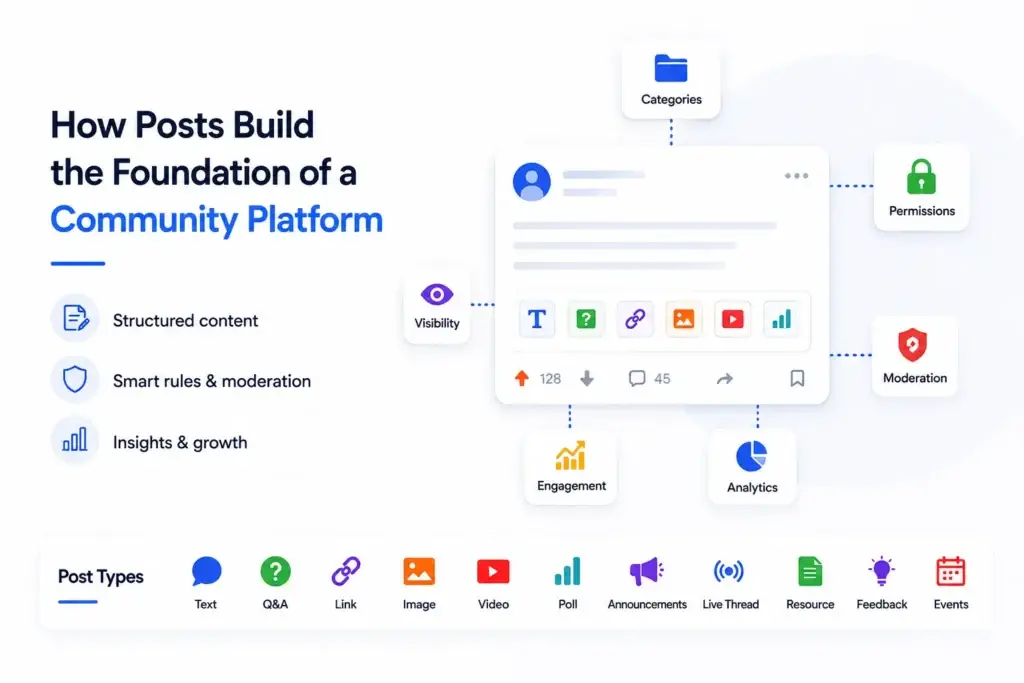
Posts are the starting point of community activity. But in a serious community discussion platform, a post is not just a text box. It is a structured content object connected to categories, permissions, visibility rules, moderation states, engagement signals, and analytics.
A platform may support different post types such as:
- Text discussions.
- Questions and answers.
- Link sharing.
- Image posts.
- Video posts.
- Polls.
- Announcements.
- Live discussion threads.
- Resource pages.
- Product feedback posts.
- Event discussions.
The right post types depend on the business model.
A professional knowledge community platform features need long-form posts and accepted answers. A gaming community may need media, live threads, and polls. A product feedback community may need tags, status labels, and admin replies. A creator-led private community may need premium-only posts or member-only discussion spaces.
Why Post Structure Matters
The post structure affects everything that happens later.
If posts are poorly structured, search becomes weak, moderation becomes messy, and analytics become shallow. If posts are well structured, the platform can answer important questions:
- Which topics drive the most engagement?
- Which communities produce the highest-quality discussions?
- Which users create the most useful content?
- Which post formats increase retention?
- Which topics need moderation attention?
- Which discussions convert users into paid members?
This is why founders should think beyond the posting screen. The backend data model behind each post shapes future growth, moderation, monetization, and personalization.
Why Voting Systems Are More Than Engagement Features
Voting is one of the strongest ranking signals in a community-driven platform. It helps the community decide what deserves attention.
But voting is not just an engagement mechanic. It is a visibility engine.
When members vote on posts and comments, the platform can use those signals to rank discussions, highlight helpful replies, suppress low-quality content, and personalize feeds.
A strong voting system may include:
- Upvotes.
- Downvotes.
- Reactions.
- Comment-level voting.
- Weighted scoring.
- Time-based ranking.
- Hot, new, top, and trending filters.
- Reputation-based influence.
- Vote fraud detection.
- Rate limits.
- Vote history for abuse review.
Voting Without Governance Can Become Risky
Voting can improve content discovery, but it can also create problems if the platform has no safeguards.
Common risks include:
- Coordinated voting.
- Popularity bias.
- Low-quality viral posts.
- Harassment through downvoting.
- Spam boosting.
- New-user discouragement.
- Group manipulation.
- Engagement chasing instead of useful discussion.
That is why voting should work with moderation, reputation, and admin controls. The goal is not only to reward popular content. The goal is to surface useful, relevant, and trustworthy discussions.
Voting System Design and Founder Impact
| Voting Layer | What It Does | Founder Impact |
|---|---|---|
| Post voting | Lets members rank full discussions | Helps high-value posts gain visibility faster |
| Comment voting | Lets members identify helpful replies | Improves answer quality and thread usefulness |
| Time-based ranking | Balances freshness with engagement | Prevents old content from dominating every feed |
| Reputation weighting | Uses member credibility as a signal | Rewards trusted contributors without silencing new users |
| Anti-abuse checks | Detects suspicious voting behavior | Protects community trust and feed quality |
| Admin override | Allows operators to control harmful or sensitive visibility patterns | Gives the business final control during abuse or crisis scenarios |
How Threaded Comments Turn Posts Into Conversations
A post starts the discussion. Comments create the depth.
Threaded comments allow members to reply directly to specific ideas instead of forcing every response into one flat timeline. This matters because community conversations often branch into multiple subtopics.
For example, a post about launching a creator community may lead to separate comment threads about pricing, moderation, onboarding, content strategy, and member retention. Without threaded replies, those discussions become difficult to follow.
A strong comment system should support:
- Parent-child reply structure.
- Comment sorting.
- Comment voting.
- Mentions.
- Edit history where needed.
- Deleted comment handling.
- Report buttons.
- Moderator notes.
- Collapse and expand behavior.
- Comment depth controls.
- Notification triggers.
- Spam and abuse detection.
Why Comment Architecture Matters
Comment systems can become technically complex as platforms grow.
A single post may receive hundreds or thousands of replies. If the platform retrieves every comment inefficiently, the page slows down. If deleted comments are removed without audit context, moderation history breaks. If replies have no depth limits, discussions can become unreadable.
For founders, this creates a product decision: should the platform prioritize fast, simple conversations or deep knowledge threads?
The answer depends on the community model. A professional Q&A network may need deeper thread structure. A creator fan community may need faster, lighter comments. A product feedback platform may need admin responses, status labels, and pinned replies.
Read more – Community-Led Growth Strategy: Seed Content, Moderators, and Referral Loops for Discussion Platforms
Why Moderation Is the Real Trust Layer
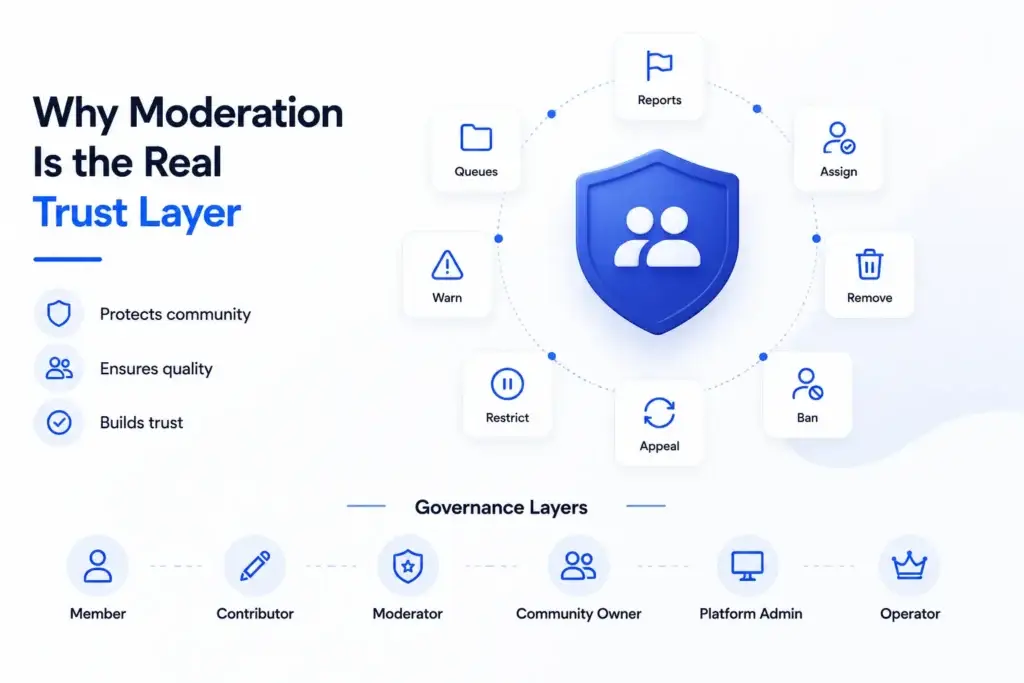
Moderation is where many founders underestimate the work.
At the beginning, a community discussion platform may feel easy to manage. There are fewer users, fewer posts, and fewer disputes. But once activity grows, the platform needs clear workflows for rule enforcement, abuse reporting, spam control, member disputes, and content quality.
Moderation is not only about removing harmful posts. It is about protecting the conditions that make people willing to participate.
A platform without moderation can suffer from:
- Spam.
- Harassment.
- Low-quality posting.
- Repeated rule violations.
- Unsafe content.
- Misinformation risks.
- Community owner conflicts.
- Moderator inconsistency.
- Member distrust.
- Advertiser or partner concerns.
A strong moderation system should include:
- Report categories.
- Report queues.
- Moderator assignment.
- Removal reasons.
- Warning systems.
- Temporary restrictions.
- Permanent bans.
- Appeals.
- Moderator notes.
- Admin escalation.
- Audit logs.
- Automated rule checks.
- Spam and rate-limit controls.
- Community-level rules.
- Platform-wide policy controls.
Community-Level Moderation vs Platform-Level Oversight
A scalable community-driven platform usually needs both.
Community-level moderation allows local moderators or community owners to manage day-to-day rules. Platform-level oversight allows the operator to enforce broader safety, legal, brand, and business standards.
| Governance Layer | Responsible Role | Typical Controls |
| Member | Participates, votes, reports, comments | Report content, follow rules, manage profile |
| Contributor | Creates regular posts and comments | Publish, edit, engage, build reputation |
| Moderator | Handles community-level quality | Review reports, remove content, warn users |
| Community owner | Manages a specific community space | Set rules, assign moderators, configure community settings |
| Platform admin | Controls the whole platform | Manage users, content, payments, policies, analytics |
| Operator | Owns business-level decisions | Monetization, compliance workflows, growth strategy, platform roadmap |
This role separation is important. If every moderation action requires the platform owner, the operation will not scale. If community moderators have too much unrestricted power, the platform may face abuse, inconsistency, or trust issues.
Good governance gives each role the right level of control.
How Member Governance Helps Communities Scale
Member governance is the system that lets communities participate in their own quality control.
It can include voting, reporting, moderator roles, community rules, reputation systems, badges, contribution history, and access permissions.
When governance works well, members feel that the platform is not just owned by an operator. They feel responsible for the quality of the space.
This can improve:
- Retention.
- Trust.
- Content quality.
- Contributor motivation.
- Community identity.
- Moderator efficiency.
- New-member onboarding.
- Long-term platform defensibility.
Reputation as a Governance Signal
Reputation systems help identify trusted contributors.
A platform can assign reputation based on:
- Post quality.
- Comment helpfulness.
- Votes received.
- Reports avoided.
- Moderator approvals.
- Time in community.
- Verified identity where relevant.
- Expert status.
- Community-specific contribution.
Reputation should be handled carefully. If it is too powerful, early users dominate the platform. If it is too weak, quality contributors may not feel recognized.
A balanced approach uses reputation as one signal among many, not as the only ranking or permission system.
How Feeds and Discovery Work in a Community Discussion Platform
Discovery decides whether users find value quickly.
A community discussion platform may include several discovery paths:
- Home feed.
- Community feed.
- Trending posts.
- New posts.
- Top posts.
- Search.
- Tags.
- Recommended communities.
- Saved posts.
- Related discussions.
- Personalized notifications.
- Digest emails.
The discovery layer should reflect the platform’s purpose.
For a public knowledge community, search and evergreen discussions may matter most. For a fan community, trending posts and real-time engagement may matter more. For a professional community, topic filters, expert replies, and saved discussions may create more value.
Feed Ranking Should Match Business Goals
A feed can rank content by:
- Freshness.
- Votes.
- Comments.
- Saves.
- Reports.
- Community activity.
- User interests.
- Followed topics.
- Reputation signals.
- Paid promotion where clearly disclosed.
- Admin curation.
Founders should decide early what the feed should reward.
Does the platform reward speed, quality, expertise, debate, entertainment, learning, or member support? The answer should shape the ranking logic.
Monetization Should Follow Community Value
A community platform business model can monetize in several ways, but monetization should not be forced before trust exists.
Common monetization options include:
| Monetization Model | How It Works | Best Fit |
| Premium communities | Members pay to access private spaces | Creator, expert, education, or professional communities |
| Membership tiers | Users pay for extra access, badges, or privileges | Strong identity-based communities |
| Sponsored discussions | Brands sponsor relevant communities or topics | Niche platforms with clear audience segments |
| Promoted posts | Approved posts receive paid visibility | Job, product, event, or marketplace-style communities |
| Awards or credits | Members reward useful posts or comments | Communities with strong contribution culture |
| Business accounts | Organizations pay for branded tools or analytics | SaaS, professional, or B2B communities |
| Ads | Display or native placements | High-traffic public discussion platforms |
The mistake is adding monetization before the community has value. Users are more willing to pay when the platform already gives them access, identity, status, learning, entertainment, or problem-solving.
For founders, the monetization question should be:
“What does this community help members do that they cannot easily do elsewhere?”
Once that answer is clear, pricing and revenue models become easier to design.
Founder Decision Signals
Speed
If your product needs posting, voting, moderation, roles, admin control, and monetization workflows, starting with a launch-ready foundation can reduce avoidable build complexity.
Trust
If discussions involve user-generated content, moderation must be planned early. Reports, bans, appeals, and audit records are difficult to retrofit under pressure.
Retention
If members do not discover useful discussions quickly, they will not return. Feed ranking, notifications, search, and topic-based communities directly affect retention.
Control
If pricing, rules, roles, and community settings require developer support every time, the founder loses operational flexibility after launch.
Admin Control: The Layer Founders Cannot Ignore
Members see the community interface. Founders operate the admin layer.
The admin dashboard should let the platform operator control users, communities, content, reports, monetization, settings, and analytics without depending on developers for every small change.
A strong admin layer may include:
- User management.
- Community approvals.
- Post and comment review.
- Report queues.
- Moderator assignment.
- Ban and appeal management.
- Rule configuration.
- Category and tag management.
- Content visibility controls.
- Featured content settings.
- Monetization settings.
- Payment and subscription controls.
- Analytics dashboards.
- Audit logs.
- Notification templates.
- Site configuration.
This is where a community discussion platform becomes a real business system. Without admin control, the founder may launch the product but struggle to manage it after users arrive.
Mistakes Founders Should Avoid
Building a posting tool instead of a community system
A post button alone does not create community value. Founders need topic spaces, voting, comments, moderation, roles, discovery, and admin controls working together.
Adding moderation after problems appear
Trust and safety workflows should be part of the foundation. Waiting until abuse appears makes moderation harder, more expensive, and more stressful to fix.
Using one role for every type of user
Members, moderators, community owners, admins, and platform operators need different permissions. Poor role design can create security and governance risks.
Letting voting decide everything
Voting is useful, but it should not be the only ranking or governance signal. Reputation, reports, moderator decisions, and admin oversight also matter.
Launching without a clear community niche
Broad communities are harder to grow because users do not know why they should join. A focused audience, use case, or discussion category helps early traction.
When a Launch-Ready Community Platform Foundation Makes Sense
A founder can build a community platform development cost from scratch, but that is not always the fastest or safest route.
Custom development may make sense when the platform has a highly unique interaction model. But if the core need is topic-based communities, posts, voting, comments, moderation, member roles, notifications, monetization, and admin control, a launch-ready foundation can be more practical.
A ready-made foundation is useful when:
- You want to launch faster.
- You need source-code ownership.
- You want branded design and custom positioning.
- You need web and mobile planning.
- You want moderation tools from day one.
- You want admin control over users, communities, and content.
- You want to test premium spaces, awards, memberships, or promoted posts.
- You want future customization without starting from zero.
Miracuves helps founders build white-label solution platforms with source code, branded interfaces, role-based access, moderation workflows, admin dashboards, monetization settings, and faster deployment.
The objective is not to replicate another platform’s identity. The objective is to use proven community mechanics to create a differentiated discussion product for your own audience, niche, or business model.
Connects broader social Network platform intent to a relevant service For a deeper look at the launch-ready product foundation, explore the community discussion platform solution from Miracuves.
Final Thoughts: Community Platforms Work When Members Help Shape the Product
A Reddit when users feel that their contributions matter.
That happens when posts are easy to create, voting helps useful content rise, comments support real discussion, moderation protects trust, and member governance gives communities a sense of ownership.
For founders, the lesson is clear: do not only build the visible interface. Build the operating logic behind the community.
A strong community discussion platform needs:
- Topic-based spaces.
- Structured posts.
- Voting and ranking.
- Threaded comments.
- Member roles.
- Moderation workflows.
- Reputation signals.
- Search and discovery.
- Notifications.
- Monetization controls.
- Admin dashboards.
- Source-code flexibility.
When these layers work together, the platform becomes more than a feed. It becomes a digital place where members return because the conversations are useful, organized, and worth joining.
Miracuves can help founders turn that product logic into a launch-ready community platform with white-label branding, admin control, source-code ownership, and practical customization support.
FAQs
What is a community discussion platform?
A community discussion platform is an online space where members join topic-based communities, create posts, comment in threads, vote on content, report issues, build reputation, and participate in moderated discussions.
How does a community-driven platform work?
A community-driven platform works through a loop of joining communities, publishing posts, voting, commenting, moderating, discovering useful discussions, and returning through notifications or member habit.
Why are voting systems important in online communities?
Voting systems help members signal which posts and comments are useful. This allows the platform to rank content, improve discovery, and reward valuable contributions.
What role does moderation play in a community platform?
Moderation protects community quality and trust. It helps manage reports, spam, harassment, removals, bans, appeals, rule enforcement, and admin escalation.
What is member governance?
Member governance is the system that allows users, moderators, and community owners to help shape the quality and rules of the platform through voting, reporting, moderation, reputation, and role-based permissions.
Can a community discussion platform make money?
Yes. A platform can monetize through premium communities, memberships, awards, promoted posts, sponsored spaces, business accounts, or ads. The best model depends on the audience, niche, and value of the community.
What features should founders prioritize first?
Founders should prioritize topic-based communities, post creation, comments, voting, moderation, member roles, search, notifications, admin control, and analytics before adding advanced monetization or complex personalization.
How can Miracuves help build a community discussion platform?
Miracuves helps founders launch white-label community platforms with source code, admin dashboards, moderation workflows, member roles, voting systems, monetization options, and faster deployment support.
Miracuves is an independent software development company. We are not affiliated with, connected to, sponsored by, or endorsed by any company or product named in this article.
Terms such as “X Clone” are used descriptively. It is how the software industry refers to building a platform with functionality comparable to a known service, and how clients search for it.
The entire design and codebase of our products is built by our own team. Our products contain no code, design, graphics, or content originating from any third-party website or applications.
All third-party names and marks referenced in this article are the property of their respective owners, referenced solely to identify the services discussed.