
Key Takeaways
- Zipcar is a car-sharing platform that gives members access to vehicles by the hour or day.
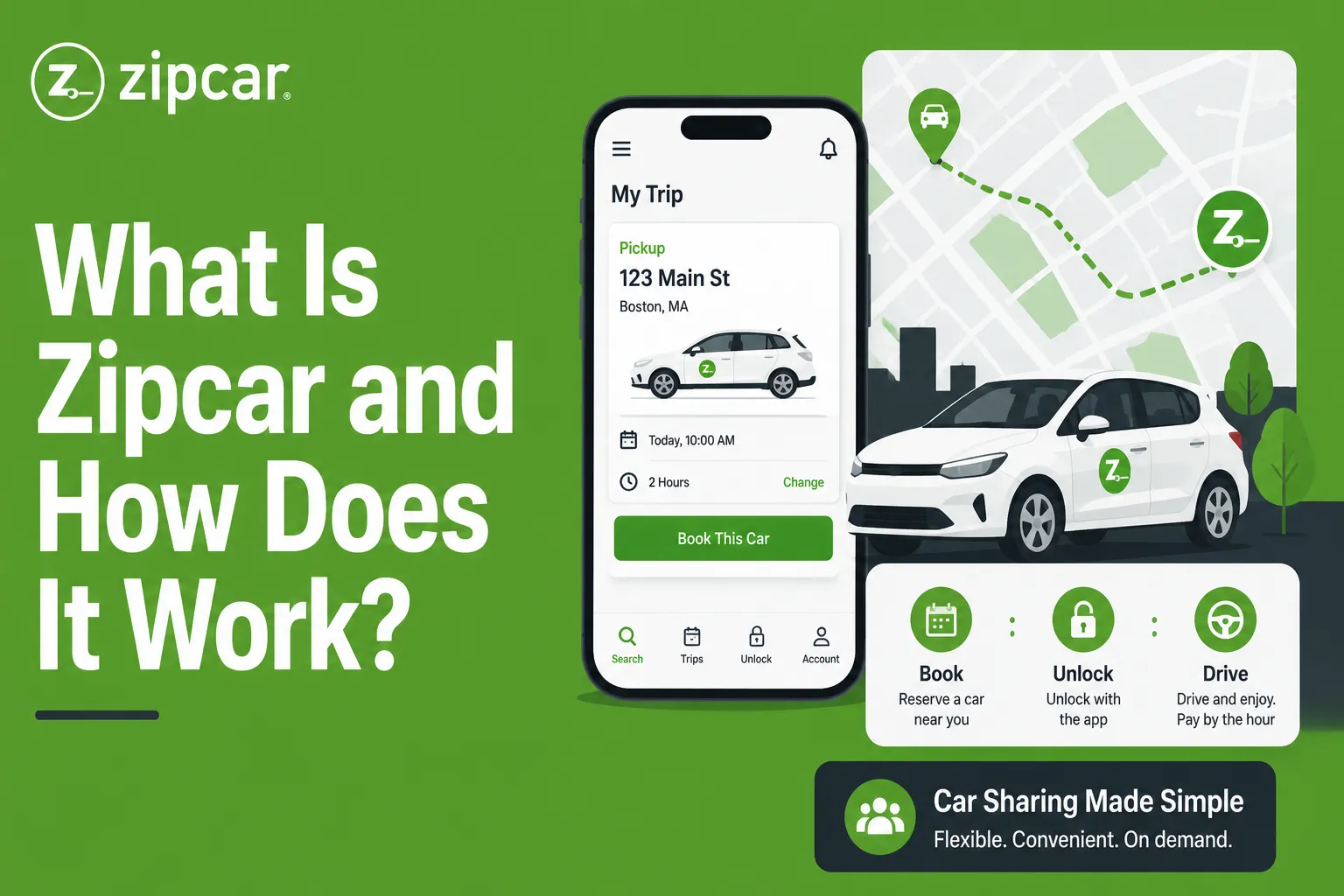
- Users can reserve, unlock, drive, and return cars through a self-service app flow.
- Membership fees, usage charges, campus programs, and penalties support the business model.
- Fleet management, parking spots, billing, and vehicle access systems must work together.
- A Zipcar-style platform works best in cities, campuses, and high-density residential areas.
Feature Signals
- Users need signup, license verification, membership plans, reservations, and trip history.
- The app needs car search, availability calendars, hourly pricing, and booking extensions.
- Fleet teams need tools for vehicle placement, cleaning, fueling, maintenance, and rotation.
- Admins need control over users, bookings, payments, mileage, penalties, and disputes.
- Vehicle access, telematics, alerts, and automated billing make the experience reliable.
Real Insights
- Car sharing succeeds when access feels easier than ownership.
- Dedicated parking spots reduce pickup confusion and improve user confidence.
- Weak scheduling logic can create overlapping bookings and poor vehicle utilization.
- Transparent pricing helps users trust hourly and daily car-sharing services.
- Miracuves builds Zipcar-style car-sharing platforms with reservation, fleet, and admin workflows.
Imagine you need a car for a grocery run, a weekend trip, or an important meeting—but owning a car feels expensive and unnecessary. Instead of dealing with insurance, parking, and maintenance, you reserve a car nearby, unlock it with your phone, and return it when you’re done. That’s the everyday convenience Zipcar was built to deliver.
Zipcar is a membership-based car sharing service that gives people short-term access to cars by the hour or day. Unlike traditional rentals or peer-to-peer sharing, Zipcar operates its own fleet of vehicles placed in dedicated parking spots across cities, campuses, and residential areas.
What makes Zipcar different is predictability. Pricing includes fuel, insurance, and maintenance, and cars are always where the app says they’ll be—making it a reliable alternative to owning a car, especially in cities.
By the end of this guide, you’ll understand what Zipcar is, how it works step by step, how it makes money, its key features, and why entrepreneurs study Zipcar when building car-sharing platforms—and how Miracuves can help build similar mobility solutions.
What Is Zipcar? The Simple Explanation
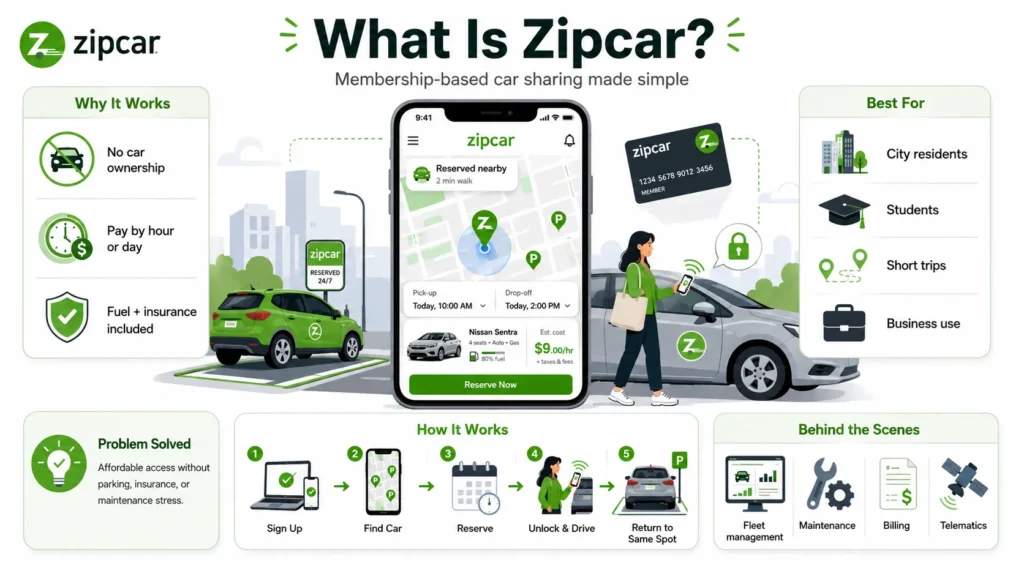
Zipcar is a membership-based car sharing service that lets people rent cars by the hour or day from a company-owned fleet. In simple terms, it gives you access to a nearby car whenever you need one—without the costs and responsibilities of owning a vehicle.
The Core Problem Zipcar Solves
Owning a car in cities can be expensive and inconvenient due to parking, insurance, maintenance, and low usage. Zipcar solves this by offering on-demand access to cars only when you actually need them, making transportation more efficient and affordable.
Target Users and Use Cases
Zipcar is commonly used by:
• Urban residents who don’t want to own a car
• College students and campus communities
• Professionals needing occasional transportation
• People running errands or short trips
• Businesses needing short-term vehicle access
Current Market Position
Zipcar is one of the most established car sharing brands in the United States, especially strong in major cities, universities, and residential complexes. Its company-owned fleet model makes it different from peer-to-peer car sharing platforms.
Why It Became Successful
Zipcar succeeded because it focused on reliability and simplicity. Cars are pre-placed in known locations, pricing includes fuel and insurance, and the booking-to-driving process is fast. This predictability makes it easy for users to trust and rely on the service.
ed spots nearby. Each listing shows:
- Car type and features
- Hourly or daily rate
- Availability window
- Location of the parking spot
Users reserve a car for the exact time they need—by the hour or day.
Unlocking and Driving
At the start of the reservation, members unlock the car using the app or a Zipcar access card. Keys are stored inside the vehicle. Fuel, insurance, and maintenance are included, so members just drive.
During the Trip
Members can extend the reservation through the app if the car isn’t booked by someone else. Mileage limits apply based on the plan.
Returning the Car
At the end of the reservation, members return the car to the same designated parking spot, lock it via the app or card, and end the trip.
Example Member Journey
User signs up → finds nearby Zipcar → reserves time slot → unlocks car → drives → refuels if needed → returns to same spot → trip ends.
For Zipcar (Fleet Operator)
Fleet Management
Zipcar owns and maintains the vehicles. It manages:
- Vehicle placement and parking agreements
- Cleaning, fueling, and maintenance
- Insurance coverage
- Fleet rotation and upgrades
Operations & Support
Zipcar monitors usage, handles roadside assistance, manages damage claims, and supports members through in-app and customer service tools.
Technical Overview (Simplified)
Zipcar operates through an integrated mobility system that includes:
- Member mobile app and access cards
- Reservation and scheduling engine
- Vehicle access and telematics
- Fleet operations and maintenance systems
- Billing and membership management
All systems work together to make car access predictable and self-service.
Read More: Best Zipcar Clone Scripts 2026 Build a Smart Car Sharing Platform
Zipcar’s Business Model Explained
How Zipcar Makes Money
Zipcar follows a membership + usage-based model. Unlike peer-to-peer platforms, Zipcar owns and operates its fleet, which lets it control availability, pricing, and service quality.
Primary revenue streams include:
- Membership fees: Users pay a monthly or annual subscription
- Usage fees: Hourly or daily rental charges per reservation
- Enterprise and campus programs: Contracted access for companies and universities
- Add-ons and penalties: Late returns, extra mileage, or policy violations
Pricing Structure
Zipcar pricing is straightforward and transparent:
- Hourly or daily rates based on vehicle type
- Fuel, insurance, and maintenance included
- Mileage limits included (with overage fees if exceeded)
Members see the full cost before booking, which keeps expectations clear.
Fee Breakdown
- Membership subscription (recurring)
- Time-based rental charges
- Optional or penalty-based fees
Because Zipcar controls the fleet, pricing is standardized across locations.
Market Size and Demand
Zipcar serves a growing demand for access over ownership, especially in dense cities, campuses, and residential communities where cars are used infrequently but still necessary.
Profitability Insights
Zipcar improves margins by:
- Maximizing vehicle utilization per day
- Placing cars in high-demand locations
- Using data to optimize fleet size and mix
- Reducing idle time through reservations and extensions
Revenue Model Breakdown
| Revenue Stream | Description | Who Pays | Nature |
|---|---|---|---|
| Membership Fees | Monthly/annual plans | Members | Subscription |
| Usage Fees | Hourly/daily rentals | Members | Transaction-based |
| Enterprise/Campus | Bulk access programs | Orgs | Contract-based |
| Add-ons & Penalties | Mileage, late returns | Members | Variable |
Key Features That Make Zipcar Successful
Membership-based access
Zipcar operates on a membership model, which creates commitment and repeat usage. Once users join, they tend to rely on Zipcar regularly instead of switching between rental options.
Company-owned fleet
Unlike peer-to-peer car sharing, Zipcar owns and manages its vehicles. This ensures consistent quality, predictable availability, and standardized pricing across locations.
Dedicated parking spots
Zipcar vehicles are placed in fixed, reserved parking spots. Users always know exactly where to pick up and return the car, which removes uncertainty.
Hourly and daily reservations
Zipcar supports short-term rentals by the hour as well as longer daily bookings, making it suitable for errands, meetings, and weekend trips.
Fuel and insurance included
Pricing includes fuel, insurance, and maintenance. This all-in-one model makes cost comparison easy and reduces mental overhead for users.
App-based access and reservations
Members can reserve, unlock, extend, and end trips directly from the app, creating a smooth self-service experience.
Predictable availability
Because cars are reserved in advance and returned to the same spot, users can plan trips confidently without last-minute surprises.
Campus and residential partnerships
Zipcar partners with universities, apartments, and businesses to place cars where demand is guaranteed, improving utilization.
Simple pricing transparency
Users see the total cost upfront, including mileage limits, which helps build trust and reduce disputes.
Reliable support and roadside assistance
Zipcar provides customer support and roadside assistance, reinforcing reliability for members who depend on the service.
The Technology Behind Zipcar
Tech stack overview (simplified)
Zipcar runs on a fleet-based mobility technology stack that tightly connects software with company-owned vehicles. The main layers include:
- Member app: reservations, unlock/lock, extensions, billing
- Vehicle access system: in-car hardware for secure entry and trip control
- Fleet management backend: availability, utilization, maintenance, and rotation
- Billing and membership systems: subscriptions, usage charges, penalties
- Operations and support tools: roadside assistance, damage handling, customer care
Vehicle access and telematics
Each Zipcar vehicle is equipped with in-car technology that enables:
- App-based or card-based unlocking
- Trip start and end verification
- Mileage and usage tracking
- Alerts for fuel level or maintenance needs
This eliminates key exchanges and ensures accurate trip timing.
Reservation and scheduling engine
Zipcar’s reservation system must:
- Prevent overlapping bookings
- Enforce return-to-same-spot rules
- Allow extensions if no conflict exists
- Handle late returns and penalties automatically
Because cars are company-owned, the platform can strictly control availability and usage.
Fleet management and maintenance systems
Technology helps Zipcar manage thousands of vehicles by:
- Tracking utilization rates by location
- Scheduling cleaning, fueling, and servicing
- Rotating vehicles to high-demand areas
- Flagging issues reported by members
This keeps the fleet reliable and ready for use.
Payments and membership management
Zipcar’s billing system handles:
- Recurring membership fees
- Time-based rental charges
- Mileage limits and overages
- Late fees and policy violations
All charges are calculated automatically based on trip data.
Trust, security, and compliance
Zipcar enforces safety and trust through:
- Driver identity and license verification
- Secure access controls
- Audit logs for every trip
- Clear policies for damage and misuse
Because Zipcar owns the vehicles, compliance and risk management are central to the platform.
Scalability approach
Zipcar scales by:
- Adding vehicles to high-demand locations
- Partnering with campuses and residential complexes
- Using data to optimize fleet size and placement
- Expanding service areas gradually
Why this technology matters for business
Zipcar’s technology turns cars into shared, bookable assets. By controlling access, reservations, and fleet operations through software, it delivers a predictable alternative to car ownership—something users can depend on daily.
Miracuves Zipcar-Like Platform Solution Cost and Tech Stack
Miracuves Pricing for a Zipcar-Like Smart Car Sharing Platform developed using JavaScript architecture is available on request. Final pricing depends on car sharing modules, membership workflows, fleet management features, booking logic, smart access integrations, payment systems, scalability requirements, and deployment scope. Estimated delivery timeline: 30 to 90 days.
Get a fully developed, custom car sharing platform modeled around Zipcar-style short-term vehicle access and membership-based mobility. Built on a modern JavaScript foundation, this solution can be customized for car rental startups, fleet operators, corporate mobility providers, university transport programs, city-based car sharing businesses, and shared mobility platforms.
- Core Workflows: User registration, membership plans, vehicle search, car booking, availability calendar, pickup scheduling, smart access flow, trip management, cancellation handling, and customer notifications.
- Built-in Revenue Logic: Membership fees, hourly rentals, daily rentals, mileage-based charges, late return fees, cancellation fees, insurance add-ons, corporate plans, and location-based pricing rules.
- Management Hub: Admin dashboard, fleet management, member management, booking tracking, vehicle availability control, payment records, refund handling, damage reports, branch/location management, and rental analytics.
- Smart Car Sharing-Ready Architecture: Prepared for fleet-based rentals, membership access, location-based vehicle discovery, smart lock integrations, payment gateway setup, verification workflows, real-time availability syncing, and long-term mobility platform growth.
Why Does a Zipcar-Like Platform Require JavaScript Architecture?
A Zipcar-like platform needs more than a basic rental booking system. It handles member accounts, vehicle availability, hourly bookings, location-based search, smart car access, payments, usage tracking, cancellation flows, fleet records, and real-time marketplace activity. A modern JavaScript architecture helps manage these workflows smoothly across customers, admins, fleet teams, and location operators.
We recommend JavaScript architecture for this type of platform because:
- Built for Booking and Availability Logic: JavaScript-based backend systems can manage vehicle availability, hourly rental slots, membership access, reservation updates, pickup schedules, and high-volume booking activity.
- Advanced Frontend Experience: React.js or other JavaScript frameworks can power smooth car search pages, booking flows, map-based discovery, member dashboards, pricing screens, trip history, and admin panels.
- Scalable Mobility Operations: JavaScript architecture supports multiple cities, vehicle categories, fleet locations, member accounts, payment flows, usage records, damage reports, and growing car sharing demand.
- Flexible Integration Layer: The platform can connect with map APIs, payment gateways, smart lock systems, telematics tools, document verification systems, SMS/email tools, CRM platforms, analytics tools, and customer support systems.
You get a scalable Zipcar-like car sharing platform designed for flexible rentals, fleet control, member convenience, recurring revenue, and long-term mobility business growth.
Note: Final pricing depends on selected car sharing modules, membership workflows, fleet management needs, smart access integrations, payment setup, deployment infrastructure, and custom feature development.
Zipcar’s Impact & Market Opportunity
Industry disruption caused
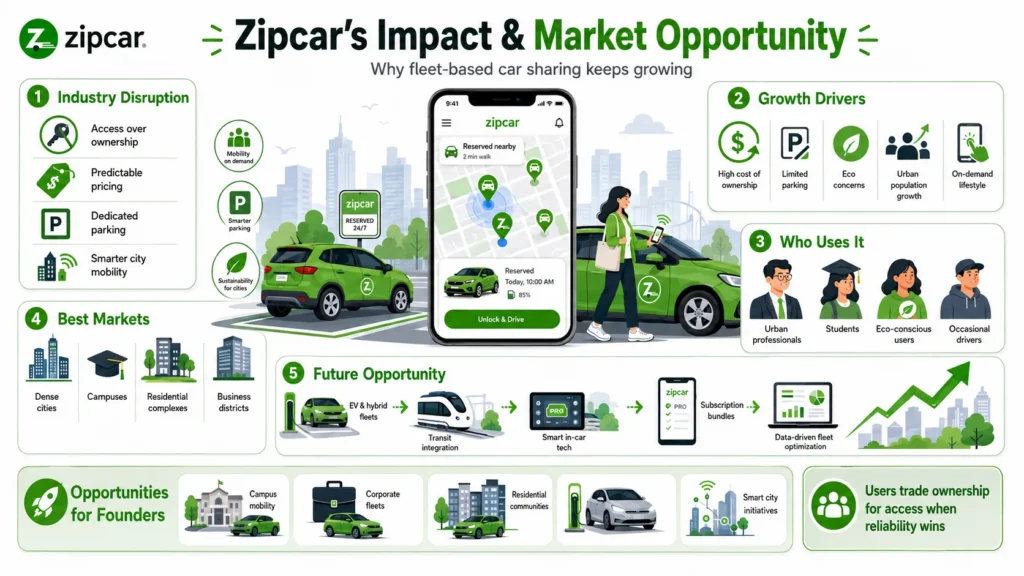
Zipcar helped pioneer the idea that people don’t need to own cars to have reliable access to them. By introducing hourly car sharing with predictable pricing and dedicated parking, it changed how urban residents think about transportation.
It also influenced city planning and campus mobility by reducing the need for personal vehicle ownership and parking infrastructure.
Market size and growth drivers
Car sharing continues to grow due to:
- High costs of car ownership in cities
- Limited parking availability
- Environmental concerns and shared usage
- Growth of urban populations
- Preference for flexible, on-demand services
Zipcar benefits from long-term trends toward access-based mobility.
User demographics and behavior
Zipcar users typically include:
- Urban professionals and city residents
- College students and campus communities
- Environmentally conscious users
- People who drive occasionally but not daily
A key behavior pattern is planned usage. Users often reserve cars in advance for errands, meetings, or weekend trips.
Geographic presence
Zipcar works best in:
- Dense urban areas
- College campuses
- Residential complexes
- Business districts
These environments support high vehicle utilization and predictable demand.
Future projections
The future of Zipcar-style platforms includes:
- Greater use of electric and hybrid vehicles
- Deeper integration with public transit
- Improved in-car technology and automation
- Subscription bundles for frequent users
- Data-driven fleet optimization
Opportunities for entrepreneurs
There are strong opportunities to build Zipcar-like platforms for:
- Campuses and student housing
- Corporate fleets and business travel
- Residential communities
- EV-only shared fleets
- Smart city mobility initiatives
This massive success is why founders continue to explore fleet-based car sharing—once reliability is achieved, users willingly trade ownership for access.
Building Your Own Zipcar-Like Platform
Why businesses want Zipcar-style car sharing platforms
Zipcar proves that ownership isn’t necessary when access is reliable. Entrepreneurs like this model because:
- Cars are high-value assets with predictable usage patterns
- Demand is recurring (errands, work trips, weekends)
- Memberships create stable, repeat revenue
- Fleet ownership allows control over quality and pricing
- Cities and campuses actively support shared mobility.
This model works especially well where parking is limited and car usage is occasional.
Key considerations before development
If you’re planning to build a Zipcar-like platform, think through:
- Fleet strategy: owned vehicles vs leased fleets
- Parking partnerships and reserved spots
- Membership structure (monthly, annual, tiered)
- Hourly vs daily pricing rules
- Mileage limits and overage handling
- Vehicle access method (app, card, hybrid)
- Maintenance, cleaning, and fleet rotation workflows
- Insurance and compliance requirements
Miracuves Zipcar-Like Platform Solution Cost and Tech Stack
Miracuves Pricing for a Zipcar-Like Smart Car Sharing Platform developed using JavaScript architecture is available on request. Final pricing depends on car sharing modules, membership workflows, fleet management features, booking logic, smart access integrations, payment systems, scalability requirements, and deployment scope. Estimated delivery timeline: 30 to 90 days.
Get a fully developed, custom car sharing platform modeled around Zipcar-style short-term vehicle access and membership-based mobility. Built on a modern JavaScript foundation, this solution can be customized for car rental startups, fleet operators, corporate mobility providers, university transport programs, city-based car sharing businesses, and shared mobility platforms.
- Core Workflows: User registration, membership plans, vehicle search, car booking, availability calendar, pickup scheduling, smart access flow, trip management, cancellation handling, and customer notifications.
- Built-in Revenue Logic: Membership fees, hourly rentals, daily rentals, mileage-based charges, late return fees, cancellation fees, insurance add-ons, corporate plans, and location-based pricing rules.
- Management Hub: Admin dashboard, fleet management, member management, booking tracking, vehicle availability control, payment records, refund handling, damage reports, branch/location management, and rental analytics.
- Smart Car Sharing-Ready Architecture: Prepared for fleet-based rentals, membership access, location-based vehicle discovery, smart lock integrations, payment gateway setup, verification workflows, real-time availability syncing, and long-term mobility platform growth.
Why Does a Zipcar-Like Platform Require JavaScript Architecture?
A Zipcar-like platform needs more than a basic rental booking system. It handles member accounts, vehicle availability, hourly bookings, location-based search, smart car access, payments, usage tracking, cancellation flows, fleet records, and real-time marketplace activity. A modern JavaScript architecture helps manage these workflows smoothly across customers, admins, fleet teams, and location operators.
We recommend JavaScript architecture for this type of platform because:
- Built for Booking and Availability Logic: JavaScript-based backend systems can manage vehicle availability, hourly rental slots, membership access, reservation updates, pickup schedules, and high-volume booking activity.
- Advanced Frontend Experience: React.js or other JavaScript frameworks can power smooth car search pages, booking flows, map-based discovery, member dashboards, pricing screens, trip history, and admin panels.
- Scalable Mobility Operations: JavaScript architecture supports multiple cities, vehicle categories, fleet locations, member accounts, payment flows, usage records, damage reports, and growing car sharing demand.
- Flexible Integration Layer: The platform can connect with map APIs, payment gateways, smart lock systems, telematics tools, document verification systems, SMS/email tools, CRM platforms, analytics tools, and customer support systems.
You get a scalable Zipcar-like car sharing platform designed for flexible rentals, fleet control, member convenience, recurring revenue, and long-term mobility business growth.
Note: Final pricing depends on selected car sharing modules, membership workflows, fleet management needs, smart access integrations, payment setup, deployment infrastructure, and custom feature development.
Essential features to include
A strong Zipcar-style MVP should include:
- User onboarding with license verification
- Membership plans and subscriptions
- Hourly/daily car reservations
- App-based vehicle access
- Mileage tracking and trip logs
- Automated billing and penalties
- Fleet management admin panel
High-impact extensions you can add later:
- EV fleets and charging integration
- Corporate and campus access plans
- Subscription bundles for frequent users
- Predictive fleet placement using analytics
- Smart maintenance and diagnostics
Read More :- The Ultimate Guide to Starting a Car Rental Business
Conclusion
Zipcar shows how powerful the idea of access over ownership can be when it’s executed with reliability and structure. By combining a company-owned fleet, clear pricing, and easy app-based access, it made short-term car use practical for everyday life—especially in cities where owning a car is costly and inconvenient.
For entrepreneurs, Zipcar is a strong lesson in building trust through predictability. When users know exactly where the car is, what it costs, and how the experience will work every time, shared mobility becomes a habit rather than a backup option.
FAQs :-
What is Zipcar used for?
Zipcar is used for short-term car access, allowing members to rent cars by the hour or day without owning a vehicle.
How does Zipcar make money?
Zipcar earns revenue through membership fees and hourly or daily rental charges. Additional fees may apply for mileage overages or late returns.
Does Zipcar own its cars?
Yes. Zipcar operates a company-owned fleet, which helps ensure consistent quality, pricing, and availability.
Is fuel included with Zipcar rentals?
Yes. Fuel, insurance, and maintenance are typically included in Zipcar pricing, making costs predictable.
Where do I pick up and return Zipcar vehicles?
Zipcar vehicles are parked in designated reserved spots and must be returned to the same location after use.
Can I rent a Zipcar by the hour?
Yes. Hourly rentals are one of Zipcar’s main features, ideal for short trips and errands.
Who can use Zipcar?
Anyone who meets the age and driver’s license requirements and becomes a Zipcar member can use the service.
Is Zipcar good for students?
Yes. Zipcar is widely used on college campuses and offers convenient transportation for students without owning cars.
What makes Zipcar different from peer-to-peer car sharing?
Zipcar owns and manages its fleet, while peer-to-peer platforms rely on individual car owners. This gives Zipcar more predictability and control.
Can I build a platform like Zipcar?
Yes. With the right combination of fleet management, reservation systems, vehicle access technology, and billing, a Zipcar-style platform can be built.
How can Miracuves help build a Zipcar-like platform?
Miracuves helps founders launch Zipcar-style fleet-based car sharing platforms in 30-90 days, offering reservation engines, fleet management tools, app-based access, and scalable admin systems—fully customizable for your mobility goals.
Related Articles :-
Miracuves is an independent software development company. We are not affiliated with, connected to, sponsored by, or endorsed by any company or product named in this article.
Terms such as “X Clone” are used descriptively. It is how the software industry refers to building a platform with functionality comparable to a known service, and how clients search for it.
The entire design and codebase of our products is built by our own team. Our products contain no code, design, graphics, or content originating from any third-party website or applications.
All third-party names and marks referenced in this article are the property of their respective owners, referenced solely to identify the services discussed.