


Key Takeaways
- Starting a car rental business requires more than buying vehicles; it needs the right business model, pricing strategy, technology, insurance, and operational planning.
- Founders can choose from different models such as self-drive rentals, chauffeur-based rentals, peer-to-peer car sharing, luxury rentals, corporate rentals, or airport-focused rentals.
- A strong digital platform helps manage bookings, vehicle availability, payments, customer verification, fleet tracking, refunds, and admin operations from one place.
- Revenue can come from daily rentals, hourly rentals, subscriptions, deposits, add-ons, insurance packages, late fees, delivery charges, and corporate partnerships.
- Long-term success depends on vehicle utilization, customer trust, smooth booking experience, secure payments, maintenance planning, and strong local market demand.
Business Planning Signals
- Market research helps identify the best target users, including tourists, local commuters, corporate clients, students, event customers, and airport travelers.
- Fleet planning should consider vehicle type, purchase or lease cost, maintenance needs, fuel efficiency, insurance, resale value, and local demand.
- Pricing strategy should balance daily rates, hourly pricing, deposits, weekend demand, peak seasons, vehicle category, and competitor pricing.
- Important platform features include vehicle listings, search filters, booking calendar, user verification, payment gateway, GPS tracking, and admin dashboard.
- Startup cost changes based on fleet size, location, business model, app development, insurance, licenses, marketing, staff, and operational setup.
Real Insights
- A car rental business becomes profitable when vehicles stay booked regularly instead of sitting idle for long periods.
- Technology is important because manual booking, payment, and fleet tracking can create confusion as the business grows.
- Trust features like driver verification, secure deposits, vehicle condition reports, digital agreements, and damage tracking help reduce risk.
- Founders should start with a focused market or vehicle category before expanding into multiple cities, premium fleets, or peer-to-peer models.
- The strongest car rental businesses combine smart fleet planning, digital booking automation, secure payments, customer support, and consistent vehicle maintenance.
Starting a car rental business in 2026 is no longer only about buying vehicles and renting them from a physical counter. The industry has become more digital, app-driven, flexible, and marketplace-focused. Customers now expect online booking, real-time availability, transparent pricing, secure payments, instant communication, digital agreements, and a smooth pickup or delivery experience.
For founders, this creates multiple ways to enter the market. You can start with a small local fleet, build a luxury rental brand, focus on corporate rentals, launch an EV-focused rental service, or create a peer-to-peer car rental marketplace where vehicle owners list their cars and renters book them through your platform.
This guide explains how to start a car rental business in 2026, including business models, startup cost, fleet planning, software features, revenue streams, risks, marketing strategy, and the role of car rental app development in building a scalable rental business.
If your goal is to launch a Turo-style car rental platform, a Turo Clone can give you the marketplace foundation needed to manage vehicle listings, renter bookings, owner dashboards, payments, verification, and admin control before going live.
Why Start a Car Rental Business in 2026?
The car rental business is growing because customers want flexible access to vehicles without long-term ownership. Tourists need short-term cars. Local users need temporary mobility. Corporate teams need business travel vehicles. Gig workers need rental cars for earning opportunities. Urban users want weekend cars without buying one. At the same time, vehicle owners are looking for ways to generate income from underused cars.
This makes car rental a strong business opportunity for both fleet owners and marketplace founders.
A traditional car rental business can work well if you have capital to buy or lease vehicles, manage maintenance, handle insurance, and operate locally. A peer-to-peer car rental marketplace can be more scalable because the platform connects car owners and renters while earning from commissions, booking fees, insurance add-ons, subscriptions, and premium listings.
The biggest advantage in 2026 is technology. A car rental business can now run through a digital platform with booking management, renter verification, payment processing, owner dashboards, GPS tracking, admin controls, cancellation workflows, and automated notifications. This reduces manual work and helps founders launch a more organized rental operation from the beginning.
Car Rental Market Trends Founders Should Watch in 2026
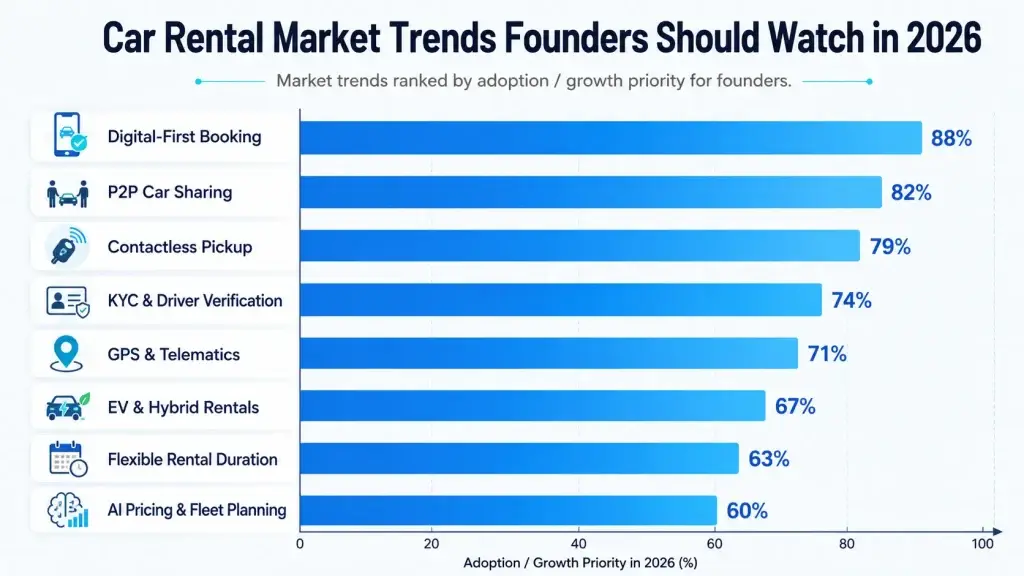
The car rental industry is changing because customers expect faster, safer, and more flexible rental experiences. These trends are important for founders planning to launch a new rental business or car rental app.
Digital-first booking: Customers prefer booking cars through websites and mobile apps instead of calling or visiting a rental office. Real-time availability, instant confirmation, online payments, and digital agreements are now basic expectations.
Peer-to-peer car sharing: Many founders are moving toward marketplace models where private vehicle owners can list their cars and earn from rentals. This reduces the need to own a large fleet from day one.
Contactless pickup and digital access: Digital keys, remote unlock, QR-based pickup, and app-based check-in can make the rental process faster and more convenient.
KYC and driver verification: Identity verification, driver license checks, selfie verification, and risk scoring are becoming important for reducing fake accounts and rental fraud.
GPS tracking and telematics: Rental businesses are using GPS and telematics to monitor vehicle location, driving behavior, mileage, route history, and misuse risk.
EV and hybrid rentals: Electric and hybrid vehicles are becoming attractive for eco-conscious customers, premium city rentals, and corporate sustainability programs.
Flexible rental duration: Customers no longer want only daily rentals. Hourly rentals, weekly rentals, monthly subscriptions, weekend packages, and long-term corporate plans can all create revenue opportunities.
AI-assisted pricing and fleet planning: Founders can use demand patterns, seasonality, local events, vehicle type, and booking history to adjust pricing and improve utilization.
Read More: Implementing Multi-Currency and Regional Taxes in Rental Apps
Traditional Fleet Model vs Peer-to-Peer Car Rental Marketplace
Before starting a car rental business, founders should decide whether they want to own the vehicles or build a marketplace that connects vehicle owners with renters.
| Factor | Traditional Car Rental Business | Peer-to-Peer Car Rental Marketplace |
|---|---|---|
| Vehicle ownership | Business owns or leases the fleet | Individual owners list their cars |
| Startup capital | Higher because vehicles must be purchased or leased | Lower fleet cost, but stronger platform and trust system needed |
| Revenue model | Rental fees, add-ons, insurance, long-term leasing | Commission, booking fee, owner plans, insurance add-ons, premium listings |
| Operational burden | Maintenance, parking, cleaning, insurance, fleet management | Owner onboarding, renter verification, dispute handling, platform management |
| Scalability | Slower because fleet expansion needs capital | Faster if owner supply and renter demand grow together |
| Best for | Local operators, airport rentals, luxury fleets, corporate rentals | Startup founders, marketplace builders, asset-light rental platforms |
A traditional fleet model gives you direct control over vehicles and customer experience. A peer-to-peer model can be more scalable because you do not need to own every vehicle listed on the platform. However, the P2P model requires strong software, trust workflows, verification, payments, insurance logic, owner-renter communication, and admin control.
For many founders, the best approach is to start with a focused niche. For example, you can build a city-specific car sharing platform, luxury car rental marketplace, EV rental platform, airport rental marketplace, or corporate vehicle rental system.
Essential Features of a Car Rental App or Platform
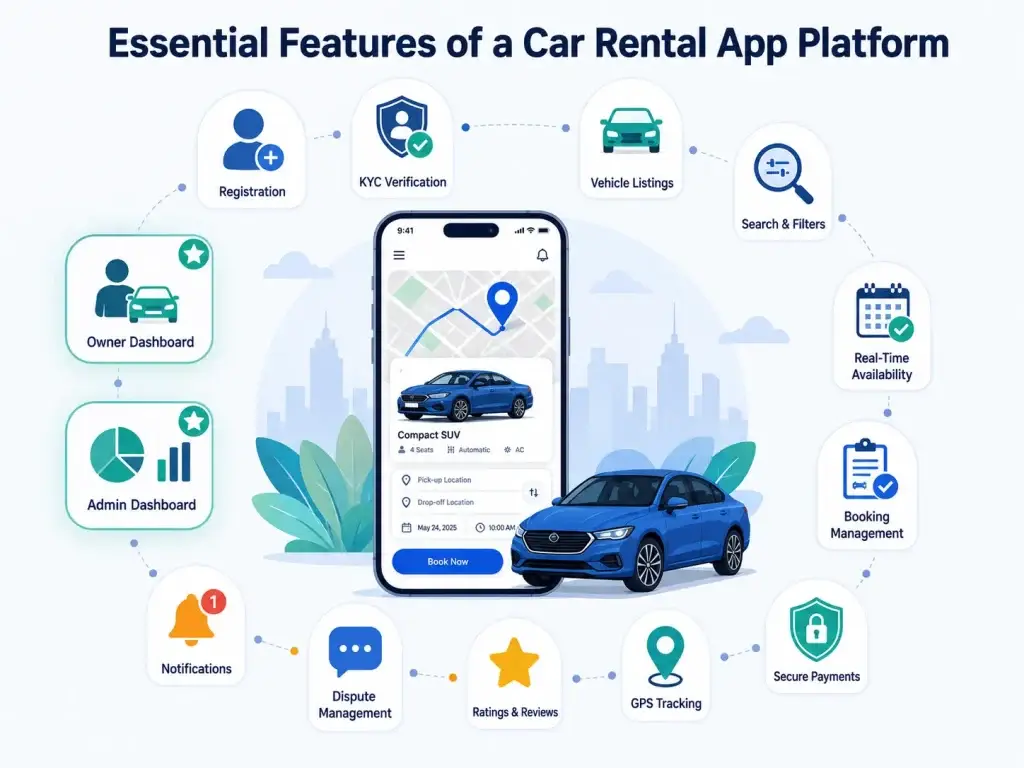
A modern car rental business needs more than a basic website. Customers expect a smooth digital experience from search to payment to return. If you are building a car rental app, these features are important:
| Feature | Business Purpose |
|---|---|
| User registration | Allows renters and owners to create accounts |
| KYC and driver verification | Helps reduce fake users and risky bookings |
| Vehicle listing | Lets owners or admins add cars with photos, pricing, and availability |
| Search and filters | Helps renters find cars by location, price, type, date, and features |
| Real-time availability | Prevents booking confusion and double bookings |
| Booking management | Allows users to request, confirm, cancel, or modify bookings |
| Secure payments | Supports renter payments, deposits, refunds, and platform fees |
| Owner dashboard | Helps car owners manage listings, bookings, earnings, and calendars |
| Admin dashboard | Gives the platform control over users, cars, bookings, disputes, and payouts |
| GPS tracking | Helps monitor vehicle location and reduce misuse |
| Ratings and reviews | Builds trust between renters and owners |
| Notifications | Sends booking updates, payment alerts, reminders, and support messages |
| Dispute management | Helps handle damage claims, late returns, cancellations, and refunds |
For a peer-to-peer car rental marketplace, owner-side features are especially important because the platform depends on vehicle owners to supply cars. A strong owner experience can improve listing quality, availability, and long-term marketplace growth.
Step-by-Step Guide to Starting a Car Rental Business
1. Choose the Right Business Model
Start by deciding whether you want to build a traditional rental company, a peer-to-peer car rental marketplace, a luxury rental brand, an EV rental service, a corporate rental business, or a subscription-based car rental platform.
Your model will decide your budget, software needs, insurance requirements, marketing strategy, and revenue streams.
2. Study Local Demand
Research your target city or region. Look at tourism flow, airport traffic, hotel density, corporate offices, local events, public transport gaps, competitor pricing, vehicle demand, and customer complaints in existing rental services.
This research will help you decide whether to offer economy cars, SUVs, luxury vehicles, EVs, chauffeur-driven cars, or long-term rental packages.
3. Create a Practical Business Plan
Your car rental business plan should include your target audience, fleet strategy, pricing model, insurance plan, revenue streams, technology setup, marketing plan, operating costs, and risk management process.
If you are building a peer-to-peer platform, your plan should also include owner acquisition, renter verification, commission structure, damage handling, dispute resolution, and payout workflows.
4. Arrange Vehicles or Owner Supply
For a traditional business, you need to buy or lease vehicles. Start with a manageable fleet and expand based on utilization.
For a peer-to-peer marketplace, your first priority is owner supply. You need to onboard vehicle owners, help them create listings, verify vehicle details, define pricing rules, and explain how they earn from bookings.
5. Handle Legal, Insurance, and Compliance Requirements
Car rental businesses need proper business registration, vehicle registration, commercial insurance, rental agreements, tax setup, and local permits. Requirements depend on your operating region.
For marketplace platforms, you also need clear terms for owner responsibility, renter responsibility, cancellation, damage claims, late returns, refunds, deposits, and insurance coverage.
6. Build Your Car Rental App or Booking Platform
A digital platform is now one of the most important parts of a car rental business. Your app or website should allow customers to search vehicles, check availability, compare prices, upload documents, make payments, manage bookings, and contact support.
For a marketplace model, you also need owner-side features such as car listing, calendar management, pricing control, earnings dashboard, payout requests, and booking approvals.
7. Add Trust and Security Workflows
Security is critical in car rentals because the platform deals with vehicles, payments, identity, location, and liability. Add KYC verification, driver license checks, secure payments, GPS tracking, rental agreements, deposits, admin approvals, fraud flags, and dispute workflows.
If your platform supports remote unlock or digital keys, security becomes even more important.
8. Set Your Pricing and Revenue Model
Pricing can include hourly rentals, daily rentals, weekly packages, monthly plans, airport pickup charges, late fees, insurance add-ons, security deposits, delivery fees, and premium vehicle charges.
Marketplace platforms can also earn from owner commissions, renter service fees, featured listings, subscription plans, cancellation fees, and value-added services.
9. Launch With a Focused Market
Avoid launching everywhere at once. Start with one city, one vehicle category, or one strong use case. For example, you can launch airport rentals in one city, luxury weekend rentals, EV rentals, corporate rentals, or a local Turo-style car sharing marketplace.
A focused launch helps you control supply, improve service quality, collect reviews, and optimize operations before scaling.
10. Track Performance and Improve
Measure booking volume, vehicle utilization, repeat customers, cancellation rate, damage claims, customer acquisition cost, average booking value, owner earnings, renter satisfaction, and support tickets.
How Much Does It Cost to Start a Car Rental Business?
The cost of starting a car rental business depends on your model, location, fleet size, vehicle type, insurance requirements, software needs, and marketing plan. A founder starting with one or two cars will have a very different budget from a company launching a full rental fleet or franchise.
| Business Model | Cost Level | What Drives the Cost |
| One-car or small test model | Low to moderate | Vehicle cost, insurance, local marketing, basic booking setup |
| Small local car rental fleet | Moderate to high | Multiple vehicles, parking, maintenance, staff, insurance, website/app |
| Luxury car rental business | High | Premium vehicles, security deposits, insurance, maintenance, branding |
| Peer-to-peer car rental marketplace | Software-heavy, lower fleet ownership cost | App development, owner onboarding, renter verification, payments, GPS, admin panel |
| Franchise car rental business | High | Franchise fee, brand requirements, location setup, fleet investment |
| EV rental business | Moderate to high | EV purchase/lease, charging partnerships, maintenance, insurance |
If you want to reduce fleet investment, the peer-to-peer car rental marketplace model may be a better option. Instead of buying every vehicle, you build a platform where car owners list their vehicles and renters book them. Your business earns through commissions, booking fees, add-ons, subscription plans, and premium services.
However, a marketplace model needs a strong technology foundation. You need renter verification, owner dashboards, car listing management, booking calendars, payment gateway integration, commission logic, cancellation rules, admin controls, notifications, and dispute workflows.
Revenue Model for Car Rental Business
A car rental business can earn from multiple revenue streams depending on its model. Traditional fleet-based businesses mainly earn from vehicle rentals, add-ons, long-term contracts, and corporate plans. Peer-to-peer car rental marketplaces can also earn through commissions, renter service fees, owner subscriptions, featured listings, and insurance-related add-ons.
A strong revenue model should not depend on only one income source. Founders should combine rental income, value-added services, recurring plans, and marketplace fees to improve profitability and reduce seasonal risk.
| Revenue Stream | How It Works | Best For |
|---|---|---|
| Daily and hourly rentals | Customers pay based on rental duration, such as hourly, daily, weekend, or weekly bookings | Local rentals, tourist rentals, self-drive rentals |
| Long-term leasing | Customers or businesses rent vehicles for weeks or months | Corporate clients, professionals, monthly users |
| Subscription plans | Customers pay a recurring fee for flexible vehicle access | Urban users, premium renters, frequent users |
| Add-on services | Extra charges for insurance, GPS, child seats, Wi-Fi, doorstep delivery, or chauffeur service | Fleet businesses and premium rentals |
| Corporate rental packages | Businesses pay for employee travel, client visits, or operational vehicle needs | B2B car rental companies |
| Marketplace commission | Platform keeps a percentage from every booking between car owners and renters | Peer-to-peer car rental marketplaces |
| Renter service fee | Extra platform fee charged to renters for booking, support, or convenience | Marketplace rental platforms |
| Owner subscription plans | Vehicle owners pay to list more cars, access premium tools, or get better visibility | P2P car rental platforms |
| Featured listings | Owners pay to highlight their cars in search results | Marketplace and multi-owner platforms |
| Insurance and protection add-ons | Platform earns from optional protection plans, damage waivers, or coverage upgrades | Traditional and P2P rental businesses |
| Late return and cancellation fees | Charges applied for late returns, last-minute cancellations, or policy violations | All rental models |
| Advertising and partnerships | Revenue from vehicle ads, hotel partnerships, travel packages, or affiliate bookings | Local rental brands and tourist markets |
1. Daily and Hourly Rentals
Daily and hourly rentals are the core revenue source for most car rental businesses. Customers pay for short-term access to a vehicle based on duration, vehicle type, location, and demand.
This model works well for tourists, local users, airport travelers, business visitors, and customers who need a car for a few hours or days. Pricing can vary for economy cars, SUVs, luxury vehicles, EVs, and chauffeur-driven vehicles.
2. Long-Term Leasing
Long-term leasing provides more predictable revenue because customers rent vehicles for weeks or months instead of short trips. This model is useful for corporate clients, professionals, gig workers, temporary residents, and businesses that need vehicles without purchasing them.
Long-term plans can improve cash flow and reduce idle fleet time, especially during low-demand seasons.
3. Subscription Plans
Subscription-based car rental allows customers to pay a recurring monthly fee for access to one or more vehicles. This model is useful for users who want flexibility without owning a car.
A subscription plan can include vehicle swaps, maintenance, insurance support, roadside assistance, or mileage limits. It can work well in urban markets where customers want access instead of ownership.
4. Add-On Services
Add-on services can increase average booking value. A car rental business can charge extra for insurance upgrades, child seats, GPS devices, Wi-Fi, doorstep delivery, airport pickup, chauffeur service, fuel plans, or premium support.
These small upsells can improve profit margins because they add revenue beyond the base rental price.
5. Corporate Rental Packages
Corporate rental packages help businesses generate steady B2B revenue. Companies may need vehicles for employee travel, client visits, sales teams, airport pickup, logistics, or temporary projects.
Founders can offer monthly billing, priority support, fixed-rate packages, dedicated account managers, and long-term vehicle access for corporate customers.
6. Marketplace Commission
For a peer-to-peer car rental marketplace, commission is the main revenue stream. When a renter books a vehicle from an owner, the platform keeps a percentage of the booking amount and pays the remaining balance to the vehicle owner.
This model is scalable because the platform can earn from bookings without owning every vehicle listed on the marketplace.
7. Renter Service Fees
A platform can charge renters a service fee for using the marketplace, payment processing, support, protection, or booking convenience. This fee can be fixed or percentage-based.
Renter service fees help the platform cover operational costs while keeping the owner commission structure flexible.
8. Owner Subscription Plans and Featured Listings
Vehicle owners can pay for premium features such as higher listing visibility, featured placement, advanced analytics, faster payouts, or the ability to list more vehicles.
This works well when the platform has enough renter demand and owners want more bookings from the marketplace.
9. Insurance and Protection Add-Ons
Insurance and protection plans can become an important revenue layer. Customers may pay extra for collision damage waivers, theft protection, roadside assistance, extended coverage, or lower-deductible plans.
For peer-to-peer platforms, protection add-ons also help build trust between renters and vehicle owners.
10. Late Fees, Cancellation Fees, and Policy Charges
A car rental business can earn from late return fees, cancellation charges, cleaning fees, fuel charges, mileage overage fees, damage processing fees, and no-show penalties.
These fees should be transparent. Clear policies protect the business while reducing customer disputes.
11. Partnerships and Advertising
Partnerships with hotels, airlines, travel agencies, event planners, and local tour operators can generate additional bookings or referral income. In tourist-heavy locations, vehicle advertising can also create extra revenue from local brands.
These streams may not be the main source of profit, but they can support brand visibility and secondary income.
A profitable car rental business should combine direct rental income with recurring plans, add-ons, marketplace fees, and B2B opportunities. For founders building a Turo-style platform, the strongest model usually includes booking commission, renter service fees, owner subscriptions, featured listings, protection add-ons, and transparent policy-based charges.
Read More : Key Security Integrations for Peer-to-Peer Car Sharing Apps in 2026
Automating Operations: Turo Clone App vs Custom Car Rental Software
Starting a car rental business is not only about managing vehicles. As bookings increase, founders also need to manage availability, renter verification, payments, deposits, owner payouts, cancellations, disputes, GPS tracking, and customer support. Handling these operations manually can slow down growth and create errors.
This is where car rental app development becomes important. A digital platform can help automate booking flows, reduce manual coordination, improve renter trust, and give the business better control over daily operations.
For founders building a peer-to-peer car rental marketplace, a Turo clone app can provide the core foundation needed to connect vehicle owners with renters. Instead of building every module from scratch, a ready-made Turo clone script can include the main marketplace workflows such as vehicle listings, booking calendars, renter profiles, owner dashboards, payment integration, commission management, ratings, reviews, and admin controls.
A custom car rental software solution, on the other hand, gives more flexibility if the business has unique requirements, complex fleet operations, regional compliance needs, or a different rental model. However, custom development usually takes more planning, development time, testing, and budget.
| Option | Best For | Key Advantage |
|---|---|---|
| Turo clone app | Founders launching a peer-to-peer car rental marketplace | Faster launch with ready marketplace workflows |
| Turo clone script | Startups that want a pre-built software foundation | Saves time compared to building from zero |
| Custom car rental software | Businesses with unique operational requirements | More flexibility and deep customization |
| P2P car sharing script | Founders focused on owner-renter marketplace models | Supports vehicle owners, renters, bookings, and commissions |
| White-label car rental platform | Founders who want their own branded rental app | Faster branding, deployment, and market entry |
A Turo clone app is useful when the business model depends on multiple vehicle owners listing their cars on the platform. In this model, the software should support owner onboarding, car listing approval, renter verification, booking requests, payment collection, security deposits, insurance add-ons, dispute handling, and payout workflows.
A strong P2P car sharing script should also include operational features such as dynamic pricing, GPS tracking, telematics support, keyless entry integration, damage reporting, mileage tracking, cancellation rules, and admin monitoring. These features help the platform manage trust, safety, and booking accuracy as the marketplace grows.
For traditional fleet-based businesses, custom car rental software may be enough to manage vehicles, reservations, customer records, invoices, maintenance schedules, and staff operations. But for marketplace founders, the platform must handle both sides of the business: renters who book vehicles and owners who supply them.
If your goal is to launch a Turo-style car rental marketplace, a white-label Turo clone can reduce development complexity and help you go live faster with the essential workflows already planned. The platform can then be customized around your brand, pricing model, location strategy, insurance logic, payment gateways, and growth roadmap.
What Licenses Are Required to Start a Car Rental Business?
Licensing is one of the most important steps in starting a car rental business. The exact licenses, permits, insurance rules, and tax requirements depend on your country, state, city, business model, fleet size, and whether you operate from a physical location, airport counter, online platform, or peer-to-peer marketplace.
Before launching, founders should check local regulations and speak with a legal or licensing expert. This helps avoid penalties, insurance issues, claim rejection, or business interruptions later.
1. Business Registration or Trade License
Most car rental businesses need a legal business registration or trade license before operating. This allows the business to function as a recognized legal entity and open business bank accounts, sign contracts, collect payments, and apply for other permits.
Depending on the location, founders may register as a sole proprietorship, partnership, limited liability company, private limited company, or another approved business structure.
2. Vehicle Registration and Commercial Use Approval
Every vehicle used for rental must be properly registered according to local transport rules. In many regions, vehicles used for commercial rental may require a different registration category than private vehicles.
Founders should confirm whether their vehicles need commercial registration, rental-use approval, fitness certificates, inspection documents, roadworthiness certificates, or transport authority permissions.
For peer-to-peer car rental marketplaces, the platform should clearly define what documents vehicle owners must provide before listing their cars.
3. Commercial Vehicle Insurance
Insurance is essential for any car rental business because rented vehicles carry higher risk than privately used vehicles. Standard personal vehicle insurance may not cover rental usage.
A car rental business may need commercial vehicle insurance, third-party liability coverage, collision protection, theft protection, damage coverage, renter liability terms, and optional add-on protection plans.
For a peer-to-peer rental marketplace, founders should clarify how insurance works between the platform, vehicle owner, and renter. This should be clearly mentioned in rental terms and user agreements.
4. Tax Registration and Sales Tax Permit
Car rental businesses may need tax registration to collect and pay applicable taxes on rental income. Depending on the region, this may include sales tax, GST, VAT, service tax, tourism tax, rental surcharge, airport fee, or local mobility-related charges.
If the business accepts online bookings, tax rules should also be reflected in the booking system, invoice generation, and payment workflow.
5. Zoning Permit or Location Approval
If you operate from a physical office, vehicle lot, parking space, garage, or rental counter, you may need zoning approval from the local authority. This confirms that the location can legally be used for commercial rental activity.
This is especially important if the business stores multiple vehicles, receives customers on-site, or operates from an area not originally approved for commercial use.
6. Airport Operation Permit
If your car rental business operates at or near an airport, you may need permission from the airport authority. Airports often have their own rules for rental counters, shuttle pickup, parking access, customer pickup points, signage, and concession fees.
Airport-based rental businesses can generate strong demand, but compliance and operating costs are usually higher than standard local rental operations.
7. Franchise License or Brand Agreement
If you plan to operate under an established car rental franchise, you may need a franchise agreement or brand license. This gives you the right to use the franchisor’s brand name, operating system, marketing support, and business processes.
Founders should carefully review franchise fees, royalty terms, territory rights, brand guidelines, technology requirements, and operational restrictions before signing.
8. Digital Platform, Data, and Payment Compliance
If your car rental business uses a website or mobile app, you may also need to follow digital compliance rules. This can include privacy policy requirements, user data protection, payment security, refund terms, electronic agreements, and customer consent for document uploads or location tracking.
For car rental apps and peer-to-peer marketplaces, this is especially important because the platform may collect identity documents, driving licenses, payment details, GPS data, booking records, and user communication history.
| License or Requirement | Why It Matters |
|---|---|
| Business registration or trade license | Allows the business to operate legally |
| Vehicle registration | Confirms vehicles are approved for road use and rental use |
| Commercial insurance | Protects the business against accidents, damage, theft, and liability |
| Tax registration | Allows proper tax collection, invoicing, and reporting |
| Zoning or location approval | Confirms your office, lot, or parking location is legally usable |
| Airport permit | Required if operating from or near an airport |
| Franchise agreement | Required if using another company’s brand and business model |
| Digital and payment compliance | Protects user data, payment workflows, and online booking operations |
Licensing should not be treated as a one-time formality. As the business grows into new cities, adds more vehicles, launches an app, accepts online payments, or moves into a peer-to-peer marketplace model, compliance requirements may also change.
The safest approach is to verify local requirements before launch, keep all documents updated, and build your booking platform in a way that supports invoices, digital agreements, tax rules, renter verification, insurance terms, and admin records.
Read More : Turo Revenue Model: How Turo Makes Money in 2026
Market Penetration Strategies for a Car Rental Business
Entering the car rental market in 2026 requires a focused growth strategy. Customers already compare local rental shops, large rental brands, travel portals, ride-hailing options, and peer-to-peer car sharing platforms before making a decision. To gain market share, a new car rental business must offer clear value, local visibility, smooth digital booking, transparent pricing, and a reliable customer experience.
Below are practical strategies to help a car rental business attract customers, build trust, and grow faster.
1. Choose a Clear Market Niche
A new car rental business should not target everyone from day one. A focused niche makes your positioning stronger and your marketing easier.
You can focus on airport rentals, self-drive cars, luxury rentals, EV rentals, corporate rentals, tourist rentals, long-term rentals, or peer-to-peer car sharing. For example, a business in a tourist city can target weekend travelers, while a business in a corporate hub can offer monthly rental plans for professionals and companies.
2. Offer Value-Based Pricing
Competitive pricing helps attract first-time renters, but low pricing alone can reduce profit. Instead, create packages that match customer needs.
Useful pricing offers can include first-time renter discounts, weekend packages, weekly rental plans, monthly subscriptions, airport pickup bundles, corporate rental plans, and loyalty discounts. The goal is not to become the cheapest provider, but to offer better convenience, trust, and value.
3. Strengthen Local SEO
Local SEO is one of the strongest customer acquisition channels for car rental businesses. Many users search for terms like “car rental near me,” “self-drive car rental in [city],” “airport car rental in [city],” and “luxury car rental in [city].”
Optimize your website, Google Business Profile, city landing pages, service pages, reviews, images, FAQs, and contact options. For a peer-to-peer marketplace, create separate content for renters and vehicle owners so both sides of the platform can grow.
4. Build a Smooth Online Booking Experience
A slow or manual booking process can make users choose a competitor. Customers expect to search vehicles, check availability, compare prices, upload documents, make payments, and manage bookings online.
A strong car rental app or website should include real-time availability, booking calendars, secure payments, renter verification, cancellation management, notifications, and admin controls. For a peer-to-peer model, add owner dashboards, listing management, payout tracking, and commission workflows.
5. Create Local Partnerships
Partnerships can bring customers without depending only on paid ads. Hotels, travel agencies, airports, tour operators, event planners, corporate offices, colleges, and local businesses can become referral partners.
For example, hotels can recommend your rental service to guests, tour operators can bundle rentals with travel packages, and companies can use your vehicles for employee travel. Keep partnership offers simple through referral commissions, fixed discounts, or corporate packages.
6. Use Referral and Loyalty Programs
Referral programs help bring new customers through existing users. Offer discounts, rental credits, free upgrades, or wallet rewards when customers refer friends or family.
Loyalty programs can improve repeat bookings through member pricing, priority support, free upgrades, or discounted long-term plans. For peer-to-peer platforms, referral rewards can work for both renters and vehicle owners.
7. Expand Fleet Based on Demand
Fleet expansion should follow real customer demand, not assumptions. Start with the vehicle types your audience needs most, such as economy cars, SUVs, luxury cars, EVs, or corporate vehicles.
Use booking data, customer inquiries, seasonal demand, and competitor gaps to decide which vehicles to add next. This helps improve utilization and reduces unnecessary maintenance costs.
8. Improve Customer Experience
Customer experience directly affects reviews, repeat bookings, referrals, and local rankings. Hidden fees, poor vehicle condition, slow support, and confusing policies can damage trust quickly.
Keep pricing transparent, maintain clean vehicles, simplify pickup and return, send clear booking updates, provide fast support, and make cancellation or refund policies easy to understand.
9. Use Helpful Content Marketing
Content marketing can attract customers before they are ready to book. Create blogs, city guides, comparison pages, rental tips, pricing explainers, and vehicle selection guides.
Useful topics include:
- Best cars to rent for family trips
- Airport car rental vs taxi
- Weekly vs daily car rental cost
- How to rent a car safely
- EV rental guide for first-time users
- How to list your car on a rental marketplace
This helps build organic traffic, trust, and topical authority.
10. Expand Location-Wise, Not Randomly
Geographic expansion should happen only after validating demand, pricing, operations, and customer acquisition cost in one market. Expanding too early can create service issues and cash flow pressure.
Start with one city or region, build reviews, improve operations, and then expand into nearby high-demand locations. For peer-to-peer marketplaces, expansion should happen only when renter demand and owner supply are strong enough in the new location.
Market penetration is not only about increasing bookings. It is about choosing the right niche, building local visibility, improving trust, making booking easier, and using technology to control operations. With the right strategy, a car rental business can grow from a local rental service into a scalable car rental brand or marketplace.
Challenges to Starting a Car Rental Business and How to Solve Them
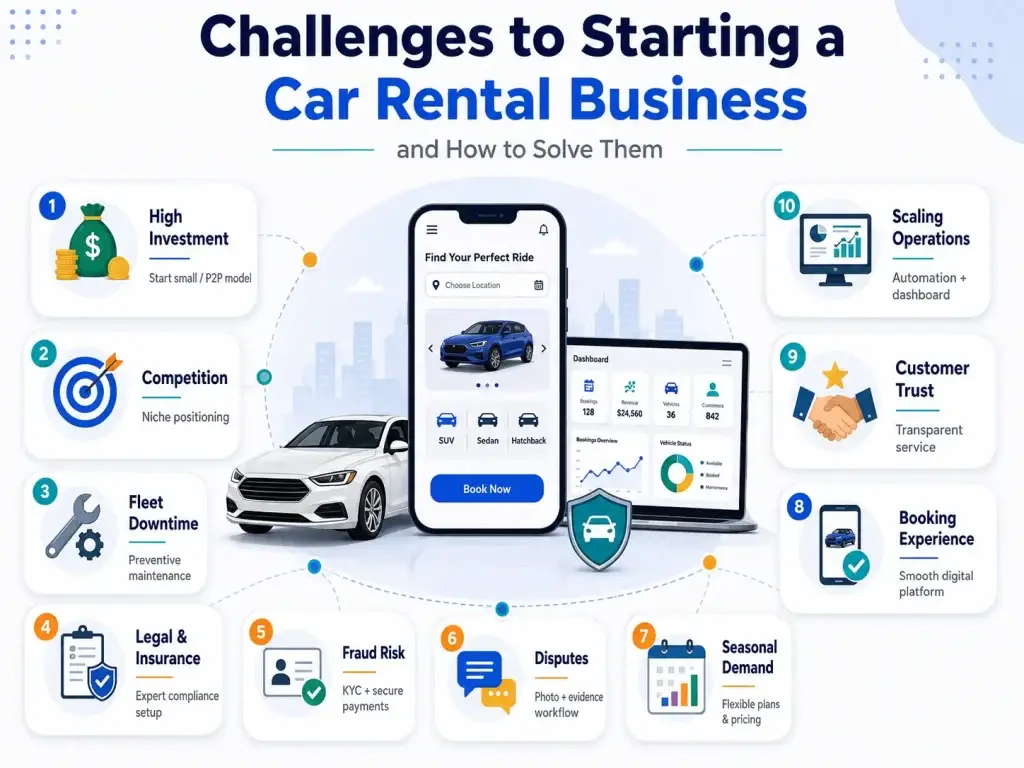
Starting a car rental business can be profitable, but it also comes with operational, financial, legal, and technology-related challenges. Founders need to manage vehicles, renters, payments, insurance, customer trust, and daily operations carefully. If the business model is peer-to-peer, the platform must also protect vehicle owners and create a smooth experience for both sides of the marketplace.
Below are the major challenges founders should prepare for before launching.
1. High Initial Investment
One of the biggest challenges in a traditional car rental business is the cost of acquiring vehicles. Buying or leasing cars, arranging insurance, setting up parking, hiring staff, building a website, and managing operations can require significant upfront capital.
To reduce this pressure, founders can start with a small fleet, lease vehicles instead of buying them, target one city first, or focus on a specific niche such as airport rentals, luxury cars, EV rentals, or corporate rentals. Another option is to build a peer-to-peer car rental marketplace where private vehicle owners list their cars and the platform earns from bookings without owning every vehicle.
2. Strong Market Competition
The car rental industry is competitive because founders must compete with local rental shops, large rental brands, travel platforms, ride-hailing options, and peer-to-peer car sharing platforms. Competing only on price can reduce margins and make the business difficult to sustain.
A better approach is to choose a clear positioning. For example, you can focus on luxury rentals, long-term rentals, airport pickup, EV rentals, self-drive cars, corporate packages, or local peer-to-peer car sharing. Strong customer service, transparent pricing, easy online booking, and local SEO can also help a new rental business stand out.
3. Fleet Maintenance and Vehicle Downtime
Vehicle maintenance directly affects customer experience and profitability. If a car breaks down, remains unavailable, or receives poor reviews, the business loses both revenue and trust. Maintenance becomes even more complex as the fleet grows.
Founders should create a preventive maintenance plan from the beginning. This includes regular servicing, tire checks, cleaning, inspection reports, mileage tracking, damage records, and vehicle availability monitoring. A fleet management system or car rental app dashboard can help track vehicle usage, maintenance schedules, bookings, and downtime in one place.
4. Insurance, Licensing, and Legal Compliance
Car rental businesses need proper business registration, vehicle documents, insurance coverage, rental agreements, tax setup, and local permits. These requirements can vary by country, state, and city. If compliance is not handled properly, the business may face penalties, claim rejection, or legal disputes.
Founders should work with legal and insurance experts before launch. Rental agreements should clearly explain renter responsibilities, damage liability, late return charges, cancellation rules, deposit terms, and insurance coverage. For peer-to-peer platforms, the terms should also define owner responsibility, platform responsibility, renter responsibility, and dispute handling.
5. Renter Verification and Fraud Risk
Car rental businesses deal with high-value assets, so fake accounts, stolen identities, invalid licenses, payment fraud, and vehicle misuse can become serious risks. This challenge is even bigger for peer-to-peer rental marketplaces because private car owners need confidence before listing their vehicles.
A secure platform should include identity verification, driver license validation, selfie or liveness checks, secure payment processing, fraud alerts, deposit handling, and admin approval for suspicious accounts. These trust layers help reduce risky bookings and protect both the business and vehicle owners.
6. Damage Claims and Dispute Management
Vehicle damage, late returns, fuel disputes, cleaning issues, accidents, traffic fines, and cancellation conflicts are common in the rental business. Without a clear process, these issues can damage customer trust and create financial losses.
Founders should create a structured dispute workflow. This can include pre-trip and post-trip vehicle photos, digital inspection forms, rental agreements, damage reporting, admin review, deposit deductions, refund rules, and customer support records. In a marketplace model, the platform should make it easy for both owners and renters to submit evidence and track dispute status.
7. Cash Flow and Seasonal Demand
Car rental demand can change based on tourism seasons, local events, holidays, weather, and business travel patterns. During slow months, founders may still need to pay for vehicle maintenance, insurance, parking, staff, and marketing.
To manage cash flow, rental businesses can offer weekly or monthly plans, corporate rental packages, airport rental services, chauffeur add-ons, subscription-style rentals, and seasonal discounts. Tracking vehicle utilization, average booking value, repeat customers, and cancellation rates can also help founders improve pricing and revenue planning.
8. Technology and Booking Experience
Customers now expect a simple digital booking experience. If your website or app is slow, confusing, or manual, users may choose a competitor. A poor booking system can also create double bookings, payment issues, missed inquiries, and customer support problems.
A modern car rental platform should include vehicle search, real-time availability, booking calendars, secure payments, user verification, notifications, admin controls, cancellation management, and customer support features. For peer-to-peer platforms, owner dashboards, listing management, payout workflows, and commission tracking are also important.
9. Customer Trust and Retention
Trust is one of the biggest growth factors in car rental. Customers want clear pricing, clean vehicles, simple terms, fast support, and a reliable booking experience. Hidden charges, poor vehicle condition, unclear policies, and slow refunds can quickly damage the brand.
To build trust, founders should keep pricing transparent, show vehicle details clearly, collect reviews, respond quickly to support requests, offer flexible booking options, and maintain consistent service quality. Loyalty programs, referral offers, and repeat customer discounts can also help improve retention.
10. Scaling Operations Without Losing Control
A small rental business may be easy to manage manually, but scaling to multiple vehicles, owners, cities, or booking categories becomes difficult without proper systems. Manual spreadsheets, phone-based bookings, and scattered payment records can create errors as the business grows.
Founders should build scalable workflows from the beginning. A strong admin dashboard can help manage users, vehicles, bookings, payments, refunds, disputes, commissions, reports, and support activity. This gives the business better control as it expands from a small rental operation into a larger car rental platform.
By preparing for these challenges early, founders can reduce risk and build a more reliable car rental business. The goal is not only to rent vehicles, but to create a trusted system where customers can book easily, payments are secure, vehicles are protected, and operations can scale smoothly.
How Miracuves Helps Founders Launch a Turo-Style Car Rental Platform
Launching a Turo-style car rental platform requires more than a basic booking website. Founders need a system that can manage vehicle owners, renters, listings, availability, payments, commissions, verification, disputes, and admin operations from one place.
Miracuves helps founders build peer-to-peer car rental platforms with white-label branding, source-code ownership, scalable workflows, and marketplace-ready features.
- Ready-made Turo clone app foundation: Supports vehicle listings, renter bookings, owner dashboards, secure payments, commission management, ratings, reviews, and admin controls.
- Owner and renter workflows: Helps manage owner onboarding, car listing approval, renter verification, booking requests, cancellation rules, payouts, and dispute handling.
- Trust and safety features: Can include GPS tracking, damage reporting, document verification, payment security, insurance logic, user reviews, and admin monitoring.
- Custom branding and growth flexibility: The platform can be customized around your brand, target location, pricing model, vehicle categories, payment gateways, and expansion roadmap.
For founders planning to launch a local car sharing marketplace, luxury rental platform, EV rental app, or multi-city peer-to-peer car rental business, Miracuves provides a faster starting point without building every marketplace feature from scratch.
Conclusion
Starting a car rental business in 2026 can be a strong opportunity, but success depends on choosing the right model from the beginning. A traditional fleet rental business works well for operators who have vehicle capital, local demand, parking access, and a clear maintenance plan. A peer-to-peer car rental marketplace works better for founders who want a more scalable, asset-light model where vehicle owners list their cars and renters book them through a digital platform.
The strongest rental businesses today are not built only around vehicles. They are built around trust, convenience, availability, secure payments, renter verification, insurance workflows, GPS tracking, customer support, and strong admin control. Whether you manage your own fleet or build a Turo clone script , your platform needs to make booking, payments, verification, communication, and dispute handling simple for every user.
For founders planning to launch a car rental app or peer-to-peer rental marketplace, Miracuves can help build a white-label platform with booking flows, owner dashboards, renter verification, payment integration, GPS tracking, admin controls, commission management, and scalable marketplace features.
Contact Miracuves to discuss your car rental app idea and build a launch-ready rental platform around your business model.
FAQ
How many cars do you need to start a car rental business?
You can start with one car to test demand, but a small fleet of 3 to 5 vehicles gives more flexibility. If one vehicle is booked, damaged, or under maintenance, other vehicles can still generate revenue. For a peer-to-peer marketplace, you do not need to own every vehicle because private owners can list their cars on your platform.
Is a peer-to-peer car rental marketplace better than owning a fleet?
It depends on your budget and business goal. A fleet model gives you direct control over vehicles, pricing, and service quality. A peer-to-peer marketplace can be more scalable because you do not need to purchase every vehicle, but it requires strong technology, verification, insurance workflows, owner management, and dispute handling.
What software do I need for a car rental business?
A car rental business needs booking management, fleet availability, payment integration, customer management, document verification, rental agreements, notifications, reporting, and admin control. A peer-to-peer platform also needs owner dashboards, listing management, commission logic, payout workflows, and dispute management.
How does a car rental marketplace make money?
A car rental marketplace can earn through booking commissions, renter service fees, owner subscription plans, featured listings, insurance add-ons, delivery fees, late return fees, cancellation charges, and premium support services.
Can Miracuves help build a Turo-style car rental app?
Yes. Miracuves can help founders build Turo-style car rental platforms with renter flows, owner dashboards, vehicle listings, booking calendars, payment gateway integration, commission workflows, KYC verification, GPS tracking, admin controls, and white-label branding.
Miracuves is an independent software development company. We are not affiliated with, connected to, sponsored by, or endorsed by any company or product named in this article.
Terms such as “X Clone” are used descriptively. It is how the software industry refers to building a platform with functionality comparable to a known service, and how clients search for it.
The entire design and codebase of our products is built by our own team. Our products contain no code, design, graphics, or content originating from any third-party website or applications.
All third-party names and marks referenced in this article are the property of their respective owners, referenced solely to identify the services discussed.