
Key Takeaways
- A white-label video creation platform helps startups launch faster than building every creator workflow from scratch.
- Custom development gives more flexibility but usually needs more time, planning, testing, infrastructure, and technical execution.
- Core features include video uploads, editing tools, templates, subscriptions, monetization, live content, and admin control.
- A ready-made video platform foundation helps founders reduce launch risk while keeping room for branding, customization, and scale.
Decision Signals
- Founders need to compare launch speed, feature depth, ownership terms, scalability, maintenance, and available runway.
- Creators need smooth video publishing, editing options, profile control, audience insights, monetization tools, and payout visibility.
- Admins need control over users, creators, videos, subscriptions, payments, moderation, reports, and platform settings.
- Backend systems should support media storage, video processing, secure playback, recurring billing, notifications, and scalable infrastructure.
Real Insights
- Startups choose white-label platforms when speed, tested workflows, and cost control matter more than building from zero.
- Custom video platform development can become expensive when teams rebuild uploads, playback, subscriptions, and creator dashboards.
- Source-code ownership helps founders customize monetization, creator tools, design, integrations, and platform logic later.
- Miracuves builds white-label video creation platforms with creator tools, video workflows, subscriptions, monetization, secure playback, analytics, and admin control.
For many startups, a video creation platform looks simple from the outside. Users record or upload videos, edit content, add effects, publish posts, follow creators, and engage through likes, comments, shares, and recommendations.
But once founders move from idea to execution, the real complexity appears.
For founders, the decision is not only about building an app. It is about choosing the right foundation for a scalable video content platform that can support uploads, playback, creator workflows, monetization, admin control, and future growth without slowing down the first launch.
A video creation platform is not just a mobile app with an upload button. It needs video processing, storage, feed logic, creator profiles, moderation, analytics, monetization, notifications, admin control, and infrastructure that can handle media-heavy usage.
That is why one of the first strategic questions founders face is:
Should we build the platform from scratch, or should we launch faster with a white-label video creation platform?
The right answer depends on your budget, timeline, product uniqueness, technical depth, and growth stage. For early-stage startups, the smartest path is often not the longest build. It is the path that helps the business validate demand faster without losing control over branding, features, and future scalability.
Miracuves helps founders launch ready-made and white-label video platforms with branded design, admin dashboards, creator workflows, monetization-ready modules, and source-code ownership for faster market entry.
What Is a Video Creation Platform?
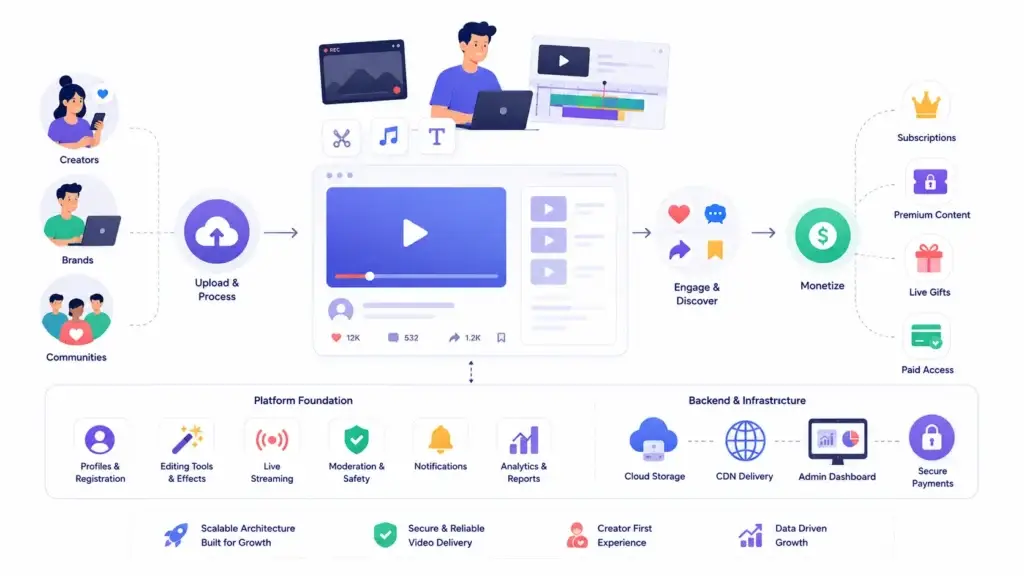
A video creation platform allows users, creators, brands, or communities to create, edit, publish, manage, and monetize video content.
Depending on the business model, it may include short videos, long-form uploads, livestreams, editing tools, creator profiles, paid content, subscriptions, community feeds, or branded content spaces.
If the startup is focused on reels, mobile-first discovery, creator engagement, and fast content consumption, a short-form video platform foundation can be more relevant than a broad streaming product. This route is useful when the core experience depends on vertical feeds, creator profiles, social engagement, content discovery, and monetization-ready workflows.
A serious video creation platform usually includes:
- User registration and profiles
- Video upload and processing
- In-app recording or editing tools
- Filters, audio, captions, or effects
- Creator dashboards
- Video feed and discovery
- Likes, comments, shares, and saves
- Content moderation
- Notifications
- Monetization features
- Admin dashboard
- Analytics and reporting
- Cloud storage and CDN setup
- Secure payment integration where needed
For founders, the important point is this: the visible app is only one part of the product. The backend, admin layer, video pipeline, moderation workflow, and infrastructure decisions decide whether the platform can actually grow.
What Building From Scratch Really Means
Building a video creation platform from scratch means every module is planned, designed, coded, tested, deployed, and maintained separately.
This route gives full flexibility. The founder can define every workflow, every feature, every user role, every backend rule, and every monetization model.
But that flexibility comes with a cost.
A from-scratch build usually requires:
- Product strategy and feature planning
- UI/UX design
- Mobile app development
- Web platform development if needed
- Backend development
- API architecture
- Video upload and compression logic
- Media storage setup
- CDN integration
- Admin dashboard development
- Content moderation workflows
- Payment gateway integration
- Analytics setup
- Security planning
- QA testing
- App store deployment
- Ongoing maintenance
For a startup still testing demand, this can become risky. The team may spend months building the foundation before learning whether creators, viewers, brands, or paying users actually want the platform.
Custom development is powerful, but it is not always the best first move.
What a White-Label Video Creation Platform Means
A white-label video creation platform is a ready-made product foundation that can be rebranded and customized for your business.
Instead of building every feature from zero, the startup begins with an existing platform structure. The brand name, logo, colors, user flows, selected features, monetization rules, and business logic can be customized based on the launch plan.
A good white-label platform should not feel like a generic template. It should give founders a working foundation while still allowing room for differentiation.
For a video creation startup, a white-label solution may include:
- Branded mobile apps
- Video upload and publishing flows
- Creator profiles
- Video feed
- Engagement features
- Admin dashboard
- User management
- Content moderation
- Monetization modules
- Notifications
- Analytics
- Source-code access where included
- Deployment support
Miracuves’ white-label approach is useful for founders who want to launch a short-video or creator-focused platform faster without waiting for every basic module to be engineered from scratch.
White-Label vs Scratch Build: Quick Comparison
| Decision Factor | Build From Scratch | White-Label Video Creation Platform |
|---|---|---|
| Launch speed | Slower because every module is built separately | Faster because the core foundation already exists |
| Upfront cost | Usually higher due to custom engineering | Usually more cost-efficient for early validation |
| Customization | Highest flexibility | Strong customization if the platform is built properly |
| Technical risk | Higher because everything must be tested from zero | Lower because core workflows are already available |
| Founder focus | More time spent on product development | More time available for launch, users, creators, and monetization |
| Scalability | Can be deeply tailored from day one | Depends on code quality, backend readiness, and customization scope |
| Best for | Funded teams with unique product logic | Startups that want faster launch and market validation |
| Main risk | Spending too much before validation | Choosing a weak vendor with limited customization or no source-code control |
Why Video Platforms Are Harder Than Normal Apps
A video creation platform is more complex than a marketplace, booking app, or basic social app because media usage creates infrastructure pressure.
Every video has to be uploaded, processed, stored, delivered, displayed, and moderated. As usage grows, the platform needs to handle more storage, more bandwidth, more playback requests, and more backend events.
Founders must think about:
- Video compression
- Playback quality
- Upload speed
- Feed performance
- Cloud storage cost
- CDN delivery
- Abuse reporting
- Creator verification
- Copyright or policy reporting workflows
- Spam detection
- Admin review queues
- Payment and payout safety if monetization is included
This is why building from scratch requires more than hiring a mobile app developer. A strong video platform needs backend architecture, media infrastructure, admin logic, security controls, and cloud infrastructure for video platforms that can support storage, delivery, processing, and performance as creator activity grows.
When Startups Should Choose a White-Label Video Creation Platform
A white-label solution is usually the better path when the startup needs to launch quickly, validate demand, control budget, and test a niche before investing heavily in custom engineering.
Choose white-label when:
- You want to launch a branded video platform faster
- You are testing a creator, community, education, entertainment, or niche content idea
- Your first priority is user validation, not proprietary infrastructure
- You need common features like profiles, uploads, feeds, likes, comments, admin control, and monetization
- You want a source-code-owned foundation that can be customized later
- You do not want to spend months building basic app flows
- You want to focus on creator acquisition, content strategy, and monetization
For example, a founder building a short-video platform for fitness creators, local entertainers, educators, regional influencers, or niche communities may not need a fully custom engine on day one. They need a working platform, a clear brand, admin control, and a practical short-video startup launch plan that helps them test creator onboarding, content seeding, retention, and monetization with real users.
That is where a white-label video platform can be the smarter startup move.
When Building From Scratch Makes More Sense
Custom development makes more sense when the product idea depends on technology that cannot be handled by a standard white-label foundation.
Build from scratch when:
- Your recommendation engine is the core differentiator
- You need a unique video editing or rendering engine
- Your business model has unusual creator monetization rules
- Your platform depends on advanced AI workflows
- You need deep enterprise integrations
- You have a funded technical team
- You already validated demand and now need custom scale
- You need very specific compliance, moderation, or data architecture
In this case, building from scratch may be worth the investment because the uniqueness of the product is inside the technology itself.
But if your startup is still proving the audience, content category, creator supply, pricing model, and retention loop, building everything from zero may slow you down before the market has even responded.
The Founder Decision Signal: Are You Validating or Scaling?
The easiest way to decide is to ask one question:
Are you trying to validate the market, or are you scaling an already-proven product?
If you are validating, white-label usually makes more sense. You need speed, working features, and enough control to test your idea with real users.
If you are scaling, custom development may become more important. You may need deeper infrastructure, unique data models, custom algorithms, or advanced creator tools.
For many startups, the best path is not white-label forever or custom forever. It is a staged approach.
Start with a launch-ready foundation. Watch how users behave. Identify what creators need. Study which features drive retention. Then customize the platform around real demand instead of assumptions.
The Hybrid Path: Start White-Label, Customize Strategically
A hybrid approach gives founders the strongest balance.
Instead of spending months building the full platform from zero, the startup launches with a ready-made foundation and customizes the parts that matter most to its niche.
For example:
| Platform Type | Start With | Customize Later |
|---|---|---|
| Short-video community | Feed, upload, profiles, engagement | Recommendation logic, creator rewards, niche discovery |
| Education video platform | Courses, video library, user dashboard | Tutor tools, assessments, certificates |
| Creator monetization platform | Profiles, subscriptions, paid content | Wallet, payout rules, premium creator analytics |
| Brand video platform | Uploads, categories, admin control | Campaign workflows, branded dashboards |
| AI video creation platform | User dashboard, media library, publishing flow | AI generation, templates, automated editing workflows |
The hybrid route works best when founders understand which workflows should run automatically after launch. For video uploads, moderation queues, notifications, creator activity, wallet updates, and payout operations, background processing for creator platforms becomes an important backend layer that supports smoother scaling without slowing the user experience.
This route helps founders avoid overbuilding too early while still keeping room for differentiation.
Features a Startup Should Not Ignore
Whether you build from scratch or use a white-label solution, your video creation platform should include the right product foundation.
The essential feature set usually includes:
| Feature | Why It Matters |
|---|---|
| Video upload and processing | Enables users or creators to publish content smoothly |
| Creator profiles | Helps build identity, following, and content ownership |
| Video feed | Drives discovery, engagement, and repeat usage |
| Search and categories | Helps users find relevant content faster |
| Likes, comments, and shares | Creates social interaction and distribution loops |
| Admin dashboard | Gives the platform operator control over users, content, reports, and settings |
| Content moderation | Protects platform quality, brand safety, and user trust |
| Monetization tools | Supports ads, subscriptions, paid content, tips, or premium access |
| Analytics | Helps founders understand user behavior and creator performance |
| Notifications | Brings users back into the platform |
| Secure payments | Required for subscriptions, paid content, wallets, or creator payouts |
Some startups do not need a short-video-first product. If the business depends on channels, uploads, searchable videos, creator publishing, livestreaming, and long-term content discovery, a video sharing platform model may be more suitable. This structure gives creators more room to publish different formats while giving users a familiar way to browse, watch, follow, and engage.
The admin dashboard is especially important. Without strong admin control, founders may struggle to manage users, content, abuse reports, payments, creators, and platform settings after launch.
Monetization Models for Video Creation Platforms
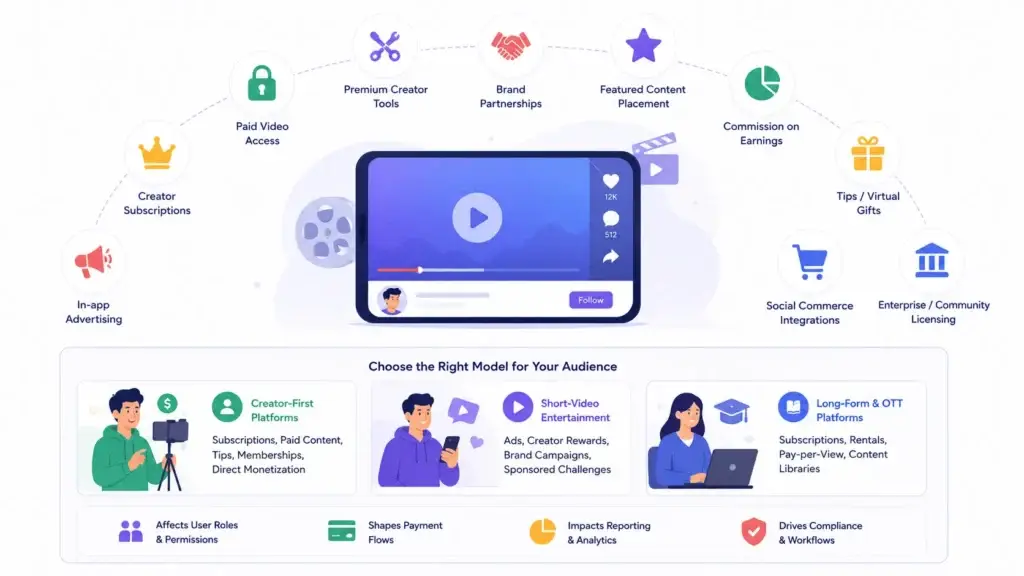
A video creation platform should not be built only for engagement. It should also have a clear monetization path.
Common monetization models include:
- In-app advertising
- Creator subscriptions
- Paid video access
- Premium creator tools
- Brand partnerships
- Featured content placement
- Commission on creator earnings
- Tips or virtual gifts
- Sponsored challenges
- Social commerce integrations
- Enterprise or community licensing
The right model depends on the target audience.
For creator-first businesses, monetization may go beyond ads. A subscription-based content platform can support paid access, memberships, premium content, creator-subscriber interaction, and direct audience monetization. This is especially useful when the startup wants creators to earn from loyal communities instead of relying only on public video views.
A short-video entertainment platform may focus on ads, creator rewards, and brand campaigns. An education-focused video platform may rely on subscriptions or course fees. A creator monetization platform may use paid content, memberships, tips, and commissions.
If the product is built around movies, shows, courses, premium libraries, or long-form content, an OTT streaming platform may be a better fit than a short-video app. This model works well when the business needs subscriptions, rentals, pay-per-view access, content libraries, and multi-device viewing.
This decision should be made before development starts because monetization affects user roles, payment flows, admin dashboards, reporting, and compliance workflows.
Security and Moderation Should Be Part of the Foundation
Video platforms are user-generated content environments. That means safety and moderation cannot be added as an afterthought.
A startup should plan for:
- Content moderation
- Abuse reporting
- Community guidelines
- Creator verification
- Admin review queues
- Spam detection
- Comment moderation
- Copyright or takedown request workflows where relevant
- Secure payment gateway integration
- Role-based admin access
- Activity logs
- Privacy-conscious data handling
This does not mean every startup needs enterprise-grade moderation on day one. But the foundation should support the workflows needed to keep the platform trustworthy as content grows.
Common Mistakes Startups Make
Mistake 1: Building Too Much Before Testing Demand
Many founders want a full-featured platform before launch. They add advanced editing, AI recommendations, livestreaming, wallets, creator subscriptions, and analytics before testing whether users even want the product.
This increases cost and delays learning.
A better route is to launch with the right core features, then improve based on real usage.
Mistake 2: Choosing the Cheapest White-Label Option Without Checking Control
Not every white-label solution is equal.
Founders should check whether they get source-code ownership, customization flexibility, deployment support, admin control, documentation, and post-launch scalability.
A low-cost product with poor code quality can become expensive later.
Mistake 3: Ignoring the Admin Dashboard
The admin panel is the control room of the platform. It helps manage users, creators, content, reports, payments, notifications, categories, and platform rules.
If the admin dashboard is weak, the founder becomes dependent on developers for every operational change.
Mistake 4: Treating Video Infrastructure as a Future Problem
Video infrastructure affects user experience from day one. Slow uploads, poor playback, feed delays, or failed processing can hurt retention early.
Even if you start with a white-label solution, the backend and media workflow should be ready for growth.
Mistake 5: Copying a Big Platform Without a Niche Strategy
A startup does not win by becoming another generic TikTok, YouTube, or CapCut-style product.
It wins by choosing a sharper audience, stronger creator use case, better monetization angle, or more focused community experience.
How Miracuves Helps Startups Launch Faster
Miracuves helps founders move from idea to launch with ready-made and white-label video platform solutions built for branded user experiences, creator workflows, admin control, monetization, and source-code ownership.
Instead of spending months building every upload, feed, profile, moderation, and dashboard module from scratch, startups can begin with a working product foundation and customize it around their audience, content model, and revenue strategy.
This approach is especially useful for founders planning to launch a short-form video platform, creator economy app, video sharing community, influencer-led platform, entertainment network, niche content app, or monetization-focused creator product.
For founders who want a faster route to market, Miracuves offers a scalable video content platform foundation that supports faster validation, brand control, admin visibility, and long-term customization.
Final Verdict: What Should Startups Choose?
Startups should build a video creation platform from scratch when the product depends on proprietary technology, advanced AI, unique video editing logic, or deeply custom infrastructure.
But for most early-stage founders, a white-label video creation platform is the smarter first move.
It reduces development risk, speeds up launch, provides a working product foundation, and allows the business to test real users before investing heavily in custom development.
The strongest startup decision is not always to build everything from zero. It is to launch with the right foundation, validate the market, learn from users, and customize where differentiation truly matters.
Miracuves helps founders take that practical route with ready-made and white-label video app solutions designed for faster launch, brand control, admin visibility, monetization, and long-term customization.
FAQs
Should a startup build a video creation platform from scratch?
A startup should build from scratch only when the product depends on unique technology, proprietary video editing, advanced AI, or custom infrastructure. If the goal is faster validation, a white-label video creation platform is usually more practical.
What is a white-label video creation platform?
A white-label video creation platform is a ready-made app foundation that can be rebranded and customized under your business name. It usually includes video upload, creator profiles, feeds, admin control, engagement features, and monetization modules.
Is white-label better than custom development for startups?
White-label is better when startups need faster launch, lower development risk, and quicker market validation. Custom development is better when the startup already has a validated product and needs highly unique workflows or architecture.
Can a white-label video platform be customized?
Yes. A strong white-label solution can be customized for branding, features, user flows, monetization, admin rules, and integrations. Founders should confirm customization scope and source-code access before choosing a vendor.
What features should a video creation platform include?
A video creation platform should include video upload, profiles, feeds, search, engagement tools, admin dashboard, moderation, notifications, analytics, and monetization options. Advanced platforms may also include livestreaming, AI tools, wallets, and creator subscriptions.
How can startups monetize a video creation platform?
Startups can monetize through ads, subscriptions, paid videos, creator commissions, tips, virtual gifts, sponsored content, premium tools, brand campaigns, and social commerce integrations.
Why is admin control important in a video platform?
Admin control helps the platform operator manage users, creators, videos, reports, payments, categories, content moderation, analytics, and platform settings without depending on developers for every operational change.
Can Miracuves help launch a white-label video platform?
Yes. Miracuves helps founders launch white-label video and short-video platforms with branded design, creator workflows, admin dashboards, monetization modules, and source-code ownership.
Miracuves is an independent software development company. We are not affiliated with, connected to, sponsored by, or endorsed by any company or product named in this article.
Terms such as “X Clone” are used descriptively. It is how the software industry refers to building a platform with functionality comparable to a known service, and how clients search for it.
The entire design and codebase of our products is built by our own team. Our products contain no code, design, graphics, or content originating from any third-party website or applications.
All third-party names and marks referenced in this article are the property of their respective owners, referenced solely to identify the services discussed.