Key Takeaways
- Short-term rental host acquisition strategy should focus on building quality host supply before spending heavily on guest acquisition.
- A focused destination, property type, or traveler segment helps founders create stronger supply density instead of spreading listings across too many markets.
- Good host supply depends on relevant listings, accurate calendars, competitive pricing, strong photos, verification, and responsive hosts.
- Direct owner outreach, property manager partnerships, local ambassadors, referrals, and tourism partnerships can help build early inventory.
- Guest acquisition should scale only when the marketplace has enough trusted and bookable listings to satisfy a specific search intent.
Supply Signals
- Host onboarding should guide property owners through verification, property details, photos, amenities, pricing, calendars, policies, and payout setup.
- Listing quality matters more than raw listing count because incomplete or unavailable properties can weaken guest trust and conversion.
- Hosts need clear commission rules, payout timing, booking controls, support access, performance insights, and reliable calendars to remain active.
- Founders should monitor active verified hosts, published listings, calendar freshness, response time, pricing competitiveness, and booking acceptance rates.
- Early host incentives should reward verification, listing quality, availability, responsiveness, and completed bookings rather than simple registrations.
Real Insights
- Paid guest traffic cannot fix weak supply; guests who find too few relevant properties, outdated calendars, or unclear prices are unlikely to convert.
- A marketplace with fewer high-quality listings in one destination can perform better than one with hundreds of scattered listings across multiple locations.
- Host education is growth infrastructure because active hosts need to understand pricing, photography, calendar management, guest communication, and payouts.
- Guest marketing becomes more efficient once the host funnel consistently produces verified, complete, available, and bookable inventory.
- The strongest growth path is: choose a focused supply wedge → acquire hosts → improve listings → activate calendars → build trust → prove supply density → scale guest acquisition.
short-term rental host acquisition strategy often fail because they market to guests too early.
Founders spend on ads, SEO, influencers, referral campaigns, and destination pages before the platform has enough quality listings to convert demand. Guests arrive, search a location, find limited availability, see weak photos, notice unclear pricing, or discover that the dates they want are not bookable. Then they leave.
That is not a guest-acquisition problem. It is a supply problem.
A rental marketplace grows when hosts and guests create value for each other. But the sequence matters. Before scaling guest demand, founders need enough verified hosts, quality listings, reliable calendars, clear pricing, strong photos, trust signals, and host-side operations.
This guide explains how short-term rental marketplaces should build host supply before scaling guest acquisition, how to avoid wasted marketing spend, and when founders should move from supply building to demand growth.
Why Host Supply Comes Before Guest Acquisition
A short-term rental marketplace is not only a travel app. It is a two-sided marketplace. One side creates inventory, and the other side creates demand.
Guests cannot book what does not exist. They also cannot trust listings that look incomplete, unverified, poorly priced, or unavailable. That is why supply must be strong before demand is scaled.
Strong host supply gives the marketplace:
- More available stays in a target location
- Better search results for guests
- Higher booking conversion
- More trust signals
- Better SEO landing-page depth
- Stronger destination coverage
- More review-generation opportunities
- Lower paid marketing waste
- Better repeat booking potential
If the platform runs guest campaigns before supply is ready, the founder may pay for clicks that cannot convert. The issue may look like a marketing problem, but the real weakness is marketplace readiness.
Read more- How Short-Term Rental Marketplaces Make Money Beyond Booking Commissions
The Marketplace Cold Start Problem in Short-Term Rentals
The cold start problem happens when a marketplace has neither enough hosts nor enough guests at the beginning.
Hosts do not want to list if there are no guests. Guests do not want to search if there are no useful listings. This creates a loop.
The founder’s job is to break that loop by creating concentrated value in a specific segment first.
Instead of trying to launch across every city, property type, and traveler profile, a new rental marketplace should usually begin with a focused supply wedge.
Examples include:
- Boutique homestays in one tourist city
- Furnished apartments for remote workers
- Weekend villas near a metro area
- Budget private rooms near universities
- Corporate stays for project teams
- Pet-friendly stays in selected destinations
- Long-weekend rentals in high-demand local markets
- Regional guest houses and independent hotels
A focused supply wedge makes onboarding easier, marketing clearer, and guest acquisition more efficient.
What “Good Host Supply” Actually Means
More listings do not automatically mean better supply.
A marketplace with 1,000 weak listings may perform worse than one with 100 highly relevant, well-presented, bookable listings in the right location.
Good supply has five qualities:
| Supply Quality Factor | What It Means | Why It Matters |
|---|---|---|
| Relevance | Listings match the target guest need | Improves conversion and search satisfaction |
| Availability | Calendars are accurate and bookable | Reduces failed booking attempts |
| Trust | Hosts, photos, rules, and reviews feel credible | Increases guest confidence |
| Price Fit | Pricing matches local demand and property quality | Reduces bounce and negotiation friction |
| Responsiveness | Hosts reply quickly and keep listings updated | Improves booking completion and guest experience |
Founders should measure supply quality, not just listing count.
Start With a Narrow Destination Strategy
Short-term rental marketplaces should usually begin with one strong location before expanding.
This helps the founder understand:
- Which hosts are easiest to onboard
- Which property types convert best
- What guests search for
- Which amenities matter most
- What price range works
- What seasonal demand looks like
- Which local marketing channels perform
- What operational issues hosts face
Launching too broadly creates scattered supply. A guest searching one city may find five listings, another city may show two, and another may show none. That weakens trust and makes the platform feel empty.
A destination-first strategy builds density.
For example, instead of targeting “all vacation rentals,” the marketplace may start with “weekend stays near Pune,” “beach homestays in Goa,” “budget rooms near London universities,” or “furnished apartments for remote workers in Dubai.”
This makes the host pitch sharper and the guest marketing message easier to scale later.
Build a Host Value Proposition Before Outreach
Hosts do not join a marketplace simply because it exists. They join when they believe the platform can help them earn more, reduce friction, or reach a better guest segment.
Before outreach, founders should define a clear host value proposition.
A strong host pitch may focus on:
- More direct bookings
- Lower dependency on large travel platforms
- Better control over pricing and rules
- Faster listing setup
- Transparent payout tracking
- Local destination marketing
- Better host support
- Lower early-stage commission
- Access to a niche guest segment
- Professional listing improvement support
The pitch should be specific. “List your property with us” is weak. “Reach weekend travelers looking for pet-friendly villas near your region” is stronger.
The more specific the value proposition, the easier it becomes to recruit the first high-quality hosts.
Host Acquisition Channels That Work in the Early Stage
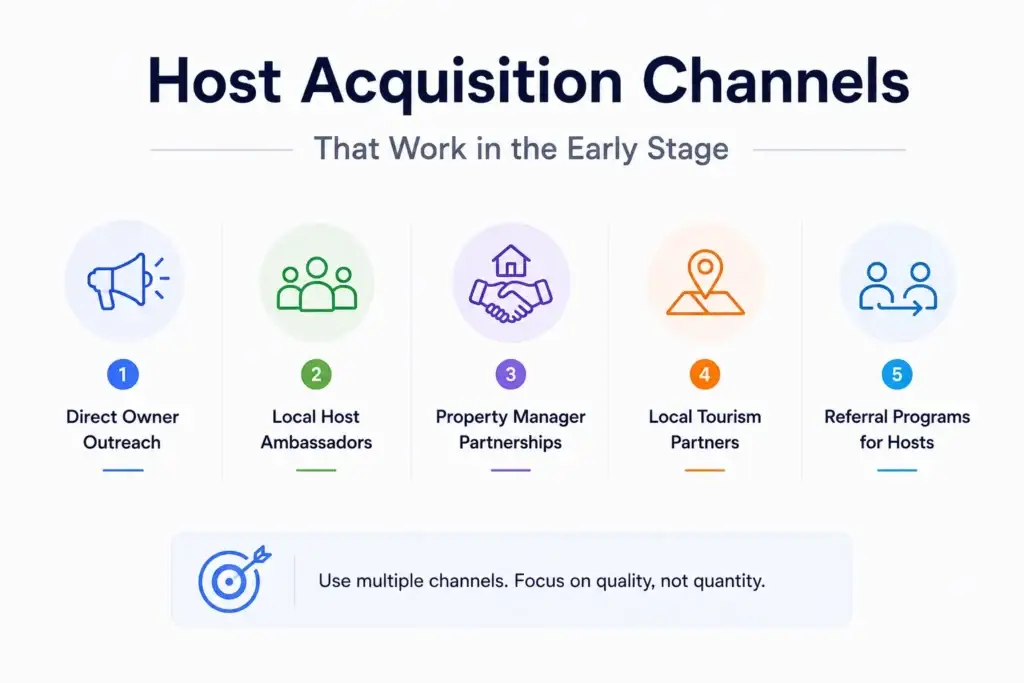
Founders should not rely on one acquisition channel. Host supply is usually built through a mix of direct outreach, partnerships, referrals, local operators, and content.
1. Direct Property Owner Outreach
Direct outreach works well when the founder targets a specific location or property type.
The team can build a list of:
- Independent vacation rental owners
- Guest house operators
- Boutique hotel owners
- Furnished apartment providers
- Homestay owners
- Property managers
- Local real estate agents
- Serviced apartment operators
- Student housing operators
- Relocation accommodation providers
The outreach message should not sound generic. It should explain why the platform is relevant to that owner’s property type, location, and guest segment.
2. Local Host Ambassador Programs
Host ambassadors can help onboard property owners in a target city.
They may be:
- Local travel creators
- Property consultants
- Community managers
- Tourism professionals
- Real estate brokers
- Local operators
- Existing superhosts
Ambassadors can help with trust because hosts often respond better to someone local than to a cold online message.
3. Property Manager Partnerships
Property managers already control multiple units. One successful partnership can bring many listings at once.
This is useful when the marketplace wants to build inventory quickly in a city. However, founders should still check listing quality, pricing, availability, and calendar readiness before publishing everything.
4. Local Tourism and Experience Partners
Some supply can come through local travel ecosystems.
Possible partners include:
- Local tour operators
- Destination management companies
- Coworking spaces
- Event organizers
- Wedding planners
- University housing coordinators
- Corporate relocation consultants
These partners may not own properties directly, but they often know who does.
5. Referral Programs for Early Hosts
Hosts often know other hosts.
A referral program can reward existing hosts for bringing verified property owners to the platform. Rewards may include commission discounts, featured listing credits, subscription upgrades, or listing photography support.
The reward should encourage quality, not spam. Pay or reward only when referred hosts complete verification and publish usable listings.
Host Onboarding Should Remove Friction
Getting a host interested is only the first step. The bigger challenge is getting the listing live, accurate, attractive, and bookable.
A strong host onboarding process should help with:
- Account creation
- Identity or business verification
- Property details
- Room or unit setup
- Photo upload
- Amenities
- House rules
- Pricing
- Availability calendar
- Cancellation policy
- Payment and payout details
- Tax or local document fields where needed
- Listing review before publishing
If onboarding is confusing, hosts drop off. If listing quality is weak, guest conversion drops.
This is why host onboarding should feel guided, not like a blank form.
Listing Quality: The Supply Layer That Improves Guest Conversion
Guest acquisition becomes easier when listings look trustworthy.
Founders should create listing quality standards before scaling supply. These standards may include:
- Minimum number of photos
- Clear cover image
- Accurate location area
- Property type
- Sleeping arrangement
- Amenities
- Clean pricing breakdown
- Check-in rules
- Cancellation policy
- Host response expectations
- Safety and accessibility information
- Verification status
- Calendar accuracy
Weak listings should not be pushed live just to increase inventory count. A few poor listings can reduce trust across the marketplace.
Host Education Helps Supply Stay Active
A host who lists once but never updates pricing or availability is not useful supply.
Founders should educate hosts on how to perform well.
Useful host education topics include:
- How to write a better listing title
- Which photos increase trust
- How to set seasonal pricing
- How to keep calendars updated
- How to respond quickly to guest messages
- How cancellation policies affect conversion
- How reviews influence future bookings
- How payout timing works
- How promotions or featured placements work
- How to prepare for peak travel dates
This can be delivered through onboarding emails, dashboard tips, webinars, help center articles, WhatsApp support, or local host workshops.
Host education is not only customer support. It is growth infrastructure.
Build Supply Density Before Paid Guest Campaigns
Paid guest acquisition should begin only when the platform has enough supply density in a target location.
Supply density means guests can search a destination and see enough relevant listings to compare.
A useful readiness check includes:
| Readiness Question | Why It Matters |
| Are there enough listings in the target location? | Guests need choice before they book |
| Are calendars updated? | Availability must be reliable |
| Are prices competitive? | Poor pricing reduces conversion |
| Are hosts responsive? | Slow replies create booking friction |
| Are photos strong enough? | Visual trust affects booking decisions |
| Are cancellation rules clear? | Guests need confidence before payment |
| Are payouts clear for hosts? | Host trust protects supply retention |
| Are reviews or trust signals available? | Social proof helps early demand convert |
If most answers are weak, guest ads will waste money.
When to Start Guest Acquisition
Guest acquisition should begin when the platform has enough supply to satisfy a specific search intent.
The first guest campaigns should be narrow and measurable.
Instead of running broad “book vacation rentals” campaigns, start with focused demand such as:
- Weekend villas near a specific city
- Affordable private rooms near a university
- Furnished apartments for remote workers
- Beach homestays for family trips
- Corporate stays for project teams
- Pet-friendly short stays in a destination
- Long-stay rentals for relocating professionals
This makes it easier to match supply and demand. It also helps founders learn which guest segments convert before expanding marketing spend.
The Right Marketing Funnel for a Supply-First Rental Marketplace
A supply-first marketing funnel works differently from a traditional app promotion funnel.
The first funnel is for hosts. The second funnel is for guests.
Host Funnel
| Stage | Goal | Founder Action |
| Awareness | Hosts discover the platform | Local outreach, partner referrals, host content |
| Interest | Hosts understand the value | Clear pitch, earnings logic, supply niche |
| Onboarding | Hosts create listings | Guided setup, photo help, pricing support |
| Activation | Listings become bookable | Calendar setup, payout setup, listing review |
| Retention | Hosts keep supply active | Education, analytics, payouts, support |
| Growth | Hosts invite other hosts | Referral programs and performance incentives |
Guest Funnel
| Stage | Goal | Founder Action |
| Awareness | Guests discover destination inventory | SEO, ads, social, partnerships |
| Search | Guests compare stays | Filters, photos, trust badges, pricing clarity |
| Booking | Guests complete checkout | Availability, payment, cancellation clarity |
| Stay | Guest experience matches promise | Communication and support |
| Review | Guest leaves feedback | Review reminders and host quality loops |
| Repeat | Guest returns or refers | Offers, loyalty, destination campaigns |
The mistake is starting the guest funnel before the host funnel is working.
Product Features That Support Host Supply Growth
Host supply growth is not only a marketing activity. It depends heavily on product design.
Important product features include:
Host Supply Growth Features
| Feature | Business Value | Founder Impact |
|---|---|---|
| Guided host onboarding | Helps hosts create complete listings faster | Improves supply activation rate |
| Listing quality review | Prevents weak listings from damaging guest trust | Improves marketplace credibility |
| Availability calendar | Lets hosts manage bookable dates and blocked dates | Reduces failed bookings and calendar conflicts |
| Pricing controls | Supports nightly rates, seasonal pricing, discounts, and fees | Helps hosts stay competitive |
| Host earnings dashboard | Shows booking value, deductions, and payout status | Builds host confidence |
| Verification workflow | Supports identity, property, or operator checks | Improves trust and reduces platform risk |
| Messaging system | Enables guest-host communication | Improves booking completion and support clarity |
| Admin supply dashboard | Tracks active listings, host status, quality, and location coverage | Helps operators manage supply growth strategically |
For a deeper breakdown of modules that support host, guest, booking, and admin workflows, founders can review these short-term rental marketplace features.
Host Trust Signals That Improve Supply Retention
Hosts care about more than bookings. They want to know whether the platform is reliable, fair, and worth maintaining.
Important host trust signals include:
- Clear commission structure
- Transparent payout timing
- Booking rules they can control
- Calendar reliability
- Guest verification options
- Dispute support
- Cancellation policy clarity
- Listing visibility insights
- Support access
- Performance reporting
- Review management
- Fair host penalties
- Admin transparency
If hosts feel the platform is unclear or risky, they may stop updating listings or move guests elsewhere.
A supply-first marketplace should build host trust before scaling guest traffic.
Why Payout Clarity Helps Host Acquisition
Payouts are one of the strongest trust factors for hosts.
Hosts want to understand:
- When they get paid
- How much commission is deducted
- Whether guest fees affect their earnings
- What happens after cancellation
- What happens during disputes
- How failed payouts are handled
- Where they can view payout history
- Whether payout requests need admin approval
A host acquisition pitch becomes stronger when the platform can explain payout flow clearly.
For example, saying “you can track earnings and payout status from your dashboard” is stronger than saying “we will pay you after bookings.”
Founders planning host supply should connect their marketing pitch with their actual payout workflow.
Security and Verification Should Support Host Growth
Trust is part of supply growth.
A rental marketplace handles guest profiles, host details, property information, booking history, payments, payouts, and support records. If the platform does not show clear verification and access controls, serious hosts may hesitate to join.
Useful safety layers include:
- Host verification
- Guest verification
- Secure payment gateway integration
- Role-based access control
- Activity logs
- Admin approval workflows
- Abuse reporting
- Dispute management
- Secure payout handling
- Review moderation
Founders can use this rental marketplace security guide to understand how trust, verification, and access control support marketplace growth.
Host Incentives That Do Not Damage Long-Term Revenue
Early hosts often need a reason to join before demand is proven.
Useful incentives include:
- Zero commission for the first few bookings
- Reduced commission for early verified hosts
- Free professional listing review
- Featured placement credits
- Free photography support
- Free onboarding assistance
- Early access to analytics
- Referral rewards
- Seasonal promotion support
- Priority support for verified hosts
The goal is not to discount forever. The goal is to reduce the host’s early risk while supply is being built.
Founders should avoid incentives that attract low-quality hosts. Reward activation, availability, quality, responsiveness, and completed bookings rather than simple signup volume.
Read more- How to Build Booking, Calendar, and Host Payout Logic for a Short-Term Rental Platform
How Content Marketing Supports Host Acquisition
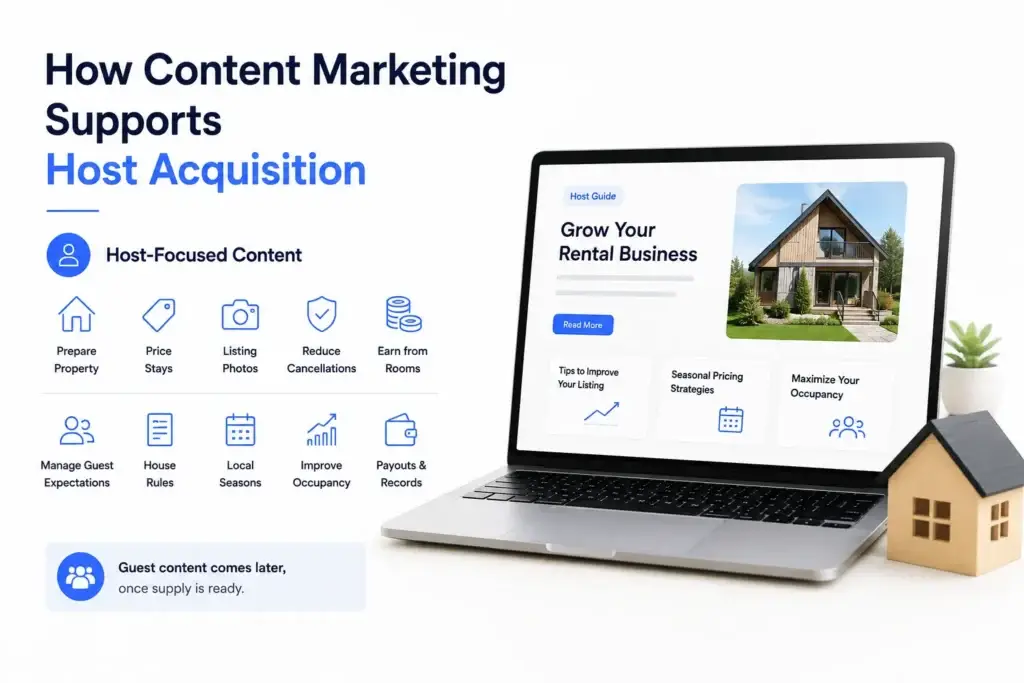
The existing slug has marketing intent, so the blog should still support growth strategy. But the first content audience should be hosts, not only guests.
Host-focused content can include:
- How to prepare your property for short-term rentals
- How to price weekend stays
- How to improve listing photos
- How to reduce cancellations
- How to earn from unused rooms
- How to manage guest expectations
- How to create house rules
- How to handle local travel seasons
- How to improve occupancy
- How to manage payouts and booking records
This content can attract property owners searching for earning opportunities or listing guidance.
Guest-focused content should come later, once the supply exists to serve search demand.
Local SEO for Supply-First Marketplace Growth
Local SEO can support both host acquisition and guest acquisition, but the sequence matters.
In the supply-building stage, create content for property owners and local operators:
- “How to list your homestay in [city]”
- “Short-term rental rules hosts should understand in [region]”
- “How villa owners can increase bookings near [destination]”
- “What travelers look for in [location] stays”
- “How property owners can prepare for peak season in [city]”
Once supply is strong, create guest-facing destination pages:
- “Weekend stays near [city]”
- “Pet-friendly rentals in [destination]”
- “Family homestays in [region]”
- “Monthly furnished apartments in [city]”
- “Budget private rooms near [area]”
This approach prevents the marketplace from ranking pages that cannot convert because supply is too thin.
Metrics Founders Should Track Before Guest Scaling
A founder should not guess when supply is ready. Track readiness metrics.
| Metric | What It Shows | Why It Matters |
| Active verified hosts | Number of usable supply partners | Measures real supply base |
| Published listings | Inventory available to guests | Shows marketplace depth |
| Listings per target location | Supply density | Helps decide where to market |
| Calendar freshness | Whether hosts keep dates updated | Protects booking reliability |
| Host response time | Host engagement quality | Affects booking completion |
| Listing completion score | Quality of listing content | Improves conversion potential |
| Price competitiveness | Fit with local demand | Reduces guest drop-off |
| Booking acceptance rate | Host willingness to transact | Shows supply reliability |
| Cancellation rate | Trust and operational risk | Helps protect guest experience |
| Payout satisfaction | Host trust and retention | Protects long-term supply |
Guest scaling should begin when these indicators are healthy in a specific location or segment.
Founder Decision Signals
Supply Density
If guests search and see too few relevant listings, pause broad guest marketing and build more host supply in that destination first.
Host Activation
If many hosts sign up but few publish complete listings, improve onboarding, listing review, photo guidance, and payout clarity.
Guest Readiness
If listings are verified, priced clearly, and calendar-ready, focused guest acquisition can begin for that specific segment.
Platform Control
If the admin cannot track host status, listing quality, availability, and payout issues, scaling supply will become hard to manage.
When Guest Acquisition Becomes Worth Scaling
Guest acquisition becomes worth scaling when the marketplace can answer “yes” to these questions:
- Do we have enough listings in the target location?
- Are the listings relevant to a specific guest need?
- Are calendars reliable?
- Are prices competitive?
- Are hosts responsive?
- Is checkout clear?
- Are payouts transparent for hosts?
- Can support handle booking issues?
- Do we have at least some trust signals?
- Can we measure conversion by location and campaign?
If yes, the platform can begin scaling demand through SEO, paid ads, referral campaigns, destination content, partnerships, influencer campaigns, and retargeting.
If not, the founder should keep improving supply before increasing guest acquisition spend.
Mistakes Founders Should Avoid
Running Guest Ads Before Supply Is Ready
Paid traffic will not fix weak inventory. If guests find too few listings, poor photos, unclear pricing, or unavailable dates, campaigns will waste budget.
Chasing Listing Count Instead of Listing Quality
A marketplace with many weak listings can lose trust quickly. Focus on verified, complete, searchable, and bookable supply.
Launching Too Many Locations at Once
Scattered supply makes the platform feel empty. Build density in one destination, segment, or use case before expanding.
Ignoring Host Retention
Acquiring hosts is not enough. Hosts must keep calendars updated, respond to guests, maintain pricing, and trust the payout process.
Miracuves Perspective: Build the Host Spine Before Scaling Demand
A short-term rental marketplace needs more than guest-side marketing. It needs a host-side operating system that can support onboarding, listings, calendars, pricing, booking rules, payouts, verification, and admin review.
Miracuves helps founders launch rental marketplace platforms with ready-made and white-label workflows that support guest discovery, host management, booking, payment, payout, and operator control. For founders who want a launch-ready product foundation before scaling host and guest acquisition, the Miracuves short-stay rental marketplace solution is the most relevant next step.
The advantage of starting with a structured product foundation is that the founder can focus on supply density, local partnerships, host onboarding, destination positioning, and conversion strategy instead of rebuilding every marketplace workflow from zero.
How Development Scope Affects Host-Supply Strategy
Supply growth depends on the product’s operational depth. If your platform needs custom host dashboards, local payment methods, special pricing rules, operator-level controls, or regional workflows, the development scope should be planned before marketing begins.
Founders estimating budget can review these rental marketplace development cost factors to understand how host, guest, booking, payout, and admin modules influence the build.
If the platform needs a more customized product journey, Miracuves’ custom mobile app development services can support unique workflows beyond a standard marketplace launch.
Choosing the Right Build Partner for Supply-Led Growth
A rental marketplace development partner should understand more than app screens. The partner should understand how hosts are onboarded, how listings become bookable, how calendars stay accurate, how guests convert, how payouts build trust, and how admins manage marketplace operations.
Founders evaluating implementation options can review how to choose a rental marketplace development company before committing to a build path.
Connecting Host Supply With Revenue Strategy
Host supply also affects monetization.
A marketplace with strong supply can introduce revenue streams such as booking commissions, guest service fees, featured listing upgrades, host subscription plans, photography packages, local service add-ons, and corporate stay programs.
But monetization should not come too early. If hosts are still testing the platform, aggressive fees may reduce adoption. Founders should first create host value, then add revenue layers as booking volume and trust increase.
For deeper planning, explore this short-term rental marketplace business model.
From Supply Building to Full Growth Marketing
Once host supply is strong in a location, the marketplace can begin guest acquisition with more confidence.
Guest growth channels may include:
- Destination SEO pages
- Paid search campaigns
- Social ads
- Creator partnerships
- Referral programs
- Local travel partnerships
- Email remarketing
- Seasonal campaigns
- Corporate travel outreach
- Retargeting for abandoned searches
At this stage, marketing becomes more efficient because the platform has inventory that can actually convert. The founder is no longer sending guests to an empty marketplace.
Final Thoughts
Short-term rental marketplaces should not scale guest acquisition before host supply is ready. Demand only converts when guests find enough relevant listings, clear prices, reliable calendars, strong photos, trust signals, and responsive hosts.
The smarter path is supply-first growth. Start with a focused destination or use case. Onboard high-quality hosts. Help them create better listings. Build trust through verification, payout clarity, and calendar reliability. Then scale guest acquisition when the marketplace can actually satisfy search demand.
For founders, the goal is not just to launch a rental app. The goal is to create a marketplace where hosts want to stay, guests can confidently book, and the operator has enough control to grow without chaos.
FAQs
Why should short-term rental marketplaces build host supply first?
Host supply should come first because guests need enough relevant, trusted, and bookable listings before they convert. Without strong supply, guest marketing spend may bring traffic that leaves without booking.
What is host supply in a rental marketplace?
Host supply refers to the property owners, managers, and operators who list bookable inventory on the platform. Good supply includes complete listings, accurate calendars, clear pricing, host responsiveness, and reliable payout setup.
How many listings does a rental marketplace need before guest acquisition?
There is no universal number. The platform needs enough listings to satisfy a specific location or search intent. A focused destination with 50 strong listings may perform better than a broad marketplace with hundreds of scattered weak listings.
What are the best ways to acquire hosts for a short-term rental marketplace?
Effective methods include direct property owner outreach, local ambassador programs, property manager partnerships, host referrals, tourism partnerships, local events, and host-focused educational content.
How can founders improve host onboarding?
Founders can improve host onboarding with guided listing setup, photo guidance, pricing support, calendar setup, payout explanation, verification workflows, and listing quality review before publishing.
When should a rental marketplace start guest marketing?
Guest marketing should begin when the platform has enough quality supply in a target segment, updated calendars, competitive pricing, responsive hosts, clear booking rules, and enough trust signals to support conversion.
What product features help build host supply?
Useful features include host dashboards, listing management, availability calendars, pricing controls, payout tracking, verification workflows, messaging, reviews, and admin dashboards for supply monitoring.
How does host retention affect marketplace growth?
Host retention keeps supply active and reliable. If hosts stop updating listings, calendars, or prices, guest conversion drops. Strong payout clarity, support, visibility, and booking performance help hosts stay engaged.
Miracuves is an independent software development company. We are not affiliated with, connected to, sponsored by, or endorsed by any company or product named in this article.
Terms such as “X Clone” are used descriptively. It is how the software industry refers to building a platform with functionality comparable to a known service, and how clients search for it.
The entire design and codebase of our products is built by our own team. Our products contain no code, design, graphics, or content originating from any third-party website or applications.
All third-party names and marks referenced in this article are the property of their respective owners, referenced solely to identify the services discussed.