
Key Takeaways
- Short-stay rental app security should be treated as a core marketplace foundation because the platform handles guest data, host information, bookings, payments, payouts, messages, and administrative records.
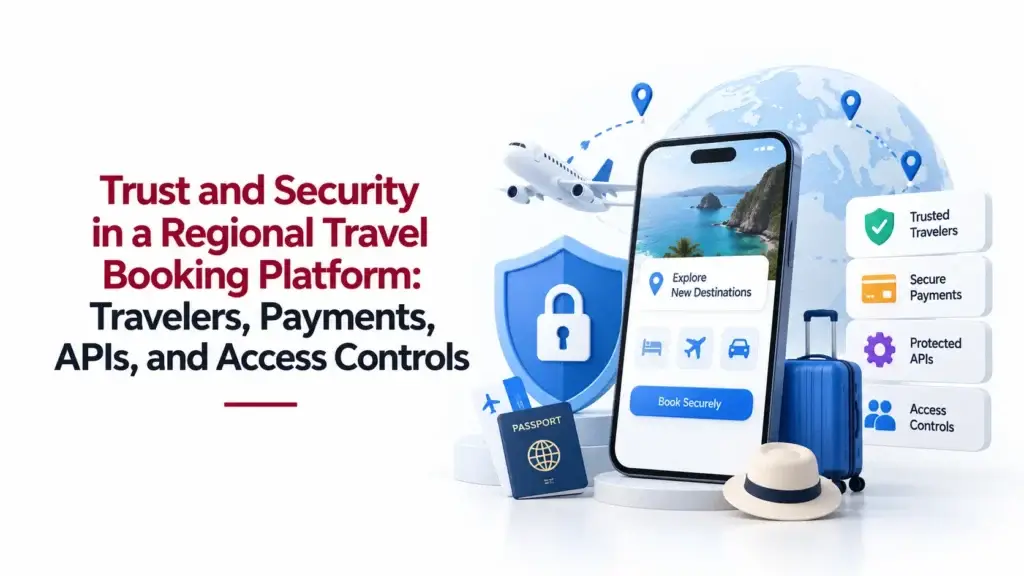
- Security must protect all three sides of the marketplace: guests who book and pay, hosts who manage properties and payouts, and operators who control platform activity.
- Secure authentication, encrypted data handling, role-based access control, protected APIs, payment gateway security, and audit logs should be planned before launch.
- Booking security requires server-side availability validation, protected status changes, payment-to-booking matching, controlled refunds, and traceable administrative adjustments.
- A white-label rental platform can be secure when its architecture, source-code ownership, access controls, maintenance practices, payment handling, and security responsibilities are clearly defined.
Security Signals
- Guest protection should include strong authentication, secure sessions, encrypted data transfer, limited exposure of personal information, protected booking history, and safe messaging.
- Host security should protect listings, pricing, calendars, booking requests, earnings records, payout information, and sensitive account changes.
- Payment workflows should verify transaction states and gateway callbacks while maintaining traceable records for refunds, commissions, failed payments, disputes, and host payouts.
- API security should combine authentication, authorization, rate limiting, input validation, secure file handling, logging, webhook verification, and restricted admin endpoints.
- Admin dashboards should separate support, finance, moderation, operations, and super-admin permissions instead of giving every administrator unrestricted access.
Real Insights
- A polished rental marketplace can still be unsafe if backend permissions, APIs, payment flows, booking records, or administrative controls are poorly designed.
- Frontend restrictions are not enough; important actions must always be authenticated, authorized, and validated by the backend.
- Audit logs are essential because operators need to know who changed a booking, edited a listing, processed a refund, modified a payout, or changed marketplace settings.
- Security and compliance are connected but not identical; a platform can support compliance-ready workflows while final legal requirements depend on jurisdiction, payment partners, integrations, and the operating model.
- The strongest security foundation is: authentication → encryption → role-based access → secure APIs → booking integrity → payment protection → audit logs → incident response.
Security is one of the most important trust layers in a short-stay rental marketplace.
A rental app does more than show rooms, apartments, private stays, and local accommodations. It stores guest profiles, host details, property information, booking history, payment records, payout data, messages, reviews, documents, admin actions, and support conversations. If that data is not protected properly, the platform can lose user trust long before it reaches scale.
This is why short-stay rental app security should be treated as a foundation, not an afterthought.
Founders often focus first on property listings, booking flows, availability calendars, and payments. Those modules matter, but they must be built on secure authentication, encrypted data handling, role-based access control, secure APIs, payment gateway protection, audit logs, and clear incident response workflows.
A secure short-stay rental platform protects three sides of the marketplace:
- Guests who book and pay.
- Hosts who list properties and receive payouts.
- Operators who manage bookings, disputes, payments, users, and platform settings.
This guide explains how founders should evaluate security before launching a short-stay rental app, white-label booking marketplace, vacation stay platform, private room rental app, or property booking system.
Why Security Matters in Short-Stay Rental Platforms
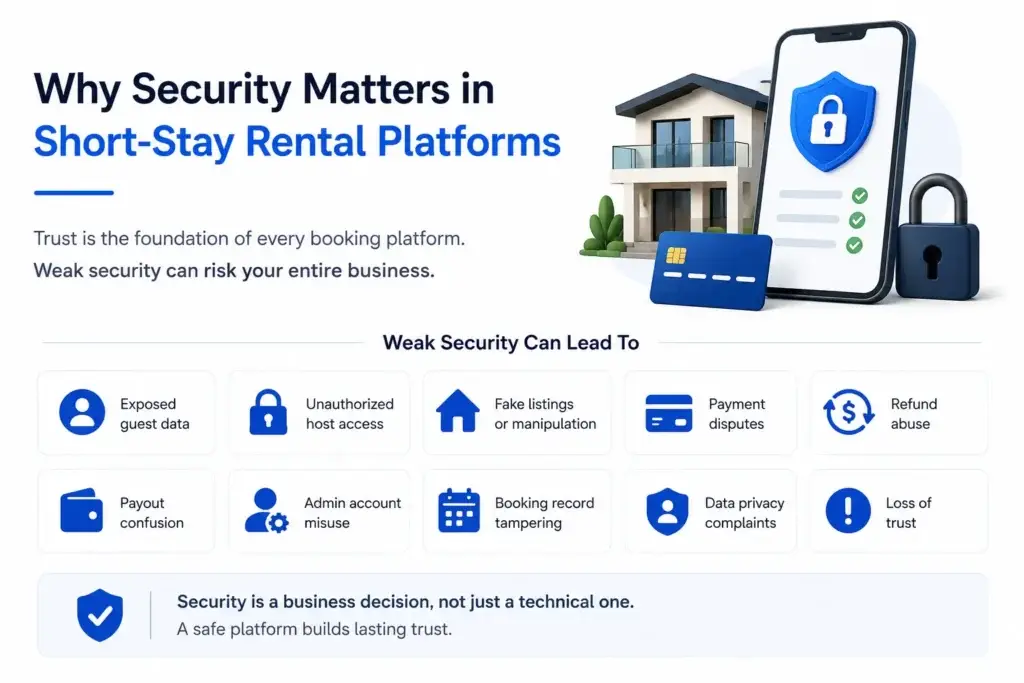
A short-stay rental marketplace runs on trust.
Guests trust the platform with personal details, travel dates, payment information, and booking records. Hosts trust the platform with property data, calendar availability, payout details, guest communication, and earning history. Operators trust the admin system to manage transactions, disputes, cancellations, refunds, and user activity safely.
If security is weak, the risk is not limited to a technical breach. It can affect the entire business.
Weak security can lead to:
- Exposed guest profiles
- Unauthorized host account access
- Fake listings or listing manipulation
- Payment disputes
- Refund abuse
- Payout confusion
- Admin account misuse
- Booking record tampering
- Data privacy complaints
- Loss of marketplace trust
For founders, this means security is not only a developer responsibility. It is a business continuity decision.
A booking platform can have a polished interface and still be unsafe if the backend, APIs, admin roles, payment flow, and data policies are poorly designed.
What Data a Short-Stay Rental App Needs to Protect
Rental marketplaces handle more sensitive information than many founders expect.
Security planning should also connect with the platform’s core product modules. Founders who want to review the broader product layer can explore this short-stay rental marketplace features including host tools, booking flows, pricing controls, payout workflows, admin controls, and guest-side marketplace features.
A guest may share name, phone number, email address, location preferences, booking dates, payment status, stay history, messages, reviews, support requests, and sometimes identity documents. A host may share property details, address information, payout settings, bank-related records through payment partners, tax-related details where applicable, pricing rules, and private communication with guests.
The platform must protect both sides.
Critical Data Layers in Short-Stay Rental App Security
| Data Layer | What It Includes | Security Priority |
|---|---|---|
| Guest Data | Name, email, phone, booking history, messages, reviews, saved listings, and support records. | Protect with encrypted transfer, secure storage, access control, and privacy-conscious handling. |
| Host Data | Host profile, property details, calendar rules, payout records, listing documents, and communication history. | Protect against unauthorized access, listing manipulation, and payout-related abuse. |
| Booking Records | Reservation dates, check-in/check-out rules, guest count, cancellation status, refund status, and booking logs. | Maintain accurate, tamper-resistant records for disputes, refunds, and reporting. |
| Payment Events | Payment status, transaction IDs, refunds, platform fees, coupons, and payout events. | Use secure payment gateway integration, transaction logs, and restricted admin visibility. |
| Admin Activity | User edits, listing approvals, refund actions, commission changes, dispute decisions, and support interventions. | Track through role-based access, audit logs, and permission-based dashboards. |
| API Requests | Login, search, booking, messaging, payment callbacks, calendar updates, and admin actions. | Protect with authentication, authorization, validation, rate limits, and monitoring. |
Guest Protection: Secure Accounts, Privacy, and Booking Confidence
Guest trust starts with account security.
A guest should be able to register, search, book, pay, message hosts, and manage reservations without worrying that their personal data or booking history is exposed.
A secure guest-side experience should include:
- Strong authentication
- Password reset protection
- Secure session handling
- Encrypted data transfer
- Privacy-conscious profile storage
- Limited exposure of personal details to hosts
- Protected booking history
- Safe messaging workflows
- Secure payment redirection or gateway integration
- Clear cancellation and refund records
The platform should avoid showing unnecessary personal data. Hosts may need booking information, arrival details, and communication access, but they do not need unrestricted access to sensitive guest records.
Security also affects conversion. Guests are more likely to complete a booking when the platform feels professional, payment-safe, and transparent.
Host Protection: Listings, Calendars, Payouts, and Account Access
Hosts are the supply side of the marketplace. If they do not trust the platform, they will not list quality inventory.
A secure host dashboard should protect:
- Property listing details
- Room or unit availability
- Pricing rules
- Calendar blocks
- Booking requests
- Guest communication
- Earnings history
- Payout records
- Listing approval status
- Review history
Host accounts need strong access control because account compromise can create serious operational issues. An attacker could change prices, manipulate availability, edit payout settings, approve fake bookings, or damage listing credibility.
A secure rental marketplace should support:
- Host verification workflows
- Admin approval for sensitive listing changes where needed
- Secure payout update controls
- Activity logs for important host actions
- Listing moderation
- Calendar change history
- Abuse reporting
- Dispute management
For founders, host protection is also supply protection. The stronger the host control layer, the easier it becomes to build long-term marketplace trust.
Booking Security: Protecting Reservations From Manipulation
Booking records are the operational center of a rental marketplace.
A booking includes property, guest, host, dates, price, platform fee, payment status, cancellation rules, refund status, and communication history. If booking records are incomplete or editable without proper control, the platform becomes difficult to manage.
A secure booking workflow should include:
- Server-side availability validation
- Protected booking status changes
- Clear payment-to-booking matching
- Cancellation rule enforcement
- Refund status tracking
- Admin approval for manual adjustments
- Audit logs for booking changes
- Guest and host notification records
- Dispute records linked to the booking
Founders should avoid treating bookings as simple database rows. In a real marketplace, bookings are financial and operational records.
Every status change should be traceable.
Payment Security: Guest Payments and Host Payouts
Payment security is one of the highest-risk areas in rental marketplace development.
A short-stay rental app usually handles guest payments, platform fees, refunds, cancellations, host payouts, failed transactions, promotional discounts, and payment gateway callbacks. Even if a third-party payment gateway processes sensitive card data, the platform still needs secure transaction handling.
Once payment security is planned, founders should also understand how the platform earns from each transaction. A clear short-stay rental marketplace revenue model can include booking commissions, host-side fees, guest service charges, featured listings, payout logic, and marketplace fee controls.
A secure payment setup should include:
- Secure payment gateway integration
- Tokenized payment handling where applicable
- Payment status validation
- Transaction IDs stored safely
- Webhook verification
- Refund workflow control
- Host payout tracking
- Commission calculation logs
- Failed payment recovery
- Dispute and chargeback visibility
- Admin permissions for refund and payout actions
Payment events should match booking records. A confirmed booking should not exist without a valid payment state. A refund should update the booking record, guest history, host payout logic, and admin reporting.
For founders, payment security is not only about protecting money. It is about maintaining a trustworthy financial record across the entire platform.
API Security: Protecting the System Behind the Screens
Most short-stay rental apps depend on APIs.
APIs connect guest apps, host dashboards, admin panels, payment gateways, notification services, map tools, messaging systems, and external integrations. If APIs are weak, attackers may attempt unauthorized access, data scraping, account takeover, fake bookings, or admin misuse.
A secure rental app API strategy should include:
- Authentication for protected endpoints
- Authorization checks by user role
- Rate limiting
- Input validation
- Secure file upload handling
- API logging
- Payment webhook verification
- Protection against brute-force login attempts
- Admin endpoint restrictions
- Secure integration keys
- Version control and documentation
The platform should not rely only on frontend restrictions. Every important action should be validated on the backend.
A user interface can hide a button. The backend must still decide whether the user has permission to perform that action.
Admin Access Control: The Layer Founders Often Underestimate
The admin dashboard is powerful. That makes it risky.
Admins may approve hosts, edit listings, process refunds, change commissions, manage payouts, moderate reviews, resolve disputes, update platform settings, and access reports. If admin access is not controlled properly, one compromised account can affect the entire marketplace.
A secure admin layer should include:
- Role-based access control
- Permission-based dashboards
- Admin activity logs
- Limited access by responsibility
- Multi-step approval for sensitive actions
- Secure login requirements
- Session timeout rules
- Audit trails for refunds, payouts, and listing edits
- Review of admin user privileges
- Clear separation between support, finance, operations, and super-admin roles
Not every admin should see or control everything.
A support user may need booking records. A finance user may need payment and payout reports. A content moderator may need listing and review access. A platform owner may need commission and system settings.
Role separation reduces risk.
Founder Decision Signals
Guest Trust
If guests are sharing personal data, booking dates, and payment information, the platform needs secure authentication, encrypted transfer, and transparent booking records.
Host Confidence
If hosts manage listings, calendars, pricing, and payouts, the platform must protect host accounts from unauthorized changes and payout-related abuse.
Payment Safety
If payments, refunds, commissions, and host payouts are part of the business model, transaction records must be secure, traceable, and admin-controlled.
Operational Control
If multiple team members use the admin panel, role-based permissions and audit logs are essential to reduce internal and external risk.
Compliance-Ready Workflows: What Founders Should Understand
Security and compliance are connected, but they are not the same thing.
A secure platform can support compliance workflows, but final compliance depends on the target market, legal review, payment partners, data processing rules, operational model, and integrations.
Founders should avoid assuming that a platform is automatically compliant everywhere. Instead, they should look for a compliance-ready foundation that supports the controls needed for their region and business type.
Useful compliance-supporting workflows may include:
- Privacy-conscious data handling
- User consent records
- Secure payment gateway integration
- Role-based data access
- Audit logs
- Data retention controls
- Incident response procedures
- User data export or deletion workflows where required
- Clear refund and cancellation records
- Secure document handling where verification is used
The safest wording is: the platform can support compliance workflows, but final compliance depends on jurisdiction and operating model.
Provider Security Checklist for White-Label Rental Platforms
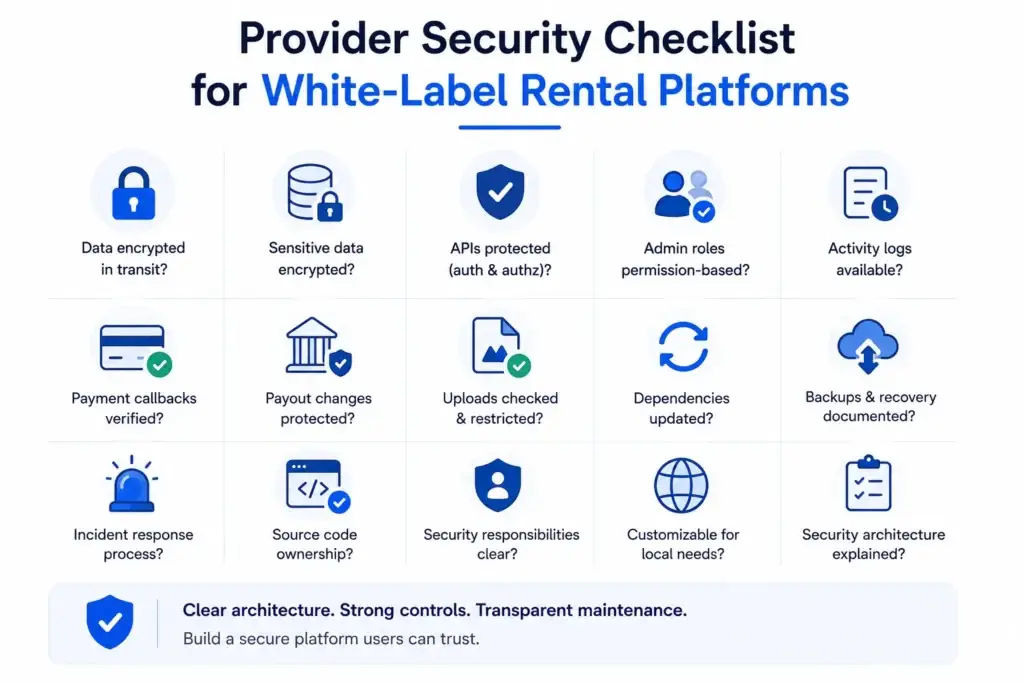
A white-label rental platform can be secure when the provider has strong architecture, clear controls, and transparent maintenance practices.
The risk is not white-label itself. The risk is choosing a poorly engineered platform with weak access controls, unclear ownership, outdated code, or no security documentation.
Security requirements can also affect the final build scope. Before choosing modules, integrations, or custom workflows, founders should review the short-stay rental platform development cost to understand how features, security layers, payment gateways, admin controls, and customization can influence pricing.
Before choosing a provider, founders should ask:
- Is user data encrypted in transit?
- Is sensitive data encrypted in storage where appropriate?
- Are APIs protected with authentication and authorization?
- Are admin roles permission-based?
- Are activity logs available for important actions?
- Are payment gateway callbacks verified?
- Are host payout changes protected?
- Are file uploads checked and restricted?
- Are dependencies maintained and updated?
- Are backup and recovery processes documented?
- Is there a clear incident response process?
- Is source code ownership included?
- Are security responsibilities explained clearly?
- Can the platform be customized for local privacy and payment requirements?
A provider who cannot explain security architecture clearly may not be ready to support a serious booking marketplace.
Red Flags Founders Should Avoid
Security Red Flags Founders Should Avoid
No Clear Access Control
If every admin user can access every setting, payout record, refund action, and user profile, the platform is exposed to unnecessary operational risk.
No Audit Logs
Without activity logs, it becomes difficult to investigate who changed a booking, edited a listing, processed a refund, or updated payout details.
Unclear Payment Handling
If payment status, refund records, platform fees, and host payouts are not connected clearly, financial disputes become harder to resolve.
No Source-Code Transparency
If the provider cannot explain what code you own, what is encrypted, and how future security updates work, long-term platform control may become limited.
Where Miracuves Fits Into Secure Short-Stay Rental Marketplace Launches
Miracuves helps founders launch ready-made and white-label solution with source-code ownership, branded design, host workflows, guest booking flows, payment handling, admin control, and faster deployment.
For founders evaluating short-stay rental app security, the important question is not only whether the platform can launch quickly. The question is whether the platform gives enough control over users, hosts, listings, bookings, payments, payouts, admin roles, and future customization.
A secure rental marketplace should support:
- Guest and host account protection
- Listing moderation
- Booking record control
- Secure payment gateway integration
- Payout visibility
- Admin permissions
- Audit logs
- Dispute workflows
- Source-code ownership
- Security-aware customization
If you are ready to move from security planning to solution evaluation, explore this launch-ready short-stay rental marketplace platform as the next step. This blog should remain focused on security education, while the solution page handles direct product, demo, pricing, and purchase-intent details.
Final Thoughts: Security Is the Foundation of Rental Marketplace Trust
A short-stay rental app cannot build trust only through design, listings, or marketing.
Guests need to know that their data, payments, bookings, and communication are protected. Hosts need to know that their listings, calendars, earnings, and payout details are safe. Operators need enough admin control to manage disputes, refunds, user issues, and platform records without creating unnecessary risk.
That is why short-stay rental app security should be planned before launch.
A secure platform should combine encrypted data handling, secure APIs, role-based access, payment protection, booking record integrity, audit logs, incident response planning, and provider transparency.
Before choosing a build partner, founders should evaluate more than launch speed. The right short-stay rental marketplace development partner should understand booking security, payment protection, host payout workflows, admin permissions, source-code ownership, and post-launch support.
The strongest rental marketplace is not simply the one that launches fastest. It is the one that launches with enough security, control, and trust infrastructure to support real guests, real hosts, and real transactions.
FAQs
What is short-stay rental app security?
Short-stay rental app security refers to the systems and workflows that protect guest data, host accounts, booking records, payments, payouts, admin access, API endpoints, messages, reviews, and platform activity.
Why is security important for a rental marketplace?
Security is important because rental marketplaces handle personal data, booking history, payment events, host payout records, property details, and user communication. Weak security can damage guest trust, host confidence, and platform operations.
How should guest data be protected in a booking platform?
Guest data should be protected through secure authentication, encrypted data transfer, privacy-conscious storage, limited profile exposure, secure payment gateway integration, and controlled access to booking records.
How can a platform protect hosts?
A platform can protect hosts through account security, listing moderation, payout update controls, calendar activity logs, host verification, secure messaging, and admin review for sensitive changes.
What security features should an admin dashboard include?
An admin dashboard should include role-based access control, permission-based views, activity logs, refund and payout controls, listing moderation, dispute workflows, secure login, and limited access based on responsibility.
Is a white-label rental platform secure?
A white-label rental platform can be secure if it is built with strong architecture, secure APIs, encrypted data handling, admin access controls, payment protection, audit logs, and ongoing maintenance. The risk comes from poor engineering, not from the white-label model itself.
Does a secure platform guarantee legal compliance?
No. A secure platform can support compliance workflows, but final compliance depends on jurisdiction, legal review, payment partners, data processing rules, integrations, and the business operating model.
How can Miracuves help with secure rental marketplace development?
Miracuves helps founders launch ready-made, white-label rental marketplace platforms with source-code ownership, host and guest workflows, payment handling, admin control, booking modules, and customization support for faster market entry.
Miracuves is an independent software development company. We are not affiliated with, connected to, sponsored by, or endorsed by any company or product named in this article.
Terms such as “X Clone” are used descriptively. It is how the software industry refers to building a platform with functionality comparable to a known service, and how clients search for it.
The entire design and codebase of our products is built by our own team. Our products contain no code, design, graphics, or content originating from any third-party website or applications.
All third-party names and marks referenced in this article are the property of their respective owners, referenced solely to identify the services discussed.