A professional networking platform becomes significantly more useful when users can move from a large pool of jobs and profiles to genuinely relevant opportunities without opening dozens of unsuitable results. That is the real purpose of advanced job search.
The challenge is that professional search is rarely based on one factor. A recruiter may need a backend engineer with specific cloud skills, five or more years of relevant experience, availability within a particular region, and experience in a regulated industry. A job seeker may want a remote product role that matches existing skills while still allowing a move into a new sector.
Neither query can be solved well with a basic keyword box.
A stronger search experience combines structured skills, work history, seniority, geography, work preferences, job requirements, user intent, profile freshness and relevance ranking. Candidate matching then builds on those signals to answer a harder question: not simply “Does this profile contain my keywords?” but “How closely does this person or opportunity fit what the searcher actually needs?”
For founders building talent communities, sector-specific professional networks, alumni platforms, recruitment marketplaces or private career networks, this search layer can directly affect activation, repeat usage and marketplace quality.
Key Takeaways
- Advanced job search should combine skills, experience, location, preferences and relevance instead of relying only on keywords.
- Skills need normalization because equivalent capabilities may be described using different terms.
- Experience matching should consider role relevance and seniority, not simply total years worked.
- Location matching must account for remote, hybrid, onsite, relocation and geographic-radius preferences.
- Candidate matching works best when retrieval, filtering, ranking and match explanations operate as separate layers.
- Clean profile and job data is more important than adding AI to an unstructured database.
- Search quality should be measured through outcomes such as useful result engagement, applications and recruiter shortlists—not search volume alone.
Why Advanced Job Search Is a Matching Problem, Not Just a Filter Problem
Filters are necessary, but filters alone do not create good search.
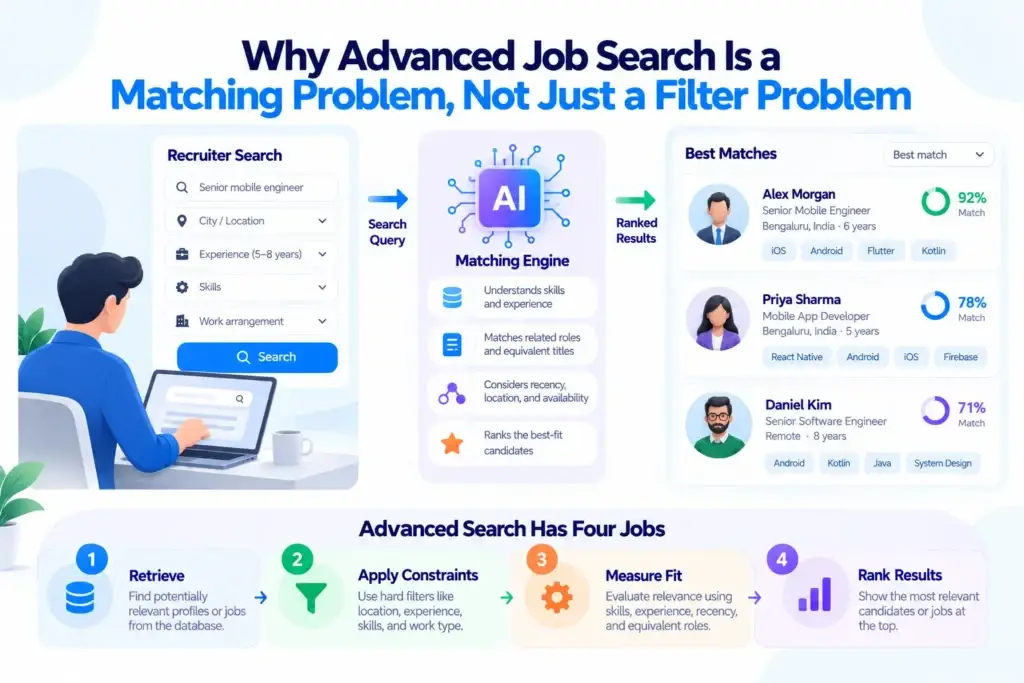
Imagine a recruiter searching for a senior mobile engineer. A conventional search interface may let the recruiter choose a city, enter “mobile developer,” and select five to eight years of experience. That narrows the database, but it still leaves several questions unanswered.
- Does the candidate have the specific technical capabilities needed?
- Is the person’s experience recent enough to be relevant?
- Does five years in an adjacent role count the same as five years performing the exact role?
- Is the candidate open to the required work arrangement?
- Is the candidate available in the employer’s target geography?
- Should an equivalent job title be considered a match?
- Which of several technically qualified candidates should appear first?
Advanced search therefore has at least four jobs: retrieve potentially relevant profiles or jobs, apply hard constraints, measure fit, and rank the remaining results.
This distinction matters because a platform can have dozens of filters and still produce weak results. Conversely, a smaller set of well-designed filters combined with clean data and strong ranking logic can feel considerably more intelligent.
Founders evaluating the broader profile, networking, hiring and communication foundation can review Miracuves’ professional networking platform solution. This guide deliberately stays focused on the search and matching layer rather than duplicating the complete product structure.
The Four Signals That Determine Search Quality
Most useful professional searches can be understood through four major signal groups: skills, experience, location and candidate-to-role fit. Additional factors such as salary expectations, availability, credentials, industry and activity can strengthen the model, but these four usually form the foundation.
1. Skills: Matching Capability Instead of Exact Words
Skills appear simple until real profile data is involved.
Different people can describe similar capabilities differently. One profile may use a broad category, another may list a specific framework, and a third may describe the same capability only inside a work-experience paragraph. Job descriptions are equally inconsistent.
A useful system therefore benefits from separating raw profile text from normalized skill entities. Instead of treating every word as independent, the platform can maintain a controlled skill vocabulary and map equivalent or related terms to that vocabulary.
That makes several search behaviors possible:
- Exact required-skill filters
- Related-skill expansion
- Must-have versus preferred skills
- Skill-category searches
- Proficiency or years-of-use signals
- Skills inferred from structured experience
- Skill-gap explanations
The distinction between required and preferred skills is particularly important. If every skill becomes a hard filter, a strong candidate can disappear because of one missing optional capability. If no skills are hard constraints, the search may become too broad.
2. Experience: Matching Relevance, Seniority and Recency
Total years of employment are an imperfect proxy for role suitability.
Two candidates may each have eight years of professional experience, yet one may have spent six years working directly in the required discipline while the other has only one year of relevant exposure. A search system that looks exclusively at total years will treat them too similarly.
Experience matching becomes stronger when the platform structures:
- Role title and normalized role family
- Start and end dates
- Seniority level
- Skills demonstrated within each position
- Industry or domain context
- Management versus individual-contributor responsibility
- Current versus historical experience
- Employment continuity where relevant to the use case
This allows the ranking layer to distinguish between general career length and directly relevant experience.
For example, a platform might consider recent experience in the requested role more relevant than a similar role held a decade earlier. The exact weighting should depend on the hiring market and should remain configurable rather than being treated as a universal rule.
3. Location: More Than a City Filter
Location has become a multi-dimensional hiring signal.
A user’s current city does not necessarily indicate where that person can work. Candidates may prefer remote work, accept hybrid roles within a travel radius, be open to relocation, hold work authorization in another market, or only consider roles within a specific time zone.
A practical location model may therefore separate:
- Current location
- Preferred job locations
- Remote-work eligibility
- Hybrid-work radius
- Relocation willingness
- Country or regional eligibility
- Time-zone compatibility
- Employer workplace requirements
This prevents a common search mistake: excluding a suitable candidate simply because the profile’s current city does not exactly equal the employer’s city.
4. Candidate Matching: Turning Signals Into Ranked Fit
Candidate matching brings the previous signals together.
Instead of asking whether a candidate passes one filter, the platform evaluates how closely the candidate aligns with the role across multiple dimensions. Skills may be strong while location is weak. Experience may be excellent while availability does not match. Another candidate may satisfy every mandatory condition but have less directly relevant experience.
The purpose of matching is not necessarily to produce one magical score. Its more valuable function is to organize these trade-offs so recruiters and job seekers can understand which results deserve attention first.
| Search Signal | What the System Evaluates | Why It Matters |
|---|---|---|
| Skills | Required, preferred and related capabilities | Measures functional fit |
| Experience | Role relevance, seniority, duration and recency | Separates general experience from applicable experience |
| Location | Geography, work mode, radius and relocation preferences | Prevents unsuitable geographic matches |
| Job preferences | Role type, work arrangement and career direction | Improves intent alignment |
| Availability | Immediate or future availability where supplied | Improves hiring practicality |
| Profile quality | Completeness and freshness of structured data | Determines how confidently the system can match |
| Relevance ranking | Combined fit across multiple factors | Decides which results appear first |
Recruiter Search and Job-Seeker Search Need Different Logic
A professional network serves at least two search directions, and they should not be treated as identical experiences.
Recruiter-to-Candidate Search
Recruiters often begin with constraints. They already know the role, essential skills, hiring geography and approximate seniority. Their main challenge is reducing a large talent pool to a manageable shortlist without excluding good adjacent profiles.
Recruiter-facing search therefore benefits from precise controls such as required skills, role families, experience ranges, locations, current or past industries, availability, certifications and Boolean logic.
But discovery should not stop at the results page. Once a recruiter finds someone relevant, the next actions may include saving the profile, adding it to a hiring workflow, comparing candidates, sending a message, sharing the profile internally or revisiting the search later.
This is why advanced search works best when it connects directly to recruiter workflows rather than existing as an isolated filter screen. For a broader view of how member and recruiter roles can be structured across the product, see the member and recruiter feature framework.
Job-Seeker-to-Opportunity Search
Job seekers often have a less precise starting point. Someone may know their desired industry, preferred work arrangement and strongest skills without knowing the exact title that employers use for comparable positions.
Job-seeker search therefore benefits from both explicit filters and discovery assistance.
- Relevant role families
- Related job titles
- Skill-based job suggestions
- Experience-level alignment
- Location and work-mode preferences
- Recently published opportunities
- Saved searches and alerts
- “Why this matches” explanations
A professional-network environment has an additional advantage: search can draw from a richer professional profile instead of relying only on a standalone resume. Skills, work history, credentials, professional interests and networking activity can potentially provide more context, subject to the platform’s privacy rules and matching design.
From Filters to Matching: How the Search Pipeline Should Work
Advanced search becomes easier to design when it is treated as a pipeline instead of one algorithm.
Step 1: Normalize Profile and Job Data
Search quality starts before anyone enters a query.
If skills, job titles, locations, industries and experience exist only inside unstructured text, the search engine has to interpret everything at query time. That increases ambiguity.
Structured fields allow important information to be searched consistently. A candidate profile can maintain separate records for experience, education, skills and job preferences, while job listings maintain structured requirements for role, seniority, location, work type and capability requirements.
Founders planning this underlying information model can explore the Miracuves guide to a professional profile database and social-graph schema, which goes deeper into how profiles, skills, jobs and related records can be represented.
Step 2: Retrieve a Broad Candidate Set
The first search stage should retrieve potentially relevant results without trying to make every final ranking decision immediately.
This candidate set may be based on keywords, normalized skills, role categories or semantic similarity. At smaller scale, carefully indexed database queries may be sufficient. As the volume of profiles, jobs and concurrent queries grows, a dedicated search layer can be introduced behind the application.
The architecture should make that transition possible without forcing the entire product to be rebuilt.
Step 3: Apply Hard Constraints
Some requirements are negotiable; others are not.
If a position legally requires a credential, if an employer requires onsite attendance in a specific location, or if a job seeker explicitly excludes contract roles, these conditions may function as hard constraints.
Separating hard constraints from preference signals prevents the ranking model from promoting a technically impressive result that cannot actually satisfy the basic requirement.
Step 4: Calculate Relative Fit
Once hard constraints are satisfied, the platform can compare remaining results across softer signals such as skill similarity, relevant experience, seniority, location preference, industry background, availability or career interests.
Weights should not be assumed to be universal. A healthcare staffing community may prioritize credentials and geography, while a remote technical community may give skills and time-zone compatibility greater importance.
The better strategy is to treat weighting as configurable product logic.
Step 5: Rank Results
Filtering answers, “Which results are eligible?” Ranking answers, “Which eligible results should users see first?”
Ranking can consider fit together with result freshness, profile quality and user behavior. However, behavioral signals should be used carefully. A popular profile should not automatically outrank a better-qualified candidate merely because it already receives more attention.
The platform should ultimately optimize for useful outcomes rather than raw clicks.
Step 6: Explain the Match
A numerical score with no explanation is difficult to trust.
Instead, the interface can provide understandable reasons such as:
- Matches 8 of 10 required skills
- Has four years of directly relevant experience
- Open to the required work arrangement
- Located within the employer’s preferred region
- Has recent experience in the target industry
- Missing one preferred certification
These explanations help recruiters verify the recommendation rather than blindly accepting a score. They also help job seekers understand why an opportunity is being recommended and what information in their profile influenced the match.
Why Skill Normalization Matters More Than Adding More Filters
A long filter menu can create the appearance of sophisticated search while still producing weak results underneath.
Consider two profiles that describe similar work using different terminology. Without normalization, one may appear and the other may disappear simply because the recruiter’s query uses one term instead of another.
A skill taxonomy helps the platform understand relationships among capabilities. It can distinguish exact skills from broader categories and related concepts. That enables controlled search expansion without turning every query into an overly broad semantic guess.
The same principle applies to job titles. “Account Executive,” “Enterprise Sales Executive” and “B2B Sales Executive” may overlap in some contexts but not in others. A good platform should maintain normalized role families while preserving the user’s original title.
This dual structure—original text plus normalized entity—keeps profiles authentic while making them easier to search.
Experience Matching Should Understand Career Direction
Professional careers are not always linear. Someone may move from customer support to implementation, from engineering into product management, or from an industry specialist role into consulting.
If search only matches exact previous titles, it can miss candidates with transferable experience.
A more useful matching system can distinguish between direct experience and adjacent experience. Direct experience can carry greater relevance while related backgrounds remain discoverable rather than being completely excluded.
This is particularly useful for job seekers because the platform can surface opportunities that fit their capabilities even when they have never held the exact advertised title.
However, the system should avoid pretending that every transferable skill creates equal qualification. The purpose is to widen discovery intelligently, not erase meaningful experience requirements.
Designing Location Search for Remote, Hybrid and Local Hiring
Traditional job search often represents location as a city string. Modern professional platforms need a richer model.
A hybrid position might require attendance within commuting distance twice per week. A remote employer may recruit only within certain countries because of payroll or legal constraints. A candidate may live in one country while actively planning relocation to another.
That creates several useful product rules.
- Store current and preferred locations separately.
- Represent remote, hybrid and onsite requirements explicitly.
- Allow radius-based matching where commuting distance matters.
- Let candidates specify relocation preferences.
- Avoid assuming “remote” automatically means available worldwide.
- Give users control over how location information affects recommendations.
Location is therefore both a search filter and an intent signal.
Candidate Matching Scores Should Support Decisions, Not Replace Them
It can be tempting to reduce every candidate to a single percentage. A simple score is convenient, but it can hide important context.
A recruiter may prefer to see several dimensions separately:
| Dimension | Example Interpretation |
|---|---|
| Skills fit | How closely capabilities align with required and preferred skills |
| Experience fit | How relevant the candidate’s work history is to the role |
| Seniority fit | Whether responsibility level aligns with the opportunity |
| Location fit | Whether work-location requirements and preferences align |
| Availability fit | Whether hiring timing is compatible |
| Preference fit | Whether role type and work mode align with candidate intent |
The platform can still calculate an overall ranking value internally, but showing meaningful component explanations improves transparency.
This is especially important when automated recommendations are involved. Search should help users make better decisions, not create a black box that pretends to make the hiring decision for them.
Saved Searches Turn One Search Into an Ongoing Discovery Loop
Professional search is rarely completed in one session.
A recruiter may be hiring for the same role over several weeks. A job seeker may monitor a specific combination of title, location and work arrangement while waiting for the right opportunity.
Saved searches preserve that intent.
Instead of requiring users to rebuild their criteria repeatedly, the platform can store the search definition and notify them when meaningful new results appear.
The important word is meaningful. Sending an alert every time a loosely related result enters the database creates notification fatigue. Alert logic should consider whether the new result genuinely satisfies the saved criteria and whether the user has already seen it.
For recruiters, saved candidate searches can create a continuously updating talent pool. For job seekers, saved opportunity searches can transform the platform from a place they manually check into a system that actively monitors the market on their behalf.
Search Feedback Can Improve Relevance Over Time
Users constantly generate signals about search quality.
A recruiter who repeatedly ignores profiles matching one keyword may be showing that the term is too broad. A job seeker who consistently hides onsite positions may be signaling a strong remote preference. An unusually high number of zero-result searches for one skill may indicate a supply gap or a taxonomy problem.
Useful signals can include:
- Result clicks
- Profiles saved
- Jobs saved
- Messages initiated
- Applications started
- Applications completed
- Results hidden
- Searches reformulated
- Filters added after a poor result set
- Searches returning no results
These signals should not automatically rewrite ranking behavior without controls. They are evidence that helps the platform operator understand where discovery is working and where it needs adjustment.
Search Analytics Founders Should Actually Monitor
A high number of searches does not necessarily mean search is good. Users may be searching repeatedly because the first results were poor.
Founders should connect search activity to downstream outcomes.
| Metric | What It Can Reveal |
|---|---|
| Zero-result rate | Missing inventory, taxonomy problems or overly strict filters |
| Search reformulation rate | Whether users need repeated attempts to express intent |
| Result-to-profile-view rate | Whether ranking is producing potentially relevant profiles |
| Search-to-save rate | Whether results are valuable enough to revisit |
| Search-to-message rate | Whether recruiters find candidates worth contacting |
| Search-to-application rate | Whether job discovery leads to genuine applicant intent |
| Saved-search return rate | Whether alerts and persistent intent create repeat engagement |
| Irrelevant-result feedback | Where ranking or taxonomy may need improvement |
This changes the product conversation from “How many filters do we have?” to “How reliably does search help users reach a useful next action?”
Advanced Search Can Support Monetization Without Making Free Search Useless
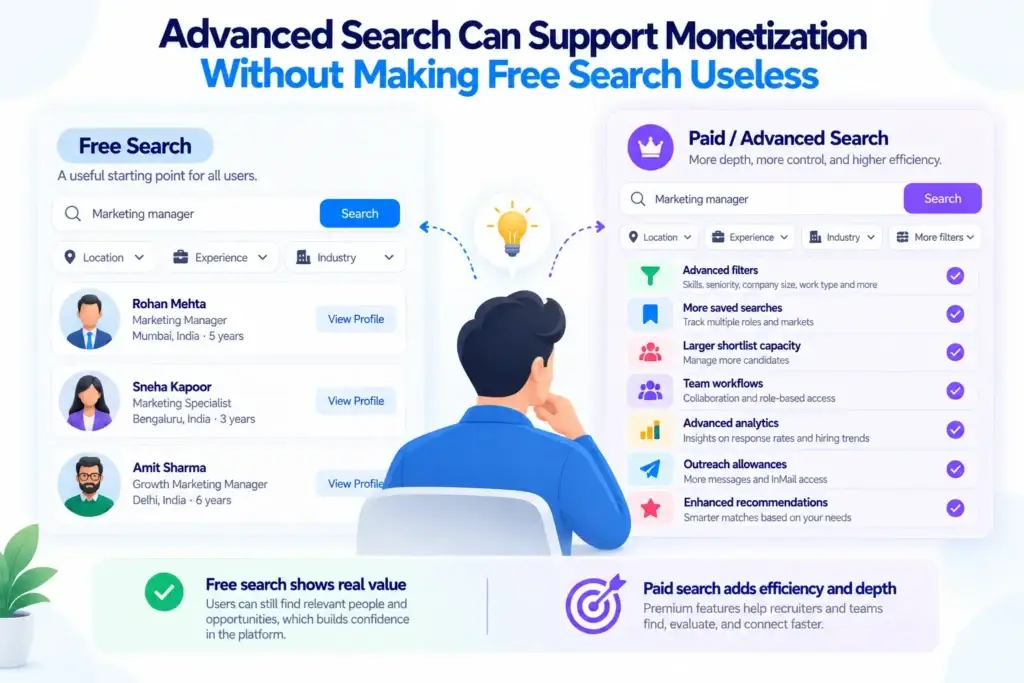
Search can become part of a paid professional-networking model, particularly on the recruiter side. However, monetization should add efficiency and depth rather than deliberately degrading basic relevance.
Examples of higher-value capabilities can include expanded filters, more saved searches, larger shortlist capacity, team workflows, advanced analytics, outreach allowances or enhanced recommendation tools.
The free experience should still demonstrate that the underlying network contains relevant people and opportunities. Otherwise users may conclude that the product itself is weak rather than understanding the value of an upgrade.
Founders planning how recruiter access, member tiers and paid search capabilities fit together can review the dedicated professional-network monetization model rather than mixing full revenue-model coverage into the search article.
Privacy and Search Visibility Need to Be Designed Together
Better search depends on richer professional data, but collecting more data does not automatically mean every field should become searchable.
Platforms should determine which profile fields are public, which are searchable only by particular roles, which require user consent, and which should remain private.
A candidate may be comfortable listing availability for verified recruiters while not wanting that status exposed publicly. Contact information may require stronger access controls than professional skills. Internal recruiter notes should never become discoverable to candidates or unrelated users.
This makes permission design part of search architecture rather than a separate afterthought.
For a deeper treatment of authentication, role-based controls, privacy and platform governance, the related professional networking safety and data-protection guide provides the more appropriate supporting context.
A Practical Build Sequence for Advanced Job Search
Not every platform needs semantic search, complex recommendation models and deep personalization on its first day.
A practical build sequence is usually more valuable than implementing every possible search technology at once.
Phase 1: Get Structured Data Right
Define consistent fields for skills, roles, experience, jobs, locations and user preferences. Build clean create-and-edit experiences so users actually provide this information.
Phase 2: Build High-Intent Filters
Launch filters around the factors that genuinely determine eligibility in the target market: role, skills, location, seniority, experience and work type are common starting points.
Phase 3: Add Ranking
Once multiple results satisfy the filters, introduce relevance ranking so stronger matches appear before marginal ones.
Phase 4: Preserve User Intent
Add saved searches, saved jobs or candidates, alerts and preference profiles so users do not restart the discovery process during every session.
Phase 5: Introduce Semantic and Recommendation Layers Where Data Justifies Them
When structured data, search activity and marketplace density are sufficient, semantic retrieval and personalized recommendations can add value beyond exact keyword matching.
The sequence matters. AI cannot compensate for inconsistent job titles, empty skills, inaccurate locations and poorly structured experience data.
Founder Decision Signals
Data Quality
If profiles and jobs are mostly unstructured, improve the data model before investing heavily in complex matching.
Marketplace Density
Recommendation sophistication matters less if there are too few relevant candidates or opportunities to rank.
Search Complexity
Start with the filters users genuinely need. Add semantic or personalized layers when basic retrieval no longer solves the problem well enough.
Business Model
Decide which search capabilities create baseline marketplace value and which can reasonably become higher-value recruiter or member tools.
Common Advanced-Search Mistakes Founders Should Avoid
Building Too Many Filters Before Understanding Search Intent
More filters do not automatically improve discovery. If users cannot understand which filters matter, the interface becomes work. Start from actual hiring and career-discovery decisions.
Treating Skills as Unstructured Text
Free-text skills make normalization, filtering and recommendations unnecessarily difficult. Preserve user wording, but map important capabilities to searchable entities.
Using Total Experience as the Only Experience Signal
Total years cannot explain whether the experience is relevant, recent or aligned with the required responsibility level.
Making Location an Exact String Match
Modern work arrangements require remote, hybrid, radius, relocation and geographic-eligibility logic. Exact city matching can unnecessarily remove otherwise suitable results.
Adding Semantic Search Before Cleaning Profile Data
Semantic retrieval can broaden discovery, but poor source data still produces poor context. Structured skills, roles, locations and job requirements remain foundational.
Showing a Match Score Without Explaining It
Users need enough context to understand why a result was recommended. Factor-level explanations are often more actionable than one unexplained percentage.
Optimizing Search for Clicks Instead of Outcomes
The real objective is not simply generating search activity. Recruiter shortlists, meaningful messages, saved opportunities and qualified applications provide stronger signals of discovery quality.
How Miracuves Can Help Build the Search Layer Into a Professional Network
Advanced job search works best when profiles, jobs, recruiter workflows, messaging and admin controls already share a consistent data foundation. Otherwise search becomes a disconnected feature trying to interpret information created by unrelated modules.
Miracuves can provide a ready-made professional-networking foundation with the broader profile, hiring, communication and operator workflows already in place, then align search behavior with the founder’s specific market requirements.
The ready-made base solution can be deployed in six working days. Deeper custom requirements—such as specialized taxonomies, domain-specific matching models, custom recommendation logic or external search infrastructure—should be scoped separately according to the required behavior and data model.
That distinction is useful for founders. You do not need to rebuild an entire professional network simply because your competitive advantage is a better way of matching people to opportunities. The stronger approach can be to start with the broader product foundation and concentrate customization where it creates actual differentiation.
Related reading: planning a professional networking platform for a niche.
Final Thoughts: Better Search Starts With Better Professional Data
Advanced job search is not defined by how many filters appear beside the results page. Its quality depends on how well the platform understands people, opportunities and intent.
Skills need consistent representation. Experience needs context. Location needs to account for modern working arrangements. Matching needs to separate mandatory requirements from softer preferences. Ranking needs to put stronger results first. And recommendations need enough explanation that users can understand why they are seeing them.
For founders, the most important sequence is therefore straightforward: structure the data, build reliable retrieval, add meaningful filters, create transparent ranking, preserve user intent through saved searches, and only then introduce deeper semantic or personalized matching where it improves the experience.
When those pieces work together, search stops being a utility hidden inside the navigation. It becomes the mechanism that helps recruiters discover relevant talent, helps professionals find realistic opportunities and helps the network create value from the information its members contribute.
FAQs
What is advanced job search in a professional networking platform?
Advanced job search combines structured filters, profile data, job requirements and relevance ranking to help users find suitable jobs or candidates. It can use skills, experience, location, work preferences, availability and other signals instead of relying only on basic keyword matching.
How does skills-based candidate matching work?
Skills-based matching compares the capabilities required by a role with skills associated with a candidate profile. Strong systems normalize equivalent and related skill terms, separate required skills from preferred skills, and use those relationships to improve retrieval and ranking.
How should experience be used in candidate matching?
Experience should consider more than total years worked. Relevant role history, seniority, recency, industry context and skills demonstrated within previous positions can provide a stronger view of whether a candidate’s background fits a particular role.
How should location-based job search handle remote and hybrid work?
Location search should distinguish current location, preferred locations, remote eligibility, hybrid commuting radius, relocation willingness and employer geography requirements. This prevents suitable candidates or jobs from being excluded simply because two city fields do not exactly match.
Does an advanced job-search platform need semantic search?
Not necessarily at the beginning. Structured data, strong indexing and well-designed filters can solve many discovery problems. Semantic search becomes more valuable when users need related-term discovery, natural-language queries or matching across different terminology.
Should recruiters rely on a single candidate match score?
A match score can help order results, but it should support rather than replace recruiter judgment. Showing why a candidate matches—such as skills, relevant experience, location or availability—makes recommendations easier to evaluate and more transparent.
Which metrics show whether job search is working well?
Useful metrics include zero-result rate, search reformulation, result-to-profile views, search-to-save rate, recruiter messages, applications, saved-search engagement and irrelevant-result feedback. These outcome-oriented measures provide more insight than search volume alone.
Miracuves is an independent software development company. We are not affiliated with, connected to, sponsored by, or endorsed by any company or product named in this article.
Terms such as “X Clone” are used descriptively. It is how the software industry refers to building a platform with functionality comparable to a known service, and how clients search for it.
The entire design and codebase of our products is built by our own team. Our products contain no code, design, graphics, or content originating from any third-party website or applications.
All third-party names and marks referenced in this article are the property of their respective owners, referenced solely to identify the services discussed.