


A professional networking platform may look simple from the user side. Someone creates a profile, lists experience and skills, connects with other professionals, follows companies, searches for opportunities, applies for jobs, and receives recommendations.
Behind those familiar actions is a much harder database-design problem. The platform does not only need to know who a user is. It must understand how that person relates to employers, skills, jobs, companies, colleagues, recruiters, content, professional interests, and other members of the network.
That is why professional networking platform database design should not begin with a generic social-media schema containing users, posts, likes, followers, and messages. Those entities may still exist, but they are only part of the system. The real foundation is a structured professional graph in which identity, career history, skills, relationships, opportunities, and trust signals can be queried independently and combined when needed.
For founders and product teams, these decisions affect much more than backend cleanliness. A weak data model eventually appears in the product as irrelevant search results, duplicate connection records, poor job matching, unreliable recommendations, difficult moderation, slow graph queries, or expensive schema migrations.
This guide focuses specifically on that database layer: how to model profiles, connections, skills, companies, jobs, applications, search data, trust controls, and the relationships that turn separate tables into a useful professional graph.
Key Takeaways
- Professional networking platform database design should treat professional identity as structured data rather than one large profile record.
- Connections, follows, blocks, company relationships, skills, and job applications represent different relationship types and should not be collapsed into one generic table.
- Skills work best as canonical entities that can connect profiles, jobs, search filters, recommendations, and endorsements.
- Jobs should have their own lifecycle, skills, locations, applications, and application-history records instead of behaving like ordinary social posts.
- A relational database can handle the authoritative transactional model for many professional networks; graph and search technologies can be introduced where query patterns justify them.
Why Professional Networking Databases Need More Than a Generic Social Schema
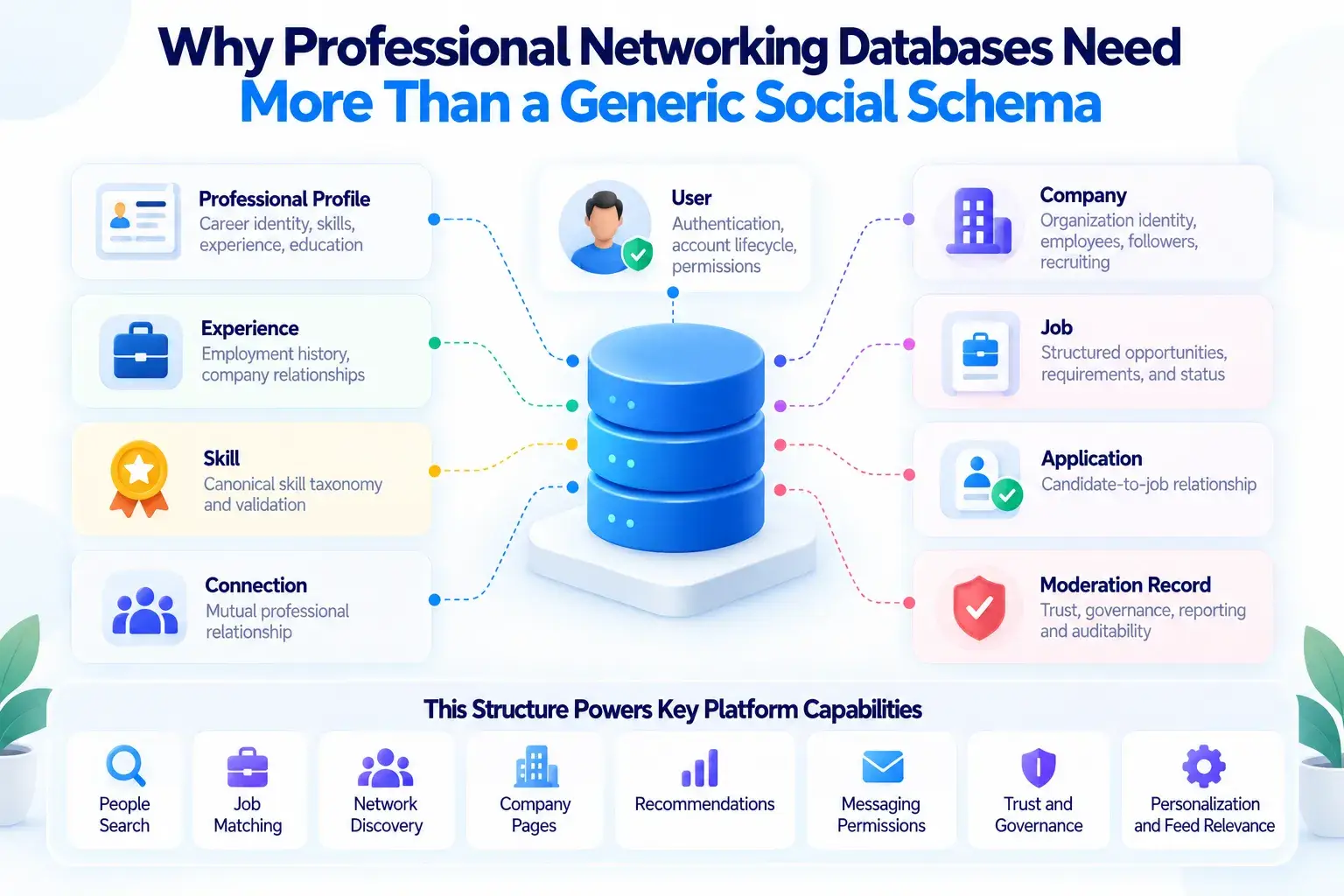
A basic community platform may be able to operate with users, posts, comments, reactions, followers, and messages. A professional network has a different responsibility because the information attached to a person has semantic meaning.
A job title is not simply profile text. It can become a recruiter filter. A skill can affect people search, job matching, recommendation ranking, endorsements, and learning suggestions. A company can connect employees, recruiters, followers, job listings, content, and administrative roles. A connection can influence messaging permissions, mutual-contact calculations, recommendation quality, and feed relevance.
The database therefore needs to represent both entities and relationships. Entities describe things such as users, companies, jobs, and skills. Relationships describe how those things interact: a person works at a company, possesses a skill, applies for a job, connects with another user, follows an organization, or endorses someone else’s expertise.
| Entity or Relationship | Database Responsibility | Product Capability It Can Support |
|---|---|---|
| User | Authentication and account lifecycle | Login, account status, permissions |
| Professional profile | Career identity | Profile pages, discovery, personalization |
| Experience | Employment history | Recruiter filters, credibility, company relationships |
| Skill | Canonical capability taxonomy | Search, matching, endorsements |
| Connection | Mutual professional relationship | Network discovery, mutual contacts, permissions |
| Follow | Directional interest | Company/member updates and feed signals |
| Company | Organization identity | Employment, company pages, recruiting |
| Job | Structured opportunity | Job search and recommendation |
| Application | Candidate-to-job relationship | Recruitment pipeline |
| Moderation record | Trust and governance | Reporting, investigations, appeals, auditability |
Thinking in this way also makes feature planning easier. Product teams can review a broader professional networking feature set and then ask a more useful technical question: which entities and relationships are required to make each workflow reliable?
Start With a Stable User Identity and Build the Professional Graph Around It
The user account is normally the stable identity at the center of the professional graph. But that does not mean every attribute belongs in the users table.
The authentication record should remain relatively small. Email, password hash or authentication-provider reference, account status, verification state, timestamps, and similar identity fields belong there. Professional information should live in related tables with their own lifecycle and indexes.
This separation matters because a professional profile evolves differently from an account. A user may add ten employment records, twenty skills, several certificates, multiple projects, different privacy settings, and changing job preferences without the authentication model changing at all.
CREATE TABLE users (
    id BIGSERIAL PRIMARY KEY,
    email VARCHAR(255) UNIQUE NOT NULL,
    password_hash TEXT,
    account_status VARCHAR(30) NOT NULL DEFAULT 'active',
    email_verified BOOLEAN NOT NULL DEFAULT FALSE,
    created_at TIMESTAMPTZ NOT NULL DEFAULT NOW(),
    updated_at TIMESTAMPTZ NOT NULL DEFAULT NOW()
);

CREATE TABLE professional_profiles (
    user_id BIGINT PRIMARY KEY REFERENCES users(id) ON DELETE CASCADE,
    first_name VARCHAR(100),
    last_name VARCHAR(100),
    headline VARCHAR(255),
    about TEXT,
    location_id BIGINT,
    industry_id BIGINT,
    profile_slug VARCHAR(160) UNIQUE,
    visibility VARCHAR(30) NOT NULL DEFAULT 'public',
    open_to_work BOOLEAN NOT NULL DEFAULT FALSE,
    updated_at TIMESTAMPTZ NOT NULL DEFAULT NOW()
);
A one-to-one professional profile works well when every user can have one primary career identity. Additional information can then branch from that profile or directly from the user ID depending on the domain model.
Do Not Put Experience and Education Into Large Text Fields
A professional summary can remain free text because it is intended for human expression. Employment history, education, skills, certifications, languages, and projects are different. These should generally be structured records.
Structured experience makes questions such as “Who currently works in logistics?”, “Who previously worked at this organization?”, or “Which product managers have at least five years of experience?” possible without attempting to reverse-engineer meaning from biography text.
CREATE TABLE experiences (
    id BIGSERIAL PRIMARY KEY,
    user_id BIGINT NOT NULL REFERENCES users(id) ON DELETE CASCADE,
    company_id BIGINT,
    company_name_raw VARCHAR(255),
    job_title VARCHAR(255) NOT NULL,
    employment_type VARCHAR(50),
    location_id BIGINT,
    started_on DATE,
    ended_on DATE,
    is_current BOOLEAN NOT NULL DEFAULT FALSE,
    description TEXT,
    created_at TIMESTAMPTZ NOT NULL DEFAULT NOW()
);

CREATE INDEX idx_experiences_user
ON experiences(user_id);

CREATE INDEX idx_experiences_company
ON experiences(company_id)
WHERE company_id IS NOT NULL;
The optional raw company name deserves attention. Not every employer will have an official company record in the platform. Allowing a raw value prevents the application from blocking legitimate experience entries, while a nullable company_id lets verified or recognized organizations participate in the wider graph.
Design Skills as Shared Entities, Not Comma-Separated Profile Text
Skills often look like a small profile feature, but they become one of the most reusable data structures in a professional network. The same skill can connect a member to search results, jobs, recruiters, endorsements, recommendations, courses, and related professionals.
A common mistake is storing skills as comma-separated text such as “JavaScript, React, Product Management.” That is convenient when building a form but weak when the product needs consistent filtering. “JS,” “Javascript,” and “JavaScript” may represent the same capability, while similarly named skills may represent different concepts.
A better design creates a canonical skill record and maps users to it.
CREATE TABLE skills (
    id BIGSERIAL PRIMARY KEY,
    canonical_name VARCHAR(150) UNIQUE NOT NULL,
    category_id BIGINT,
    status VARCHAR(30) NOT NULL DEFAULT 'active',
    created_at TIMESTAMPTZ NOT NULL DEFAULT NOW()
);

CREATE TABLE skill_aliases (
    id BIGSERIAL PRIMARY KEY,
    skill_id BIGINT NOT NULL REFERENCES skills(id) ON DELETE CASCADE,
    alias VARCHAR(150) NOT NULL,
    UNIQUE(skill_id, alias)
);

CREATE TABLE user_skills (
    user_id BIGINT NOT NULL REFERENCES users(id) ON DELETE CASCADE,
    skill_id BIGINT NOT NULL REFERENCES skills(id) ON DELETE CASCADE,
    proficiency_level VARCHAR(30),
    years_experience NUMERIC(4,1),
    is_primary BOOLEAN NOT NULL DEFAULT FALSE,
    added_at TIMESTAMPTZ NOT NULL DEFAULT NOW(),
    PRIMARY KEY(user_id, skill_id)
);
The aliases table makes search normalization easier without creating duplicate skill entities. A taxonomy layer can also group skills by discipline, industry, technology family, or another business-specific classification.
Treat Endorsements as Relationships, Not Skill Counters
If a platform supports endorsements, storing only an endorsement_count on user_skills throws away useful graph information. A stronger model records who endorsed whom, for which skill, and when.
That enables duplicate prevention, abuse review, network-aware weighting, and future ranking experiments. An endorsement from someone who has actually worked with a user could eventually carry a different signal from one coming from a distant account, provided the product has an appropriate and transparent model for doing so.
The important design principle is to preserve the underlying event. Aggregated counts can be cached or derived later.
Model Connections as Stateful Graph Edges
The connection table is where a professional networking database begins behaving like a graph.
A mutual professional connection is different from a directional follow. It is also different from a pending invitation, a rejected request, a block, a mute, or an account restriction. Combining all of those states into one generic “relationship” value may look flexible, but it can make authorization and querying unnecessarily difficult.
Prevent Duplicate Reverse Connections
A subtle schema mistake occurs when the database has a unique constraint on requester_id and receiver_id but permits the reverse pair. The database can then contain both user 17 → user 42 and user 42 → user 17 as separate connection records.
For a relationship that becomes mutual after acceptance, one reliable approach is to maintain a canonical pair using the lower and higher user IDs while separately storing who initiated the request.
CREATE TABLE connections (
    id BIGSERIAL PRIMARY KEY,
    user_low_id BIGINT NOT NULL REFERENCES users(id) ON DELETE CASCADE,
    user_high_id BIGINT NOT NULL REFERENCES users(id) ON DELETE CASCADE,
    requested_by BIGINT NOT NULL REFERENCES users(id),
    status VARCHAR(30) NOT NULL DEFAULT 'pending',
    requested_at TIMESTAMPTZ NOT NULL DEFAULT NOW(),
    responded_at TIMESTAMPTZ,
    CHECK (user_low_id < user_high_id),
    UNIQUE(user_low_id, user_high_id)
);

CREATE INDEX idx_connections_low_status
ON connections(user_low_id, status);

CREATE INDEX idx_connections_high_status
ON connections(user_high_id, status);
The application computes the canonical pair before insertion. That makes one row the authoritative relationship regardless of who initiated it.
Connections and Follows Should Usually Remain Separate
A follow is directional. A person may follow an industry expert, recruiter, organization, or company without receiving a reciprocal relationship. That makes follows useful for content distribution and interest signals, but they should not automatically grant the same permissions as accepted connections.
Blocks also deserve their own model because blocking is not merely a connection status. It may affect search visibility, connection suggestions, profile access, messaging, mentions, and feed delivery across several modules.
For teams working on deeper connection-degree calculations, Miracuves also has a technical guide to connection-tree database architecture, which goes further into performance considerations around multi-degree professional relationships.
How First-, Second-, and Third-Degree Relationships Affect Database Queries
A first-degree connection is relatively straightforward: retrieve accepted connection rows containing the current user. Second-degree discovery is more expensive because the system must identify connections belonging to those first-degree users, remove direct connections and the current user, and often rank the remaining candidates using mutual-count or relevance signals.
Third-degree traversal expands the search space again. This does not mean a relational database immediately becomes unsuitable. PostgreSQL or another mature relational database can support substantial graph-style workloads when edges are indexed properly, queries are bounded, and common results are cached or precomputed where appropriate.
The architectural question should therefore be driven by query patterns rather than fashion. If the platform mainly needs direct connections, mutual contacts, suggestions within limited depth, and structured professional filters, a relational model may remain an effective source of truth. If deep path traversal and graph algorithms become dominant workloads, a specialized graph layer can become useful.
Companies Need Their Own Identity and Relationship Model
A company is not simply text attached to a work-history record. Once organizations can publish jobs, manage company pages, employ members, assign recruiters, publish posts, or verify administrators, they become first-class entities.
The company table can hold the organization’s canonical identity, while relationship tables describe people associated with it.
| Table | Purpose |
|---|---|
| companies | Canonical organization record |
| experiences | Member employment history |
| company_admins | Users permitted to manage an organization page |
| company_followers | Users following company updates |
| company_verification_requests | Verification workflow where the business requires it |
| jobs | Open opportunities owned by an organization |
Separating employment from administrative permission is particularly important. Someone may legitimately list a company in their work history without having permission to edit that company’s page or publish jobs on its behalf.
Jobs Should Be Modeled as Opportunities, Not Social Posts
Professional networking products often combine community behavior with hiring. That can tempt teams to treat a job listing as a special kind of post. The two objects have different lifecycles and should normally remain separate.
A post is published, viewed, commented on, reacted to, hidden, or deleted. A job has structured requirements, company ownership, recruiter permissions, locations, employment types, workplace arrangements, required skills, application rules, an expiry date, and a hiring status.
CREATE TABLE jobs (
    id BIGSERIAL PRIMARY KEY,
    company_id BIGINT NOT NULL REFERENCES companies(id),
    posted_by_user_id BIGINT NOT NULL REFERENCES users(id),
    title VARCHAR(255) NOT NULL,
    description TEXT NOT NULL,
    employment_type VARCHAR(50),
    workplace_type VARCHAR(50),
    status VARCHAR(30) NOT NULL DEFAULT 'draft',
    published_at TIMESTAMPTZ,
    expires_at TIMESTAMPTZ,
    created_at TIMESTAMPTZ NOT NULL DEFAULT NOW(),
    updated_at TIMESTAMPTZ NOT NULL DEFAULT NOW()
);

CREATE TABLE job_skills (
    job_id BIGINT NOT NULL REFERENCES jobs(id) ON DELETE CASCADE,
    skill_id BIGINT NOT NULL REFERENCES skills(id),
    importance VARCHAR(30) NOT NULL DEFAULT 'required',
    minimum_years NUMERIC(4,1),
    PRIMARY KEY(job_id, skill_id)
);
Notice how the same canonical skills used on professional profiles can also be attached to jobs. That gives the system a shared vocabulary for candidate search and matching instead of comparing unrelated strings.
Teams designing filters, ranking, saved searches, and recruiter discovery can go deeper into those workflows in the guide to advanced job search and professional discovery.
Design Job Applications as Stateful Records With History
An application establishes a relationship between a user and a job, but the current status alone does not tell the whole story.
Consider an application moving from submitted to reviewed, shortlisted, interview, offer, hired, or rejected. If the application table only stores the current value, the product cannot reliably answer when a transition happened, who changed it, or how long applicants spend at each stage.
A stronger pattern keeps the current state on the application for fast access and records each transition in a separate event or history table.
CREATE TABLE job_applications (
    id BIGSERIAL PRIMARY KEY,
    job_id BIGINT NOT NULL REFERENCES jobs(id) ON DELETE CASCADE,
    applicant_id BIGINT NOT NULL REFERENCES users(id) ON DELETE CASCADE,
    current_status VARCHAR(40) NOT NULL DEFAULT 'submitted',
    applied_at TIMESTAMPTZ NOT NULL DEFAULT NOW(),
    updated_at TIMESTAMPTZ NOT NULL DEFAULT NOW(),
    UNIQUE(job_id, applicant_id)
);

CREATE TABLE application_status_history (
    id BIGSERIAL PRIMARY KEY,
    application_id BIGINT NOT NULL REFERENCES job_applications(id) ON DELETE CASCADE,
    from_status VARCHAR(40),
    to_status VARCHAR(40) NOT NULL,
    changed_by_user_id BIGINT REFERENCES users(id),
    changed_at TIMESTAMPTZ NOT NULL DEFAULT NOW()
);
This pattern improves auditability and creates useful operational data. Hiring teams can later analyze conversion between stages without reconstructing events that were never stored.
Keep Transactional Truth Separate From Matching Scores
A candidate’s skills, experience, location preferences, job interests, and application records are authoritative product data. A recommendation score is derived data.
That distinction becomes important as ranking logic changes. Suppose a job-matching model initially weights shared skills heavily but later incorporates seniority, work arrangement, location, activity, or recruiter preferences. The underlying profile and job data should remain unchanged while the derived score can be recalculated.
Depending on scale, matching outputs can live in a cache, dedicated recommendation table, feature store, or search index. The database design should avoid turning one experimental score into permanent business truth.
Search Architecture Should Be Designed Around Structured Professional Data
Search is where good data modeling becomes visible to users.
A professional may search for a person by name, title, company, location, skill, previous employer, industry, education, or availability. Recruiters can combine several of those dimensions. Job seekers may search by title, skill, work arrangement, location, employer, experience level, or other opportunity-specific attributes.
SQL indexes can support early-stage exact filters and many structured queries. As fuzzy matching, autocomplete, synonyms, relevance ranking, faceting, and cross-entity search become important, a dedicated search engine can sit alongside the transactional database.
Do Not Make the Search Index the Source of Truth
The primary database should remain authoritative. The search system is a projection optimized for retrieval.
A reliable design therefore needs a synchronization mechanism. When a profile, job, company, or skill relationship changes, an indexing event can be added to a queue or outbox. A background worker updates the appropriate search document and records whether the update succeeded.
This is safer than attempting to update several independent systems inline during every user request because a temporary search outage should not prevent someone from saving their profile.
The Professional Graph Extends Beyond Connections
It is easy to think of the professional graph as a map of person-to-person connections. In practice, its value comes from multiple edge types.
| From | Relationship | To | Potential Use |
|---|---|---|---|
| User | has skill | Skill | Search and matching |
| User | worked at | Company | Professional context |
| User | connected to | User | Network graph |
| User | follows | Company | Interest signal |
| User | applied to | Job | Hiring workflow |
| Job | requires | Skill | Candidate matching |
| Company | published | Job | Recruiting |
| User | endorsed | User + Skill | Professional signal |
A recommendation system can combine these edges. Two users may not share direct connections but may work in the same industry, possess similar skills, follow related companies, and operate in the same location. A job may match a member because profile skills intersect with job skills while the member’s preferences align with its location and work arrangement.
The database does not need to calculate every recommendation directly. Its responsibility is to preserve clean, queryable signals from which ranking systems can work.
Content, Messaging, and Notifications Should Connect to the Graph Without Owning It
Posts, reactions, comments, messages, and notifications are important supporting domains, but they should not become the organizing center of a professional networking schema.
The professional identity remains the durable core. Content is activity generated by that identity. Messaging is communication between identities. Notifications report changes involving those identities and the entities they interact with.
This distinction makes future changes easier. The feed algorithm can evolve without rewriting employment history. Messaging can move to dedicated infrastructure without changing the connection graph. Search can use a new indexing technology without changing authoritative profile data.
Privacy, Blocking, Moderation, and Audit Data Belong in the Original Schema
Trust controls are sometimes treated as launch-later features. That creates problems because privacy and moderation affect how other modules are allowed to query and expose data.
For example, blocking can influence profile discovery, messaging, connection recommendations, mentions, feed visibility, and notifications. Profile visibility can determine whether a field is public, available only to connections, visible to recruiters, or private. Moderator actions may need an audit record independent of the original report.
A practical trust layer can include user blocks, content/profile reports, moderation cases, moderation actions, account restrictions, appeals where the operating model requires them, role-based administrative access, and immutable or carefully controlled audit records.
Security requirements will depend on the final market and operating model, but the database should make responsible controls possible rather than forcing them into ad-hoc application logic later. The related guide on professional networking platform safety and trust controls explores that layer in more detail.
Relational Database vs Graph Database vs Hybrid Architecture
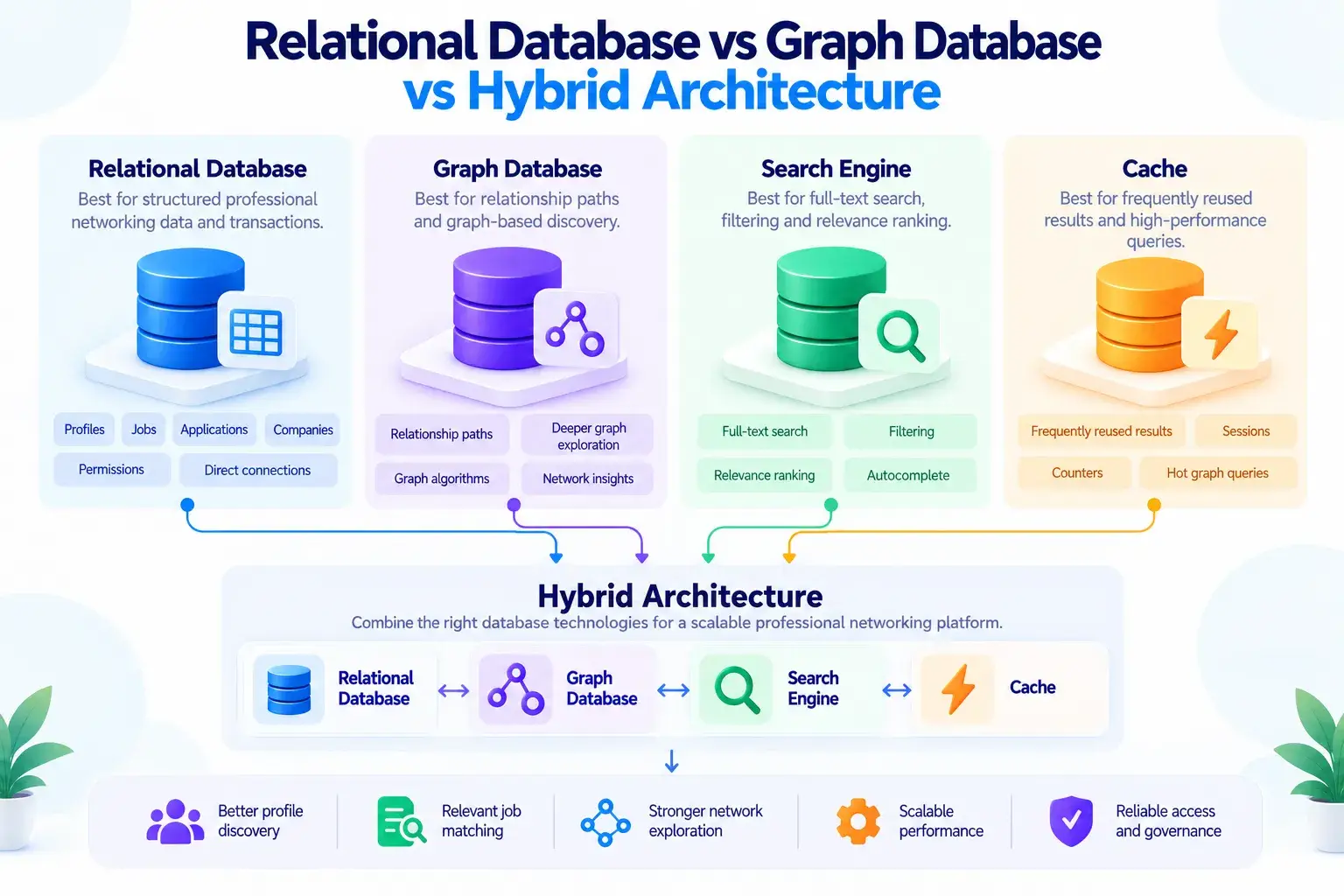
Professional networking applications naturally contain graph-shaped relationships, but that does not automatically mean the primary database must be a graph database.
| Architecture | Good Fit | Primary Trade-Off |
|---|---|---|
| Relational database | Profiles, jobs, applications, companies, permissions, direct connections | Deep graph traversal can require optimization |
| Graph database | Relationship paths, deeper graph exploration, specialized graph algorithms | Additional operational and synchronization complexity |
| Search engine | Full-text search, filtering, relevance ranking, autocomplete | Requires synchronization with authoritative data |
| Cache | Frequently reused results, sessions, counters, hot graph queries | Invalidation and consistency must be managed |
| Hybrid architecture | Platforms with distinct transactional, search, and graph workloads | More infrastructure and observability requirements |
A sensible first architecture often keeps transactional truth in PostgreSQL or another relational database, adds a search layer when discovery requirements justify it, and introduces graph-specific infrastructure when measurable graph workloads become difficult to serve efficiently from the relational model.
Starting with several specialized databases before the query patterns are known can increase engineering overhead without improving the user experience. Architecture should grow with evidence.
Indexes Should Follow Real Professional-Network Queries
Adding indexes indiscriminately is not the same as designing for performance. Every index has storage and write costs. The useful indexes are the ones aligned with common query patterns.
Typical candidates include connection endpoints plus status, user skills by skill_id and user_id, active jobs by company and publication status, applications by applicant and job, experience by user and company, follows by follower and followed entity, reports by status, and search-outbox records by processing state.
Partial indexes can be useful when most queries target a small active subset, such as open jobs or pending indexing events. Composite index order should be based on the actual filters and sort patterns rather than copied mechanically from another application.
Query plans should then be measured as data volume grows. The objective is not to predict every scaling problem at launch; it is to avoid a schema that makes routine optimization impossible.
A Practical Relationship Map for the Core Database
users
 ├── professional_profiles
 ├── experiences ───────────────► companies
 ├── education
 ├── user_skills ───────────────► skills
 │                                  ▲
 │                                  │
 │                              job_skills
 │                                  │
 ├── connections ◄─────────────── users
 ├── follows
 ├── user_blocks
 ├── job_applications ───────────► jobs ─────────► companies
 │                                  │
 │                                  └────────────► job_skills
 ├── posts
 ├── conversations/messages
 ├── notifications
 └── reports

Derived layers:
profiles + skills + graph + activity ─► search index
profiles + job skills + preferences ─► job recommendations
connections + shared entities ───────► people recommendations
This simplified map is intentionally not a complete production schema. Billing, entitlement rules, media storage, analytics, learning, recruiter workspaces, sales workflows, integrations, and other product domains may introduce additional entities. The value of the diagram is showing which records should act as authoritative building blocks for the professional graph.
Founder Decision Signals: What the Database Must Let the Product Do Later
Founder Decision Signals
Discovery
Can structured profile, experience, company, and skill data support useful people and opportunity search without parsing biography text?
Relationship Integrity
Can the system distinguish connections, requests, follows, blocks, endorsements, and employment relationships without ambiguous states?
Scalability
Can high-frequency graph and search queries be indexed, cached, projected, or moved to specialized infrastructure without replacing the source-of-truth model?
Product Flexibility
Can the same professional graph support a focused industry network, recruiting community, alumni platform, association, or internal talent network?
Common Professional Networking Database Design Mistakes
1. Putting the Entire Professional Identity Into the Users Table
This creates a wide, difficult-to-maintain table and mixes authentication with independently changing career information. Keep account identity stable and model professional domains separately.
2. Storing Skills as Unstructured Strings
Free-text skills make normalization, search, recommendations, and job matching progressively harder. Canonical skills and aliases provide a reusable taxonomy.
3. Allowing Duplicate Connection Pairs
A simple requester/receiver uniqueness rule may still allow the reversed pair. Use a canonical pair or another integrity strategy appropriate to the relationship model.
4. Treating Follows, Connections, and Blocks as the Same Edge
These relationships have different directionality, permissions, and lifecycle semantics. Modeling them deliberately simplifies privacy and authorization rules.
5. Building Jobs as Ordinary Content Posts
Jobs have structured requirements, ownership, skills, status, expiry, location, and applications. They deserve a dedicated model.
6. Saving Only the Current Application Status
Without state history, hiring analytics and operational auditing become difficult. Preserve meaningful transitions separately.
7. Treating Recommendation Scores as Permanent Data
Ranking logic changes. Keep the underlying professional facts authoritative and treat scores as recalculable projections.
8. Making a Search Engine the Authoritative Store
Search indexes are optimized projections. Maintain reliable synchronization from the transactional source of truth instead.
9. Adding Trust and Privacy Controls After Launch
Blocks, visibility, reports, moderation, and access rules affect several domains. Retrofitting them later can require changes to queries and application permissions across the platform.
10. Introducing a Graph Database Before the Workload Requires It
Graph-shaped data does not automatically require graph-specific infrastructure. Measure relationship depth, query latency, data size, and operational complexity before adding another authoritative or synchronized datastore.
A Practical Database Build Sequence for a New Professional Network
Teams can reduce rework by building the schema in dependency order rather than implementing visible screens in isolation.
- Identity and profile: establish users, profiles, privacy, locations, industries, and account lifecycle.
- Professional history: add experience, education, certifications, projects, languages, and organization references.
- Skills taxonomy: create canonical skills, aliases, profile mappings, and optional endorsement relationships.
- Network graph: add connection requests, accepted relationships, follows, blocks, and the indexes needed for mutual-network queries.
- Companies: model organizations, administrators, followers, verification workflows, and employment relationships.
- Jobs and applications: connect jobs to companies and skills, then preserve applicant lifecycle history.
- Search projection: index structured profile, company, skill, and job information once search requirements outgrow straightforward relational querying.
- Recommendations: generate derived people and job signals from the professional graph without changing authoritative source records.
- Trust and operations: ensure reporting, moderation, audit logs, account controls, and data lifecycle processes operate across every relevant module.
This sequence does not mean every feature must be launched at once. It means the schema should recognize dependencies early enough that later modules do not require rebuilding the core identity and relationship model.
How This Database Foundation Supports Focused Professional Networks
The strongest professional-networking data model is rarely the one with the greatest number of tables. It is the one that represents the specific professional relationships the target community actually cares about.
A healthcare community may require licenses, specialties, institutions, and credential verification. A founder network may care more about startup stage, industry, funding interests, mentorship, and introductions. An alumni network may prioritize institutions, graduation years, mentoring, employment, and local chapters. An internal talent network may require skills, current roles, internal opportunities, learning credentials, and permission-aware visibility.
This is also why focused communities can benefit from thinking beyond a broad general-purpose network. The Miracuves guide to building focused professional-network communities explores the strategic side of narrowing the audience while this article concentrates on the database underneath it.
Where a Ready-Made Platform Fits Into the Database Decision
Founders do not necessarily need to design every profile, connection, job, moderation, and administrative table from zero. What matters is whether the product foundation they choose has a structured data model that can be adapted to the audience rather than forcing every professional use case into a generic social schema.
For teams evaluating a ready-made LinkedIn clone, the useful technical questions are therefore about schema ownership, source-code access, customization, relationship integrity, search readiness, role control, and whether the data model can support future modules without a complete rebuild.
Miracuves provides a ready-made, source-code-owned professional networking foundation that can be white-labeled and configured around the target business. Where the ready-made scope fits the requirement, Miracuves’ 6-day solution delivery gives founders a faster path to deployment while still leaving the professional graph and business rules available for further customization.
Final Thoughts: The Database Is What Turns Profiles Into a Professional Graph
A professional networking platform becomes useful when separate pieces of professional information start reinforcing one another.
A profile connects to experience. Experience connects to companies. Profiles and jobs connect through a shared skills taxonomy. Users connect to each other through explicit graph edges. Applications connect professionals to opportunities. Search and recommendation systems then use those relationships to make the network easier to navigate.
That is the real purpose of professional networking platform database design. The goal is not to create the largest possible schema. It is to preserve clean professional facts and explicit relationships so the product can answer increasingly valuable questions without corrupting its source of truth.
If those foundations are correct, new search tools, recommendation models, recruiter workflows, community features, analytics, and specialized graph infrastructure can be introduced as the product grows. If the foundations are weak, every advanced feature inherits the same ambiguity.
Build the professional graph as a data model first. The interface can evolve around it.
FAQs
What database is best for a professional networking platform?
A relational database such as PostgreSQL can be a strong primary database because profiles, skills, companies, jobs, applications, permissions, and connection states contain structured relationships that benefit from transactions and referential integrity. Search engines, caches, or graph databases can be added when specific workloads justify them.
How should connections be stored in a professional networking database?
Mutual connections should use an explicit relationship record with clear states such as pending and accepted. The schema should also prevent reverse duplicate pairs. Directional follows, blocks, and other relationship types can be modeled separately because they have different permissions and lifecycle rules.
Does a professional network need a graph database?
Not necessarily. A relational database can support direct connections, mutual-contact queries, structured search, and limited-degree graph traversal for many platforms. A graph database becomes more useful when deep relationship traversal, path analysis, or graph algorithms become major workloads that are difficult to serve efficiently from the primary relational model.
How should skills be modeled for profile search and job matching?
Skills should normally exist as canonical entities in a skills table and connect to users through a many-to-many mapping. Alias records can normalize terms that mean the same thing. Jobs can reference the same skill IDs, giving search and matching systems a shared vocabulary instead of comparing inconsistent text fields.
How should jobs and applications connect to professional profiles?
Jobs should belong to companies and reference structured attributes such as skills, employment type, workplace type, and status. Applications then connect a user to a job. Keeping application-status history separately makes recruiter workflows, analytics, and auditing more reliable.
Should the search index store the main profile and job data?
The search index should usually be treated as a retrieval-optimized projection rather than the authoritative source. The transactional database remains the source of truth, while a queue, outbox, or event process keeps profile, skill, company, and job search documents synchronized.
What database design mistakes make professional networks difficult to scale?
Common problems include giant user tables, free-text skills, duplicate connection pairs, jobs modeled as ordinary posts, missing application history, weak privacy relationships, recommendation scores treated as permanent facts, and introducing specialized graph infrastructure before real query patterns require it.
How does database design affect professional network recommendations?
Recommendation quality depends on clean source signals. Structured experience, skills, company relationships, connections, follows, job preferences, and interaction events give ranking systems useful inputs. Recommendation scores should remain derived data so they can change without rewriting authoritative professional records.
Miracuves is an independent software development company. We are not affiliated with, connected to, sponsored by, or endorsed by any company or product named in this article.
Terms such as “X Clone” are used descriptively. It is how the software industry refers to building a platform with functionality comparable to a known service, and how clients search for it.
The entire design and codebase of our products is built by our own team. Our products contain no code, design, graphics, or content originating from any third-party website or applications.
All third-party names and marks referenced in this article are the property of their respective owners, referenced solely to identify the services discussed.