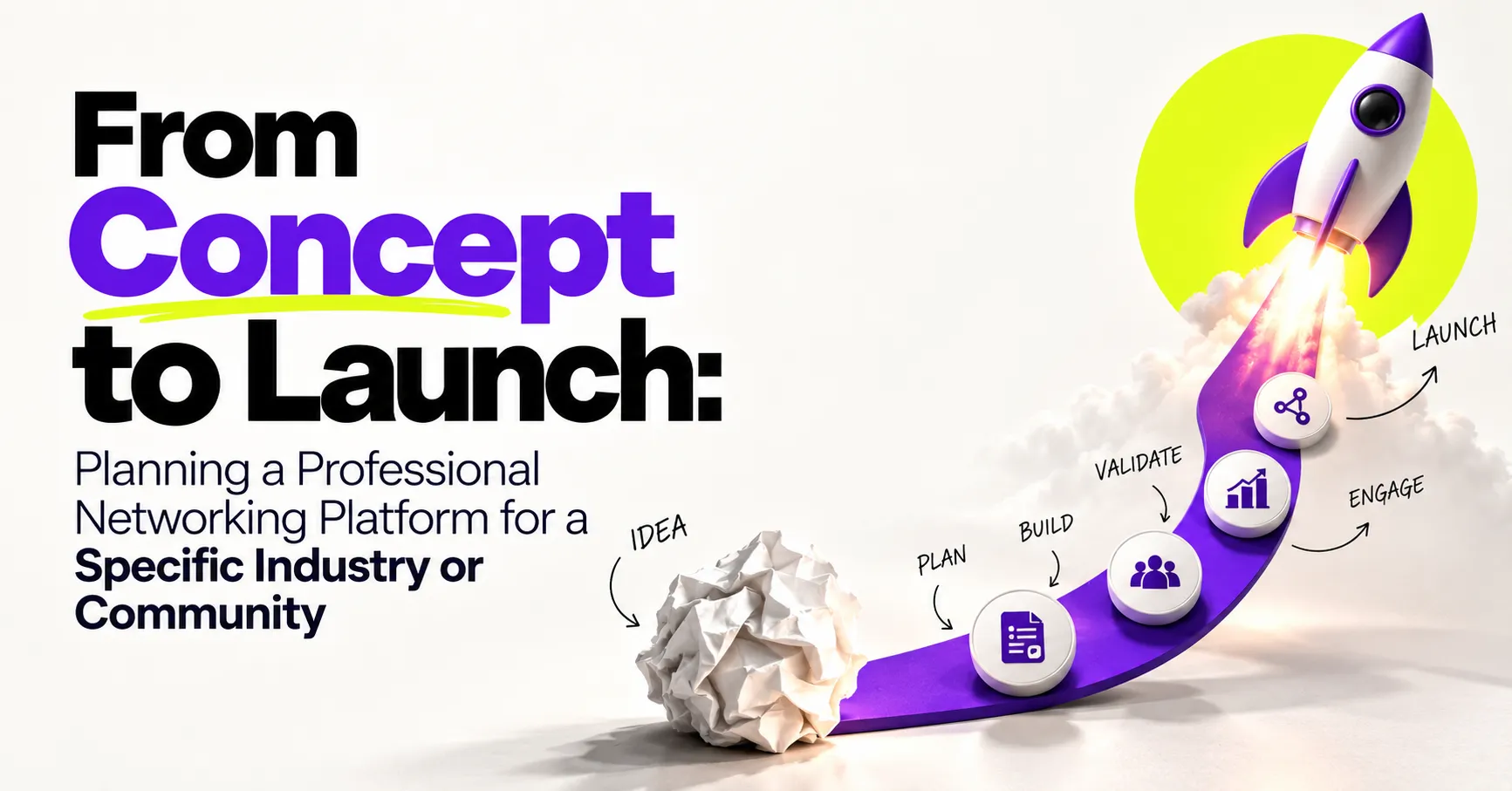
Building a professional networking platform is no longer just about copying a broad career network and adding a different logo. The stronger opportunity is to create a focused platform for a specific industry, region, association, alumni group, talent pool, creator community, or professional category where members have a clear reason to join, return, and participate.
A general professional network tries to serve everyone. A niche professional networking platform serves a defined group better. That difference matters because professionals do not join another platform just because it exists. They join when the platform solves a specific problem: finding relevant people, proving credibility, discovering opportunities, hiring faster, learning from peers, building reputation, or accessing a trusted community that feels more useful than a noisy public feed.
This guide explains how to plan a professional networking platform from concept to launch without turning the product into a bloated feature list. You will learn how to define your audience, choose the right feature scope, design trust systems, plan monetization, and decide whether to build from scratch or start with a ready-made foundation.
Key Takeaways
- Professional networking platform planning starts with a focused community, not a generic feature list.
- A niche professional network should solve a clear problem for a specific audience, such as hiring, referrals, mentorship, collaboration, learning, or credential visibility.
- The strongest platforms combine member profiles, discovery, messaging, content, jobs, events, trust controls, and admin governance in a way that fits the community.
- Monetization should support member value instead of weakening trust or turning the platform into a sales-heavy environment.
- Miracuves helps founders move from idea to launch faster with ready-made and white-label app solutions that can be customized for professional communities.
Why a Specific Industry or Community Is a Stronger Starting Point
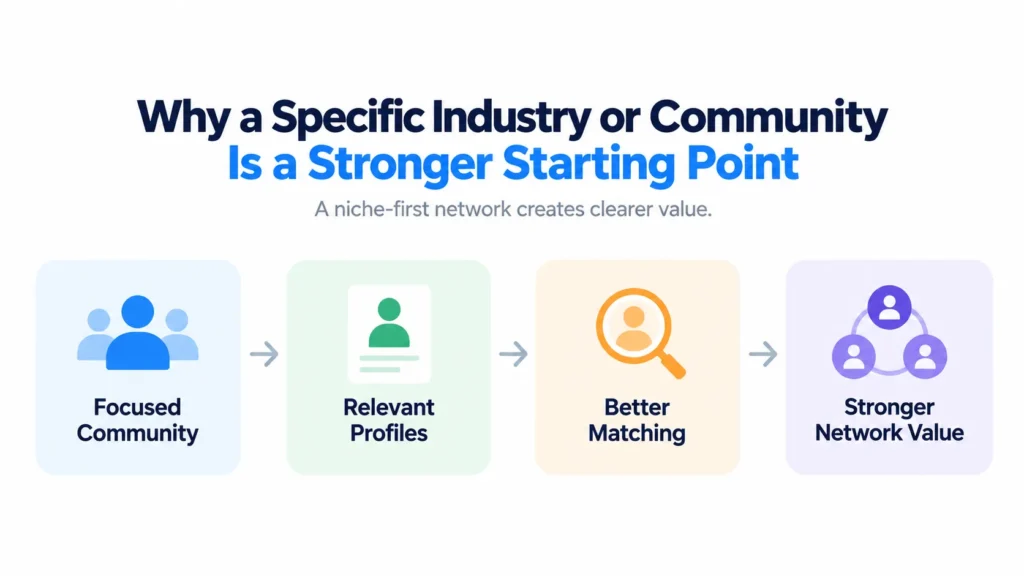
The biggest mistake founders make when planning a professional networking platform is trying to build “a platform for professionals” in general. That sounds large, but it is difficult to position, hard to acquire users for, and expensive to differentiate. A founder with a clear niche can make sharper product decisions from day one.
For example, a professional network for healthcare specialists does not need the same profile structure as a platform for creative freelancers. A network for construction project managers may need certifications, project history, safety credentials, and location-based availability. A network for university alumni may need mentoring, chapters, events, donations, referrals, and career transitions. A network for independent consultants may need lead discovery, paid sessions, case-study portfolios, and reputation signals.
The more specific the audience, the easier it becomes to answer important product questions: What does a valuable profile look like? What kind of connections matter? What should members search for? What trust signals are required? What monetization model feels acceptable? What makes users return every week?
Founder Insight: The Community Is the Product Strategy
In a professional networking platform, the software is only one part of the product. The real asset is the professional graph: members, relationships, credentials, conversations, opportunities, and reputation. If your community is poorly defined, even strong features may feel generic. If your community is sharply defined, even a focused first version can feel valuable because every interaction is more relevant.
Start With the Core Professional Problem You Want to Solve
Before choosing features, define the primary problem your platform will solve. A professional networking platform can support many workflows, but the first launch should be anchored around one dominant use case. This helps avoid overbuilding and gives users a clear reason to join.
Common professional networking problems include:
- Discovery: Members need to find relevant professionals, experts, collaborators, mentors, candidates, vendors, or partners.
- Credibility: Members need a better way to prove skills, experience, certifications, portfolio work, or industry reputation.
- Hiring: Recruiters, companies, or community managers need a focused talent pool with better matching and less irrelevant noise.
- Knowledge sharing: Professionals want industry-specific posts, events, webinars, discussions, and learning resources.
- Community ownership: Associations, enterprises, creator-led communities, or alumni groups want to own the member experience instead of depending only on external platforms.
- Business development: Consultants, agencies, founders, and sales teams need warmer discovery, better context, and relationship-based outreach.
A platform that tries to solve all of these equally from day one can become unfocused. A better approach is to choose the strongest primary use case, then build secondary modules around it.
Define the Audience Before You Define the Features
Feature planning becomes easier when you know exactly who the platform is for. A good audience definition is more than “professionals” or “job seekers.” It should describe the member type, their motivation, their pain point, and the value they expect from the platform.
Audience Planning Framework for a Professional Networking Platform
| Audience Type | What They Need | Platform Planning Implication |
|---|---|---|
| Industry professionals | Relevant peers, credibility, jobs, updates, and knowledge | Build detailed profiles, topic feeds, credential fields, and industry-specific search filters. |
| Recruiters and hiring teams | Qualified candidates, pipeline tracking, outreach, and screening | Add job posts, candidate search, saved profiles, application workflows, and messaging controls. |
| Associations and member bodies | Member directory, events, renewals, verification, and communication | Prioritize membership status, chapters, admin controls, event management, and verified profiles. |
| Alumni communities | Mentorship, referrals, career transitions, reunions, and networking | Include alumni cohorts, mentorship matching, groups, events, and opportunity boards. |
| Consultants and experts | Reputation, leads, paid sessions, content, and portfolio visibility | Add portfolio sections, availability, booking workflows, thought leadership content, and lead forms. |
This audience-first approach also helps with marketing. If the platform has a clear community identity, your messaging becomes easier: “a professional network for healthcare operations leaders,” “a career community for renewable energy talent,” or “a private alumni platform for founders and mentors” is stronger than a broad promise to connect everyone.
Map the Member Journey From First Visit to Long-Term Value
A professional networking platform succeeds when the user journey creates value quickly. The first visit should answer, “Why should I create a profile here?” The first week should answer, “Who can I meet or what can I access?” The first month should answer, “Why should I keep coming back?”
A practical member journey may look like this:
- Discovery: The user understands the platform’s community focus and value proposition.
- Onboarding: The user creates a profile with role, skills, industry, location, goals, portfolio, credentials, and availability.
- Activation: The platform recommends people, groups, jobs, events, or discussions that match the user’s interests.
- Engagement: The user connects, follows, messages, applies, posts, comments, joins groups, or attends events.
- Trust building: The user receives endorsements, verifies credentials, completes profile sections, or gains reputation signals.
- Retention: The platform sends relevant notifications, updates, opportunities, and community prompts.
- Monetization: The user upgrades, pays for access, buys credits, books a session, posts a job, or joins a premium community layer.
This journey should be planned before design and development begin. Otherwise, founders often end up with features that exist individually but do not create a complete product experience.
Choose Features Based on Community Value, Not Platform Imitation
A professional networking platform usually needs profiles, networking, messaging, content, search, notifications, and admin control. But the depth of each feature should depend on the community. A platform for verified medical professionals may need license verification and private groups. A platform for creators may need content monetization and portfolio-first profiles. A platform for recruiters may need hiring pipelines and candidate tagging.
The goal is not to add every possible feature. The goal is to build the smallest complete platform experience that solves the core professional problem well.
Core Feature Areas and Business Value
| Feature Area | Business Value | Founder Impact |
|---|---|---|
| Professional profiles | Turns each member into a searchable identity with skills, work history, portfolio, certifications, and goals. | Creates the foundation for search, matching, trust, hiring, and community engagement. |
| Connection graph | Helps members build relationships through follows, connections, groups, and recommendations. | Makes the platform more valuable as the community grows. |
| Search and discovery | Allows users to find people, jobs, companies, mentors, content, or opportunities. | Improves activation because users quickly see relevant value. |
| Messaging and outreach | Enables private communication, referrals, hiring outreach, and collaboration. | Creates deeper relationship workflows beyond public posting. |
| Jobs and opportunities | Connects talent with employers, projects, gigs, grants, or partnership openings. | Gives users a practical reason to return and complete their profiles. |
| Content and discussions | Supports posts, insights, articles, questions, polls, and community conversations. | Builds habit and helps the platform become a trusted industry resource. |
| Events and learning | Supports webinars, meetups, workshops, courses, and credential updates. | Creates monetization and retention opportunities beyond networking. |
| Admin dashboard | Controls users, reports, roles, content, monetization, verification, and analytics. | Gives the platform operator control without depending on developers for every operational change. |
If you want to explore a ready-made professional networking foundation after planning your concept, Miracuves’ LinkedIn Clone page explains the commercial platform modules, source-code ownership, and launch-ready structure in more detail.
Design Trust, Verification, and Moderation From the Beginning
Trust is not optional in a professional networking platform. Members are sharing career details, credentials, messages, job interests, business relationships, and sometimes sensitive identity information. A weak trust layer can damage the platform before it has a chance to scale.
Trust planning should include profile verification, role-based access, content moderation, abuse reporting, admin review queues, account protection, and privacy-conscious data handling. For some industries, credential verification may be essential. For others, community moderation and reputation signals may matter more.
Important trust layers to consider include:
- Identity checks: Email verification, organization verification, professional license checks, or community approval depending on the platform.
- Profile credibility: Verified badges, skill endorsements, portfolio evidence, certificates, work samples, or peer recommendations.
- Content moderation: Admin review tools, report buttons, spam detection, and moderation logs.
- Messaging controls: Limits on cold outreach, blocked users, reporting, and permission-based communication.
- Data protection: Secure authentication, encrypted data transfer, role-based access control, and activity logs.
- Community governance: Rules, acceptable-use policies, appeal workflows, and transparent moderation actions.
For founders, trust planning is also a business decision. A trusted community can support premium subscriptions, employer access, verified member directories, and higher-value partnerships. A platform that feels spam-heavy or unmoderated will struggle to keep serious professionals engaged.
Plan Monetization Without Damaging Community Quality
Monetization should feel connected to user value. If every useful action is paywalled too early, members may leave before the network has momentum. If monetization is added too late, the platform may grow activity without a clear business model. The right model depends on who pays and what value they receive.
Professional networking platforms can use several monetization models:
- Member subscriptions: Premium visibility, advanced search, profile analytics, saved searches, or exclusive communities.
- Recruiter access: Candidate search, job posting, pipeline tools, outreach credits, and hiring analytics.
- Company pages: Employer branding, team pages, culture content, job promotions, and sponsored updates.
- Event monetization: Paid webinars, workshops, conferences, networking rooms, or private sessions.
- Learning and credentials: Paid courses, certificates, assessments, and skill-verification programs.
- Expert monetization: Paid consulting sessions, mentorship access, premium content, or template downloads.
- Community sponsorships: Carefully placed industry sponsorships that add value rather than clutter.
The most important rule is alignment. A recruiter plan makes sense when the platform has a strong talent pool. Premium member plans make sense when users receive better discovery, analytics, credibility, or opportunities. Event monetization makes sense when the community already values learning and access.
For a deeper breakdown of monetization logic, you can connect this planning article to Miracuves’ professional network business model guide, which is better suited for readers ready to compare revenue streams in detail.
Read more: What Features and Cost Factors Matter Most When Planning a Professional Networking Platform?
Build the Admin and Operations Layer Early
Many founders focus heavily on the user-facing app and forget the operator experience. But the admin layer decides whether the platform can be managed efficiently after launch. A professional networking platform needs control over users, content, reports, subscriptions, job posts, company pages, verification requests, analytics, and platform rules.
A strong admin dashboard should help the operator answer practical questions:
- Who is joining the platform?
- Which profiles are incomplete or unverified?
- Which posts, messages, or users have been reported?
- Which communities, roles, or industries are growing fastest?
- Which features are driving activation and retention?
- Which subscriptions, job posts, or paid modules are generating revenue?
- Which users need moderation, support, or approval?
This matters because a professional network is not a static website. It is an operating system for a community. The operator needs visibility, permissions, moderation controls, analytics, and monetization settings from the beginning.
Decide Your Launch Scope: First Version vs. Long-Term Platform
A complete professional networking platform can eventually include profiles, groups, jobs, company pages, messaging, feeds, events, courses, credentials, recruiter tools, analytics, subscription tiers, and advanced search. But the first launch should focus on the platform experience that proves demand.
A practical first version may include:
- Member registration and onboarding
- Professional profile creation
- Search and discovery
- Connection or follow system
- Basic feed or discussion layer
- Messaging or inquiry workflow
- Jobs, opportunities, mentorship, or events depending on the niche
- Admin dashboard for users, content, reports, and platform settings
Long-term modules can be added once the platform has stronger community signals. These may include premium subscriptions, recruiter seats, AI-assisted matching, learning paths, credential verification, company pages, advanced analytics, paid events, and integration with CRM or HR systems.
Founders who already have a defined audience, existing community, or industry access may benefit from starting with a ready-made foundation instead of building every module from zero. This can reduce avoidable development time and allow faster market validation.
Founder Decision Signals
Speed
If you already know the audience and core use case, a ready-made foundation can help you move faster than a long custom build.
Cost
Costs depend on features, integrations, branding, platform scope, and customization. Planning the launch scope first prevents expensive overbuilding.
Scalability
The platform should support member growth, content growth, search, messaging, admin workflows, and monetization without needing a rebuild too early.
Market Fit
The stronger signal is not how many features you launch with. It is whether the right professionals join, complete profiles, connect, and return.
Think About Community Growth Before Product Launch
A professional networking platform does not grow only through app store downloads or paid ads. It grows when the first members believe the community is worth joining and inviting others into. That means community growth should be planned before launch, not after development is complete.
Useful pre-launch growth activities include:
- Recruiting founding members from the target industry or community
- Creating an invite-only beta for credibility and feedback
- Partnering with associations, universities, employers, or creator-led groups
- Launching with a focused event, report, job board, or member directory
- Giving early users a reason to complete profiles before the public launch
- Building ambassador programs for respected community members
- Publishing useful industry content that attracts the right members
The first users should not feel like they are entering an empty platform. Even if the platform starts small, it should feel active, relevant, and intentionally curated.
Custom Build vs. Ready-Made Foundation: Which Path Fits Your Launch?
There are two common ways to build a professional networking platform. A custom build gives full flexibility but usually requires more planning, design, development, testing, and budget. A ready-made or white-label foundation gives founders a faster starting point when the core workflows already match their business model.
Custom Build vs. Ready-Made Foundation
| Build Route | Best For | Planning Consideration |
|---|---|---|
| Custom development | Founders with highly unique workflows, complex integrations, or unusual product logic. | Requires deeper discovery, longer development planning, larger testing scope, and careful budget control. |
| Ready-made foundation | Founders who need profiles, feeds, jobs, messaging, admin control, monetization, and branding faster. | Works well when the core platform model is clear and customization is focused on niche positioning. |
| White-label professional network | Associations, agencies, enterprises, communities, and startups that want branded ownership. | Useful when speed, brand control, source-code ownership, and admin management matter from launch. |
Miracuves helps founders launch ready-made and white-label app solutions with source-code ownership, branded design, admin control, and faster deployment. For professional networking platforms, this can be useful when the founder already knows the audience and wants to validate the community without waiting through a long ground-up build.
You can also explore Miracuves’ broader social network app solutions if your idea sits between professional networking, community building, social feeds, messaging, and member-led engagement.
What to Prepare Before Speaking With a Development Partner
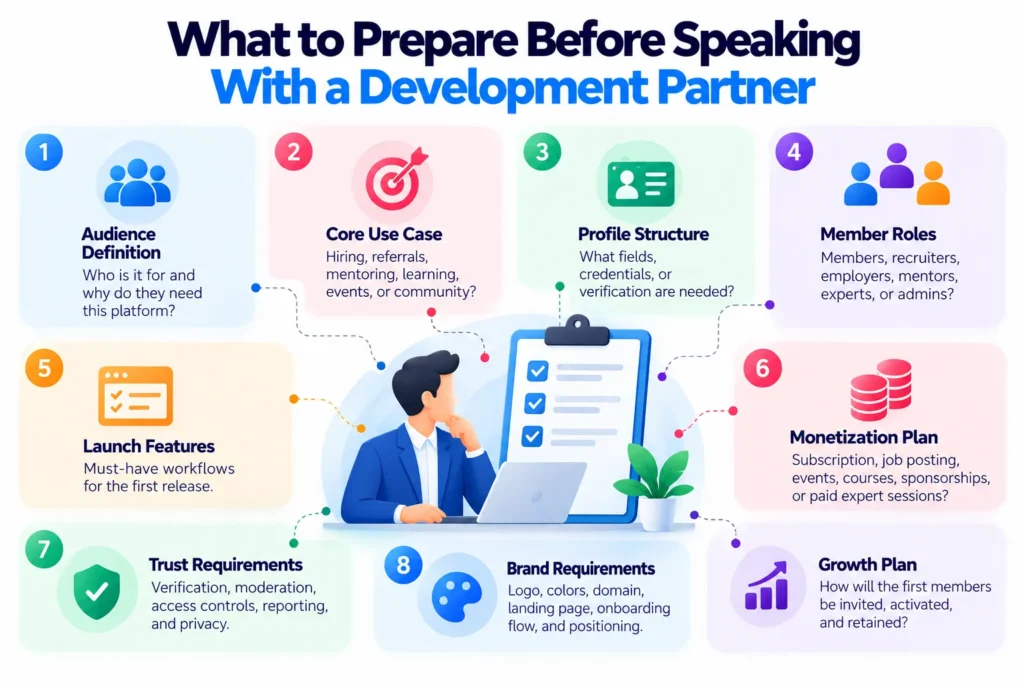
A productive development conversation starts with clarity. You do not need every feature documented perfectly, but you should know the community, the core use case, the launch goal, and the business model direction.
Before starting development, prepare:
- Audience definition: Who the platform is for and why they need a separate professional network.
- Core use case: Hiring, referrals, mentoring, credential discovery, expert access, learning, events, or community ownership.
- Profile structure: What fields, credentials, portfolio items, roles, or verification data matter.
- Member roles: Members, recruiters, employers, mentors, experts, admins, moderators, or association managers.
- Launch features: The must-have workflows for the first public release.
- Monetization plan: Subscription, job posting, recruiter access, events, courses, sponsorships, or paid expert sessions.
- Trust requirements: Verification, moderation, access controls, reporting, and privacy expectations.
- Brand requirements: Logo, colors, domain, landing page, onboarding flow, tone, and community positioning.
- Growth plan: How the first members will be invited, activated, and retained.
This preparation helps your development partner recommend the right platform scope instead of simply giving you a long feature checklist.
Mistakes Founders Should Avoid When Planning a Professional Network
Mistakes Founders Should Avoid
Building for Everyone
A broad professional network is difficult to position and expensive to grow. Start with a specific audience where the need is clear.
Copying Features Without Understanding User Motivation
Profiles, feeds, and messaging only matter when they support a real member goal. Plan the user journey before finalizing features.
Ignoring Trust and Moderation
Professional communities need credibility. Verification, reporting, admin controls, and privacy workflows should be included early.
Adding Monetization Too Aggressively
Paywalls should match value. If users feel blocked before they experience the community, activation and retention can suffer.
Launching Without Founding Members
A network needs initial density. Recruit early members, partners, or ambassadors before launch so the platform does not feel empty.
How Miracuves Helps Founders Move From Concept to Launch
Miracuves works with founders, startups, agencies, communities, and businesses that want to launch digital platforms faster without building every workflow from zero. For professional networking concepts, the planning process usually starts with audience clarity, feature scope, monetization logic, admin control, and launch priorities.
A ready-made foundation can be especially useful when your platform needs common professional network modules such as profiles, connections, feeds, messaging, jobs, company pages, admin controls, and monetization settings. From there, the platform can be customized for your niche, branding, member roles, trust workflows, and community model.
Where relevant, Miracuves’ ready-made approach can support a 6-day launch timeline for launch-ready solutions, with final scope depending on selected modules, branding, integrations, and customization requirements. This is useful for founders who want to test demand faster, present a working product to stakeholders, or launch a focused community without a long development cycle.
Final Thoughts: Build a Network People Have a Reason to Join
The strongest professional networking platforms are not built around generic features. They are built around a specific community, a clear professional problem, and a reason for members to participate repeatedly. A focused platform can help people discover relevant peers, prove credibility, access opportunities, share knowledge, and build relationships in a more meaningful environment.
Before development begins, define the audience, core use case, trust model, monetization path, launch scope, and community growth plan. Once those decisions are clear, the technical build becomes much easier to scope. For founders who already know their niche and want to move faster, a ready-made, white-label foundation can provide the structure needed to launch, validate, and improve with real users.
FAQs
What is a professional networking platform?
A professional networking platform is a digital community where members create career or business profiles, connect with relevant people, share industry knowledge, find opportunities, message other users, and build credibility within a professional group or industry.
How do I plan a professional networking platform for a specific industry?
Start by defining the audience, the professional problem, the profile structure, the discovery experience, the trust model, and the main reason users will return. Then prioritize launch features such as profiles, search, connections, messaging, content, jobs, events, or admin controls based on that audience.
What features should a niche professional network include?
A niche professional network should usually include member profiles, search and discovery, connections or follows, messaging, content or discussions, notifications, admin controls, moderation, and a focused opportunity layer such as jobs, mentorship, events, learning, referrals, or expert access.
How can a professional networking platform make money?
Common monetization models include member subscriptions, recruiter access, job postings, company pages, paid events, learning programs, premium communities, expert sessions, sponsored content, and access-based tiers. The right model depends on who receives the strongest value from the platform.
Is it better to build a professional networking platform from scratch or use a ready-made foundation?
A custom build is useful when the workflow is highly unique. A ready-made foundation is useful when you need standard professional network modules such as profiles, feeds, messaging, jobs, admin controls, and monetization faster. The right choice depends on your launch timeline, budget, customization needs, and platform strategy.
Why is trust important in a professional networking platform?
Trust affects whether members feel safe sharing career details, messaging others, applying for opportunities, and building relationships. Verification, moderation, abuse reporting, privacy controls, and role-based admin access help protect platform quality as the community grows.
Can Miracuves help launch a professional networking platform quickly?
Yes. Miracuves helps founders launch ready-made and white-label app solutions with branding, source-code ownership, admin dashboards, and faster deployment. For ready-made solutions, a 6-day launch may be possible depending on selected modules, customization scope, and launch requirements.
Miracuves is an independent software development company. We are not affiliated with, connected to, sponsored by, or endorsed by any company or product named in this article.
Terms such as “X Clone” are used descriptively. It is how the software industry refers to building a platform with functionality comparable to a known service, and how clients search for it.
The entire design and codebase of our products is built by our own team. Our products contain no code, design, graphics, or content originating from any third-party website or applications.
All third-party names and marks referenced in this article are the property of their respective owners, referenced solely to identify the services discussed.