
Key Takeaways
- AI Load Matching should rank freight opportunities using carrier fit, route efficiency, timing, equipment, compliance, and rate signals.
- The nearest or cheapest carrier is not always the best match; reliability, lane history, equipment fit, and pickup feasibility also matter.
- Route intelligence can reduce deadhead miles by matching loads with a truck’s current position, direction, and backhaul opportunities.
- Rate guidance should provide confidence ranges and market context instead of forcing one automated price.
- Human-in-the-loop recommendations are often the strongest starting point because freight decisions still involve exceptions and operator judgment.
Matching Signals
- Carrier fit should combine equipment type, pickup timing, lane history, reliability, compliance, and rate expectations.
- Route matching should consider truck location, pickup distance, delivery direction, driver availability, fuel, tolls, and future load positioning.
- Clean load records and complete carrier profiles are essential because weak data leads to weak recommendations.
- Match explanations help brokers and dispatchers understand why a carrier or load is being recommended.
- Admin controls should allow operators to adjust match weights, carrier eligibility, risk thresholds, preferred lists, and manual overrides.
Real Insights
- AI matching creates more value when it reduces decision waste rather than simply adding more recommendations.
- A smaller set of highly relevant carrier-load matches can be more useful than a large board of poorly matched options.
- Matching intelligence should sit on top of carrier verification, compliance, insurance, and document checks rather than bypassing them.
- Accepted bids, rejected offers, cancellations, delays, and disputes can become feedback signals that improve future recommendations.
- The strongest flow is: collect load and carrier data → verify eligibility → score carrier fit → evaluate route efficiency → estimate rate confidence → explain recommendation → let operator approve → feed outcome back into matching logic.
A Freight Marketplace becomes valuable when it does more than show available loads and trucks.
A basic board helps shippers, brokers, and carriers find each other. But a smarter platform helps them make better decisions faster. It can recommend the right carrier for a load, surface loads that fit a truck’s current route, reduce unnecessary empty miles, and guide rate decisions with better context.
That is where AI load matching becomes important.
AI load matching uses data signals such as equipment type, lane history, pickup timing, carrier availability, route direction, service performance, location, pricing behavior, and shipment requirements to recommend stronger load-carrier matches.
For startups building a digital freight product, this is not just a technical upgrade. It can become the difference between a marketplace that users visit occasionally and a platform they rely on daily for freight decisions.
Why Freight Marketplaces Need Smarter Matching
Traditional freight discovery depends heavily on manual search.
A broker posts a load. Carriers search by lane, equipment, price, or location. Dispatchers call drivers. Shippers wait for updates. Brokers compare offers manually. Carriers scan multiple boards to avoid empty miles.
If you are still mapping the basics of load posting, broker-carrier discovery, payment flow, and carrier search behavior, this freight load board guide explains how digital freight boards work before AI-based matching is added.
This works, but it creates friction.
The platform may have available carriers, but they may not be the right carriers. A truck may be close to pickup but unavailable. A carrier may accept the lane but lack the right equipment. A low bid may look attractive but carry higher risk. A driver may accept a load that creates an inefficient return route.
AI load matching improves this process by narrowing the search space.
For readers who want more context on how large freight boards are used by truckers, fleets, and brokers, this guide on how large freight boards work can provide useful background before exploring AI matching.
Instead of showing every possible option equally, the system can rank matches based on fit. This helps users move from “search and compare everything” to “review the strongest options first.”
For a founder, this matters because better matching can improve platform liquidity. If users consistently find relevant opportunities faster, they have a stronger reason to return.
What AI Load Matching Means in a Freight Marketplace
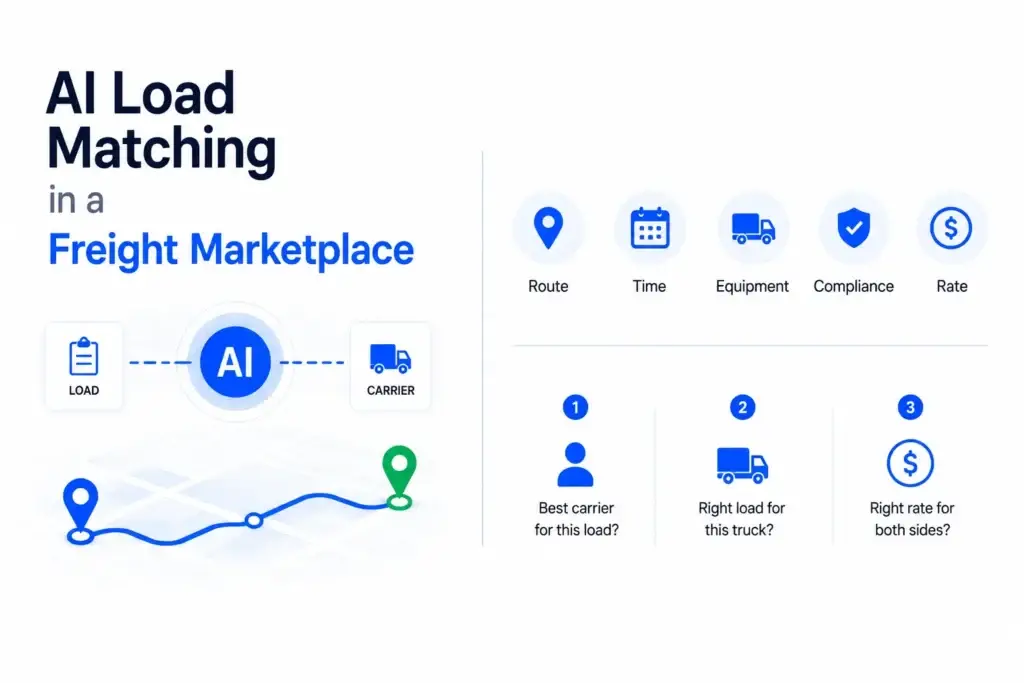
AI load matching is the process of using data-driven rules, machine learning models, or recommendation logic to connect loads with carriers that are more likely to be a good operational and commercial fit.
In practice, the platform may evaluate:
- Origin and destination
- Pickup and delivery window
- Equipment type
- Load weight and dimensions
- Carrier location
- Truck availability
- Lane history
- Deadhead distance
- Backhaul opportunity
- Carrier rating
- On-time performance
- Compliance status
- Insurance or document validity
- Preferred lanes
- Rate expectations
- Fuel and toll impact
- Prior acceptance behavior
- Shipper or broker preferences
The goal is not to make the platform “look smart.” The goal is to reduce decision waste.
Founders comparing different freight marketplace models can also review this 123Loadboard working guide, which explains real-time load search, carrier filters, routing tools, and safety signals.
A freight marketplace should help users answer three practical questions:
- Which carrier is most suitable for this load?
- Which load fits this truck’s route and availability?
- What rate decision makes sense for both sides?
Carrier Fit: The Core of AI Load Matching
Carrier fit is the foundation of a good matching engine.
The nearest truck is not always the best truck. The cheapest carrier is not always the safest choice. The carrier with available capacity may still be a poor fit if the lane, cargo, equipment, or timing does not match.
A carrier fit score can combine several signals.
Carrier Fit Signals in AI Load Matching
| Fit Signal | What It Checks | Why It Matters |
|---|---|---|
| Equipment Match | Whether the carrier has the right vehicle type, trailer type, capacity, refrigeration, or special handling ability. | Prevents poor matches that fail after negotiation because the truck cannot move the freight properly. |
| Lane History | Whether the carrier has handled similar origin-destination routes before. | Carriers with lane familiarity may handle timing, stops, tolls, and route expectations more confidently. |
| Pickup Timing | Whether the truck can realistically reach pickup within the requested window. | Protects the shipper from late pickup and protects the carrier from unrealistic commitments. |
| Reliability Score | On-time delivery, cancellation rate, document quality, dispute history, and broker feedback. | Helps avoid choosing only by price when service quality matters. |
| Rate Fit | Whether the carrier’s expected rate aligns with lane benchmarks, fuel cost, urgency, and platform margin rules. | Improves negotiation speed and reduces offers that are unlikely to close. |
| Backhaul Fit | Whether the load moves the truck toward a useful next lane or home market. | Reduces empty miles and makes the load more attractive to the carrier. |
A strong system should not hide the logic completely. Brokers and dispatchers should be able to understand why a carrier is recommended.
For example, the platform may show: “Strong fit: correct trailer type, previous lane history, 38 miles from pickup, active insurance, good on-time record, rate within expected range.”
That explanation builds trust.
Route Efficiency: Matching Loads to the Truck’s Real Movement
Freight matching is not only about origin and destination.
A carrier wants to know whether the load fits the truck’s real movement. A load that looks profitable on paper may create deadhead miles, poor return positioning, or schedule conflicts.
AI route matching can consider:
- Current truck location
- Distance to pickup
- Planned direction of travel
- Delivery location
- Nearby future loads
- Backhaul opportunity
- Driver hours and availability
- Stop sequence
- Fuel and toll impact
- Urban delay zones
- Warehouse appointment windows
- Multi-stop compatibility
For example, a truck finishing delivery in Dallas may prefer a load that moves it toward a stronger outbound lane rather than one that leaves it in a weak market. A carrier with predictable lanes may prefer repeat-fit loads over random one-time opportunities.
Route efficiency also depends on real-time visibility after the match is accepted. This digital freight marketplace tracking guide can support readers who want to understand GPS tracking, shipment visibility, and movement updates after booking.
This is where AI can improve decision quality.
It can identify matches that are not obvious in a simple search filter. It can also warn users when a load creates inefficient movement, even if the rate looks attractive.
Rate Decisions: How AI Supports Pricing Without Removing Human Judgment
Rate decisions in freight are sensitive.
A rate that is too low may fail to attract carriers. A rate that is too high may reduce broker margin or shipper savings. A rate that ignores urgency, lane conditions, equipment type, fuel, seasonality, or carrier preference may slow the booking process.
AI can support rate decisions by analyzing:
- Historical lane rates
- Recent accepted bids
- Current demand
- Truck availability
- Pickup urgency
- Delivery requirements
- Equipment scarcity
- Fuel and toll estimates
- Carrier acceptance patterns
- Broker margin guardrails
- Shipper budget range
- Platform transaction history
The purpose is not to force one automatic price. The better approach is to provide a rate confidence range.
For example:
- Suggested offer range
- Market-sensitive rate band
- Minimum margin-safe rate
- Carrier-likely acceptance range
- Urgency premium suggestion
- Price warning if the posted rate is unlikely to attract capacity
This helps brokers and shippers make faster decisions while still keeping human judgment in the loop.
Matching Engine Architecture: What the Platform Needs Under the Hood
AI load matching depends on clean operational data. If the platform only has incomplete load posts and weak carrier profiles, the recommendations will be poor.
To connect AI matching with load posting, carrier tools, bidding, dispatch, POD, admin controls, and tracking workflows, founders can review this freight marketplace feature breakdown.
A scalable matching engine needs several connected modules.
| Module | Purpose | Founder Benefit |
|---|---|---|
| Load Data Layer | Stores load origin, destination, timing, cargo, equipment, rate, documents, and status. | Creates reliable input for matching and pricing decisions. |
| Carrier Profile Layer | Stores equipment, fleet size, lanes, insurance, ratings, availability, and compliance documents. | Helps the platform evaluate fit beyond basic location. |
| Location and Route Layer | Uses current truck location, pickup distance, route direction, and delivery positioning. | Improves efficiency and reduces deadhead-heavy matches. |
| Rate Intelligence Layer | Tracks historical bids, accepted rates, lane trends, urgency, and pricing guardrails. | Helps users make better offer and counter-offer decisions. |
| Recommendation Layer | Scores and ranks carrier-load matches based on selected business rules. | Surfaces stronger options faster than manual search. |
| Feedback Loop | Learns from accepted bids, rejected offers, cancellations, delays, and disputes. | Improves match quality over time. |
| Admin Control Layer | Lets operators adjust match weights, rule priorities, access, plans, and risk thresholds. | Gives the marketplace owner control without changing code for every policy shift. |
This is why AI load matching should not be bolted on at the end. It should connect with the marketplace architecture from the beginning.
What Data Should Feed the Matching Algorithm?
A matching algorithm is only as useful as the signals it receives.
Startups should structure data collection around real freight decisions, not vanity data.
Important inputs include:
Load-Level Data
- Pickup location
- Delivery location
- Pickup window
- Delivery window
- Load type
- Weight and dimensions
- Equipment requirement
- Handling requirement
- Temperature control requirement
- Hazmat or compliance requirement where applicable
- Posted rate or target rate
- Broker or shipper notes
- Urgency level
Carrier-Level Data
- Fleet type
- Available truck location
- Equipment type
- Preferred lanes
- Service regions
- Insurance status
- Document status
- Rating
- On-time delivery history
- Cancellation history
- Average response time
- Accepted rate pattern
- Driver availability
- Compliance status
Marketplace-Level Data
- Hot lanes
- Posted versus accepted rate trends
- Bid density
- Time-to-cover
- Load rejection reasons
- Carrier search behavior
- Route imbalance
- Seasonal demand changes
- Broker margin rules
- Subscription tier access where relevant
When these signals are stored properly, the platform can move from simple filtering to intelligent recommendation.
Human-in-the-Loop Matching: Why Full Automation Is Not Always the Best First Step
Not every freight decision should be fully automated from day one.
A human-in-the-loop model is often safer for startups. The platform can rank the best options, explain why they fit, and let the broker, dispatcher, or shipper approve the final action.
This approach works well because freight has exceptions:
- Special cargo requirements
- Shipper-specific preferences
- Known carrier relationships
- Last-minute warehouse delays
- Driver schedule changes
- Border or permit complications
- Detention risk
- Weather disruption
- Sensitive customer requirements
- Negotiation history
AI should reduce manual work, not remove judgment where judgment still matters.
A practical first version may offer:
- Top 5 carrier recommendations
- Fit score explanation
- Rate confidence range
- Route efficiency notes
- Risk warnings
- Suggested next action
That creates immediate value without forcing risky full automation.
Founder Decision Signals for AI Load Matching
Speed
If brokers or dispatchers spend too much time searching, calling, and comparing, AI recommendations can shorten the decision path.
Trust
If carriers reject too many irrelevant loads, better fit scoring can make the marketplace feel more useful and less noisy.
Scalability
If load volume grows, manual matching becomes difficult to manage. A recommendation layer helps teams prioritize the strongest options first.
Revenue
If the platform monetizes subscriptions, premium tools, transaction fees, or add-on modules, AI matching can become a higher-value feature layer.
How AI Load Matching Improves Marketplace Liquidity
Liquidity is the heartbeat of a Freight Marketplace.
If shippers post loads but carriers do not respond, the platform feels empty. If carriers search but find irrelevant freight, they stop returning. If brokers receive bids that do not fit the load, they move the conversation back to phone calls.
AI matching improves liquidity by making the right side of the marketplace more visible to the other side.
For carriers, the platform can recommend:
- Loads near current location
- Loads matching preferred lanes
- Loads that reduce empty miles
- Loads with attractive rate ranges
- Loads that fit equipment type
- Loads that support backhaul strategy
For brokers and shippers, the platform can recommend:
- Carriers with lane experience
- Carriers with correct equipment
- Carriers near pickup
- Carriers with better response history
- Carriers with valid documents
- Carriers likely to accept the proposed rate
This creates better relevance on both sides.
A marketplace with fewer but more relevant recommendations can be more useful than a board with many poorly matched listings.
How AI Matching Supports Freight Marketplace Monetization
AI load matching can also support revenue design.
A freight platform may monetize matching intelligence through:
- Premium carrier recommendations
- Broker intelligence dashboards
- Rate guidance tools
- Hot lane insights
- Advanced search and saved filters
- Priority matching
- Add-on AI coverage modules
- Managed dispatch support
- Transaction fees on accepted matches
- Subscription tiers for advanced automation
The important point is sequencing.
Founders should not charge for AI features before the marketplace has enough useful load and carrier activity. First, the platform must create liquidity. Then it can monetize higher-value decision support.
For a deeper commercial view, Miracuves’ freight platform business model explains how subscription tiers, transaction fees, managed dispatch, add-on modules, and white-label licensing can work around one load record.
Admin Controls for AI Matching Rules
AI should not become a black box for the platform operator.
The admin dashboard should allow the business owner to manage how matching works.
Useful controls include:
- Match weight by equipment type
- Match weight by distance to pickup
- Match weight by lane history
- Match weight by carrier rating
- Match weight by compliance status
- Match weight by rate fit
- Minimum carrier verification level
- Excluded carrier rules
- Preferred carrier lists
- Shipper-specific carrier rules
- Risk thresholds
- Region-specific matching rules
- Add-on module access
- Manual override
- Match result audit logs
These controls matter because freight rules change by market, lane, cargo, customer, and operating model.
A founder should not need a developer every time a customer changes carrier preference or a region needs tighter verification.
Security, Compliance, and Risk Controls in AI Load Matching
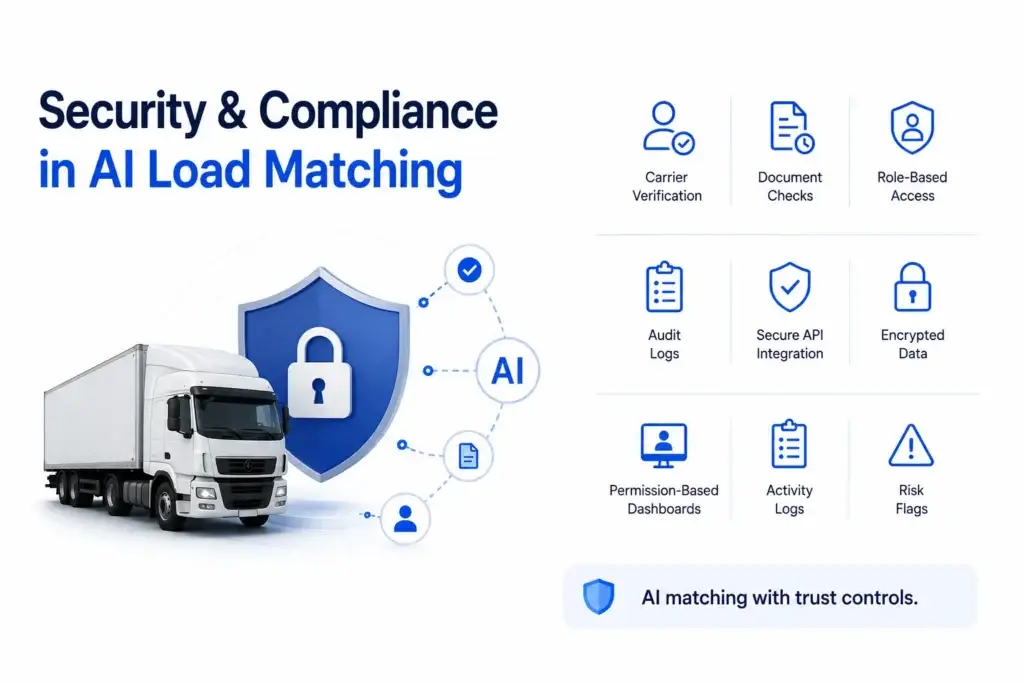
Matching speed should not come at the cost of trust.
A freight marketplace should avoid recommending carriers that fail basic verification or compliance checks. Depending on the region and business model, the platform may need to consider insurance validity, licensing, operating authority, document status, cargo-specific requirements, safety signals, and customer restrictions.
Important safeguards include:
- Carrier verification
- Document expiry checks
- Role-based admin access
- Audit logs
- Secure API integration
- Encrypted data transfer
- Permission-based dashboards
- Activity logs
- Manual review flags
- Suspicious bidding detection
- Blocklisted or restricted carrier controls
AI matching should sit on top of trust controls, not bypass them.
A fast match is not a good match if it creates operational or legal risk.
Common Mistakes Startups Should Avoid
Ranking by Distance Alone
The closest truck is not always the best carrier. Equipment, timing, lane history, compliance, reliability, and rate fit should also influence recommendations.
Launching AI Without Clean Data
AI matching depends on structured load records, complete carrier profiles, route history, bid data, and operational feedback. Weak data creates weak recommendations.
Hiding Match Logic From Users
Brokers, dispatchers, and carriers need to understand why a match is recommended. Fit explanations improve trust and adoption.
Automating Sensitive Decisions Too Early
Full automation may be risky before the platform understands customer rules, lane behavior, and exception patterns. Human-in-the-loop matching is often safer for the first version.
Where a Ready-Made Freight Platform Foundation Helps
Building a Freight Marketplace from zero requires more than a posting board.
The platform needs load records, carrier profiles, bidding, counter-offers, route matching, dispatch workflows, GPS visibility, proof of delivery, invoicing, payments, admin controls, analytics, and marketplace rules.
If your next step is budgeting, review these freight marketplace development cost factors to understand how modules, integrations, ownership, and deployment scope affect planning.
AI load matching adds another layer on top of that foundation.
For startups, the practical question is whether to build every module from scratch or start with a ready-made foundation that can be customized around the business model.
Miracuves offers a freight marketplace and load board solution for founders who want a launch-ready platform with load posting, carrier workflows, dispatch control, tracking, monetization, and admin operations. This article focuses on the AI matching layer, while the solution page remains the commercial destination for product evaluation.
Founders who want to review the product-level modules can also explore the freight marketplace feature breakdown. If budgeting is the next step, the freight marketplace development cost factors page explains how scope, integrations, ownership, and launch timelines affect planning.
Startups that need implementation support can also evaluate Miracuves as a freight app development partner for marketplace workflows, AI matching logic, carrier tools, dispatch operations, and admin control.
For teams that need broader freight, fleet, dispatch, carrier portal, or supply-chain workflows, Miracuves’ logistics app development services can support more customized implementation routes.
Final Thoughts: Better Matching Creates a Stronger Freight Marketplace
A Freight Marketplace should not only help users find loads. It should help them make better freight decisions.
AI load matching improves the platform by ranking better carrier-load fit, reducing manual search, improving route efficiency, supporting rate decisions, and helping dispatchers focus on the options most likely to close.
For broader digital transformation across transportation, fulfillment, fleet operations, and supply-chain workflows, explore Miracuves’ logistics and supply chain software solutions.
For founders, the strongest opportunity is not to add AI as a buzzword. It is to connect matching intelligence with real freight data: equipment, lanes, timing, reliability, compliance, pricing, tracking, and user behavior.
When the matching engine understands the business context, the platform becomes more than a digital board. It becomes a decision system for freight movement.
FAQs
What is AI load matching in a Freight Marketplace?
AI load matching is the use of data-driven logic, machine learning, or recommendation rules to connect freight loads with carriers that are more likely to be a strong fit based on route, equipment, timing, availability, rate expectations, reliability, and compliance signals.
How does AI improve carrier fit?
AI improves carrier fit by ranking carriers against multiple signals instead of only distance or price. It can consider equipment type, lane history, pickup window, carrier ratings, document status, response behavior, and accepted rate patterns.
Can AI load matching reduce empty miles?
Yes, AI matching can help reduce empty miles by recommending loads that fit a carrier’s current location, route direction, delivery destination, and backhaul needs. The platform still needs accurate location, route, and availability data for this to work well.
How does AI support freight rate decisions?
AI can support rate decisions by comparing historical lane data, accepted bids, urgency, equipment scarcity, carrier expectations, fuel impact, and margin guardrails. It can suggest a rate range instead of forcing a single fixed rate.
Should freight matching be fully automated?
Not always. Many startups should begin with human-in-the-loop matching, where AI recommends the best options and explains the fit, while brokers, dispatchers, or shippers approve final decisions.
What data is needed for AI load matching?
Useful data includes load details, pickup and delivery windows, equipment requirements, carrier profiles, lane history, truck availability, location, rate history, bid behavior, compliance status, ratings, cancellations, and delivery performance.
What admin controls are needed for AI matching?
Admins should be able to adjust match weights, carrier eligibility rules, shipper preferences, region-specific settings, risk thresholds, premium feature access, manual overrides, and match result audit logs.
Can Miracuves help build a freight marketplace with AI matching workflows?
Yes. Miracuves helps founders launch ready-made and white-label freight marketplace platforms with load posting, carrier workflows, dispatch tools, tracking, monetization, admin dashboards, and source-code ownership. AI matching workflows can be planned around the selected business model and customization scope.
Miracuves is an independent software development company. We are not affiliated with, connected to, sponsored by, or endorsed by any company or product named in this article.
Terms such as “X Clone” are used descriptively. It is how the software industry refers to building a platform with functionality comparable to a known service, and how clients search for it.
The entire design and codebase of our products is built by our own team. Our products contain no code, design, graphics, or content originating from any third-party website or applications.
All third-party names and marks referenced in this article are the property of their respective owners, referenced solely to identify the services discussed.