
Key Takeaways
- Real estate syndication crowdfunding platforms need investor trust before aggressive growth. A polished interface cannot replace verified property information, credible sponsor details, transparent financial assumptions, and accountable investment processes.
- Property opportunities should be supported by evidence. Investors need access to relevant diligence materials, ownership information, valuation assumptions, financing details, property conditions, and clearly dated documents.
- Investment terms must be easy to understand. Platforms should clearly explain the ownership structure, capital stack, sponsor fees, profit sharing, distribution waterfall, risks, and potential liquidity limitations.
- Regulatory structure determines how investors can participate. Regulation D and Regulation Crowdfunding have different requirements for solicitation, eligibility, disclosures, intermediaries, and investor protections. The appropriate structure should be established before fundraising begins.
- Investor commitments and actual funded investments are not the same. Platforms should clearly distinguish registrations, reservations, commitments, received funds, accepted investments, and completed closings.
- Financial controls are essential for online property investment. Reconciliation, appropriate fund-handling arrangements, ownership records, restricted permissions, and accurate investor statements help reduce operational uncertainty.
- Investor communication must continue after funding. Regular reporting should explain property performance, material variances, expenses, financing developments, distributions, and changes to the original investment assumptions.
- Liquidity should be presented as a risk, not a promise. Many syndication investments are illiquid and may include holding periods or transfer restrictions. A digital resale feature does not guarantee that an investor can exit.
- Technology supports trust but does not replace due diligence. Real estate syndication crowdfunding platforms can organize documents, verification, subscriptions, financial records, and investor communications, but they cannot guarantee property performance or eliminate investment risk.
- Software deployment and regulatory readiness are separate. A ready-made platform can accelerate implementation, but securities requirements, investor eligibility, financial arrangements, legal approvals, and jurisdiction-specific obligations still need to be addressed independently.
Imagine discovering a promising real estate investment opportunity through a newly launched online platform. The property looks attractive, the projected returns appear encouraging, and the minimum investment seems accessible. Yet before committing any money, one question immediately comes to mind: can this business actually be trusted with my capital?
That question represents one of the biggest challenges facing founders entering online real estate syndication. Bringing property opportunities to investors through a digital interface is only the beginning. The more difficult task is convincing people that the properties are genuine, the sponsors are capable, the financial assumptions are reasonable, and their investments will be handled through accountable processes.
For founders planning a Real Estate Crowdfunding Platform, investor confidence should influence the business model before the first offering goes live. Property information, sponsor verification, financial disclosures, legal documentation, payment handling, and investor communications must work together to provide a credible investment journey.
Established digital investment models demonstrate the value of making complex property opportunities easier to understand and access. However, a polished interface alone cannot establish investment credibility. New businesses must demonstrate that the investment opportunity can withstand scrutiny.
That distinction matters because investor interest, account registrations, and funding commitments are not the same thing. A platform may attract significant attention and still struggle to close its first property offering if prospective investors cannot verify the sponsor, evaluate the risks, or understand what happens to their money.
This guide explores how online real estate syndication works, what makes investors trust a new investment business, how transparent offerings can support capital raising, and which operational mistakes founders should avoid before accepting investor funds.
What Is Online Real Estate Syndication, and Why Does Investor Trust Matter?
Real estate syndication is an investment arrangement in which multiple investors participate in a property opportunity, typically through an entity or contractual structure managed by a sponsor. The sponsor identifies the opportunity, coordinates acquisition or development, arranges financing, and oversees the investment according to the governing documents.
Investors contribute capital in exchange for the economic rights described in their investment agreements. Depending on the structure, those rights might involve interests in a property-owning entity, a fund, or another eligible investment vehicle.
Online syndication brings parts of this process into a digital environment. Investors can review information, complete applicable eligibility checks, examine offering documents, and submit investment commitments through authorized workflows.
But digitization introduces a new trust challenge. In a traditional relationship-driven offering, investors may know the sponsor or have opportunities for direct evaluation. On an online platform, the first interaction often happens without an established relationship.
The website must therefore help investors understand the opportunity without replacing the independent judgment and due diligence that financial investments require.
Online Syndication Is Not the Same as Direct Property Ownership
An investor buying a syndication interest does not necessarily receive direct legal title to a fraction of the building. Often, the investor owns an interest in an entity whose assets or contractual rights relate to the property.
That distinction determines who controls the property, how decisions are made, how profits are distributed, and which rights investors have if the investment performs poorly.
Founders should make the ownership model understandable before asking for a commitment. Ambiguous phrases such as “own part of this property” can be misleading when the legal structure is more complex.
Why New Platforms Face a Different Trust Challenge
An established investment business may have a history of acquisitions, reporting, completed exits, and investor relationships. A new operator may have none of those platform-level indicators.
That does not make the new business inherently untrustworthy. It means the operator must demonstrate credibility through other forms of evidence, such as verified sponsor experience, independently supported valuations, documented investment policies, and accountable custody arrangements.
Immediate investor trust should be understood as early confidence in the quality and honesty of available information—not an expectation that investors will commit money without completing due diligence.
The Five Questions Investors Ask Before Funding an Online Property Deal
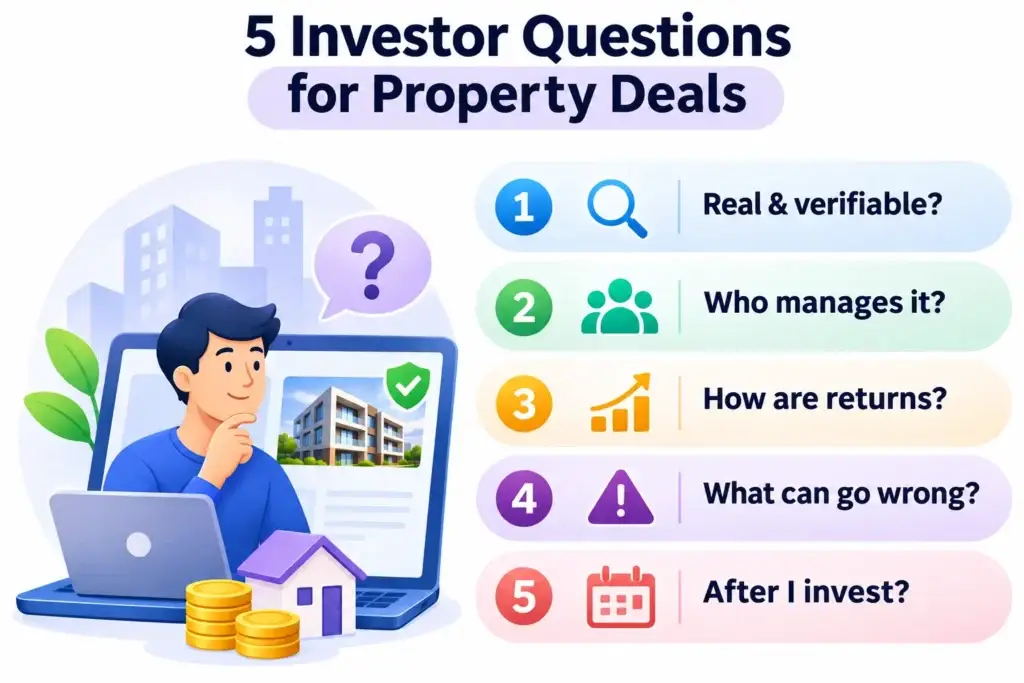
Founders often approach investor acquisition as a marketing problem. But attracting an interested visitor is different from resolving the uncertainties that prevent a financial commitment.
Most serious investors need clear answers to five fundamental questions.
1. Is the Property Opportunity Real and Independently Verifiable?
Investors need more than promotional descriptions and attractive photographs. They want to know what property is being acquired, who owns or controls it, what rights the investment vehicle has, and whether the stated financial information can be supported.
Depending on the deal, supporting materials may include valuation reports, title-related information, property condition assessments, rental records, debt terms, market information, or other relevant diligence documents.
Not every document must be published without restrictions. Some materials contain confidential information and should be shared through appropriate investor access controls. The objective is to create an auditable evidence trail, not an uncontrolled document repository.
2. Who Is Managing the Investment?
A property investment is partly a judgment about the people responsible for acquiring, financing, managing, and eventually exiting the asset.
Sponsor profiles should explain relevant experience, investment responsibilities, compensation, potential conflicts, and the role of external property managers or advisors.
If founders have limited experience, it is better to describe that accurately and demonstrate the capabilities of verified partners than to imply a track record that does not exist.
3. How Are Returns Calculated?
Projected distributions and appreciation estimates can attract attention, but investors need to understand the assumptions producing those figures.
Rental income, vacancy, operating expenses, borrowing costs, maintenance reserves, acquisition fees, and exit valuation assumptions all affect possible outcomes.
A return illustration should clearly distinguish assumptions from contractual obligations. A preferred return, for example, is not necessarily a guaranteed payment; its availability and priority depend on the agreements and actual investment performance.
4. What Can Go Wrong?
Serious investors expect discussion of risks rather than assurances that every property will succeed.
Vacancies can increase. Renovations can take longer than expected. Interest rates can affect refinancing. Construction expenses may exceed forecasts. Market conditions may reduce achievable exit prices.
Trust improves when these risks are explained prominently and connected to the specific investment rather than buried in generic disclaimers.
5. What Happens After I Send the Money?
Investors need clarity about when a commitment becomes binding, how funds are handled, when the offering closes, how ownership is recorded, and what communications they will receive afterward.
The platform should also explain what happens when a financing target is not met, an investment is rejected, a transaction fails, or a property acquisition does not proceed.
A trustworthy system gives investors understandable answers before funds are transferred, not only after support is contacted.
How New Syndication Businesses Build Investor Confidence Before Their First Deal
A new investment business cannot manufacture years of completed investments. It can, however, establish a professional process for presenting opportunities, verifying information, and taking responsibility for investor communication.
The goal is to replace unsupported promotional claims with a documented process investors can examine.
Make Sponsor Identity and Responsibility Visible
A credible offering clearly identifies the relevant investment parties. These may include the issuer, sponsor, asset manager, property manager, and service providers. Their exact roles should be consistent with the legal documents and actual operating arrangements.
Founders should avoid vague statements such as “managed by industry experts” when specific, verifiable information can be supplied.
Where relevant, explain the sponsor’s historical experience, investment decision process, and how conflicts are reviewed. If the offering depends on a related-party transaction, that relationship should be appropriately disclosed.
Use Evidence-Backed Property Pages
A property listing should help users evaluate the investment rather than function only as a sales brochure.
For an income-producing property, relevant information may include location, asset type, occupancy, lease characteristics, expenses, financing terms, acquisition assumptions, and projected holding period.
For development projects, the focus may shift toward construction milestones, permits, contractor responsibilities, contingency budgets, financing availability, and completion risks.
Investors should know the date of key documents and whether projections have changed since the offering was prepared. Outdated figures presented without explanation can undermine confidence even when the original information was accurate.
Demonstrate an Organized Due Diligence Process
Property due diligence involves reviewing the assumptions, documents, counterparties, and risks that support an investment decision.
A platform can make this process easier to understand through documented review stages and appropriately accessible supporting materials.
For example, an offering may explain whether legal ownership, title-related issues, financial statements, property condition, sponsor background, and applicable financing have been reviewed. A generic “verified property” label is less useful unless the platform explains precisely what verification involved.
Founders should distinguish between completed diligence and pending conditions. If a valuation or financing approval remains outstanding, that fact belongs in the investment decision process.
Why Transparent Investment Terms Matter More Than Attractive Return Headlines
A projected annual return is easy to display. Explaining the economic rights behind that number requires more effort.
Investors may receive income distributions, participate in profits from a sale, or hold debt instruments with specified payment terms. Those arrangements are not interchangeable, and they may involve different priorities, risks, and legal rights.
A credible offering must explain the selected structure in plain language while providing access to the governing documents.
Explain the Capital Stack
The capital stack describes the financing sources involved in an investment and their relative economic and legal priorities.
Debt holders, preferred equity holders, and common equity investors may have different rights and exposure to losses. Founders should make these relationships understandable rather than describing all contributions as equivalent investments.
If the property is financed with borrowing, investors should understand the debt terms, maturity, significant covenants, and the potential consequences of refinancing difficulties.
Clarify Sponsor Fees and Profit Sharing
An investment may involve acquisition fees, asset management fees, servicing costs, property management expenses, and performance-based compensation.
Some fees may be paid regardless of the investor’s ultimate return. Others may depend on specific performance or distribution conditions.
Rather than hiding these details behind a single platform-fee label, offering materials should show how compensation affects available cash and aligns or conflicts with investor interests.
Show How the Distribution Waterfall Works
A distribution waterfall establishes the order and conditions under which available proceeds are allocated among participants.
For example, a hypothetical agreement might prioritize certain capital or preferred-return obligations before calculating a sponsor’s share of remaining profits. The actual outcome depends on the signed documents, available funds, and the specific waterfall provisions.
Founders should use clearly labeled hypothetical illustrations where helpful, but investors must be able to distinguish examples from forecasts and binding rights.
The Difference Between an Attractive Offering and a Trustworthy Offering
| Investor Question | Weak Presentation | Trust-Oriented Presentation |
|---|---|---|
| Who manages the asset? | Unverified claims about experience | Identified sponsor, responsibilities, and verifiable background |
| What supports the valuation? | A promotional property price | Dated valuation assumptions and relevant diligence materials |
| How are returns calculated? | Prominent return percentage without context | Assumptions, fees, scenarios, and distribution priorities |
| Can I sell my investment? | Vague promises of easy exits | Clearly described holding periods, restrictions, and liquidity limitations |
| Where does my money go? | Unexplained payment instructions | Documented fund flow, appropriate intermediaries, and reconciliation |
| What if the deal underperforms? | Only optimistic marketing claims | Specific risk factors and clear ongoing communication |
The purpose of this comparison is not to suggest that better documentation eliminates investment risk. It shows how founders can make investor decisions more informed, reducing uncertainty caused by incomplete or misleading presentation.
How Online Real Estate Syndication Platforms Turn Investor Interest Into Capital Commitments
Capital raising involves more than generating leads. Investors pass through a sequence of understanding, eligibility review, due diligence, documentation, commitment, and settlement.
For founders, each stage should have a clear purpose and a reliable record. The process must also reflect the legal offering structure and whether the operator is permitted to conduct the relevant activity.
Stage 1: Build Informed Awareness
At this stage, prospective investors are learning about the sponsor’s strategy, the types of assets being considered, and how the investment model operates.
Educational content might explain rental-income risks, property financing, investment time horizons, or the difference between direct property ownership and investing through an entity.
However, securities marketing rules matter. Communications that appear educational may become securities offers depending on their content and circumstances. Founders must determine the permissible outreach model before advertising specific opportunities.
Once the legal strategy has been established, a broader property investment audience growth strategy can address suitable acquisition channels and long-term investor education without allowing marketing activity to outrun compliance requirements.
Stage 2: Help Investors Evaluate the Opportunity
Interested users should be able to understand the offering, access the relevant documents, review financial assumptions, and identify the questions that remain unanswered.
A well-organized information experience can reduce avoidable confusion, but founders should not interpret faster browsing or fewer questions as proof that adequate due diligence has occurred.
Where required, investor education and risk acknowledgments must be completed in the appropriate manner before commitments are accepted.
Stage 3: Confirm Eligibility and Complete Required Checks
Investor eligibility depends on the governing securities rules. Some offerings require accredited investor verification; others allow eligible non-accredited investors subject to specified limits and protections.
Identity verification, anti-money-laundering controls, sanctions screening, suitability-related procedures, and investor classification should be mapped to the responsibilities of the issuer, intermediary, and other participating financial institutions.
Founders should never assume that a simple identity-document upload establishes compliance with all relevant investment requirements.
Stage 4: Obtain an Investment Commitment
Once a user is eligible to proceed, the platform may facilitate review and execution of applicable subscription documents and record the proposed commitment.
The system should make clear what the investor is agreeing to, whether the commitment can be canceled, what conditions must be met before acceptance, and when the investor acquires enforceable rights.
An indicated interest or reservation should not be counted as fully raised capital. A signed commitment may also remain conditional until the relevant closing and settlement requirements are satisfied.
Stage 5: Handle Funds Through the Appropriate Arrangement
Funds handling is one of the most sensitive parts of any online investment process. The proper arrangement depends on the securities offering type, relevant intermediaries, contractual structure, and applicable law.
For U.S. Regulation Crowdfunding offerings, the registered intermediary must follow specific requirements, and a funding portal cannot itself hold or handle investor funds. Qualified third-party arrangements are used according to the applicable rules.
The software experience should show accurate status information without implying that money has been received or settled before the responsible financial institution confirms it.
Stage 6: Complete Closing and Maintain Investor Records
When an investment closes, the operator should have reliable records showing accepted subscriptions, funds received, investor interests, governing documents, and any relevant ownership or accounting entries.
Operational reliability becomes particularly important when investor commitments, payment transactions, and ownership records are maintained through different systems.
For deeper technical planning, founders can explore the relationship between transaction records, permissions, and reconciliation in a property investment transaction architecture guide. The key business requirement is that every material event can be explained and verified.
Regulation D vs. Regulation Crowdfunding: Why the Offering Structure Changes the Investor Journey
Online property investment does not operate under one universal set of fundraising rules. In the United States, different securities exemptions create different eligibility, disclosure, solicitation, intermediary, and reporting requirements.
The choice of exemption should be made with qualified securities counsel before the platform begins promoting or accepting investments.
Regulation D, Rule 506(b)
Rule 506(b) permits qualifying private offerings without general solicitation or general advertising. It can involve accredited investors and, subject to conditions, a limited number of sophisticated non-accredited investors.
A founder cannot simply advertise an offering broadly on public channels and assume that a later investor verification step makes the marketing permissible under this route.
Regulation D, Rule 506(c)
Rule 506(c) permits general solicitation for qualifying offerings, but all purchasers must be accredited investors and the issuer must take reasonable steps to verify their accredited status.
This means the business may have broader marketing flexibility but must implement the appropriate verification process before completing sales.
Regulation Crowdfunding
Regulation Crowdfunding provides a separate framework for eligible securities offerings. As of November 2026, the general aggregate issuer limit is $5 million over a 12-month period, subject to the applicable requirements.
Offerings must be conducted through an appropriately registered intermediary, and the framework includes issuer disclosures, investor education, investment limits for non-accredited investors, and other requirements.
The ability to build a public-facing website does not itself authorize that website to act as a registered crowdfunding intermediary.
Real estate pooled vehicles may also raise investment-company and other legal questions. Founders should not assume that every property SPV or fund automatically qualifies for a chosen exemption.
Why Investor Money Handling Must Be Transparent From Day One
Investor confidence can deteriorate quickly when the status of funds is unclear. Someone who has transferred money needs to know whether it is pending, received, accepted, allocated, refundable, or invested.
Each status should correspond to a defined event and the responsible party’s records. Founders should avoid using the word “funded” interchangeably for an investor’s stated intention, a payment initiation, and a completed investment closing.
Appropriate financial controls may include transaction reconciliation, segregation arrangements where required, dual approval of sensitive actions, correction records, and restricted access to payout instructions.
Investor statements should accurately reflect the legal and financial reality. An attractive portfolio interface is not a substitute for a reliable record of capital contributions, distributions, charges, and ownership rights.
What Happens if the Minimum Funding Threshold Is Not Reached?
Offering documents should explain the closing conditions and how funds are treated if the stated conditions are not met.
Where the applicable framework requires cancellation or return of funds, the operator must follow those obligations. In other structures, the subscription documents may define conditional closings, extensions, or other lawful arrangements.
The important product principle is to communicate the rules before accepting commitments and preserve an accurate record of every change in status.
Investor Trust Does Not End When the Property Is Funded
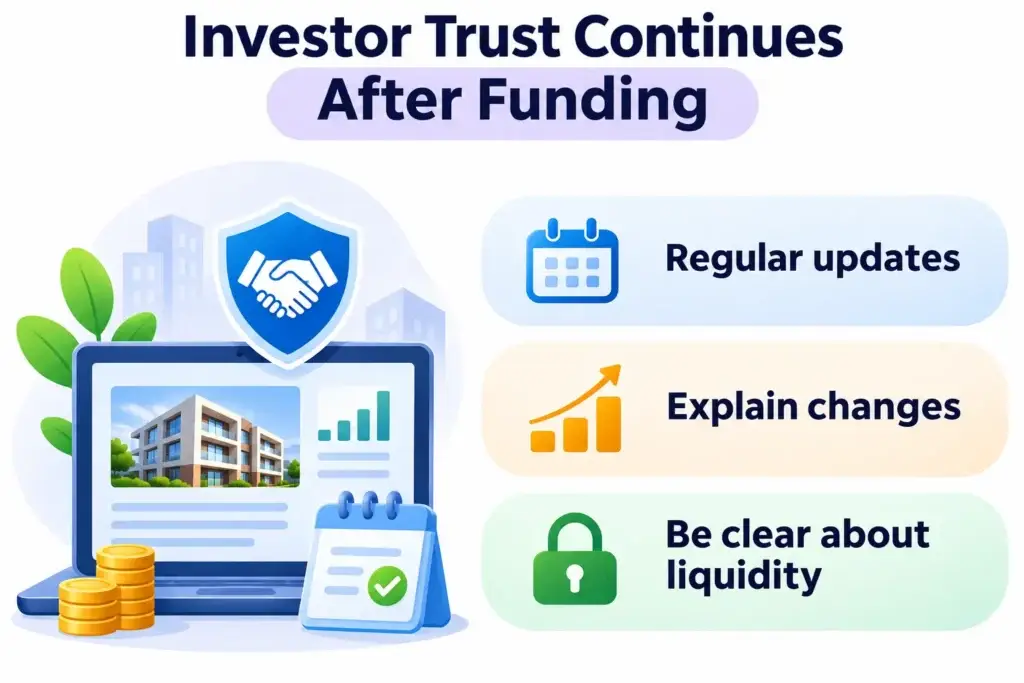
Many fundraising strategies focus heavily on bringing new investors into the first offering. Long-term credibility, however, depends on how an operator behaves after receiving capital.
Property performance rarely follows a perfectly smooth forecast. Expenses change, vacancies occur, financing decisions become necessary, and exit timelines may shift.
Investors are more likely to understand these developments when the sponsor communicates consistently and explains what has changed, why it matters, and what management intends to do.
Establish a Predictable Reporting Cadence
A property investment may warrant periodic updates covering operating performance, occupancy, material expenses, capital projects, debt conditions, and distributions.
The frequency and content depend on governing documents and regulatory obligations. Whatever cadence the business adopts, founders should avoid promising reports they cannot consistently deliver.
Explain Variances Instead of Hiding Them
Suppose an apartment property experiences higher maintenance expenses than initially projected. Reporting only the original forecast would leave investors with an incomplete understanding of current performance.
Better communication explains the variance, its potential effect on available cash, the corrective actions being considered, and any remaining uncertainty.
Trustworthy reporting does not require every period to deliver positive results. It requires material information to be presented accurately and without misleading omissions.
Treat Liquidity as a Risk, Not a Selling Point
Many syndication investments are illiquid and may involve substantial holding periods. Investors might not be able to sell their interests when they want, and there may be transfer restrictions or no active buyer market.
A digital interface that displays a resale or withdrawal option should never imply that an exit is guaranteed. Any secondary transaction mechanism also requires appropriate securities-law analysis, operational controls, and legally permitted transfer procedures.
Clear liquidity disclosures may reduce the number of investors who are unsuitable for the product, but that is preferable to attracting commitments through misleading expectations.
How to Measure Investor Trust Without Relying on Vanity Metrics
A large number of registrations does not necessarily indicate that a property-investment business has established credibility. Founders should evaluate whether interested users understand the opportunity, complete legitimate diligence steps, and reach appropriate investment decisions.
Useful operational measurements may include the percentage of eligible prospects who finish required document review, how frequently investors request missing information, the number of incomplete subscription records, settlement reconciliation issues, and the time needed to answer substantive investor questions.
Post-investment measurements can include the timeliness of required reports, unresolved investor inquiries, distribution reconciliation exceptions, and the accuracy of ownership records.
Commitment conversion can be monitored, but compliance and suitability should not be treated as obstacles to be removed solely to improve conversion rates.
Repeat investment may indicate confidence, yet it should be interpreted carefully. Investors can make repeated decisions for many reasons, and no performance metric proves that future returns are secure.
A Founder-Ready Framework for Launching the First Credible Property Offering
New syndication businesses benefit from a practical launch sequence that prioritizes credibility before aggressive acquisition campaigns.
Phase 1: Define the Investment Thesis and Legal Structure
Identify the intended asset category, investment strategy, sponsor role, investor audience, securities structure, and target jurisdictions.
Engage appropriate counsel to establish the lawful offering route and the activities the business itself is permitted to perform. This determines how marketing, eligibility checks, subscriptions, and fund handling can operate.
Phase 2: Select a Property That Can Withstand Scrutiny
The first offering has a disproportionate effect on credibility because future investors may evaluate how thoroughly the operator presented and managed the initial opportunity.
Founders should prioritize appropriate diligence, documented assumptions, realistic financing, and transparent risks instead of selecting a property solely because its headline projections look marketable.
Phase 3: Prepare the Investor Evidence Package
Create consistent offering materials that explain the sponsor, investment structure, risk factors, financial assumptions, fees, potential conflicts, and relevant property information.
All summaries should remain consistent with the actual governing documents. Marketing pages should not promise rights or outcomes that the subscription agreement does not support.
Phase 4: Validate the Investor Journey
Test whether an eligible investor can locate the relevant documents, understand the investment, complete applicable verification, submit a valid commitment, and receive accurate transaction communications.
Also test rejected eligibility checks, incomplete payments, cancellations, offering changes, and failure to meet closing conditions.
These workflow requirements should inform technical planning, whether the operator uses a ready-made solution or a customized product foundation. Founders evaluating ready-made property investment software foundations should confirm that their actual offering structure and operational controls can be accommodated.
Phase 5: Prepare Post-Closing Operations Before Accepting Funds
Determine who maintains investor records, approves distributions, handles inquiries, updates offering information, reconciles financial transactions, and coordinates required reporting.
The business must be prepared to support investors after the initial raise. A successful closing without dependable ongoing operations can damage the trust that the launch worked to establish.
Founder Decision Signals: Is Your Syndication Business Ready to Raise Capital?
Before spending heavily on marketing, founders should evaluate whether the offering can answer the questions a cautious investor would reasonably ask.
Legal Readiness
Is the securities offering structure defined, and are the required intermediaries, approvals, and documents identified?
Property Evidence
Can the business substantiate important property assumptions and clearly disclose material uncertainties?
Financial Control
Are investor commitments, funds handling, ownership records, and distribution responsibilities properly established?
Investor Communication
Can the operator explain the investment accurately before and after the offering closes?
If the answers are incomplete, the next priority may be due diligence, legal structuring, or financial controls rather than launching additional marketing campaigns.
Common Mistakes That Weaken Investor Confidence in Online Syndication
The following mistakes can undermine trust even when a property opportunity initially attracts interest.
Mistakes Founders Should Avoid
Advertising projected returns without context. Investors need the assumptions, uncertainties, and economic terms behind any displayed figures.
Using unverifiable sponsor credentials. A short but accurate professional history is more useful than unsupported claims of exceptional experience.
Treating every registration as a qualified investor. Eligibility depends on the specific offering framework, not merely on account creation.
Confusing reservations with closed capital. Capital commitments, received funds, and accepted investments must be recorded distinctly.
Promising easy exits for illiquid securities. Transfer restrictions and a lack of buyers can prevent investors from selling when desired.
Hiding fees and sponsor conflicts. Compensation structures and related-party relationships can materially affect investor decisions.
Failing to plan for underperformance. Investors need accurate updates when project outcomes diverge from the original projections.
How Technology Supports Investor Confidence Without Replacing Due Diligence
Technology can make an investment process more organized, transparent, and accountable. It can help investors find the right documents, understand their investment status, and receive consistent updates.
It cannot determine whether a property is a sound investment or independently certify that a sponsor will perform as projected.
For a growing syndication business, useful technical capabilities often include controlled document access, reliable investor verification workflows, accurate subscription records, financial reconciliation, restricted administrative permissions, and traceable reporting processes.
As the product expands, these requirements become part of broader real estate and property technology operations, where financial workflows, asset information, and investor communications must remain consistent as the portfolio grows.
The goal should be to reduce administrative uncertainty, not to create a false impression that every investment is protected from market loss.
Where Miracuves Fits Into a Trust-First Property Investment Strategy
Once founders have established their intended investment structure and operational responsibilities, they need software that can support the required investor and administrative workflows.
Miracuves provides ready-made and customizable digital product foundations for businesses planning property-investment operations. The relevant technology decisions should follow the investor journey, ownership structure, verification requirements, funds handling arrangements, and reporting obligations of the selected business model.
For its defined ready-made property investment solution, Miracuves offers rebranding and deployment in six working days with source-code ownership. Production integrations, security hardening, jurisdiction-specific configurations, and other custom requirements are scoped separately.
Most importantly, six-day software deployment does not constitute securities registration, intermediary authorization, legal approval, or permission to accept investor funds. These matters remain the responsibility of the relevant business and its qualified legal and financial advisors.
Founders considering a different investment structure or wider property-service ecosystem may also need custom property application integrations beyond a ready-made foundation. Such decisions are best made after clarifying the regulated activities, ownership model, and information requirements.
Final Thoughts: Investor Trust Is Earned Through Transparency, Not Promises
Online real estate syndication can make property investment opportunities easier to discover and evaluate, but access alone does not create trust. Investors still need reliable evidence, understandable financial terms, realistic risk disclosures, and confidence in the people and processes responsible for their capital.
For new businesses, the strongest starting point is not an aggressive promise of returns or an impressive list of features. It is an investment process that explains the property, identifies the sponsor, documents the risks, respects securities laws, handles commitments correctly, and communicates consistently after closing.
Clear offering materials and accountable financial operations can help reduce avoidable investor uncertainty. They cannot guarantee successful fundraising or prevent investment losses, but they provide a more credible foundation for long-term relationships.
When founders are ready to move from their investment model into implementation, the right Real Estate Crowdfunding Platform can support a more organized digital experience while preserving the need for independent diligence, appropriate regulatory arrangements, and transparent communications.
The real objective is not simply to collect capital quickly. It is to build an investment operation worthy of the confidence that capital represents.
Frequently Asked Questions
Miracuves is an independent software development company. We are not affiliated with, connected to, sponsored by, or endorsed by any company or product named in this article.
Terms such as “X Clone” are used descriptively. It is how the software industry refers to building a platform with functionality comparable to a known service, and how clients search for it.
The entire design and codebase of our products is built by our own team. Our products contain no code, design, graphics, or content originating from any third-party website or applications.
All third-party names and marks referenced in this article are the property of their respective owners, referenced solely to identify the services discussed.