
Key Takeaways
- Daily horoscopes, Panchang updates, and transit alerts give users recurring reasons to revisit a digital astrology platform.
- Horoscopes create routine, Panchang provides practical utility, and transit alerts add timely personal relevance.
- Saved birth details, language preferences, location, interests, and previous activity can make daily content more meaningful.
- Free recurring content can naturally guide engaged users toward consultations, premium reports, remedies, and wallet recharges.
- Strong astrology app retention depends on connecting content, personalization, notifications, monetization, and admin control.
Retention Strategy Signals
- Personalize daily horoscopes by zodiac sign, moon sign, ascendant, language, and life category.
- Provide location-based Panchang information such as tithi, nakshatra, muhurta, rahu kaal, festivals, sunrise, and sunset.
- Send transit alerts that explain the planetary change, personal relevance, duration, and recommended next action.
- Allow users to select notification categories, frequency, language, interests, and reminder preferences.
- Track daily active users, repeat visits, content engagement, consultation conversion, wallet recharge, and notification response.
Real Insights
- Generic daily content may attract traffic, but personalized and timely guidance is more likely to build lasting habits.
- Panchang becomes more valuable when it supports location, reminders, festival context, and practical planning.
- Frequent generic notifications can increase uninstall risk, while relevant reminders can strengthen repeat engagement.
- Admin controls let teams test content schedules, audience segments, offers, consultation prompts, and retention campaigns without repeated development work.
- Miracuves develops white-label astrology platforms with recurring content, personalized alerts, consultations, wallets, analytics, source-code ownership, and six-day delivery where the ready-made scope applies.
A digital astrology platform does not grow only because users ask one question, book one consultation, or generate one birth chart. Long-term growth comes from repeat behavior. Users return when the platform becomes part of their daily routine, spiritual planning, personal reflection, and decision-making habits.
That is where daily horoscopes, panchang updates, and transit alerts become powerful retention features.
For a founder, these are not just content sections. They are recurring engagement loops. A horoscope gives users a reason to open the app every morning. Panchang helps them plan important days, rituals, travel, purchases, or ceremonies. Transit alerts create personalized moments that feel timely and relevant. Together, they turn an astrology platform from a one-time consultation product into a daily-use digital destination.
This blog explains how these features improve repeat visits, where they fit inside an astrology app experience, and how founders can use them to build stronger engagement without overwhelming users.
Why Repeat Visits Matter More Than One-Time Astrology App Traffic
Many astrology platforms attract users through curiosity. Someone checks today’s horoscope, generates a kundali, reads about a transit, or asks a question during an emotional moment. But curiosity alone does not create a sustainable platform.
A founder needs repeat visits because repeat users are more likely to:
- Save their birth details
- Read personalized content
- Explore premium reports
- Follow astrologers
- Join live sessions
- Recharge their wallet
- Book a consultation
- Purchase remedies, puja services, courses, or digital products
- Invite family members to check charts or compatibility
This is why daily-use features matter. They reduce dependency on paid acquisition and give users a reason to return before they are ready to spend money.
A strong astrology platform should not push every visitor directly into a paid consultation. It should first create trust, routine, and relevance. Daily horoscopes, panchang, and transit alerts help build that bridge.
Read More: What Should Founders Check Before Launching an Astrology Consultation Platform?
Daily Horoscopes Create a Natural Habit Loop
Daily horoscope content works because it matches a simple user behavior: people like checking what the day may bring before starting work, travel, meetings, relationships, or personal decisions.
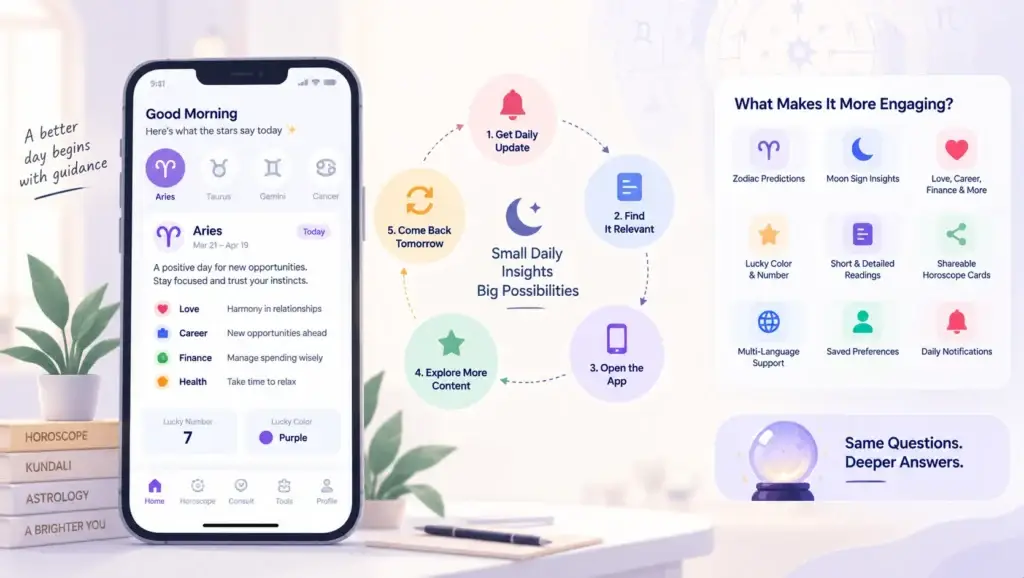
For astrology platforms, this creates a predictable habit loop:
- The user receives or sees a daily update.
- The content feels personally relevant.
- The user opens the app to read more.
- The platform suggests related content, tools, or consultation paths.
- The user returns the next day for a fresh update.
The key is freshness. A static astrology app quickly loses attention. A daily horoscope section gives the platform a content rhythm that users can rely on.
What Makes Daily Horoscope Features More Engaging?
A basic horoscope page may attract traffic, but a well-designed daily horoscope experience can improve retention. The difference comes from personalization and product flow.
Useful horoscope layers include:
- Zodiac-wise daily prediction
- Moon-sign-based horoscope
- Love, career, finance, health, and family categories
- Lucky color, lucky number, and favorable time
- Short daily summary for quick readers
- Detailed reading for users who want depth
- Shareable horoscope cards
- Language-based horoscope delivery
- Saved user preferences
- Morning notification reminders
The founder’s goal should not be to make the horoscope section longer. The goal should be to make it more useful, easier to consume, and connected to the user’s intent.
For example, a user reading a career horoscope may be shown a relevant career consultation prompt. A user reading relationship predictions may be guided toward compatibility tools or relationship-focused readings. The platform experience becomes more intelligent when content, tools, and consultations are connected.
Panchang Turns an Astrology App Into a Daily Utility
Daily horoscopes drive emotional and personal engagement. Panchang features drive practical utility.
A panchang is useful because many users check auspicious timing, festival dates, tithi, nakshatra, rahu kaal, muhurta, sunrise, sunset, and other calendar-based details. Unlike generic astrology content, panchang has a strong reason-to-return pattern because it changes every day and often depends on location and timing.
For digital astrology platforms, panchang can become one of the strongest daily retention surfaces.
Why Users Return for Panchang Updates
Users may open the platform to check:
- Today’s tithi
- Current nakshatra
- Rahu kaal and gulika kaal
- Abhijit muhurta
- Choghadiya
- Festival and vrat dates
- Sunrise and sunset timing
- Auspicious timing for travel, puja, business, marriage, housewarming, or purchases
- Location-specific calendar details
This makes panchang different from a one-time birth chart tool. It is not something users check once and forget. It works as a recurring decision-support feature.
For founders, that matters because a utility feature can build trust even before monetization. When users rely on the platform for daily timing and planning, they are more likely to explore deeper features later.
Transit Alerts Add Personal Relevance to Retention
Transit alerts are powerful because they connect planetary movement to the individual user’s chart, sign, or interest area.
A general article about a planetary transit may bring traffic. But a personalized transit notification can bring the user back.
For example, instead of saying:
“Planetary transit update available.”
A better alert would say:
“Your career sector may need attention today. View the transit insight.”
The second version feels more personal, specific, and action-oriented.
What Good Transit Alerts Should Include
Transit alerts should not simply announce that a planet moved. They should help the user understand meaning and next steps.
A strong transit alert experience can include:
- Planetary movement summary
- Sign or chart-based relevance
- Impact category such as career, love, money, health, or family
- Duration of influence
- Suggested reading or report
- Option to consult an expert
- Reminder for major upcoming transitions
- Saved alerts for important birth chart placements
Transit alerts are especially useful for users who do not want to read long astrology articles every day. They prefer timely prompts that tell them when something important may affect them.
How These Features Work Together Inside the User Journey
Daily horoscopes, panchang, and transit alerts should not sit as isolated modules. They should work together as a repeat-visit system.
Here is how the engagement journey can look:
Astrology Retention Feature Map
| Feature | User Reason to Return | Business Value for Founders |
|---|---|---|
| Daily Horoscope | Check personal guidance for the day | Builds daily app-opening habits and content engagement |
| Panchang | Find tithi, nakshatra, muhurta, and auspicious timing | Turns the platform into a daily planning utility |
| Transit Alerts | Understand timely planetary changes and personal impact | Creates personalized re-engagement moments |
| Saved Birth Details | Access personalized readings without entering data again | Improves account retention and profile completeness |
| Consultation Prompts | Ask an expert when a reading feels important | Connects free engagement to paid conversion naturally |
The strongest astrology products use free daily engagement to create trust. Once trust exists, users are more open to deeper readings, paid reports, live consultations, remedies, subscriptions, and wallet-based services.
The Founder’s Retention Question: What Should Bring Users Back Tomorrow?
Every founder building an astrology platform should ask one product question:
“What will make the user return tomorrow without needing another advertisement?”
The answer usually comes from a mix of routine, relevance, and timing.
Routine
Daily horoscope and panchang create predictable usage patterns because the content changes every day and fits morning or planning behavior.
Personalization
Transit alerts, saved birth charts, sign preferences, and language choices make the app feel more relevant than a generic astrology website.
Conversion Readiness
Users who return often are easier to guide toward reports, consultations, wallet recharge, live sessions, or premium services when the timing feels natural.
Admin Control
Founders need backend control over notifications, content categories, banners, offers, and feature visibility so retention can be improved without rebuilding the app.
Notification Strategy: Helpful Reminders, Not Spam
Push notifications can improve repeat visits, but only when they are useful. Astrology users may welcome daily reminders, but they can also uninstall quickly if every notification feels generic or excessive.
A better notification system should respect user intent.
Useful notification categories include:
- “Your daily horoscope is ready”
- “Today’s panchang is updated for your location”
- “A major transit insight is available”
- “A saved muhurta reminder is coming up”
- “Your weekly love/career/finance reading is ready”
- “An astrologer you follow is live”
- “Your report is available to download”
- “Your wallet balance may be low before consultation”
The message should be short, relevant, and connected to a clear action. More importantly, users should be able to choose the type of alerts they want.
This is where product design affects retention. A platform that lets users manage notification preferences builds more trust than one that sends everything to everyone.
Personalization Makes Astrology Engagement Feel Deeper
Astrology is naturally personal. A digital platform should reflect that.
If every user sees the same generic horoscope, the platform becomes a content site. But when the app remembers the user’s chart, language, location, favorite categories, followed practitioners, previous consultations, and alert preferences, the experience becomes much stronger.
Personalization can include:
- Birth chart-based daily insights
- Moon sign or ascendant-based readings
- Location-based panchang
- Preferred language content
- Saved relationship compatibility profiles
- Favorite astrologers
- Category interests such as marriage, career, finance, education, or health
- Personalized report recommendations
- Reminder history and upcoming event alerts
Founders should treat personalization as a retention layer, not just a feature. The more relevant the app feels, the more likely users are to return.
How Daily Content Supports Monetization Without Feeling Pushy
The strongest monetization journey is not aggressive. It is contextual.
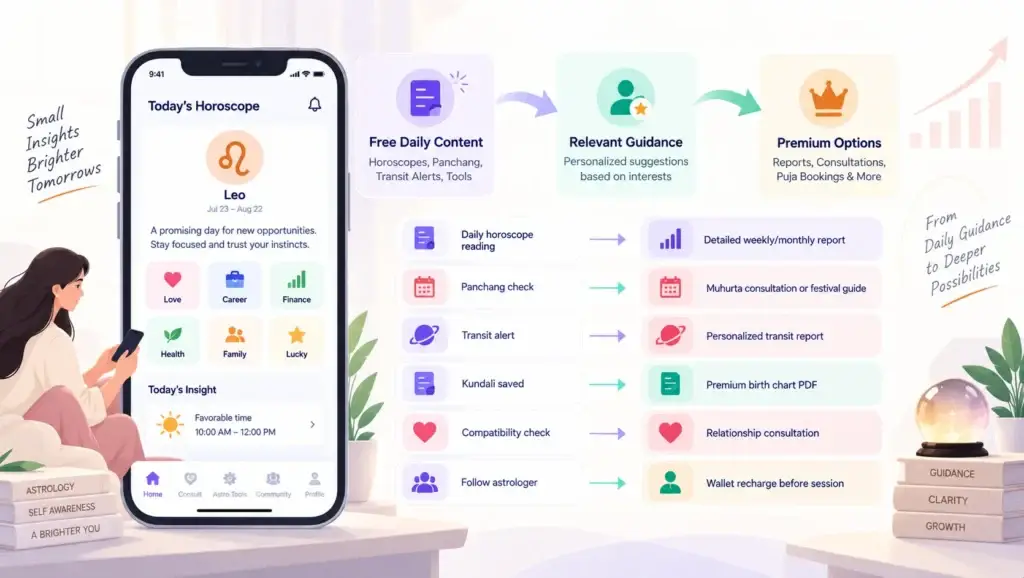
A user reading a daily horoscope may not be ready to pay immediately. But if the reading mentions career uncertainty, the platform can suggest a deeper career report or a relevant consultation option. If a user checks a muhurta, the platform can suggest a puja booking, detailed calendar, or expert guidance. If a transit alert feels important, the platform can offer a personalized reading.
The key is timing.
Monetization works better when the paid step feels like a natural continuation of the free feature.
Example flows:
| Free Engagement Moment | Natural Paid Next Step |
|---|---|
| Daily horoscope reading | Detailed weekly/monthly report |
| Panchang check | Muhurta consultation or festival guide |
| Transit alert | Personalized transit report |
| Kundali saved | Premium birth chart PDF |
| Compatibility check | Relationship consultation |
| Live astrologer followed | Wallet recharge before session |
This is why free tools should not be treated as “extra” features. They are often the top of the funnel for long-term revenue.
Admin Control Is Critical for Retention Experiments
Founders often focus on user-side features and forget the admin side. But retention improves only when the platform operator can test, adjust, and optimize engagement.
The admin dashboard should allow the business team to manage:
- Daily horoscope categories
- Panchang content and display rules
- Transit alert templates
- Notification scheduling
- User segments
- Language content
- Promotional banners
- Featured astrologers
- Report pricing
- Consultation prompts
- Wallet recharge offers
- Content publishing calendar
- Engagement analytics
Without admin control, every small retention experiment becomes a development task. That slows the business down.
A founder should be able to test whether users respond better to morning horoscope alerts, evening transit summaries, weekly relationship readings, or festival-based panchang reminders. The faster the team can learn, the better the platform can retain users.
Mistakes Founders Should Avoid When Building Astrology Retention Features
Publishing Generic Daily Content Only
Generic horoscope content may fill a page, but it rarely builds strong retention. Users return when the content feels personal, timely, and connected to their situation.
Sending Too Many Notifications
Notifications should support user intent, not interrupt the user repeatedly. Segment alerts by interest, language, saved chart, location, and previous behavior.
Treating Panchang as a Static Calendar
Panchang works better as a utility layer with location, timing, reminders, festival context, and muhurta relevance rather than a simple table users scroll once.
Separating Free Tools From Paid Journeys
Free features should naturally connect to reports, consultations, remedies, wallet actions, and personalized readings. If the journey is disconnected, users may engage without converting.
Where Miracuves Fits Into Astrology Platform Development
For founders, the challenge is not only adding horoscope, panchang, or transit pages. The bigger challenge is connecting those features to user accounts, saved birth data, notifications, consultation flows, wallet logic, reports, admin controls, and analytics.
A ready-made foundation from Miracuves can help founders launch faster with a white-label astrology platform that supports user engagement, practitioner workflows, admin control, branding, and source-code ownership. For ready-made astrology solutions, Miracuves’ 6-day delivery timeline helps businesses move from planning to market validation without building every module from zero.
The practical advantage is speed with control. Founders can start with a launch-ready base, customize the retention flows that matter most, and then improve engagement based on real user behavior.
Final Thoughts: Retention Is Built Into the Daily Ritual
Astrology platforms have a natural advantage that many app categories do not: users already connect astrology with daily reflection, timing, planning, and personal guidance.
But that advantage only works when the product is designed around repeat behavior.
Daily horoscopes create routine. Panchang creates utility. Transit alerts create personal relevance. Together, they help users return without needing constant advertising. For founders, the real opportunity is not just launching an astrology app. It is building a platform that becomes part of the user’s daily decision-making habit.
When these retention layers connect with consultations, reports, wallet flows, remedies, and admin-controlled campaigns, the platform becomes more than a content destination. It becomes a growth-ready astrology ecosystem.
FAQs
How do daily horoscopes improve astrology app retention?
Daily horoscopes improve retention by giving users a fresh reason to open the app every day. When the content is personalized by zodiac sign, moon sign, language, or life category, it becomes more relevant and habit-forming.
Why is panchang important for a digital astrology platform?
Panchang is important because it gives users practical daily information such as tithi, nakshatra, muhurta, rahu kaal, festival timing, and auspicious periods. This turns the platform into a daily-use utility rather than a one-time reading tool.
What are transit alerts in an astrology app?
Transit alerts notify users about important planetary movements and their possible relevance. A strong transit alert explains what changed, why it matters, and what the user can do next, such as reading a detailed report or consulting an expert.
How can astrology apps use push notifications without annoying users?
Astrology apps should segment notifications based on user preferences, saved birth chart, language, location, and interests. Helpful reminders work better than frequent generic alerts.
Can free astrology tools help increase paid consultations?
Yes. Free tools such as horoscope, panchang, kundali, and compatibility checks can build trust and repeat visits. When the user wants deeper guidance, the platform can naturally guide them toward reports, wallet recharge, or expert consultations.
What retention features should founders prioritize first?
Founders should usually prioritize daily horoscope, panchang, saved birth details, personalized notifications, transit alerts, and admin-controlled content publishing. These features create routine engagement before advanced monetization layers are added.
Why does admin control matter for astrology app retention?
Admin control lets the platform operator manage content, notifications, banners, offers, featured experts, pricing, and engagement campaigns without depending on developers for every change. This helps teams test retention ideas faster.
How does Miracuves help with astrology platform development?
Miracuves helps founders build launch-ready, white-label astrology platforms with source-code ownership, branded design, admin dashboards, user engagement flows, and faster deployment for market validation.
Miracuves is an independent software development company. We are not affiliated with, connected to, sponsored by, or endorsed by any company or product named in this article.
Terms such as “X Clone” are used descriptively. It is how the software industry refers to building a platform with functionality comparable to a known service, and how clients search for it.
The entire design and codebase of our products is built by our own team. Our products contain no code, design, graphics, or content originating from any third-party website or applications.
All third-party names and marks referenced in this article are the property of their respective owners, referenced solely to identify the services discussed.