


Key Takeaways
- An astrology consultation platform business model connects users, astrologers, consultation services, wallets, payments, commissions, and payouts within one digital marketplace.
- Users discover astrologers and pay for chat, call, video, or scheduled consultations, while astrologers manage availability, pricing, sessions, earnings, and payout requests.
- The platform typically earns by applying commissions or service fees to completed consultations while managing payment collection, wallet balances, refunds, and astrologer settlements.
User & Astrologer Flow Signals
- Users can browse astrologer profiles, specialties, languages, ratings, availability, consultation rates, and service formats before selecting a practitioner.
- Astrologers need onboarding, verification, profile management, availability schedules, per-minute or fixed pricing, consultation history, earnings dashboards, and payout controls.
- Chat, voice calls, video sessions, appointment booking, notifications, ratings, reviews, refunds, and support workflows keep both sides connected throughout the consultation journey.
Wallet & Commission Insights
- Wallets can support balance recharges, consultation deductions, promotional credits, refunds, transaction history, and faster repeat payments for returning users.
- Commission logic should calculate platform fees, astrologer earnings, taxes or deductions where applicable, refunds, payout eligibility, and final settlement records for each consultation.
- Miracuves develops customizable astrology consultation platforms with astrologer onboarding, chat and call consultations, wallets, commissions, payments, payouts, scheduling, reviews, analytics, and admin controls.
An astrology consultation business is easy to misunderstand.
From the outside, it may look like a directory where users find astrologers and start a chat or call. But a functioning marketplace has a much deeper commercial loop.
Users bring demand.
Astrologers provide consultation capacity.
The wallet converts user intent into prepaid value.
Chat, voice, video, or live sessions consume that balance.
Commission determines how the consultation value is divided between the practitioner and platform operator.
Payouts close the loop for astrologers, while good consultations, remaining wallet balance, saved history, and trusted practitioners encourage users to return.
That connection is the real astrology consultation platform business model.
Founders who understand the whole loop can make better decisions about pricing, practitioner supply, wallet design, commission rules, retention, and marketplace operations.
What Is an Astrology Consultation Platform Business Model?
An astrology consultation marketplace creates value by connecting two groups:
Users want convenient access to astrologers who match their question, language, consultation style, availability, and budget.
Astrologers want qualified demand, communication infrastructure, payment collection, scheduling, reputation, and predictable settlement without having to build those systems themselves.
The platform sits between them.
Its job is not merely to display astrologer profiles. It manages the transaction.
A typical business loop looks like this:
Discovery → Practitioner Selection → Wallet Recharge → Consultation → Billing → Commission → Practitioner Earnings → Repeat Usage
That distinction matters.
A simple directory helps users find a practitioner and may lose the transaction once the two parties connect directly.
A consultation marketplace keeps discovery, payment, service delivery, settlement, reviews, and repeat usage within the product.
For founders unfamiliar with the complete product journey, this guide to how an online astrology consultation platform works provides useful background before going deeper into the business model.
The Four Participants Behind the Business Model
Although users and astrologers are the visible sides of the marketplace, the commercial system actually involves four layers.
Core Participants in an Astrology Consultation Marketplace
| Participant | Main Role | Business Impact |
|---|---|---|
| User | Discovers practitioners, funds the wallet, starts consultations, purchases reports, and returns for future guidance. | Creates marketplace demand and generates transaction volume. |
| Astrologer | Provides chat, voice, video, live, or scheduled consultation services. | Creates supply and directly influences trust, retention, and consultation quality. |
| Platform Operator | Controls pricing rules, commission, practitioner approval, promotions, refunds, disputes, and marketplace policies. | Coordinates supply and demand while managing platform economics. |
| Wallet & Payment Layer | Collects user funds, records consumption, handles deductions, refunds, and settlement records. | Turns consultation activity into trackable marketplace transactions. |
Step 1: User Demand Starts the Marketplace
Every marketplace begins with demand.
A user may arrive because they want:
- Relationship guidance
- Compatibility insights
- Career guidance
- Birth-chart interpretation
- Marriage-related consultation
- Financial or business guidance
- Numerology
- Tarot
- Vastu
- A second opinion
- A recurring consultation with a trusted practitioner
The user’s first action does not always need to be paid.
An Astrology Portal Platform can use free tools and content to create discovery before pushing a user toward consultation.
Examples include:
- Horoscope pages
- Birth-chart tools
- Compatibility tools
- Panchang
- Numerology tools
- Educational articles
- Free introductory reports
- AI-assisted insights
These entry points perform an acquisition role.
Their business purpose is to help a casual visitor become a qualified consultation user.
The mistake is assuming traffic itself is the business model. Traffic becomes commercially meaningful when the platform gives users a clear next step toward a service they value enough to pay for.
Step 2: Practitioner Discovery Converts Intent Into Choice
Once a user wants consultation, the next problem is selection.
Different users care about different things:
- Language
- Speciality
- Consultation rate
- Rating
- Experience
- Availability
- Consultation format
- Response time
- Familiar practitioner
- Specific astrology discipline
This is why practitioner discovery affects conversion.
If users cannot quickly answer “Who should I speak to?”, they may leave even when the marketplace has plenty of astrologers.
Useful discovery controls include:
- Skills
- Languages
- Consultation categories
- Availability
- Rates
- Ratings
- Profile information
- Chat/call/video availability
- Featured or recommended practitioners
Founders planning these workflows can review the astrology consultation platform features required across user discovery, practitioner operations, wallet billing, consultations, and operator control.
Step 3: The Wallet Converts Intent Into Prepaid Value
The wallet is one of the most important commercial layers in the model.
Without it, a platform may need to process a fresh payment for every consultation event.
With a prepaid balance, users can recharge once and use that value across supported experiences.
A basic flow looks like:
User chooses recharge amount → payment is verified → wallet balance increases → consultation starts → service consumption reduces balance
From a business perspective, the wallet does more than simplify checkout.
It can reduce payment friction during future sessions, support small repeated transactions, enable promotional credit, simplify consultation metering, and give users a balance they can return to later.
However, founders should treat wallet records seriously.
The platform should be able to explain every balance change:
- Recharge
- Bonus
- Consultation deduction
- Refund
- Report purchase
- Promotional credit
- Manual adjustment
- Other paid service
A wallet that cannot explain its own balance creates support and reconciliation problems.
Step 4: Consultation Turns Wallet Balance Into Service Consumption
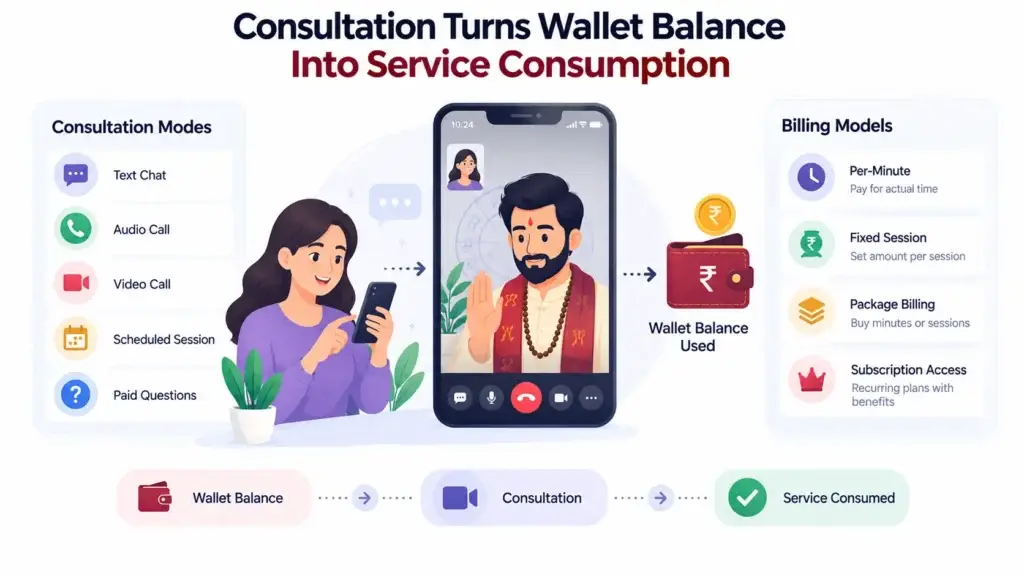
The actual consultation is where demand meets supply.
Platforms may support:
- Text chat
- Audio calls
- Video calls
- Live sessions
- Scheduled consultations
- Paid questions
The charging model can vary.
Per-minute billing
The user is charged according to session duration.
This works well when consultation length varies significantly.
Fixed-session billing
The user pays a set amount for a defined consultation.
This is easier to understand but less flexible when sessions vary in length.
Package billing
Users buy a bundle of minutes, sessions, or consultation credits.
This may support repeat usage when the business wants users to commit in advance.
Subscription access
Some platforms may combine recurring membership with credits, discounts, or premium access.
Founders should not choose a billing method because it sounds sophisticated. They should choose it based on how practitioners work and how users prefer to buy guidance.
Step 5: Commission Connects Platform Revenue to Practitioner Earnings
The commission model determines how the value generated by a consultation is divided.
Suppose a user spends a certain amount on a consultation.
That transaction may need to account for:
Gross consultation value
− practitioner share
− platform share
− applicable payment costs
− refunds or adjustments
− applicable tax/withholding treatment
The exact percentage should be determined by the operator’s market, practitioner supply, pricing strategy, and local requirements.
There is no universal percentage that fits every consultation marketplace.
Why commission matters to both sides
A high platform commission may improve operator margin but make practitioner recruitment and retention harder.
A very low commission may attract supply but leave too little margin for:
- User acquisition
- Payment processing
- Support
- Refunds
- Real-time communication infrastructure
- Moderation
- Technology
- Operations
The right commission structure balances marketplace sustainability with practitioner earning potential.
For deeper commercial configuration, including monetization beyond the core consultation loop, founders can review the consultation marketplace revenue model nseparately.
That keeps this article focused on how the marketplace participants connect rather than duplicating the complete commercial monetization page.
Step 6: Practitioner Earnings Must Become Clear, Traceable Payouts
Commission only works if practitioners trust the settlement process.
An astrologer should be able to understand:
- Gross consultation earnings
- Platform deductions
- Promotional adjustments
- Refund impact
- Withdrawal eligibility
- Pending balance
- Paid balance
- Payout history
This is a marketplace trust issue.
Users judge the product by consultation quality.
Practitioners judge it partly by whether they are paid correctly and predictably.
A strong practitioner experience therefore includes more than receiving consultation requests. It also needs transparent earning and payout records.
Step 7: The Operator Controls Marketplace Economics
The platform operator sits above the user and practitioner sides.
Typical operator decisions include:
- Who can join as a practitioner?
- What consultation formats are enabled?
- What pricing flexibility does each practitioner receive?
- What commission applies?
- Can commission vary by practitioner?
- How are introductory promotions handled?
- How are refunds approved?
- When can practitioners withdraw?
- Which users receive promotional credit?
- Which services are enabled?
- What happens when a session fails?
- How are disputes investigated?
This is why the admin dashboard should be viewed as a business-control layer, not simply a backend screen.
The strongest marketplaces let operators adjust practical business rules without needing engineering work for every small pricing or operational change.
The Complete Money Flow
A simplified consultation transaction can be visualized like this:
How Money Moves Through an Astrology Consultation Platform
| Stage | What Happens | Business Meaning |
|---|---|---|
| 1. Discovery | User enters through search, content, free tools, referral, promotion, or direct brand traffic. | Demand enters the marketplace. |
| 2. Practitioner Selection | User chooses an astrologer based on skills, language, rate, availability, reviews, or familiarity. | Intent moves toward a specific supply source. |
| 3. Wallet Recharge | User adds prepaid balance through a payment method. | Interest becomes stored monetary value. |
| 4. Consultation | User consumes chat, audio, video, live, or another paid service. | Service delivery generates transaction value. |
| 5. Commission | The transaction is divided according to the operator’s commission rules. | Platform and practitioner economics are calculated. |
| 6. Practitioner Earnings | The practitioner’s eligible share moves into their earning balance. | Supply is compensated. |
| 7. Return Loop | User keeps history, remaining balance, practitioner relationships, reviews, and personalized recommendations. | The marketplace creates a reason for repeat usage. |
The business model becomes stronger when those stages operate as one connected system.
Why Repeat Consultations Matter More Than First-Time Traffic
A marketplace can spend heavily acquiring new users and still struggle if very few return.
Repeat consultation behavior matters because acquisition has already happened.
A returning user may already have:
- An account
- Stored birth information
- Consultation history
- A preferred practitioner
- Wallet balance
- Trust in the product
- Previous reports
- Familiarity with pricing
That reduces friction.
Retention can be strengthened through:
- Practitioner follows
- Saved favorites
- Consultation history
- Follow-up sessions
- Relevant notifications
- Personalized reports
- Wallet balance reminders
- Loyalty rewards
- Useful free content
- New service recommendations
The goal should not be to send as many notifications as possible.
The goal should be to give users a useful reason to return.
Practitioner Retention Is the Other Half of Marketplace Retention
Many founders focus almost entirely on user retention.
But a two-sided marketplace also needs practitioner retention.
If experienced astrologers repeatedly leave, users may lose the people they trust.
Practitioners are more likely to value:
- Reliable consultation demand
- Clear rates
- Accurate earnings
- Predictable payouts
- Fair dispute handling
- Good communication tools
- Control over availability
- Useful performance information
- Platform reputation
- Low operational friction
This creates an important founder insight:
Marketplace retention has two sides.
User loyalty without reliable practitioner supply creates waiting and disappointment.
Practitioner supply without user demand creates idle professionals who eventually leave.
Growth means keeping both sides healthy.
Supply and Demand Must Stay Balanced
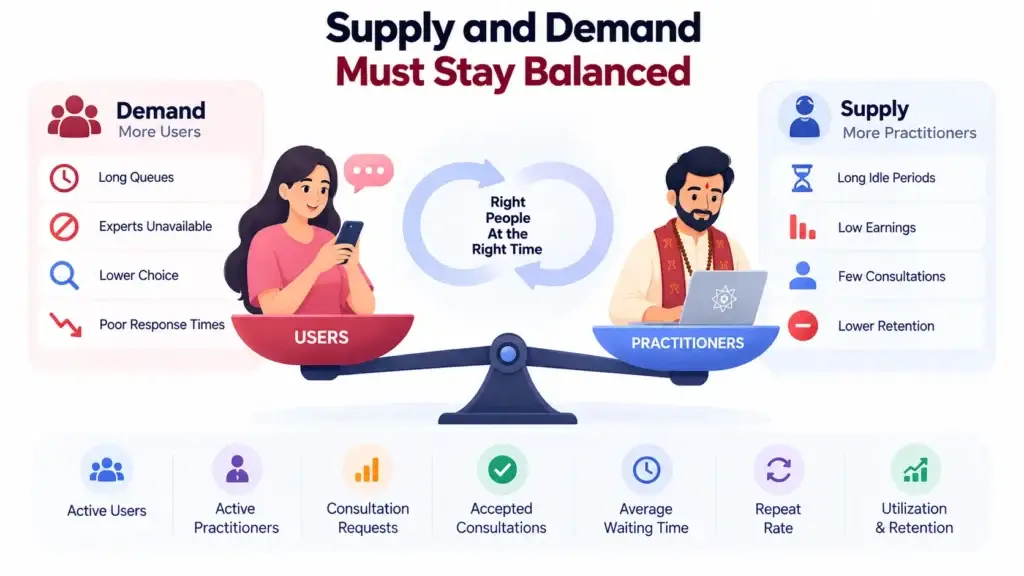
An astrology marketplace can fail even when total registrations look impressive.
Imagine two situations.
Too much demand, too little practitioner supply
Users experience:
- Long queues
- Unavailable experts
- Missed requests
- Lower choice
- Poor response times
Too much supply, too little demand
Practitioners experience:
- Long idle periods
- Low earnings
- Few consultations
- Weak incentive to remain active
The founder’s job is therefore not merely to maximize users or astrologers.
It is to create marketplace liquidity—enough relevant practitioners available when users want consultations.
Useful metrics may include:
- Active users
- Active practitioners
- Consultation requests
- Accepted consultations
- Session completion
- Average waiting time
- Repeat consultation rate
- Practitioner utilization
- Wallet recharge rate
- Refund rate
- Practitioner retention
The exact dashboard will vary, but founders should watch the relationship between supply and demand rather than headline registrations alone.
What Role Should Free Astrology Tools Play?
Free astrology tools can become valuable acquisition surfaces.
Examples include:
- Kundali generation
- Horoscopes
- Compatibility
- Numerology
- Panchang
- Birth-chart insights
- Educational content
They help an Astrology Portal Platform attract users who may not initially be ready for a consultation.
But free tools should connect logically to the paid experience.
For example:
Compatibility result → relationship consultation
Birth-chart insight → detailed interpretation
Career horoscope → career-focused practitioner
Personalized report → optional consultation
The stronger journey does not force a sale. It presents a relevant next step.
Where AI Fits Into the Business Model
AI can fill gaps between free content and human consultation.
It can support:
- Instant questions
- Chart explanations
- Report summaries
- Category recommendations
- User onboarding
- Practitioner discovery
- After-hours guidance
But founders should avoid positioning AI and practitioners as identical products.
Their cost structures and user expectations are different.
AI can deliver fast, repeatable responses.
Human practitioners deliver interpretation, conversation, empathy, and contextual follow-up.
For platforms planning both, Miracuves’ white-label AI astrology platform provides a useful reference for connecting AI-assisted experiences with paid reports, wallets, and human consultation escalation.
Understanding Basic Marketplace Unit Economics
Founders do not need a complicated financial model to understand the basic logic.
At a simplified level:
User consultation spend
− practitioner payout
− payment and transaction costs
− consultation infrastructure costs
− refunds/support costs
= contribution available to the operator
Then subtract broader business expenses such as:
- Marketing
- Staff
- Technology
- Legal/accounting
- Support
- Infrastructure
- Practitioner acquisition
- Content
The objective is not simply to maximize commission.
The objective is to create a marketplace where:
- Users see enough value to keep paying.
- Practitioners earn enough to remain available.
- The operator retains enough margin to acquire, operate, and improve the marketplace.
That balance is the business model.
Founder Decision Signals
Demand Source
If you already have horoscope, birth-chart, social, community, or spiritual-content traffic, focus on converting existing demand into consultation rather than adding more acquisition surfaces first.
Practitioner Supply
If high-quality practitioners are scarce, solve onboarding, availability, pricing, and payout trust before investing aggressively in user acquisition.
Wallet Strategy
If consultation values are frequent and relatively small, a prepaid wallet can reduce repeated checkout friction and support metered services more naturally.
Commission Sustainability
Your commission needs to support marketplace operations without making practitioner economics unattractive. Test the full margin structure, not just the operator percentage.
Business Model Checklist for Founders
Before launching, founders should answer:
- Who is the first user segment?
- What problem triggers a consultation?
- What brings users into the platform?
- Which free tools support acquisition?
- How will users discover practitioners?
- Which consultation modes launch first?
- Will users pay per minute, session, or package?
- Does the product need a prepaid wallet?
- How will promotional credits work?
- What commission model applies?
- Can commission vary by practitioner?
- How are refunds treated?
- How are practitioner earnings calculated?
- When can practitioners withdraw?
- Which payment costs affect margin?
- How will disputes be resolved?
- What keeps practitioners active?
- What gives users a reason to return?
- Which metrics show marketplace liquidity?
- Which revenue layers should wait until the consultation loop is proven?
If you are still deciding which capabilities belong in the first release, this guide to essential astrology platform features can help separate core consultation workflows from secondary product layers.
For founders comparing ready-made product foundations, this guide to astrology platform scripts, features, and pricing can support the next stage of evaluation.
Mistakes Founders Should Avoid
Thinking the Business Model Is Only Commission
Commission is one part of the model. Demand generation, wallet conversion, practitioner availability, session completion, payouts, and repeat usage determine whether that commission is generated consistently.
Acquiring Users Before Practitioner Supply Is Ready
Driving traffic into a marketplace with too few available practitioners creates waiting, abandoned consultation requests, and weak first impressions.
Setting Commission Without Calculating Operating Costs
A percentage may look attractive until payment fees, refunds, consultation infrastructure, support, marketing, and practitioner acquisition are included.
Treating Wallet Balance as a Simple Number
Every credit and debit should have a traceable reason. Weak ledger logic creates refund, support, reconciliation, and practitioner-payment problems.
Ignoring Practitioner Retention
Users return partly because they trust particular practitioners. Unclear earnings, poor payout operations, or weak consultation demand can damage the supply side of the marketplace.
How Miracuves Helps Founders Launch Consultation Marketplaces
Miracuves helps founders launch white-label consultation marketplaces with customer and practitioner experiences, wallet billing, real-time consultation workflows, operator controls, and source-code ownership.
Founders who have already validated their marketplace economics can explore Miracuves’ ready-made astrology consultation platformas a product foundation for connecting practitioner discovery, consultations, wallets, commission logic, and operator workflows.
For teams moving from business modelling into implementation, the astrology platform development partner guide explains what to evaluate around technical delivery and launch readiness.
Budget-conscious founders can separately review astrology consultation platform development cost once the required scope, integrations, consultation formats, and customization requirements are clear.
Where the ready-made solution scope fits the business requirements, Miracuves can support 6-day solution delivery, helping founders avoid rebuilding every marketplace workflow from zero while still allowing branding and business-specific configuration.
Final Thoughts: The Business Model Is the Loop, Not One Revenue Line
The most useful way to understand an astrology consultation marketplace is not to ask how many ways it can monetize.
Ask whether the main loop works.
Can users find the right practitioner?
Can they fund the service without unnecessary friction?
Can the consultation be delivered and billed correctly?
Can the platform calculate its share transparently?
Can practitioners understand and withdraw their earnings?
Do users have enough trust and continuity to return?
When those parts connect, the marketplace has a functioning economic engine.
Additional monetization can come later.
For founders, the priority should be building a healthy relationship between demand, supply, wallet value, consultation delivery, commission, payout, and retention.
That is the foundation on which the rest of the astrology platform business can grow.
FAQs
What is an astrology consultation platform business model?
It is a two-sided marketplace model connecting users seeking astrology guidance with practitioners providing consultations. The platform usually manages discovery, payments, consultation delivery, wallet records, commission, practitioner earnings, and repeat engagement.
How does an Astrology Consultation Platform make money?
The core marketplace can earn a governed share of consultation transactions. Platforms may later add other monetization layers, but founders should first ensure the core consultation transaction is economically sustainable.
Why use a prepaid wallet for astrology consultations?
A prepaid wallet can reduce repeated checkout friction and make metered or small-value consultations easier to manage. It also creates one transaction history for recharge, consultation deductions, refunds, credits, and other supported purchases.
How does an astrologer commission model work?
The platform defines how consultation value is divided between the operator and practitioner. The exact rate depends on practitioner supply, operating costs, market conditions, promotions, and the marketplace strategy.
What is the role of astrologers in the business model?
Astrologers provide the marketplace’s service supply. Their availability, specialization, consultation quality, pricing, ratings, and payout experience directly influence user conversion and retention.
Why are practitioner payouts important?
Clear and reliable payouts help maintain practitioner trust. A marketplace may attract users successfully but still struggle if experienced practitioners leave because earnings or settlement processes are unclear.
Can free astrology tools support the consultation business?
Yes. Horoscope pages, birth-chart tools, compatibility, numerology, and related content can attract users before they are ready for paid consultation. These tools work best when they connect naturally to a relevant next step.
Can AI and human astrologers operate in the same platform?
Yes. AI can support instant explanations, basic guidance, reports, and after-hours engagement, while human practitioners can provide deeper interpretation and conversation. Their pricing and product roles should be treated differently.
What should founders validate before launching?
Validate practitioner supply, consultation demand, pricing, wallet logic, commission, payouts, refund processes, marketplace support, and the economics of acquiring and retaining both users and practitioners.
Miracuves is an independent software development company. We are not affiliated with, connected to, sponsored by, or endorsed by any company or product named in this article.
Terms such as “X Clone” are used descriptively. It is how the software industry refers to building a platform with functionality comparable to a known service, and how clients search for it.
The entire design and codebase of our products is built by our own team. Our products contain no code, design, graphics, or content originating from any third-party website or applications.
All third-party names and marks referenced in this article are the property of their respective owners, referenced solely to identify the services discussed.



