Key Takeaways
- Before launching an astrology platform launch guide, founders should validate astrologer onboarding, user consultation flows, scheduling, payments, communication, ratings, and admin operations.
- Core features should support astrologer profiles, chat and call consultations, appointment booking, availability, wallets, payments, consultation history, notifications, and reviews.
- Trust, astrologer verification, payment reliability, privacy, consultation quality, platform security, and clear pricing should be tested before user acquisition begins.
Pre-Launch Check Signals
- Founders should test astrologer registration, profile approval, availability management, consultation pricing, chat or call connections, appointment scheduling, and payout workflows.
- User journeys should cover signup, astrologer discovery, filters, consultation booking, wallet recharge, payment confirmation, session history, ratings, refunds, and support.
- Admin controls should manage astrologers, users, consultations, commissions, payments, payouts, disputes, promotions, content, reports, moderation, and platform analytics.
Founder Readiness Insights
- Founders should define target users, astrology services, consultation formats, commission structure, pricing logic, astrologer supply strategy, payment methods, and MVP scope before launch.
- A focused first version should prove that users can discover trusted astrologers, complete payments, start consultations smoothly, receive support, and return for repeat sessions.
- Miracuves develops customizable astrology consultation platforms with astrologer onboarding, chat and call consultations, scheduling, wallets, payments, payouts, reviews, analytics, security, and admin controls.
Launching an astrology platform is not simply a matter of putting practitioner profiles online and enabling a chat button.
The moment real users arrive, the platform begins handling personal birth details, private conversations, practitioner availability, wallet balances, payment confirmations, session timers, refunds, commissions, reviews, and potentially AI-generated guidance.
Every one of those workflows can affect user trust.
That is why founders should treat launch readiness as an operational checklist rather than a feature checklist.
An Astrology Consultation Platform may look complete during a demo, but the more important questions appear when something goes wrong: What happens when a call disconnects? What happens when a payment succeeds but the wallet does not update? Who can manually adjust balance? Can an admin action be traced? What happens when a practitioner disappears during a paid session? How does the platform respond when an API provider goes down?
Founders who want to understand the complete user, practitioner, wallet, and consultation journey first can review this guide on how an astrology consultation platform works before moving into the pre-launch checklist.
Those are the questions founders should answer before going live.
Check the Product Model Before Checking the Feature List
The first launch question should be commercial:
What exactly happens when a user enters the platform?
Different astrology products have different operating models.
A consultation-first platform may guide the user directly toward practitioner profiles, wallet recharge, chat, calls, or live sessions.
An Astrology Portal Platform may begin with free horoscope content, kundali tools, matching, birth-chart insights, panchang, or AI-assisted guidance before moving the user toward something paid.
A hybrid product may combine both.
Before launch, map the first user journey clearly:
- How does the user arrive?
- What can they do free?
- What requires payment?
- What requires a human practitioner?
- What can AI handle?
- When is money added to the wallet?
- When does billing begin?
- What happens after the consultation?
- How are refunds handled?
- What encourages the user to return?
If you are still defining the first release, this breakdown of essential astrology platform features can help separate launch-critical workflows from features that can be added later.
If those answers are unclear, adding more features will not fix the product.
Verify Practitioner Onboarding Before Recruiting at Scale
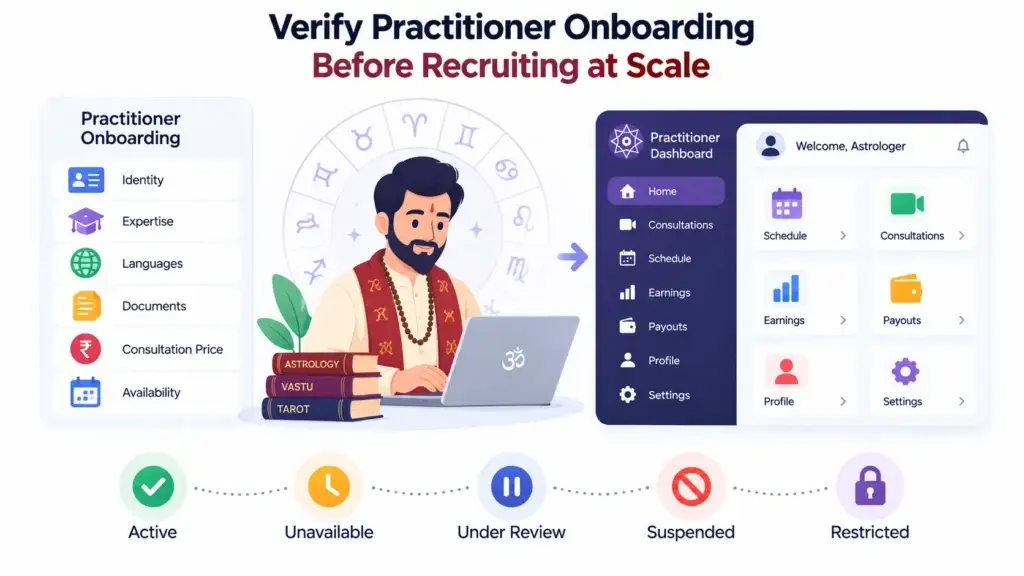
A consultation marketplace depends on the quality and reliability of its supply side.
Founders should decide what practitioners must provide before they become visible.
Depending on the business model and target market, onboarding may include:
- identity information
- profile photograph
- skills and specialties
- astrology methods
- languages
- years of experience
- consultation price
- availability schedule
- payout information
- relevant supporting documents
- profile description
- service categories
Verification does not end when the practitioner is approved.
The operator should also be able to control whether a practitioner is active, unavailable, suspended, under review, or restricted from specific consultation types.
Check the practitioner dashboard
Before launch, test whether practitioners can actually:
- update availability
- accept or reject consultation requests
- see upcoming sessions
- enter and leave calls reliably
- check earnings
- view wallet or payout records
- update relevant profile information
- review session history
- understand commission deductions
- request withdrawals where applicable
A marketplace with strong user acquisition and weak practitioner operations usually turns growth into support problems.
Test the Entire Consultation Flow, Not Just Chat
Real-time consultation is a chain of connected systems.
The user sees one button.
Behind that button may sit presence tracking, chat infrastructure, an RTC provider, notifications, session timing, wallet deductions, pricing rules, low-balance alerts, practitioner status updates, and admin monitoring.
Test the full lifecycle.
Consultation Flow Founders Should Test Before Launch
| Stage | What Should Happen | What Can Go Wrong |
|---|---|---|
| Practitioner discovery | User sees accurate availability, rate, skills, language, and consultation options. | Offline practitioners appear available or stale rates remain visible. |
| Session request | Practitioner receives the request and the user sees a clear waiting state. | Duplicate requests, lost notifications, or indefinite waiting. |
| Session start | Wallet eligibility, practitioner availability, and session state are validated. | Session starts without enough balance or practitioner status becomes inconsistent. |
| Active session | Timer, billing, messages, call state, and balance stay synchronized. | Incorrect deductions, timer mismatch, dropped calls, or duplicate billing. |
| Low balance | User receives warning and can recharge based on platform rules. | Call ends unexpectedly or continues without billable balance. |
| Session end | Final duration, deduction, practitioner earning, and transaction record are saved. | Billing and session duration disagree. |
| After-session | User can review history, rating, receipt, support, or refund options. | No evidence exists when a dispute occurs. |
Founders can also review the core astrology consultation platform features needed across user, practitioner, wallet, live-session, and admin workflows.
Verify Wallet and Payment Logic With Real Failure Scenarios
A prepaid wallet can simplify consultation billing, but only when the ledger is trustworthy.
Do not test only successful recharge.
Test:
- successful payment
- failed payment
- payment timeout
- duplicate gateway callback
- delayed callback
- duplicate user tap
- wallet recharge with promotional credit
- consultation deduction
- mid-session recharge
- canceled transaction
- refund
- manual wallet adjustment
- practitioner earning calculation
- payout request
A particularly important rule is that the frontend should not decide whether money has been received.
Payment status should be verified through the backend using the gateway’s trusted response or webhook flow before wallet balance changes.
The wallet should also maintain transaction history that explains every increase and decrease.
A user support agent should be able to answer:
Why does this user have this balance?
If the platform cannot reconstruct that answer, it is not ready for real-money operations.
For a deeper technical explanation of wallet refill and payment verification, founders can review Miracuves’ guide to payment and wallet workflows in astrology consultation apps.
Confirm Commission and Practitioner Payout Rules Before Launch
Practitioner economics should be settled before onboarding begins.
Do not wait until the first payout cycle to decide how revenue sharing works.
Founders should define:
- consultation rate
- practitioner share
- operator share
- promotional-session logic
- free-minute treatment
- boosted-profile rules
- refund impact on earnings
- cancellation treatment
- taxes or withholding where applicable
- minimum withdrawal level
- payout schedule
- dispute hold rules
- currency conversion where relevant
For deeper planning around consultation fees, commissions, paid reports, wallet revenue, practitioner earnings, and operator monetization, review the astrology consultation business model.
The important principle is consistency.
The practitioner should understand how earnings are calculated, and the operator should be able to reconstruct the calculation from platform records.
If commissions live in spreadsheets while consultation billing lives inside the platform, reconciliation becomes unnecessarily fragile.
Review Refund and Dispute Workflows Before You Need Them
Every consultation platform eventually receives complaints.
Typical examples include:
- practitioner did not respond
- session disconnected
- call quality was poor
- user was charged after disconnection
- wallet deduction seems incorrect
- user selected the wrong practitioner
- practitioner canceled
- duplicate recharge occurred
- report was not delivered
A good platform needs more than a “refund” button.
It should show:
- original transaction
- consultation record
- session duration
- payment status
- wallet deductions
- practitioner earning
- refund amount
- adjustment reason
- operator handling the case
- final resolution
Disputes become much easier when evidence is built into the product.
Check User, Practitioner, Finance, and Admin Permissions
An operator dashboard may expose the most sensitive controls in the entire business.
Not every team member should be able to:
- modify wallet balance
- approve withdrawals
- change consultation prices
- edit commission rules
- issue refunds
- suspend practitioners
- view private account information
- modify promotional credit
- change payment settings
Use permission-based dashboards.
A support agent may need consultation history but not payout settings. A finance user may need settlement records but not content controls. A practitioner manager may need profile approval without permission to change wallet balances.
Before launch, map every sensitive admin action to the role allowed to perform it.
Check Whether Important Admin Actions Can Be Reconstructed
Access control answers:
Who is allowed to do this?
Auditability answers:
Who actually did it?
Both matter.
For sensitive operations, founders should ideally be able to reconstruct:
- who changed a practitioner rate
- who issued a wallet bonus
- who approved a refund
- who changed commission settings
- who suspended an account
- who approved a withdrawal
- when the action occurred
- what the previous value was
- what the new value became
This becomes increasingly important as the operations team grows.
Do not assume an admin panel automatically includes a complete audit trail. Verify it explicitly before launch.
Remove Test Hooks, Development Credentials, and Debug Paths
One of the most practical launch checks is also one of the easiest to forget:
Remove anything that only exists for testing.
Review:
- test OTP bypasses
- test accounts
- fixed login codes
- development API keys
- staging URLs
- debug mode
- exposed stack traces
- development payment credentials
- test practitioner accounts
- sample administrator credentials
- temporary contact hooks
- unused SDKs
- old secrets committed in configuration
Production should not inherit development shortcuts.
Founders evaluating technical readiness should also understand what to check when choosing an astrology platform development partner, especially around production credentials, code ownership, integrations, testing, and launch support.
This should be part of a formal pre-production hardening pass, not a casual last-minute check.
Review Every External Provider Account
Consultation platforms often depend on outside services for important parts of the experience.
These may include:
- OTP delivery
- payment gateways
- real-time voice/video infrastructure
- push notifications
- customer-support chat
- AI APIs
- map/geocoding services
- astrology chart calculations
- email/SMS providers
- file or media storage
Before launch, identify who owns each provider account.
Ideally, the business should hold the production credentials for critical services instead of relying indefinitely on a developer-owned account.
For every provider, verify:
- production account exists
- billing is active
- API key is stored securely
- usage limits are understood
- callback URLs are correct
- fallback behavior is defined
- logs can be reviewed
- credentials can be rotated
- staging and production keys are separate
A consultation app can be technically healthy and still fail because one external account is misconfigured.
Separate Astrology Calculation From AI Interpretation
AI can improve the user experience, but founders should understand what AI should and should not do.
If the platform offers birth charts, planetary positions, matching, panchang, transits, or structured astrology reports, those calculations should come from a validated calculation engine or structured data source.
AI can then help:
- explain chart outputs
- summarize sections
- answer contextual questions
- personalize language
- recommend relevant reports
- route the user toward a practitioner
The risky pattern is allowing a general language model to invent the underlying chart.
A hybrid Astrology Portal Platform should separate:
calculation layer → structured astrology data → interpretation layer → user response
This creates a more controlled product than asking an AI model to produce everything from scratch.
Decide When AI Should Hand Off to a Human Practitioner
An AI feature and an Astrology Consultation Platform should not operate like unrelated products.
Define the handoff.
For example:
- user asks a basic birth-chart question → AI explanation
- user wants deeper relationship interpretation → practitioner suggestion
- user asks repeated follow-up questions → consultation CTA
- user buys a detailed report → optional practitioner review
- user needs live discussion → chat/call/video workflow
For businesses planning AI discovery alongside human consultation, Miracuves’ white-label AI astrology platform shows how AI guidance, reports, wallet billing, and practitioner escalation can work within one product journey.
The best handoff feels helpful rather than promotional.
AI can reduce pressure on practitioner supply, but practitioners can provide the human context many users expect from a consultation experience.
Test Privacy Around Birth Data and Consultation History
Astrology products can hold personal information that users may consider highly private.
Examples include:
- date of birth
- time of birth
- birthplace
- phone/email
- saved family profiles
- relationship information
- private chat history
- consultation topics
- purchased reports
- payment records
Founders should decide:
- what data is necessary
- who can access it
- how long it is retained
- whether users can request deletion
- which practitioner data is visible to users
- which user data is visible to practitioners
- how support teams access consultation information
- how backups are protected
Privacy should be an operating rule, not just a policy page.
Verify Reviews, Ratings, and Practitioner Moderation
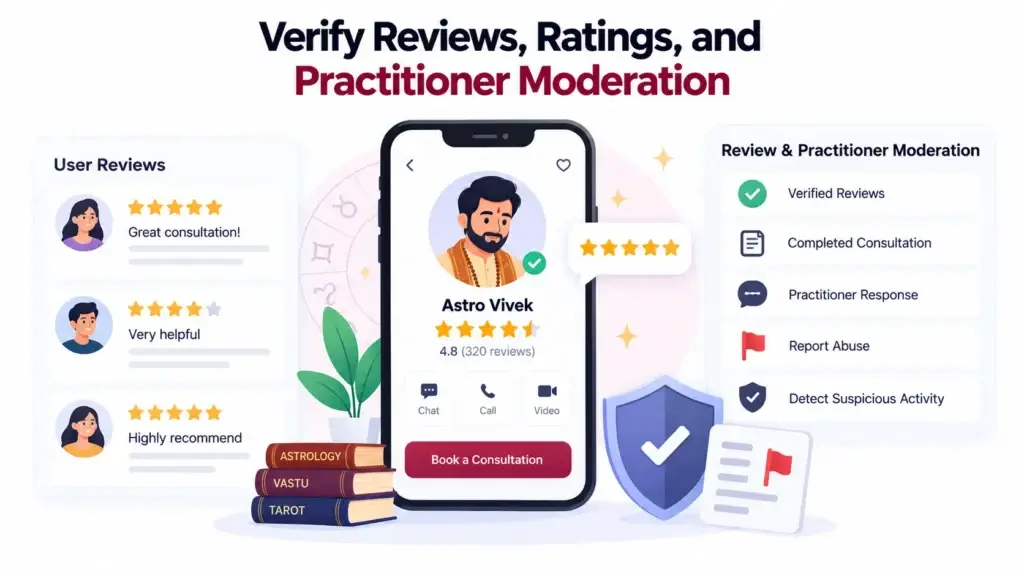
Reviews influence which practitioners get booked.
That means review systems need governance.
Before launch, decide:
- who can leave a review
- whether a completed consultation is required
- whether practitioners can respond
- how abusive reviews are handled
- whether ratings can be edited
- whether suspicious review patterns are flagged
- how practitioners report abusive users
- how users report practitioner behavior
Marketplace trust depends on protecting both sides.
Test Notifications Without Depending on Them
Notifications are useful, but the core product should not break when one notification is delayed.
Test:
- consultation request alert
- practitioner acceptance
- queue update
- low-wallet warning
- recharge confirmation
- session-start notification
- session-end receipt
- refund status
- withdrawal update
- missed consultation
- practitioner going online
Then verify that the same status is visible inside the app or web portal.
A push notification should improve the experience—not be the only place where important information exists.
Test Admin Operations With Realistic Support Scenarios
Do not test the admin panel only by clicking menus.
Run real scenarios.
Ask your team to resolve:
- failed wallet recharge
- dropped call
- refund request
- practitioner payout question
- user account restriction
- duplicate payment
- incorrect rate complaint
- abusive review
- practitioner suspension
- AI response complaint
- missing report
Measure whether the support team can understand what happened without database access or developer intervention.
That is the real admin usability test.
Founder Decision Signals Before Launch
Money Flow
If wallet recharge, consultation deductions, refunds, commissions, and practitioner payouts cannot be reconstructed from platform records, postpone public payment traffic.
Consultation Reliability
If chat, call, availability, timer, balance, and practitioner status have only been tested separately, run complete end-to-end sessions before launch.
Operational Control
If support and finance teams still need developers to investigate routine issues, improve the admin workflow before scaling acquisition.
AI Readiness
If AI is generating astrology calculations instead of interpreting verified structured outputs, separate the calculation and interpretation layers first.
Pre-Launch Checklist for an Astrology Consultation Platform
Before opening the platform to real users, founders should confirm:
- practitioner onboarding and approval rules are defined
- practitioner availability updates correctly
- chat, voice, and video flows have been tested end to end
- wallet balance is checked before paid sessions
- payment confirmation is verified server-side
- duplicate payment callbacks do not double-credit wallets
- session duration matches wallet deductions
- low-balance behavior is defined
- commissions are calculated consistently
- practitioner earnings can be reconstructed
- refunds have clear reason codes and records
- withdrawal rules are documented
- admin permissions follow team roles
- sensitive operator actions are logged where required
- production credentials are separated from development credentials
- test hooks and bypasses are removed
- APIs have authentication and rate controls
- critical provider accounts are owned by the business
- AI interpretation uses validated chart data
- privacy rules cover birth information and consultation history
- review and abuse-reporting workflows exist
- support teams can investigate incidents from the dashboard
- backup and recovery processes have been tested
- privacy, payment, practitioner, and user terms have been reviewed for the target market
If you are comparing ready-made launch routes, this guide to ready-made astrology platform options can help you evaluate scripts, features, pricing logic, and rollout scope before deployment.
The launch decision should be based on this operational loop—not on whether every planned feature appears in the interface.
Mistakes Founders Should Avoid Before Going Live
Testing Features Individually Instead of Testing the Money Loop
A working chat screen does not prove that availability, session timing, wallet deduction, practitioner earnings, refunds, and admin records work together correctly.
Assuming Every Configured Payment Gateway Is Production-Ready
A gateway appearing in a settings page does not automatically mean every callback, webhook, refund state, currency rule, and server-side verification path has been completed for production.
Recruiting Practitioners Before Finalizing Earnings Logic
Changing commission, payout, tax, free-session, or promotional rules after practitioner onboarding can create avoidable trust problems.
Launching With Test Hooks or Shared Credentials
Development shortcuts, test OTPs, shared keys, staging credentials, and debug paths should be removed or isolated during a formal pre-production hardening pass.
Calling the Platform “Secure” Without Testing Operator Actions
Security is not only encryption. Founders should also verify role permissions, wallet adjustment controls, refund access, payout approval, activity history, and incident handling.
How Miracuves Helps Founders Prepare an Astrology Platform for Launch
Miracuves provides a ready-made consultation marketplace foundation covering customer and practitioner experiences, metered consultation workflows, wallet billing, AI-assisted services, and operator controls.
Founders evaluating a ready-made foundation can explore Miracuves’aunch-ready astrology consultation platform after defining their practitioner model, billing rules, target market, payment setup, and pre-production checklist.
For businesses that want AI discovery to sit alongside human consultation, Miracuves’ white-label AI astrology platform provides another path for combining free astrology tools, AI-assisted experiences, wallet billing, reports, and practitioner escalation.
The ready-made deployment process can support a 6-day delivery window where the base scope fits. Founders should still plan for production account setup, payment provider onboarding, real-time communication credentials, AI provider access, chart APIs, store requirements, and security hardening before public launch.
Founders planning budget and customization scope can also review the astrology platform development cost guide before finalizing integrations, practitioner workflows, payment setup, and launch requirements.
Final Thoughts: Launch Readiness Is About Evidence, Not Reassurance
A consultation marketplace should not be declared ready simply because login, chat, and checkout screens work.
A real launch means people will trust the product with money, private questions, practitioner relationships, birth information, live conversations, and personal history.
Founders should therefore test what happens outside the happy path.
Test the failed payment. Test the dropped call. Test the refund. Test the low balance. Test the unavailable practitioner. Test the duplicate callback. Test the admin role that should not have access. Test whether someone can explain who changed a sensitive setting.
That is what turns a working product into an operationally prepared platform.
For founders, the stronger launch decision is not “How quickly can we make the platform public?”
It is:
“Can our team understand, control, and recover from the important things that can go wrong after it becomes public?”
FAQs
What should founders check before launching an Astrology Consultation Platform?
Founders should check practitioner onboarding, consultation reliability, wallet and payment logic, commission rules, payouts, refunds, admin access, APIs, external provider accounts, privacy, auditability, support workflows, and pre-production security hardening.
How should wallet payments work in an astrology consultation platform?
The backend should verify the payment before wallet balance changes. The platform should maintain transaction records for recharge, bonus credit, consultation deduction, refund, manual adjustment, and practitioner-related settlement activity.
What should be tested before enabling paid chat and calls?
Test practitioner presence, session requests, wallet balance, session start, timer synchronization, billing, low-balance handling, dropped connections, mid-session recharge, session completion, earnings calculation, and dispute evidence.
Should an astrology platform use AI before launch?
AI can be useful for explanations, report summaries, and instant user guidance. Astrology calculations themselves should come from a validated calculation layer or structured data source rather than being invented by a general language model.
Why are admin access controls important?
Admin dashboards may contain wallet, refund, payout, practitioner, pricing, and user controls. Permission-based access reduces the risk of accidental or unauthorized changes.
What should founders check about payment gateways?
Check production credentials, server-side payment verification, webhook handling, duplicate callbacks, failed transactions, refunds, supported currencies, reconciliation records, and who owns the gateway account.
Why should test hooks be removed before production?
Development shortcuts such as test OTPs, debug paths, shared credentials, and sample accounts can create unnecessary security exposure if they remain enabled when the platform becomes public.
Can Miracuves help founders launch faster?
Miracuves provides ready-made consultation marketplace foundations and can support 6-day deployment where the standard scope fits. Production launch can also depend on external accounts, payment onboarding, real-time communication providers, AI or astrology APIs, app-store requirements, and the final hardening scope.
Miracuves is an independent software development company. We are not affiliated with, connected to, sponsored by, or endorsed by any company or product named in this article.
Terms such as “X Clone” are used descriptively. It is how the software industry refers to building a platform with functionality comparable to a known service, and how clients search for it.
The entire design and codebase of our products is built by our own team. Our products contain no code, design, graphics, or content originating from any third-party website or applications.
All third-party names and marks referenced in this article are the property of their respective owners, referenced solely to identify the services discussed.