

Key Takeaways
- A forex brokerage platform needs connected trader onboarding, account, market data, payment, and admin workflows.
- Important features include KYC, demo and live accounts, charts, watchlists, portfolios, deposits, and withdrawals.
- Development cost depends on platform scope, trading logic, integrations, security, and compliance requirements.
- Real-time market data and reliable financial workflows are more complex than standard application features.
- Founders should compare operational readiness and source-code ownership instead of evaluating screens alone.
Trading Platform Signals
- Check registration, KYC verification, trader profiles, demo accounts, and live account activation.
- Review market feeds, charting tools, watchlists, order workflows, positions, and portfolio tracking.
- Test deposits, withdrawals, payment statuses, transaction history, approvals, and reconciliation.
- Inspect admin controls for traders, accounts, risk rules, staff permissions, reports, and audit logs.
- Clarify costs for data providers, trading integrations, payment gateways, customization, deployment, and support.
Real Insights
- A polished trading dashboard cannot compensate for inaccurate data or unreliable transaction logic.
- Weak deposit and withdrawal workflows can damage trader confidence faster than missing advanced features.
- Market data, liquidity, KYC, and payment integrations can become major development cost drivers.
- Compliance-ready software supports brokerage operations but does not replace licensing or legal approval.
- Miracuves develops JavaScript-based trading platforms with trader accounts, KYC, market dashboards, payments, risk controls, and admin reporting.
Launching a forex or CFD brokerage platform is not only about building a trading screen. For founders, the real challenge is creating a reliable business foundation around onboarding, KYC, account management, deposits, withdrawals, partner programs, reporting, risk controls, and admin operations.
A trading interface may attract users, but the operational layer decides whether the business can handle real customers, financial workflows, support tickets, compliance reviews, and growth. This is why founders should review trading platform features and cost factors before choosing between custom development, white-label software, or a ready-made brokerage platform foundation.
This guide explains the key modules, cost drivers, and decision points founders should evaluate before launching a forex brokerage platform.
Why Forex Brokerage Platforms Need More Than a Trading Interface
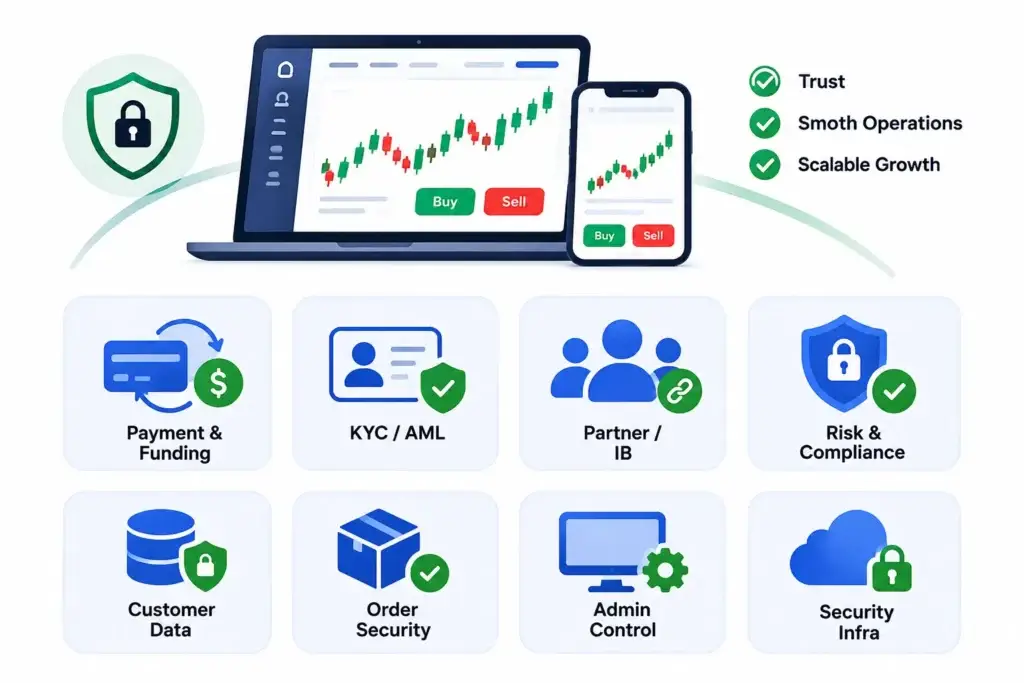
Image Source: AI-generated visual by Miracuves
Many founders begin with the visible part of the product: charts, watchlists, account screens, and trading dashboards. These are important, but they are only one part of the platform.
A brokerage business also needs systems for identity verification, deposits, withdrawals, trading account provisioning, partner commissions, risk review, audit logs, support workflows, and internal team permissions. Without this foundation, the business may look ready on the surface but struggle during daily operations.
For example, a user may sign up smoothly but get stuck during KYC. A trader may deposit funds but face delays during withdrawal review. A partner may refer clients but not trust the rebate calculation. A compliance team may need audit history but find that admin actions were not tracked clearly.
These are not small product details. They directly affect user trust, team efficiency, and the founder’s ability to scale the brokerage.
The Real Feature Layers Behind a Modern Brokerage Platform
A modern forex brokerage platform should be planned in layers. Each layer supports a different part of the business.
Core Brokerage Platform Layers
| Platform Layer | What It Includes | Founder Impact |
|---|---|---|
| Trader Experience | Signup, login, dashboard, accounts, charts, watchlists, deposits, withdrawals, documents, and support. | Improves user trust, onboarding completion, and repeat usage. |
| Account Operations | Demo accounts, live accounts, account status, trading profile, funding history, and transaction records. | Helps the brokerage manage users across different account stages. |
| KYC and Risk | Identity checks, document upload, review queues, verification status, suspicious activity flags, and audit logs. | Supports safer onboarding and prepares the business for compliance workflows. |
| Payments and Wallets | Deposits, withdrawals, payment gateway integration, transaction status, wallet records, and finance approvals. | Reduces payment confusion and improves financial workflow visibility. |
| Partner Program | Introducing broker tracking, affiliate links, referrals, rebates, partner dashboards, and commission reporting. | Supports acquisition through partner-led growth channels. |
| Admin Dashboard | User management, KYC review, payments, reports, role permissions, support tickets, and system settings. | Gives the operator control over daily brokerage operations. |
The mistake many founders make is treating these layers as optional add-ons. In reality, they work together. A strong trader dashboard is useful only when the account, funding, verification, and support workflows behind it are equally reliable.
Trader-Facing Features That Shape Trust and Retention
Trader-facing features are the first part users notice. These screens must feel simple, fast, and reliable because traders are highly sensitive to friction. For a brokerage platform, the user experience should not only help traders explore markets, but also support account setup, verification, deposits, withdrawals, and ongoing engagement without confusion.
Founders can review the complete forex brokerage platform features to understand how trader-side workflows, account controls, and brokerage-ready modules can be structured inside a launch-ready solution.
The key trader-side features include:
- Secure registration and login
- Profile and account management
- Demo and live account options
- KYC document upload
- Market dashboard
- Watchlists
- Charting experience
- Deposit and withdrawal requests
- Transaction history
- Account statements
- Notifications
- Support ticket access
- Educational or onboarding content
For founders, the main question is not “How many features can we add?” The better question is:
Which features reduce user hesitation and help traders move confidently from signup to funded account?
A demo account may help new users explore the platform before committing real funds. A clear transaction history may reduce support queries. A simple document upload flow may improve verification completion. A transparent withdrawal status may protect trust during sensitive financial moments.
Good trading platform design is not only visual. It is operational clarity translated into product experience.
Admin and Back-Office Controls Founders Should Prioritize
The admin dashboard is where the brokerage actually operates. If the admin system is weak, the team may depend on developers, spreadsheets, manual checks, or disconnected tools for daily tasks.
A strong brokerage admin dashboard should help operators manage:
- User profiles and account status
- KYC review queues
- Deposit and withdrawal approvals
- Trading account provisioning
- Partner and referral tracking
- Commission or rebate visibility
- Support tickets
- Risk notes
- Reports and exports
- Role-based access
- Activity logs
- System settings
Role-based access control is especially important. Compliance, finance, support, marketing, and admin teams should not all have the same permissions. A finance team may need withdrawal visibility, but not permission to change KYC decisions. A support team may need user history, but not access to system-level settings.
This separation protects the business from avoidable errors and creates better internal accountability.
KYC, AML, Risk, and Compliance Workflows to Plan Early
Security and compliance workflows should be treated as part of the platform foundation, not as a final-stage plugin.
Forex and CFD brokerage businesses often operate in compliance-sensitive environments. The exact requirements depend on jurisdiction, legal structure, license type, payment partners, trading products, and operating model. Founders should get legal and regulatory guidance before launch.
From a product planning perspective, the platform should be able to support:
- KYC document collection
- User verification status
- AML workflow support
- Suspicious activity flags
- Transaction monitoring
- Audit logs
- Role-based admin permissions
- Secure payment gateway integration
- Encrypted data transfer
- Encrypted data storage
- Admin access controls
- Compliance reporting support
The goal is not to claim that software alone makes a brokerage compliant. Final compliance depends on jurisdiction, legal review, integrations, documentation, and operating controls.
The practical founder takeaway is simple: build compliance-ready workflows early so the platform does not need to be rebuilt when verification, reporting, or risk controls become more complex.
What Actually Drives Forex Trading Platform Development Cost?
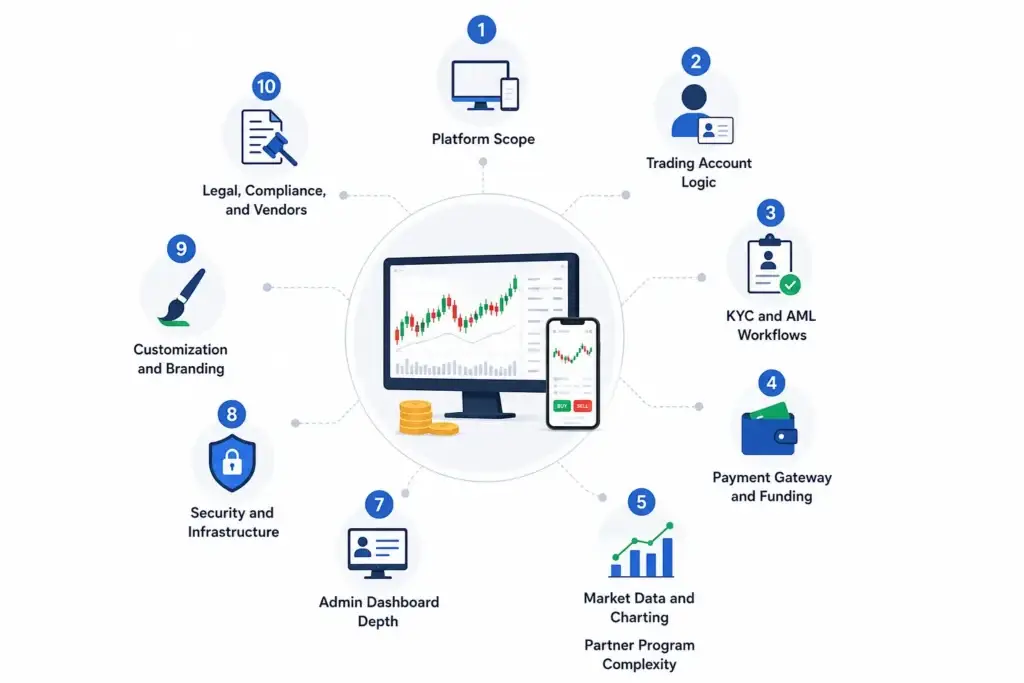
Image Source: AI-generated visual by Miracuves
Trading platform development cost depends on the depth of the product, not just the number of screens. Two platforms may look similar to users but differ greatly in backend logic, integrations, security, and admin control.
The main cost factors include:
1. Platform Scope
A web-only platform usually has a different cost structure from a platform that includes web, iOS, Android, admin dashboard, partner portal, and support workflows.
More surfaces mean more design, engineering, QA, permissions, and maintenance.
2. Trading Account Logic
Demo accounts, live accounts, account status, trading profile, statements, and linked trading environments require careful planning. The more account types and business rules you support, the more complex the platform becomes.
3. KYC and AML Workflows
Basic document upload is simpler than a full review workflow with verification statuses, admin queues, rejection reasons, audit logs, and integration with external KYC providers.
4. Payment Gateway and Funding Workflows
Deposits and withdrawals need secure handling, transaction status tracking, finance approval, reconciliation, and clear user communication. Payment complexity increases when multiple regions, currencies, or providers are involved.
5. Market Data and Charting Requirements
Real-time or near-real-time data, charting tools, watchlists, pricing feeds, and technical indicators can change the platform architecture. These may also depend on third-party provider access and commercial terms.
6. Partner Program Complexity
Introducing broker programs, affiliate tracking, referral attribution, rebate logic, and partner dashboards add a separate business layer. If partner-led acquisition is part of the model, this should be planned from the beginning.
7. Admin Dashboard Depth
A basic admin panel may only manage users. A brokerage-grade admin system may need KYC workflows, payments, risk notes, support tickets, reports, role permissions, audit trails, and system settings.
8. Security and Infrastructure
Secure API integrations, encrypted data handling, admin access controls, audit logs, infrastructure monitoring, backups, and role-based permissions all affect development effort.
9. Customization and Branding
White-label branding may be faster when the product foundation already exists. Deep customization, custom journeys, new modules, or unique business rules can increase cost and timeline.
10. Legal, Compliance, and Vendor Dependencies
Some costs are not purely development costs. Licensing, legal review, payment provider onboarding, KYC vendors, market data providers, liquidity relationships, and compliance operations may sit outside the software build. Founders should plan for these separately.
Miracuves Forex Brokerage Platform Solution Cost and Tech Stack
Miracuves Pricing for a Forex Brokerage Trading Platform developed in JavaScript For $9,099 USD (One-Time Price) in just 6 days
Get a fully developed, deployment-ready trading platform built for forex brokers, CFD businesses, investment startups, financial service providers, and trading marketplace operators. Built on a modern JavaScript foundation, this complete package includes everything you need to launch and scale:
Core Workflows: Trader registration, KYC verification, account setup, forex pair listing, trading dashboard, deposits, withdrawals, order placement, portfolio tracking, transaction history, and trade activity updates.
Built-in Revenue Logic: Spread-based revenue, trading commissions, account fees, premium tools, deposit or withdrawal charges, affiliate referrals, partner broker revenue, and subscription-based analytics.
Management Hub: Centralized admin dashboard, trader management, KYC review, account controls, deposit tracking, withdrawal approvals, trading records, risk monitoring, support handling, and brokerage analytics.
Launch-Ready: Fully prepared for your custom branding, configuration, payment gateway setup, KYC workflow setup, trading module configuration, admin controls, and immediate market entry.
Why Is Forex Brokerage Platform Development More Affordable?
Most forex brokerage platforms become expensive when businesses choose fully custom development from scratch. Building separate workflows for traders, admins, KYC verification, deposits, withdrawals, trading dashboards, order flows, reporting, risk controls, liquidity integrations, and compliance logs can increase cost, timeline, and technical complexity.
We took a smarter, more practical approach:
You Aren’t Paying for Ground-Up Development: Our trading platform engine is already developed, tested, and ready to deploy. You skip the inflated cost and long waiting period usually required for building a forex brokerage platform from scratch.
The Power of JavaScript: We built this solution on a modern JavaScript architecture that supports interactive trading dashboards, scalable financial workflows, fast frontend performance, API-driven integrations, and smooth admin operations.
You get a launch-ready forex brokerage trading platform with practical trading features, source code access, and faster deployment without the high custom development price tag.
Note: This cost is for the solution, re-branding, deployment, and source code only.
White-Label vs Custom Development: Which Route Makes Sense?
Founders usually compare three routes before launching a brokerage platform.
| Build Route | How It Works | Best For | Tradeoff |
|---|---|---|---|
| Fully Custom Development | Build the platform from scratch around your exact business model. | Founders with unique workflows, larger budgets, and longer timelines. | More control, but slower and usually more expensive. |
| White-Label Platform | Use an existing platform foundation and rebrand it for your business. | Founders who want faster launch and lower initial development risk. | Less flexible than a fully custom build unless source code and customization are available. |
| Ready-Made Source-Code-Owned Foundation | Start with a launch-ready product base, customize branding and workflows, and keep ownership of the code. | Founders who want speed, control, and room for future customization. | Requires careful scope selection to avoid unnecessary complexity at launch. |
The right choice depends on your launch goal. If you are still validating market demand, a ready-made foundation can help reduce avoidable development effort. If your brokerage model requires unusual workflows or complex institutional integrations, deeper custom development may be needed.
Miracuves helps founders evaluate this decision by mapping product scope, user journeys, admin control, security requirements, and launch priorities before recommending the right path.
Founder Decision Signals
Speed
If you need to validate a brokerage idea quickly, avoid building every workflow from zero. Start with the essential journeys: onboarding, account setup, funding, admin review, and reporting.
Cost
Cost increases when you add more platforms, deeper KYC logic, multiple payment providers, advanced partner programs, and custom reporting workflows.
Scalability
A scalable platform needs clean backend architecture, secure APIs, admin permissions, audit logs, and infrastructure that can support more users and transactions over time.
Market Fit
Before adding advanced features, validate whether users trust the onboarding, funding, account, and support experience. These workflows often matter more than extra dashboard elements.
Mistakes Founders Should Avoid While Planning a Brokerage Platform
Planning the trading screen before the operating model
A brokerage platform needs onboarding, KYC, funding, support, reporting, partner tracking, and admin control. If these workflows are not planned early, the platform may look polished but fail operationally.
Ignoring withdrawal and payment workflows
Deposits may help acquire users, but withdrawals protect trust. Founders should plan transaction status, approval flows, finance visibility, reconciliation, and support communication from the beginning.
Using one admin role for every internal team
Compliance, finance, support, and marketing teams need different permissions. Role-based access helps reduce internal risk and creates cleaner accountability.
Treating compliance as a post-launch task
KYC, AML workflow support, audit logs, and risk visibility should be part of the foundation. Final compliance depends on jurisdiction and legal review, but the product should support the right operational controls.
How Miracuves Supports Faster Brokerage Platform Launches
Founders planning a forex or CFD brokerage platform need more than a development team. They need clarity on product scope, launch priorities, operational workflows, user roles, security layers, and future customization.
Miracuves helps founders build ready-made and white-label app solutions with source-code ownership, branded design, admin control, and faster deployment. For brokerage founders, this means the launch discussion can begin with practical workflows instead of a blank product document.
If you are comparing custom development with a launch-ready brokerage foundation, you can review the ready-made brokerage operations platform from Miracuves to understand how trader onboarding, partner workflows, admin control, funding logic, and compliance-ready processes can be packaged into a faster launch path.
The stronger decision is not always to build everything from zero. The stronger decision is to understand which parts need deep customization and which parts can start from a proven foundation.
Final Thoughts: Build Around Trust Before You Build Around Features
A forex brokerage platform should not be judged only by how modern the dashboard looks. Founders should evaluate whether the platform can support real user onboarding, funding workflows, partner growth, KYC review, admin control, reporting, and secure operations.
The most expensive mistake is not choosing the wrong color theme or missing one advanced feature. It is launching without the operational foundation needed to manage users, payments, risk, and internal teams.
For founders, the practical path is to map the must-have workflows first, understand what drives development cost, and then choose the build route that matches the business model. A ready-made, source-code-owned foundation can help reduce avoidable build time while still leaving room for branding, customization, and future growth.
FAQs
What features should a forex trading platform include?
A forex trading platform should include secure signup, trader dashboard, demo and live account options, KYC document upload, deposits, withdrawals, transaction history, account statements, support access, admin dashboard, reports, and role-based permissions. More advanced platforms may also include partner programs, risk workflows, market data, charting tools, and compliance reporting support.
What affects forex trading platform development cost?
Cost depends on platform scope, web and mobile coverage, admin dashboard depth, payment gateway integrations, KYC/AML workflows, market data requirements, partner program logic, reporting needs, security layers, and customization. Legal, licensing, market data, liquidity, and compliance expenses may sit outside software development.
Is a white-label trading platform better than custom development?
A white-label trading platform is usually better when founders want faster launch and lower initial development risk. Custom development is better when the brokerage has unique workflows, complex integrations, or a long-term product roadmap that cannot fit into an existing foundation.
Why is the admin dashboard important for a brokerage platform?
The admin dashboard controls daily brokerage operations. It helps teams manage users, KYC reviews, deposits, withdrawals, account statuses, partner activity, reports, support tickets, and permissions. Without a strong admin layer, the business may rely too heavily on manual processes.
Should compliance workflows be added before or after launch?
Compliance-ready workflows should be planned before launch. KYC, AML workflow support, audit logs, role-based access, user verification, and transaction monitoring should be part of the product foundation. Final compliance depends on jurisdiction, legal review, integrations, and operating model.
What is the difference between trading UI and brokerage operations software?
Trading UI is the visible interface where users view accounts, charts, markets, and transactions. Brokerage operations software includes the backend workflows for onboarding, KYC, funding, withdrawals, partner tracking, reporting, risk review, and admin control. A serious brokerage platform needs both.
How can founders reduce trading platform development risk?
Founders can reduce risk by starting with clear workflows, prioritizing essential features, using secure architecture, planning admin permissions early, validating payment and KYC flows, and considering a ready-made or white-label foundation instead of building everything from zero.
Can Miracuves help launch a forex brokerage platform faster?
Yes. Miracuves helps founders create ready-made and white-label app solutions with source-code ownership, branded design, admin dashboards, and faster deployment. The final launch scope depends on selected features, integrations, branding, compliance workflow requirements, and business model.
Miracuves is an independent software development company. We are not affiliated with, connected to, sponsored by, or endorsed by any company or product named in this article.
Terms such as “X Clone” are used descriptively. It is how the software industry refers to building a platform with functionality comparable to a known service, and how clients search for it.
The entire design and codebase of our products is built by our own team. Our products contain no code, design, graphics, or content originating from any third-party website or applications.
All third-party names and marks referenced in this article are the property of their respective owners, referenced solely to identify the services discussed.